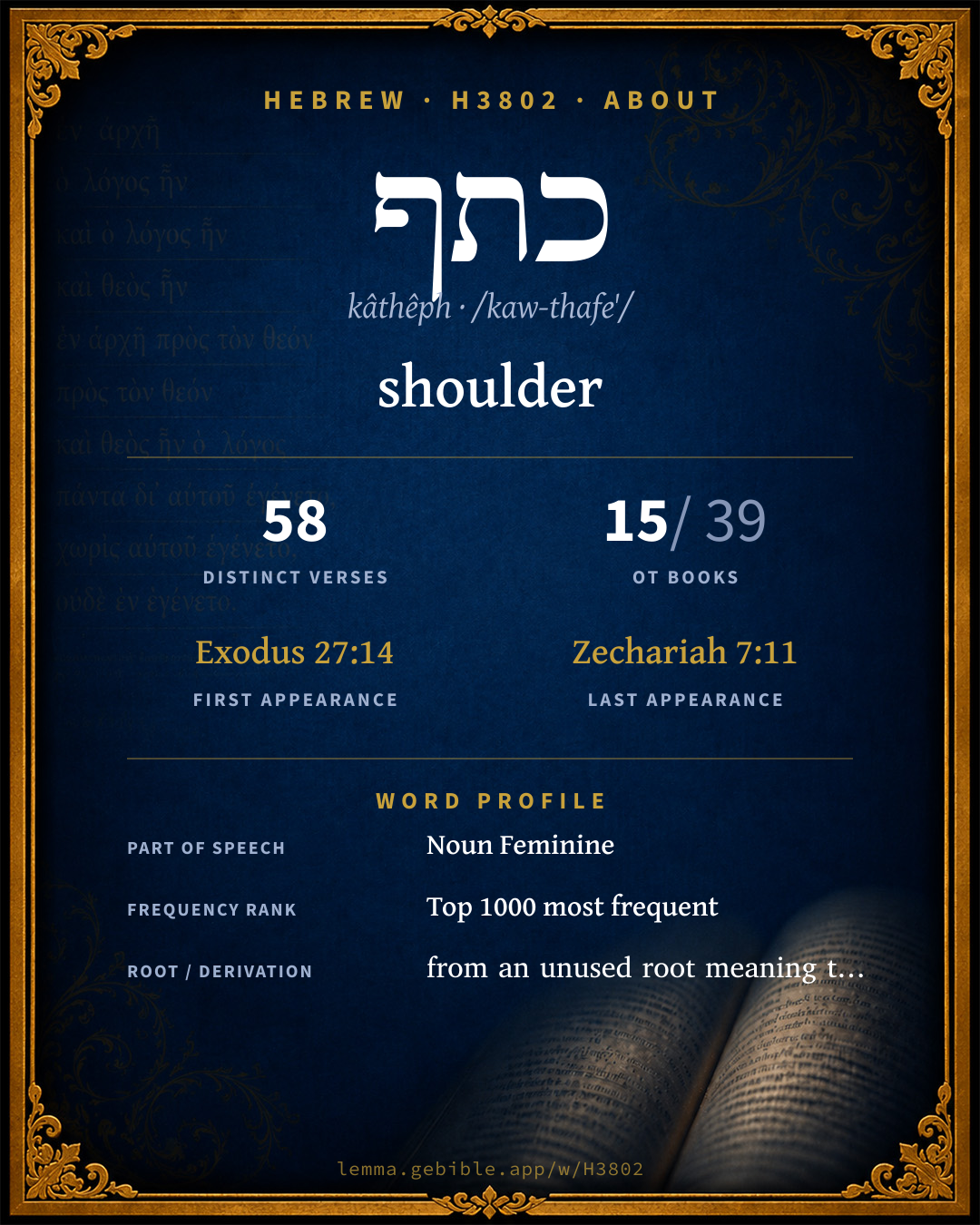
כָּתֵף
shoulder
also: shoulder-blade, side, slope fuller range ↓
Full lexicon entry — Brown-Driver-Briggs (BDB)
From Brown-Driver-Briggs (BDB)
Where this word appears
See every Construct-state word in the Hebrew Bible →
Grammar key — what these labels mean
Part of speech
- Noun
- A naming word — a person, place, thing, or idea.
Noun type
- Common
- A common noun — a general class of person, place, or thing (“king,” “city,” “water”), not a specific name.
State
- Construct
- A noun bound to a following noun in a possessive / “of” relationship (the construct chain).
- Absolute
- The independent form of a noun, not bound to a following word.
Gender
- Feminine
- Grammatically feminine.
Number
- Singular
- One.
- Plural
- More than one (in Hebrew, generally three or more).
- Dual
- Exactly two — for natural pairs and some measures of time.
35 distinct verses where H3802 appears in the Construct state, across 13 books. Filtered view — show all forms. Click any verse to open its interlinear word-by-word view. Verse text shown in the World English Bible for context — . Each verse’s Hebrew form is shown with its reference; the English is not keyword-highlighted, since the data carries no word-level English alignment. Use “Compare translations” on any verse to read it across multiple English versions. This concordance covers the Hebrew Bible; Septuagint (Greek Old Testament) occurrences are not indexed here.
Exodus 6 verses
- Exodus 28:12 כִּתְפֹ֣ת כְתֵפָ֖י/ו n c fp cs n c fd cs + sfx pers 3ms You shall put the two stones on the shoulder-pieces of the ephod, to be stones of memorial for the children of Israel: and Aaron shall bear their names before Yahweh on his two shoulders for a memorial.
- Exodus 28:25 כִּתְפ֥וֹת n c fp cs The other two ends of the two braided chains you shall put on the two settings, and put them on the shoulder-pieces of the ephod in the forepart of it.
- Exodus 28:27 כִתְפ֨וֹת n c fp cs You shall make two rings of gold, and shall put them on the two shoulder-pieces of the ephod underneath, in the forepart of it, close by the coupling of it, above the skillfully woven band of the ephod.
- Exodus 39:7 כִּתְפֹ֣ת n c fp cs He put them on the shoulder-pieces of the ephod, to be stones of memorial for the children of Israel, as Yahweh commanded Moses.
- Exodus 39:18 כִּתְפֹ֥ת n c fp cs The other two ends of the two braided chains they put on the two settings, and put them on the shoulder-pieces of the ephod, in the front of it.
- Exodus 39:20 כִתְפֹ֨ת n c fp cs They made two rings of gold, and put them on the two shoulder-pieces of the ephod underneath, in the front of it, close by its coupling, above the skillfully woven band of the ephod.
Numbers 1 verse
Deuteronomy 1 verse
Joshua 8 verses
- Joshua 15:8 כֶּ֤תֶף n c fs cs and the border went up by the valley of the son of Hinnom to the side of the Jebusite southward (the same is Jerusalem); and the border went up to the top of the mountain that lies before the valley of Hinnom westward, which is at the uttermost part of the valley of Rephaim northward;
- Joshua 15:10 כֶּ֧תֶף n c fs cs and the border turned about from Baalah westward to Mount Seir, and passed along to the side of Mount Jearim on the north (the same is Chesalon), and went down to Beth-shemesh, and passed along by Timnah;
- Joshua 15:11 כֶּ֣תֶף n c fs cs and the border went out to the side of Ekron northward; and the border extended to Shikkeron, and passed along to Mount Baalah, and went out at Jabneel; and the goings out of the border were at the sea.
- Joshua 18:12 כֶּ֨תֶף n c fs cs Their border on the north quarter was from the Jordan; and the border went up to the side of Jericho on the north, and went up through the hill-country westward; and the goings out of it were at the wilderness of Beth Aven.
- Joshua 18:13 כֶּ֤תֶף n c fs cs The border passed along from there to Luz, to the side of Luz (the same is Bethel), southward; and the border went down to Ataroth Addar, by the mountain that lies on the south of Beth Horon the lower.
- Joshua 18:16 כֶּ֤תֶף n c fs cs and the border went down to the uttermost part of the mountain that lies before the valley of the son of Hinnom, which is in the valley of Rephaim northward; and it went down to the valley of Hinnom, to the side of the Jebusite southward, and went down to En Rogel;
- Joshua 18:18 כֶּ֥תֶף n c fs cs and it passed along to the side over against the Arabah northward, and went down to the Arabah;
- Joshua 18:19 כֶּ֣תֶף n c fs cs and the border passed along to the side of Beth Hoglah northward; and the goings out of the border were at the north bay of the Salt Sea, at the south end of the Jordan: this was the south border.
Judges 1 verse
1 Samuel 1 verse
1 Kings 3 verses
- 1 Kings 6:8 כֶּ֥תֶף n c fs cs The door for the middle side-chambers was in the right side of the house: and they went up by winding stairs into the middle [story], and out of the middle into the third.
- 1 Kings 7:34 כְּתֵפ֔וֹת כְּתֵפֶֽי/הָ n c fp n c fd cs + sfx pers 3fs There were four supports at the four corners of each base: the supports of it were of the base itself.
- 1 Kings 7:39 כֶּ֤תֶף כֶּ֥תֶף מִ/כֶּ֨תֶף n c fs cs n c fs cs prep + n c fs cs He set the bases, five on the right side of the house, and five on the left side of the house: and he set the sea on the right side of the house eastward, toward the south.
2 Kings 1 verse
1 Chronicles 1 verse
2 Chronicles 2 verses
- 2 Chronicles 4:10 מִ/כֶּ֧תֶף prep + n c fs cs He set the sea on the right side [of the house] eastward, toward the south.
- 2 Chronicles 23:10 מִ/כֶּ֨תֶף כֶּ֤תֶף prep + n c fs cs n c fs cs He set all the people, every man with his weapon in his hand, from the right side of the house to the left side of the house, along by the altar and the house, by the king round about.
Job 1 verse
Isaiah 1 verse
Ezekiel 8 verses
- Ezekiel 25:9 כֶּ֤תֶף n c fs cs therefore, behold, I will open the side of Moab from the cities, from his cities which are on his frontiers, the glory of the country, Beth-jeshimoth, Baal Meon, and Kiriathaim,
- Ezekiel 40:18 כֶּ֣תֶף n c fs cs The pavement was by the side of the gates, answerable to the length of the gates, even the lower pavement.
- Ezekiel 40:41 לְ/כֶ֣תֶף prep + n c fs cs Four tables were on this side, and four tables on that side, by the side of the gate; eight tables, whereupon they killed [the sacrifices].
- Ezekiel 40:44 כֶּ֨תֶף֙ כֶּ֨תֶף֙ n c fs cs n c fs cs Outside of the inner gate were chambers for the singers in the inner court, which was at the side of the north gate; and their prospect was toward the south; one at the side of the east gate having the prospect toward the north.
- Ezekiel 41:2 וְ/כִתְפ֣וֹת conj + n c fp cs The breadth of the entrance was ten cubits; and the sides of the entrance were five cubits on the one side, and five cubits on the other side: and he measured the length of it, forty cubits, and the breadth, twenty cubits.
- Ezekiel 41:26 כִּתְפ֖וֹת n c fp cs There were closed windows and palm trees on the one side and on the other side, on the sides of the porch: thus were the side-chambers of the house, and the thresholds.
- Ezekiel 46:19 כֶּ֣תֶף n c fs cs Then he brought me through the entry, which was at the side of the gate, into the holy chambers for the priests, which looked toward the north: and, behold, there was a place on the hinder part westward.
- Ezekiel 47:1 מִ/כֶּ֤תֶף prep + n c fs cs He brought me back to the door of the house; and, behold, waters issued out from under the threshold of the house eastward; (for the forefront of the house was toward the east;) and the waters came down from under, from the right side of the house, on the south of the altar.
About this entry
At a glance — auto-summarized from this page’s data, not written by a person. Every figure links to its source below. This summary describes the numbers; it doesn’t interpret them.
“shoulder” is the headline sense of the Hebrew noun כתף (kâthêph). Older and newer Bibles part ways — “side” in the King James Version, “shoulder of” (unfoldingWord Literal Text) in modern versions. See the renderings breakdown. It turns up in 58 verses across 15 books, a moderately common footprint. It concentrates in Ezekiel, which alone accounts for 29% of its uses. Beyond “shoulder” it also covers “shoulder-blade”, “side”, and “slope” — see its full sense range. The sections below give every sense, occurrence, and version rendering.
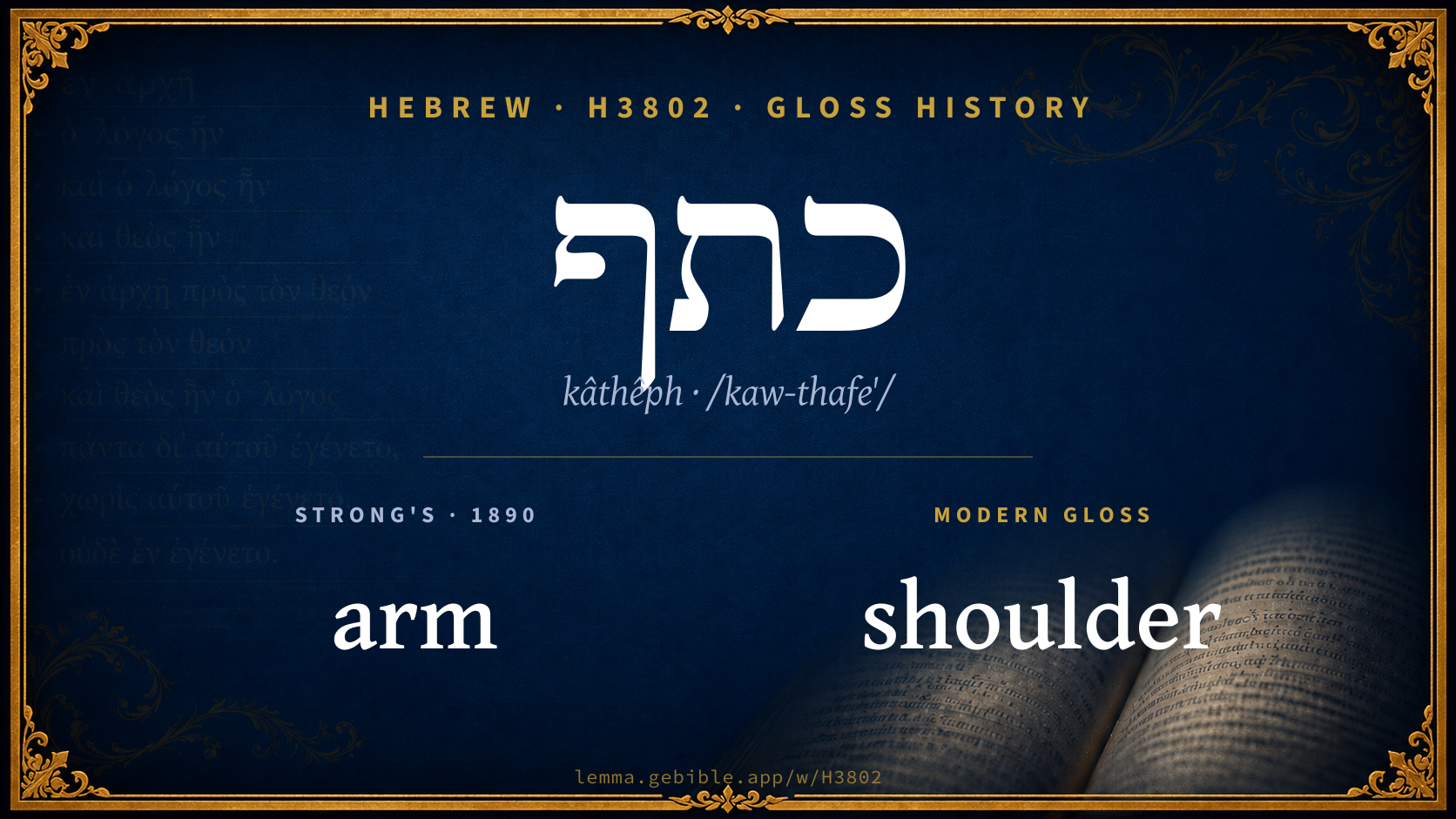
Gloss history
Strong's 1890 vs modern scholarship
About this word
Strong's H3802 catalogs a Hebrew word from the Hebrew Old Testament.
These counts are not copied from any lexicon or concordance. They are computed here, from the morphology-tagged Hebrew Old Testament. What Lemma adds →
- 58
- distinct verses
- The word appears in 58 distinct verses.
- 15 / 39
- OT books
- The word appears in 15 of 39 Old Testament books.
- #587
- by frequency
- Top 1000 most frequent Hebrew words (rank 587 of 8,640 Hebrew words by occurrence).
View all 58 occurrences in the concordance →
By section of the Old Testament
By traditional corpus
Conventional, traditional groupings — biblical authorship is debated, so this is a traditional corpus grouping, not an authorship claim. Each share is this word’s portion of its verses in that division of the Hebrew canon. Each figure is a share of the word’s 58 distinct verses.
- Prophets (Nevi'im) 37 verses · 64%
- Torah (Pentateuch) 15 verses · 26%
- Writings (Ketuvim) 6 verses · 10%
How translations render this word
Counts come from each version’s own published word-to-Strong’s tagging or interlinear alignment — an approximate guide to how each version renders this word, not a word-level alignment the data otherwise carries. Because each total is that version’s own tagged count, the per-version totals vary from one another and need not match the appearance or distinct-verse counts above. These counts may also differ from a printed concordance because Lemma counts each distinctly tagged rendering and does not collapse phrase taggings into a single head-word total. This is a fixed set of word-tagged versions (KJV, ASV, BSB, ULT) and does not change with the reading translation you choose elsewhere. Each version’s license is shown beside its name below (and on Sources).
- King James Version: Side 23×, Shoulders 11×, Shoulder 7×
- American Standard Version: Side 23×, Shoulder-pieces 8×, Shoulder 7×
- Berean Standard Bible: Side 14×, Shoulder 9×, Shoulders 9×
- unfoldingWord Literal Text: Shoulder of 14×, Shoulder 11×, Shoulders 10×
King James Version Public Domain
Renders H3802 across 67 tagged occurrences — most commonly:
Plus 9 renderings that appear only once — usually multi-word phrases or single function words the recovered tagging swept in, not distinct renderings.
American Standard Version Public Domain
Renders H3802 across 66 tagged occurrences — most commonly:
Plus 16 renderings that appear only once — usually multi-word phrases or single function words the recovered tagging swept in, not distinct renderings.
Berean Standard Bible Public Domain
Renders H3802 across 62 tagged occurrences — most commonly:
Plus 9 renderings that appear only once — usually multi-word phrases or single function words the recovered tagging swept in, not distinct renderings. Not rendered by a distinct English word in 4 further occurrences.
unfoldingWord Literal Text CC BY-SA 4.0
Renders H3802 across 81 tagged occurrences — most commonly:
Plus 9 renderings that appear only once — usually multi-word phrases or single function words the recovered tagging swept in, not distinct renderings.
6 senses and sub-senses in the full BDB
What do BDB’s symbols mean?
BDB uses these scholarly abbreviations:
| Symbol | Meaning |
|---|---|
| 𝔊 | the Septuagint (the ancient Greek translation, LXX) |
| 𝔙 | the Vulgate (the Latin translation) |
| 𝔖 | the Syriac version (the Peshitta) |
| 𝔗 | the Targum (the Aramaic translation) |
| ψ | the Psalms |
| √ | root (the underlying root or stem) |
| ‖ | parallel passage (a synonymous or contrasted parallel) |
| † | the dagger: every passage where the word occurs is cited |
The 6 senses and sub-senses the full Brown-Driver-Briggs lexicon distinguishes for this word, in lexicon order (not ranked by frequency), with BDB’s own verbatim wording and sub-sense lettering. Shown in Hebrew script with BDB’s own scholarly abbreviations. The condensed entry is in the Lexicon Entry tab. See also the Forms in the corpus table below.
- 1.
- a. of man, shoulder, shoulder-blade (while שְׁכֶם, q.v. = neck and shoulders), כִּידוֹן נְחשֶׁת בֵּין כְּתֵפָיו 1 S 17:6; cf. fig. of י׳’s dwelling between the shoulders of Benj. Dt 33:12 (v. Dr); כְּתֵפִי מִשִּׁכְמָה תִפּוֹל Jb 31:22 my shoulder-blade, from the shoulder let it fall; as support for burdens Ju 16:3 Ez 12:6, 7, 12 Is 46:7; 49:22 (in fig.), Ex 28:12 Nu 7:9 (both P), 1 Ch 15:15 2 Ch 35:3; cf. כָּל־כ׳ מְרוּטָה Ez 29:18 every shoulder was rubbed bare (of Nebuch.’s soldiers chafed by armour and toil); as aim of bird of prey Is 11:14 (fig.); cf. shoulder of Moab Ez 25:9 (fig., i.e. the side of M. exposed to invasion): Ez 29:7b read prob. כַּף (𝔊 𝔖 Sm Co, cf. v a). e.g. 1 Samuel 17:6
- b. of beasts, Is 30:6 (carrying), Ez 34:21 (thrusting, in fig.), כ׳ כֹרָ֑רֶת Zc 7:11 a refractory shoulder (refusing the yoke, fig.), so Ne 9:29; of choice meat Ez 24:4 (‖ יָרֵךְ). e.g. Isaiah 30:6
- c. = shoulder-pieces (always pl.) of ephod Ex 28:7, 12, 25, 27 = 39:4, 7, 18, 20 (P). e.g. Exodus 28:7
- 2.
- a. slope, side, of mountain, כֶּתֶף יָם־כִּנֶּרֶת Nu 34:11, i.e. the mt.-slopes NE. of the lake, cf. Jos 15:8, 10, 11; 18:12, 13, 16, 18, 19 (all P). e.g. Numbers 34:11
- b. opposite side(s), sc. of door or entrance, of tabernacle-court Ex 27:14, 15 = 38:14, 15 (all P), of temple 1 K 6:8 7:39(×3) = 2 Ch 4:10, 2 K 11:11(×2) = 2 Ch 23:10(×2); cf. Ez 40:18, 40(×2), 41, 44(×2); 41:2, 26; 46:19; 47:1, 2. e.g. Exodus 27:14
- 3. supports of the bases for the lavers beside the temple 1 K 7:30(×2), 34(×2). e.g. 1 Kings 7:30
Senses from the full Brown-Driver-Briggs lexicon (Brown, Driver, Briggs; Oxford 1906 — public domain), digitized via Sefaria, supplemented by the OpenScriptures HebrewLexicon (CC BY 4.0). Full attribution on Sources.
Word origin
n.f. Ex 27:15 shoulder, shoulder-blade, side (NH id.; Aramaic כַּתְפָּא, ܟܰܬܦܳܐ; Arabic كَتِفٌ );—abs. כ׳ Zc 7:11 +; cstr. כֶּ֫תֶף 1 K 6:8 +, app. כָּתֵף Is 11:14 (but regard as appos., or read כֶּתֶף); sf. כְּתֵפִי Jb 31:22; כְּתֵפָם 1 Ch 15:15; pl. abs. כְּתֵפֹת Ex 28:7 +, כְּתֵפוֹת 1 K 7:30, 34; cstr. כִּתְפֹת Ex 28:12 +, כִּתְפוֹת Ez 41:2 +; du. sf. כְּתֵפָיו Dt 33:12 + 3 times, כְּתֵפֶיהָ 1 K 7:34;—
— Brown-Driver-Briggs (Oxford 1906, public domain), digitized via Sefaria, supplemented by the OpenScriptures HebrewLexicon (CC BY 4.0). See Sources.
Origin: from an unused root meaning to clothe
Jastrow Dictionary
A second Hebrew/Aramaic lexicon for comparison, covering Aramaic and post-biblical (Talmudic, Targumic, Midrashic) usage that the biblical-Hebrew BDB does not. Matched by lemma rather than by Strong’s number, so a lemma may carry more than one Jastrow headword (shown separately below), and the entries cover usage well beyond the Bible.
כָּתַף
- (cmp. כָּתַת) to join; denom. כָּתֵף.—[Midr. Till. to Ps. II, 3 כתופין, ed. Bub. כתיפין, read: כפותין, v. כָּפַת.]
- (denom. of כָּתֵף) to carry; to shoulder. Y. Shebi. VIII, 38ᵇ מְכַתְּפֵי פירות carriers of fruits (in the Sabbatical year). Y. Nidd. II, beg. 49ᵈ היתה מְכַתֶּפֶת יינות וכ׳ carried vessels with wine for libations; (Bab. ib. 6ᵇ גפה, v. גָּפַף).—B. Kam. 31ᵃ עמד לכַתֵּף he halted for the sake of shifting the burden on his shoulder; Keth. 31ᵃ, sq.; Sabb. 5ᵇ. Ib. 8ᵃ; Erub. 33ᵃ רבים מְכַתְּפִין עליו people rest and rearrange their burdens on it. [Bets. 25ᵇ ובלבר שלא יְכַתֵּף provided one allows not the chair to be carried on shoulders, v. אֲלַנְקִי; perhaps to be read: יִכָּתֵף Nif.]
כְּתַף
- , Pa. כַּתֵּף same. Sabb. 8ᵃ ולא כַתּוּפֵי מְכַתְּפֵי עלויה Ms. M. nor do they not use it for rearranging burdens; ודאי מְכַתְּפִין עילויה people surely use it &c. Ib. 119ᵃ מְכַתַּף ועייל וכ׳ carried things in and out. Ib. מי לא מְכַתִּיפְנָא קמייהו should I not carry things in and out for their reception?—Esp. to carry a person (in a chair) on shoulders, v. אֲלַנְקִי. Yoma 87ᵃ; Snh. 7ᵇ. Bets. 25ᵇ הוו מְכַתְּפֵי להו (v. Rabb. D. S. a. l. note 8) they carried them; (ed. מִכַּתְּפוּ להו Ithpa. allowed themselves to be carried).
- to be carried on shoulders, v. supra.
כַּתָּף
- (preced.) carrier, porter. Tosef. Ber. II, 7. Kel. XXVI, 5 עור הכ׳ the hide which the porter uses to protect his clothes. Y. Kidd. II, beg. 62ᵃ ע"ר הכ׳ on the testimony of the carrier (that delivered the goods); a. e.—Pl. כַּתָּפִים, כַּתָּפִין. Y. M. Kat. III, 82ᵇ bot.; Y. Ber. III, 6ᵃ top נמסר לכ׳ when the corpse has been given over to the pall-bearers. Y. Shebi. VIII, 38ᵇ [read:] החמרין הכ׳ וכל העושין בשביעית שכרן וכ׳ the drivers and porters and all employees in the Sabbatical year take their wages in fruits of that year (v. Tosef. ib. VI, 26); a. e.—שבח המגיע לכ׳ an improvement touching the carriers, i.e. an increase of the value of the crop, opp. to an increase of the value of the land. B. Kam. 95ᵇ; B. Mets. 15ᵇ; a. e.
כַּתַּף
- —Pl. כַּתָּפִין, כַּתָּפַיָּא. Y. Shebu. VII, 38ᵃ top סמכון כ׳ גבי וכ׳ paid the porters with orders drawn on the retailers (sellers of provision &c.).
כָּתֵף
- v. כָּתַף)
- 1. joint, shoulder. Shebi. III, 9 אבני כ׳ באין וכ׳ heavy stones may be taken in the Sabbatical year from any place (their size showing their designation for building purposes); כל שהן נטלות … על הכ׳ those which are carried, two or three at a time, on the shoulder. B. Mets. 68ᵇ; Tosef. ib. V, 6 מקום שנהגו להעלות שכר כ׳ למעות where it is customary to add a remuneration for carriage to the money (to be paid to the partner on settling). Gen. R. s. 56 (ref. to Gen. XXII, 6) כזה שהוא טוען … על כְּתֵפוֹ like him (the culprit) who carries his cross on his shoulders; a. fr. e.g. Genesis 22:6
- 2. grapes on an arm of a vine which branches off into twigs, contrad. to נטף grapes hanging down from the trunk. Peah VII, 4 what is gleaning (belonging to the poor, Lev. XIX, 10)? כל שאין לה כ׳ וכ׳ the grapes remaining on a stalk which has no arm (its grapes having been collected) &c.; expl. Tosef. ib. III, 11; Y. ib. VII, 20ᵃ bot., v. פְּסִיגָה.—Pl. כְּתֵפִים, כְּתֵיפִים, constr. כִּתְפוֹת. Pesik. R. s. 20 נאה להרכיבה על כ׳ it is proper to carry her on (human) shoulders; a. e.—[Yalk. Gen. 161; Y. Sot. I, 17ᵇ bot., v. כְּפָתָה.—Tosef. Kel. B. Bath. II, 4, v. כָּפִיס.] e.g. Leviticus 19:10
כְּתַף ²
- Targ. Zeph. III, 9. Targ. Job XXXI, 22 כִּתְפִי; a. fr.—Kidd. 81ᵃ מותיב … על כִּתְפֵיה placed a halter over his shoulder. Y. Kidd. I, 61ᵃ bot. מסתמיך אַכִּתְפֵיה וכ׳ leaning on the shoulder of &c.; Y. Sabb. I, 3ᵃ כְּתַפְתֵּיה.—Pl. כַּתְפִין, כִּתְפֵי. Targ. Ex. XXVIII, 12; a. fr.—B. Mets. 107ᵇ כמלא כ׳ נגדי וכ׳ as much space along the riverside as is occupied by those dragging the tow.—[Lev. R. s. 21; Yalk. Sam. 126 חזק כתפוי, v. כֵּיפְתָא.]
A Dictionary of the Targumim, the Talmud Babli and Yerushalmi, and the Midrashic Literature (Marcus Jastrow; London, Luzac, 1903) — Public Domain. Digitized via Sefaria. Digitized via Sefaria. Full attribution on Sources.
Forms in the corpus
The 47 distinct written forms H3802 takes in the Hebrew Bible, most frequent first — each parse links to that state’s occurrences in the concordance. Hebrew forms include their vowel points and cantillation, so a single lemma takes many written forms.
Same root — word family
Other BDB entries built from the same root as H3802, grouped by Strong’s listed origin. These share a root / origin per the lexicon — not necessarily a shared meaning. Each links to that word’s own entry.
Derived from this word
Compare all same-root words → They share a root, not necessarily a meaning.
Septuagint verse parallels
This word appears in 55 verses that also exist in the Greek Old Testament (Septuagint), out of the 58 Hebrew verses it occurs in. You can read those verses in Greek by switching the Old Testament edition to the Septuagint.
Read these verses in the Septuagint
- Exodus 27:14
- Numbers 7:9
- Deuteronomy 33:12
- Joshua 15:8
- Judges 16:3
- 1 Samuel 17:6
- 1 Kings 6:8
- 2 Kings 11:11
- 1 Chronicles 15:15
- 2 Chronicles 4:10
- Job 31:22
- Isaiah 11:14
This is a verse-level parallel only — the same verses exist in both the Hebrew and Greek Old Testaments. No word-level Hebrew↔Greek correspondence is claimed: the data carries no such alignment, so no Greek word is shown as this Hebrew word’s translation. Coverage is not total — the Septuagint omits the deuterocanon and renumbers the Psalms, so some Hebrew verses have no direct Greek parallel.