
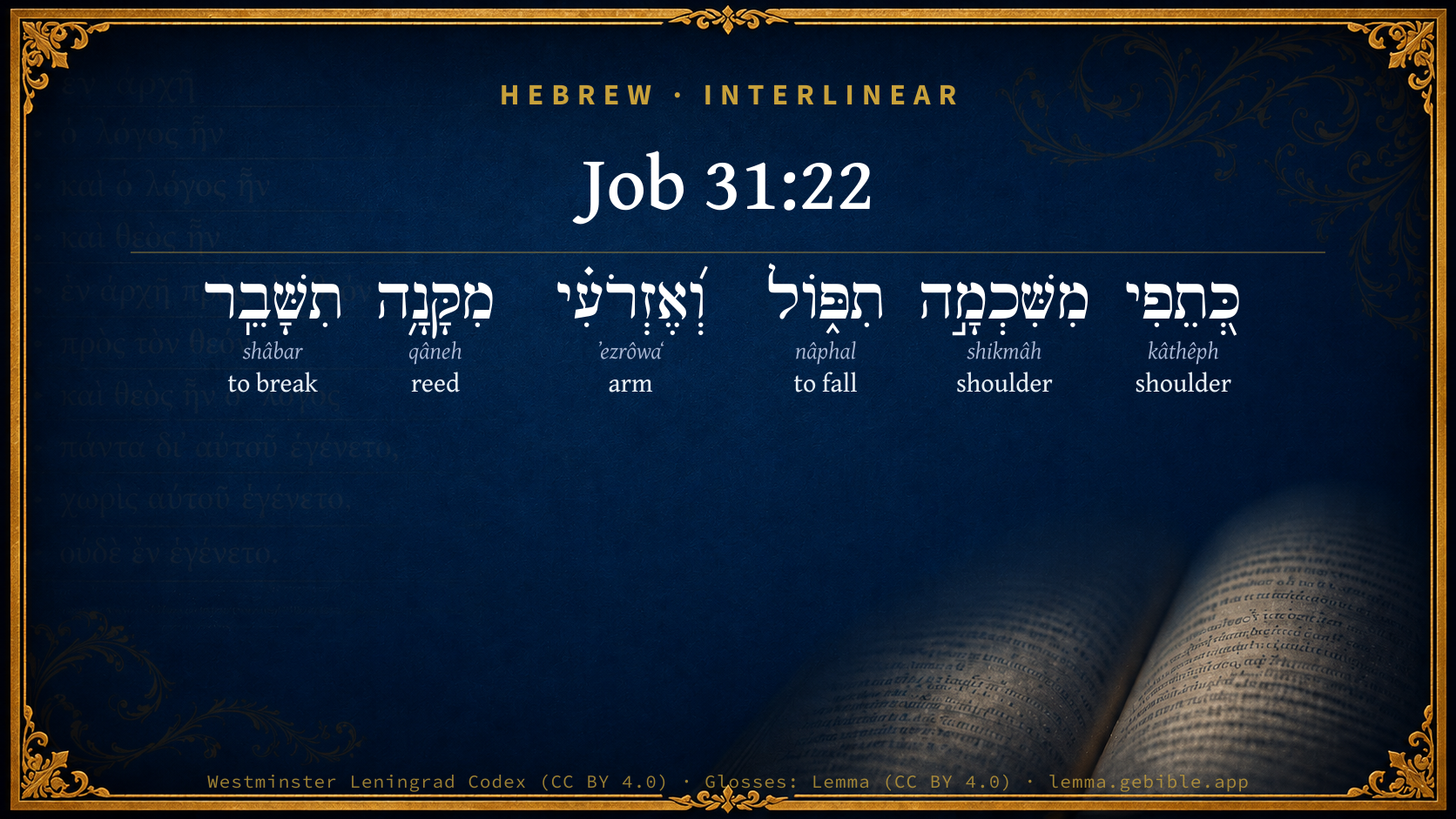
Job 31:22

Hebrew (Westminster Leningrad Codex) Job 31:22 appears in the Hebrew Old Testament. The text above is from the Westminster Leningrad Codex. Each word links to its Strong’s number, a concise gloss, and parsing drawn from the Open Scriptures Hebrew Bible morphology. Click any word for its full Brown-Driver-Briggs (BDB) entry.
Download image
Cite this verse

Job 31:22 (World English Bible). Public Domain. Lemma interlinear Bible study tool, https://lemma.gebible.app/v/job/31/22.

Show BibTeX & RIS
BibTeX
RIS
English Translation
Then let my shoulder fall from the shoulder-blade, And my arm be broken from the bone.
World English Bible · Public Domain
Highlights
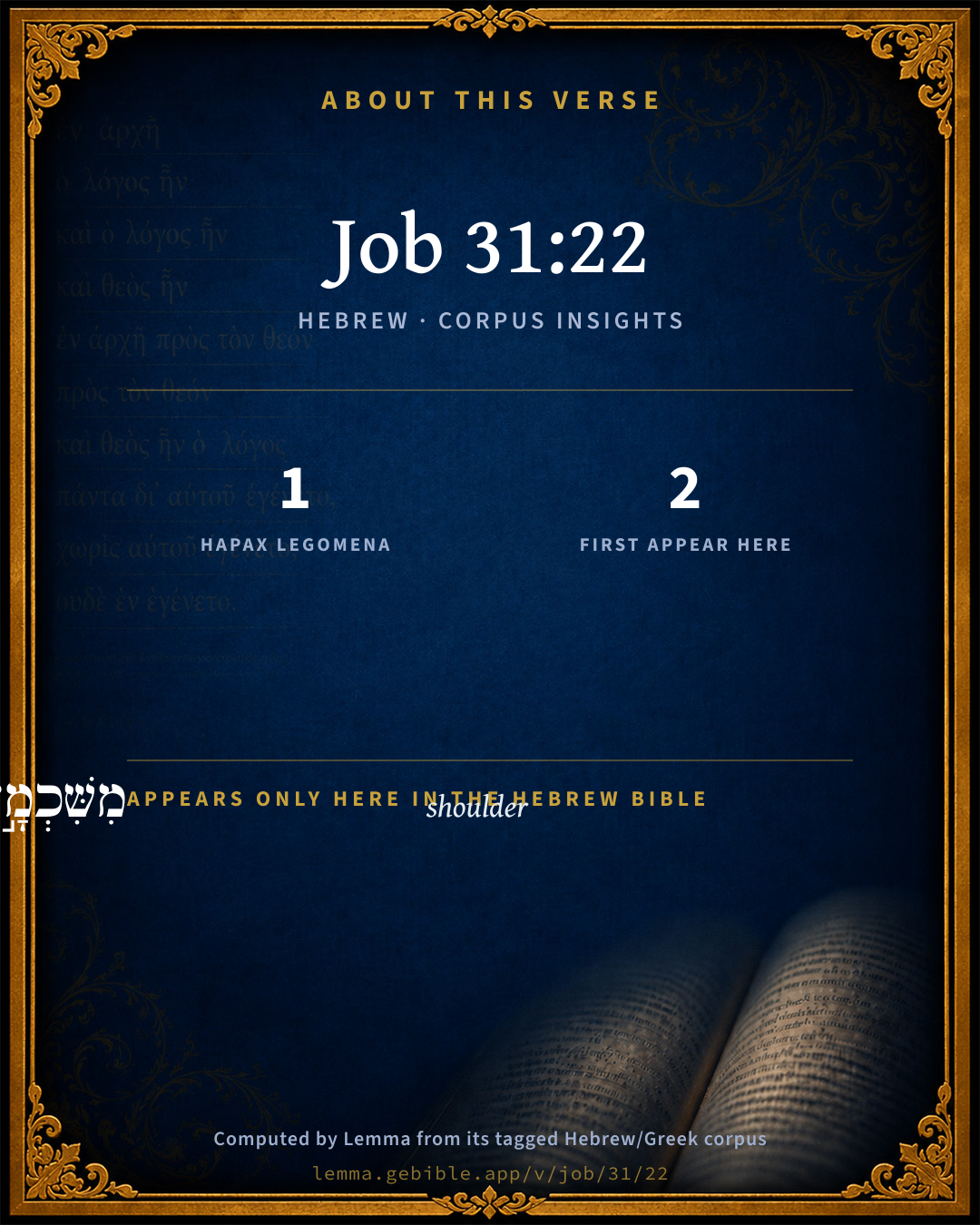
  • 1 hapax legomenon — only here in the Hebrew Bible
  • 2 first appearances in the Hebrew Bible
Full analysis ↓
Download a study sheet

One document with this verse’s original text, its word-by-word gloss line, the meaning frame, cross-references with their text, attributed commentary, and full source and license credits — printable, and it pastes into notes with its structure intact.

This verse Autodidact and up

Study sheet (.html) Plain text (.txt)

A passage Seminary Student

Up to 50 verses in one chapter. A passage sheet keeps up to 6 commentary sources and 12 cross-references per verse, in the order this page ranks them, and says so on the sheet whenever that leaves anything out. Ask for a single verse and you get the Autodidact verse sheet above.

Everything on this page stays free to read, with no account — the sheet is a download of what is already on screen, not access to it.

Want to remove ads? Support Godless Engineer
Compare translations 3

The same verse in 3 English versions, stacked beneath the original-language interlinear above. Click any original word for its lexicon entry.

Each is an independent rendering of the whole verse — the interlinear is not word-aligned to these translations.

Highlighted words mark where these versions differ — a whole-verse word diff, not a word-by-word alignment.

  • World English Bible Public Domain
    Then let my shoulder fall from the shoulder-blade, And my arm be broken from the bone.
  • King James Version Public Domain
    Then let mine arm fall from my shoulder blade, and mine arm be broken from the bone.
  • unfoldingWord Literal Text CC BY-SA 4.0
    may my upper arm fall from the shoulder blade; yes, may my arm be broken from its socket!

unfoldingWord Literal Text — © unfoldingWord, licensed CC BY-SA 4.0. Word-aligned USFM3 via Door43 (git.door43.org/unfoldingWord/en_ult).

Versions to compare (up to 4)

3 of 4 selected

Show all 18 translations

Every available English version of this verse, each an independent rendering of the whole verse.

  • World English Bible Public Domain
    Then let my shoulder fall from the shoulder-blade, And my arm be broken from the bone.
  • Berean Standard Bible Public Domain
    then may my arm fall from my shoulder and be torn from its socket.
  • Majority Standard Bible Public Domain
    then may my arm fall from my shoulder and be torn from its socket.
  • King James Version Public Domain
    Then let mine arm fall from my shoulder blade, and mine arm be broken from the bone.
  • American Standard Version (1901) Public Domain
    Then let my shoulder fall from the shoulder-blade, And mine arm be broken from the bone.
  • Revised Version (1885) Public Domain
    Then let my shoulder fall from the shoulder blade, and mine arm be broken from the bone.
  • Geneva Bible (1599) Public Domain
    Let mine arme fal from my shoulder, and mine arme be broken from the bone.
  • Douay-Rheims (1899) Public Domain
    Let my shoulder fall from its joint, and let my arm with its bones be broken.
  • Young's Literal Translation Public Domain
    My shoulder from its blade let fall, And mine arm from the bone be broken.
  • Literal Standard Version CC BY-SA 4.0
    Let my shoulder fall from its blade, || And the bone from my arm be broken.
  • Unlocked Literal Bible CC BY-SA 4.0
    If I have done these things, then let my shoulder fall from the shoulder blade, and let my arm be broken from its joint.
  • unfoldingWord Literal Text CC BY-SA 4.0
    may my upper arm fall from the shoulder blade; yes, may my arm be broken from its socket!
  • Darby Bible Public Domain
    [Then] let my shoulder fall from the shoulder-blade, and mine arm be broken from the bone!
  • World Messianic Bible Public Domain
    then let my shoulder fall from the shoulder blade, and my arm be broken from the bone.
  • Webster's Bible Public Domain
    Then let my arm fall from my shoulder-blade, and my arm be broken from the bone.
  • Free Bible Version CC BY-SA 4.0
    then let my shoulder be pulled from its joint, my arm wrenched out of its socket.
  • Bible in Basic English Public Domain
    May my arm be pulled from my body, and be broken from its base.
  • JPS Tanakh (1917) Public Domain
    Then let my shoulder fall from the shoulder-blade, and mine arm be broken from the bone.

Literal Standard Version (2020), Covenant Press — licensed CC BY-SA 4.0. Text via the HelloAO Bible API (eBible.org). Unlocked Literal Bible (unfoldingWord) — licensed CC BY-SA 4.0. Text via the HelloAO Bible API (eBible.org). unfoldingWord Literal Text — © unfoldingWord, licensed CC BY-SA 4.0. Word-aligned USFM3 via Door43 (git.door43.org/unfoldingWord/en_ult). Free Bible Version, Dr. Jonathan Gallagher — licensed CC BY-SA 4.0. Text via the HelloAO Bible API (eBible.org).

Word by word

More ways to search: Search by grammar → Find every occurrence → Compare this word →

Practice this passage: Drill this verse → Learn its vocabulary →

מִשִּׁכְמָ֣ה
shikmâh
H7929
“from · shoulder · her”
Preposition + Noun, Common, Masculine, Singular, Construct + Suffix, Personal, 3rd Person, Feminine, Singular
Part of Speech
Preposition + Noun
Type
Common
Gender
Masculine
Number
Singular
State
Construct
Full BDB Definition

Origin: from H7926

TWOT: 2386a

shoulder, back - shoulder, shoulder-blade - back (in general)
  1. כְּ֭תֵפִי kâthêph H3802 “shoulder · my” Noun, Common, Feminine, Singular, Construct + Suffix, Personal, 1st Person, Common, Singular
  2. תִפּ֑וֹל nâphal H5307 “to fall” Verb, Qal, Imperfect, 3rd Person, Feminine, Singular
  3. וְ֝אֶזְרֹעִ֗י ʼezrôwaʻ H248 “and · arm · my” Conjunction + Noun, Common, Feminine, Singular, Construct + Suffix, Personal, 1st Person, Common, Singular
  4. מִקָּנָ֥ה qâneh H7070 “from · reed · her” Preposition + Noun, Common, Masculine, Singular, Construct + Suffix, Personal, 3rd Person, Feminine, Singular
  5. תִשָּׁבֵֽר shâbar H7665 “to break” Verb, Niphal, Imperfect, 3rd Person, Feminine, Singular

About this verse

These counts appear in no published source. They are computed here, from the morphology-tagged text and Lemma’s own curated glosses. What Lemma adds →

6
words
6
distinct lemmas
Wisdom
section

Notable vocabulary

1 hapax legomenon — a word that appears only here in the entire Hebrew Bible:

  • מִשִּׁכְמָ֣ה shoulder H7929

First appearance in Scripture

These words make their first canonical appearance in the Hebrew Bible here:

  • מִשִּׁכְמָ֣ה shoulder H7929
  • וְ֝אֶזְרֹעִ֗י arm H248

Shared distinctive vocabulary

וְ֝אֶזְרֹעִ֗י arm H248 occurs in 2 verses of the Hebrew Bible. Also found in:

Grammatical profile

  • 2 verbs
  • 4 nouns

Verb forms

  • תִפּ֑וֹל Qal · Imperfect
  • תִשָּׁבֵֽר Niphal · Imperfect

Hebrew & Septuagint length

In English translation the verse runs 16 words from the Hebrew and 17 from the Septuagint (LXX English) — closely comparable.

A rough comparison of the two English renderings, which tokenize alike — not a word-level alignment.

Word counts can differ between the Hebrew and the Greek without any difference in meaning — e.g. the Hebrew direct-object marker אֵת has no separate Greek word, and Greek often adds the article ὁ.

Cross-references

6

Topical passages linked to Job 31:22 in the Treasury of Scripture Knowledge — connected by theme and wording, ordered by reader-vote popularity; previews shown in the World English Bible.

  • Joshua 22:22–23 The Mighty One, God, Yahweh, the Mighty One, God, Yahweh, he knows; and Israel he shall know: if it be in rebellion, or if in trespass against Yahweh (don't save us this day),
  • Job 31:10 Then let my wife grind for another, And let others sleep with her.
  • Job 31:40 Let briars grow instead of wheat, And stinkweed instead of barley." The words of Job are ended.
  • Job 38:15 From the wicked, their light is withheld, The high arm is broken.
  • Psalms 7:4–5 If I have rewarded evil to him who was at peace with me (Yes, I have delivered him who without cause was my adversary),
  • Psalms 137:6 Let my tongue stick to the roof of my mouth if I don't remember you; If I don't prefer Jerusalem above my chief joy.

Cross-references courtesy of OpenBible.info (CC BY 4.0).

Hebrew and Greek witnesses Masoretic Hebrew ↔ Greek Septuagint

The same verse in the two great witnesses to the Old Testament, shown verse-for-verse.

These are two independent witnesses, not word-aligned to each other, and the Septuagint is shown in lemma (dictionary) form.

Hebrew Job 31:22 Masoretic · Westminster Leningrad Codex

כְּ֭תֵפִי מִשִּׁכְמָ֣ה תִפּ֑וֹל וְ֝אֶזְרֹעִ֗י מִקָּנָ֥ה תִשָּׁבֵֽר

Then let my shoulder fall from the shoulder-blade, And my arm be broken from the bone.

World English Bible · Public Domain

Greek LXX Job 31:22 Septuagint · lemma form

ἀποἵστημι ἄρα ὁ ὦμος ἐγώ ἀπό ὁ κλείς ὁ δέ βραχίων ἐγώ ἀπό ὁ ἀγκών ἐγώ συντρίβω

let them my shoulder start from the blade-bone, and my arm be crushed off from the elbow.

LXX2012 (modern English Septuagint) · Public Domain

On this verse, Albert Barnes' Notes on the Bible discusses the Septuagint’s reading. Read the note in Commentary ↓

Hebrew: Westminster Leningrad Codex (CC BY 4.0). Greek: Septuagint (public domain); English from LXX2012 (modern English Septuagint) (Public Domain). How the Septuagint differs from the Hebrew →

Commentary

Notes on Job 31:22 from classic Christian and Jewish commentators (each source and its license shown beneath its notes). The classic Christian expositions comment on the surrounding passage and are grouped to its opening verse, so a note may address several verses; the Jewish commentaries on the Tanakh (Rashi and others) are per-verse, so they appear only where the commentator wrote on this verse.

Lemma curates 59 commentaries, every one of them public domain or Creative Commons licensed, each selected and text-cleaned for this edition rather than reprinted as found. About our sources →

Trapp's Complete Commentary

John Trapp

Job 31:22 [Then] let mine arm fall from my shoulder blade, and mine arm be broken from the bone.

Ver. 22. Then let mine arm fall from the shoulder blade] That unworthy arm of mine (as Cranmer cried out of that unworthy right hand of his, which he therefore burnt first), so injuriously lifted up against the fatherless, Job 31:21, let it never be useful to me any more, but let me be punished with that wherewith I have sinned. God sometimes takes notice of the offending member; as in Jeroboam’s withered hand, Abimelech’s head, which had stolen the crown, Samson’s eyes, the rich man’s tongue, the adulteress’s thigh, Num 5:27. This Job knew, and therefore subjoineth this imprecation, Diris se devovens, thereby to clear himself from Eliphaz’s false imputations, Job 22:6-7. The like may be done by us, but sparingly, and not without great necessity, for the helping of the truth in necessity, lest if we do it falsely or rashly, God say, Amen, and set his fiat to it; as he had done in sundry instances in several ages; witness Alexander, the cruel keeper of Newgate, and his son-in-law, John Peter, who rotted above ground, according to their wish. So Anne Averies, in Queen Elizabeth’s days; Sir Gervaise Elloways, in King James’s, hanged on the Tower hill, which he confessed was just upon him, for that in carding and dicing he had often wished himself hanged, if it were not so and so.

And mine arm be broken from the bone] Broken to shivers, as the word signifieth, and by the infamous hands of the hangman, for a terror to all false judges, as some do sense it; Rumpar medius, saith Brentius, as Judas burst in the midst with a huge crack, Act 1:18, his guts gushing out; as did likewise Foxford’s, a great persecutor in Henry VIII’s time. Some men’s sins go before to judgment, God hanging them up, as it were, in gibbets, that others may hear and fear, and do no more so.

John Trapp, A Commentary or Exposition upon All the Books of the Old and New Testament (1647–1656) — public domain. Text from a community e-Sword module.

Tyndale Open Study Notes

Tyndale Open Resources

31:22-23 If an arm was used in sinful action (31:21), having it torn from its socket would be a fitting punishment and better than facing God’s judgment (cp. Matt 5:28-30).

Tyndale Open Study Notes — © Tyndale Open Resources, licensed CC BY-SA 4.0. Text via the HelloAO Bible API.

Geneva Bible (1599)

Geneva Bible translators

Let me rot in pieces.

Geneva Bible (1599) marginal notes — public domain. Text via Bolls.life.

Jamieson, Fausset & Brown

Robert Jamieson, A. R. Fausset & David Brown

Apodosis to Job 31:13, Job 31:16-17, Job 31:19-21. If I had done those crimes, I should have made a bad use of my influence ("my arm," figuratively, Job 31:21): therefore, if I have done them let my arm (literally) suffer. Job alludes to Eliphaz' charge (Job 22:9). The first "arm" is rather the shoulder. The second "arm" is the forearm.

from the bone--literally, "a reed"; hence the upper arm, above the elbow.

Jamieson, Fausset & Brown — Commentary Critical and Explanatory on the Whole Bible (1871) — public domain (CC PDM 1.0). Text via the HelloAO Bible API.

Adam Clarke's Commentary

Verse 22. Let mine arm fall] Mr. Good, as a medical man, is at home in the translation of this verse: -

"May my shoulder-bone be shivered at the blade,

And mine arm be broken off at the socket."

Let judgment fall particularly on those parts which have either done wrong, or refused to do right when in their power.

Adam Clarke's Commentary on the Bible (1810–1826) — public domain. Text from a community e-Sword/MySword module.

The Cambridge Bible for Schools and Colleges

gen. ed. J. J. S. Perowne

22. The imprecation is closely connected in form with the preceding verse—if I have lifted up mine hand, then let mine arm, &c.

mine arm fall] Or, my shoulder fall.

from the bone] Marg. the chanel bone, “an old term for the collar bone” (Wright, Bible Word-Book). The word is lit. tube, or shaft.

The Cambridge Bible for Schools and Colleges (gen. ed. J. J. S. Perowne; Cambridge University Press, 1878–1918) — public domain. Text from a community e-Sword module.

John Gill's Exposition

If I have made gold my hope,.... Job here purges himself from idolatry in a figurative sense, as he afterwards does from it, taken in a literal sense; for covetousness is idolatry, and a covetous man is an idolater; he worships his gold and silver, placing his affections on them, and putting his trust and confidence in them, Eph 5:5; for to make gold the object or ground of hope is to place it in the room of God, who is the Hope of Israel, and in whom every good man should trust, and whom he should make his hope, Jer 14:8; not gold on earth, but glory in heaven, is what the good man is hoping for; and not riches, but Christ and his righteousness, are the foundation of such an hope; to make gold our hope, is to have hope in this life, and to make a thing present the object of it; whereas true hope is of things not seen and future, and if only in this life good men have hope, they are of all most miserable; but they have in heavens better and a more enduring substance, and a better ground for hope of that substance, than worldly wealth and riches can give:

or have said to the fine gold, thou art my confidence; as bad men do, and good men are prone unto, and therefore to be cautioned against it, Psa 49:6; for this is not only to trust in uncertain riches, and in unsatisfying ones, but to put them in the stead of God, who is or ought to be the confidence of the ends of the earth: not gold, but the living God, who gives all things richly to enjoy, is to be trusted in; when men covet riches, and trust in them as their security from evil, and that they may live independent of the providence of God, it is virtually to deny it, and carries in it secret atheism; as well as such a confidence is destruction of the worship of God, and such a temper makes a man an unprofitable hearer, plunges him into errors and hurtful lusts, and endangers his everlasting happiness, Hab 2:9; in later times the Romans worshipped the goddess "Pecunia", or money, as Austin (z) relates.

(z) De Civitate Dei, l. 4. c. 21.

John Gill's Exposition of the Whole Bible (1746–1763) — public domain (CC PDM 1.0). Text via the HelloAO Bible API.

Albert Barnes' Notes on the Bible

Then let mine arm - The strong language which Job uses here, shows his consciousness of innocence, and his detestation of the offences to which he here refers, Job 31:16-22. The word rendered “arm” here (כתף kâthêph) means properly the shoulder. Isa 46:7; Isa 49:22; Num 7:9; compare the notes at Isa 11:14. There is no instance, it is believed, unless this is one, in which it means arm, and the meaning here is, that he wished, if he had been guilty, his shoulder might separate from the blade. So Herder, Rosenmuller, Umbreit, and Noyes render it; and so the Vulgate and the Septuagint.

From my shoulder-blade - The scapula - the flat bone to which the upper arm is attached. The wish of Job is, that the shoulder might separate from that, and of course the arm would be useless. Such a strong imprecation implies a firm consciousness of innocence.

And mine arm - The word arm here denotes the forearm - the arm from the elbow to the fingers.

From the bone - Margin, “the chanelbone.” Literally, “from the reed” - מקנה miqâneh. Umbreit renders it, Schneller als ein Rohr - quicker than a reed. The word קנה qâneh means properly a reed, cane, calamus (see the notes at Isa 43:24), and is here applied to the upper arm, or arm above the elbow, from its resemblance to a reed or cane. It is applied, also, to the arm or branch of a chandelier, or candlestick, Exo 25:31, and to the rod or beam of a balance, Isa. xlvi. 6. The meaning here is, that he wished that his arm should be broken at the elbow, or the forearm be separated from the upper arm, if he were guilty of the sins which he had specified. There is allusion, probably, and there is great force and propriety in the allusion, to what he had said in Job 31:2 l: “If his arm had been lifted up against an orphan, he prayed that it might fall powerless.”

Albert Barnes' Notes on the Bible (1834–1885) — public domain. Text from a community e-Sword/MySword module.

Haydock's Catholic Bible Commentary

With. Hebrew, "from its bone," at the elbow. (Septuagint) (Calmet)

George Leo Haydock (1774–1849), Haydock's Catholic Family Bible and Commentary, 1859 edition — public domain. Excludes Psalms (Douay-Rheims chapter numbering differs from Protestant) and Deuterocanonical books (Catholic canon only).

Matthew Poole's English Annotations

I am contented that that arm which hath been so wickedly employed may either rot off, or fall out of joint, and so be useless and burdensome to me.

Matthew Poole's English Annotations on the Holy Bible (1683–1685) — public domain. Text from a community e-Sword/MySword module.

Whedon's Commentary on the Bible

Daniel D. Whedon

22. Mine arm — There is a striking grandeur in this imprecation on the arm that was lifted up to threaten an orphan in the court of justice. (Scott.)

Daniel D. Whedon (gen. ed.), Commentary on the Old and New Testaments (1874–1909) — public domain. Text from a community e-Sword module.

The Pulpit Commentary

Then let mine arm (rather, my shoulder) fall from my shoulder-blade. Job was, perhaps, led to make this rather strange imprecation by the fact that, in the disease from which he was suffering, portions of bone sometimes detach themselves and come away. And mine arm be broken from the bone. My forearm, i.e, detach itself from the bone of the upper arm, and come away from it.

The Pulpit Commentary (1880–1919), ed. H.D.M. Spence-Jones & Joseph S. Exell — public domain. Text from a community e-Sword module.

unfoldingWord translationNotes

Door43 World Missions Community

then let my shoulder fall from the shoulder blade, and let my arm be broken from its joint

This can be stated in active form. AT: "then let someone tear off my shoulder from the shoulder blade and break my arm from its joint" (See: Active or Passive)

For I dreaded ... his majesty

This is the reason that Job did not do any of the wicked things he spoke of in verses 7 through 21.

translationWords

majesty

unfoldingWord translationNotes — © Distant Shores Media and the Door43 World Missions Community, licensed CC BY-SA 4.0. Source: git.door43.org/Door43/en_tn.

Rashi

Rabbi Shlomo Yitzchaki (Rashi)

from its shoulder blade That is the width of the shoulder.

from its bone That is the upper bone, which is round as a reed (קנה), and because it is round as a reed, it is called so.

Rashi on the Tanakh — English translations: “The Judaica Press complete Tanach with Rashi, translated by A. J. Rosenberg” (CC BY 4.0); “Pentateuch with Rashi's commentary by M. Rosenbaum and A.M. Silbermann, 1929-1934” (public domain); “The Metsudah Tanach series, Lakewood, N.J” (CC BY 4.0); and “The Book of Joshua, Metsudah Publications, 1997” (CC BY 4.0). Text via Sefaria.

Lesson kit

Teaching starters — assembled from the data on this page, not authored interpretation. Every prompt links to the verse data it draws on. Edit before teaching.

Job, in the Wisdom, opens this verse with 6 words (6 distinct Hebrew lemmas). Its most distinctive word is shikmâh (“shoulder”). A historical commentator’s framing appears above. Read the whole chapter for the surrounding context.

Discussion questions

  1. The word shikmâh carries the sense “shoulder.” How does it shape the verse?
  2. 1 word here appears nowhere else in the Hebrew Bible. Why might the author reach for such rare wording?
  3. 2 words make their first appearance in Scripture here. What does this debut establish?
  4. How does Jeremiah 32:21, which shares the word «arm», read alongside this verse?
  5. The translations on this page render this verse differently — a whole-verse word diff, not a word-by-word alignment. What might account for the different wordings?
  6. «תִפּ֑וֹל» is a Qal Imperfect verb. How does that grammatical form shape the action described?
  7. Compare how Trapp's Complete Commentary and Tyndale Open Study Notes read this verse. Where do they agree or differ?

Things to notice

  • 1 word in this verse appears nowhere else in the Hebrew Bible.
  • 2 words make their first canonical appearance in Scripture here.
  • These translations choose different wording for 9 words in this verse.
  • 6 distinct Hebrew lemmas span 6 words in this verse.

Reading settings

Reading text

Shown beneath each verse's original-language words.

Old Testament
Old Testament edition

Read the OT as the Masoretic Hebrew (MT) or the Greek Septuagint (LXX).

English shown for the Greek Septuagint (in the Hebrew ↔ Greek comparison).

Comparing translations? Open the Compare panel on any verse page to stack up to four side by side.