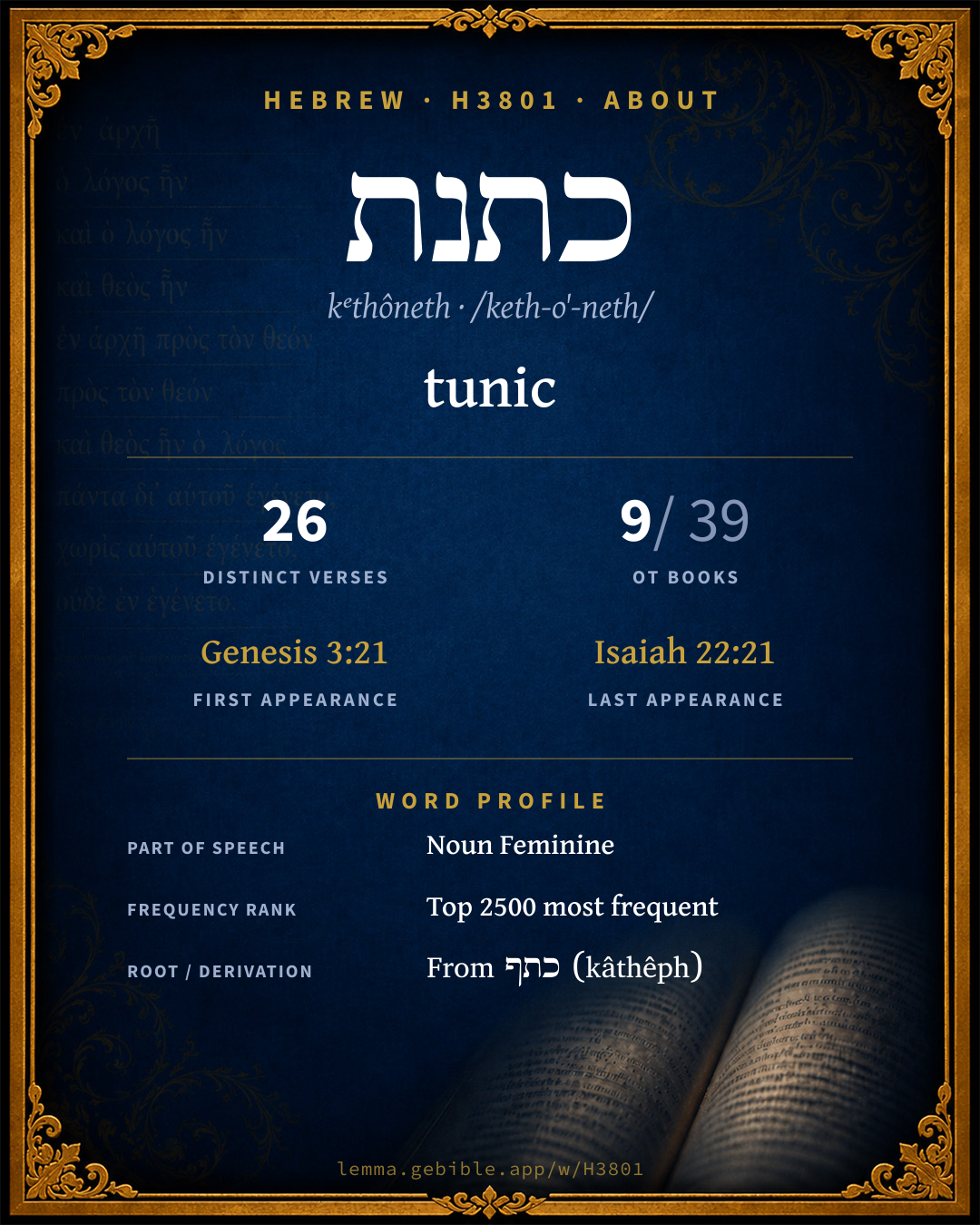
כֻּתֹּ֫נֶת
tunic
‘tunic’ is one of 2 main senses fuller range ↓
Full lexicon entry — Brown-Driver-Briggs (BDB)
From Brown-Driver-Briggs (BDB)
Where this word appears
See every Construct-state word in the Hebrew Bible →
Grammar key — what these labels mean
Part of speech
- Noun
- A naming word — a person, place, thing, or idea.
Noun type
- Common
- A common noun — a general class of person, place, or thing (“king,” “city,” “water”), not a specific name.
State
- Construct
- A noun bound to a following noun in a possessive / “of” relationship (the construct chain).
- Absolute
- The independent form of a noun, not bound to a following word.
Gender
- Feminine
- Grammatically feminine.
Number
- Singular
- One.
- Plural
- More than one (in Hebrew, generally three or more).
Grammatical forms
- Noun, Common, Feminine, Singular, Construct 15 times (52%)
- Noun, Common, Feminine, Plural, Absolute 5 times (17%)
- Noun, Common, Feminine, Plural, Construct 5 times (17%)
- Noun, Common, Feminine, Singular, Absolute 4 times (14%)
Parsed forms decoded from the imported morphology (morphhb / Westminster Leningrad Codex — WLC text public domain, morphhb tagging CC BY 4.0), counted across 29 parsed occurrences — not distinct verses.
Every verse where H3801 appears — 26 distinct verses across 9 books. Click any verse to open its interlinear word-by-word view. Verse text shown in the World English Bible for context — . Each verse’s Hebrew form is shown with its reference; the English is not keyword-highlighted, since the data carries no word-level English alignment. Use “Compare translations” on any verse to read it across multiple English versions. This concordance covers the Hebrew Bible; Septuagint (Greek Old Testament) occurrences are not indexed here.
Genesis 6 verses
- Genesis 3:21 כָּתְנ֥וֹת n c fp cs Yahweh God made coats of skins for Adam and for his wife, and clothed them.
- Genesis 37:3 כְּתֹ֥נֶת n c fs cs Now Israel loved Joseph more than all his children, because he was the son of his old age, and he made him a coat of many colors.
- Genesis 37:23 כֻּתָּנְתּ֔/וֹ כְּתֹ֥נֶת n c fs cs + sfx pers 3ms n c fs cs It happened, when Joseph came to his brothers, that they stripped Joseph of his coat, the coat of many colors that was on him;
- Genesis 37:31 כְּתֹ֣נֶת הַ/כֻּתֹּ֖נֶת n c fs cs ptcl def.art + n c fs They took Joseph's coat, and killed a male goat, and dipped the coat in the blood.
- Genesis 37:32 כְּתֹ֣נֶת הַ/כְּתֹ֧נֶת n c fs cs ptcl inter + n c fs cs They took the coat of many colors, and they brought it to their father, and said, "We have found this. Examine it, now, whether it is your son's coat or not."
- Genesis 37:33 כְּתֹ֣נֶת n c fs cs He recognized it, and said, "It is my son's coat. An evil animal has devoured him. Joseph is without doubt torn in pieces."
Exodus 7 verses
- Exodus 28:4 וּ/כְתֹ֥נֶת conj + n c fs cs These are the garments which they shall make: a breastplate, and an ephod, and a robe, and a coat of checker work, a turban, and a sash: and they shall make holy garments for Aaron your brother, and his sons, that he may minister to me in the priest's office.
- Exodus 28:39 הַ/כְּתֹ֣נֶת ptcl def.art + n c fs You shall weave the coat in checker work of fine linen, and you shall make a turban of fine linen, and you shall make a sash, the work of the embroiderer.
- Exodus 28:40 כֻתֳּנֹ֔ת n c fp "You shall make coats for Aaron's sons, and you shall make sashes for them and headbands shall you make for them, for glory and for beauty.
- Exodus 29:5 הַ/כֻּתֹּ֔נֶת ptcl def.art + n c fs You shall take the garments, and put on Aaron the coat, the robe of the ephod, the ephod, and the breastplate, and dress him with the skillfully woven band of the ephod;
- Exodus 29:8 כֻּתֳּנֹֽת n c fp You shall bring his sons, and put coats on them.
- Exodus 39:27 הַ/כָּתְנֹ֥ת ptcl def.art + n c fp They made the coats of fine linen of woven work for Aaron, and for his sons,
- Exodus 40:14 כֻּתֳּנֹֽת n c fp You shall bring his sons, and put coats on them.
Leviticus 4 verses
- Leviticus 8:7 הַ/כֻּתֹּ֗נֶת ptcl def.art + n c fs He put the coat on him, tied the sash on him, clothed him with the robe, put the ephod on him, and he tied the skillfully woven band of the ephod on him, and fastened it to him with it.
- Leviticus 8:13 כֻּתֳּנֹת֙ n c fp Moses brought Aaron's sons, and clothed them with coats, and tied sashes on them, and put headbands on them; as Yahweh commanded Moses.
- Leviticus 10:5 בְּ/כֻתֳּנֹתָ֔/ם prep + n c fp cs + sfx pers 3mp So they drew near, and carried them in their coats out of the camp, as Moses had said.
- Leviticus 16:4 כְּתֹֽנֶת n c fs cs He shall put on the holy linen coat, and he shall have the linen breeches on his body, and shall put on the linen sash, and he shall be dressed with the linen turban. They are the holy garments. He shall bathe his body in water, and put them on.
2 Samuel 3 verses
- 2 Samuel 13:18 כְּתֹ֣נֶת n c fs cs She had a garment of various colors on her; for with such robes were the king's daughters who were virgins dressed. Then his servant brought her out, and bolted the door after her.
- 2 Samuel 13:19 וּ/כְתֹ֧נֶת conj + n c fs cs Tamar put ashes on her head, and tore her garment of various colors that was on her; and she laid her hand on her head, and went her way, crying aloud as she went.
- 2 Samuel 15:32 כֻּתָּנְתּ֔/וֹ n c fs cs + sfx pers 3ms It happened that when David had come to the top [of the ascent], where God was worshiped, behold, Hushai the Archite came to meet him with his coat torn, and earth on his head.
Ezra 1 verse
Nehemiah 2 verses
- Nehemiah 7:70 כָּתְנוֹת֙ n c fp cs Some from among the heads of fathers' [houses] gave to the work. The governor gave to the treasury one thousand darics of gold, fifty basins, and five hundred thirty priests' garments.
- Nehemiah 7:72 וְ/כָתְנֹ֥ת conj + n c fp cs That which the rest of the people gave was twenty thousand darics of gold, and two thousand minas of silver, and sixty-seven priests' garments.
Job 1 verse
Song of Solomon 1 verse
Isaiah 1 verse
About this entry
At a glance — auto-summarized from this page’s data, not written by a person. Every figure links to its source below. This summary describes the numbers; it doesn’t interpret them.
The Hebrew noun כתנת centers on the idea of “tunic.” Where the King James Version says “coat,” newer translations reach for “robe” (Berean Standard Bible) and “tunic” (unfoldingWord Literal Text); the renderings breakdown has the detail. The Hebrew Bible uses it across 26 verses — moderately common. Exodus dominates its distribution — 7 of 26 verses. Lexicons map it across 2 senses. Dig into 26-verse concordance and the renderings breakdown below.
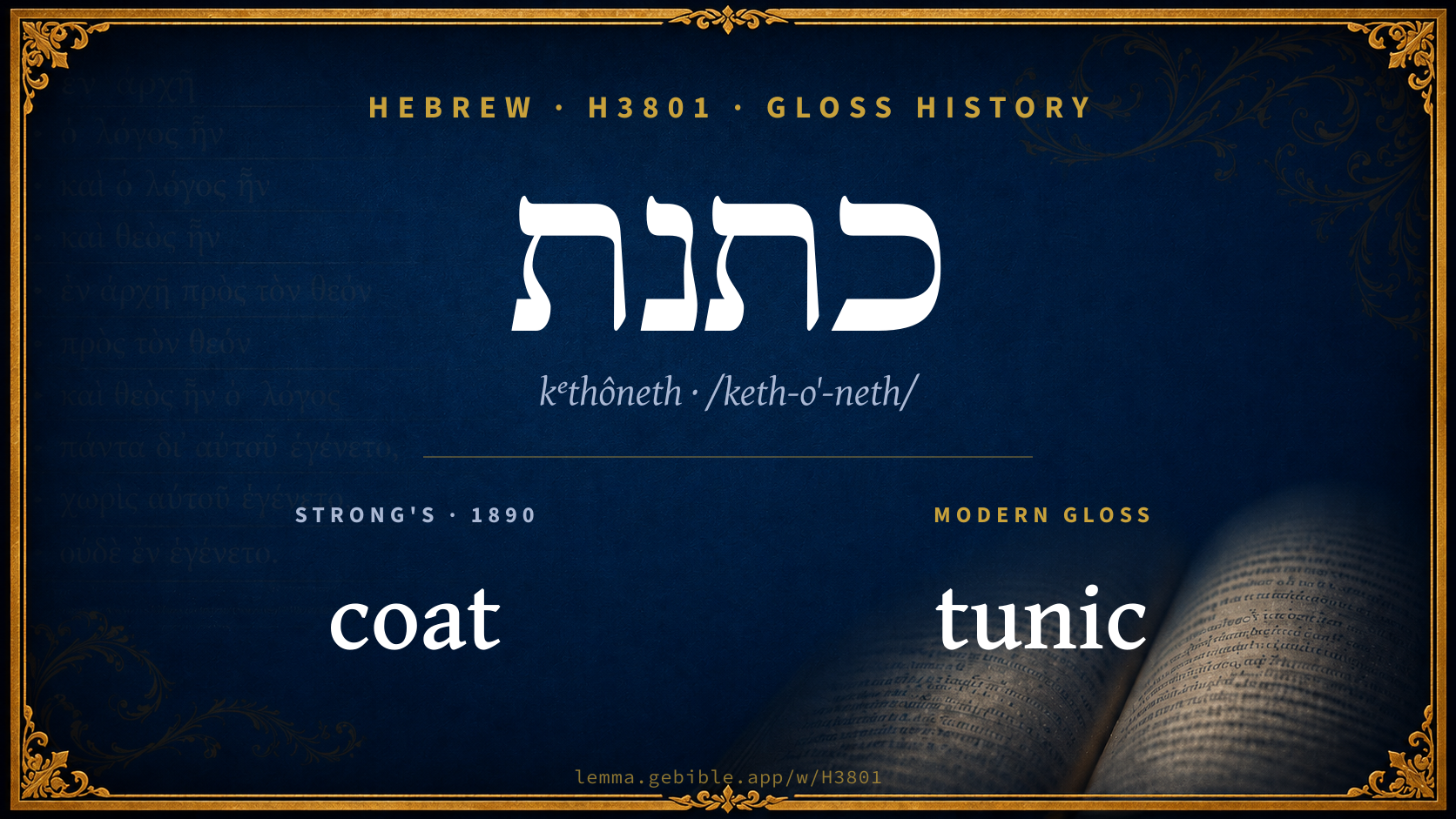
Gloss history
Strong's 1890 vs modern scholarship
About this word
Strong's H3801 catalogs a Hebrew word from the Hebrew Old Testament.
These counts are not copied from any lexicon or concordance. They are computed here, from the morphology-tagged Hebrew Old Testament. What Lemma adds →
- 26
- distinct verses
- The word appears in 26 distinct verses.
- 9 / 39
- OT books
- The word appears in 9 of 39 Old Testament books.
- #1,160
- by frequency
- Top 2500 most frequent Hebrew words (rank 1,160 of 8,640 Hebrew words by occurrence).
View all 26 occurrences in the concordance →
By section of the Old Testament
By traditional corpus
Conventional, traditional groupings — biblical authorship is debated, so this is a traditional corpus grouping, not an authorship claim. Each share is this word’s portion of its verses in that division of the Hebrew canon. Each figure is a share of the word’s 26 distinct verses.
- Torah (Pentateuch) 17 verses · 65%
- Writings (Ketuvim) 5 verses · 19%
- Prophets (Nevi'im) 4 verses · 15%
How translations render this word
Counts come from each version’s own published word-to-Strong’s tagging or interlinear alignment — an approximate guide to how each version renders this word, not a word-level alignment the data otherwise carries. Because each total is that version’s own tagged count, the per-version totals vary from one another and need not match the appearance or distinct-verse counts above. These counts may also differ from a printed concordance because Lemma counts each distinctly tagged rendering and does not collapse phrase taggings into a single head-word total. This is a fixed set of word-tagged versions (KJV, ASV, BSB, ULT) and does not change with the reading translation you choose elsewhere. Each version’s license is shown beside its name below (and on Sources).
- King James Version: Coat 16×, Coats 7×, Garments 3×
- American Standard Version: Coat 12×, Coats 5×, ' garments 3×
- Berean Standard Bible: Robe 13×, Tunic 6×, Garments 4×
- unfoldingWord Literal Text: Tunic 11×, Tunics 5×, Robe 4×
King James Version Public Domain
Renders H3801 across 29 tagged occurrences — most commonly:
Plus 3 renderings that appear only once — usually multi-word phrases or single function words the recovered tagging swept in, not distinct renderings.
American Standard Version Public Domain
Renders H3801 across 29 tagged occurrences — most commonly:
Plus 3 renderings that appear only once — usually multi-word phrases or single function words the recovered tagging swept in, not distinct renderings.
Berean Standard Bible Public Domain
Renders H3801 across 29 tagged occurrences — most commonly:
Plus 2 renderings that appear only once — usually multi-word phrases or single function words the recovered tagging swept in, not distinct renderings.
unfoldingWord Literal Text CC BY-SA 4.0
Renders H3801 across 42 tagged occurrences — most commonly:
Plus 6 renderings that appear only once — usually multi-word phrases or single function words the recovered tagging swept in, not distinct renderings.
Senses in BDB
The 2 senses BDB distinguishes for this word, in lexicon order (not ranked by frequency or importance). The full entry — with sub-senses — is in the Lexicon Entry tab.
- tunic, under-garment
- a long shirt-like garment usually of linen
Word origin
n.f. tunic (NH id.; Aramaic כִּתּוּנָא, etc., ܟܽܘܬܻܝܢܳܐ, etc.; Ethiopic ክታን tunic, linen; cf. also √ supr.);—abs. כֻּתֹּנֶת Gn 37:31 + 2 times; כְּתֹנֶת Ex 28:39; cstr. כְּתֹנֶת Gn 37:3 + 9 times; sf. כֻּתָּנְתּוֹ Gn 37:23 2 S 15:32, כֻּתָּנְתֶּ֑ךָ Is 22:21, כֻּתָּנְתִּי Jb 30:18 Ct 5:3; pl. abs. כֻּתֳּנֹת Ex 28:40 + 3 times, הַכָּתְנֹת 39:27; cstr. כָּתְנוֹת Gn 3:21 + 2 times, כָּתְנֹת Ezr 2:69; sf. כֻּתֳּנֹתָם Lv 10:5;—tunic, principal ordinary garment (v. BenzArch. 98 f. NowArch. i, 121, 193) of man and woman, worn next the person, כָּתְנֹת עוֹר Gn 3:21 tunics of skin; of man 2 S 15:32; פִּי כ׳ Jb 30:18 mouth of any tunic (i.e. its collar); כ׳ פַּסִּים Gn 37:3, 23, 32 i.e. tunic with long skirts and sleeves (v. פַּס), cf. v 23, 31(×2), 32, 33; of woman Ct 5:3 (put off at night); כ׳ פַּסִּים 2 S 13:18, 19 (of king’s daughter; rent, as sign of grief, cf. also 15:32, and v. קרע). Specif. of priest’s tunic Ex 28:4, 39 (embroidered, v. שׁבץ, תַּשְׁבֵּץ), v 40; 29:5, 8; 39:27 (made of שֵׁשׁ, q.v.), 40:14 Lv 8:7, 13; 10:5; כּ׳־בַּד קֹדֶשׁ 16:4 a holy linen tunic, of high priest; כ׳־כֹּהֲנִים Ezr 2:69 Ne 7:69, 71 (van d. H. v 70, 72); of Shebna’s official tunic Is 22:21.
— Brown-Driver-Briggs (Oxford 1906, public domain), digitized via Sefaria, supplemented by the OpenScriptures HebrewLexicon (CC BY 4.0). See Sources.
Derived from כתף (kâthêph) (H3802) — shoulder.
Jastrow Dictionary
A second Hebrew/Aramaic lexicon for comparison, covering Aramaic and post-biblical (Talmudic, Targumic, Midrashic) usage that the biblical-Hebrew BDB does not. Matched by lemma rather than by Strong’s number, so a lemma may carry more than one Jastrow headword (shown separately below), and the entries cover usage well beyond the Bible.
כְּתֹנֶת
- , v. כְּתוֹנֶת
A Dictionary of the Targumim, the Talmud Babli and Yerushalmi, and the Midrashic Literature (Marcus Jastrow; London, Luzac, 1903) — Public Domain. Digitized via Sefaria. Digitized via Sefaria. Full attribution on Sources.
Forms in the corpus
The 22 distinct written forms H3801 takes in the Hebrew Bible, most frequent first — each parse links to that state’s occurrences in the concordance. Hebrew forms include their vowel points and cantillation, so a single lemma takes many written forms.
Same root — word family
Other BDB entries built from the same root as H3801, grouped by Strong’s listed origin. These share a root / origin per the lexicon — not necessarily a shared meaning. Each links to that word’s own entry.
Derives from
Derived from this word
Compare all same-root words → They share a root, not necessarily a meaning.
Septuagint verse parallels
This word appears in 23 verses that also exist in the Greek Old Testament (Septuagint), out of the 26 Hebrew verses it occurs in. You can read those verses in Greek by switching the Old Testament edition to the Septuagint.
Read these verses in the Septuagint
- Genesis 3:21
- Exodus 28:4
- Leviticus 8:7
- 2 Samuel 13:18
- Ezra 2:69
- Job 30:18
- Song of Solomon 5:3
- Isaiah 22:21
This is a verse-level parallel only — the same verses exist in both the Hebrew and Greek Old Testaments. No word-level Hebrew↔Greek correspondence is claimed: the data carries no such alignment, so no Greek word is shown as this Hebrew word’s translation. Coverage is not total — the Septuagint omits the deuterocanon and renumbers the Psalms, so some Hebrew verses have no direct Greek parallel.