
Ezekiel 12:6

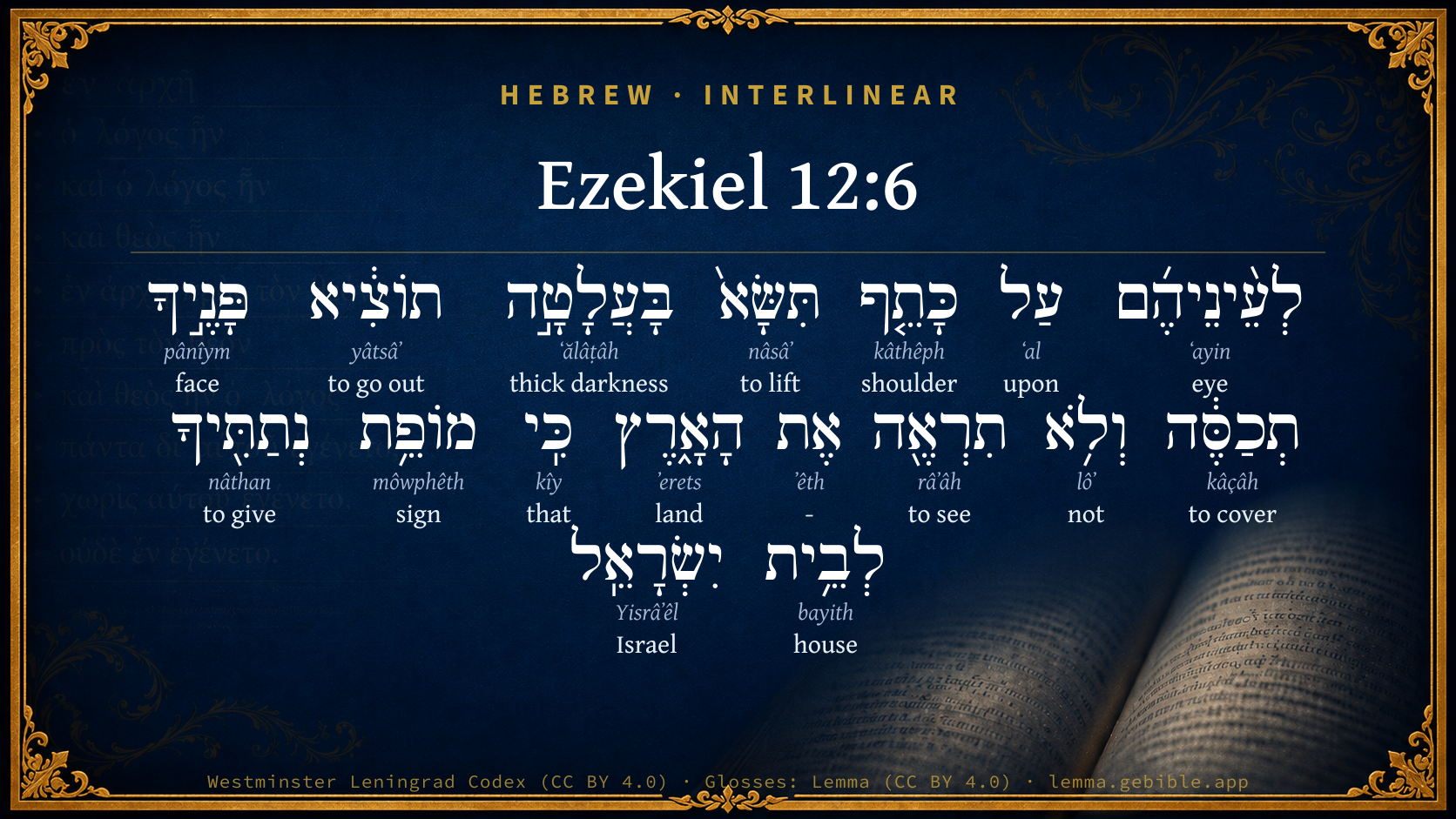
Hebrew (Westminster Leningrad Codex) Ezekiel 12:6 appears in the Hebrew Old Testament. The text above is from the Westminster Leningrad Codex. Each word links to its Strong’s number, a concise gloss, and parsing drawn from the Open Scriptures Hebrew Bible morphology. Click any word for its full Brown-Driver-Briggs (BDB) entry.
Download image
Cite this verse

Ezekiel 12:6 (World English Bible). Public Domain. Lemma interlinear Bible study tool, https://lemma.gebible.app/v/ezekiel/12/6.

Show BibTeX & RIS
BibTeX
RIS
English Translation
In their sight shall you bear it on your shoulder, and carry it forth in the dark; you shall cover your face, that you don't see the land: for I have set you for a sign to the house of Israel.
World English Bible · Public Domain
Download a study sheet

One document with this verse’s original text, its word-by-word gloss line, the meaning frame, cross-references with their text, attributed commentary, and full source and license credits — printable, and it pastes into notes with its structure intact.

This verse Autodidact and up

Study sheet (.html) Plain text (.txt)

A passage Seminary Student

Up to 50 verses in one chapter. A passage sheet keeps up to 6 commentary sources and 12 cross-references per verse, in the order this page ranks them, and says so on the sheet whenever that leaves anything out. Ask for a single verse and you get the Autodidact verse sheet above.

Everything on this page stays free to read, with no account — the sheet is a download of what is already on screen, not access to it.

Want to remove ads? Support Godless Engineer
Compare translations 3

The same verse in 3 English versions, stacked beneath the original-language interlinear above. Click any original word for its lexicon entry.

Each is an independent rendering of the whole verse — the interlinear is not word-aligned to these translations.

Highlighted words mark where these versions differ — a whole-verse word diff, not a word-by-word alignment.

  • World English Bible Public Domain
    In their sight shall you bear it on your shoulder, and carry it forth in the dark; you shall cover your face, that you don't see the land: for I have set you for a sign to the house of Israel.
  • King James Version Public Domain
    In their sight shalt thou bear it upon thy shoulders, and carry it forth in the twilight: thou shalt cover thy face, that thou see not the ground: for I have set thee for a sign unto the house of Israel.
  • unfoldingWord Literal Text CC BY-SA 4.0
    In their sight, lift up your things onto your shoulder, and bring them out in the darkness. Cover your face, for you must not see the land, since I have set you as a sign to the house of Israel.”

unfoldingWord Literal Text — © unfoldingWord, licensed CC BY-SA 4.0. Word-aligned USFM3 via Door43 (git.door43.org/unfoldingWord/en_ult).

Versions to compare (up to 4)

3 of 4 selected

Show all 18 translations

Every available English version of this verse, each an independent rendering of the whole verse.

  • World English Bible Public Domain
    In their sight shall you bear it on your shoulder, and carry it forth in the dark; you shall cover your face, that you don't see the land: for I have set you for a sign to the house of Israel.
  • Berean Standard Bible Public Domain
    And as they watch, lift your bags to your shoulder and take them out at dusk; cover your face so that you cannot see the land. For I have made you a sign to the house of Israel.”
  • Majority Standard Bible Public Domain
    And as they watch, lift your bags to your shoulder and take them out at dusk; cover your face so that you cannot see the land. For I have made you a sign to the house of Israel.”
  • King James Version Public Domain
    In their sight shalt thou bear it upon thy shoulders, and carry it forth in the twilight: thou shalt cover thy face, that thou see not the ground: for I have set thee for a sign unto the house of Israel.
  • American Standard Version (1901) Public Domain
    In their sight shalt thou bear it upon thy shoulder, and carry it forth in the dark; thou shalt cover thy face, that thou see not the land: for I have set thee for a sign unto the house of Israel.
  • Revised Version (1885) Public Domain
    In their sight shalt thou bear it upon thy shoulder, and carry it forth in the dark; thou shalt cover thy face, that thou see not the ground: for I have set thee for a sign unto the house of Israel.
  • Geneva Bible (1599) Public Domain
    In their sight shalt thou beare it vpon thy shoulders, and carie it foorth in the darke: thou shalt couer thy face that thou see not the earth: for I haue set thee as a signe vnto the house of Israel.
  • Douay-Rheims (1899) Public Domain
    In their sight thou shalt be carried out upon men's shoulders, thou shalt be carried out in the dark: thou shalt cover thy face, and shalt not see the ground: for I have set thee for a sign of things to come to the house of Israel.
  • Young's Literal Translation Public Domain
    Before their eyes on the shoulder thou dost bear, in the darkness thou dost bring forth, thy face thou dost cover, and thou dost not see the earth, for a type I have given thee to the house of Israel.'
  • Literal Standard Version CC BY-SA 4.0
    Carry on the shoulder before their eyes, bring forth in the darkness, cover your face, and you do not see the earth, for I have given you [as] a sign to the house of Israel.”
  • Unlocked Literal Bible CC BY-SA 4.0
    In their sight, lift up your things onto your shoulder, and bring them out in the darkness. Cover your face, for you must not see the land, since I have set you as a sign to the house of Israel.”
  • unfoldingWord Literal Text CC BY-SA 4.0
    In their sight, lift up your things onto your shoulder, and bring them out in the darkness. Cover your face, for you must not see the land, since I have set you as a sign to the house of Israel.”
  • Darby Bible Public Domain
    In their sight shalt thou bear [it] upon [thy] shoulder, and carry it forth in the dark; thou shalt cover thy face, and thou shalt not see the ground: for I have appointed thee for a sign unto the house of Israel.
  • World Messianic Bible Public Domain
    In their sight you shall bear it on your shoulder, and carry it out in the dark. You shall cover your face, so that you don’t see the land, for I have set you for a sign to the house of Israel.”
  • Webster's Bible Public Domain
    In their sight shalt thou bear it upon thy shoulders, and carry it forth in the twilight: thou shalt cover thy face, that thou mayest not see the ground: for I have set thee for a sign to the house of Israel.
  • Free Bible Version CC BY-SA 4.0
    When it gets dark, as they continue to watch, put your bags on your shoulder and carry them as you leave. Cover your face so that you can't see the country you're leaving behind, because I'm providing you as a sign to warn the people of Israel.”
  • Bible in Basic English Public Domain
    And before their eyes, take your goods on your back and go out in the dark; go with your face covered: for I have made you a sign to the children of Israel.
  • JPS Tanakh (1917) Public Domain
    In their sight shalt thou bear it upon thy shoulder, and carry it forth in the darkness; thou shalt cover thy face, that thou see not the ground; for I have set thee for a sign unto the house of Israel.'

Literal Standard Version (2020), Covenant Press — licensed CC BY-SA 4.0. Text via the HelloAO Bible API (eBible.org). Unlocked Literal Bible (unfoldingWord) — licensed CC BY-SA 4.0. Text via the HelloAO Bible API (eBible.org). unfoldingWord Literal Text — © unfoldingWord, licensed CC BY-SA 4.0. Word-aligned USFM3 via Door43 (git.door43.org/unfoldingWord/en_ult). Free Bible Version, Dr. Jonathan Gallagher — licensed CC BY-SA 4.0. Text via the HelloAO Bible API (eBible.org).

Word by word

More ways to search: Search by grammar → Find every occurrence → Compare this word →

Practice this passage: Drill this verse → Learn its vocabulary →

בָּעֲלָטָ֣ה
ʻălâṭâh
H5939
“in/at the · thick darkness”
Preposition, Determined + Noun, Common, Feminine, Singular, Absolute
Part of Speech
Preposition + Noun
Type
Common
Gender
Feminine
Number
Singular
State
Absolute
Full BDB Definition

Origin: from an unused root meaning to cover

TWOT: 1626

thick darkness
  1. לְעֵ֨ינֵיהֶ֜ם ʻayin H5869 “to/for · eyes · their” Preposition + Noun, Common, Both, Dual, Construct + Suffix, Personal, 3rd Person, Masculine, Plural
  2. עַל ʻal H5921 “upon” Preposition
  3. כָּתֵ֤ף kâthêph H3802 “shoulder” Noun, Common, Feminine, Singular, Absolute
  4. תִּשָּׂא֙ nâsâʼ H5375 “to lift” Verb, Qal, Imperfect, 2nd Person, Masculine, Singular
  5. תוֹצִ֔יא yâtsâʼ H3318 “to go out” Verb, Hiphil, Imperfect, 2nd Person, Masculine, Singular
  6. פָּנֶ֣יךָ pânîym H6440 “face(s) · your” Noun, Common, Both, Plural, Construct + Suffix, Personal, 2nd Person, Masculine, Singular
  7. תְכַסֶּ֔ה kâçâh H3680 “to cover” Verb, Piel, Imperfect, 2nd Person, Masculine, Singular
  8. וְלֹ֥א lôʼ H3808 “and · not” Conjunction + Particle, Negative
  9. תִרְאֶ֖ה râʼâh H7200 “to see” Verb, Qal, Imperfect, 2nd Person, Masculine, Singular
  10. אֶת ʼêth H853 “-” Particle, Direct Object
  11. הָאָ֑רֶץ ʼerets H776 “the · land” Particle, Definite Article + Noun, Common, Both, Singular, Absolute
  12. כִּֽי kîy H3588 “that” Conjunction
  13. מוֹפֵ֥ת môwphêth H4159 “sign” Noun, Common, Masculine, Singular, Absolute
  14. נְתַתִּ֖יךָ nâthan H5414 “to give · you” Verb, Qal, Perfect, 1st Person, Common, Singular + Suffix, Personal, 2nd Person, Masculine, Singular
  15. לְבֵ֥ית bayith H1004 “to/for · house of” Preposition + Noun, Common, Masculine, Singular, Construct
  16. יִשְׂרָאֵֽל Yisrâʼêl H3478 “Israel” Noun, Proper

About this verse

These counts appear in no published source. They are computed here, from the morphology-tagged text and Lemma’s own curated glosses. What Lemma adds →

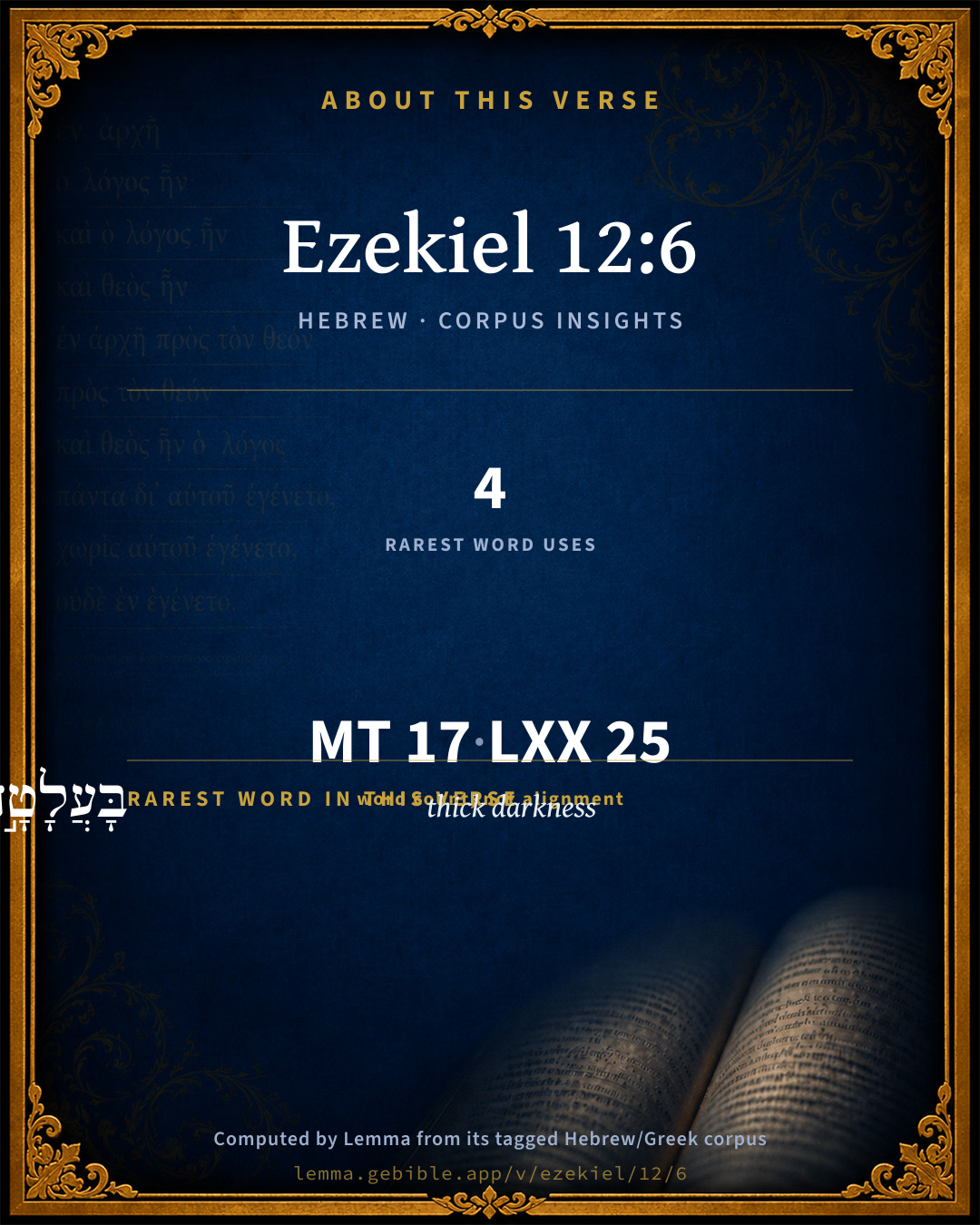
17
words
17
distinct lemmas
Prophets
section

Notable vocabulary

The rarest word here is בָּעֲלָטָ֣ה thick darkness H5939 — appearing just 4 times in the whole Hebrew Bible.

Shared distinctive vocabulary

בָּעֲלָטָ֣ה thick darkness H5939 occurs in 4 verses of the Hebrew Bible. Also found in:

Grammatical profile

  • 5 verbs
  • 8 nouns
  • 1 preposition
  • 1 conjunction
  • 2 particles

Verb forms

  • תִּשָּׂא֙ Qal · Imperfect
  • תוֹצִ֔יא Hiphil · Imperfect
  • תְכַסֶּ֔ה Piel · Imperfect
  • תִרְאֶ֖ה Qal · Imperfect
  • נְתַתִּ֖יךָ Qal · Perfect

Hebrew & Septuagint length

In English translation the verse runs 41 words from the Hebrew and 37 from the Septuagint (LXX English) — closely comparable.

A rough comparison of the two English renderings, which tokenize alike — not a word-level alignment.

Word counts can differ between the Hebrew and the Greek without any difference in meaning — e.g. the Hebrew direct-object marker אֵת has no separate Greek word, and Greek often adds the article ὁ.

In the original languages it is 17 Hebrew tokens and 25 Greek tokens — but the two are counted differently (Hebrew bundles its prefixes and suffixes into one token; the Greek is in lemma form), so that isn’t a like-for-like length.

Cross-references

8

Topical passages linked to Ezekiel 12:6 in the Treasury of Scripture Knowledge — connected by theme and wording, ordered by reader-vote popularity; previews shown in the World English Bible.

  • Ezekiel 4:3 Take for yourself an iron pan, and set it for a wall of iron between you and the city: and set your face toward it, and it shall be besieged, and you shall lay siege against it. This shall be a sign to the house of Israel.
  • Isaiah 8:18 Behold, I and the children whom Yahweh has given me are for signs and for wonders in Israel from Yahweh of Hosts, who dwells in Mount Zion.
  • Ezekiel 24:24 Thus shall Ezekiel be to you a sign; according to all that he has done shall you do: when this comes, then shall you know that I am the Lord Yahweh.
  • 1 Samuel 28:8 Saul disguised himself, and put on other clothing, and went, he and two men with him, and they came to the woman by night: and he said, Please divine to me by the familiar spirit, and bring me up whoever I shall name to you.
  • 2 Samuel 15:30 David went up by the ascent of the [Mount of] Olives, and wept as he went up; and he had his head covered, and went barefoot: and all the people who were with him covered every man his head, and they went up, weeping as they went up.
  • Job 24:17 For the morning is to all of them like thick darkness, For they know the terrors of the thick darkness.
  • Isaiah 20:2–4 at that time Yahweh spoke by Isaiah the son of Amoz, saying, Go, and loose the sackcloth from off your loins, and put your shoe from off your foot. He did so, walking naked and barefoot.
  • Ezekiel 12:11–12 Say, I am your sign: like as I have done, so shall it be done to them; they shall go into exile, into captivity.

Cross-references courtesy of OpenBible.info (CC BY 4.0).

Hebrew and Greek witnesses Masoretic Hebrew ↔ Greek Septuagint

The same verse in the two great witnesses to the Old Testament, shown verse-for-verse.

These are two independent witnesses, not word-aligned to each other, and the Septuagint is shown in lemma (dictionary) form.

Hebrew Ezekiel 12:6 Masoretic · Westminster Leningrad Codex

לְעֵ֨ינֵיהֶ֜ם עַל כָּתֵ֤ף תִּשָּׂא֙ בָּעֲלָטָ֣ה תוֹצִ֔יא פָּנֶ֣יךָ תְכַסֶּ֔ה וְלֹ֥א תִרְאֶ֖ה אֶת הָאָ֑רֶץ כִּֽי מוֹפֵ֥ת נְתַתִּ֖יךָ לְבֵ֥ית יִשְׂרָאֵֽל

In their sight shall you bear it on your shoulder, and carry it forth in the dark; you shall cover your face, that you don't see the land: for I have set you for a sign to the house of Israel.

World English Bible · Public Domain

Greek LXX Ezekiel 12:6 Septuagint · lemma form

ἐνώπιον αὐτός ἐπί ὦμος ἀναλαμβάνω καί κρύπτω ἐκἔρχομαι ὁ πρόσωπον σύ συνκαλύπτω καί οὐ μή ὁράω ὁ γῆ διότι τέρας δίδωμι σύ ὁ οἶκος ἰσραήλ

you shall be lifted up on men's shoulders, and shall go forth in secret: you shall cover your face, and shall not see the ground: because I have made you a sign to the house of Israel.

LXX2012 (modern English Septuagint) · Public Domain

On this verse, Haydock's Catholic Bible Commentary discusses the Septuagint’s reading. Read the note in Commentary ↓

Hebrew: Westminster Leningrad Codex (CC BY 4.0). Greek: Septuagint (public domain); English from LXX2012 (modern English Septuagint) (Public Domain). How the Septuagint differs from the Hebrew →

Targum (Aramaic paraphrase)

1

The Targum is the ancient Jewish Aramaic paraphrase of the Hebrew Scriptures — an interpretive translation, not the Hebrew text itself. Onkelos (literal) and Pseudo-Jonathan (expansive) render the Torah, and Jonathan the Prophets. Coverage is partial: where no permissively-licensed English translation exists for a verse, only the Aramaic is shown. This is verse-level text, not a word-by-word alignment to the Hebrew.

  1. Targum Jonathan Prophets (Joshua–Malachi)
    לְעֵינֵיהוֹן עַל כַּתְפָא תִטוֹל בְּקִבְלָא תִפּוֹק אַפָּךְ תְּכַסֵי וְלָא תֶחֱזֵי יַת אַרְעָא אֲרֵי אָת יְהָבְתָּךְ לְבֵית יִשְׂרָאֵל:

    (no public-domain English translation for this verse)

    Targum Jonathan — Aramaic: “Mikraot Gedolot” (public domain). English: “Sefaria Community Translation” (CC0 1.0 (public-domain dedication)); “London "Chaldee Paraphrase," 1871” (public domain). Text via Sefaria.

Commentary

Notes on Ezekiel 12:6 from classic Christian and Jewish commentators (each source and its license shown beneath its notes). The classic Christian expositions comment on the surrounding passage and are grouped to its opening verse, so a note may address several verses; the Jewish commentaries on the Tanakh (Rashi and others) are per-verse, so they appear only where the commentator wrote on this verse.

Lemma curates 59 commentaries, every one of them public domain or Creative Commons licensed, each selected and text-cleaned for this edition rather than reprinted as found. About our sources →

Trapp's Complete Commentary

John Trapp

Eze 12:6 In their sight shalt thou bear [it] upon [thy] shoulders, [and] carry [it] forth in the twilight: thou shalt cover thy face, that thou see not the ground: for I have set thee [for] a sign unto the house of Israel.

Ver. 6. In their sight shalt thou bear it upon thy shoulders.] To show that King Zedekiah himself should carry out some of his most precious things upon his shoulders when he fled. See Eze 12:12. This was a base thing for a king to do. King Alphonsus indeed is renowned for drawing a poor perishing man out of a ditch, and bearing him on his back to a place of relief.

Thou shalt cover thy face.] In token that Zedekiah should be made blind. A just hand of God upon him who had eyes and saw not, {Eze 12:2} like as it was upon Muleasses King of Tunis, who had those eyes of his dug out which had been inlets of lust, and which he oft covered with his hat pulled over them, that he might listen the better to wanton ditties and profane music.

For I have set thee for a sign.] Portentum, a sign portending their going into captivity.

John Trapp, A Commentary or Exposition upon All the Books of the Old and New Testament (1647–1656) — public domain. Text from a community e-Sword module.

The Biblical Illustrator

Joseph S. Exell

Eze_12:6

I have set thee for a sign unto the house of Israel.

Men and ministers

Ideas may be communicated quite as effectively through the eye as through the ear, by visible signs as by audible words. Thus our cemeteries display a profusion of emblems which eloquently, though silently, express the sentiments both of grief and of hope. Thus our sacraments of baptism and the Lords Supper express the fundamental ideas of purification, brotherhood, and life through Christ, by symbols, or signs, as a visible Gospel. In like manner, a truth may be embodied, as it were in a person, who stands before his fellow men as the representative sign of an idea. This is the function of the Christian ministry today. The words applied to Ezekiel may be applied to every individual member of the Christian ministry: I have set thee for a sign unto the house of Israel.

I. A sign of what? To answer, we must analyse the convictions generally entertained as to the duties of the Christian ministry. These convictions, so far as reasonable, are the judgment of the conscience of the community in concurrence with the teaching of the Scriptures.

1. In purity, he must be the man above suspicion, pure even to the verge of being puritanical, forbidding himself some things in which his fellow Church members indulge themselves without rebuke.

2. In unselfishness, he must be the man who never spares himself in doing good, never discriminating between rich and poor in an all-serving helpfulness; patient under provocation, conciliating in speech and in temper, the first to deny himself, a liberal giver, a prompt, unstinting paymaster, owing no man anything but unlimited love.

3. In truth, he must be the mirror of sincerity, both in private study and in public speech and action, aiming ever at the reality of things, not the paid advocate of a creed, not the hired mouthpiece of a church or denomination, not the echo of other mens voices, not a professionalist in any way, but transparently representing the real and conscientiously formed convictions which he cherishes in his own heart and mind.

4. In courage, he must be no time server, or flatterer, never failing to ask, Is it right? before asking, Is it safe?--as bold for an unpopular truth as for a popular one, as plain spoken to rich sinners as to poor ones, willing, if need be, to lose a place by doing a duty, just as ready to be counted in a minority as in a majority, if only on the side of truth and right.

5. In piety is required the Christian ministers central and vital characteristic. Together with every other required quality, men will insist on that peculiar quality in a Christian minister which is called spirituality, and which I may call other-worldliness--an unaffected recognition of interests that lie beyond the grave, and of the Being in whom we must trust for the hereafter.

II. But why does the general conscience require this purity, unselfishness, truth, courage, piety, in the Christian minister? Certainly not by reason of any contract between him and his brethren. He has simply contracted to be their teacher. He has not contracted to furnish a model of all the virtues at so much a year. Neither is it by virtue of any profession he has made as a Christian man. The profession that every Christian man makes is a profession of a purpose and endeavour--rather than of an actual attainment--and whatever any man professes or does not profess in the way of good endeavour, to that good endeavour he is bound whether professing it or not. Why, then, this demand of the public conscience upon the Christian minister, except that, simply as a man teaching men, he in his position must be what every man in any position should be; must stand as a sign of the character that God requires of all? I ask you, then, my friends, to exalt your requirements of character in Christian ministers to the very highest, insisting only on those real excellences, which are displayed in that one only pattern of a perfect human life which God has given us in Jesus Christ. When you have done it, and formed a true and high ideal of the character that the Christian ministry should possess, then you have simply figured to yourself what a true man should be among men, independently of any contract, or profession, or endeavour after consistency. And the minister whom you expect to live up to that ideal is set to be Gods sign to you for your own living. Whatever would spot his skirts in Gods sight, will spot yours. Whatever you would be sorry to see him do, you should be sorry to see yourself do.

III. Further suggestions.

1. The danger of the clerical profession to society. What this danger is, may be illustrated by the answer which I dare say many a person would give, if asked why a Christian minister should pray, Why, it is his business to. The subtle fallacy in that word, his business, is no small drawback to a ministers influence for good, and the only way he can offset it is by that high personal character which the most unspiritual men must admit to be everybodys business.

2. The Divine end in the institution of the Christian ministry is the formation of right character. What we need most is to take our grand and beautiful and vital truths out of showcases, and put them on as everyday clothing. Let us insist that those shall do this whose privilege it is to make these truths their especial study, and to exhibit them to others. But remember, that in so doing they are but a sign of that which is required of all.

3. The alleged decline of the influence of the Christian ministry is a real gain be its influence on character. A fallacy has gone out and a truth has come in. When the Christian minister has been brought down from his former fictitious elevation to his proper level of a man among men, then the spiritual rule by which he is judged is brought down to be the rule for all. This is a solid gain for the power of conscience, when the high expectations which the congregation press upon their minister are perceived to declare the obligations which press equally upon every one of them as the servant of God. (J. M. Whiten, Ph. D.)

Sign making lost among modern prophets

He was to be performing a very singular act, and to be so constantly doing it that people would say, What is he doing now? He is moving things: what is the madman after today? Watch him:--he brings forth his stuff in their sight; he goes forth at even in their sight; he digs through the wall in their sight; in their sight he bears the burden upon his shoulders and carries it forth in the twilight (i.e. in the dark)

; he covers his face that he may not see the ground. The Lord makes this use of the man that by an act singular, absurd, irrational, unaccountable, he may attract attention, so that the people may say, What is it? It is thus the preachers would do if they dare. The preacher has lost his power of sign making, and he has taken now to sentence making. The preacher should always be doing something that attracts the religious attention of mankind. He should be praying so unexpectedly and vehemently as to cause people to say, What is this? But he dare not. Quietness has been patented, and indifference has been gazetted respectable. They are right who beat drums, sound trumpets, fly flags, tramp the streets like soldiers taking a fortress, so that people shall say, looking out of high windows and round the street corners, What is this? what are these men doing now? It may be, saith the Lord,--it may be they will consider. But they can only be brought to consideration by sign and token, by madness on the part of the Church. Trust the Church for going mad today! The Church now locks up its premises six days out of seven, and blesses the man who occupies it as little as possible on the seventh day. Rebelliousness overfloods the fading energy and zeal of the Church. (J. Parker.)

The Biblical Illustrator, edited by Joseph S. Exell (c. 1880s–1900s) — public domain. Text from a community e-Sword module.

Geneva Bible (1599)

Geneva Bible translators

That as thou doest, so shall they do, and therefore in thee they shall see their own plague and punishment.

Geneva Bible (1599) marginal notes — public domain. Text via Bolls.life.

Jamieson, Fausset & Brown

Robert Jamieson, A. R. Fausset & David Brown

in . . . twilight--rather, "in the dark." So in Gen 15:17, "it" refers to "thy stuff."

cover thy face--as one who muffles his face, afraid of being recognized by anyone meeting him. So the Jews and Zedekiah should make their exit stealthily and afraid to look around, so hurried should be their fight [CALVIN].

sign--rather, "a portent," namely, for evil.

Jamieson, Fausset & Brown — Commentary Critical and Explanatory on the Whole Bible (1871) — public domain (CC PDM 1.0). Text via the HelloAO Bible API.

Adam Clarke's Commentary

Verse 6. Thou shalt cover thy face, that thou see not the ground] Referring to the blinding of Zedekiah: even the covering of the face might be intended to signify that in this way Zedekiah should be carried to Babylon on men's shoulders in some sort of palanquin, with a cloth tied over his eyes, because of the recent wounds made by extracting them. All the prophecies from this to the twentieth chapter are supposed to have been delivered in the sixth year of Zedekiah, five years before the taking of Jerusalem. How accurate the prediction! and how exactly fulfilled!

Adam Clarke's Commentary on the Bible (1810–1826) — public domain. Text from a community e-Sword/MySword module.

Ellicott's Commentary for English Readers

(6) Bear it . . . carry it.—The pronouns are not in the original, and are better omitted. Otherwise, the “it” might seem to refer to the stuff already carried out during the day. Read, “Thou shalt bear upon thy shoulders, and carry forth in the dark.” The word rendered “twilight” is used only here and in Eze_12:12, and in Gen_15:17, and means dark.

That thou see not the ground.—This covering of the face might primarily be a token of grief; but as the whole action is distinctly prophetic (and is so interpreted; see Eze_12:11-14), so especially was this sign. (See the account of the capture of Zedekiah in 2Ki_25:4-7; Jer_39:4-7; Jer_52:7-11.) The king, with his men of war, escaped from the city secretly by night, was pursued and captured, and carried to Riblah, where his eyes were put out, and he was then taken in chains to Babylon.

A Bible Commentary for English Readers, edited by Charles John Ellicott (1878–1897) — public domain. Text from a community e-Sword module.

The Cambridge Bible for Schools and Colleges

gen. ed. J. J. S. Perowne

6. The verse refers to the prophet’s going out through the city wall, bearing on his shoulder the bundle of articles he carried with him in his flight.

in the twilight] in the darkness. So Eze_12:7. The word again only Gen_15:17.

cover thy face] This might be to disguise himself, but the next words “thou shalt not see the land” (ground) seem to require a different sense. Cf. Eze_12:12-13.

a sign unto … Israel] A typical sign, as explained Eze_12:11, “As I have done so shall it be done unto them.” Comp. ch. Eze_24:24; Eze_24:27; Isa_8:18; Isa_20:3; Zec_3:8.

The Cambridge Bible for Schools and Colleges (gen. ed. J. J. S. Perowne; Cambridge University Press, 1878–1918) — public domain. Text from a community e-Sword module.

John Gill's Exposition

And I did so as I was commanded,.... Though it might seem ridiculous in the sight of men, and he be bantered and despised for it; yet, it being the will of God, he was obedient to it; as it becomes the servants of the Lord to be with all readiness and cheerfulness; even in things for which they may be laughed at by others:

I brought forth my stuff by day, as stuff for captivity; brought his goods out of his house, in order to be had to another place, as a type of the captivity of his countrymen the Jews:

and in the even I digged through the wall with mine hand; not with an iron instrument, with which walls are dug; but with his hand, he having no such instrument with him, and being in haste, and also that it might be done without noise; denoting the suddenness of Zedekiah's flight, and the haste he was in; not having time and leisure to take proper instruments with him, he and his men pulled out the stones of the wall with their own hands, and silently made their way through and escaped; see Eze 12:12;

I brought it forth in the twilight, and I bare it upon my shoulder in their sight: that it might be a sign and emblem of the above things to them, and they might learn some instructions from it.

John Gill's Exposition of the Whole Bible (1746–1763) — public domain (CC PDM 1.0). Text via the HelloAO Bible API.

Albert Barnes' Notes on the Bible

Thou shalt cover thy face - A sign of mourning (see Eze 24:17); also of Zedekiah’s blindness Eze 12:12.

Albert Barnes' Notes on the Bible (1834–1885) — public domain. Text from a community e-Sword/MySword module.

Haydock's Catholic Bible Commentary

Be carried. (Septuagint) St. Jerome reads, "thou shalt carry thy bundles on the shoulder," as many explain the Hebrew, (Calmet) and also ver. 7. "I bear it upon my shoulder," ver. 12. (Protestants) (Haydock) --- Cover, to denote the blindness of Sedecias, (Calmet) or his attempt to disguise himself. (Haydock) --- The faces of criminals were covered, Esther vii. The king and nobles escaped through a breach, Jeremias xxxix. 4. (Calmet) --- Sign. Literally, "a prodigy to," &c. (Haydock) --- The actions as well as the words of the prophet indicated what would happen. (St. Jerome, ver. 11.)

George Leo Haydock (1774–1849), Haydock's Catholic Family Bible and Commentary, 1859 edition — public domain. Excludes Psalms (Douay-Rheims chapter numbering differs from Protestant) and Deuterocanonical books (Catholic canon only).

Matthew Poole's English Annotations

Upon thy shoulders; in testimony of the servitude they shall be reduced to, who then must do what servants or beasts were wont to be employed in.

Carry it forth; either the stuff or thyself; thou shalt go forth in the twilight, when there is a little light to guide thy way, but more darkness to conceal thy person and thy flight.

Cover thy face; as full of shame, and exceeding unwilling to be seen or known.

For I have set thee: there is good reason why thou shouldst do this, how strange, unmanly, or ridiculous soever this may seem; the moral concerns the house of Israel and its king; I have set thee for a sign to them, and thou shalt tell them the meaning of these hieroglyphics in due time.

Matthew Poole's English Annotations on the Holy Bible (1683–1685) — public domain. Text from a community e-Sword/MySword module.

John Wesley's Explanatory Notes

Bare it - In testimony of the servitude they shall be reduced to, who then must do what servants or beasts were wont to be employed in. Cover thy face - As unwilling to be seen or known. For - I have set thee for a sign to them, and thou shalt tell them the meaning of these things in due time.

John Wesley, Explanatory Notes Upon the Whole Bible (1754–1765) — public domain. Text via the GEBible commentary corpus.

Rashi

Rabbi Shlomo Yitzchaki (Rashi)

in the dark you shall bring [them] out When it becomes dark, you shall bring out your implements.

Rashi on the Tanakh — English translations: “The Judaica Press complete Tanach with Rashi, translated by A. J. Rosenberg” (CC BY 4.0); “Pentateuch with Rashi's commentary by M. Rosenbaum and A.M. Silbermann, 1929-1934” (public domain); “The Metsudah Tanach series, Lakewood, N.J” (CC BY 4.0); and “The Book of Joshua, Metsudah Publications, 1997” (CC BY 4.0). Text via Sefaria.

Lesson kit

Teaching starters — assembled from the data on this page, not authored interpretation. Every prompt links to the verse data it draws on. Edit before teaching.

Ezekiel, in the Prophets, opens this verse with 17 words (17 distinct Hebrew lemmas). Its most distinctive word is ʻălâṭâh (“thick darkness”). A historical commentator’s framing appears above. Read the whole chapter for the surrounding context.

Discussion questions

  1. What does “thick darkness” (ʻălâṭâh) contribute to the verse as a whole?
  2. Genesis 15:17 shares the word «thick darkness» with this verse. How do the two illuminate each other?
  3. These translations render this verse differently. What is at stake in choosing one wording over another?
  4. The verb «תִּשָּׂא֙» is Qal Imperfect. How does its form color the action?
  5. Reading how Trapp's Complete Commentary and The Biblical Illustrator read this verse, where do the two commentators agree and where do they part?

Things to notice

Reading settings

Reading text

Shown beneath each verse's original-language words.

Old Testament
Old Testament edition

Read the OT as the Masoretic Hebrew (MT) or the Greek Septuagint (LXX).

English shown for the Greek Septuagint (in the Hebrew ↔ Greek comparison).

Comparing translations? Open the Compare panel on any verse page to stack up to four side by side.