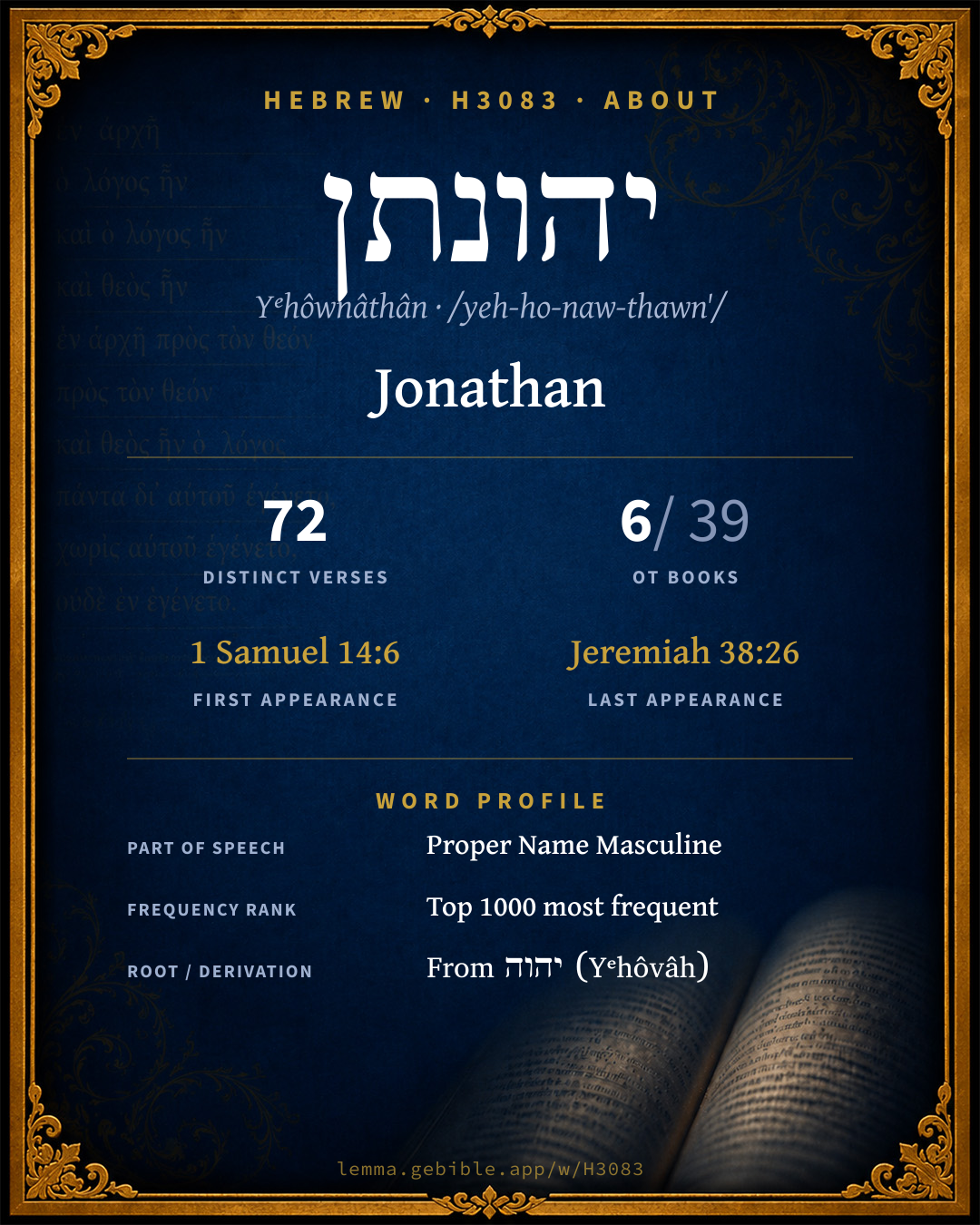
יְהוֹנָתָן
Jonathan
BDB lists 10 entries for ‘Jonathan’ fuller range ↓
Full lexicon entry — Brown-Driver-Briggs (BDB)
From Brown-Driver-Briggs (BDB)
Where this word appears
Grammar key — what these labels mean
Part of speech
- Noun
- A naming word — a person, place, thing, or idea.
Noun type
- Proper
- A name of a specific person, place, or people (e.g. Abraham, Zion, Israel).
Every verse where H3083 appears in the Book of 2 Samuel — 23 distinct verses. Click any verse to open its interlinear word-by-word view. Verse text shown in the World English Bible for context — . Each verse’s Hebrew form is shown with its reference; the English is not keyword-highlighted, since the data carries no word-level English alignment. Use “Compare translations” on any verse to read it across multiple English versions. This concordance covers the Hebrew Bible; Septuagint (Greek Old Testament) occurrences are not indexed here.
2 Samuel
- 2 Samuel 1:4 וִ/יהוֹנָתָ֥ן conj + n Proper David said to him, How went the matter? Please tell me. He answered, The people are fled from the battle, and many of the people also are fallen and dead; and Saul and Jonathan his son are dead also.
- 2 Samuel 1:5 וִ/יהֽוֹנָתָ֥ן conj + n Proper David said to the young man who told him, How know you that Saul and Jonathan his son are dead?
- 2 Samuel 1:12 יְהוֹנָתָ֣ן n Proper and they mourned, and wept, and fasted until even, for Saul, and for Jonathan his son, and for the people of Yahweh, and for the house of Israel; because they were fallen by the sword.
- 2 Samuel 1:17 יְהוֹנָתָ֥ן n Proper David lamented with this lamentation over Saul and over Jonathan his son
- 2 Samuel 1:22 יְה֣וֹנָתָ֔ן n Proper From the blood of the slain, from the fat of the mighty, The bow of Jonathan didn't turn back, The sword of Saul didn't return empty.
- 2 Samuel 1:23 וִ/יהוֹנָתָ֗ן conj + n Proper Saul and Jonathan were lovely and pleasant in their lives, In their death they were not divided: They were swifter than eagles, They were stronger than lions.
- 2 Samuel 1:25 יְה֣וֹנָתָ֔ן n Proper How are the mighty fallen in the midst of the battle! Jonathan is slain on your high places.
- 2 Samuel 1:26 יְה֣וֹנָתָ֔ן n Proper I am distressed for you, my brother Jonathan: Very pleasant have you been to me: Your love to me was wonderful, Passing the love of women.
- 2 Samuel 4:4 וְ/לִ/יהֽוֹנָתָן֙ וִ/יהֽוֹנָתָ֜ן conj + prep + n Proper conj + n Proper Now Jonathan, Saul's son, had a son who was lame of his feet. He was five years old when the news came of Saul and Jonathan out of Jezreel; and his nurse took him up, and fled: and it happened, as she made haste to flee, that he fell, and became lame. His name was Mephibosheth.
- 2 Samuel 9:1 יְהוֹנָתָֽן n Proper David said, Is there yet any who is left of the house of Saul, that I may show him kindness for Jonathan's sake?
- 2 Samuel 9:3 לִ/יהוֹנָתָ֖ן prep + n Proper The king said, Is there not yet any of the house of Saul, that I may show the kindness of God to him? Ziba said to the king, Jonathan has yet a son, who is lame of his feet.
- 2 Samuel 9:6 יְהוֹנָתָ֤ן n Proper Mephibosheth, the son of Jonathan, the son of Saul, came to David, and fell on his face, and did obeisance. David said, Mephibosheth. He answered, Behold, your servant!
- 2 Samuel 9:7 יְהוֹנָתָ֣ן n Proper David said to him, "Don't be afraid of him; for I will surely show you kindness for Jonathan your father's sake, and will restore you all the land of Saul your father; and you shall eat bread at my table continually."
- 2 Samuel 15:27 וִ/יהוֹנָתָ֧ן conj + n Proper The king said also to Zadok the priest, "Aren't you a seer? Return into the city in peace, and your two sons with you, Ahimaaz your son, and Jonathan the son of Abiathar.
- 2 Samuel 15:36 וִ/יהוֹנָתָ֖ן conj + n Proper Behold, they have there with them their two sons, Ahimaaz, Zadok's son, and Jonathan, Abiathar's son; and by them you shall send to me everything that you shall hear.
- 2 Samuel 17:17 וִ/יהוֹנָתָ֨ן conj + n Proper Now Jonathan and Ahimaaz were staying by En Rogel; and a maid-servant used to go and tell them; and they went and told king David: for they might not be seen to come into the city.
- 2 Samuel 17:20 וִ/יה֣וֹנָתָ֔ן conj + n Proper Absalom's servants came to the woman to the house; and they said, Where are Ahimaaz and Jonathan? The woman said to them, They have gone over the brook of water. When they had sought and could not find them, they returned to Jerusalem.
- 2 Samuel 21:7 יְהוֹנָתָ֣ן יְהוֹנָתָ֥ן n Proper n Proper But the king spared Mephibosheth, the son of Jonathan the son of Saul, because of Yahweh's oath that was between them, between David and Jonathan the son of Saul.
- 2 Samuel 21:12 יְהוֹנָתָ֣ן n Proper David went and took the bones of Saul and the bones of Jonathan his son from the men of Jabesh Gilead, who had stolen them from the street of Beth-shan, where the Philistines had hanged them, in the day that the Philistines killed Saul in Gilboa;
- 2 Samuel 21:13 יְהוֹנָתָ֣ן n Proper and he brought up from there the bones of Saul and the bones of Jonathan his son: and they gathered the bones of those who were hanged.
- 2 Samuel 21:14 וִ/יהוֹנָֽתָן conj + n Proper They buried the bones of Saul and Jonathan his son in the country of Benjamin in Zela, in the tomb of Kish his father: and they performed all that the king commanded. After that God was entreated for the land.
- 2 Samuel 21:21 יְה֣וֹנָתָ֔ן n Proper When he defied Israel, Jonathan the son of Shimei, David's brother, killed him.
- 2 Samuel 23:32 יְהוֹנָתָֽן n Proper Eliahba the Shaalbonite, the sons of Jashen, Jonathan,
About this entry
At a glance — auto-summarized from this page’s data, not written by a person. Every figure links to its source below. This summary describes the numbers; it doesn’t interpret them.
“Jonathan” is the headline sense of the Hebrew name יהונתן (Yᵉhôwnâthân). It clusters heavily in 1 Samuel, which alone accounts for 51% of its uses. With 72 verses in 6 books, it is a moderately common word in the Hebrew Bible. Scripture first uses it in 1 Samuel 14:6. The sections below give every occurrence and version rendering.
Gloss history
Strong's 1890 vs modern scholarship
About this word
Strong's H3083 catalogs a Hebrew word from the Hebrew Old Testament.
These counts are not copied from any lexicon or concordance. They are computed here, from the morphology-tagged Hebrew Old Testament. What Lemma adds →
- 72
- distinct verses
- The word appears in 72 distinct verses.
- 6 / 39
- OT books
- The word appears in 6 of 39 Old Testament books.
- #506
- by frequency
- Top 1000 most frequent Hebrew words (rank 506 of 8,640 Hebrew words by occurrence).
View all 72 occurrences in the concordance →
Most concentrated in
- 1 Samuel 37 verses 51%
- 2 Samuel 23 verses 32%
- 1 Chronicles 7 verses 10%
By section of the Old Testament
By traditional corpus
Conventional, traditional groupings — biblical authorship is debated, so this is a traditional corpus grouping, not an authorship claim. Each share is this word’s portion of its verses in that division of the Hebrew canon. Each figure is a share of the word’s 72 distinct verses.
- Prophets (Nevi'im) 63 verses · 88%
- Writings (Ketuvim) 9 verses · 13%
How translations render this word
Counts come from each version’s own published word-to-Strong’s tagging or interlinear alignment — an approximate guide to how each version renders this word, not a word-level alignment the data otherwise carries. Because each total is that version’s own tagged count, the per-version totals vary from one another and need not match the appearance or distinct-verse counts above. These counts may also differ from a printed concordance because Lemma counts each distinctly tagged rendering and does not collapse phrase taggings into a single head-word total. This is a fixed set of word-tagged versions (KJV, ASV, BSB, ULT) and does not change with the reading translation you choose elsewhere. Each version’s license is shown beside its name below (and on Sources).
- King James Version: Jonathan 69×, Jonathan's 3×, Jehonathan 2×
- American Standard Version: Jonathan 67×, Jehonathan 2×, Now jonathan 2×
- Berean Standard Bible: Jonathan 71×, He 2×, Jonathan’s 2×
- unfoldingWord Literal Text: Jonathan 71×, Jehonathan 2×
King James Version Public Domain
Renders H3083 across 82 tagged occurrences — most commonly:
Plus 8 renderings that appear only once — usually multi-word phrases or single function words the recovered tagging swept in, not distinct renderings.
American Standard Version Public Domain
Renders H3083 across 81 tagged occurrences — most commonly:
Plus 10 renderings that appear only once — usually multi-word phrases or single function words the recovered tagging swept in, not distinct renderings.
Berean Standard Bible Public Domain
Renders H3083 across 80 tagged occurrences — most commonly:
Plus 5 renderings that appear only once — usually multi-word phrases or single function words the recovered tagging swept in, not distinct renderings. Not rendered by a distinct English word in 2 further occurrences.
unfoldingWord Literal Text CC BY-SA 4.0
Renders H3083 across 77 tagged occurrences — most commonly:
Plus 4 renderings that appear only once — usually multi-word phrases or single function words the recovered tagging swept in, not distinct renderings.
18 senses and sub-senses in the full BDB
What do BDB’s symbols mean?
BDB uses these scholarly abbreviations:
| Symbol | Meaning |
|---|---|
| 𝔊 | the Septuagint (the ancient Greek translation, LXX) |
| 𝔙 | the Vulgate (the Latin translation) |
| 𝔖 | the Syriac version (the Peshitta) |
| 𝔗 | the Targum (the Aramaic translation) |
| ψ | the Psalms |
| √ | root (the underlying root or stem) |
| ‖ | parallel passage (a synonymous or contrasted parallel) |
| † | the dagger: every passage where the word occurs is cited |
The 18 senses and sub-senses the full Brown-Driver-Briggs lexicon distinguishes for this word, in lexicon order (not ranked by frequency), with BDB’s own verbatim wording and sub-sense lettering. Shown in Hebrew script with BDB’s own scholarly abbreviations. The condensed entry is in the Lexicon Entry tab. See also the Forms in the corpus table below.
- 1. יְהוֹ׳ son of Saul 1 S 14:6, 8; 18:1(×2) + 40 times 1 S; 2 S 1:4 + 18 times 2 S; 1 Ch 8:33, 34; 9:39, 40; = יוֹ׳ 1 S 13:2, 3 + 27 times 1 S, 1 Ch 10:2. e.g. 1 Samuel 14:6
- 2. יְהוֹ׳ son of Abiathar 2 S 15:27, 36; 17:17, 20; = יוֹ׳ 1 K 1:42, 43. e.g. 2 Samuel 15:27
- 3. יְהוֹ׳ nephew of David 2 S 21:21 = 1 Ch 20:7; appar. called Jonadab 2 S 13:3 ff. where 𝔊L Ἰωναθαν, cf. יהונדב 2. e.g. 2 Samuel 21:21
- 4. יְהוֹ׳; דּוֹד of David, i.e. his uncle? 1 Ch 27:32. e.g. 1 Chronicles 27:32
- 5. יְהוֹ׳ one of David’s heroes 2 S 23:32 (cf. Dr) = יוֹנָתָן 1 Ch 11:34. e.g. 2 Samuel 23:32
- 6. יְהוֹ׳ one of David’s treasurers 1 Ch 27:25. e.g. 1 Chronicles 27:25
- 7. יְהוֹ׳ a scribe Je 37:15, 20; 38:26. e.g. Jeremiah 37:15
- 8. Levites
- a. יְהוֹ׳ 2 Ch 17:8; e.g. 2 Chronicles 17:8
- b. יוֹ׳ Ne 12:35. e.g. Nehemiah 12:35
- 9. יְהוֹ׳ a priest Ne 12:18. e.g. Nehemiah 12:18
- 10. יְהוֹ׳ priest to the tribe of Dan, son of Gershom Ju 18:30. e.g. Judges 18:30
- 11. יוֹ׳ a Judaite captain, after fall of Jerus. Je 40:8. e.g. Jeremiah 40:8
- 12. יוֹ׳ a Judaite 1 Ch 2:32, 33. e.g. 1 Chronicles 2:32
- 13. יוֹ׳ father of Ebed Ezr 8:6. e.g. Ezra 8:6
- 14. יוֹ׳ son of Asahel Ezr 10:15. e.g. Ezra 10:15
- 15. יוֹ׳ a priest Ne 12:14. e.g. Nehemiah 12:14
- 16. יוֹ׳ son of Joiada Ne 12:11(×2) appar. = יְהוֹחָנָן 2. e.g. Nehemiah 12:11
Senses from the full Brown-Driver-Briggs lexicon (Brown, Driver, Briggs; Oxford 1906 — public domain), digitized via Sefaria, supplemented by the OpenScriptures HebrewLexicon (CC BY 4.0). Full attribution on Sources.
Word origin
יְהוֹנָתָן, יוֹנָתָן n.pr.m. 𝔊 Ἰωναθαν throughout, with occasional var. (י׳ hath given; cf. אֶלְנָתָן, נְתַנְיָהוּ, נְתַנְאֵל, & reff., Temanite רמננתן HalRÉJ 1884, ix. 7 f. NbrStud. Bib. i. 211; Sab. והבאום Hal 10)—
— Brown-Driver-Briggs (Oxford 1906, public domain), digitized via Sefaria, supplemented by the OpenScriptures HebrewLexicon (CC BY 4.0). See Sources.
Derived from יהוה (Yᵉhôvâh) (H3068) — LORD.
Jastrow Dictionary
A second Hebrew/Aramaic lexicon for comparison, covering Aramaic and post-biblical (Talmudic, Targumic, Midrashic) usage that the biblical-Hebrew BDB does not. Matched by lemma rather than by Strong’s number, so a lemma may carry more than one Jastrow headword (shown separately below), and the entries cover usage well beyond the Bible.
יְהוֹנָתָן
- , v. יוֹנָתָן
יוֹנָתָן
- (b. h.) pr. n. m. Jonathan,
- 1. J. b. Gershom (Jud. XVIII, 30), a priest of idolatry, supposed to be a descendant of Moses. B. Bath. 109ᵇ יו׳ Ms. M. (ed. יהו׳). Cant. R. to II, 5; Ab. d’R. N. ch. XXXIV; Y. Ber. IX, 13ᵈ top; a. e. e.g. Judges 18:30
- 2. J. son of Saul. Ab. V, 16 אהבת דוד וי׳ the friendship between David and J. Ḥull. 95ᵇ כי׳ בן וכ׳ like the omen of J. &c. (1 Sam. XIV, 8 sq.). Cant. R. to VIII, 6; a. e.
- 3. J. b. Uziel, author of the Chaldaic version of the Prophets (v. Zunz, Gottesd. Vortr. p. 66, sq.). Succ. 28ᵃ; B. Bath. 134ᵃ. Meg. 3ᵃ תרגיס של נכיאים י׳ וכ׳ the version of the Prophets has been composed by J. b. U. at the dictation of Haggai &c. Y. Ned. V, end, 39ᵇ גדול שבהן י׳ ב׳ ע׳ the greatest among the disciples of R. Joh. b. Zaccai, was J. &c.
- 4. R. J., a Tannai. Sot. 24ᵃ. Pes. 24ᵃ. Ḥull. 70ᵇ; a. v. fr.—[Erub. 96ᵃ י׳ הקיטוני.]—[Ab. IV, 9, v. Frank. Darkhé, p. 147, note.]
- 5. name of several Amoraim (v. Fr. M’bo, p. 99ᵃ, sq.). Gitt. 78ᵇ. Y. Maas. Sh. III, 54ᵇ top. Ber. 18ᵃ; Y. ib. II, 4ᶜ bot.; a. fr.—Y. Yoma VII, 44ᵇ bot. R. J. of Beth Gubrin.—Y. Peah V, beg. 18ᵈ (R. S. to Peah V, 1 quotes R. Johanan); Y. Shek. I, 46ᵃ bot. R. J. son of R. Isaac bar Aḥa.—Y. Ter. XI, end, 48ᵇ J. b. ʿAkhmai; a. e.
A Dictionary of the Targumim, the Talmud Babli and Yerushalmi, and the Midrashic Literature (Marcus Jastrow; London, Luzac, 1903) — Public Domain. Digitized via Sefaria. Digitized via Sefaria. Full attribution on Sources.
Forms in the corpus
The 28 distinct written forms H3083 takes in the Hebrew Bible, most frequent first — each parse links to that state’s occurrences in the concordance. Hebrew forms include their vowel points and cantillation, so a single lemma takes many written forms.
| Form | Parsing | Example | Uses |
|---|---|---|---|
| יְה֣וֹנָתָ֔ן | Noun, Proper | 1 Chronicles 20:7 | 12 |
| יְהוֹנָתָ֖ן | Noun, Proper | 1 Chronicles 8:34 | 11 |
| יְהוֹנָתָ֣ן | Noun, Proper | 1 Samuel 20:27 | 9 |
| יְהֽוֹנָתָן֙ | Noun, Proper | 1 Chronicles 8:33 | 8 |
| וִ/יהוֹנָתָ֖ן | Noun, Proper | 1 Samuel 20:42 | 3 |
| יְהוֹנָתָ֗ן | Noun, Proper | 1 Samuel 18:4 | 3 |
| יְהוֹנָתָ֛ן | Noun, Proper | 1 Samuel 18:3 | 3 |
| יְהוֹנָתָ֜ן | Noun, Proper | 1 Samuel 14:6 | 3 |
| יְהוֹנָתָ֤ן | Noun, Proper | 1 Samuel 19:4 | 3 |
| יְהוֹנָתָֽן | Noun, Proper | 2 Samuel 9:1 | 3 |
| יְהוֹנָתָ֑ן | Noun, Proper | 1 Samuel 19:6 | 2 |
| יְהוֹנָתָ֥ן | Noun, Proper | 2 Samuel 1:17 | 2 |
| יְהוֹנָתָן֙ | Noun, Proper | 1 Samuel 19:2 | 2 |
| בִּ/יה֣וֹנָתָ֔ן | Noun, Proper | 1 Samuel 20:30 | 1 |
| וְ/לִ/יהֽוֹנָתָן֙ | Noun, Proper | 2 Samuel 4:4 | 1 |
| וִ/יה֣וֹנָתָ֔ן | Noun, Proper | 2 Samuel 17:20 | 1 |
| וִ/יהֽוֹנָתָ֜ן | Noun, Proper | 2 Samuel 4:4 | 1 |
| וִ/יהֽוֹנָתָ֥ן | Noun, Proper | 2 Samuel 1:5 | 1 |
| וִ/יהוֹנָֽתָן | Noun, Proper | 2 Samuel 21:14 | 1 |
| וִ/יהוֹנָתָ֗ן | Noun, Proper | 2 Samuel 1:23 | 1 |
| וִ/יהוֹנָתָ֥ן | Noun, Proper | 2 Samuel 1:4 | 1 |
| וִ/יהוֹנָתָ֧ן | Noun, Proper | 2 Samuel 15:27 | 1 |
| וִ/יהוֹנָתָ֨ן | Noun, Proper | 2 Samuel 17:17 | 1 |
| וִֽ/יהוֹנָתָ֤ן | Noun, Proper | 1 Chronicles 27:32 | 1 |
| וִֽ/יהוֹנָתָן֩ | Noun, Proper | 2 Chronicles 17:8 | 1 |
| יְהוֹנָתָ֧ן | Noun, Proper | 1 Samuel 31:2 | 1 |
| לִ/יהוֹנָתָ֖ן | Noun, Proper | 2 Samuel 9:3 | 1 |
| לִֽ/יהוֹנָתָ֜ן | Noun, Proper | 1 Samuel 20:13 | 1 |
Same root — word family
Other BDB entries built from the same root as H3083, grouped by Strong’s listed origin. These share a root / origin per the lexicon — not necessarily a shared meaning. Each links to that word’s own entry.
Derives from
Proper names from this root
People and places named from this root — a name, not an additional meaning of the word.
- הושמע Hôwshâmâʻ H1953 Hoshama
- יה Yâhh H3050 Jah
- יהוא Yêhûwʼ H3058 Jehu
- יהואחז Yᵉhôwʼâchâz H3059 Jehoahaz
- יהואש Yᵉhôwʼâsh H3060 Jehoash
- יהוה Yᵉhôvih H3069 LORD
- יהוה יראה Yᵉhôvâh yirʼeh H3070 Jehovah-jireh
- יהוה נסי Yᵉhôvâh niççîy H3071 Jehovah-nissi
- יהוה צדקנו Yᵉhôvâh tsidqênûw H3072 a sacred name symbolically applied to
- יהוה שלום Yᵉhôvâh shâlôwm H3073 Jehovah-shalom
- יהוה שמה Yᵉhôvâh shâmmâh H3074 Jehovahshammah
- יהוזבד Yᵉhôwzâbâd H3075 Jehozabad
- יהוחנן Yᵉhôwchânân H3076 Jehohanan
- יהוידע Yᵉhôwyâdâʻ H3077 Jehoiada
- יהויכין Yᵉhôwyâkîyn H3078 Jehoiachin
- יהויקים Yᵉhôwyâqîym H3079 Jehoiakim
- יהויריב Yᵉhôwyârîyb H3080 Jehoiarib
- יהונדב Yᵉhôwnâdâb H3082 Jehonadab
- יהועדה Yᵉhôwʻaddâh H3085 Jehoadah
- יהועדין Yᵉhôwʻaddîyn H3086 Jehoaddan
- יהוצדק Yᵉhôwtsâdâq H3087 Jehozadak
- יהורם Yᵉhôwrâm H3088 Jehoram
- יהושבע Yᵉhôwshebaʻ H3089 Jehosheba
- יהושוע Yᵉhôwshûwaʻ H3091 Joshua
- יונתן Yôwnâthân H3129 Jonathan
+11 more proper names from this root (not shown).
Compare all same-root words → Showing 4 of 38 — not the complete family. 37 of the same-root words are proper names (people or places). They share a root, not necessarily a meaning.
Bible dictionary
Public-domain dictionary articles matched to this entry by name (Jonathan). A biblical name can be shared by more than one person or place, so an article may treat several.
Easton's Bible Dictionary · M. G. Easton, 1897
Whom Jehovah gave, the name of fifteen or more persons that are mentioned in Scripture. The chief of these are, (1.) A Levite descended from Gershom (Judg. 18:30). His history is recorded in 17:7-13 and 18:30. The Rabbins changed this name into Manasseh "to screen the memory of the great lawgiver from the stain of having so unworthy an apostate among his near descendants." He became priest of the idol image at Dan, and this office continued in his family till the Captivity.
(2.) The eldest son of king Saul, and the bosom friend of David. He is first mentioned when he was about thirty years of age, some time after his father's accession to the throne (1 Sam. 13:2). Like his father, he was a man of great strength and activity (2 Sam. 1:23), and excelled in archery and slinging (1 Chr. 12:2;2 Sam. 1:22). The affection that evidently subsisted between him and his father was interrupted by the growth of Saul's insanity. At length, "in fierce anger," he left his father's presence and cast in his lot with the cause of David (1 Sam. 20:34). After an eventful career, interwoven to a great extent with that of David, he fell, along with his father and his two brothers, on the fatal field of Gilboa (1 Sam. 31:2, 8). He was first buried at Jabesh-gilead, but his remains were afterwards removed with those of his father to Zelah, in Benjamin (2 Sam. 21:12-14). His death was the occasion of David's famous elegy of "the Song of the Bow" (2 Sam. 1:17-27). He left one son five years old, Merib-baal, or Mephibosheth (2 Sam. 4:4; comp. 1 Chr. 8:34).
(3.) Son of the high priest Abiathar, and one who adhered to David at the time of Absalom's rebellion (2 Sam. 15:27, 36). He is the last descendant of Eli of whom there is any record.
(4.) Son of Shammah, and David's nephew, and also one of his chief warriors (2 Sam. 21:21). He slew a giant in Gath.
Smith's Bible Dictionary · William Smith, 1863
that is, "the gift of Jehovah, " the eldest son of King Saul. (B.C. about 1095-1056.) He was a man of great strength and activity. (2 Samuel 1:23) He was also famous as a warrior, (1 Chronicles 12:2) as is shown by the courage he showing in attacking the garrison of the Philistines, in company with is armor-bearer only, slaying twenty men and putting an army to flight. (1 Samuel 14:6-16) During the pursuit, Jonathan, who had not heard of the rash curse, ch. (1 Samuel 14:24) which Saul invoked on any one who ate before the evening, tasted the honey which lay on the ground. Saul would have sacrificed him; but the people interposed in behalf of the hero of that great day, and Jonathan was saved. ch. (1 Samuel 14:24-45) The chief interest of Jonathan's career is derived from the friendship with David, which began on the day of David's return from the victory over the champion of Gath, and continued till his death. Their last meeting was in and forest of Ziph, during Saul's pursuit of David. (1 Samuel 23:16-18) From this time forth we hear no more till the battle of Gilboa. In that battle he fell. (1 Samuel 31:2,8) (B.C. 1056.) his ashes were buried first at Jabesh-gilead, ch. (1 Samuel 31:13) but were afterward removed with those of his father to Zelah in Benjamin. (2 Samuel 21:12) The news of his death occasioned the celebrated elegy of David. He left a son, Mephibosheth. [Mephibosheth]
+ A nephew of David. (2 Samuel 21:21; 1 Chronicles 20:7) He engaged in single combat with and slew a gigantic Philistine of Gath. (2 Samuel 21:21) (B.C. 1018.) + The son of Abiathar, the high priest, is the last descendant of Eli of whom we hear anything. (2 Samuel 15:36; 17:15-21; 1 Kings 1:42,43) (B.C. 1023.) + One of David's heroes. (2 Samuel 23:32; 1 Chronicles 11:34) + The son or descendant of Gershom the son of Moses. (Judges 18:30) [Micah] (B.C. about 1425.) + One of the Bene-Adin. (Ezra 8:6) + A priest, the son of Asahel, in the time of Ezra. (Ezra 10:15) (B.C. 459.) + A priest of the family of Melieu. (Nehemiah 12:14) + One of the sons of Kareah, and brother of Johanan. (Jeremiah 40:8) (B.C. 587.) + Son of Joiada, and his successor in the high priesthood. (Nehemiah 12:11,22,23) (B.C. before 332.) + Father of Zechariah, a priest who blew the trumpet at the dedication of the wall. (Nehemiah 12:35) + 1 Esdr. 8:32. [See No. 6] (B.C. 446.)
Hitchcock's Bible Names Dictionary · Roswell D. Hitchcock, 1869
given of God
Classic public-domain reference works; full attribution on Sources.
Septuagint verse parallels
This word appears in 70 verses that also exist in the Greek Old Testament (Septuagint), out of the 72 Hebrew verses it occurs in. You can read those verses in Greek by switching the Old Testament edition to the Septuagint.
Read these verses in the Septuagint
This is a verse-level parallel only — the same verses exist in both the Hebrew and Greek Old Testaments. No word-level Hebrew↔Greek correspondence is claimed: the data carries no such alignment, so no Greek word is shown as this Hebrew word’s translation. Coverage is not total — the Septuagint omits the deuterocanon and renumbers the Psalms, so some Hebrew verses have no direct Greek parallel.