
Nehemiah 12:11

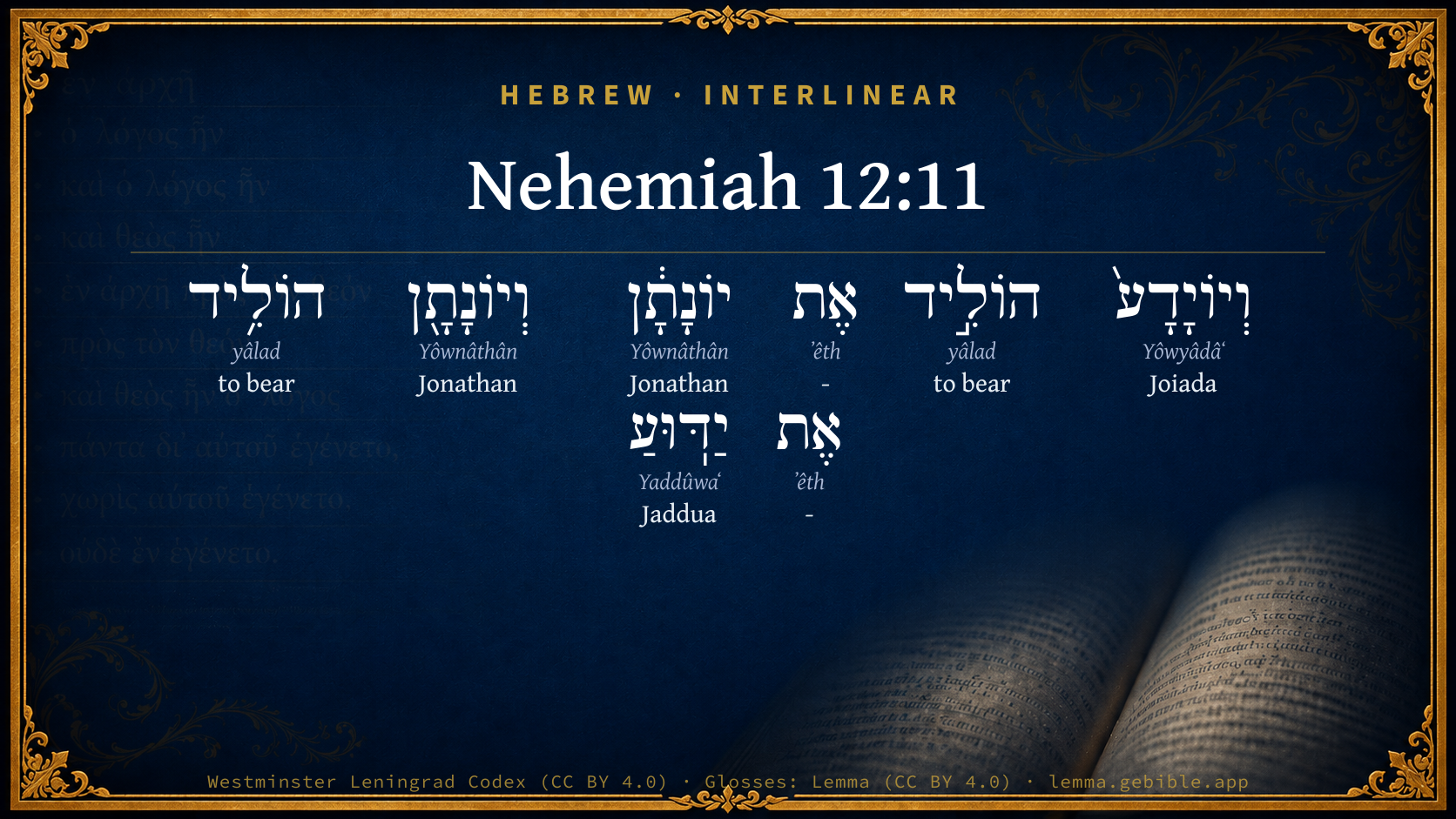
Hebrew (Westminster Leningrad Codex) Nehemiah 12:11 appears in the Hebrew Old Testament. The text above is from the Westminster Leningrad Codex. Each word links to its Strong’s number, a concise gloss, and parsing drawn from the Open Scriptures Hebrew Bible morphology. Click any word for its full Brown-Driver-Briggs (BDB) entry.
Download image
Cite this verse

Nehemiah 12:11 (World English Bible). Public Domain. Lemma interlinear Bible study tool, https://lemma.gebible.app/v/nehemiah/12/11.

Show BibTeX & RIS
BibTeX
RIS
English Translation
and Joiada became the father of Jonathan, and Jonathan became the father of Jaddua.
World English Bible · Public Domain
Download a study sheet

One document with this verse’s original text, its word-by-word gloss line, the meaning frame, cross-references with their text, attributed commentary, and full source and license credits — printable, and it pastes into notes with its structure intact.

This verse Autodidact and up

Study sheet (.html) Plain text (.txt)

A passage Seminary Student

Up to 50 verses in one chapter. A passage sheet keeps up to 6 commentary sources and 12 cross-references per verse, in the order this page ranks them, and says so on the sheet whenever that leaves anything out. Ask for a single verse and you get the Autodidact verse sheet above.

Everything on this page stays free to read, with no account — the sheet is a download of what is already on screen, not access to it.

Want to remove ads? Support Godless Engineer
Compare translations 3

The same verse in 3 English versions, stacked beneath the original-language interlinear above. Click any original word for its lexicon entry.

Each is an independent rendering of the whole verse — the interlinear is not word-aligned to these translations.

Highlighted words mark where these versions differ — a whole-verse word diff, not a word-by-word alignment.

  • World English Bible Public Domain
    and Joiada became the father of Jonathan, and Jonathan became the father of Jaddua.
  • King James Version Public Domain
    And Joiada begat Jonathan, and Jonathan begat Jaddua.
  • unfoldingWord Literal Text CC BY-SA 4.0
    and Joiada fathered Jonathan; and Jonathan fathered Jaddua.

unfoldingWord Literal Text — © unfoldingWord, licensed CC BY-SA 4.0. Word-aligned USFM3 via Door43 (git.door43.org/unfoldingWord/en_ult).

Versions to compare (up to 4)

3 of 4 selected

Show all 18 translations

Every available English version of this verse, each an independent rendering of the whole verse.

  • World English Bible Public Domain
    and Joiada became the father of Jonathan, and Jonathan became the father of Jaddua.
  • Berean Standard Bible Public Domain
    Joiada was the father of Jonathan, and Jonathan was the father of Jaddua.
  • Majority Standard Bible Public Domain
    Joiada was the father of Jonathan, and Jonathan was the father of Jaddua.
  • King James Version Public Domain
    And Joiada begat Jonathan, and Jonathan begat Jaddua.
  • American Standard Version (1901) Public Domain
    and Joiada begat Jonathan, and Jonathan begat Jaddua.
  • Revised Version (1885) Public Domain
    and Joiada begat Jonathan, and Jonathan begat Jaddua.
  • Geneva Bible (1599) Public Domain
    And Ioiada begate Ionathan, and Ionathan begate Iaddua,
  • Douay-Rheims (1899) Public Domain
    And Joiada beget Jonathan, and Jonathan beget Jeddoa.
  • Young's Literal Translation Public Domain
    and Joiada hath begotten Jonathan, and Jonathan hath begotten Jaddua.
  • Literal Standard Version CC BY-SA 4.0
    and Joiada has begotten Jonathan, and Jonathan has begotten Jaddua.
  • Unlocked Literal Bible CC BY-SA 4.0
    Joiada was the father of Jonathan, and Jonathan was the father of Jaddua.
  • unfoldingWord Literal Text CC BY-SA 4.0
    and Joiada fathered Jonathan; and Jonathan fathered Jaddua.
  • Darby Bible Public Domain
    and Joiada begot Jonathan, and Jonathan begot Jaddua.
  • World Messianic Bible Public Domain
    and Joiada became the father of Jonathan, and Jonathan became the father of Jaddua.
  • Webster's Bible Public Domain
    And Joiada begat Jonathan, and Jonathan begat Jaddua.
  • Free Bible Version CC BY-SA 4.0
    who was the father of Jonathan, who was the father of Jaddua.
  • Bible in Basic English Public Domain
    And Joiada was the father of Jonathan, and Jonathan was the father of Jaddua.
  • JPS Tanakh (1917) Public Domain
    and Joiada begot Jonathan and Jonathan begot Jaddua.

Literal Standard Version (2020), Covenant Press — licensed CC BY-SA 4.0. Text via the HelloAO Bible API (eBible.org). Unlocked Literal Bible (unfoldingWord) — licensed CC BY-SA 4.0. Text via the HelloAO Bible API (eBible.org). unfoldingWord Literal Text — © unfoldingWord, licensed CC BY-SA 4.0. Word-aligned USFM3 via Door43 (git.door43.org/unfoldingWord/en_ult). Free Bible Version, Dr. Jonathan Gallagher — licensed CC BY-SA 4.0. Text via the HelloAO Bible API (eBible.org).

Word by word

More ways to search: Search by grammar → Find every occurrence → Compare this word →

Practice this passage: Drill this verse → Learn its vocabulary →

About this verse

These counts appear in no published source. They are computed here, from the morphology-tagged text and Lemma’s own curated glosses. What Lemma adds →

8
words
5
distinct lemmas
Historical
section

Notable vocabulary

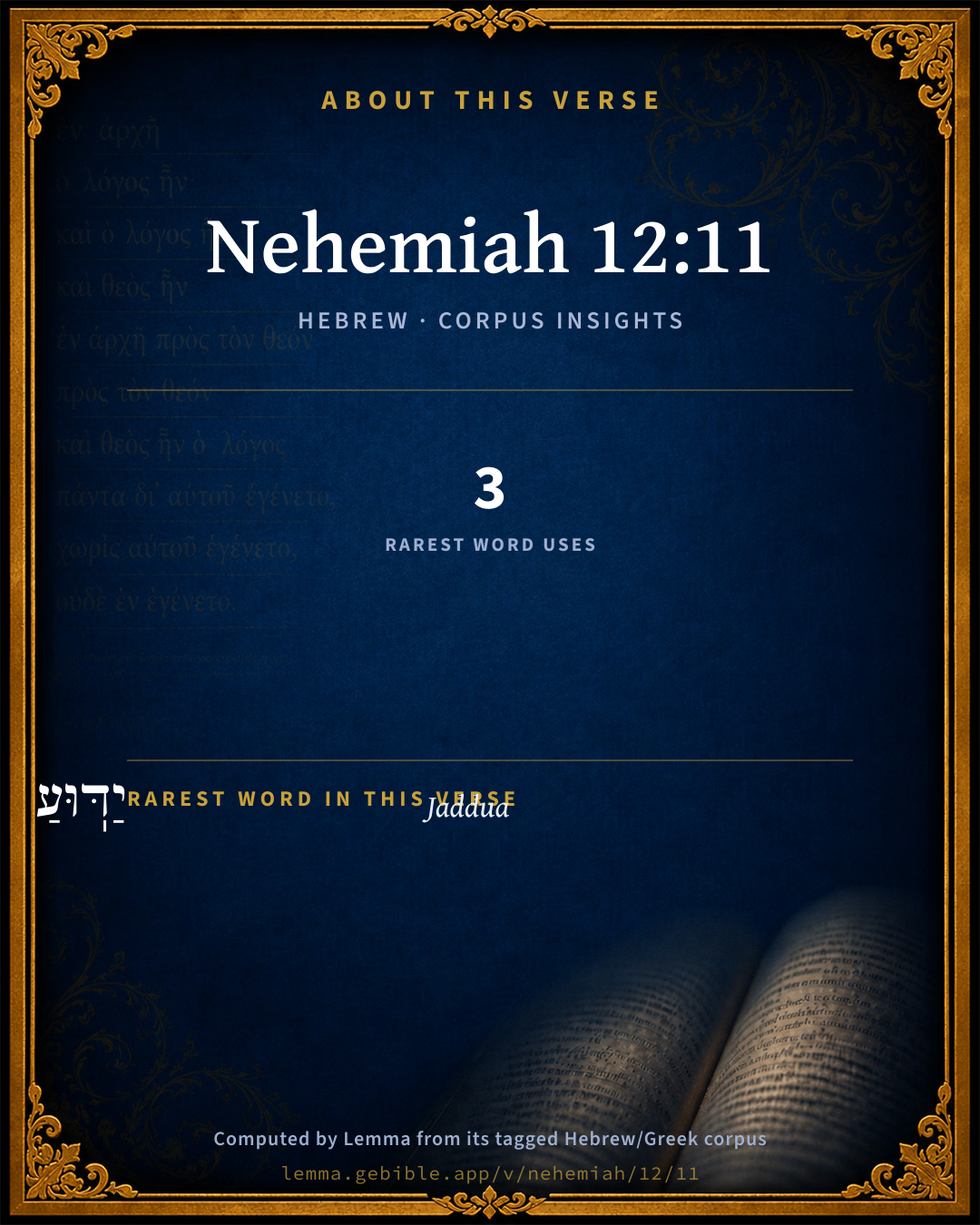
The rarest word here is יַדּֽוּעַ Jaddua H3037 — appearing just 3 times in the whole Hebrew Bible.

Shared distinctive vocabulary

יַדּֽוּעַ Jaddua H3037 occurs in 3 verses of the Hebrew Bible. Also found in:

Grammatical profile

  • 2 verbs
  • 4 nouns
  • 2 particles

Verb forms

  • הוֹלִ֣יד Hiphil · Perfect
  • הוֹלִ֥יד Hiphil · Perfect

Repetition

Words recur within this verse — often emphatic in Hebrew:

  • הוֹלִ֣יד to bear H3205 ×2
  • יוֹנָתָ֔ן Jonathan H3129 ×2
Hebrew and Greek witnesses Masoretic Hebrew ↔ Greek Septuagint

The same verse in the two great witnesses to the Old Testament, shown verse-for-verse.

These are two independent witnesses, not word-aligned to each other, and the Septuagint is shown in lemma (dictionary) form.

Hebrew Nehemiah 12:11 Masoretic · Westminster Leningrad Codex

וְיוֹיָדָע֙ הוֹלִ֣יד אֶת יוֹנָתָ֔ן וְיוֹנָתָ֖ן הוֹלִ֥יד אֶת יַדּֽוּעַ

and Joiada became the father of Jonathan, and Jonathan became the father of Jaddua.

World English Bible · Public Domain

Greek LXX Structure differs

The Septuagint has no separate book of Nehemiah. Its Greek text is the second half of Esdras B (2 Esdras), chapters 11–23; Ezra is the first half (1–10).

A verse-for-verse comparison isn’t shown here because the chapters and verses don’t line up. Switch to the LXX edition with the MT / LXX toggle above to read the Greek directly.

Hebrew: Westminster Leningrad Codex (CC BY 4.0). Greek: Septuagint (public domain); English from a public-domain English Septuagint. How the Septuagint differs from the Hebrew →

Commentary

Notes on Nehemiah 12:11 from classic Christian and Jewish commentators (each source and its license shown beneath its notes). The classic Christian expositions comment on the surrounding passage and are grouped to its opening verse, so a note may address several verses; the Jewish commentaries on the Tanakh (Rashi and others) are per-verse, so they appear only where the commentator wrote on this verse.

Lemma curates 59 commentaries, every one of them public domain or Creative Commons licensed, each selected and text-cleaned for this edition rather than reprinted as found. About our sources →

Trapp's Complete Commentary

John Trapp

Neh 12:11 And Joiada begat Jonathan, and Jonathan begat Jaddua.

Ver. 11. And Jonathan begat Jaddua] Who was high priest in Alexander the Great’s time; and meeting him, in his formalities, prevailed with him to spare the city of Jerusalem, and to confirm the privileges thereof, as Josephus reports.

John Trapp, A Commentary or Exposition upon All the Books of the Old and New Testament (1647–1656) — public domain. Text from a community e-Sword module.

Jamieson, Fausset & Brown

Robert Jamieson, A. R. Fausset & David Brown

Jaddua--It is an opinion entertained by many commentators that this person was the high priest whose dignified appearance, solemn manner, and splendid costume overawed and interested so strongly the proud mind of Alexander the Great; and if he were not this person (as some object that this Jaddua was not in office till a considerable period after the death of Nehemiah), it might probably be his father, called by the same name.

Jamieson, Fausset & Brown — Commentary Critical and Explanatory on the Whole Bible (1871) — public domain (CC PDM 1.0). Text via the HelloAO Bible API.

Ellicott's Commentary for English Readers

(11) Jonathan.—Should be Johanan (Neh_12:22); and “Jaddua” is most probably the high priest who confronted Alexander the Great.

A Bible Commentary for English Readers, edited by Charles John Ellicott (1878–1897) — public domain. Text from a community e-Sword module.

Haydock's Catholic Bible Commentary

Jonathan, is called Johanan by St. Jerome, (in Daniel) Josephus, &c. --- Jeddoa. The Jaddus, who went to meet Alexander, in his pontifical attire, and was graciously received by him; as the monarch revered in his person the God of the Hebrews, who had formerly appeared to him in this manner, to encourage him to undertake the conquests of Asia. (Josephus, [Antiquities?] xi. 8.) --- Some think that the names of Jonathan and Jeddoa, and the ver. 22, 23, and 24, have been inserted since the time of Nehemias; as he must have lived 140 years, to see the conquests of Alexander. (Tirinus; Petau; N. Alex. T. 2 Dis. 7.) --- He could not be less than 20, when he returned in [the year of the world] 3550. Jaddus met Alexander in 3672; consequently, at that time, Nehemias was 142 years old. But if he died at the commencement of the reign of Darius Codomannus 3668, he would still be 138. (Calmet) --- Yet this longevity is by no means incredible, ver. 1., and chap. xiii. 28. (Haydock) --- Usher (the year of the world 3602) maintains that Johanan was pontiff under Memnon.

George Leo Haydock (1774–1849), Haydock's Catholic Family Bible and Commentary, 1859 edition — public domain. Excludes Psalms (Douay-Rheims chapter numbering differs from Protestant) and Deuterocanonical books (Catholic canon only).

Matthew Poole's English Annotations

Generally supposed to be the same man who was high priest in the days of Alexander the Great, as Josephus mentions; whence a great difficulty ariseth, how Nehemiah could mention this man, who seems not to have been high priest till many years after Nehemiah’s death. But it seems not necessary that this

Jaddua should be the same person, for he might be the father of that Jaddua, both being called by the same name; or, if he were the same, the blessing of a very long life might be given to this great and excellent governor, as it was to Ezra, that famous scribe, as was noted on Neh 12:1, and that for the very same reason. He might also live to see Jaddua, though not to see him high priest, which might be many years after. Or this passage might be put into this book by some sacred or inspired penman, there being some, though but few, such passages in the foregoing books of Scripture, which were added by succeeding men of God in after-times.

Matthew Poole's English Annotations on the Holy Bible (1683–1685) — public domain. Text from a community e-Sword/MySword module.

The Pulpit Commentary

Jonathan, or "Johanan," as the name is given in vers. 22, 23, became high priest about B.C. 380, according to Syncellus and the Paschal Chronicle, and held the office for thirty-two years. Josephus, who calls him "Jannseus" (=John), says that he murdered his own brother, Jeshua, in the temple, because he was endeavouring to supplant him in the high priesthood through the influence of the Persians. Jaddua is mentioned as high priest at the time of Alexander"s entrance into Jerusalem by Josephus ("Ant. Jud:," 11:8, and Eusebius ("Chron. Can.," 2. p. 346). The story of Alexander"s having previously seen him in a dream is not generally credited. He is said to been high priest for twenty years, and to have outlived Alexander.

The Pulpit Commentary (1880–1919), ed. H.D.M. Spence-Jones & Joseph S. Exell — public domain. Text from a community e-Sword module.

Lesson kit

Teaching starters — assembled from the data on this page, not authored interpretation. Every prompt links to the verse data it draws on. Edit before teaching.

Nehemiah, in the Historical, opens this verse with 8 words (5 distinct Hebrew lemmas). Its most distinctive word is Yaddûwaʻ (“Jaddua”). A historical commentator’s framing appears above. Read the whole chapter for the surrounding context.

Discussion questions

  1. The word Yaddûwaʻ carries the sense “Jaddua.” How does it shape the verse?
  2. Nehemiah 10:21 shares the word «Jaddua» with this verse. How do the two illuminate each other?
  3. “to bear” occurs 2× in this one verse. What is the effect of the repetition?
  4. These translations render this verse differently; the difference is in the English rendering, not the original. What questions does that raise?
  5. The verb «הוֹלִ֣יד» is Hiphil Perfect. How does its form color the action?
  6. Reading how Trapp's Complete Commentary and Jamieson, Fausset & Brown read this verse, where do the two commentators agree and where do they part?

Things to notice

  • These translations choose different wording for 4 words in this verse.
  • “to bear” occurs 2× in this single verse.
  • 5 distinct Hebrew lemmas span 8 words in this verse.

Reading settings

Reading text

Shown beneath each verse's original-language words.

Old Testament
Old Testament edition

Read the OT as the Masoretic Hebrew (MT) or the Greek Septuagint (LXX).

English shown for the Greek Septuagint (in the Hebrew ↔ Greek comparison).

Comparing translations? Open the Compare panel on any verse page to stack up to four side by side.