
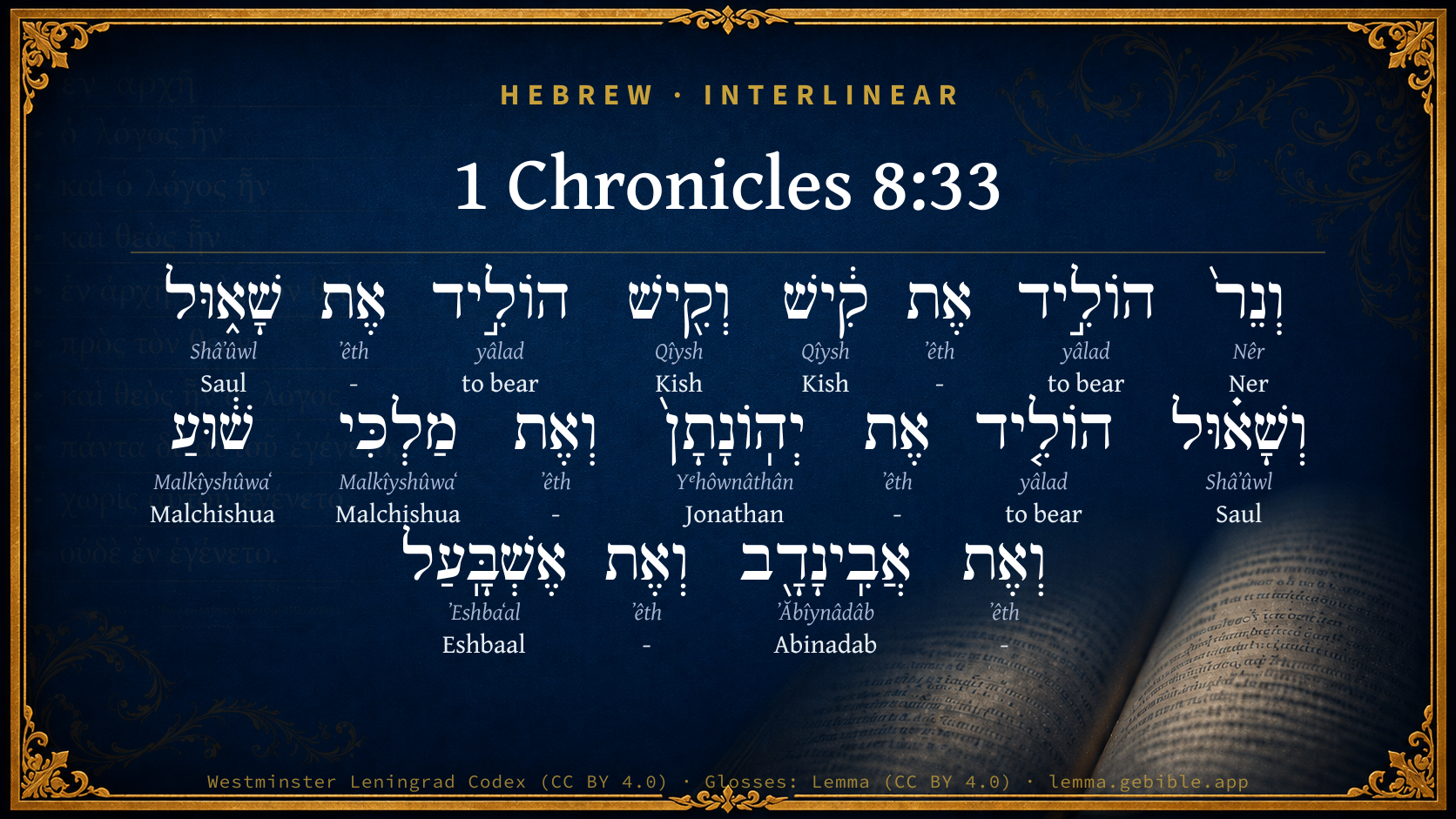
1 Chronicles 8:33

Hebrew (Westminster Leningrad Codex) 1 Chronicles 8:33 appears in the Hebrew Old Testament. The text above is from the Westminster Leningrad Codex. Each word links to its Strong’s number, a concise gloss, and parsing drawn from the Open Scriptures Hebrew Bible morphology. Click any word for its full Brown-Driver-Briggs (BDB) entry.
Download image
Cite this verse

1 Chronicles 8:33 (World English Bible). Public Domain. Lemma interlinear Bible study tool, https://lemma.gebible.app/v/1-chronicles/8/33.

Show BibTeX & RIS
BibTeX
RIS
English Translation
Ner became the father of Kish; and Kish became the father of Saul; and Saul became the father of Jonathan, and Malchishua, and Abinadab, and Eshbaal.
World English Bible · Public Domain
Highlights Full analysis ↓
Download a study sheet

One document with this verse’s original text, its word-by-word gloss line, the meaning frame, cross-references with their text, attributed commentary, and full source and license credits — printable, and it pastes into notes with its structure intact.

This verse Autodidact and up

Study sheet (.html) Plain text (.txt)

A passage Seminary Student

Up to 50 verses in one chapter. A passage sheet keeps up to 6 commentary sources and 12 cross-references per verse, in the order this page ranks them, and says so on the sheet whenever that leaves anything out. Ask for a single verse and you get the Autodidact verse sheet above.

Everything on this page stays free to read, with no account — the sheet is a download of what is already on screen, not access to it.

Want to remove ads? Support Godless Engineer
Compare translations 3

The same verse in 3 English versions, stacked beneath the original-language interlinear above. Click any original word for its lexicon entry.

Each is an independent rendering of the whole verse — the interlinear is not word-aligned to these translations.

Highlighted words mark where these versions differ — a whole-verse word diff, not a word-by-word alignment.

  • World English Bible Public Domain
    Ner became the father of Kish; and Kish became the father of Saul; and Saul became the father of Jonathan, and Malchishua, and Abinadab, and Eshbaal.
  • King James Version Public Domain
    And Ner begat Kish, and Kish begat Saul, and Saul begat Jonathan, and Malchishua, and Abinadab, and Eshbaal.
  • unfoldingWord Literal Text CC BY-SA 4.0
    And Ner fathered Kish, and Kish fathered Saul, and Saul fathered Jonathan and Malki Shua and Abinadab and Esh Baal.

unfoldingWord Literal Text — © unfoldingWord, licensed CC BY-SA 4.0. Word-aligned USFM3 via Door43 (git.door43.org/unfoldingWord/en_ult).

Versions to compare (up to 4)

3 of 4 selected

Show all 18 translations

Every available English version of this verse, each an independent rendering of the whole verse.

  • World English Bible Public Domain
    Ner became the father of Kish; and Kish became the father of Saul; and Saul became the father of Jonathan, and Malchishua, and Abinadab, and Eshbaal.
  • Berean Standard Bible Public Domain
    Ner was the father of Kish, Kish was the father of Saul, and Saul was the father of Jonathan, Malchishua, Abinadab, and Esh-baal.
  • Majority Standard Bible Public Domain
    Ner was the father of Kish, Kish was the father of Saul, and Saul was the father of Jonathan, Malchishua, Abinadab, and Esh-baal.
  • King James Version Public Domain
    And Ner begat Kish, and Kish begat Saul, and Saul begat Jonathan, and Malchishua, and Abinadab, and Eshbaal.
  • American Standard Version (1901) Public Domain
    And Ner begat Kish; and Kish begat Saul; and Saul begat Jonathan, and Malchi-shua, and Abinadab, and Eshbaal.
  • Revised Version (1885) Public Domain
    And Ner begat Kish; and Kish begat Saul; and Saul begat Jonathan, and Malchi-shua, and Abinadab, and Eshbaal.
  • Geneva Bible (1599) Public Domain
    And Ner begate Kish, and Kish begat Saul, and Saul begate Ionathan, and Malchishua, and Abinadab, and Eshbaal.
  • Douay-Rheims (1899) Public Domain
    And Ner beget Cia, and Cia beget Saul. And Saul begot Jonathan and Melchisua, and Abinadab, and Esbaal.
  • Young's Literal Translation Public Domain
    And Ner begat Kish, and Kish begat Saul, and Saul begat Jonathan, and Malchi-Shua, and Abinadab, and Esh-Baal.
  • Literal Standard Version CC BY-SA 4.0
    And Ner begot Kish, and Kish begot Saul, and Saul begot Jonathan, and Malchi-Shua, and Abinadab, and Esh-Ba‘al.
  • Unlocked Literal Bible CC BY-SA 4.0
    Ner was the father of Kish. Kish was the father of Saul. Saul was the father of Jonathan, Malki-Shua, Abinadab, and Esh-Baal.
  • unfoldingWord Literal Text CC BY-SA 4.0
    And Ner fathered Kish, and Kish fathered Saul, and Saul fathered Jonathan and Malki Shua and Abinadab and Esh Baal.
  • Darby Bible Public Domain
    And Ner begot Kish; and Kish begot Saul; and Saul begot Jonathan, and Malchishua, and Abinadab, and Esh-baal.
  • World Messianic Bible Public Domain
    Ner became the father of Kish. Kish became the father of Saul. Saul became the father of Jonathan, Malchishua, Abinadab, and Eshbaal.
  • Webster's Bible Public Domain
    And Ner begat Kish, and Kish begat Saul, and Saul begat Jonathan, and Malchi-shua, and Abinadab, and Esh-baal.
  • Free Bible Version CC BY-SA 4.0
    Ner was the father of Kish, Kish was the father of Saul, and Saul was the father of Jonathan, Malki-Shua, Abinadab and Esh-Baal.
  • Bible in Basic English Public Domain
    And Ner was the father of Abner, and Kish was the father of Saul, and Saul was the father of Jonathan and Malchi-shua and Abinadab and Eshbaal.
  • JPS Tanakh (1917) Public Domain
    And Ner begot Kish; and Kish begot Saul; and Saul begot Jonathan, and Malchi-shua, and Abinadab, and Eshbaal.

Literal Standard Version (2020), Covenant Press — licensed CC BY-SA 4.0. Text via the HelloAO Bible API (eBible.org). Unlocked Literal Bible (unfoldingWord) — licensed CC BY-SA 4.0. Text via the HelloAO Bible API (eBible.org). unfoldingWord Literal Text — © unfoldingWord, licensed CC BY-SA 4.0. Word-aligned USFM3 via Door43 (git.door43.org/unfoldingWord/en_ult). Free Bible Version, Dr. Jonathan Gallagher — licensed CC BY-SA 4.0. Text via the HelloAO Bible API (eBible.org).

Word by word

More ways to search: Search by grammar → Find every occurrence → Compare this word →

Practice this passage: Drill this verse → Learn its vocabulary →

אֶשְׁבָּֽעַל
ʼEshbaʻal
H792
“Eshbaal”
Noun, Proper
Part of Speech
Noun
Type
Proper
Full BDB Definition

Origin: from H376 and H1168

TWOT: None

Eshbaal = "a man of Baal" - the fourth son of Saul, also called Ishbosheth
  1. וְנֵר֙ Nêr H5369 “and · Ner” Conjunction + Noun, Proper
  2. הוֹלִ֣יד yâlad H3205 “to bear” Verb, Hiphil, Perfect, 3rd Person, Masculine, Singular
  3. אֶת ʼêth H853 “-” Particle, Direct Object
  4. קִ֔ישׁ Qîysh H7027 “Kish” Noun, Proper
  5. וְקִ֖ישׁ Qîysh H7027 “and · Kish” Conjunction + Noun, Proper
  6. הוֹלִ֣יד yâlad H3205 “to bear” Verb, Hiphil, Perfect, 3rd Person, Masculine, Singular
  7. אֶת ʼêth H853 “-” Particle, Direct Object
  8. שָׁא֑וּל Shâʼûwl H7586 “Saul” Noun, Proper
  9. וְשָׁא֗וּל Shâʼûwl H7586 “and · Saul” Conjunction + Noun, Proper
  10. הוֹלִ֤יד yâlad H3205 “to bear” Verb, Hiphil, Perfect, 3rd Person, Masculine, Singular
  11. אֶת ʼêth H853 “-” Particle, Direct Object
  12. יְהֽוֹנָתָן֙ Yᵉhôwnâthân H3083 “Jonathan” Noun, Proper
  13. וְאֶת ʼêth H853 “and · -” Conjunction + Particle, Direct Object
  14. מַלְכִּי Malkîyshûwaʻ H4444 “Malchishua” Noun, Proper
  15. שׁ֔וּעַ Malkîyshûwaʻ H4444 “Malchishua” Noun, Proper
  16. וְאֶת ʼêth H853 “and · -” Conjunction + Particle, Direct Object
  17. אֲבִֽינָדָ֖ב ʼĂbîynâdâb H41 “Abinadab” Noun, Proper
  18. וְאֶת ʼêth H853 “and · -” Conjunction + Particle, Direct Object

About this verse

These counts appear in no published source. They are computed here, from the morphology-tagged text and Lemma’s own curated glosses. What Lemma adds →

19
words
9
distinct lemmas
Historical
section

Notable vocabulary

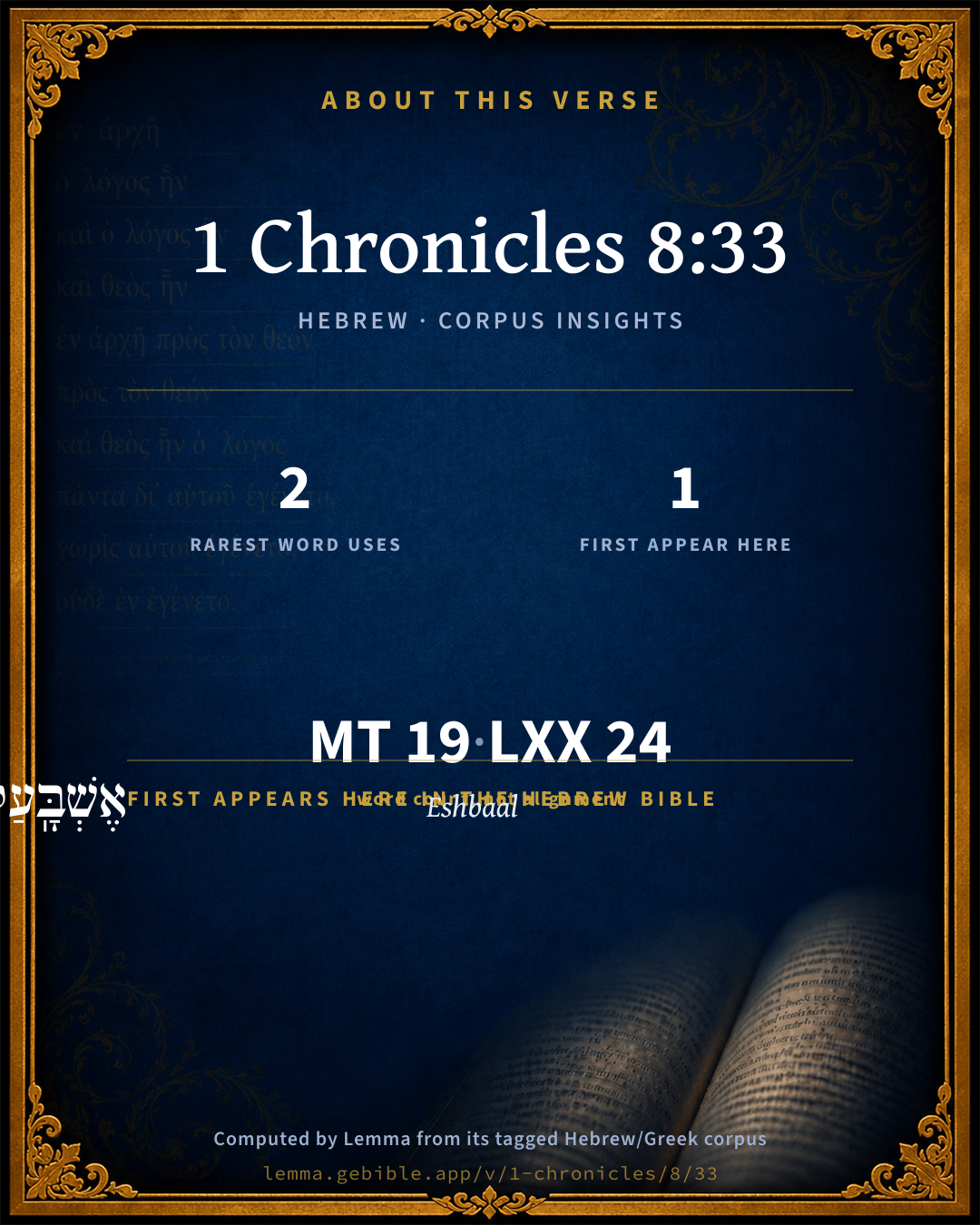
The rarest word here is אֶשְׁבָּֽעַל Eshbaal H792 — appearing just 2 times in the whole Hebrew Bible.

First appearance in Scripture

This word makes its first canonical appearance in the Hebrew Bible here:

  • אֶשְׁבָּֽעַל Eshbaal H792

Shared distinctive vocabulary

אֶשְׁבָּֽעַל Eshbaal H792 occurs in 2 verses of the Hebrew Bible. Also found in:

Grammatical profile

  • 3 verbs
  • 10 nouns
  • 6 particles

Verb forms

  • הוֹלִ֣יד Hiphil · Perfect
  • הוֹלִ֣יד Hiphil · Perfect
  • הוֹלִ֤יד Hiphil · Perfect

Repetition

Words recur within this verse — often emphatic in Hebrew:

  • הוֹלִ֣יד to bear H3205 ×3
  • קִ֔ישׁ Kish H7027 ×2
  • שָׁא֑וּל Saul H7586 ×2
  • מַלְכִּי Malchishua H4444 ×2

Hebrew & Septuagint length

In English translation the verse runs 26 words from the Hebrew and 18 from the Septuagint (LXX English) — the Septuagint runs noticeably shorter here. See the side-by-side →

A rough comparison of the two English renderings, which tokenize alike — not a word-level alignment.

Word counts can differ between the Hebrew and the Greek without any difference in meaning — e.g. the Hebrew direct-object marker אֵת has no separate Greek word, and Greek often adds the article ὁ.

In the original languages it is 19 Hebrew tokens and 24 Greek tokens — but the two are counted differently (Hebrew bundles its prefixes and suffixes into one token; the Greek is in lemma form), so that isn’t a like-for-like length.

Cross-references

7

Topical passages linked to 1 Chronicles 8:33 in the Treasury of Scripture Knowledge — connected by theme and wording, ordered by reader-vote popularity; previews shown in the World English Bible.

  • 1 Samuel 9:1 Now there was a man of Benjamin, whose name was Kish, the son of Abiel, the son of Zeror, the son of Becorath, the son of Aphiah, the son of a Benjamite, a mighty man of valor.
  • 1 Samuel 31:2 The Philistines followed hard on Saul and on his sons; and the Philistines killed Jonathan, and Abinadab, and Malchishua, the sons of Saul.
  • 2 Samuel 2:8 Now Abner the son of Ner, captain of Saul's host, had taken Ish-bosheth the son of Saul, and brought him over to Mahanaim;
  • 1 Samuel 14:49–51 Now the sons of Saul were Jonathan, and Ishvi, and Malchishua; and the names of his two daughters were these: the name of the firstborn Merab, and the name of the younger Michal:
  • Acts 13:21 Afterward they asked for a king, and God gave to them Saul the son of Kish, a man of the tribe of Benjamin, for forty years.
  • 2 Samuel 4:12 David commanded his young men, and they killed them, and cut off their hands and their feet, and hanged them up beside the pool in Hebron. But they took the head of Ish-bosheth, and buried it in the grave of Abner in Hebron.
  • 1 Chronicles 9:39–44 Ner became the father of Kish; and Kish became the father of Saul; and Saul became the father of Jonathan, and Malchishua, and Abinadab, and Eshbaal.

Cross-references courtesy of OpenBible.info (CC BY 4.0).

Hebrew and Greek witnesses Masoretic Hebrew ↔ Greek Septuagint

The same verse in the two great witnesses to the Old Testament, shown verse-for-verse.

Here the Septuagint runs noticeably shorter than the Hebrew — LXX2012 (modern English Septuagint) 18 words vs World English Bible 26. A rough length comparison of the two English translations, not a word-level alignment — read both below.

These are two independent witnesses, not word-aligned to each other, and the Septuagint is shown in lemma (dictionary) form.

Hebrew 1 Chronicles 8:33 Masoretic · Westminster Leningrad Codex

וְנֵר֙ הוֹלִ֣יד אֶת קִ֔ישׁ וְקִ֖ישׁ הוֹלִ֣יד אֶת שָׁא֑וּל וְשָׁא֗וּל הוֹלִ֤יד אֶת יְהֽוֹנָתָן֙ וְאֶת מַלְכִּי שׁ֔וּעַ וְאֶת אֲבִֽינָדָ֖ב וְאֶת אֶשְׁבָּֽעַל

Ner became the father of Kish; and Kish became the father of Saul; and Saul became the father of Jonathan, and Malchishua, and Abinadab, and Eshbaal.

World English Bible · Public Domain

Greek LXX 1 Chronicles 8:33 Septuagint · lemma form

καί νηρ γεννάω ὁ κις καί κις γεννάω ὁ σαούλ καί σαούλ γεννάω ὁ ιωναθαν καί ὁ μελχισουε καί ὁ αμιναδαβ καί ὁ ασαβαλ

And Ner begot Kis, and Kis begot Saul, and Saul begot Jonathan, and Melchisue, and Aminadab, and Asabal.

LXX2012 (modern English Septuagint) · Public Domain

Hebrew: Westminster Leningrad Codex (CC BY 4.0). Greek: Septuagint (public domain); English from LXX2012 (modern English Septuagint) (Public Domain). How the Septuagint differs from the Hebrew →

Commentary

Notes on 1 Chronicles 8:33 from classic Christian and Jewish commentators (each source and its license shown beneath its notes). The classic Christian expositions comment on the surrounding passage and are grouped to its opening verse, so a note may address several verses; the Jewish commentaries on the Tanakh (Rashi and others) are per-verse, so they appear only where the commentator wrote on this verse.

Lemma curates 59 commentaries, every one of them public domain or Creative Commons licensed, each selected and text-cleaned for this edition rather than reprinted as found. About our sources →

Matthew Henry's Commentary

It is observable that among all the genealogies of the tribes there is no mention of any of the kings of Israel after the defection from the house of David, much less of their families; not a word of Jeroboam's house or Baasha's, of Umri's or Jehu's; for they were all idolaters. But of the family of Saul, which was the royal family before the elevation of David, we have here a particular account. 1. Before Saul, Kish and Ner only are named, his father and grandfather, Ch1 8:33. His pedigree is carried higher Sa1 9:1, only there Kish is said to be the son of Abiel, here of Ner. He was in truth the son of Ner but the grandson of Abiel, as appears by Sa1 14:51, where it is said that Ner was the son of Abiel, and that Abner, who was the son of Ner, was Saul's uncle (that is, his father's brother); therefore his father was also the son of Ner. It is common in all languages to put sons for grandsons and other descendents, much more in the scanty language of the Hebrews. 2. After Saul, divers of his sons are named, but the posterity of none of them, save Jonathan only, who was blessed with numerous issue and those honoured with a place in the sacred genealogies for the sake of his sincere kindness to David. The line of Jonathan is drawn down here for about ten generations. Perhaps David was, in a particular manner, careful to preserve that, and assigned it a page by itself, because of the covenant made between his seed and Jonathan's seed forever, Sa1 20:15, Sa1 20:23, Sa1 20:42. This genealogy ends in Ulam, whose family became famous in the tribe of Benjamin for the number of its valiant men. Of that one man's posterity there were, as it should seem, at one time, 150 archers brought into the field of battle, that were mighty men of valour, Ch1 8:40. That is taken notice of concerning them which is more a man's praise than his pomp or wealth is, that they were qualified to serve their country.

Matthew Henry's Commentary on the Whole Bible (1708–1710) — public domain (CC PDM 1.0). Text via the HelloAO Bible API.

Jamieson, Fausset & Brown

Robert Jamieson, A. R. Fausset & David Brown

STOCK OF SAUL AND JONATHAN. (Ch1 8:33-40)

Ner begat Kish--The father of Ner, though not mentioned here, is stated (Ch1 9:35) to have been Jehiel. Moreover, the father of Kish is said (Sa1 9:1) to have been Abiel, the son of Zeror, whence it would seem that Abiel and Ner were names of the same person.

Abinadab--the same as Ishui (Sa1 14:49).

Esh-baal--that is, Ish-bosheth.

Jamieson, Fausset & Brown — Commentary Critical and Explanatory on the Whole Bible (1871) — public domain (CC PDM 1.0). Text via the HelloAO Bible API.

Trapp's Complete Commentary

John Trapp

1Ch 8:33 And Ner begat Kish, and Kish begat Saul, and Saul begat Jonathan, and Malchishua, and Abinadab, and Eshbaal.

Ver. 33. And Ner begat Kish.] This Ner is also called Abiel. {1Sa 9:1} The Hebrews tell us that his proper name was Abiel; and that he was called Ner - that is, a lamp or torch - because he outshone others in holiness. He had another son besides Kish, the father of Saul, viz., Ner, the father of Abner. {1Sa 14:50-51}

And Saul begat Jonathan.] Who was - as the Romans once said of Pompey - a most amiable son of an odious father. {a}

And Eshbaal.] Alias Ishbosheth; so 1Ch 8:34. Meribbaal, alias Mephibosheth. Baal is by Hosea called "That shame."

{a} εχθρου πατρος φιλτατον τεκνον.

John Trapp, A Commentary or Exposition upon All the Books of the Old and New Testament (1647–1656) — public domain. Text from a community e-Sword module.

Tyndale Open Study Notes

Tyndale Open Resources

8:33-40 The Chronicler concludes his record of Benjamin’s history with the genealogy of Saul, beginning two generations before Saul and extending through Merib-baal (=Mephibosheth; see study note on 2 Sam 4:4) and down to the families of Azel and Eshek (1 Chr 8:38-40). Micah (8:35) lived in the time of Solomon, and Ulam (8:39) lived near the end of the kingdom of Judah before the destruction of Jerusalem. Thus, Saul is connected with his larger tribal history and with a noble heritage that carried on throughout the kingdom period.

Tyndale Open Study Notes — © Tyndale Open Resources, licensed CC BY-SA 4.0. Text via the HelloAO Bible API.

Geneva Bible (1599)

Geneva Bible translators

Who in 1 Sam. 9:1 is called Abiel.

He is also named Ishbosheth, 2 Sam. 2:8.

Geneva Bible (1599) marginal notes — public domain. Text via Bolls.life.

Ellicott's Commentary for English Readers

(33) The house of Saul It is not said here that Saul’s immediate family was settled at Gibeon. From 1Sa_10:26; 1Sa_15:34, and 2Sa_21:6, we learn that Gibeah, or “Gibeah of Saul,” was the seat of the king. It is gratuitous to suppose that the chronicler has confounded two different places.

And Ner begat Kish.—1Sa_9:1 gives the following pedigree of Kish: Kish son of Abiel, son of Zeror, son of Bechorath, son of Aphiah; and 1Sa_14:51 states that Kish the father of Saul, and Ner the father of Abner, were sons of Abiel. The omission of intermediate names is not uncommon in these lists. We may, therefore, suppose that some members of the genealogical series are here omitted between Ner and Kish. The father of Abner was, of course, only a namesake of the present Ner, which is perhaps a clan, not an individual.

Saul begat Jonathan.—So 1Sa_14:49; 1Sa_31:2; save that the former passage has Ishui for Abinadab. This seems to be a case of double naming. Others identify Ishui with Ishbosheth.

Abinadab.—Comp. Nadab, 1Ch_8:30. Both are probably Divine titles, meaning “the father (i.e., Jehovah) is noble.” Comp. Kammusu Nadbi, “Chemosh is my prince,” the name of a Moabite king, mentioned by Sennacherib. Ner and Kish also both occurred in 1Ch_8:30 as Gibeonite clans. Here they (or at least Kish) may be said to be personal names.

Esh-baal.—2Sa_2:8, Ish-bosheth, David’s rival king. Esh-baal (“man of Baal”) is the true name. Ish-bosheth (“man of shame”) is a sort of euphemism, avoiding the very mention of an idol. So the Merib-baal (“Baal strives;” rather, perhaps, Meri-Baal, “man of Baal”) of 1Ch_8:34 appears in 2Sa_4:4; 2Sa_9:6, &c, as Mephibosheth, where probably the right reading is Meribbosheth. In like manner, idols are styled “abominations.” 1Ki_11:5 : “Milcom the abomination (i.e., god) of the sons of Ammon,” and elsewhere. Beth-el, the sanctuary of the golden calf, or rather bullock, is called Beth-aven. The “house of God” is a “house of wickedness” (Hos_4:15; Hos_5:8; Jos_7:2.) (See Note on 1Ch_8:30.)

A Bible Commentary for English Readers, edited by Charles John Ellicott (1878–1897) — public domain. Text from a community e-Sword module.

The Cambridge Bible for Schools and Colleges

gen. ed. J. J. S. Perowne

33–40 (cp. 1Ch_9:39-44). The Genealogy of the House of Saul

33. Abinadab] So in 1Sa_31:2, but in 1Sa_14:49 R.V., Ishvi.

Eshbaal] In 2Sa_2:8 called Ish-bosheth. Cp. 1Ch_7:6, note on Jediael (= Ashbel), In the (more generally read) Sam. text the offensive name Eshbaal “Man of Baal” has been changed to Ishbosheth, “Man of the Shameful-thing” (i.e. of the idol), but it has been left standing in the less-used text of Chron. The title Baal (“Lord”) was applied in early days (e.g. in the days of Saul) to the national God of Israel, but in later days (cp. Hos_2:17) the prophets objected to it because it was freely applied to Heathen gods. Thus to Saul and Samuel the name Eshbaal was acceptable as meaning “Man of the Lord,” i.e. of Jehovah, while to the prophetic author or reviser of the book of Samuel it was offensive as signifying “Man of a Baal,” i.e. of one of the gods worshipped by the neighbouring nations.

The Cambridge Bible for Schools and Colleges (gen. ed. J. J. S. Perowne; Cambridge University Press, 1878–1918) — public domain. Text from a community e-Sword module.

John Gill's Exposition

And Azel had six sons, whose names are these, Azrikam, Bochim, Ishmael, Sheariah, Obadiah, and Hanan,.... Which make the said number:

all these were the sons of Azel; his family was large.

John Gill's Exposition of the Whole Bible (1746–1763) — public domain (CC PDM 1.0). Text via the HelloAO Bible API.

Albert Barnes' Notes on the Bible

This verse combined with 1Ch 9:35-39, seems to show that the genealogy of Saul was:

Abiel (= Jehiel?)

Ner

Kish

Abner

Saul

Rather than that to be inferred from 1Sa 9:1; 1Sa 14:50-51.

In 1Sa 14:49 note, it is concluded that Saul’s second son bore the two names of “Ishui” and “Abinadab.” But the order of the names here:

(1) Jonathan;

(2) Malchi-shua; and

(3) Abinadab - suggests another explanation, namely, that Ishui, the second son, died young, and that Abinadab was really the fourth son.

Esh-baal - Previous to the introduction of the Phoenician Baal-worship into Israel by Ahab, the word “Baal” בעל ba‛al had no bad sense in Hebrew, but was simply an equivalent of the more ordinary אל 'êl, “God” (1Ch 3:1 note). Hence, there is nothing strange in the use at this time of the names, “Esh-baal” (“man of God”), “Baal,” “Beel-iada,” “Merib-baal,” etc. Later on such names became offensive to pious ears, and were changed for the better, or for the worse, “Beel-iada” becoming “El-iada” (“let God aid”) - “Esh-baal,” “Ish-bo-sheth” (“man of shame”) - “Merib-baal,” “Mephi-bosheth;” and the like.

Albert Barnes' Notes on the Bible (1834–1885) — public domain. Text from a community e-Sword/MySword module.

Haydock's Catholic Bible Commentary

Ner, son of Abiel, or of Jeheil, prince of Gabaon, ver. 29. (Haydock) --- From Aphia sprung Bechorah, Seror, Abiel, (1 Kings ix.) who is also called Ner and Jehiel. He had Ner, the father of Abner, and Cis, father of Saul. (Menochius) --- Abinadab, or Jessui, 1 Kings xiv. 49. (Calmet) --- Esbaal, alias Isboseth. (Challoner) --- The Hebrews avoid pronouncing the name of the idol, and substitute boseth, "confusion." (Calmet) --- Hence it is clear that many had two names. (Du Hamel)

George Leo Haydock (1774–1849), Haydock's Catholic Family Bible and Commentary, 1859 edition — public domain. Excludes Psalms (Douay-Rheims chapter numbering differs from Protestant) and Deuterocanonical books (Catholic canon only).

The Pulpit Commentary

Vers. 33, 34. The number of Saul"s children was certainly nine. In addition to the four (1Sa_31:2) mentioned here, there was Ishui, probably standing second, (1Sa_14:49) and there were two daughters, Merab and Michal, (1Sa_14:49) and there were two sons by Rizpah, (2Sa_21:8) named Armoui and Mephi-bosheth. Esh-baal; the same with Ishbo-sheth . (2Sa_2:8 2Sa_3:7-14 2Sa_4:4-12) Merib-baal; the same with Mephibosheth. (2Sa_9:12) Micah is, therefore, the great-grandson of Saul.

The Pulpit Commentary (1880–1919), ed. H.D.M. Spence-Jones & Joseph S. Exell — public domain. Text from a community e-Sword module.

Keil & Delitzsch

C. F. Keil & F. Delitzsch

And Azel had six sons, whose names are these, Azrikam, Bochim, Ishmael, Sheariah, Obadiah, and Hanan,.... Which make the said number:

all these were the sons of Azel; his family was large.

Keil & Delitzsch — Biblical Commentary on the Old Testament (1861–1891) — public domain (CC PDM 1.0). Text via the HelloAO Bible API. (Old Testament only.)

Lesson kit

Teaching starters — assembled from the data on this page, not authored interpretation. Every prompt links to the verse data it draws on. Edit before teaching.

1 Chronicles, in the Historical, opens this verse with 19 words (9 distinct Hebrew lemmas). Its most distinctive word is ʼEshbaʻal (“Eshbaal”). The Greek Septuagint runs shorter here. A historical commentator’s framing appears above. Read the whole chapter for the surrounding context.

Discussion questions

  1. What does “Eshbaal” (ʼEshbaʻal) contribute to the verse as a whole?
  2. This is the first place “Eshbaal” appears in Scripture (first appears here). What does its debut here establish?
  3. How does 1 Chronicles 9:39, which shares the word «Eshbaal», read alongside this verse?
  4. What does the repetition of “to bear” (3× in this one verse) do in this verse?
  5. The Septuagint runs shorter here than the Hebrew. What might account for the difference?
  6. These translations render this verse differently. What is at stake in choosing one wording over another?
  7. «הוֹלִ֣יד» is a Hiphil Perfect verb. How does that grammatical form shape the action described?
  8. Compare how Matthew Henry's Commentary and Jamieson, Fausset & Brown read this verse. Where do they agree or differ?

Things to notice

Reading settings

Reading text

Shown beneath each verse's original-language words.

Old Testament
Old Testament edition

Read the OT as the Masoretic Hebrew (MT) or the Greek Septuagint (LXX).

English shown for the Greek Septuagint (in the Hebrew ↔ Greek comparison).

Comparing translations? Open the Compare panel on any verse page to stack up to four side by side.