
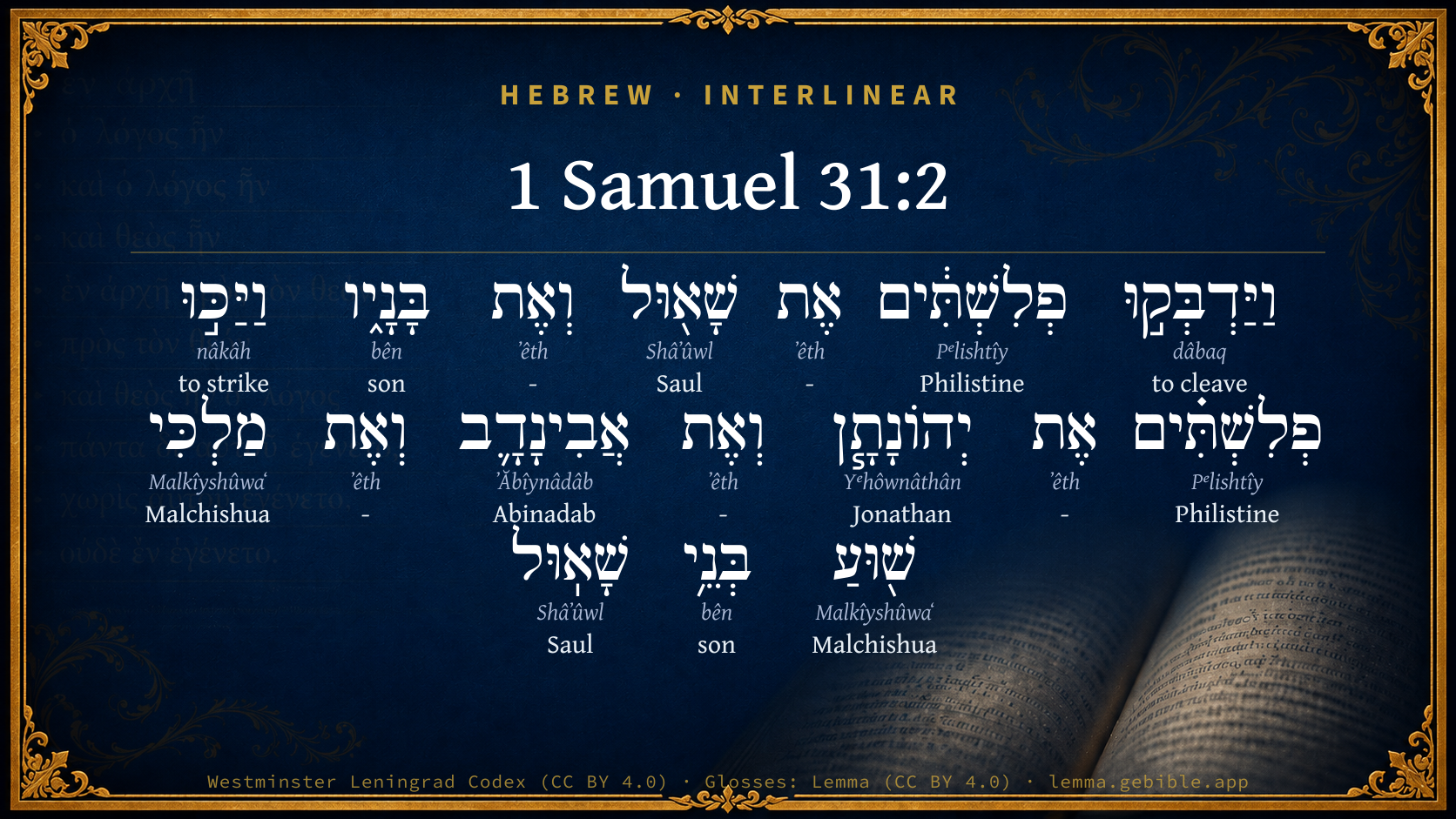
1 Samuel 31:2

Hebrew (Westminster Leningrad Codex) 1 Samuel 31:2 appears in the Hebrew Old Testament. The text above is from the Westminster Leningrad Codex. Each word links to its Strong’s number, a concise gloss, and parsing drawn from the Open Scriptures Hebrew Bible morphology. Click any word for its full Brown-Driver-Briggs (BDB) entry.
Download image
Cite this verse

1 Samuel 31:2 (World English Bible). Public Domain. Lemma interlinear Bible study tool, https://lemma.gebible.app/v/1-samuel/31/2.

Show BibTeX & RIS
BibTeX
RIS
English Translation
The Philistines followed hard on Saul and on his sons; and the Philistines killed Jonathan, and Abinadab, and Malchishua, the sons of Saul.
World English Bible · Public Domain
Download a study sheet

One document with this verse’s original text, its word-by-word gloss line, the meaning frame, cross-references with their text, attributed commentary, and full source and license credits — printable, and it pastes into notes with its structure intact.

This verse Autodidact and up

Study sheet (.html) Plain text (.txt)

A passage Seminary Student

Up to 50 verses in one chapter. A passage sheet keeps up to 6 commentary sources and 12 cross-references per verse, in the order this page ranks them, and says so on the sheet whenever that leaves anything out. Ask for a single verse and you get the Autodidact verse sheet above.

Everything on this page stays free to read, with no account — the sheet is a download of what is already on screen, not access to it.

Want to remove ads? Support Godless Engineer
Compare translations 3

The same verse in 3 English versions, stacked beneath the original-language interlinear above. Click any original word for its lexicon entry.

Each is an independent rendering of the whole verse — the interlinear is not word-aligned to these translations.

Highlighted words mark where these versions differ — a whole-verse word diff, not a word-by-word alignment.

  • World English Bible Public Domain
    The Philistines followed hard on Saul and on his sons; and the Philistines killed Jonathan, and Abinadab, and Malchishua, the sons of Saul.
  • King James Version Public Domain
    And the Philistines followed hard upon Saul and upon his sons; and the Philistines slew Jonathan, and Abinadab, and Melchishua, Saul's sons.
  • unfoldingWord Literal Text CC BY-SA 4.0
    And the Philistines overtook Saul and his sons. And the Philistines struck Jonathan and Abinadab and Malchi Shua, the sons of Saul.

unfoldingWord Literal Text — © unfoldingWord, licensed CC BY-SA 4.0. Word-aligned USFM3 via Door43 (git.door43.org/unfoldingWord/en_ult).

Versions to compare (up to 4)

3 of 4 selected

Show all 18 translations

Every available English version of this verse, each an independent rendering of the whole verse.

  • World English Bible Public Domain
    The Philistines followed hard on Saul and on his sons; and the Philistines killed Jonathan, and Abinadab, and Malchishua, the sons of Saul.
  • Berean Standard Bible Public Domain
    The Philistines followed hard after Saul and his sons, and they killed Saul’s sons Jonathan, Abinadab, and Malchishua.
  • Majority Standard Bible Public Domain
    The Philistines hotly pursued Saul and his sons, and they killed Saul’s sons Jonathan, Abinadab, and Malchishua.
  • King James Version Public Domain
    And the Philistines followed hard upon Saul and upon his sons; and the Philistines slew Jonathan, and Abinadab, and Melchishua, Saul's sons.
  • American Standard Version (1901) Public Domain
    And the Philistines followed hard upon Saul and upon his sons; and the Philistines slew Jonathan, and Abinadab, and Malchishua, the sons of Saul.
  • Revised Version (1885) Public Domain
    And the Philistines followed hard upon Saul and upon his sons; and the Philistines slew Jonathan, and Abinadab, and Malchi-shua, the sons of Saul.
  • Geneva Bible (1599) Public Domain
    And the Philistims preassed sore vpon Saul and his sonnes, and slewe Ionathan, and Abinadab, and Malchishua Sauls sonnes.
  • Douay-Rheims (1899) Public Domain
    And the Philistines fell upon Saul, and upon his sons, and they slew Jonathan, and Abinadab and Melchisua the sons of Saul.
  • Young's Literal Translation Public Domain
    and the Philistines follow Saul and his sons, and the Philistines smite Jonathan, and Abinadab, and Malchishua, sons of Saul.
  • Literal Standard Version CC BY-SA 4.0
    and the Philistines follow Saul and his sons, and the Philistines strike Jonathan, and Abinadab, and Malchishua, the sons of Saul.
  • Unlocked Literal Bible CC BY-SA 4.0
    The Philistines closely pursued Saul and his sons. The Philistines killed Jonathan, Abinadab, and Malki-Shua, his sons.
  • unfoldingWord Literal Text CC BY-SA 4.0
    And the Philistines overtook Saul and his sons. And the Philistines struck Jonathan and Abinadab and Malchi Shua, the sons of Saul.
  • Darby Bible Public Domain
    And the Philistines followed hard upon Saul and upon his sons; and the Philistines smote Jonathan, and Abinadab, and Malchishua, Saul's sons.
  • World Messianic Bible Public Domain
    The Philistines overtook Saul and his sons; and the Philistines killed Jonathan, Abinadab, and Malchishua, the sons of Saul.
  • Webster's Bible Public Domain
    And the Philistines followed hard upon Saul and upon his sons; and the Philistines slew Jonathan, and Abinadab, and Malchi-shua, Saul's sons.
  • Free Bible Version CC BY-SA 4.0
    The Philistines chased down Saul and his sons, killing Saul's sons Jonathan, Abinadab, and Malchishua.
  • Bible in Basic English Public Domain
    And the Philistines overtook Saul and his sons; and they put to death Jonathan and Abinadab and Malchi-shua, the sons of Saul.
  • JPS Tanakh (1917) Public Domain
    And the Philistines followed hard upon Saul and upon his sons; and the Philistines slew Jonathan, and Abinadab, and Malchishua, the sons of Saul.

Literal Standard Version (2020), Covenant Press — licensed CC BY-SA 4.0. Text via the HelloAO Bible API (eBible.org). Unlocked Literal Bible (unfoldingWord) — licensed CC BY-SA 4.0. Text via the HelloAO Bible API (eBible.org). unfoldingWord Literal Text — © unfoldingWord, licensed CC BY-SA 4.0. Word-aligned USFM3 via Door43 (git.door43.org/unfoldingWord/en_ult). Free Bible Version, Dr. Jonathan Gallagher — licensed CC BY-SA 4.0. Text via the HelloAO Bible API (eBible.org).

Word by word

More ways to search: Search by grammar → Find every occurrence → Compare this word →

Practice this passage: Drill this verse → Learn its vocabulary →

מַלְכִּי
Malkîyshûwaʻ
H4444
“Malchishua”
Noun, Proper
Part of Speech
Noun
Type
Proper
Full BDB Definition

Origin: from H4428 and H7769

TWOT: None

Malchishua = "my king is wealth" - a son of king Saul of Israel
  1. וַיַּדְבְּק֣וּ dâbaq H1692 “and · to cleave” Conjunction + Verb, Hiphil, Sequential Imperfect, 3rd Person, Masculine, Plural
  2. פְלִשְׁתִּ֔ים Pᵉlishtîy H6430 “Philistines” Noun, Gentilic, Masculine, Plural, Absolute
  3. אֶת ʼêth H853 “-” Particle, Direct Object
  4. שָׁא֖וּל Shâʼûwl H7586 “Saul” Noun, Proper
  5. וְאֶת ʼêth H853 “and · -” Conjunction + Particle, Direct Object
  6. בָּנָ֑יו bên H1121 “sons · his” Noun, Common, Masculine, Plural, Construct + Suffix, Personal, 3rd Person, Masculine, Singular
  7. וַיַּכּ֣וּ nâkâh H5221 “and · to strike” Conjunction + Verb, Hiphil, Sequential Imperfect, 3rd Person, Masculine, Plural
  8. פְלִשְׁתִּ֗ים Pᵉlishtîy H6430 “Philistines” Noun, Gentilic, Masculine, Plural, Absolute
  9. אֶת ʼêth H853 “-” Particle, Direct Object
  10. יְהוֹנָתָ֧ן Yᵉhôwnâthân H3083 “Jonathan” Noun, Proper
  11. וְאֶת ʼêth H853 “and · -” Conjunction + Particle, Direct Object
  12. אֲבִינָדָ֛ב ʼĂbîynâdâb H41 “Abinadab” Noun, Proper
  13. וְאֶת ʼêth H853 “and · -” Conjunction + Particle, Direct Object
  14. שׁ֖וּעַ Malkîyshûwaʻ H4444 “Malchishua” Noun, Proper
  15. בְּנֵ֥י bên H1121 “sons of” Noun, Common, Masculine, Plural, Construct
  16. שָׁאֽוּל Shâʼûwl H7586 “Saul” Noun, Proper

About this verse

These counts appear in no published source. They are computed here, from the morphology-tagged text and Lemma’s own curated glosses. What Lemma adds →

17
words
9
distinct lemmas
Historical
section

Notable vocabulary

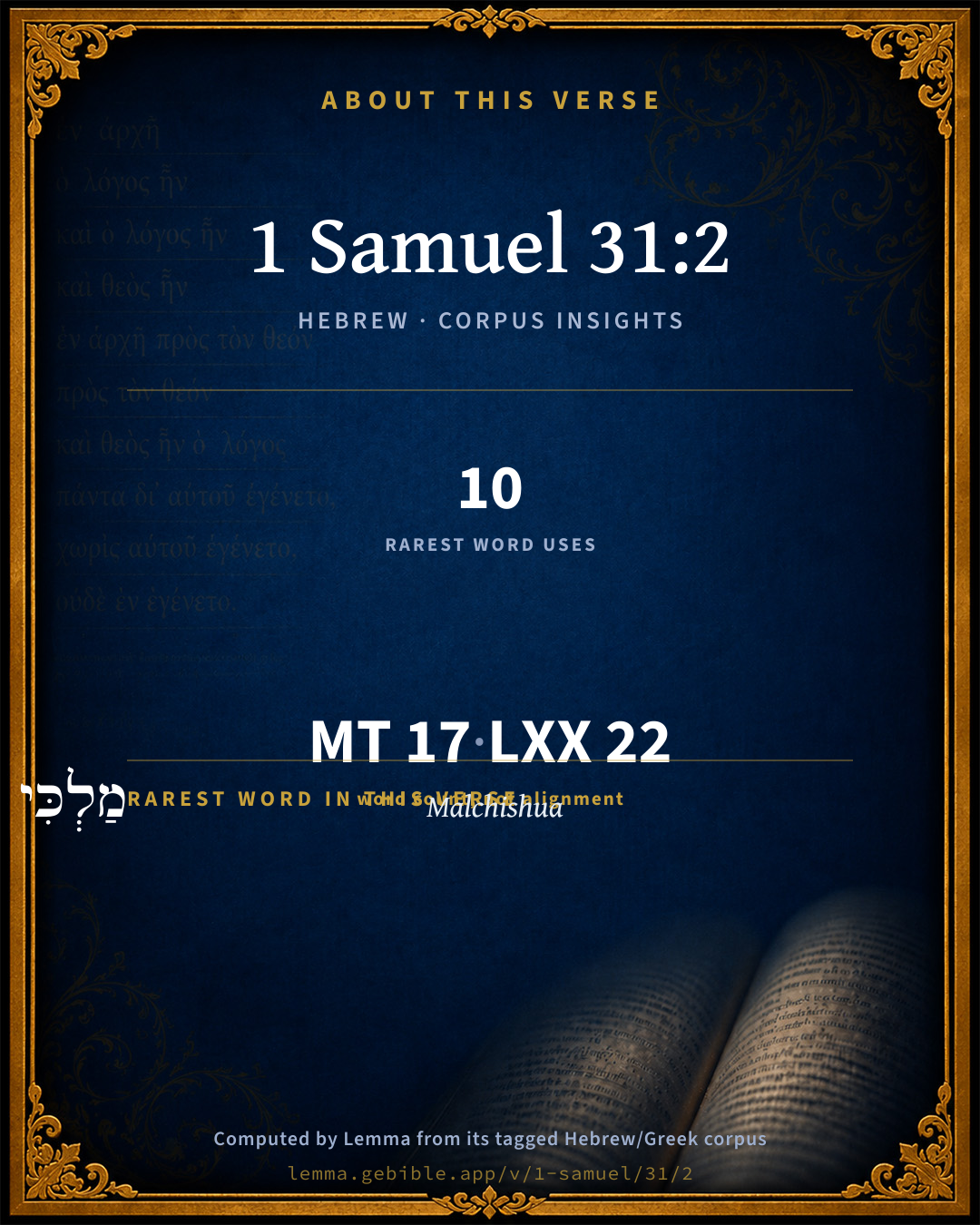
The rarest word here is מַלְכִּי Malchishua H4444 — appearing just 10 times in the whole Hebrew Bible.

Shared distinctive vocabulary

מַלְכִּי Malchishua H4444 occurs in 5 verses of the Hebrew Bible. Also found in:

Grammatical profile

  • 2 verbs
  • 10 nouns
  • 5 particles

Verb forms

  • וַיַּדְבְּק֣וּ Hiphil · Sequential Imperfect
  • וַיַּכּ֣וּ Hiphil · Sequential Imperfect

Repetition

Words recur within this verse — often emphatic in Hebrew:

  • פְלִשְׁתִּ֔ים Philistine H6430 ×2
  • שָׁא֖וּל Saul H7586 ×2
  • בָּנָ֑יו son H1121 ×2
  • מַלְכִּי Malchishua H4444 ×2

Hebrew & Septuagint length

In English translation the verse runs 23 words from the Hebrew and 22 from the Septuagint (LXX English) — closely comparable.

A rough comparison of the two English renderings, which tokenize alike — not a word-level alignment.

Word counts can differ between the Hebrew and the Greek without any difference in meaning — e.g. the Hebrew direct-object marker אֵת has no separate Greek word, and Greek often adds the article ὁ.

In the original languages it is 17 Hebrew tokens and 22 Greek tokens — but the two are counted differently (Hebrew bundles its prefixes and suffixes into one token; the Greek is in lemma form), so that isn’t a like-for-like length.

Cross-references

12

Topical passages linked to 1 Samuel 31:2 in the Treasury of Scripture Knowledge — connected by theme and wording, ordered by reader-vote popularity; previews shown in the World English Bible.

  • 1 Chronicles 8:33 Ner became the father of Kish; and Kish became the father of Saul; and Saul became the father of Jonathan, and Malchishua, and Abinadab, and Eshbaal.
  • 1 Samuel 14:49 Now the sons of Saul were Jonathan, and Ishvi, and Malchishua; and the names of his two daughters were these: the name of the firstborn Merab, and the name of the younger Michal:
  • Exodus 20:5 you shall not bow yourself down to them, nor serve them, for I, Yahweh your God, am a jealous God, visiting the iniquity of the fathers on the children, on the third and on the fourth generation of those who hate me,
  • 1 Samuel 13:2 Saul chose him three thousand men of Israel, of which two thousand were with Saul in Michmash and in the Mount of Bethel, and one thousand were with Jonathan in Gibeah of Benjamin: and the rest of the people he sent every man to his tent.
  • 1 Samuel 13:16 Saul, and Jonathan his son, and the people who were present with them, abode in Geba of Benjamin: but the Philistines encamped in Michmash.
  • 1 Samuel 18:1–4 It happened, when he had made an end of speaking to Saul, that the soul of Jonathan was knit with the soul of David, and Jonathan loved him as his own soul.
  • 1 Samuel 23:17 He said to him, Don't be afraid; for the hand of Saul my father shall not find you; and you shall be king over Israel, and I shall be next to you; and that also Saul my father knows.
  • 2 Samuel 1:6 The young man who told him said, As I happened by chance on Mount Gilboa, behold, Saul was leaning on his spear; and, behold, the chariots and the horsemen followed hard after him.
  • 1 Chronicles 9:39 Ner became the father of Kish; and Kish became the father of Saul; and Saul became the father of Jonathan, and Malchishua, and Abinadab, and Eshbaal.
  • 1 Samuel 14:1–14 Now it fell on a day, that Jonathan the son of Saul said to the young man who bore his armor, Come, and let us go over to the Philistines' garrison, that is on yonder side. But he didn't tell his father.
  • 1 Samuel 14:22 Likewise all the men of Israel who had hid themselves in the hill-country of Ephraim, when they heard that the Philistines fled, even they also followed hard after them in the battle.
  • 2 Kings 25:7 They killed the sons of Zedekiah before his eyes, and put out the eyes of Zedekiah, and bound him in fetters, and carried him to Babylon.

Cross-references courtesy of OpenBible.info (CC BY 4.0).

Hebrew and Greek witnesses Masoretic Hebrew ↔ Greek Septuagint

The same verse in the two great witnesses to the Old Testament, shown verse-for-verse.

These are two independent witnesses, not word-aligned to each other, and the Septuagint is shown in lemma (dictionary) form.

Hebrew 1 Samuel 31:2 Masoretic · Westminster Leningrad Codex

וַיַּדְבְּק֣וּ פְלִשְׁתִּ֔ים אֶת שָׁא֖וּל וְאֶת בָּנָ֑יו וַיַּכּ֣וּ פְלִשְׁתִּ֗ים אֶת יְהוֹנָתָ֧ן וְאֶת אֲבִינָדָ֛ב וְאֶת מַלְכִּי שׁ֖וּעַ בְּנֵ֥י שָׁאֽוּל

The Philistines followed hard on Saul and on his sons; and the Philistines killed Jonathan, and Abinadab, and Malchishua, the sons of Saul.

World English Bible · Public Domain

Greek LXX 1 Samuel 31:2 Septuagint · lemma form

καί συνἅπτω ἀλλόφυλος ὁ σαούλ καί ὁ υἱός αὐτός καί τύπτω ἀλλόφυλος ὁ ιωναθαν καί ὁ αμιναδαβ καί ὁ μελχισα υἱός σαούλ

And the Philistines press closely on Saul and his sons, and the Philistines strike Jonathan, and Aminadab, and Melchisa son of Saul.

LXX2012 (modern English Septuagint) · Public Domain

Hebrew: Westminster Leningrad Codex (CC BY 4.0). Greek: Septuagint (public domain); English from LXX2012 (modern English Septuagint) (Public Domain). How the Septuagint differs from the Hebrew →

Targum (Aramaic paraphrase)

1

The Targum is the ancient Jewish Aramaic paraphrase of the Hebrew Scriptures — an interpretive translation, not the Hebrew text itself. Onkelos (literal) and Pseudo-Jonathan (expansive) render the Torah, and Jonathan the Prophets. Coverage is partial: where no permissively-licensed English translation exists for a verse, only the Aramaic is shown. This is verse-level text, not a word-by-word alignment to the Hebrew.

  1. Targum Jonathan Prophets (Joshua–Malachi)
    וְאַדְבִּיקוּ פְלִשְׁתָּאֵי יַת שָׁאוּל וְיַת בְּנוֹהִי וּקְטָלוּ פְלִשְׁתָּאֵי יַת יְהוֹנָתָן וְיַת אֲבִינָדָב וְיַת מַלְכִּי שׁוּע בְּנֵי שָׁאוּל:

    (no public-domain English translation for this verse)

    Targum Jonathan — Aramaic: “Mikraot Gedolot” (public domain). English: “Sefaria Community Translation” (CC0 1.0 (public-domain dedication)); “London "Chaldee Paraphrase," 1871” (public domain). Text via Sefaria.

Commentary

Notes on 1 Samuel 31:2 from classic Christian and Jewish commentators (each source and its license shown beneath its notes). The classic Christian expositions comment on the surrounding passage and are grouped to its opening verse, so a note may address several verses; the Jewish commentaries on the Tanakh (Rashi and others) are per-verse, so they appear only where the commentator wrote on this verse.

Lemma curates 59 commentaries, every one of them public domain or Creative Commons licensed, each selected and text-cleaned for this edition rather than reprinted as found. About our sources →

Trapp's Complete Commentary

John Trapp

1Sa 31:2 And the Philistines followed hard upon Saul and upon his sons; and the Philistines slew Jonathan, and Abinadab, and Malchishua, Saul’s sons.

Ver. 2. And the Philistines followed hard upon Saul.] Heb., Clave to him; sat close upon his skirts: fighting neither against small nor great, so much as against him, as their capital enemy, the destroyer of their country, that had slain many of them, as Jdg 16:24.

And the Philistines slew Jonathan.] That peerless prince, the glory of chivalry, that lumen et columen the light and support of his country. He dieth among the rest, and hath his share as deep as any other in that common calamity: so true is that of Solomon, {Ecc 9:1-2} "there is one event to the righteous and to the wicked"; but God maketh them to differ, {Mal 3:18} as the harvest man cutteth down the good corn and the weeds together, but for a different purpose. Martyr noteth, that if Jonathan had lived, his heart might have changed toward David, and the people’s hearts might have hanged much after him, so valiant and virtuous a prince, to David’s great prejudice. We read how they were set upon it to settle Ishbosheth upon the throne, though an ουτιδανος, a worthless man, and undeserving.

And Abinadab, and Malchishua, Saul’s sons.] All whom, and many more of his dear friends, Saul lived to see slain before him, for his greater punishment. And the like befell Mauritius, the emperor - a far better man - who made a better use of it.

John Trapp, A Commentary or Exposition upon All the Books of the Old and New Testament (1647–1656) — public domain. Text from a community e-Sword module.

Joseph Benson's Commentary

1Sa 31:2. The Philistines slew Jonathan — David’s dear friend; God so ordering it for the further exercise of David’s faith and patience; and that David might depend upon God alone for his crown, and receive it solely from him, and not from Jonathan; who, doubtless, had he lived, would have speedily settled the crown upon David’s head. There was also a special providence of God in taking away Jonathan, (who, of all Saul’s sons, seems to have been the fairest for the crown,) for preventing divisions, which might have happened among the people concerning the successor: David’s way to the crown being by this means made the more clear. Abinadab — Called also Ishui, 1Sa 14:49. Ish-bosheth was not here, being possibly at home for the management of affairs there. Thus the prediction of Samuel was fulfilled: but who can forbear dropping a tear over the faithful, the amiable, the excellent Jonathan? “There are few characters among men more lovely or more extraordinary than his: fortitude, fidelity, magnanimity! a soul susceptible of the most refined friendship, and superior to all the temptations of ambition and vanity! and all these crowned with the most resigned submission to the will of God.” — Delaney.

Joseph Benson's Commentary on the Old and New Testaments (1811–1818) — public domain. Text from a community e-Sword module.

Tyndale Open Study Notes

Tyndale Open Resources

31:2 Jonathan . . . Malkishua: See 14:49. This is the first mention of Saul’s son Abinadab (cp. 1 Chr 8:33; 9:39).

Tyndale Open Study Notes — © Tyndale Open Resources, licensed CC BY-SA 4.0. Text via the HelloAO Bible API.

Adam Clarke's Commentary

Verse 2. Followed hard upon Saul and upon his sons] They, seeing the discomfiture of their troops, were determined to sell their lives as dear as possible, and therefore maintained the battle till the three brothers were slain.

Adam Clarke's Commentary on the Bible (1810–1826) — public domain. Text from a community e-Sword/MySword module.

Ellicott's Commentary for English Readers

(2) And the Philistines followed hard upon Saul and upon his sons.—“The details of the battle are but seen in broken snatches, as in the short scene of a battle acted upon the stage, or beheld at remote glimpses by an accidental spectator. But amidst the showers of arrows from the Philistine archers, or pressed hard even on the mountain side by their charioteers, the figure of the king emerges from the darkness. His three sons have fallen before him; his armourbearer lies dead beside him.”—Stanley: Jewish Church, Lect. 21

And the Philistines slew Jonathan, and Abinadab, and Melchi-shua, Saul’s sons.—But while, in his own record of the national disaster, the compiler or historian, in his stern sorrow, expunges every detail, and represses every expression of feeling, he gives us in the next chapter (2Sa_1:1-27) the stately elegy, in the beautiful moving words which the successor to the throne wrote on the death of the first king and his heroic son. Without comment he copies into his record the hymn of David on Saul and Jonathan, just as he found it in the Book of Jashar (the collection of national odes celebrating the heroes of the Theocracy). “There David speaks of the Saul of earlier times—the mighty conqueror, the delight of his people, the father of his beloved and faithful friend—like him in life, united with him in death.” (Stanley).

“Saul and Jonathan were lovely and pleasant in their lives

And in their death they were not divided.

Than eagles they were swifter, than lions more strong.”

(2Sa_1:23.) From the lost Book of Jashar.

Nothing is known of the two younger princes who fell fighting here by their father’s side, sword in hand against the enemies of their country.

The hero Jonathan and his two brave brothers, as far as we can gather from the scanty details of the battle after the army was routed in the valley of Jezreel, retreated (fighting all the while) to the hill of Gilboa. There, it seems, they made the last stand with the fideles of the royal house of Saul (1Sa_31:6), and there, no doubt defending the king to the last, they fell.

A Bible Commentary for English Readers, edited by Charles John Ellicott (1878–1897) — public domain. Text from a community e-Sword module.

The Cambridge Bible for Schools and Colleges

gen. ed. J. J. S. Perowne

2. Saul’s sons] See 1Sa_14:49. There is a tragic pathos in the simplicity of the account. Cp. 1Sa_31:6.

The Cambridge Bible for Schools and Colleges (gen. ed. J. J. S. Perowne; Cambridge University Press, 1878–1918) — public domain. Text from a community e-Sword module.

John Gill's Exposition

And the Philistines followed hard upon Saul,.... Stuck to him, pushed him close, bore hard upon him in that part of the army where he was having a design upon his person:

and upon his sons; who were with him:

and the Philistines slew Jonathan; who is mentioned first, being the eldest son, and perhaps first slain; and this was so ordered by the providence of God, that David's way to the throne might be more clear and easy; for though Jonathan would not have opposed him himself, yet the people, fond of him, would, at least many of them, been for setting him on the throne; and though he would have refused it, knowing David was the Lord's anointed, and have made interest for him, this would have looked as if he had made him king, and not the Lord:

and Abinadab and Malchishua, Saul's sons; these also were slain; former of these is called Ishui, Sa1 14:49; Ishbosheth either was not in the battle, being left at home, as unfit for war, or to take care of the kingdom; or else he fled with Abner, and others, and escaped, and who was to be a trial to David.

John Gill's Exposition of the Whole Bible (1746–1763) — public domain (CC PDM 1.0). Text via the HelloAO Bible API.

Haydock's Catholic Bible Commentary

Jonathan. Ven. Bede, &c., doubt not of his salvation. (Salien)

George Leo Haydock (1774–1849), Haydock's Catholic Family Bible and Commentary, 1859 edition — public domain. Excludes Psalms (Douay-Rheims chapter numbering differs from Protestant) and Deuterocanonical books (Catholic canon only).

Matthew Poole's English Annotations

The Philistines slew Jonathan, David’s dear friend; God so ordering it for the further exercise of David’s faith and patience; and that David might depend upon God alone for his crown, and receive it solely from him, and not from Jonathan; who doubtless, had he lived, would have speedily settled the crown upon David’s head, which would have in some sort eclipsed the glory of God’s grace and power in this work. There was also a special providence of God in taking away Jonathan, (who of all Saul’s sons seems to have been the fairest for the crown,) for the preventing divisions, which have happened amongst the people concerning the successor; David’s way to the crown being by this means made the more clear.

Abinadab, called also Ishui, 1Sa 14:49. Ish-bosheth was not here, being possibly at home, for the management of public affairs there.

Matthew Poole's English Annotations on the Holy Bible (1683–1685) — public domain. Text from a community e-Sword/MySword module.

Whedon's Commentary on the Bible

Daniel D. Whedon

2. Followed hard upon Saul and upon his sons — When Saul and his sons saw the people flying they probably placed themselves in the thickest of the battle, and sought, as by the last efforts of despair, to turn the tide of the Philistines’ victory. Thus they exposed themselves to death.

Daniel D. Whedon (gen. ed.), Commentary on the Old and New Testaments (1874–1909) — public domain. Text from a community e-Sword module.

John Wesley's Explanatory Notes

Jonathan - David's dear friend; God so ordering it for the farther exercise of David's faith and patience; and that David might depend upon God alone for his crown, and receive it solely from him, and not from Jonathan; who doubtless, had he lived, would have speedily settled the crown upon David's head. There was also a special providence of God, in taking away Jonathan, (who of all Saul's sons, seems to have been the fairest for the crown) for preventing divisions, which might have happened amongst the people concerning the successor: David's way to the crown being by this means made the more clear. Abinadab - Called also Ishui, chap. xiv, 49. Ishbosheth was not here, being possibly at home for the management of affairs there.

John Wesley, Explanatory Notes Upon the Whole Bible (1754–1765) — public domain. Text via the GEBible commentary corpus.

Lesson kit

Teaching starters — assembled from the data on this page, not authored interpretation. Every prompt links to the verse data it draws on. Edit before teaching.

1 Samuel, in the Historical, opens this verse with 17 words (9 distinct Hebrew lemmas). Its most distinctive word is Malkîyshûwaʻ (“Malchishua”). A historical commentator’s framing appears above. Read the whole chapter for the surrounding context.

Discussion questions

  1. What does “Malchishua” (Malkîyshûwaʻ) contribute to the verse as a whole?
  2. 1 Samuel 14:49 shares the word «Malchishua» with this verse. How do the two illuminate each other?
  3. “Philistine” occurs 2× in this one verse. What is the effect of the repetition?
  4. These translations render this verse differently. What is at stake in choosing one wording over another?
  5. The verb «וַיַּדְבְּק֣וּ» is Hiphil Sequential Imperfect. How does its form color the action?
  6. Reading how Trapp's Complete Commentary and Joseph Benson's Commentary read this verse, where do the two commentators agree and where do they part?

Things to notice

Reading settings

Reading text

Shown beneath each verse's original-language words.

Old Testament
Old Testament edition

Read the OT as the Masoretic Hebrew (MT) or the Greek Septuagint (LXX).

English shown for the Greek Septuagint (in the Hebrew ↔ Greek comparison).

Comparing translations? Open the Compare panel on any verse page to stack up to four side by side.