
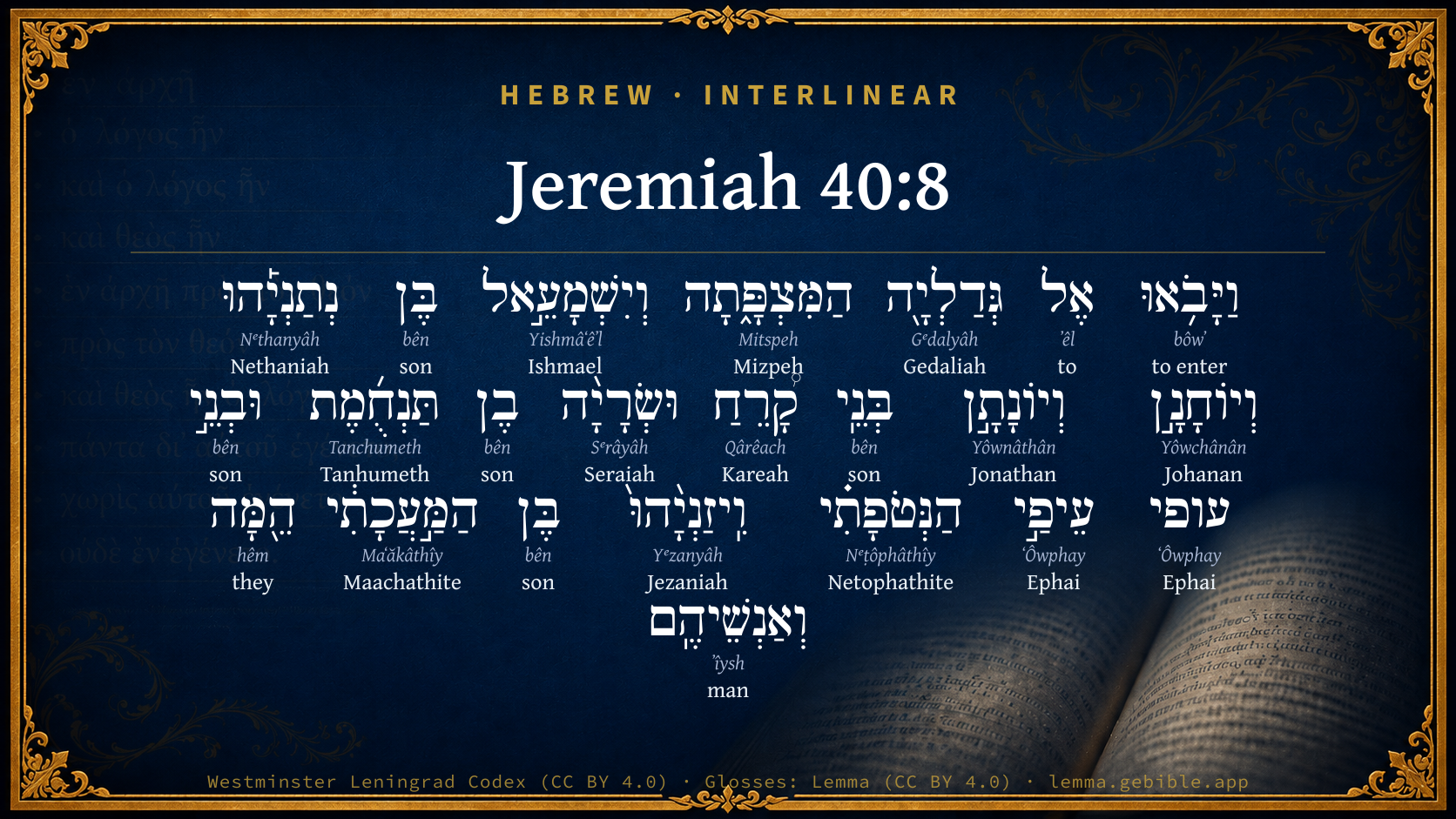
Jeremiah 40:8

Hebrew (Westminster Leningrad Codex) Jeremiah 40:8 appears in the Hebrew Old Testament. The text above is from the Westminster Leningrad Codex. Each word links to its Strong’s number, a concise gloss, and parsing drawn from the Open Scriptures Hebrew Bible morphology. Click any word for its full Brown-Driver-Briggs (BDB) entry.
Download image
Cite this verse

Jeremiah 40:8 (World English Bible). Public Domain. Lemma interlinear Bible study tool, https://lemma.gebible.app/v/jeremiah/40/8.

Show BibTeX & RIS
BibTeX
RIS
English Translation
then they came to Gedaliah to Mizpah, [to wit], Ishmael the son of Nethaniah, and Johanan and Jonathan the sons of Kareah, and Seraiah the son of Tanhumeth, and the sons of Ephai the Netophathite, and Jezaniah the son of the Maacathite, they and their men.
World English Bible · Public Domain
Highlights
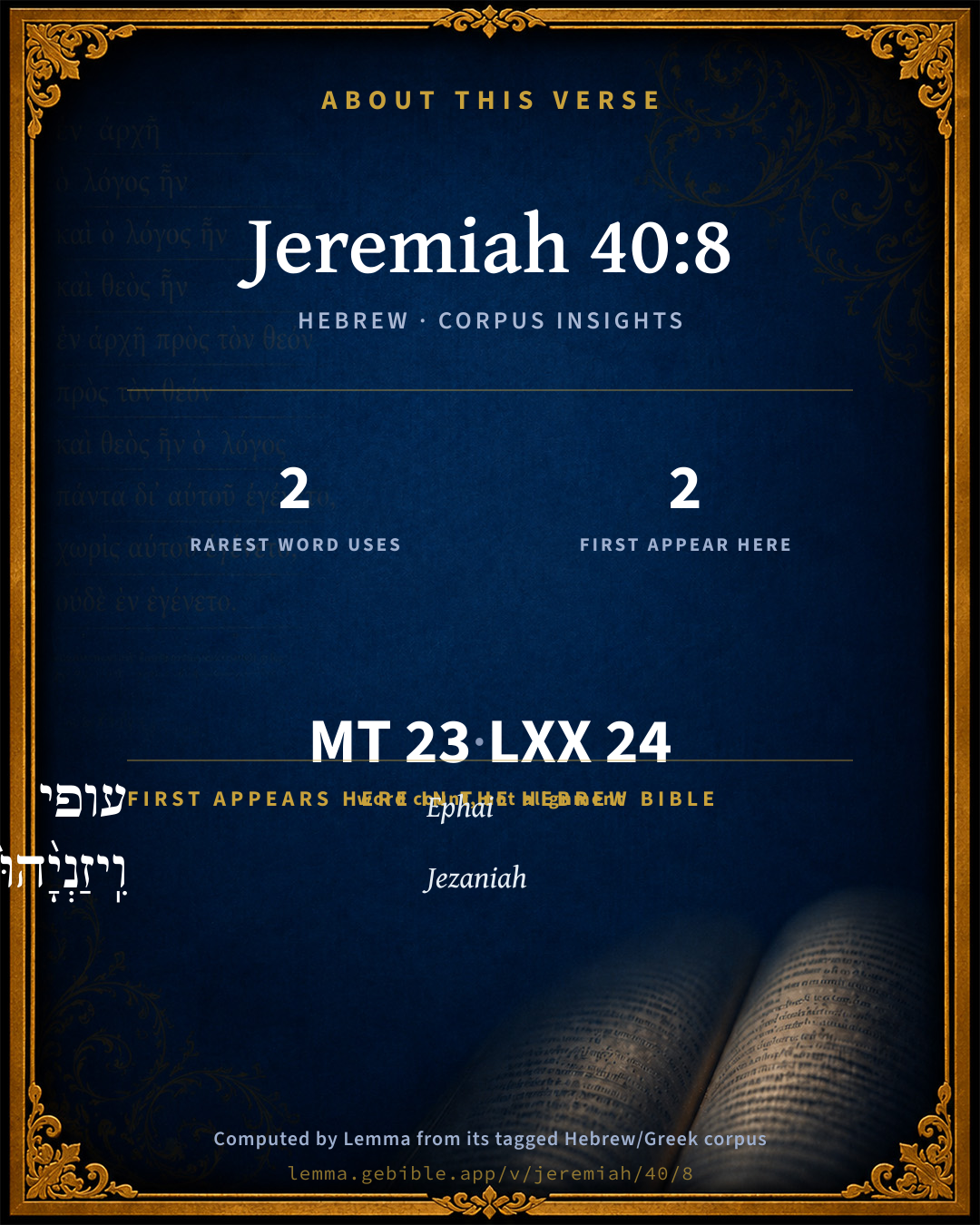
  • 2 first appearances in the Hebrew Bible
Full analysis ↓
Download a study sheet

One document with this verse’s original text, its word-by-word gloss line, the meaning frame, cross-references with their text, attributed commentary, and full source and license credits — printable, and it pastes into notes with its structure intact.

This verse Autodidact and up

Study sheet (.html) Plain text (.txt)

A passage Seminary Student

Up to 50 verses in one chapter. A passage sheet keeps up to 6 commentary sources and 12 cross-references per verse, in the order this page ranks them, and says so on the sheet whenever that leaves anything out. Ask for a single verse and you get the Autodidact verse sheet above.

Everything on this page stays free to read, with no account — the sheet is a download of what is already on screen, not access to it.

Want to remove ads? Support Godless Engineer
Compare translations 3

The same verse in 3 English versions, stacked beneath the original-language interlinear above. Click any original word for its lexicon entry.

Each is an independent rendering of the whole verse — the interlinear is not word-aligned to these translations.

Highlighted words mark where these versions differ — a whole-verse word diff, not a word-by-word alignment.

  • World English Bible Public Domain
    then they came to Gedaliah to Mizpah, [to wit], Ishmael the son of Nethaniah, and Johanan and Jonathan the sons of Kareah, and Seraiah the son of Tanhumeth, and the sons of Ephai the Netophathite, and Jezaniah the son of the Maacathite, they and their men.
  • King James Version Public Domain
    Then they came to Gedaliah to Mizpah, even Ishmael the son of Nethaniah, and Johanan and Jonathan the sons of Kareah, and Seraiah the son of Tanhumeth, and the sons of Ephai the Netophathite, and Jezaniah the son of a Maachathite, they and their men.
  • unfoldingWord Literal Text CC BY-SA 4.0
    So they went to Gedaliah at Mizpah. These men were Ishmael son of Nethaniah; Johanan and Jonathan, sons of Kareah; Seraiah son of Tanhumeth; the sons of Ephai the Netophathite; and Jaazaniah son of the Maakathite—they and their men.

unfoldingWord Literal Text — © unfoldingWord, licensed CC BY-SA 4.0. Word-aligned USFM3 via Door43 (git.door43.org/unfoldingWord/en_ult).

Versions to compare (up to 4)

3 of 4 selected

Show all 18 translations

Every available English version of this verse, each an independent rendering of the whole verse.

  • World English Bible Public Domain
    then they came to Gedaliah to Mizpah, [to wit], Ishmael the son of Nethaniah, and Johanan and Jonathan the sons of Kareah, and Seraiah the son of Tanhumeth, and the sons of Ephai the Netophathite, and Jezaniah the son of the Maacathite, they and their men.
  • Berean Standard Bible Public Domain
    they came to Gedaliah at Mizpah—Ishmael son of Nethaniah, Johanan and Jonathan the sons of Kareah, Seraiah son of Tanhumeth, the sons of Ephai the Netophathite, and Jezaniah son of the Maacathite—they and their men.
  • Majority Standard Bible Public Domain
    they came to Gedaliah at Mizpah—Ishmael son of Nethaniah, Johanan and Jonathan the sons of Kareah, Seraiah son of Tanhumeth, the sons of Ephai the Netophathite, and Jezaniah son of the Maacathite—they and their men.
  • King James Version Public Domain
    Then they came to Gedaliah to Mizpah, even Ishmael the son of Nethaniah, and Johanan and Jonathan the sons of Kareah, and Seraiah the son of Tanhumeth, and the sons of Ephai the Netophathite, and Jezaniah the son of a Maachathite, they and their men.
  • American Standard Version (1901) Public Domain
    then they came to Gedaliah to Mizpah, `to wit', Ishmael the son of Nethaniah, and Johanan and Jonathan the sons of Kareah, and Seraiah the son of Tanhumeth, and the sons of Ephai the Netophathite, and Jezaniah the son of the Maacathite, they and their men.
  • Revised Version (1885) Public Domain
    then they came to Gedaliah to Mizpah, even Ishmael the son of Nethaniah, and Johanan and Jonathan the sons of Kareah, and Seraiah the son of Tanhumeth, and the sons of Ephai the Netophathite, and Jezaniah the son of the Maacathite, they and their men.
  • Geneva Bible (1599) Public Domain
    Then they came to Gedaliah to Mizpah, euen Ishmael the sonne of Nethaniah, and Iohanan, and Ionathan the sonnes of Kareah, and Seraiah the sonne of Tanehumeth, and the sonnes of Ephai, the Netophathite, and Iezaniah the sonne of Maachathi, they and their men.
  • Douay-Rheims (1899) Public Domain
    They came to Godolias to Masphath: and Ismahel the son of Nathanias, and Johanan, and Jonathan, the sons of Caree, and Sareas the son of Thanehumeth, and the children of Ophi, that were of Netophathi, and Jezonias the son of Maachati, they and their men.
  • Young's Literal Translation Public Domain
    and they come in unto Gedaliah to Mizpah, even Ishmael son of Nethaniah, and Johanan and Jonathan sons of Kareah, and Seraiah son of Tanhumeth, and the sons of Ephai the Netophathite, and Jezaniah son of the Maachathite, they and their men.
  • Literal Standard Version CC BY-SA 4.0
    and they come to Gedaliah at Mizpah, even Ishmael son of Nethaniah, and Johanan and Jonathan [the] sons of Kareah, and Seraiah son of Tanhumeth, and the sons of Ephai the Netophathite, and Jezaniah son of the Maachathite, they and their men.
  • Unlocked Literal Bible CC BY-SA 4.0
    So they went to Gedaliah at Mizpah. These men were Ishmael son of Nethaniah; Johanan and Jonathan, sons of Kareah; Seraiah son of Tanhumeth; the sons of Ephai the Netophathite; and Jaazaniah son of the Maakathite—they and their men.
  • unfoldingWord Literal Text CC BY-SA 4.0
    So they went to Gedaliah at Mizpah. These men were Ishmael son of Nethaniah; Johanan and Jonathan, sons of Kareah; Seraiah son of Tanhumeth; the sons of Ephai the Netophathite; and Jaazaniah son of the Maakathite—they and their men.
  • Darby Bible Public Domain
    And they came to Gedaliah to Mizpah; even Ishmael the son of Nethaniah, and Johanan and Jonathan the sons of Kareah, and Seraiah the son of Tanhumeth, and the sons of Ephai the Netophathite, and Jezaniah the son of a Maachathite, they and their men.
  • World Messianic Bible Public Domain
    then Ishmael the son of Nethaniah, and Yochanan and Jonathan the sons of Kareah, and Seraiah the son of Tanhumeth, and the sons of Ephai the Netophathite, and Jezaniah the son of the Maacathite, they and their men came to Gedaliah to Mizpah.
  • Webster's Bible Public Domain
    Then they came to Gedaliah to Mizpah, even Ishmael the son of Nethaniah, and Johanan and Jonathan the sons of Kareah, and Seraiah the son of Tanhumeth, and the sons of Ephai the Netophathite, and Jezaniah the son of a Maachathite, they and their men.
  • Free Bible Version CC BY-SA 4.0
    So they along with their men came to Gedaliah at Mizpah—Ishmael son of Nethaniah, Johanan and Jonathan the sons of Kareah, Seraiah son of Tanhumeth, the sons of Ephai the Netophathite, and Jezaniah son of the Maacathite.
  • Bible in Basic English Public Domain
    Then they came to Gedaliah in Mizpah, even Ishmael, the son of Nethaniah, and Johanan, the son of Kareah, and Seraiah, the son of Tanhumeth, and the sons of Ephai the Netophathite, and Jezaniah, the son of the Maacathite, they and their men.
  • JPS Tanakh (1917) Public Domain
    then they came to Gedaliah to Mizpah, even Ishmael the son of Nethaniah, and Johanan and Jonathan the sons of Kareah, and Seraiah the son of Tanhumeth, and the sons of Ephai the Netophathite, and Jezaniah the son of the Maacathite, they and their men.

Literal Standard Version (2020), Covenant Press — licensed CC BY-SA 4.0. Text via the HelloAO Bible API (eBible.org). Unlocked Literal Bible (unfoldingWord) — licensed CC BY-SA 4.0. Text via the HelloAO Bible API (eBible.org). unfoldingWord Literal Text — © unfoldingWord, licensed CC BY-SA 4.0. Word-aligned USFM3 via Door43 (git.door43.org/unfoldingWord/en_ult). Free Bible Version, Dr. Jonathan Gallagher — licensed CC BY-SA 4.0. Text via the HelloAO Bible API (eBible.org).

Word by word

More ways to search: Search by grammar → Find every occurrence → Compare this word →

Practice this passage: Drill this verse → Learn its vocabulary →

תַּנְחֻ֜מֶת
Tanchumeth
H8576
“Tanhumeth”
Noun, Proper
Part of Speech
Noun
Type
Proper
Full BDB Definition

Origin: for H8575 (fem.)

TWOT: None

Tanhumeth = "consolation" - father of Seraiah, a leader who joined Gedaliah after Jerusalem's fall
  1. וַיָּבֹ֥אוּ bôwʼ H935 “and · to enter” Conjunction + Verb, Qal, Sequential Imperfect, 3rd Person, Masculine, Plural
  2. אֶל ʼêl H413 “to” Preposition
  3. גְּדַלְיָ֖ה Gᵉdalyâh H1436 “Gedaliah” Noun, Proper
  4. הַמִּצְפָּ֑תָה Mitspeh H4708 “the · Mizpeh · toward” Particle, Definite Article + Noun, Proper + Suffix, Demonstrative
  5. וְיִשְׁמָעֵ֣אל Yishmâʻêʼl H3458 “and · Ishmael” Conjunction + Noun, Proper
  6. בֶּן bên H1121 “son of” Noun, Common, Masculine, Singular, Construct
  7. נְתַנְיָ֡הוּ Nᵉthanyâh H5418 “Nethaniah” Noun, Proper
  8. וְיוֹחָנָ֣ן Yôwchânân H3110 “and · Johanan” Conjunction + Noun, Proper
  9. וְיוֹנָתָ֣ן Yôwnâthân H3129 “and · Jonathan” Conjunction + Noun, Proper
  10. בְּנֵֽי bên H1121 “sons of” Noun, Common, Masculine, Plural, Construct
  11. קָ֠רֵחַ Qârêach H7143 “Kareah” Noun, Proper
  12. וּשְׂרָיָ֨ה Sᵉrâyâh H8304 “and · Seraiah” Conjunction + Noun, Proper
  13. בֶן bên H1121 “son of” Noun, Common, Masculine, Singular, Construct
  14. וּבְנֵ֣י bên H1121 “and · sons of” Conjunction + Noun, Common, Masculine, Plural, Construct
  15. עופי ʻÔwphay H5778 “Ephai” Noun, Proper
  16. עֵיפַ֣י ʻÔwphay H5778 “Ephai” Noun, Proper
  17. הַנְּטֹפָתִ֗י Nᵉṭôphâthîy H5200 “the · Netophathite” Particle, Definite Article + Noun, Gentilic, Masculine, Singular, Absolute
  18. וִֽיזַנְיָ֨הוּ֙ Yᵉzanyâh H3153 “and · Jezaniah” Conjunction + Noun, Proper
  19. בֶּן bên H1121 “son of” Noun, Common, Masculine, Singular, Construct
  20. הַמַּ֣עֲכָתִ֔י Maʻăkâthîy H4602 “the · Maachathite” Particle, Definite Article + Noun, Gentilic, Masculine, Singular, Absolute
  21. הֵ֖מָּה hêm H1992 “they” Pronoun, Personal, 3rd Person, Masculine, Plural
  22. וְאַנְשֵׁיהֶֽם ʼîysh H376 “and · men · their” Conjunction + Noun, Common, Masculine, Plural, Construct + Suffix, Personal, 3rd Person, Masculine, Plural

About this verse

These counts appear in no published source. They are computed here, from the morphology-tagged text and Lemma’s own curated glosses. What Lemma adds →

23
words
18
distinct lemmas
Prophets
section

Notable vocabulary

The rarest word here is תַּנְחֻ֜מֶת Tanhumeth H8576 — appearing just 2 times in the whole Hebrew Bible.

First appearance in Scripture

These words make their first canonical appearance in the Hebrew Bible here:

  • עופי Ephai H5778
  • וִֽיזַנְיָ֨הוּ֙ Jezaniah H3153

Shared distinctive vocabulary

תַּנְחֻ֜מֶת Tanhumeth H8576 occurs in 2 verses of the Hebrew Bible. Also found in:

Grammatical profile

  • 1 verb
  • 20 nouns
  • 1 pronoun
  • 1 preposition

Verb forms

  • וַיָּבֹ֥אוּ Qal · Sequential Imperfect

Repetition

Words recur within this verse — often emphatic in Hebrew:

Hebrew & Septuagint length

In the original languages it is 23 Hebrew tokens and 24 Greek tokens — but the two are counted differently (Hebrew bundles its prefixes and suffixes into one token; the Greek is in lemma form), so that isn’t a like-for-like length.

Cross-references

23

Topical passages linked to Jeremiah 40:8 in the Treasury of Scripture Knowledge — connected by theme and wording, ordered by reader-vote popularity; previews shown in the World English Bible.

  • Jeremiah 42:1 Then all the captains of the forces, and Johanan the son of Kareah, and Jezaniah the son of Hoshaiah, and all the people from the least even to the greatest, came near,
  • Deuteronomy 3:14 Jair the son of Manasseh took all the region of Argob, to the border of the Geshurites and the Maacathites, and called them, even Bashan, after his own name, Havvoth Jair, to this day.)
  • Joshua 12:5 and ruled in Mount Hermon, and in Salecah, and in all Bashan, to the border of the Geshurites and the Maacathites, and half Gilead, the border of Sihon king of Heshbon.
  • 2 Samuel 10:6 When the children of Ammon saw that they were become odious to David, the children of Ammon sent and hired the Syrians of Beth Rehob, and the Syrians of Zobah, twenty thousand footmen, and the king of Maacah with one thousand men, and the men of Tob twelve thousand men.
  • 2 Samuel 10:8 The children of Ammon came out, and put the battle in array at the entrance of the gate: and the Syrians of Zobah and of Rehob, and the men of Tob and Maacah, were by themselves in the field.
  • 2 Samuel 23:28–29 Zalmon the Ahohite, Maharai the Netophathite,
  • Ezra 2:22 The men of Netophah, fifty-six.
  • Nehemiah 7:26 The men of Bethlehem and Netophah, one hundred eighty-eight.
  • Jeremiah 40:6 Then went Jeremiah to Gedaliah the son of Ahikam to Mizpah, and lived with him among the people who were left in the land.
  • Jeremiah 42:8 Then called he Johanan the son of Kareah, and all the captains of the forces who were with him, and all the people from the least even to the greatest,
  • Jeremiah 43:2 then spoke Azariah the son of Hoshaiah, and Johanan the son of Kareah, and all the proud men, saying to Jeremiah, You speak falsely: Yahweh our God has not sent you to say, You shall not go into Egypt to sojourn there;
  • 2 Samuel 23:34 Eliphelet the son of Ahasbai, the son of the Maacathite, Eliam the son of Ahithophel the Gilonite,
  • 2 Kings 25:23 Now when all the captains of the forces, they and their men, heard that the king of Babylon had made Gedaliah governor, they came to Gedaliah to Mizpah, even Ishmael the son of Nethaniah, and Johanan the son of Kareah, and Seraiah the son of Tanhumeth the Netophathite, and Jaazaniah the son of the Maacathite, they and their men.
  • 2 Kings 25:25 But it happened in the seventh month, that Ishmael the son of Nethaniah, the son of Elishama, of the royal seed came, and ten men with him, and struck Gedaliah, so that he died, and the Jews and the Chaldeans that were with him at Mizpah.
  • 1 Chronicles 2:48 Maacah, Caleb's concubine, bore Sheber and Tirhanah.
  • 1 Chronicles 2:54 The sons of Salma: Bethlehem, and the Netophathites, Atroth Beth Joab, and half of the Manahathites, the Zorites.
  • 1 Chronicles 11:30 Maharai the Netophathite, Heled the son of Baanah the Netophathite,
  • Ezra 2:2 who came with Zerubbabel, Jeshua, Nehemiah, Seraiah, Reelaiah, Mordecai, Bilshan, Mispar, Bigvai, Rehum, Baanah. The number of the men of the people of Israel:
  • Jeremiah 37:15 The princes were angry with Jeremiah, and struck him, and put him in prison in the house of Jonathan the scribe; for they had made that the prison.
  • Jeremiah 37:20 Now please hear, my lord the king: please let my supplication be presented before you, that you not cause me to return to the house of Jonathan the scribe, lest I die there.
  • Jeremiah 38:26 then you shall tell them, I presented my supplication before the king, that he would not cause me to return to Jonathan's house, to die there.
  • Jeremiah 40:11–41:16 Likewise when all the Jews who were in Moab, and among the children of Ammon, and in Edom, and who were in all the countries, heard that the king of Babylon had left a remnant of Judah, and that he had set over them Gedaliah the son of Ahikam, the son of Shaphan;
  • Jeremiah 43:5 But Johanan the son of Kareah, and all the captains of the forces, took all the remnant of Judah, who were returned from all the nations where they had been driven, to sojourn in the land of Judah;

Cross-references courtesy of OpenBible.info (CC BY 4.0).

Hebrew and Greek witnesses Masoretic Hebrew ↔ Greek Septuagint

The same verse in the two great witnesses to the Old Testament, shown verse-for-verse.

These are two independent witnesses, not word-aligned to each other, and the Septuagint is shown in lemma (dictionary) form.

Hebrew Jeremiah 40:8 Masoretic · Westminster Leningrad Codex

וַיָּבֹ֥אוּ אֶל גְּדַלְיָ֖ה הַמִּצְפָּ֑תָה וְיִשְׁמָעֵ֣אל בֶּן נְתַנְיָ֡הוּ וְיוֹחָנָ֣ן וְיוֹנָתָ֣ן בְּנֵֽי קָ֠רֵחַ וּשְׂרָיָ֨ה בֶן תַּנְחֻ֜מֶת וּבְנֵ֣י עופי עֵיפַ֣י הַנְּטֹפָתִ֗י וִֽיזַנְיָ֨הוּ֙ בֶּן הַמַּ֣עֲכָתִ֔י הֵ֖מָּה וְאַנְשֵׁיהֶֽם

then they came to Gedaliah to Mizpah, [to wit], Ishmael the son of Nethaniah, and Johanan and Jonathan the sons of Kareah, and Seraiah the son of Tanhumeth, and the sons of Ephai the Netophathite, and Jezaniah the son of the Maacathite, they and their men.

World English Bible · Public Domain

Greek LXX Structure differs

In the Septuagint, Jeremiah is about an eighth shorter than the Hebrew and arranges its material differently — the Oracles Against the Nations (Hebrew chapters 46–51) appear in the middle of the Greek book, after 25:13. Because the chapter and verse boundaries do not line up, a verse-for-verse comparison with the Hebrew is not shown.

A verse-for-verse comparison isn’t shown here because the chapters and verses don’t line up. Switch to the LXX edition with the MT / LXX toggle above to read the Greek directly.

On this verse, The Pulpit Commentary discusses the Septuagint’s reading. Read the note in Commentary ↓

Hebrew: Westminster Leningrad Codex (CC BY 4.0). Greek: Septuagint (public domain); English from a public-domain English Septuagint. How the Septuagint differs from the Hebrew →

Targum (Aramaic paraphrase)

1

The Targum is the ancient Jewish Aramaic paraphrase of the Hebrew Scriptures — an interpretive translation, not the Hebrew text itself. Onkelos (literal) and Pseudo-Jonathan (expansive) render the Torah, and Jonathan the Prophets. Coverage is partial: where no permissively-licensed English translation exists for a verse, only the Aramaic is shown. This is verse-level text, not a word-by-word alignment to the Hebrew.

  1. Targum Jonathan Prophets (Joshua–Malachi)
    וַאֲתוֹ לְוַת גְדַלְיָה לְמִצְפְּיָא וְיִשְׁמָעֵאל בַּר נְתַנְיָה וְיוֹנָתָן בַּר קָרֵחַ וּשְׂרָיָה בַר תַּנְחֻמֶת וּבְנֵי עֵיפִי דְמִנְטוֹפָא וִיזַנְיָה בָּר מַעֲכָת אִינוּן וְגַבְרֵיהוֹן:

    (no public-domain English translation for this verse)

    Targum Jonathan — Aramaic: “Mikraot Gedolot” (public domain). English: “Sefaria Community Translation” (CC0 1.0 (public-domain dedication)); “London "Chaldee Paraphrase," 1871” (public domain). Text via Sefaria.

Commentary

Notes on Jeremiah 40:8 from classic Christian and Jewish commentators (each source and its license shown beneath its notes). The classic Christian expositions comment on the surrounding passage and are grouped to its opening verse, so a note may address several verses; the Jewish commentaries on the Tanakh (Rashi and others) are per-verse, so they appear only where the commentator wrote on this verse.

Lemma curates 59 commentaries, every one of them public domain or Creative Commons licensed, each selected and text-cleaned for this edition rather than reprinted as found. About our sources →

Trapp's Complete Commentary

John Trapp

Jer 40:8 Then they came to Gedaliah to Mizpah, even Ishmael the son of Nethaniah, and Johanan and Jonathan the sons of Kareah, and Seraiah the son of Tanhumeth, and the sons of Ephai the Netophathite, and Jezaniah the son of a Maachathite, they and their men.

Ver. 8. Then they came to Gedaliah to Mizpah.] Where Samuel dwelt, {1Sa 7:16-17} not far from Shiloh.

Even Ishmael.] Who was of the blood royal {Jer 41:1} and envied Gedaliah his so great preferment, whom he looked upon for a transfuga, deserter and a traitor, for revolting to Nebuchadnezzar, which yet he did in obedience to God’s word by the prophet Jeremiah.

John Trapp, A Commentary or Exposition upon All the Books of the Old and New Testament (1647–1656) — public domain. Text from a community e-Sword module.

Geneva Bible (1599)

Geneva Bible translators

Who was of the king’s blood and after slew him, Jer. 41:2.

Geneva Bible (1599) marginal notes — public domain. Text via Bolls.life.

Jamieson, Fausset & Brown

Robert Jamieson, A. R. Fausset & David Brown

Netophathite--from Netophah, a town in Judah (Sa2 23:28).

Maachathite--from Maachathi, at the foot of Mount Hermon (Deu 3:14).

Jamieson, Fausset & Brown — Commentary Critical and Explanatory on the Whole Bible (1871) — public domain (CC PDM 1.0). Text via the HelloAO Bible API.

Adam Clarke's Commentary

Verse 8. Ishmael the son of Nethaniah] This is he who afterwards murdered Gedaliah. He had been employed to do this by Baalis, king of the Ammonites, with whom he appears to have taken refuge during the siege. See Jer 40:14.

Adam Clarke's Commentary on the Bible (1810–1826) — public domain. Text from a community e-Sword/MySword module.

John Calvin's Commentaries

They then and their men, came to Gedaliah, when they heard that the king of Babylon had set Gedaliah, the son of Ahikam, over Judea, and that men, women, and children were committed to his power or keeping. And then he adds, from the poverty of the land, that is, from the dregs of the people, even from those who had not been removed to Babylon: they came, even Ishmael, etc.; who, as we shall hereafter see, became a traitor. He was, as the Prophet says, of the royal family. His spirits were still very high, and influenced by envy, he killed Gedaliah, though he had been kindly received by him. He had, at the same time, received a reward for his treachery from the king of Amon. But all these things we shall see in what follows.

He names here the fugitive chiefs, the first of whom was Ishmael, and among them were the sons of Kareah; who had pledged their faith to Gedaliah; but he was too credulous, and, at the same time, closed his ears to wise counsels and warnings. The Prophet proceeds to tell us how Geda-liah dealt with his own nation, —

John Calvin's Commentaries (1540-1563) — public domain. Text from the Calvin Translation Society English edition (1840s-50s) via the Christian Classics Ethereal Library (ccel.org). Calvin's coverage is partial (roughly two-thirds of the Bible); uncommented books and verses are honest gaps, never fabricated. The 19th-century editor's footnotes and remarks are omitted so the notes are faithfully Calvin's own voice.

Ellicott's Commentary for English Readers

(8) Then they came to Gedaliah.—Of the captains thus named, Ishmael, “of the seed royal” (we have no date for determining his precise position in the line of successors) (Jer_41:1), is prominent in the history of the next chapter, Johanan (the Hebrew form of Joannes or John) in that of Jeremiah 42, Seraiah and Jaazaniah are named in the parallel passage of 2Ki_25:23, but nothing more is known of them. Netophah, to which the sons of Ephai belonged, was a town of Benjamin not far from Bethlehem (1Ch_2:54; 1Ch_9:16; Ezr_2:22; Neh_7:26). The Maachathite, whose father is not named, was probably a naturalised alien from the small kingdom of Maachah, on the east side of the Jordan, near Argob (Deu_3:14; 2Sa_10:6; 2Sa_10:8) and Bashan (Jos_12:5), not far from the modern Lejah.

A Bible Commentary for English Readers, edited by Charles John Ellicott (1878–1897) — public domain. Text from a community e-Sword module.

The Cambridge Bible for Schools and Colleges

gen. ed. J. J. S. Perowne

8. the Netophathite] Netophah was apparently identical with Beit Nettif, a village W. of Bethlehem at the entrance to the Vale of Elah. See Buhl’s Geographie des alten Palästina, p. 194. It was not far from Jerusalem (Neh_12:28).

Jezaniah] not the “Jezaniah” of ch. Jer_42:1, where see note.

Maacathite] Maacah was S.E. of Hermon.

The Cambridge Bible for Schools and Colleges (gen. ed. J. J. S. Perowne; Cambridge University Press, 1878–1918) — public domain. Text from a community e-Sword module.

John Gill's Exposition

Then they came to Gedaliah to Mizpah,.... Having heard that the Chaldean army was gone, and so were in no fear of that; and also that Gedaliah was made deputy governor, one of their own nation, a pious, prudent, good man, a man of ingenuity, mildness, and integrity; under whose government they might expect to live comfortably; and which was much preferable to captivity in a foreign country, though tributary to Babylon:

even Ishmael the son of Nethaniah; who was of the seed royal, Jer 41:1;

and Johanan and Jonathan the sons of Kareah; two brothers, but who they were, or their father, is not known, no mention being made of them but in this story:

and Seraiah the son of Tanhumeth; who he was is also uncertain:

and the sons of Ephai the Netophathite; so called from Netophah, a city of the tribe of Judah near Bethlehem, and are mentioned together, Ezr 2:22; the Netophathites inhabited several villages, Ch1 9:16; mention is made in the Misnic (t) writings of artichokes and olives this place was famous for:

and Jezaniah the son of a Maachathite; a family so called from Maacah, Caleb's concubine, Ch1 2:48;

they and their men; these generals, and the forces under their command.

(t) Shebiit, c. 9. sect. 5. & Pea, c. 7. sect. 1.

John Gill's Exposition of the Whole Bible (1746–1763) — public domain (CC PDM 1.0). Text via the HelloAO Bible API.

Matthew Poole's English Annotations

It is most likely that these captains with their forces were no newly raised and formed companies; for to what purpose should that be when their city and whole country was lost? but some commanders of parties, which either were within the city till it was taken, and then escaped out, or were about before some where in the country, and were not so much regarded by the Chaldeans, who were more intent upon the conquest of the city than pursuing these little parties, who they knew could do them no hurt. These hearing that the business was over, and a deputy governor set up, who was of their own country, and a man of a good, ingenuous temper, out of the love they had to their native country come unto him. Of these captains we read little save Ishmael, (of whom we shalt afterwards read more,) nor are we at all concerned to seek their genealogy.

Matthew Poole's English Annotations on the Holy Bible (1683–1685) — public domain. Text from a community e-Sword/MySword module.

The Pulpit Commentary

Jonathan. This name is omitted in the parallel passage, (2Ki_25:23) and by the Septuagint here. It may, of course, be a corruption of Johanan, as Ewald supposes. If so, we must read "son" for "sons," with Septuagint. The Netophathite. Netophah was in the neighbourhood of Benjamin. The son of a Maachathite; rather, the Maachathite. Maachah was a Syrian district in the neighbourhood of Hermon. (Deu_3:14 Jos_12:5) Jezaniah was, therefore, a naturalized foreigner, like Doeg the Edomite (Hitzig).

The Pulpit Commentary (1880–1919), ed. H.D.M. Spence-Jones & Joseph S. Exell — public domain. Text from a community e-Sword module.

John Wesley's Explanatory Notes

Ishmael - It is likely these were commanders of parties, which either were within the city 'till it was taken, and then escaped, or where somewhere in the country, and not so much regarded by the Chaldeans, who were more intent upon the conquest of the city, than pursuing these little parties.

John Wesley, Explanatory Notes Upon the Whole Bible (1754–1765) — public domain. Text via the GEBible commentary corpus.

Lesson kit

Teaching starters — assembled from the data on this page, not authored interpretation. Every prompt links to the verse data it draws on. Edit before teaching.

Jeremiah, in the Prophets, opens this verse with 23 words (18 distinct Hebrew lemmas). Its most distinctive word is Tanchumeth (“Tanhumeth”). A historical commentator’s framing appears above. Read the whole chapter for the surrounding context.

Discussion questions

  1. The word Tanchumeth carries the sense “Tanhumeth.” How does it shape the verse?
  2. 2 words make their first appearance in Scripture here. What does this debut establish?
  3. How does 2 Kings 25:23, which shares the word «Tanhumeth», read alongside this verse?
  4. What does the repetition of “son” (5× in this one verse) do in this verse?
  5. These translations render this verse differently. What is at stake in choosing one wording over another?
  6. «וַיָּבֹ֥אוּ» is a Qal Sequential Imperfect verb. How does that grammatical form shape the action described?
  7. Compare how Trapp's Complete Commentary and Geneva Bible (1599) read this verse. Where do they agree or differ?

Things to notice

Reading settings

Reading text

Shown beneath each verse's original-language words.

Old Testament
Old Testament edition

Read the OT as the Masoretic Hebrew (MT) or the Greek Septuagint (LXX).

English shown for the Greek Septuagint (in the Hebrew ↔ Greek comparison).

Comparing translations? Open the Compare panel on any verse page to stack up to four side by side.