Jeremiah 38:26

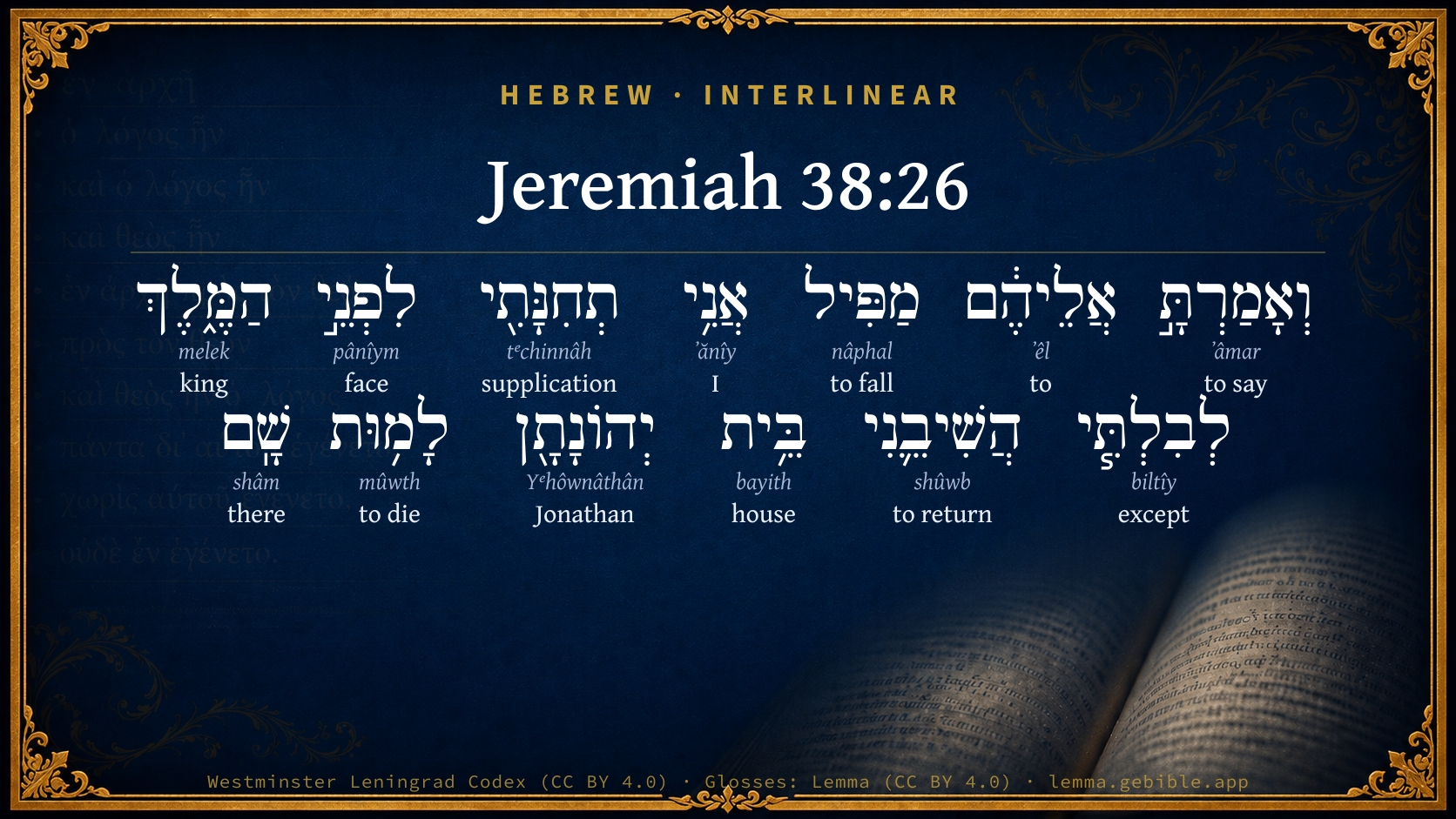
Hebrew (Westminster Leningrad Codex) Jeremiah 38:26 appears in the Hebrew Old Testament. The text above is from the Westminster Leningrad Codex. Each word links to its Strong’s number, a concise gloss, and parsing drawn from the Open Scriptures Hebrew Bible morphology. Click any word for its full Brown-Driver-Briggs (BDB) entry.
Download image
Cite this verse

Jeremiah 38:26 (World English Bible). Public Domain. Lemma interlinear Bible study tool, https://lemma.gebible.app/v/jeremiah/38/26.

Show BibTeX & RIS
BibTeX
RIS
English Translation
then you shall tell them, I presented my supplication before the king, that he would not cause me to return to Jonathan's house, to die there.
World English Bible · Public Domain
Download a study sheet

One document with this verse’s original text, its word-by-word gloss line, the meaning frame, cross-references with their text, attributed commentary, and full source and license credits — printable, and it pastes into notes with its structure intact.

This verse Autodidact and up

Study sheet (.html) Plain text (.txt)

A passage Seminary Student

Up to 50 verses in one chapter. A passage sheet keeps up to 6 commentary sources and 12 cross-references per verse, in the order this page ranks them, and says so on the sheet whenever that leaves anything out. Ask for a single verse and you get the Autodidact verse sheet above.

Everything on this page stays free to read, with no account — the sheet is a download of what is already on screen, not access to it.

Want to remove ads? Support Godless Engineer
Compare translations 3

The same verse in 3 English versions, stacked beneath the original-language interlinear above. Click any original word for its lexicon entry.

Each is an independent rendering of the whole verse — the interlinear is not word-aligned to these translations.

Highlighted words mark where these versions differ — a whole-verse word diff, not a word-by-word alignment.

  • World English Bible Public Domain
    then you shall tell them, I presented my supplication before the king, that he would not cause me to return to Jonathan's house, to die there.
  • King James Version Public Domain
    Then thou shalt say unto them, I presented my supplication before the king, that he would not cause me to return to Jonathan's house, to die there.
  • unfoldingWord Literal Text CC BY-SA 4.0
    then you must say to them, ‘I made a humble plea before the king that he would not return me to the house of Jonathan to die there.’”

unfoldingWord Literal Text — © unfoldingWord, licensed CC BY-SA 4.0. Word-aligned USFM3 via Door43 (git.door43.org/unfoldingWord/en_ult).

Versions to compare (up to 4)

3 of 4 selected

Show all 18 translations

Every available English version of this verse, each an independent rendering of the whole verse.

  • World English Bible Public Domain
    then you shall tell them, I presented my supplication before the king, that he would not cause me to return to Jonathan's house, to die there.
  • Berean Standard Bible Public Domain
    then tell them, ‘I was presenting to the king my petition that he not return me to the house of Jonathan to die there.’”
  • Majority Standard Bible Public Domain
    then tell them, ‘I was presenting to the king my petition that he not return me to the house of Jonathan to die there.’”
  • King James Version Public Domain
    Then thou shalt say unto them, I presented my supplication before the king, that he would not cause me to return to Jonathan's house, to die there.
  • American Standard Version (1901) Public Domain
    then thou shalt say unto them, I presented my supplication before the king, that he would not cause me to return to Jonathan's house, to die there.
  • Revised Version (1885) Public Domain
    then thou shalt say unto them, I presented my supplication before the king, that he would not cause me to return to Jonathan’s house, to die there.
  • Geneva Bible (1599) Public Domain
    Then shalt thou say vnto them, I humbly besought the King that he would not cause me to returne to Iehonathans house, to die there.
  • Douay-Rheims (1899) Public Domain
    Thou shalt say to them: I presented my supplication before the king, that he would not command me to be carried back into the house of Jonathan, to die there.
  • Young's Literal Translation Public Domain
    then thou hast said unto them, I am causing my supplication to fall before the king, not to cause me to return to the house of Jonathan, to die there.'
  • Literal Standard Version CC BY-SA 4.0
    then you have said to them, I am causing my supplication to fall before the king, not to cause me to return to the house of Jonathan, to die there.”
  • Unlocked Literal Bible CC BY-SA 4.0
    then you must say to them, 'I made a humble plea before the king that he would not return me to the house of Jonathan to die there.'”
  • unfoldingWord Literal Text CC BY-SA 4.0
    then you must say to them, ‘I made a humble plea before the king that he would not return me to the house of Jonathan to die there.’”
  • Darby Bible Public Domain
    then thou shalt say unto them, I presented my supplication before the king, that he would not cause me to return to Jonathan's house, to die there.
  • World Messianic Bible Public Domain
    then you shall tell them, ‘I presented my supplication before the king, that he would not cause me to return to Jonathan’s house, to die there.’”
  • Webster's Bible Public Domain
    Then thou shalt say to them, I presented my supplication before the king, that he would not cause me to return to Jonathan's house, to die there.
  • Free Bible Version CC BY-SA 4.0
    then you are to tell them, ‘I was asking the king to grant my request not to return me to the house of Jonathan to die there.’”
  • Bible in Basic English Public Domain
    Then you are to say to them, I made my request to the king, that he would not send me back to my death in Jonathan's house.
  • JPS Tanakh (1917) Public Domain
    then thou shalt say unto them: I presented my supplication before the king, that he would not cause me to return to Jonathan's house, to die there.'

Literal Standard Version (2020), Covenant Press — licensed CC BY-SA 4.0. Text via the HelloAO Bible API (eBible.org). Unlocked Literal Bible (unfoldingWord) — licensed CC BY-SA 4.0. Text via the HelloAO Bible API (eBible.org). unfoldingWord Literal Text — © unfoldingWord, licensed CC BY-SA 4.0. Word-aligned USFM3 via Door43 (git.door43.org/unfoldingWord/en_ult). Free Bible Version, Dr. Jonathan Gallagher — licensed CC BY-SA 4.0. Text via the HelloAO Bible API (eBible.org).

Word by word

More ways to search: Search by grammar → Find every occurrence → Compare this word →

Practice this passage: Drill this verse → Learn its vocabulary →

תְחִנָּתִ֖י
tᵉchinnâh
H8467
“supplication · my”
Noun, Common, Feminine, Singular, Construct + Suffix, Personal, 1st Person, Common, Singular
Part of Speech
Noun
Type
Common
Gender
Feminine
Number
Singular
State
Construct
Full BDB Definition

Origin: from H2603

TWOT: 694f

favour, supplication, supplication for favour - favour - supplication for favour
  1. וְאָמַרְתָּ֣ ʼâmar H559 “and · to say” Conjunction + Verb, Qal, Sequential Perfect, 2nd Person, Masculine, Singular
  2. אֲלֵיהֶ֔ם ʼêl H413 “to · them” Preposition + Suffix, Personal, 3rd Person, Masculine, Plural
  3. מַפִּיל nâphal H5307 “falling” Verb, Hiphil, Participle Active, Masculine, Singular, Absolute
  4. אֲנִ֥י ʼănîy H589 “I” Pronoun, Personal, 1st Person, Common, Singular
  5. לִפְנֵ֣י pânîym H6440 “to/for · face(s) of” Preposition + Noun, Common, Both, Plural, Construct
  6. הַמֶּ֑לֶךְ melek H4428 “the · king” Particle, Definite Article + Noun, Common, Masculine, Singular, Absolute
  7. לְבִלְתִּ֧י biltîy H1115 “to/for · except” Preposition + Conjunction
  8. הֲשִׁיבֵ֛נִי shûwb H7725 “to return · me” Verb, Hiphil, Infinitive Construct + Suffix, Personal, 1st Person, Common, Singular
  9. בֵּ֥ית bayith H1004 “house of” Noun, Common, Masculine, Singular, Construct
  10. יְהוֹנָתָ֖ן Yᵉhôwnâthân H3083 “Jonathan” Noun, Proper
  11. לָמ֥וּת mûwth H4191 “to die” Preposition + Verb, Qal, Infinitive Construct
  12. שָֽׁם shâm H8033 “there” Adverb

About this verse

These counts appear in no published source. They are computed here, from the morphology-tagged text and Lemma’s own curated glosses. What Lemma adds →

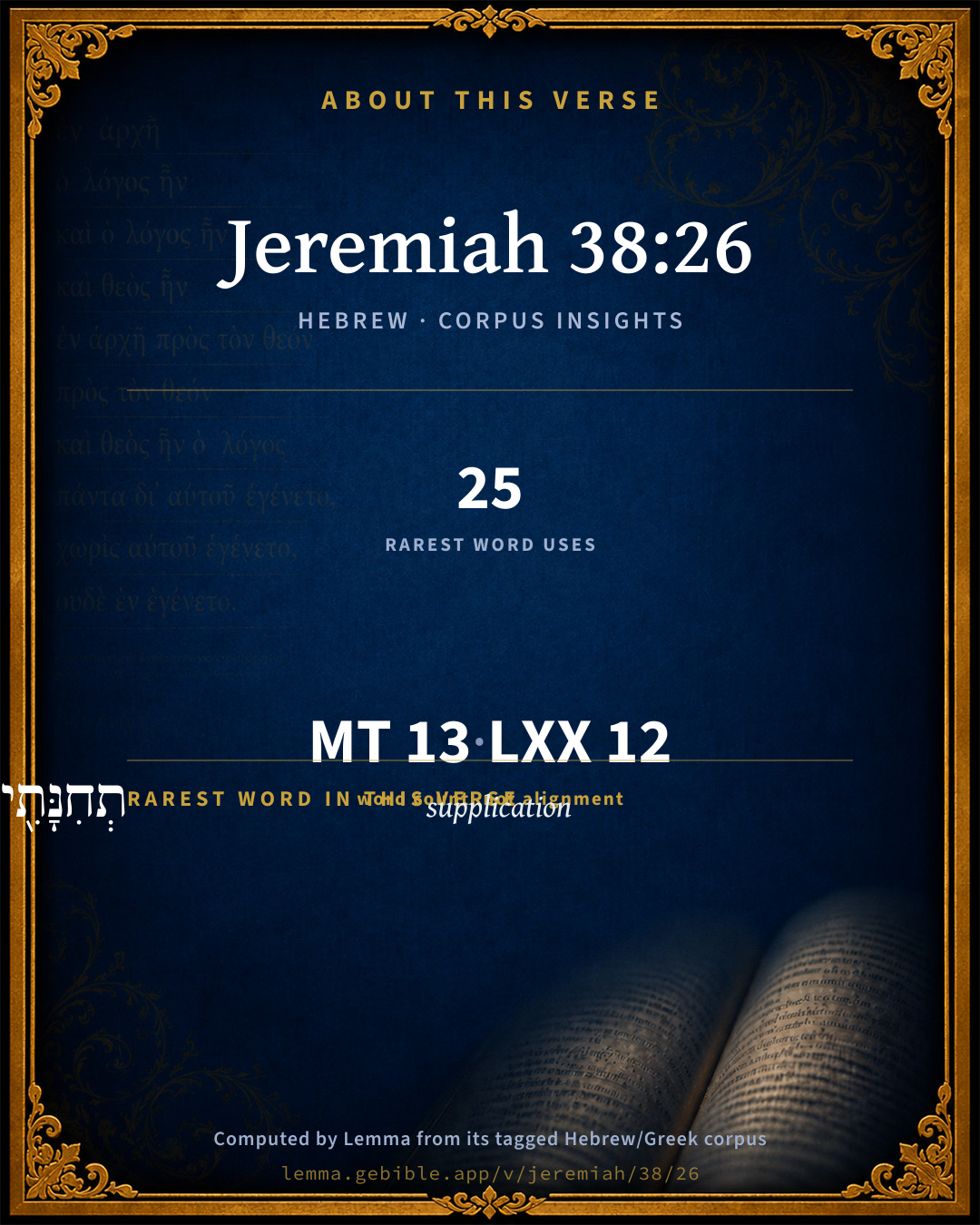
13
words
13
distinct lemmas
Prophets
section

Notable vocabulary

The rarest word here is תְחִנָּתִ֖י supplication H8467 — appearing just 25 times in the whole Hebrew Bible.

Shared distinctive vocabulary

תְחִנָּתִ֖י supplication H8467 occurs in 24 verses of the Hebrew Bible. Also found in:

Grammatical profile

  • 4 verbs
  • 5 nouns
  • 1 pronoun
  • 1 preposition
  • 1 conjunction
  • 1 adverb

Verb forms

  • וְאָמַרְתָּ֣ Qal · Sequential Perfect
  • מַפִּיל Hiphil · Participle Active
  • הֲשִׁיבֵ֛נִי Hiphil · Infinitive Construct
  • לָמ֥וּת Qal · Infinitive Construct

Hebrew & Septuagint length

In the original languages it is 13 Hebrew tokens and 12 Greek tokens — but the two are counted differently (Hebrew bundles its prefixes and suffixes into one token; the Greek is in lemma form), so that isn’t a like-for-like length.

Cross-references

4

Topical passages linked to Jeremiah 38:26 in the Treasury of Scripture Knowledge — connected by theme and wording, ordered by reader-vote popularity; previews shown in the World English Bible.

  • Jeremiah 37:20 Now please hear, my lord the king: please let my supplication be presented before you, that you not cause me to return to the house of Jonathan the scribe, lest I die there.
  • Jeremiah 37:15 The princes were angry with Jeremiah, and struck him, and put him in prison in the house of Jonathan the scribe; for they had made that the prison.
  • Esther 4:8 Also he gave him the copy of the writing of the decree that was given out in Shushan to destroy them, to show it to Esther, and to declare it to her, and to charge her that she should go in to the king, to make supplication to him, and to make request before him, for her people.
  • Jeremiah 42:2 and said to Jeremiah the prophet, Let, we pray you, our supplication be presented before you, and pray for us to Yahweh your God, even for all this remnant; for we are left but a few of many, as your eyes do see us:

Cross-references courtesy of OpenBible.info (CC BY 4.0).

Hebrew and Greek witnesses Masoretic Hebrew ↔ Greek Septuagint

The same verse in the two great witnesses to the Old Testament, shown verse-for-verse.

These are two independent witnesses, not word-aligned to each other, and the Septuagint is shown in lemma (dictionary) form.

Hebrew Jeremiah 38:26 Masoretic · Westminster Leningrad Codex

וְאָמַרְתָּ֣ אֲלֵיהֶ֔ם מַפִּיל אֲנִ֥י תְחִנָּתִ֖י לִפְנֵ֣י הַמֶּ֑לֶךְ לְבִלְתִּ֧י הֲשִׁיבֵ֛נִי בֵּ֥ית יְהוֹנָתָ֖ן לָמ֥וּת שָֽׁם

then you shall tell them, I presented my supplication before the king, that he would not cause me to return to Jonathan's house, to die there.

World English Bible · Public Domain

Greek LXX Structure differs

In the Septuagint, Jeremiah is about an eighth shorter than the Hebrew and arranges its material differently — the Oracles Against the Nations (Hebrew chapters 46–51) appear in the middle of the Greek book, after 25:13. Because the chapter and verse boundaries do not line up, a verse-for-verse comparison with the Hebrew is not shown.

A verse-for-verse comparison isn’t shown here because the chapters and verses don’t line up. Switch to the LXX edition with the MT / LXX toggle above to read the Greek directly.

Hebrew: Westminster Leningrad Codex (CC BY 4.0). Greek: Septuagint (public domain); English from a public-domain English Septuagint. How the Septuagint differs from the Hebrew →

Targum (Aramaic paraphrase)

1

The Targum is the ancient Jewish Aramaic paraphrase of the Hebrew Scriptures — an interpretive translation, not the Hebrew text itself. Onkelos (literal) and Pseudo-Jonathan (expansive) render the Torah, and Jonathan the Prophets. Coverage is partial: where no permissively-licensed English translation exists for a verse, only the Aramaic is shown. This is verse-level text, not a word-by-word alignment to the Hebrew.

  1. Targum Jonathan Prophets (Joshua–Malachi)
    וְתֵימַר לְהוֹן בְּעוּ אֲנָא בְּעֵי קֳדָם מַלְכָּא בְּדִיל דְלָא לְאַתָבוּתִי בֵּית יְהוֹנָתָן לְמֵימָת תַּמָן:

    (no public-domain English translation for this verse)

    Targum Jonathan — Aramaic: “Mikraot Gedolot” (public domain). English: “Sefaria Community Translation” (CC0 1.0 (public-domain dedication)); “London "Chaldee Paraphrase," 1871” (public domain). Text via Sefaria.

Commentary

Notes on Jeremiah 38:26 from classic Christian and Jewish commentators (each source and its license shown beneath its notes). The classic Christian expositions comment on the surrounding passage and are grouped to its opening verse, so a note may address several verses; the Jewish commentaries on the Tanakh (Rashi and others) are per-verse, so they appear only where the commentator wrote on this verse.

Lemma curates 59 commentaries, every one of them public domain or Creative Commons licensed, each selected and text-cleaned for this edition rather than reprinted as found. About our sources →

Trapp's Complete Commentary

John Trapp

Jer 38:26 Then thou shalt say unto them, I presented my supplication before the king, that he would not cause me to return to Jonathan’s house, to die there.

Ver. 26. Then shalt thou say unto them, I presented my supplication.] This was to tell part of the truth only (which might lawfully be done), and not to tell an officious, or at least an oblique lie, as some would make it to be.

John Trapp, A Commentary or Exposition upon All the Books of the Old and New Testament (1647–1656) — public domain. Text from a community e-Sword module.

Geneva Bible (1599)

Geneva Bible translators

Herein appeareth the infirmity of the Prophet, who did dissemble to save his life albeit it was not to the denial of his doctrine, or to the hurt of any.

Geneva Bible (1599) marginal notes — public domain. Text via Bolls.life.

Jamieson, Fausset & Brown

Robert Jamieson, A. R. Fausset & David Brown

presented--literally, "made my supplication to fall"; implying supplication with humble prostration (see on Jer 36:7).

Jonathan's house-- (Jer 37:15), different from Malchiah's dungeon (Jer 38:6). This statement was true, though not the whole truth; the princes had no right to the information; no sanction is given by Scripture here to Jeremiah's representation of this being the cause of his having come to the king. Fear drove him to it. Compare Gen 20:2, Gen 20:12; on the other hand, Sa1 16:2, Sa1 16:5.

left off speaking with--Hebrew, "were silent from him," that is, withdrawing from him they left him quiet (Sa1 7:8, Margin).

Jamieson, Fausset & Brown — Commentary Critical and Explanatory on the Whole Bible (1871) — public domain (CC PDM 1.0). Text via the HelloAO Bible API.

Adam Clarke's Commentary

Verse 26. I presented my supplication] This was telling the truth, and nothing but the truth, but not the whole truth. The king did not wish him to defile his conscience, nor did he propose any thing that was not consistent with the truth.

Adam Clarke's Commentary on the Bible (1810–1826) — public domain. Text from a community e-Sword/MySword module.

John Calvin's Commentaries

He says, “Though they promise thee impunity, trust them not.” Zedekiah feared lest the Prophet should be too credulous, and should freely relate to the counselors what he had said. But he no doubt had reflected on the fact, that the Prophet had already announced the destruction of the city. He then could have hardly hoped for the silence which he required. Hence then it was, that he so earnestly bid him to be careful; and though the counselors should promise that there would be no danger to him, he yet bade him to be silent. Say to them, he said, I humbly prayed the king not to send me back to the house of Jonathan, that I might not die there It was not indeed a falsehood, but this evasion cannot be wholly excused. The Prophet justly feared, and, as we have before seen, he was perplexed and anxious, for that prison was horrible, and it would have been better at once to die than to have been thus buried alive in the earth. But it is certain that he did not come to the king for this purpose, for he had been sent for. Though, then, the Prophet did not expressly or in so many words say what was false, yet it was a kind of falsehood; and what follows, in reference to himself, cannot be excused.

John Calvin's Commentaries (1540-1563) — public domain. Text from the Calvin Translation Society English edition (1840s-50s) via the Christian Classics Ethereal Library (ccel.org). Calvin's coverage is partial (roughly two-thirds of the Bible); uncommented books and verses are honest gaps, never fabricated. The 19th-century editor's footnotes and remarks are omitted so the notes are faithfully Calvin's own voice.

The Cambridge Bible for Schools and Colleges

gen. ed. J. J. S. Perowne

26. I presented my supplication] See on Jer_36:7.

to Jonathan’s house] See Jer_37:15.

The Cambridge Bible for Schools and Colleges (gen. ed. J. J. S. Perowne; Cambridge University Press, 1878–1918) — public domain. Text from a community e-Sword module.

John Gill's Exposition

Then thou shalt say unto them,.... Here the king puts words into the prophet's mouth, what he should say to the princes, to put them off from inquiring further, and so keep the matter a secret:

I presented my supplication before the king; or "caused it to fall" (d); delivered it in an humble and submissive manner:

that he would not cause me to return to Jonathan's house, to die there; this he had entreated of the king before, Jer 37:20; and now, no doubt, renewed his request, having this fair opportunity with the king alone to do it; or, however, it is highly probable he did it upon this hint of the king. This shows how much the king stood in fear of his princes in this time of his distress; and that he had only the name of a king, and had not courage and resolution enough to act of himself, according to the dictates of his mind; yea, that he feared men more than he feared the Lord.

(d) "cadere feci deprecationem meam", Pagninus; "cadere faciens fui", &c. Schmidt.

John Gill's Exposition of the Whole Bible (1746–1763) — public domain (CC PDM 1.0). Text via the HelloAO Bible API.

Haydock's Catholic Bible Commentary

There. This he had actually done, chap. xxxvii. 19. He perhaps renewed the petition, at this interview, to satisfy the king. (Haydock) --- We may conceal the truth, but must never speak what is false. (Calmet) --- "In a matter, says Puffendorf, which I am not obliged to declare to another, if I cannot with safety conceal the whole, I may fairly discover no more than a part." Who can require a privy counsellor to reveal the king’s secret? Yet Paine accuses the prophet of duplicity! (Watson)

George Leo Haydock (1774–1849), Haydock's Catholic Family Bible and Commentary, 1859 edition — public domain. Excludes Psalms (Douay-Rheims chapter numbering differs from Protestant) and Deuterocanonical books (Catholic canon only).

Matthew Poole's English Annotations

The king instructs the prophet, in case the princes should be inquisitive to know what discourse passed betwixt the king and him, to tell them that he petitioned him that he might be sent no more to the prison in the house of Jonathan, of which he complained, and petitioned the king to be freed from it, Jer 37:20.

Matthew Poole's English Annotations on the Holy Bible (1683–1685) — public domain. Text from a community e-Sword/MySword module.

Whedon's Commentary on the Bible

Daniel D. Whedon

26. I presented my supplication, etc. — True, but misleading. In this it has several parallels in the Bible. If asked whether it was right, the only safe answer is, We cannot fully decide. There may have been much affecting the case which we do not know. It is very certain that a man has a right to withhold the truth when to tell it would do harm.

Daniel D. Whedon (gen. ed.), Commentary on the Old and New Testaments (1874–1909) — public domain. Text from a community e-Sword module.

Lesson kit

Teaching starters — assembled from the data on this page, not authored interpretation. Every prompt links to the verse data it draws on. Edit before teaching.

Jeremiah, in the Prophets, opens this verse with 13 words (13 distinct Hebrew lemmas). Its most distinctive word is tᵉchinnâh (“supplication”). A historical commentator’s framing appears above. Read the whole chapter for the surrounding context.

Discussion questions

  1. What does “supplication” (tᵉchinnâh) contribute to the verse as a whole?
  2. Joshua 11:20 shares the word «supplication» with this verse. How do the two illuminate each other?
  3. These translations render this verse differently; the difference is in the English rendering, not the original. What questions does that raise?
  4. The verb «וְאָמַרְתָּ֣» is Qal Sequential Perfect. How does its form color the action?
  5. Reading how Trapp's Complete Commentary and Geneva Bible (1599) read this verse, where do the two commentators agree and where do they part?

Things to notice

Reading settings

Reading text

Shown beneath each verse's original-language words.

Old Testament
Old Testament edition

Read the OT as the Masoretic Hebrew (MT) or the Greek Septuagint (LXX).

English shown for the Greek Septuagint (in the Hebrew ↔ Greek comparison).

Comparing translations? Open the Compare panel on any verse page to stack up to four side by side.