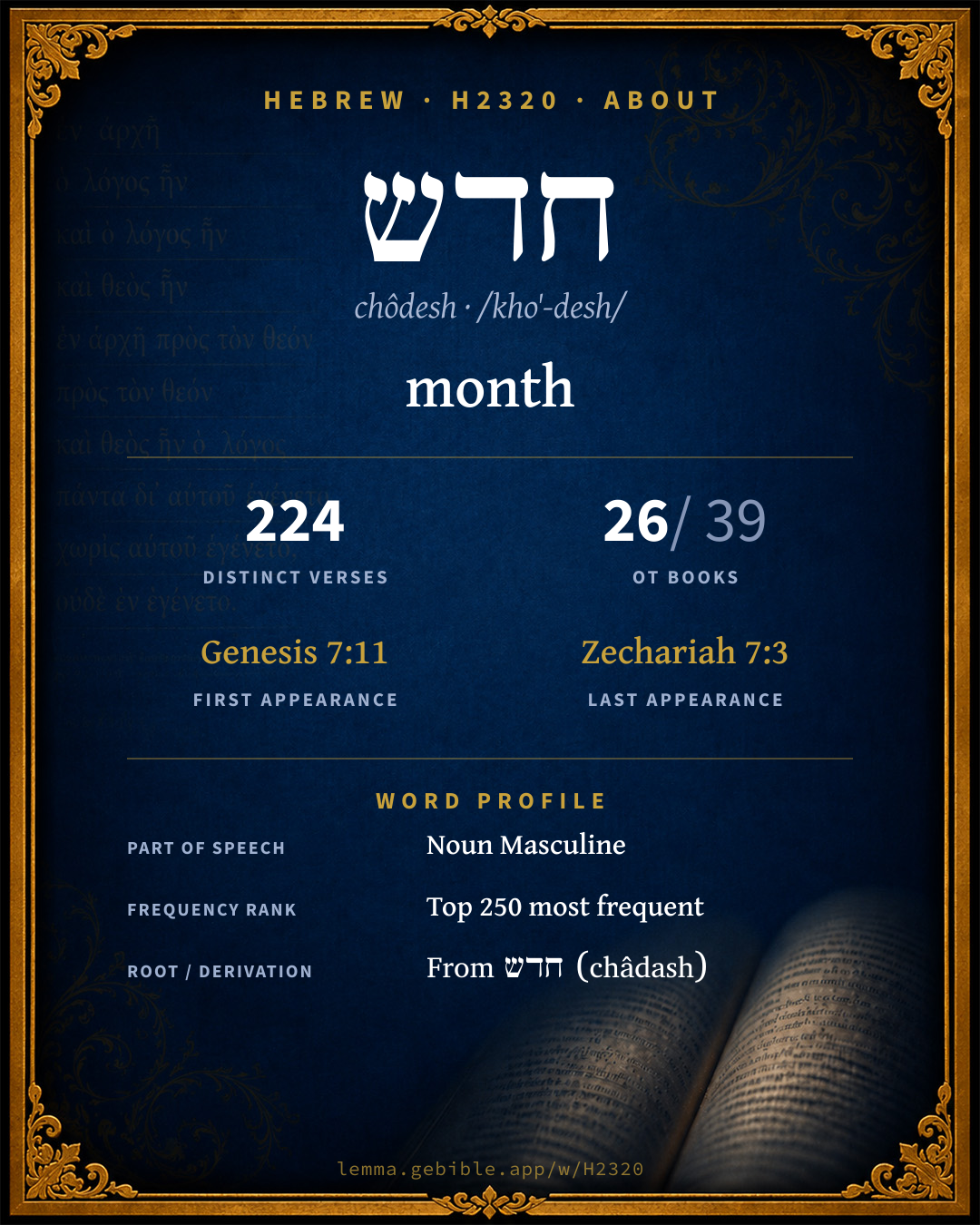
חֹ֫דֶשׁ
month
also: the new moon, monthly fuller range ↓
Full lexicon entry — Brown-Driver-Briggs (BDB)
From Brown-Driver-Briggs (BDB)
Where this word appears
See every Absolute-state word in the Hebrew Bible →
Grammar key — what these labels mean
Part of speech
- Noun
- A naming word — a person, place, thing, or idea.
Noun type
- Common
- A common noun — a general class of person, place, or thing (“king,” “city,” “water”), not a specific name.
State
- Absolute
- The independent form of a noun, not bound to a following word.
- Construct
- A noun bound to a following noun in a possessive / “of” relationship (the construct chain).
Gender
- Masculine
- Grammatically masculine.
Number
- Singular
- One.
- Plural
- More than one (in Hebrew, generally three or more).
1 verse where H2320 appears in the Construct state in the Book of Jeremiah. Filtered view — show all forms. Click any verse to open its interlinear word-by-word view. Verse text shown in the World English Bible for context — . Each verse’s Hebrew form is shown with its reference; the English is not keyword-highlighted, since the data carries no word-level English alignment. Use “Compare translations” on any verse to read it across multiple English versions. This concordance covers the Hebrew Bible; Septuagint (Greek Old Testament) occurrences are not indexed here.
Jeremiah
About this entry
At a glance — auto-summarized from this page’s data, not written by a person. Every figure links to its source below. This summary describes the numbers; it doesn’t interpret them.
“month” is the headline sense of the Hebrew noun חדש (chôdesh). First canonically at Genesis 7:11, it enters the text early. It turns up in 224 verses across 26 books, a common footprint. Not a single-sense word: its full sense range also takes in “the new moon” and “monthly”. From the same root come חדש, חדש and חדש. See the sense tree, 224-verse concordance, and the renderings breakdown below.
Gloss history
Strong's 1890 vs modern scholarship
About this word
Strong's H2320 catalogs a Hebrew word from the Hebrew Old Testament.
These counts are not copied from any lexicon or concordance. They are computed here, from the morphology-tagged Hebrew Old Testament. What Lemma adds →
- 224
- distinct verses
- The word appears in 224 distinct verses.
- 26 / 39
- OT books
- The word appears in 26 of 39 Old Testament books.
- #177
- by frequency
- Top 250 most frequent Hebrew words (rank 177 of 8,640 Hebrew words by occurrence).
View all 224 occurrences in the concordance →
Most concentrated in
- Numbers 31 verses 14%
- Ezekiel 25 verses 11%
- 1 Chronicles 19 verses 8%
By section of the Old Testament
By traditional corpus
Conventional, traditional groupings — biblical authorship is debated, so this is a traditional corpus grouping, not an authorship claim. Each share is this word’s portion of its verses in that division of the Hebrew canon. Each figure is a share of the word’s 224 distinct verses.
- Prophets (Nevi'im) 91 verses · 41%
- Writings (Ketuvim) 70 verses · 31%
- Torah (Pentateuch) 63 verses · 28%
How translations render this word
Counts come from each version’s own published word-to-Strong’s tagging or interlinear alignment — an approximate guide to how each version renders this word, not a word-level alignment the data otherwise carries. Because each total is that version’s own tagged count, the per-version totals vary from one another and need not match the appearance or distinct-verse counts above. These counts may also differ from a printed concordance because Lemma counts each distinctly tagged rendering and does not collapse phrase taggings into a single head-word total. This is a fixed set of word-tagged versions (KJV, ASV, BSB, ULT) and does not change with the reading translation you choose elsewhere. Each version’s license is shown beside its name below (and on Sources).
BDB lists this Strong’s number as 2 distinct words (homographs). Each count above pools all of them and is not split by sense — see the Senses section below. A low-frequency rendering may belong to a different one of those words, not the primary meaning.
- King James Version†: Month 160×, Day of the month 36×, Months 33×
- American Standard Version†: Month 156×, Months 31×, Day of the month 24×
- Berean Standard Bible†: Month 158×, Months 31×, Day 18×
- unfoldingWord Literal Text†: Month 176×, The 75×, Months 34×
King James Version Public Domain
Renders H2320 across 276† tagged occurrences — most commonly:
Plus 20 renderings that appear only once — usually multi-word phrases or single function words the recovered tagging swept in, not distinct renderings.
American Standard Version Public Domain
Renders H2320 across 276† tagged occurrences — most commonly:
Plus 31 renderings that appear only once — usually multi-word phrases or single function words the recovered tagging swept in, not distinct renderings.
Berean Standard Bible Public Domain
Renders H2320 across 253† tagged occurrences — most commonly:
Plus 10 renderings that appear only once — usually multi-word phrases or single function words the recovered tagging swept in, not distinct renderings. Not rendered by a distinct English word in 30 further occurrences.
unfoldingWord Literal Text CC BY-SA 4.0
Renders H2320 across 358† tagged occurrences — most commonly:
Plus 11 renderings that appear only once — usually multi-word phrases or single function words the recovered tagging swept in, not distinct renderings.
Senses in the full BDB
What do BDB’s symbols mean?
BDB uses these scholarly abbreviations:
| Symbol | Meaning |
|---|---|
| 𝔊 | the Septuagint (the ancient Greek translation, LXX) |
| 𝔙 | the Vulgate (the Latin translation) |
| 𝔖 | the Syriac version (the Peshitta) |
| 𝔗 | the Targum (the Aramaic translation) |
| ψ | the Psalms |
| √ | root (the underlying root or stem) |
| ‖ | parallel passage (a synonymous or contrasted parallel) |
| † | the dagger: every passage where the word occurs is cited |
The 4 senses and sub-senses the full Brown-Driver-Briggs lexicon distinguishes for this word, in lexicon order (not ranked by frequency), with BDB’s own verbatim wording and sub-sense lettering. Shown in Hebrew script with BDB’s own scholarly abbreviations. The condensed entry is in the Lexicon Entry tab. See also the Forms in the corpus table below.
חדש I
- 1. new moon=day, time, of new moon, as religious festival 1 S 20:5, 18, 24, 27, 34 (Dr); cf. יֹאכְלֵם ח׳ Ho 5:7 a new moon shall devour them, Hi St VB, but on text v. We; usually ‖ שַׁבָּת Am 8:5 2 K 4:23 Is 1:13 (+קְרֹא מִקְרָא), מִדֵּי חֹדֶשׁ בְּחָדְשׁוֹ 66:23, Ez 46:1, 6 (both יוֹם הַח׳), 1 Ch 23:31 2 Ch 2:3; 8:13; 31:3 Ne 10:34 (all + מוֹעֵד), Ho 2:13 Ez 45:17 (both + חג, מועד); ‖ מוֹעֵד alone Is 1:14 Ez 3:5; ‖ יוֹם חַגֵּנוּ ψ 81:4; (cf. רֹאשׁ הַח׳ Nu 10:10; 28:11; on religious observance of new moon cf. Di Lv p. 578 f BenzArchäol. § 69); as time of augury in Babylon (astrolog. prognost.) Is 47:13. e.g. 1 Samuel 20:5
- 2. month (as beginning with new moon, lunar month; cf. BenzArchäol. § 30, but then, without ref. to day of beginning):
- a. as measure of time during which Gn 38:24 (J), Nu 11:20, 21 (JE), 9:22 (P), Ju 11:37, 38, 39; 20:47 1 S 6:1; 27:7 2 S 2:11; 5:5; 6:11; 24:8, 13 = 1 Ch 21:12, Am 4:7 1 K 4:7; 5:7, 28(×3); 11:16 2 K 15:8; 23:31; 24:8 Ez 39:12, 14 1 Ch 3:4; 13:14 2 Ch 36:2, 9 Est 2:12(×3). In 1 S 10:27 b read prob. כְּמֵחֹרֶשׁ for MT כמחרישׁ, and join to 11:1, so 𝔊 We Dr (cf. Gn 38:24); in combinatios, ח׳ יָמִים a month (of) time (cf. יֶרַח ימים Dt 21:1 2 K 15:23) Gn 29:14 (J), Nu 11:20, 26 (JE), ימים ארבעה ח׳ Ju 19:2; of age מִסְפַּר־ח׳ number of his months=length of his life Jb 14:5; 21:21; cf. especially בֶּן־ח׳ Lv 27:6 Nu 3:15, 22, 28, 34, 39, 40, 43; 18:16; 26:62 (all P). e.g. Genesis 38:24
- b. calendar months, †(1) with names ח׳ הָאָבִיב Ex 13:4; 23:15; 34:18(×2) (all JE; = 1st mo. 12:2 P), Dt 16:11; ח׳ זִו 1 K 6:1 (=2nd mo. ib.;=יֶרַח זִו v 37); cf. 8:2 (הַח׳ הַשְּׁבִיעִי = יֶרַח הָאֵתָנִים), 6:38 (הַח׳ הַשְּׁמִינִי = יֶרַח בּוּל); in the postex. books occur Babyl. names (v. the several words):—ח׳ נִיסָן Ne 2:1 Est 3:7 (= 1st mo. Est 3:7); ח׳ סִיוָן Est 8:9=3rd mo.; ח׳ כִּסְלֵו Zc 7:1 Ne 1:1 (=9th mo. Zc 7:1); ח׳ טֵבֵ֑ת Est 2:16=10th mo.; ח׳ שְׁבָט Zc 1:7=11th mo.; ח׳ אֲדָר Est 3:7, 13; 8:12; 9:1 in all=12th mo., 9:15, 17, 19, 21; (cf. also אֱלוּל Ne 6:15, without ח׳ or יֶרַח; this was 6th mo.; v. further SchrCOT Ne 1:1 Benzl.c.).† (2) merely numbered (chiefly P and late) e.g. בַּח׳ הַשֵּׁנִי Gn 7:11, cf. 8:4, 5, 14 Lv 16:29 Nu 1:1, 18 (all P) + often P; Dt 1:3 (P), 1 K 12:32, 33; 2 K 25:1, 3, 8, 25, 27 Je 1:3 + 11 times Je, Ez 24:1; 32:1 Hg 1:1, 15 Zc 1:1; 7:1, 3; 1 Ch 12:15, cf. entire list 27:2–15 2 Ch 3:2 + 12 times 2 Ch; Ezr 3:1 + 10 times Ezr; Ne 7:72; 8:2, 14 Est 3:12; note especially הַח׳ הַזֶּה לָכֶם רֹאשׁ חָדָשִׁ֑ים רִאשׁוֹן הוּא לָכֶם Ex 12:2 (P), as implying that the 1st mo. was formerly not in the spring; observe also usage of omitting ח׳, e.g. בָּרִאשׁוֹן = בַּח׳ הָר׳ Gn 8:13, cf. v 5; so commonly in Ezek.:—Ez 1:1; 8:1; 20:1; 29:1, 17; 30:20; 31:1; 33:21; 45:18, 21, 25 + 26:1; 32:17; 45:20 Co(ח׳ sometimes expr., v. Ez 24:1; 32:1 supr.; on like usage with יום v. יום). (3) special phrases and usages are:— †עֹלַת חֹדֶשׁ בְּחָדְשׁוֹ לְחָדְשֵׁי שָׁנָה Nu 28:14 (P; cf. יום, and Is 66:23 supr. 1); מִיּוֹם לְיוֹם וּמֵחֹדֶשׁ לְחֹדֶשׁ Est 3:7 from day to day and from month to month; חָדְשָׁהּ Je 2:24 of wild she-ass’s mating time.† e.g. Exodus 13:4
חדש II f. a wife of Shaharaim of Benj. 1 Ch 8
Senses from the full Brown-Driver-Briggs lexicon (Brown, Driver, Briggs; Oxford 1906 — public domain), digitized via Sefaria, supplemented by the OpenScriptures HebrewLexicon (CC BY 4.0). Full attribution on Sources.
Word origin
I. n.m. Gn 7:11 (f. MT 38:24 but m. Sam Di) (newness), new moon, month (on format. cf. LgBN 144; on usage, names, etc., Muss-ArnoltJBL 1892, 72 ff., 160 ff.)—ח׳ abs. Gn 7:11 +; cstr. (rare) Gn 29:14 +; sf. חָדְשׁוֹ Nu 28:14 + 2 times; חָדְשָׁהּ Ho 2:13 Je 2:24; pl. חֳדָשִׁים Gn 38:24 +; cstr. חָדְשֵׁי Ex 12:2 + 2 times; sf. חֳדָשָׁיו Jb 14:5 + 2 times; חָדְשֵׁיכֶם Is 1:14 Nu 28:11; חָדְשֵׁכֶם Nu 10:10;—
II. n.pr.f. a wife of Shaharaim of Benj. 1 Ch 8:9, 𝔊 Ἁδα, 𝔊L Βαδαα (so v 8 = בַּעֲרָה).
— Brown-Driver-Briggs (Oxford 1906, public domain), digitized via Sefaria, supplemented by the OpenScriptures HebrewLexicon (CC BY 4.0). See Sources.
Derived from חדש (châdash) (H2318) — to renew.
Jastrow Dictionary
A second Hebrew/Aramaic lexicon for comparison, covering Aramaic and post-biblical (Talmudic, Targumic, Midrashic) usage that the biblical-Hebrew BDB does not. Matched by lemma rather than by Strong’s number, so a lemma may carry more than one Jastrow headword (shown separately below), and the entries cover usage well beyond the Bible.
חָדַשׁ
- (b. h.) [to be bright,] to be new.
- 1. to renew, renovate, polish. Lev. R. s. 29 (ref. to בחדש, Ps. LXXXI, 4) תְּחַדְּשׁוּ מעשיכם ye shall polish (cleanse) your doings. Gen. R. s. 78, beg. (ref. to Lam. III, 23) אתה מְחַדְּשֵׁנוּ וכ׳ thou renewest our lives every morning; אתה מח׳ לבוקרן וכ׳ thou inspirest us with new life in the morning (rise to power) &c., v. בֹּקֶר; a. fr. e.g. Psalms 81:4
- 2. to commence anew, do again. R. Hash. 7ᵃ, a. e. (ref. to Num. XXVIII, 14) חַדֵּשׁ והבא וכ׳ commence a new account and offer T’rumah of the new produces. e.g. Numbers 28:14
- 3. to promulgate a new law, to establish a new interpretation of a Biblical law; to find a new point. Sabb. 104ᵃ, a. fr. (ref. to Lev. XXVI, 46) אין נביא רשאי לְחַדֵּשׁ וכ׳ (v. Rabb. D. S. a. l.) since the promulgation of these laws no prophet has a right to issue a new law. Y. Erub. V, 22ᶜ bot. it is called the New Gate, because there חִידְּשׁוּ וכ׳ (not חו׳) the Sof’rim instituted the interpretation (Halakhah); a. fr. e.g. Leviticus 26:46
- 1. to be renewed, to be established as a new interpretation (cmp. Lat. novellae); to be offered as a new point (דבר חדש). Y. Yeb. VIII, 9ᶜ top (ref. to I Chr. VIII, 9) שעל ידיה נִתְחַדְּשָׁה הלכה וכ׳ at her instance the new interpretation (of the law Deut. XXIII, 4) was established; Midr. Sam. ch. XXII; Ruth R. to II, 5 כבר נ׳ הלכה the law has been interpreted long before. Sot. 3ᵇ, a. fr. לא נשנית אלא בשביל דבר שנ׳ בה the section is repeated for the sake of a new point added. e.g. 1 Chronicles 8:9
- 2. to change turns. Yoma 26ᵃ משמרות מִתְחַדְּשׁוֹת the Temple attendants are relieved.
חָדָשׁ
- preced.) new, fresh, additional. Ber. IX, 3. Sifra introd. לידון בדבר ח׳ in order to be defined by a new point (not included in the general law); a. fr.—Esp. הֶחָ׳ or חָ׳ the new produces of the field not permitted for use before the Omer day (Lev. XXIII, 10—14). Kidd. I, 9 (37ᵃ) אף (מןּ) הח׳ also with the exception of the new produces (the law concerning which applies even to foreign countries). Ib. 39ᵃ תני ח׳ read ‘the new fruit’ (leaving out ‘also’). Dem. IV, 7 שלי ח׳ הוא mine is new fruit (not yet permitted); a. fr.—Pl. חֲדָשִׁים. Yoma II, 4 ח׳ לקטורת בֹּאוּ new men for offering incense (such as never before have performed that function), come and &c. Ib. ח׳ גם ישנים new men and also old ones (who have officiated before this). Lev. R. s. 2, end (ref. to Cant. VII, 14) ח׳ the later leaders, opp. to ישנים the patriarchs; a. fr.—Fem. חֲדָשָׁה. Lev. R. s. 13 תורה ח׳ a new law, expl. חִדּוּשׁ תורה a novel interpretation of the law (concerning slaughtering). Pesik. Baḥod., p. 102ᵃ פרוזדוגמא ח׳ a recent decree; a. fr. e.g. Leviticus 23:10
חֹדֶשׁ
- preced.)
- 1. new moon, i.e. the first appearance of the crescent. R. Hash. I, 9, a. e. מי שראה את הח׳ he who sees the new moon (when it was his duty to travel to the place of the Supreme Court to testify). Ib. יוצאין לעדות הח׳ they travel for the purpose of testifying to the sight of the new moon; a. fr.
- 2. month. Snh. V, 1 באיזה ח׳ in what month?; בכמה בַּח׳ on what day of the month?; a. v. fr.—ראש ח׳ (abbr. ר"ח) the first day of the month, the festival of New Moon. Meg. 21ᵇ פרשת ר"ח the section of the Law read on the New Moon Day (Num. XXVIII, 1—15); a. fr.—Pl. חֳדָשִׁים. Ib. III, 4 בראשי ח׳ on New Moon Days. R. Hash. I, 3 על ששה ח׳ וכ׳ for the proclamation of six New Moon Days messengers are sent abroad. Keth. 60ᵃ שלשה ח׳ at an age of three months; a. fr. [Pesik. Baḥod., p. 154ᵇ ניטש מח׳ וכ׳, read חוֹרֶשׁ.—Y. Shebi. IV, 35ᵇ bot. בחדשי׳, read בחרשי׳, v. חוֹרֶשׁ.] e.g. Numbers 28:1
A Dictionary of the Targumim, the Talmud Babli and Yerushalmi, and the Midrashic Literature (Marcus Jastrow; London, Luzac, 1903) — Public Domain. Digitized via Sefaria. Digitized via Sefaria. Full attribution on Sources.
Forms in the corpus
The 84 distinct written forms H2320 takes in the Hebrew Bible, most frequent first — each parse links to that state’s occurrences in the concordance. Hebrew forms include their vowel points and cantillation, so a single lemma takes many written forms.
The 60 most common forms are shown; 24 rarer forms follow in the full concordance.
Same root — word family
Other BDB entries built from the same root as H2320, grouped by Strong’s listed origin. These share a root / origin per the lexicon — not necessarily a shared meaning. Each links to that word’s own entry.
Derives from
Shares the same root
Proper names from this root
People and places named from this root — a name, not an additional meaning of the word.
Compare all same-root words → 1 of the same-root words is a proper name (a person or place). They share a root, not necessarily a meaning.
Septuagint verse parallels
This word appears in 215 verses that also exist in the Greek Old Testament (Septuagint), out of the 224 Hebrew verses it occurs in. You can read those verses in Greek by switching the Old Testament edition to the Septuagint.
Read these verses in the Septuagint
- Genesis 7:11
- Exodus 12:2
- Leviticus 16:29
- Numbers 1:1
- Deuteronomy 1:3
- Joshua 4:19
- Judges 11:37
- 1 Samuel 6:1
- 2 Samuel 2:11
- 1 Kings 4:7
- 2 Kings 4:23
- 1 Chronicles 3:4
This is a verse-level parallel only — the same verses exist in both the Hebrew and Greek Old Testaments. No word-level Hebrew↔Greek correspondence is claimed: the data carries no such alignment, so no Greek word is shown as this Hebrew word’s translation. Coverage is not total — the Septuagint omits the deuterocanon and renumbers the Psalms, so some Hebrew verses have no direct Greek parallel.