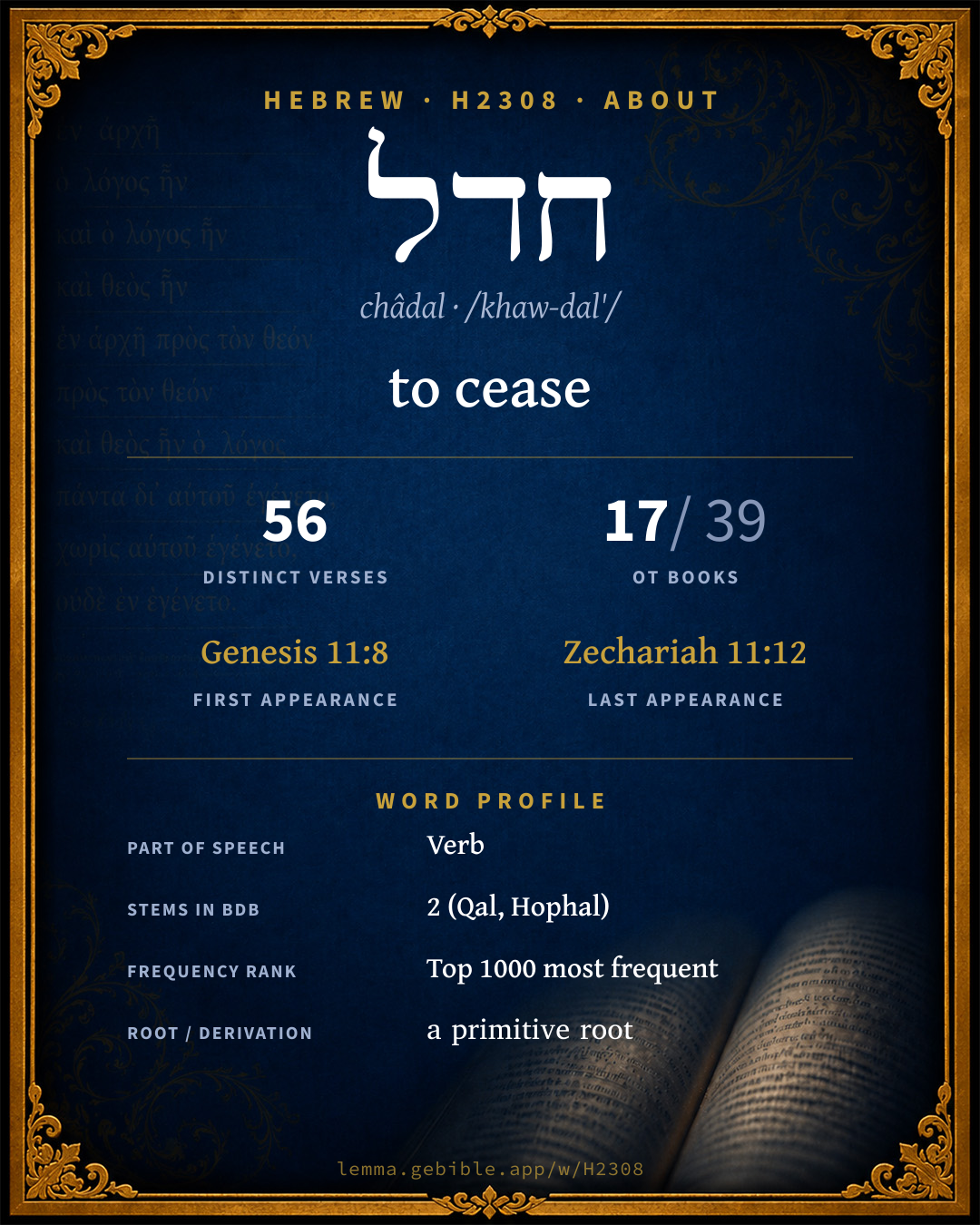
חָדַל
to cease
‘to cease’ is one of 3 main senses fuller range ↓
Full lexicon entry — Brown-Driver-Briggs (BDB)
From Brown-Driver-Briggs (BDB)
Where this word appears
Grammar key — what these labels mean
Part of speech
- Verb
- An action or state-of-being word.
Stem
- Qal
- The basic, simple active stem — the plain form of the verb (“he wrote”). Here: ‘cease’
Form
- Imperative
- A direct command (“write!”).
- Perfect
- A completed action or state — Hebrew marks aspect (completeness) more than strict tense (“he wrote”).
- Sequential Imperfect
- An imperfect with prefixed waw — the standard past-narrative form (waw-consecutive imperfect).
- Imperfect
- An incomplete, ongoing, or future action (“he will / would write”).
- Sequential Perfect
- A perfect with prefixed waw continuing a preceding imperfect or command (waw-consecutive perfect).
- Cohortative
- A first-person volitional form expressing wish or resolve (“let me / let us write”).
- Infinitive Construct
- A bound verbal noun, frequently with prepositions (“to write / in writing”).
- Jussive
- A third- or second-person volitional form expressing wish or command (“let him write”).
Person
- 2nd Person
- The one addressed (“you”).
- 3rd Person
- The one spoken about (“he / she / it / they”).
- 1st Person
- The speaker (“I / we”).
Gender
- Masculine
- Grammatically masculine.
- Common
- Either gender — not distinguished for this form.
- Feminine
- Grammatically feminine.
Number
- Singular
- One.
- Plural
- More than one (in Hebrew, generally three or more).
Grammatical forms 20 distinct
- Verb, Qal, Imperative, 2nd Person, Masculine, Singular 9 times (15%)
- Verb, Qal, Perfect, 3rd Person, Common, Plural 7 times (12%)
- Verb, Qal, Sequential Imperfect, 3rd Person, Masculine, Singular 5 times (8%)
- Verb, Qal, Imperfect, 1st Person, Common, Singular 5 times (8%)
- Verb, Qal, Perfect, 3rd Person, Masculine, Singular 5 times (8%)
- Verb, Qal, Imperfect, 3rd Person, Masculine, Singular 5 times (8%)
- Verb, Qal, Imperfect, 3rd Person, Masculine, Plural 4 times (7%)
- Verb, Qal, Perfect, 1st Person, Common, Singular 3 times (5%)
+12 more forms (16 occurrences)
Parsed forms decoded from the imported morphology (morphhb / Westminster Leningrad Codex — WLC text public domain, morphhb tagging CC BY 4.0), counted across 59 parsed occurrences — not distinct verses.
Every verse where H2308 appears — 56 distinct verses across 17 books. Click any verse to open its interlinear word-by-word view. Verse text shown in the World English Bible for context — . Each verse’s Hebrew form is shown with its reference; the English is not keyword-highlighted, since the data carries no word-level English alignment. Use “Compare translations” on any verse to read it across multiple English versions. This concordance covers the Hebrew Bible; Septuagint (Greek Old Testament) occurrences are not indexed here.
Genesis 3 verses
- Genesis 11:8 וַֽ/יַּחְדְּל֖וּ conj + Qal wimpf 3mp So Yahweh scattered them abroad from there on the surface of all the earth. They stopped building the city.
- Genesis 18:11 חָדַל֙ Qal pf 3ms Now Abraham and Sarah were old, well advanced in age. It had ceased to be with Sarah after the manner of women.
- Genesis 41:49 חָדַ֥ל Qal pf 3ms Joseph laid up grain as the sand of the sea, very much, until he stopped counting, for it was without number.
Exodus 5 verses
- Exodus 9:29 יֶחְדָּל֗וּ/ן Qal impf 3mp + sfx n Moses said to him, "As soon as I have gone out of the city, I will spread abroad my hands to Yahweh. The thunders shall cease, neither shall there be any more hail; that you may know that the earth is Yahweh's.
- Exodus 9:33 וַֽ/יַּחְדְּל֤וּ conj + Qal wimpf 3mp Moses went out of the city from Pharaoh, and spread abroad his hands to Yahweh; and the thunders and hail ceased, and the rain was not poured on the earth.
- Exodus 9:34 חָדַ֨ל Qal pf 3ms When Pharaoh saw that the rain and the hail and the thunders were ceased, he sinned yet more, and hardened his heart, he and his servants.
- Exodus 14:12 חֲדַ֥ל Qal impv 2ms Isn't this the word that we spoke to you in Egypt, saying, 'Leave us alone, that we may serve the Egyptians?' For it were better for us to serve the Egyptians, than that we should die in the wilderness."
- Exodus 23:5 וְ/חָדַלְתָּ֖ conj + Qal pf 2ms If you see the donkey of him who hates you fallen down under his burden, don't leave him, you shall surely help him with it.
Numbers 1 verse
Deuteronomy 2 verses
- Deuteronomy 15:11 יֶחְדַּ֥ל Qal impf 3ms For the poor will never cease out of the land: therefore I command you, saying, You shall surely open your hand to your brother, to your needy, and to your poor, in your land.
- Deuteronomy 23:22 תֶחְדַּ֖ל Qal impf 2ms But if you shall forbear to vow, it shall be no sin in you.
Judges 7 verses
- Judges 5:6 חָדְל֖וּ Qal pf 3cp In the days of Shamgar the son of Anath, In the days of Jael, the highways were unoccupied, The travelers walked through byways.
- Judges 5:7 חָדְל֧וּ חָדֵ֑לּוּ Qal pf 3cp Qal pf 3cp The rulers ceased in Israel, they ceased, Until that I Deborah arose, That I arose a mother in Israel.
- Judges 9:9 הֶ/חֳדַ֨לְתִּי֙ ptcl inter + Qal pf 1cs But the olive tree said to them, Should I leave my fatness, with which by me they honor God and man, and go to wave back and forth over the trees?
- Judges 9:11 הֶ/חֳדַ֨לְתִּי֙ ptcl inter + Qal pf 1cs But the fig tree said to them, Should I leave my sweetness, and my good fruit, and go to wave back and forth over the trees?
- Judges 9:13 הֶ/חֳדַ֨לְתִּי֙ ptcl inter + Qal pf 1cs The vine said to them, Should I leave my new wine, which cheers God and man, and go to wave back and forth over the trees?
- Judges 15:7 אֶחְדָּֽל Qal impf 1cs Samson said to them, If you do after this manner, surely I will be avenged of you, and after that I will cease.
- Judges 20:28 אֶחְדָּ֑ל Qal impf 1cs and Phinehas, the son of Eleazar, the son of Aaron, stood before it in those days), saying, Shall I yet again go out to battle against the children of Benjamin my brother, or shall I cease? Yahweh said, Go up; for tomorrow I will deliver him into your hand.
Ruth 1 verse
1 Samuel 4 verses
- 1 Samuel 2:5 חָדֵ֑לּוּ Qal pf 3cp Those who were full have hired out themselves for bread; Those who were hungry have ceased [to hunger]: Yes, the barren has borne seven; She who has many children languishes.
- 1 Samuel 9:5 יֶחְדַּ֥ל Qal impf 3ms When they had come to the land of Zuph, Saul said to his servant who was with him, Come, and let us return, lest my father leave off caring for the donkeys, and be anxious for us.
- 1 Samuel 12:23 מֵ/חֲדֹ֖ל prep + Qal inf.cs Moreover as for me, far be it from me that I should sin against Yahweh in ceasing to pray for you: but I will instruct you in the good and the right way.
- 1 Samuel 23:13 וַ/יֶּחְדַּ֖ל conj + Qal wimpf 3ms Then David and his men, who were about six hundred, arose and departed out of Keilah, and went wherever they could go. It was told Saul that David was escaped from Keilah; and he gave up going there.
1 Kings 3 verses
- 1 Kings 15:21 וַ/יֶּחְדַּ֕ל conj + Qal wimpf 3ms It happened, when Baasha heard of it, that he left off building Ramah, and lived in Tirzah.
- 1 Kings 22:6 אֶחְדָּ֑ל Qal impf 1cs Then the king of Israel gathered the prophets together, about four hundred men, and said to them, Shall I go against Ramoth-gilead to battle, or shall I forbear? They said, Go up; for the Lord will deliver it into the hand of the king.
- 1 Kings 22:15 נֶחְדָּ֑ל Qal impf 1cp When he was come to the king, the king said to him, Micaiah, shall we go to Ramoth-gilead to battle, or shall we forbear? He answered him, Go up and prosper; and Yahweh will deliver it into the hand of the king.
2 Chronicles 5 verses
- 2 Chronicles 16:5 וַ/יֶּחְדַּ֕ל conj + Qal wimpf 3ms It happened, when Baasha heard of it, that he left off building Ramah, and let his work cease.
- 2 Chronicles 18:5 אֶחְדָּ֑ל Qal impf 1cs Then the king of Israel gathered the prophets together, four hundred men, and said to them, Shall we go to Ramoth-gilead to battle, or shall I forbear? They said, Go up; for God will deliver it into the hand of the king.
- 2 Chronicles 18:14 אֶחְדָּ֑ל Qal impf 1cs When he was come to the king, the king said to him, Micaiah, shall we go to Ramoth-gilead to battle, or shall I forbear? He said, Go up, and prosper; and they shall be delivered into your hand.
- 2 Chronicles 25:16 חֲדַל וַ/יֶּחְדַּ֣ל Qal impv 2ms conj + Qal wimpf 3ms It happened, as he talked with him, that [the king] said to him, Have we made you of the king's counsel? Stop! Why should you be struck down? Then the prophet stopped, and said, I know that God has determined to destroy you, because you have done this, and have not listened to my counsel.
- 2 Chronicles 35:21 חֲדַל Qal impv 2ms But he sent ambassadors to him, saying, What have I to do with you, you king of Judah? [I come] not against you this day, but against the house with which I have war; and God has commanded me to make haste: forbear you from [meddling with] God, who is with me, that he not destroy you.
Job 7 verses
- Job 3:17 חָ֣דְלוּ Qal pf 3cp There the wicked cease from troubling; There the weary are at rest.
- Job 7:16 חֲדַ֥ל Qal impv 2ms I loathe my life. I don't want to live forever. Leave me alone; for my days are but a breath.
- Job 10:20 יחדל וַ/חֲדָ֑ל Qal juss 3ms conj + Qal impv 2ms Aren't my days few? Cease then, Leave me alone, that I may find a little comfort,
- Job 14:6 וְ/יֶחְדָּ֑ל conj + Qal impf 3ms Look away from him, that he may rest, Until he shall accomplish, as a hireling, his day.
- Job 14:7 תֶחְדָּֽל Qal impf 3fs "For there is hope for a tree, If it is cut down, that it will sprout again, That the tender branch of it will not cease.
- Job 16:6 וְ֝/אַחְדְּלָ֗ה conj + Qal coh 1cs "Though I speak, my grief is not subsided. Though I forbear, what am I eased?
- Job 19:14 חָדְל֥וּ Qal pf 3cp My relatives have gone away. My familiar friends have forgotten me.
Psalms 2 verses
Proverbs 3 verses
- Proverbs 10:19 יֶחְדַּל Qal impf 3ms In the multitude of words there is no lack of disobedience, But he who restrains his lips does wisely.
- Proverbs 19:27 חַֽדַל Qal impv 2ms If you stop listening to instruction, my son, You will stray from the words of knowledge.
- Proverbs 23:4 חֲדָֽל Qal impv 2ms Don't weary yourself to be rich. In your wisdom, show restraint.
Isaiah 3 verses
- Isaiah 1:16 חִדְל֖וּ Qal impv 2mp Wash yourselves, make yourself clean. Put away the evil of your doings from before my eyes; Cease to do evil.
- Isaiah 2:22 חִדְל֤וּ Qal impv 2mp Stop trusting in man, whose breath is in his nostrils; For of what account is he?
- Isaiah 24:8 חָדַ֖ל Qal pf 3ms The mirth of tambourines ceases, the noise of those who rejoice ends, the joy of the harp ceases.
Jeremiah 4 verses
- Jeremiah 40:4 חֲדָ֑ל Qal impv 2ms Now, behold, I loose you this day from the chains which are on your hand. If it seem good to you to come with me into Babylon, come, and I will look well to you; but if it seem ill to you to come with me into Babylon, forbear: behold, all the land is before you; where it seems good and right to you to go, there go.
- Jeremiah 41:8 וַ/יֶּחְדַּ֕ל conj + Qal wimpf 3ms But ten men were found among those who said to Ishmael, Don't kill us; for we have stores hidden in the field, of wheat, and of barley, and of oil, and of honey. So he stopped, and didn't kill them among their brothers.
- Jeremiah 44:18 חָדַ֜לְנוּ Qal pf 1cp But since we left off burning incense to the queen of the sky, and pouring out drink-offerings to her, we have wanted all things, and have been consumed by the sword and by the famine.
- Jeremiah 51:30 חָדְלוּ֩ Qal pf 3cp The mighty men of Babylon have forborne to fight, they remain in their strongholds; their might has failed; they are become as women: her dwelling-places are set on fire; her bars are broken.
Ezekiel 4 verses
- Ezekiel 2:5 יֶחְדָּ֔לוּ Qal impf 3mp They, whether they will hear, or whether they will forbear, (for they are a rebellious house), yet shall know that there has been a prophet among them.
- Ezekiel 2:7 יֶחְדָּ֑לוּ Qal impf 3mp You shall speak my words to them, whether they will hear, or whether they will forbear; for they are most rebellious.
- Ezekiel 3:11 יֶחְדָּֽלוּ Qal impf 3mp Go, get you to them of the captivity, to the children of your people, and speak to them, and tell them, Thus says the Lord Yahweh; whether they will hear, or whether they will forbear.
- Ezekiel 3:27 יֶחְדָּ֔ל Qal impf 3ms But when I speak with you, I will open your mouth, and you shall tell them, Thus says the Lord Yahweh: He who hears, let him hear; and he who forbears, let him forbear: for they are a rebellious house.
Amos 1 verse
Zechariah 1 verse
About this entry
At a glance — auto-summarized from this page’s data, not written by a person. Every figure links to its source below. This summary describes the numbers; it doesn’t interpret them.
חדל — transliterated châdal — is a Hebrew verb carrying the sense “to cease.” It first appears in Genesis 11:8. With 56 verses in 17 books, it is a moderately common word in the Hebrew Bible. The verb spans 2 stems, from Qal to Hophal. From the same root come חדל and חדל. Each statement above links to its evidence; the full detail follows below.
Gloss history
Strong's 1890 vs modern scholarship
About this word
Strong's H2308 catalogs a Hebrew word from the Hebrew Old Testament.
These counts are not copied from any lexicon or concordance. They are computed here, from the morphology-tagged Hebrew Old Testament. What Lemma adds →
- 56
- distinct verses
- The word appears in 56 distinct verses.
- 17 / 39
- OT books
- The word appears in 17 of 39 Old Testament books.
- #647
- by frequency
- Top 1000 most frequent Hebrew words (rank 647 of 8,640 Hebrew words by occurrence).
View all 56 occurrences in the concordance →
By section of the Old Testament
By traditional corpus
Conventional, traditional groupings — biblical authorship is debated, so this is a traditional corpus grouping, not an authorship claim. Each share is this word’s portion of its verses in that division of the Hebrew canon. Each figure is a share of the word’s 56 distinct verses.
- Prophets (Nevi'im) 27 verses · 48%
- Writings (Ketuvim) 18 verses · 32%
- Torah (Pentateuch) 11 verses · 20%
How translations render this word
Counts come from each version’s own published word-to-Strong’s tagging or interlinear alignment — an approximate guide to how each version renders this word, not a word-level alignment the data otherwise carries. Because each total is that version’s own tagged count, the per-version totals vary from one another and need not match the appearance or distinct-verse counts above. These counts may also differ from a printed concordance because Lemma counts each distinctly tagged rendering and does not collapse phrase taggings into a single head-word total. This is a fixed set of word-tagged versions (KJV, ASV, BSB, ULT) and does not change with the reading translation you choose elsewhere. Each version’s license is shown beside its name below (and on Sources).
- King James Version: Cease 7×, Ceased 4×, Forbear 4×
- American Standard Version: Cease 7×, Forbear 3×, Or shall i forbear 3×
- Berean Standard Bible: Stop 4×, He stopped 3×, Should i stop giving 3×
- unfoldingWord Literal Text: Cease 11×, Ceased 4×, Stop 4×
King James Version Public Domain
Renders H2308 across 58 tagged occurrences — most commonly:
Plus 33 renderings that appear only once — usually multi-word phrases or single function words the recovered tagging swept in, not distinct renderings. Not rendered by a distinct English word in 1 further occurrence.
American Standard Version Public Domain
Renders H2308 across 58 tagged occurrences — most commonly:
Plus 32 renderings that appear only once — usually multi-word phrases or single function words the recovered tagging swept in, not distinct renderings.
Berean Standard Bible Public Domain
Renders H2308 across 57 tagged occurrences — most commonly:
Plus 38 renderings that appear only once — usually multi-word phrases or single function words the recovered tagging swept in, not distinct renderings. Not rendered by a distinct English word in 1 further occurrence.
unfoldingWord Literal Text CC BY-SA 4.0
Renders H2308 across 60 tagged occurrences — most commonly:
Plus 25 renderings that appear only once — usually multi-word phrases or single function words the recovered tagging swept in, not distinct renderings.
Senses in the full BDB
Hebrew verbs can shift meaning by stem (binyan): Qal is the basic action, Niphal is often passive or reflexive, Piel often intensifies or makes it factitive, and Hiphil is typically causative. The senses below are grouped under the stem BDB assigns to each. This entry also uses Hophal (the passive of Hiphil).
What do BDB’s symbols mean?
BDB uses these scholarly abbreviations:
| Symbol | Meaning |
|---|---|
| 𝔊 | the Septuagint (the ancient Greek translation, LXX) |
| 𝔙 | the Vulgate (the Latin translation) |
| 𝔖 | the Syriac version (the Peshitta) |
| 𝔗 | the Targum (the Aramaic translation) |
| ψ | the Psalms |
| √ | root (the underlying root or stem) |
| ‖ | parallel passage (a synonymous or contrasted parallel) |
| † | the dagger: every passage where the word occurs is cited |
The 4 senses and sub-senses the full Brown-Driver-Briggs lexicon distinguishes for this word, in lexicon order (not ranked by frequency), with BDB’s own verbatim wording and sub-sense lettering. Shown in Hebrew script with BDB’s own scholarly abbreviations. The condensed entry is in the Lexicon Entry tab. See also the Forms in the corpus table below.
Qal
- Pf. חָדַל Gn 18:11 + 4 times; וְחָדַל consec. Nu 9:13 ψ 49:9; 2 ms. וְחָדַלְתָּ֫ Ex 23:5; pl. חָֽדְלוּ Ju 5:6 + 4 times; חָדֵ֑לּוּ (cf. Köi, 243) Ju 5:7 1 S 2:5; 1 pl. חָדַלְנוּ Je 44:18; Impf. יֶחְדַּל Dt 15:11 + (Jb 10:20 Kt יחדל jussive > Qr וַחֲדָ֑ל Imv.); אֶחְדָּ֑ל Ju 15:7 + 3 times; וְאַחְדְּלָה Jb 16:6; pl. יֶחְדָּ֑לוּ Ez 2:5 + 2 times; יֶחְדָּלוּ֔ן Ex 9:29; וַיַּחְדְּלוּ Gn 11:8 Ex 9:33, נֶחְדָּ֑ל 1 K 22:15, etc.; Inf. cstr. חֲדֹל 1 S 12:23; Imv. חֲדַל Ex 14:12 +, etc.; חִדְלוּ Is 1:16; 2:22; חֲדָ֑לוּ Zc 11:12;— e.g. Genesis 18:11
- 1. cease, come to an end Ex 9:29, 33, 34 (J), Is 24:8; impers. חָדַל לִהְיוֹת לְשָׂרָה Gn 18:11 (J); cease to be Dt 15:11 (sq. מִן), and poet. Ju 5:6, 7(×2) 1 S 2:5 Jb 14:7; = be lacking, fail Jb 19:14 Pr 10:19. e.g. Exodus 9:29
- 2. cease, leave off, sq. inf. c. לְ Gn 11:8 (J), 41:49 (E), Nu 9:13 (P), 1 S 12:23; 23:13 Je 44:18; 51:30 Dt 23:23 ψ 36:4 Pr 19:27 Ru 1:18; inf. alone Is 1:16; so also Ho 8:10, where read וְחָֽדְלוּ for וַיָּחֵלּוּ 𝔊 Che We; sq. inf. c. מִן Ex 23:5 (JE), 1 K 15:21=2 Ch 16:5; sq. subst. c. מִן (cease regarding) Is 2:22 (but Che Du al. treat v. as interpol.; om. 𝔊), 1 S 9:5 Pr 23:4; sq. מֵאלהים 2 Ch 35:21, i.e. leave off provoking God; Ex 14:12 (J), sq. מִמֶּנּו desist from us, let us alone; Jb 7:16; sq. acc. Jb 3:17 ח׳ רֹגֶז; Jb 14:6 have rest (i.e. cease from being troubled, see Di; cf. v 1); no complem. expressed, cease, forbear Ju 15:7; 20:28 Am 7:5 1 K 22:6, 15 = 2 Ch 18:5, 14, Je 40:4; 41:8 Zc 11:12 ψ 49:9 Jb 16:6 2 Ch 25:16 Jb 10:20 (but read here prob. יְמֵי חֶלְדִּי 𝔊 𝔖 Bi Bu Du); specif. of refusal to hear Ez 2:5, 7; 3:11, 27 (all opp. שָׁמַע). e.g. Genesis 11:8
Hophal
- Pf. (contracted) c. interrog. part. הֶחֳדַלְתִּי Ju 9:9, 11, 13 should I be made to leave, sq. acc. (cf. Köi, 240 ff.); but perhaps read הֶחָדַלְתִּי, Qal Pf. Stu Be, cf., for acc. sq., Jb 3:17. e.g. Judges 9:9
Senses from the full Brown-Driver-Briggs lexicon (Brown, Driver, Briggs; Oxford 1906 — public domain), digitized via Sefaria, supplemented by the OpenScriptures HebrewLexicon (CC BY 4.0). Full attribution on Sources.
Word origin
vb. cease (Sab. חדל be negligent, Sab. Denkm.76)—
— Brown-Driver-Briggs (Oxford 1906, public domain), digitized via Sefaria, supplemented by the OpenScriptures HebrewLexicon (CC BY 4.0). See Sources.
Origin: a primitive root
Jastrow Dictionary
A second Hebrew/Aramaic lexicon for comparison, covering Aramaic and post-biblical (Talmudic, Targumic, Midrashic) usage that the biblical-Hebrew BDB does not. Matched by lemma rather than by Strong’s number, so a lemma may carry more than one Jastrow headword (shown separately below), and the entries cover usage well beyond the Bible.
חָדַל
- (b. h.) [to be cut off,] to cease, to omit. Gen. R. s. 48 (expl. חדל, Gen. XVIII, 1, by ref. to Deut. XXIII, 23 and Num. IX, 13) פסק. e.g. Genesis 18:1
A Dictionary of the Targumim, the Talmud Babli and Yerushalmi, and the Midrashic Literature (Marcus Jastrow; London, Luzac, 1903) — Public Domain. Digitized via Sefaria. Digitized via Sefaria. Full attribution on Sources.
Forms in the corpus
The 46 distinct written forms H2308 takes in the Hebrew Bible, most frequent first — each parse links to that stem’s occurrences in the concordance. Hebrew forms include their vowel points and cantillation, so a single lemma takes many written forms.
| Form | Parsing | Example | Uses |
|---|---|---|---|
| אֶחְדָּ֑ל | Verb, Qal, Imperfect, 1st Person, Common, Singular | 1 Kings 22:6 | 4 |
| הֶ/חֳדַ֨לְתִּי֙ | Verb, Qal, Perfect, 1st Person, Common, Singular | Judges 9:9 | 3 |
| וַ/יֶּחְדַּ֕ל | Verb, Qal, Sequential Imperfect, 3rd Person, Masculine, Singular | 1 Kings 15:21 | 3 |
| חֲדַל | Verb, Qal, Imperative, 2nd Person, Masculine, Singular | Amos 7:5 | 3 |
| חֲדַ֥ל | Verb, Qal, Imperative, 2nd Person, Masculine, Singular | Exodus 14:12 | 2 |
| חָדֵ֑לּוּ | Verb, Qal, Perfect, 3rd Person, Common, Plural | 1 Samuel 2:5 | 2 |
| חָדַ֖ל | Verb, Qal, Perfect, 3rd Person, Masculine, Singular | Isaiah 24:8 | 2 |
| יֶחְדַּ֥ל | Verb, Qal, Imperfect, 3rd Person, Masculine, Singular | Deuteronomy 15:11 | 2 |
| אֶחְדָּֽל | Verb, Qal, Imperfect, 1st Person, Common, Singular | Judges 15:7 | 1 |
| וְ/חָדַ֥ל | Verb, Qal, Sequential Perfect, 3rd Person, Masculine, Singular | Psalms 49:8 | 1 |
| וְ/חָדַל֙ | Verb, Qal, Sequential Perfect, 3rd Person, Masculine, Singular | Numbers 9:13 | 1 |
| וְ/חָדַלְתָּ֖ | Verb, Qal, Perfect, 2nd Person, Masculine, Singular | Exodus 23:5 | 1 |
| וְ/יֶחְדָּ֑ל | Verb, Qal, Imperfect, 3rd Person, Masculine, Singular | Job 14:6 | 1 |
| וְ֝/אַחְדְּלָ֗ה | Verb, Qal, Cohortative, 1st Person, Common, Singular | Job 16:6 | 1 |
| וַ/חֲדָ֑ל | Verb, Qal, Imperative, 2nd Person, Masculine, Singular | Job 10:20 | 1 |
| וַ/יֶּחְדַּ֖ל | Verb, Qal, Sequential Imperfect, 3rd Person, Masculine, Singular | 1 Samuel 23:13 | 1 |
| וַ/יֶּחְדַּ֣ל | Verb, Qal, Sequential Imperfect, 3rd Person, Masculine, Singular | 2 Chronicles 25:16 | 1 |
| וַ/תֶּחְדַּ֖ל | Verb, Qal, Sequential Imperfect, 3rd Person, Feminine, Singular | Ruth 1:18 | 1 |
| וַֽ/יַּחְדְּל֤וּ | Verb, Qal, Sequential Imperfect, 3rd Person, Masculine, Plural | Exodus 9:33 | 1 |
| וַֽ/יַּחְדְּל֖וּ | Verb, Qal, Sequential Imperfect, 3rd Person, Masculine, Plural | Genesis 11:8 | 1 |
| חֲדָ֑ל | Verb, Qal, Imperative, 2nd Person, Masculine, Singular | Jeremiah 40:4 | 1 |
| חֲדָ֑לוּ | Verb, Qal, Imperative, 2nd Person, Masculine, Plural | Zechariah 11:12 | 1 |
| חֲדָֽל | Verb, Qal, Imperative, 2nd Person, Masculine, Singular | Proverbs 23:4 | 1 |
| חִדְל֖וּ | Verb, Qal, Imperative, 2nd Person, Masculine, Plural | Isaiah 1:16 | 1 |
| חִדְל֤וּ | Verb, Qal, Imperative, 2nd Person, Masculine, Plural | Isaiah 2:22 | 1 |
| חַֽדַל | Verb, Qal, Imperative, 2nd Person, Masculine, Singular | Proverbs 19:27 | 1 |
| חָ֣דְלוּ | Verb, Qal, Perfect, 3rd Person, Common, Plural | Job 3:17 | 1 |
| חָדְל֖וּ | Verb, Qal, Perfect, 3rd Person, Common, Plural | Judges 5:6 | 1 |
| חָדְל֥וּ | Verb, Qal, Perfect, 3rd Person, Common, Plural | Job 19:14 | 1 |
| חָדְל֧וּ | Verb, Qal, Perfect, 3rd Person, Common, Plural | Judges 5:7 | 1 |
| חָדְלוּ֩ | Verb, Qal, Perfect, 3rd Person, Common, Plural | Jeremiah 51:30 | 1 |
| חָדַ֜לְנוּ | Verb, Qal, Perfect, 1st Person, Common, Plural | Jeremiah 44:18 | 1 |
| חָדַ֥ל | Verb, Qal, Perfect, 3rd Person, Masculine, Singular | Genesis 41:49 | 1 |
| חָדַ֨ל | Verb, Qal, Perfect, 3rd Person, Masculine, Singular | Exodus 9:34 | 1 |
| חָדַל֙ | Verb, Qal, Perfect, 3rd Person, Masculine, Singular | Genesis 18:11 | 1 |
| יֶחְדַּל | Verb, Qal, Imperfect, 3rd Person, Masculine, Singular | Proverbs 10:19 | 1 |
| יֶחְדָּ֑לוּ | Verb, Qal, Imperfect, 3rd Person, Masculine, Plural | Ezekiel 2:7 | 1 |
| יֶחְדָּ֔ל | Verb, Qal, Imperfect, 3rd Person, Masculine, Singular | Ezekiel 3:27 | 1 |
| יֶחְדָּ֔לוּ | Verb, Qal, Imperfect, 3rd Person, Masculine, Plural | Ezekiel 2:5 | 1 |
| יֶחְדָּֽלוּ | Verb, Qal, Imperfect, 3rd Person, Masculine, Plural | Ezekiel 3:11 | 1 |
| יֶחְדָּל֗וּ/ן | Verb, Qal, Imperfect, 3rd Person, Masculine, Plural | Exodus 9:29 | 1 |
| יחדל | Verb, Qal, Jussive, 3rd Person, Masculine, Singular | Job 10:20 | 1 |
| מֵ/חֲדֹ֖ל | Verb, Qal, Infinitive Construct | 1 Samuel 12:23 | 1 |
| נֶחְדָּ֑ל | Verb, Qal, Imperfect, 1st Person, Common, Plural | 1 Kings 22:15 | 1 |
| תֶחְדַּ֖ל | Verb, Qal, Imperfect, 2nd Person, Masculine, Singular | Deuteronomy 23:22 | 1 |
| תֶחְדָּֽל | Verb, Qal, Imperfect, 3rd Person, Feminine, Singular | Job 14:7 | 1 |
Same root — word family
Other BDB entries built from the same root as H2308, grouped by Strong’s listed origin. These share a root / origin per the lexicon — not necessarily a shared meaning. Each links to that word’s own entry.
Derived from this word
Compare all same-root words → They share a root, not necessarily a meaning.
Septuagint verse parallels
This word appears in 55 verses that also exist in the Greek Old Testament (Septuagint), out of the 56 Hebrew verses it occurs in. You can read those verses in Greek by switching the Old Testament edition to the Septuagint.
Read these verses in the Septuagint
- Genesis 11:8
- Exodus 9:29
- Numbers 9:13
- Deuteronomy 15:11
- Judges 5:6
- Ruth 1:18
- 1 Samuel 2:5
- 1 Kings 15:21
- 2 Chronicles 16:5
- Job 3:17
- Psalms 36:3
- Proverbs 10:19
This is a verse-level parallel only — the same verses exist in both the Hebrew and Greek Old Testaments. No word-level Hebrew↔Greek correspondence is claimed: the data carries no such alignment, so no Greek word is shown as this Hebrew word’s translation. Coverage is not total — the Septuagint omits the deuterocanon and renumbers the Psalms, so some Hebrew verses have no direct Greek parallel.