Judges 5:6

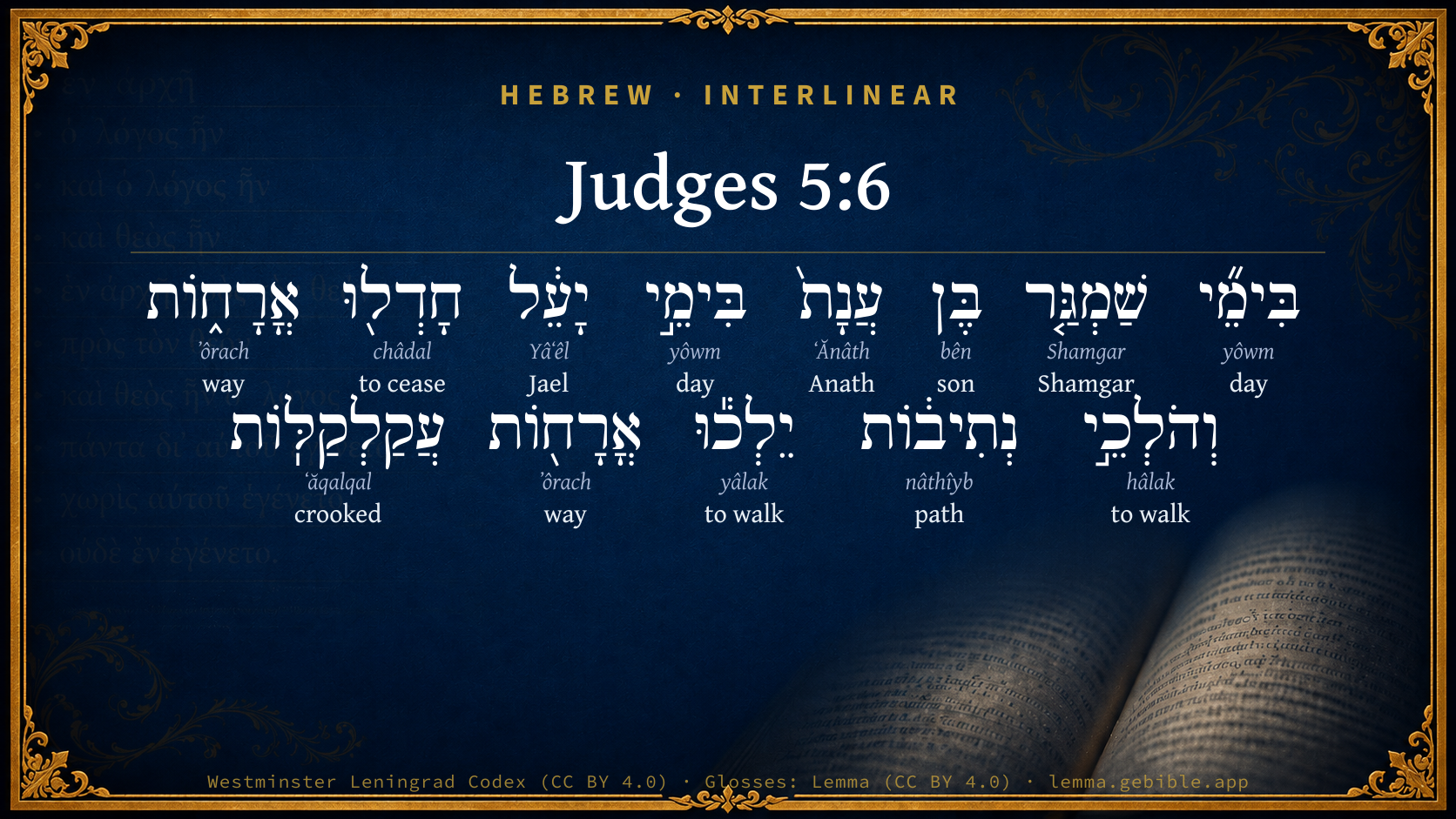
Hebrew (Westminster Leningrad Codex) Judges 5:6 appears in the Hebrew Old Testament. The text above is from the Westminster Leningrad Codex. Each word links to its Strong’s number, a concise gloss, and parsing drawn from the Open Scriptures Hebrew Bible morphology. Click any word for its full Brown-Driver-Briggs (BDB) entry.
Download image
Cite this verse

Judges 5:6 (World English Bible). Public Domain. Lemma interlinear Bible study tool, https://lemma.gebible.app/v/judges/5/6.

Show BibTeX & RIS
BibTeX
RIS
English Translation
In the days of Shamgar the son of Anath, In the days of Jael, the highways were unoccupied, The travelers walked through byways.
World English Bible · Public Domain
Highlights
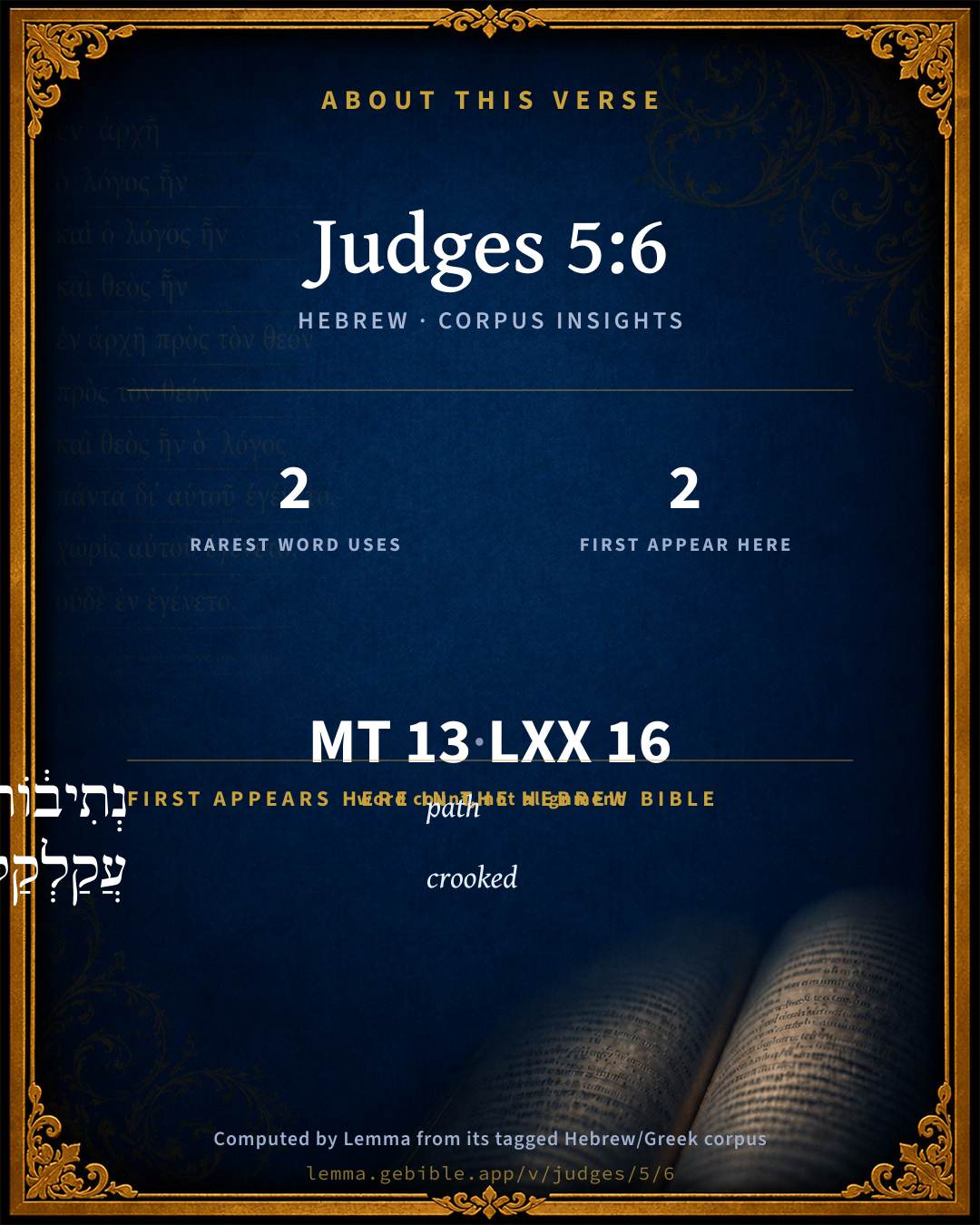
  • 2 first appearances in the Hebrew Bible
Full analysis ↓
Download a study sheet

One document with this verse’s original text, its word-by-word gloss line, the meaning frame, cross-references with their text, attributed commentary, and full source and license credits — printable, and it pastes into notes with its structure intact.

This verse Autodidact and up

Study sheet (.html) Plain text (.txt)

A passage Seminary Student

Up to 50 verses in one chapter. A passage sheet keeps up to 6 commentary sources and 12 cross-references per verse, in the order this page ranks them, and says so on the sheet whenever that leaves anything out. Ask for a single verse and you get the Autodidact verse sheet above.

Everything on this page stays free to read, with no account — the sheet is a download of what is already on screen, not access to it.

Want to remove ads? Support Godless Engineer
Compare translations 3

The same verse in 3 English versions, stacked beneath the original-language interlinear above. Click any original word for its lexicon entry.

Each is an independent rendering of the whole verse — the interlinear is not word-aligned to these translations.

Highlighted words mark where these versions differ — a whole-verse word diff, not a word-by-word alignment.

  • World English Bible Public Domain
    In the days of Shamgar the son of Anath, In the days of Jael, the highways were unoccupied, The travelers walked through byways.
  • King James Version Public Domain
    In the days of Shamgar the son of Anath, in the days of Jael, the highways were unoccupied, and the travellers walked through byways.
  • unfoldingWord Literal Text CC BY-SA 4.0
    In the days of Shamgar, the son of Anath, in the days of Jael, roads ceased, and walkers of paths walked crooked roads.

unfoldingWord Literal Text — © unfoldingWord, licensed CC BY-SA 4.0. Word-aligned USFM3 via Door43 (git.door43.org/unfoldingWord/en_ult).

Versions to compare (up to 4)

3 of 4 selected

Show all 18 translations

Every available English version of this verse, each an independent rendering of the whole verse.

  • World English Bible Public Domain
    In the days of Shamgar the son of Anath, In the days of Jael, the highways were unoccupied, The travelers walked through byways.
  • Berean Standard Bible Public Domain
    In the days of Shamgar son of Anath, in the days of Jael, the highways were deserted and the travelers took the byways.
  • Majority Standard Bible Public Domain
    In the days of Shamgar son of Anath, in the days of Jael, the highways were deserted and the travelers took the byways.
  • King James Version Public Domain
    In the days of Shamgar the son of Anath, in the days of Jael, the highways were unoccupied, and the travellers walked through byways.
  • American Standard Version (1901) Public Domain
    In the days of Shamgar the son of Anath, In the days of Jael, the highways were unoccupied, And the travellers walked through byways.
  • Revised Version (1885) Public Domain
    In the days of Shamgar the son of Anath, in the days of Jael, the highways were unoccupied, and the travellers walked through byways.
  • Geneva Bible (1599) Public Domain
    In the dayes of Shamgar the sonne of Anath, in the dayes of Iael the hie wayes were vnoccupied, and the trauelers walked through by wayes.
  • Douay-Rheims (1899) Public Domain
    In the days of Samgar the son of Anath, in the days of Jahel the paths rested: and they that went by them, walked through by-ways.
  • Young's Literal Translation Public Domain
    In the days of Shamgar son of Anath -- In the days of Jael -- The ways have ceased, And those going in the paths go `in' crooked ways.
  • Literal Standard Version CC BY-SA 4.0
    In the days of Shamgar son of Anath—In the days of Jael—The ways have ceased, || And those going in the paths go [in] crooked ways.
  • Unlocked Literal Bible CC BY-SA 4.0
    In the days of Shamgar (son of Anath), in the days of Jael, the main roads were abandoned, and those who walked only used the winding paths.
  • unfoldingWord Literal Text CC BY-SA 4.0
    In the days of Shamgar, the son of Anath, in the days of Jael, roads ceased, and walkers of paths walked crooked roads.
  • Darby Bible Public Domain
    "In the days of Shamgar, son of Anath, in the days of Ja'el, caravans ceased and travelers kept to the byways.
  • World Messianic Bible Public Domain
    “In the days of Shamgar the son of Anath, in the days of Jael, the highways were unoccupied. The travelers walked through byways.
  • Webster's Bible Public Domain
    In the days of Shamgar the son of Anath, in the days of Jael, the highways were unoccupied, and the travelers walked through by-ways.
  • Free Bible Version CC BY-SA 4.0
    In the days of Shamgar, son of Anath, in the days of Jael, people didn't use the main highways and stayed on winding paths.
  • Bible in Basic English Public Domain
    In the days of Shamgar, the son of Anath, in the days of Jael, the highways were not used, and travellers went by side roads.
  • JPS Tanakh (1917) Public Domain
    In the days of Shamgar the son of Anath, in the days of Jael, the highways ceased, and the travellers walked through byways.

Literal Standard Version (2020), Covenant Press — licensed CC BY-SA 4.0. Text via the HelloAO Bible API (eBible.org). Unlocked Literal Bible (unfoldingWord) — licensed CC BY-SA 4.0. Text via the HelloAO Bible API (eBible.org). unfoldingWord Literal Text — © unfoldingWord, licensed CC BY-SA 4.0. Word-aligned USFM3 via Door43 (git.door43.org/unfoldingWord/en_ult). Free Bible Version, Dr. Jonathan Gallagher — licensed CC BY-SA 4.0. Text via the HelloAO Bible API (eBible.org).

Word by word

More ways to search: Search by grammar → Find every occurrence → Compare this word →

Practice this passage: Drill this verse → Learn its vocabulary →

שַׁמְגַּ֤ר
Shamgar
H8044
“Shamgar”
Noun, Proper
Part of Speech
Noun
Type
Proper
Full BDB Definition

Origin: of uncertain derivation

TWOT: None

Shamgar = "sword" - son of Anath and a judge of Israel; with an ox-goad he slew 600 Philistines and delivered Israel
  1. בִּימֵ֞י yôwm H3117 “in/at · days of” Preposition + Noun, Common, Masculine, Plural, Construct
  2. בֶּן bên H1121 “son of” Noun, Common, Masculine, Singular, Construct
  3. עֲנָת֙ ʻĂnâth H6067 “Anath” Noun, Proper
  4. בִּימֵ֣י yôwm H3117 “in/at · days of” Preposition + Noun, Common, Masculine, Plural, Construct
  5. יָעֵ֔ל Yâʻêl H3278 “Jael” Noun, Proper
  6. חָדְל֖וּ châdal H2308 “to cease” Verb, Qal, Perfect, 3rd Person, Common, Plural
  7. אֳרָח֑וֹת ʼôrach H734 “ways” Noun, Common, Both, Plural, Absolute
  8. וְהֹלְכֵ֣י hâlak H1980 “and · walking” Conjunction + Verb, Qal, Participle Active, Masculine, Plural, Construct
  9. נְתִיב֔וֹת nâthîyb H5410 “paths” Noun, Common, Both, Plural, Absolute
  10. יֵלְכ֕וּ yâlak H3212 “to walk” Verb, Qal, Imperfect, 3rd Person, Masculine, Plural
  11. אֳרָח֖וֹת ʼôrach H734 “ways” Noun, Common, Both, Plural, Absolute
  12. עֲקַלְקַלּֽוֹת ʻăqalqal H6128 “crooked” Adjective, Adjective, Feminine, Plural, Absolute

About this verse

These counts appear in no published source. They are computed here, from the morphology-tagged text and Lemma’s own curated glosses. What Lemma adds →

13
words
11
distinct lemmas
Historical
section

Notable vocabulary

The rarest word here is שַׁמְגַּ֤ר Shamgar H8044 — appearing just 2 times in the whole Hebrew Bible.

First appearance in Scripture

These words make their first canonical appearance in the Hebrew Bible here:

  • נְתִיב֔וֹת path H5410
  • עֲקַלְקַלּֽוֹת crooked H6128

Shared distinctive vocabulary

שַׁמְגַּ֤ר Shamgar H8044 occurs in 2 verses of the Hebrew Bible. Also found in:

Grammatical profile

  • 3 verbs
  • 9 nouns
  • 1 adjective

Verb forms

  • חָדְל֖וּ Qal · Perfect
  • וְהֹלְכֵ֣י Qal · Participle Active
  • יֵלְכ֕וּ Qal · Imperfect

Repetition

Words recur within this verse — often emphatic in Hebrew:

  • בִּימֵ֞י day H3117 ×2
  • אֳרָח֑וֹת way H734 ×2

Hebrew & Septuagint length

In English translation the verse runs 23 words from the Hebrew and 26 from the Septuagint (LXX English) — closely comparable.

A rough comparison of the two English renderings, which tokenize alike — not a word-level alignment.

Word counts can differ between the Hebrew and the Greek without any difference in meaning — e.g. the Hebrew direct-object marker אֵת has no separate Greek word, and Greek often adds the article ὁ.

In the original languages it is 13 Hebrew tokens and 16 Greek tokens — but the two are counted differently (Hebrew bundles its prefixes and suffixes into one token; the Greek is in lemma form), so that isn’t a like-for-like length.

Cross-references

9

Topical passages linked to Judges 5:6 in the Treasury of Scripture Knowledge — connected by theme and wording, ordered by reader-vote popularity; previews shown in the World English Bible.

  • Judges 3:31 After him was Shamgar the son of Anath, who struck of the Philistines six hundred men with an ox-goad: and he also saved Israel.
  • Isaiah 33:8 The highways lie waste, the wayfaring man ceases: [the enemy] has broken the covenant, he has despised the cities, he doesn't regard man.
  • Leviticus 26:22 I will send the wild animals among you, which will rob you of your children, destroy your cattle, and make you few in number; and your roads will become desolate.
  • Lamentations 1:4 The ways of Zion do mourn, because none come to the solemn assembly; All her gates are desolate, her priests do sigh: Her virgins are afflicted, and she herself is in bitterness.
  • Judges 4:17–18 However Sisera fled away on his feet to the tent of Jael the wife of Heber the Kenite; for there was peace between Jabin the king of Hazor and the house of Heber the Kenite.
  • 2 Chronicles 15:5 In those times there was no peace to him who went out, nor to him who came in; but great vexations were on all the inhabitants of the lands.
  • Psalms 125:5 But as for those who turn aside to their crooked ways, Yahweh will lead them away with the workers of iniquity. Peace be on Israel.
  • Lamentations 4:18 They hunt our steps, so that we can't go in our streets: Our end is near, our days are fulfilled; for our end is come.
  • Micah 3:12 Therefore Zion for your sake will be plowed like a field, And Jerusalem will become heaps of rubble, And the mountain of the temple like the high places of a forest.

Cross-references courtesy of OpenBible.info (CC BY 4.0).

Hebrew and Greek witnesses Masoretic Hebrew ↔ Greek Septuagint

The same verse in the two great witnesses to the Old Testament, shown verse-for-verse.

These are two independent witnesses, not word-aligned to each other, and the Septuagint is shown in lemma (dictionary) form.

Hebrew Judges 5:6 Masoretic · Westminster Leningrad Codex

בִּימֵ֞י שַׁמְגַּ֤ר בֶּן עֲנָת֙ בִּימֵ֣י יָעֵ֔ל חָדְל֖וּ אֳרָח֑וֹת וְהֹלְכֵ֣י נְתִיב֔וֹת יֵלְכ֕וּ אֳרָח֖וֹת עֲקַלְקַלּֽוֹת

In the days of Shamgar the son of Anath, In the days of Jael, the highways were unoccupied, The travelers walked through byways.

World English Bible · Public Domain

Greek LXX Judges 5:6 Septuagint · lemma form

ἐν ἡμέρα σαμεγαρ υἱός αναθ ἐν ἡμέρα ιαηλ ἐκλείπω ὁδός καί πορεύομαι ἀτραπός πορεύομαι ὁδός διαστρέφω

In the days of Samegar son of Anath, in the days of Jael, they deserted the ways, and went in by-ways; they went in crooked paths.

LXX2012 (modern English Septuagint) · Public Domain

On this verse, Lange's Commentary on the Holy Scriptures discusses the Septuagint’s reading. Read the note in Commentary ↓

Hebrew: Westminster Leningrad Codex (CC BY 4.0). Greek: Septuagint (public domain); English from LXX2012 (modern English Septuagint) (Public Domain). How the Septuagint differs from the Hebrew →

Targum (Aramaic paraphrase)

1

The Targum is the ancient Jewish Aramaic paraphrase of the Hebrew Scriptures — an interpretive translation, not the Hebrew text itself. Onkelos (literal) and Pseudo-Jonathan (expansive) render the Torah, and Jonathan the Prophets. Coverage is partial: where no permissively-licensed English translation exists for a verse, only the Aramaic is shown. This is verse-level text, not a word-by-word alignment to the Hebrew.

  1. Targum Jonathan Prophets (Joshua–Malachi)
    כַּד חָבוּ בְּיוֹמֵי שַׁמְגַר בַּר עֲנָת בְּיוֹמֵי יָעֵל פְּסַקוּ עָדֵי אוֹרְחָן דַהֲווֹן מְהַלְכִין בִּשְׁבִילִין דְתַקְנִין תָּבוּ לְמֶהֱוֵי אָזְלִין בְּאוֹרְחָן מְגַנְבָן:

    (no public-domain English translation for this verse)

    Targum Jonathan — Aramaic: “Mikraot Gedolot” (public domain). English: “Sefaria Community Translation” (CC0 1.0 (public-domain dedication)); “London "Chaldee Paraphrase," 1871” (public domain). Text via Sefaria.

Commentary

Notes on Judges 5:6 from classic Christian and Jewish commentators (each source and its license shown beneath its notes). The classic Christian expositions comment on the surrounding passage and are grouped to its opening verse, so a note may address several verses; the Jewish commentaries on the Tanakh (Rashi and others) are per-verse, so they appear only where the commentator wrote on this verse.

Lemma curates 59 commentaries, every one of them public domain or Creative Commons licensed, each selected and text-cleaned for this edition rather than reprinted as found. About our sources →

Matthew Henry's Commentary

Here, I. Deborah describes the distressed state of Israel under the tyranny of Jabin, that the greatness of their trouble might make their salvation appear the more illustrious and the more gracious (Jdg 5:6): From the days of Shamgar, who did something towards the deliverance of Israel from the Philistines, to the days of Jael, the present day, in which Jael has so signalized herself, the country has been in a manner desolate. 1. No trade. For want of soldiers to protect men of business in their business from the incursions of the enemy, and for want of magistrates to restrain and punish thieves and robbers among them (men of broken fortunes and desperate spirits, that, having no employment, took to rob on the highroad), all commerce ceased, and the highways were unoccupied; no caravans of merchants, as formerly. 2. No travelling. Whereas in times when there was some order and government the travellers might be safe in the open roads, and the robbers were forced to lurk in the by-ways, no, on the contrary, the robbers insulted on the open roads without check, and the honest travellers were obliged to sculk and walk through by-ways, in continual frights. 3. No tillage. The fields must needs be laid waste and unoccupied when the inhabitants of the villages, the country farmers, ceased from their employment, quitted their houses which were continually alarmed and plundered by the banditti, and were obliged to take shelter for themselves and their families in walled and fenced cities. 4. No administration of justice. There was war in the gates where their courts were kept, Jdg 5:8. So that it was not till this salvation was wrought that the people of the Lord durst go down to the gates, Jdg 5:11. The continual incursions of the enemy deprived the magistrates of the dignity, and the people of the benefit, of their government. 5. No peace to him that went out nor to him that came in. The gates through which they passed and repassed were infested by the enemy; nay, the places of drawing water were alarmed by the archers - a mighty achievement to terrify the drawers of water. 6. Neither arms nor spirit to help themselves with, not a shield nor spear seen among forty thousand, Jdg 5:8. Either they were disarmed by their oppressors, or they themselves neglected the art of war; so that, though they had spears and shields, they were not to be seen, but were thrown by and suffered to rust, they having neither skill nor will to use them.

II. She shows in one word what it was that brought all this misery upon them: They chose new gods, Jdg 5:8. It was their idolatry that provoked God to give them up thus into the hands of their enemies. The Lord their God was one Lord, but this would not content them: they must have more, many more, still more. Their God was the Ancient of days, still the same, and therefore they grew weary of him, and must have new gods, which they were as fond of as children of new clothes, names newly invented, heroes newly canonized. Their fathers, when put to their choice, chose the Lord for their God (Jos 24:21), but they would not abide by that choice, they must have gods of their own choosing.

III. She takes notice of God's great goodness to Israel in raising up such as should redress these grievances. Herself first (Jdg 5:7): Till that I Deborah arose, to restrain and punish those who disturbed the public peace, and protect men in their business, and then the face of things was changed for the better quickly; those beasts of prey retired upon the breaking forth of this joyful light, and man went forth again to his work and labour, Psa 104:22, Psa 104:23. Thus she became a mother in Israel, a nursing mother, such was the affection she bore to her people, and such the care and pains she took for the public welfare. Under her there were other governors of Israel (Jdg 5:9), who, like her, had done their part as governors to reform the people, and then, like her, offered themselves willingly to serve in the war, not insisting upon the exemption which their dignity and office entitled them to, when the had so fair an opportunity of appearing in their country's cause; and no doubt the example of the governors influenced the people in like manner willingly to offer themselves, Jdg 5:2. Of these governors she says, My heart is towards them, that is, "I truly love and honour them; they have won my heart for ever; I shall never forget them." Note, Those are worthy of double honour that recede voluntarily from the demands of their honour to serve God and his church.

IV. She calls upon those who had a particular share in the advantages of this great salvation to offer up particular thanks to God for it, Jdg 5:10, Jdg 5:11. Let every man speak as he found of the goodness of God in this happy change of the posture of public affairs. 1. You that ride on white asses, that is, the nobility and gentry. Horses were little used in that county; they had, it is probable, a much better breed of asses than we have; but persons of quality, it seems, were distinguished by the colour of the asses they rode on; the white being more rare were therefore more valued. Notice is taken of Abdon's sons and grandsons riding on ass-colts, as indicating them to be men of distinction, Jdg 12:14. Let such as are by this salvation restored, not only to their liberty as other Israelites, but to their dignity, speak God's praises. 2. Let those that sit in judgment be sensible of it, and thankful for it as a very great mercy, that they may sit safely there, that the sword of justice is not struck out of their hand by the sword of war. 3. Let those that walk by the way, and meet with none there to make them afraid, speak to themselves in pious meditations, and to their fellow-travellers in religious discourses, of the goodness of God in ridding the roads of those banditti that had so long infested them. 4. Let those that draw in peace, and have not their wells taken from them, or stopped up, nor are in danger of being caught by the enemy when they go forth to draw, there, where they find themselves so much more safe and easy than they have been, there let them rehearse the acts of the Lord, not Deborah's acts, nor Barak's, but the Lord's, taking notice of his hand making peace in their borders, and creating a defence upon all the glory. This is the Lord's doing. Observe in these acts of his, (1.) Justice executed on his daring enemies. They are the righteous acts of the Lord. See him pleading a righteous cause, and sitting in the throne judging aright, and give him glory as the Judge of all the earth. (2.) Kindness shown to his trembling people, the inhabitants of the villages, who lay most open to the enemy, had suffered most, and were most in danger, Eze 38:11. It is the glory of God to protect those that are most exposed, and to help the weakest. Let us all take notice of the share we in particular have in the public peace and tranquility, the inhabitants of the villages especially, and give God the praise of it.

Matthew Henry's Commentary on the Whole Bible (1708–1710) — public domain (CC PDM 1.0). Text via the HelloAO Bible API.

Trapp's Complete Commentary

John Trapp

Jdg 5:6 In the days of Shamgar the son of Anath, in the days of Jael, the highways were unoccupied, and the travellers walked through byways.

Ver. 6. In the days of Shamgar.] From the death of Ehud until this conflict with Jabin: for though Shamgur did worthily, - especially if without help of others he slew at one time six hundred of the enemy with an ox goad, Scanderbeg is said to have slain eight hundred Turks at several times with his own hands, some say three thousand, - and though Jael, a woman of a public spirit, and active beyond her sex, did her utmost; yet the times were very troublesome, "neither was there any peace to him that went out, or to him that came in, but great vexations"; {2Ch 15:5} and no free commerce, or safe abode in any village, but

“ Luctus ubique, metus, et plurima morris imago. ”

Thus the dangers bypast are fitly recounted, that the present freedom may be the better prized. The miseries also of war, especially civil, when

“ vi geritur res, ”

are lively described, an evil so great as no words, how wide soever, are able to express. See Lam 1:4; Lam 4:18.

John Trapp, A Commentary or Exposition upon All the Books of the Old and New Testament (1647–1656) — public domain. Text from a community e-Sword module.

Joseph Benson's Commentary

Jdg 5:6. In the days of Shamgar, &c. — In this and the two following verses Deborah, to give the Israelites a just sense of their deliverance, and excite them to greater thankfulness, represents the miseries to which the Canaanites had reduced them by twenty years’ oppression; their public roads or high-ways were deserted for fear of robbers or violence; their villages depopulated; their cities blocked up, and their country overrun with the enemy’s soldiers; while themselves were disarmed, dispirited, and helpless; till it pleased God to look down upon them with compassion, and raise up deliverance for them. In the days of Jael, &c. — Jael, though an illustrious woman, effected nothing for the deliverance of God’s people. The travellers walked through by-ways — Because of the Philistines and Canaanites, who, besides the public burdens which they laid upon the Israelites, waited for all opportunities to do them mischief secretly; watching for travellers in common roads, as is usual with enemies in times of war; and because of the wicked even of their own people, who, having cast off the fear of God, and there being no king in Israel to punish them, broke forth into acts of injustice and violence, even against their own brethren. The Jael mentioned in this verse is generally taken to be the wife of Heber, who slew Sisera. But “the phrase, in the days of Jael, implies times past, and supposes that Jael was dead as well as Shamgar. Besides, what honour could redound to the prophetess from such a comparison? Is it worthy of a boast, that she, who was judge in Israel, had done more in delivering them from the enemy than Heber’s wife, who was only a sojourner in Israel, and whose husband was at peace with the enemy? The Jael, therefore, here mentioned, seems to have been a prophetess raised up before Deborah to judge Israel, but who died without delivering them. It is true indeed the name of this prophetess is not mentioned before; but neither are any of the transactions of the time in which she is supposed to have lived recorded; nor is Shamgar’s name mentioned more than once, Jdg 3:31, and then principally on account of that single exploit, of slaying six hundred Philistines with an ox-goad.” — Dodd.

Joseph Benson's Commentary on the Old and New Testaments (1811–1818) — public domain. Text from a community e-Sword module.

Lange's Commentary on the Holy Scriptures

The Previous Distress

Jdg_5:6-8.

6After14 the days of Shamgar, son of Anath,

After the Helper’s (Jael’s) days,

The highways were deserted.

The traveller went in winding ways.

7Deserted were Israel’s hamlets,15 deserted,

Till I Deborah rose up—rose up a mother in Israel.

8New gods had they got them16—therefore the press of war approached their gates;17

Among forty thousand in Israel was there found18 or shield or spear?

TEXTUAL AND GRAMMATICAL

[1 Jdg_5:6.—On this translation of בְּ, compare the author’s remarks below. The justification they attempt, is, however too forced and artificial to be satisfactory. The passages cited in its support, are rather against it. For in Num_14:11, it is the very fact that Israel’s unbelief exists contemporaneously, in the presence, as it were, of mighty wonders, that makes it so culpable. And so in the passages cited from Isaiah (Jdg_5:25; Jdg_9:11 (12); Jdg_10:4), it is the continuance of Jehovah’s anger while surrounded, so to speak, by the terrible evidences of previous punitive inflictions, that gives it its full dreadfulness. It seems necessary, therefore, to take בְּ here in the sense of “in,” “during.” It is necessary, further, to place Shamgar not in, but after, the eighty years’ rest procured by Ehud, cf. on Jdg_3:31; for while the “land rested,” such a state of affairs as Deborah here describes cannot have existed. He belongs to the period of the Canaanite oppression in the north, and fought against the Philistines who rose up in the south (so Bachmann and others). A single exploit is told of him; and the comparatively inferior position assigned him in the Book of Judges, seems to warrant the conclusion that it was the only remarkable deed he did. That deed, however, was one which would make him universally known and held up as a great hero. Deborah seizes on this popular estimate of Shamgar, in order by contrast to heighten the glory of the divine deliverance just achieved. Such was your condition when your great hero lived, she says: but now, behold, what hath God wrought!—The words בִּימֵי יָעֵל, “in the days of Jael,” contain another difficulty. It must strike every one as inappropriate that one who, so far as we know, had only now become famous, and that by a deed of deliverance, namely, Jael, the slayer of Sisera, should be connected with the past misery. Dr. Cassel’s suggestion that יָעֵל is to be taken as a surname or popular designation of some hero (see below), becomes therefore exceedingly attractive. But according to our view of בִּ, the hero thus designated cannot be Ehud, but must be Shamgar.—Tr.

[2 Jdg_5:7—פּרָזוֹן. Gesenius and Fürst define this word as properly meaning, “rule, dominion;” here, concrete* for “rulers, leaders.” So also Bertheau, De Wette, Bunsen, and similarly many previous expositors and versions: LXX., Cod Vat. δυνατοί, al. codd. οἱ κρατοῦντες (Cod. Al. simply transfers the word, and writes φράζων); It. Vers. potentes, Vulg. fortes. This undoubtedly yields a good sense; but, as Bachmann points out, it rests on a meaning of the root פָּרַז, which although belonging to it in Arabic, it does not practically have in Hebrew. Moreover, it appears to be a hazardous proceeding to separate פְּרָזוֹן from פְּרָזָה in signification, if not (as Fürst does) in root-relations. Accordingly, Bachmann and Keil, like our author and others, explain פְּרָזוֹן by פְּרָזָה, and make it mean the “open country,” or “the unwalled cities or villages of the open country.” In this they only follow the Targum, Peshito, most of the Rabbins, and many earlier and later expositors. The form of the word shows that it is properly an abstract, cf. Ges. Gr. 83, 2; 84, 15; Ewald, 163, b, d. Keil and Cassel make it apply in the concrete to the cities, villages, or hamlets, Bachmann to the population, of the open country (Landvolk). The connection of the passage, he thinks, requires a personal, not local, signification; for as Jdg_5:8 a corresponds to (or rather gives the ground of) Jdg_5:6 c d, so Jdg_5:7 a (the cessation of פְּרָזוֹן) must correspond to Jdg_5:8 b (the absence of shield and spear). He further argues that as in Jdg_5:2; Jdg_5:7 b, and 8 b, בְּיִשׂרָאֵל refers to the people of Israel, it must also refer to them in Jdg_5:7 a; and, finally, that the signification “rural population,” is more suitable in Jdg_5:11. The ultimate result is the same whether one or the other interpretation be adopted; yet, as Bachmann’s arguments do not appear to have much force, and as the immediately preceding mention of highways leads the mind to think of local centres of population rather than of the population itself, we prefer to interpret villages or hamlets.—Tr.]

[3 Jdg_5:8.—Dr. Cassel’s translation conforms more closely to the original: Gewählt hatten sie neue Götter,—“they had chosen new gods.” The above English rendering was adopted in order to reproduce the alliteration of the German.—Tr.]

[4 Jdg_5:8.—אָז֖ לָחֶ֣ם שְׁעָרי֑ם: literally, “then war (was at the) gates.” לָחֶם is best explained as a verbal noun from piel, the vowel of the final syllable of the absolute לָחֵם being shortened because of the close connection with the following word, and the retraction of the tone being omitted on account of the toneless initial syllable of שְׁעָרִים (Bertheau, Keil, Bachmann). שְׁעָרִים may be genitive (in which case לָחֶֽם must be in the construct state) or accusative of place, which is more simple.—Tr.]

[5 Jdg_5:8.—אִם־יֵרָאֶה. According to Keil and others אִם introduces a negative interrogatory. But as אִם with simple, direct questions is rare, cf. Ges. Gr. 153, 2, Bachmann prefers to regard it as the אִם of obtestation: “if shield or spear were seen!” i.e. they were not seen. So also Bertheau, Gesenius, Fürst (in their Lexicons), and many others.—Tr.]

EXEGETICAL AND DOCTRINAL

Jdg_5:6-8. After the days of Shamgar, שַׁמגַּר בִּימֵי. The difficulty of the passage can scarcely be removed, if, as is usually done, the preposition בְּ be taken in the sense of “in,” “during.” During the days of Shamgar such misery cannot have come upon Israel. The narrator could not in that case have said of him, Jdg_3:31, that he “delivered Israel,” just as (Jdg_5:15) he speaks of Ehud as a “deliverer.” If Shamgar was no deliverer, how can it be said “and after him (or like him, i.e. Ehud, cf. on Jdg_3:31) was Shamgar?” It seems impossible to assume (as nevertheless Keil also does), that the poetess could say of the days of such a hero, that there was no resistance and defense, no sword or shield, in Israel. The disparaging connection in which, were this assumption true, it would please her to exhibit the hero, is also wholly at variance with her spirit. To this must be added that, as was above shown to be probable, Shamgar’s famous exploit and further activity fall within the eighty years of “rest” after Ehud. At all events, Shamgar’s fame is related before the time in which Israel again begins to sin, and consequently again falls into servitude. It cannot therefore be otherwise understood, than that Deborah retraces the misery of her people up to the time of this last hero. “Since the days of Shamgar,” i.e. upon and after his days, the highways began to be deserted.19 Philologically, this form of expression is not without analogies. God says (Num_14:11), “They believe not me, בְּכֹל הָאֹתוֹת”, in, i.e. after “all the wonders I have done among them.” In the same manner we are to interpret בְּכָל several passages of Isaiah (Jdg_9:11 (12); Jdg_5:25; Jdg_10:4): “the Syrians and Philistines devour Israel,—in all that, after all that, notwithstanding all that, his anger is not turned away.” Thus the sense of our passage also becomes clear. Notwithstanding that the days of Shamgar have been, i.e. after them, misery began. His heroic deed against the Philistines, was the last great act performed by Israel. But the author adds, “in, after, the days of Jael.” That this cannot be the stout-hearted woman who slew Sisera, is self-evident, since Deborah, speaking of her contemporary, could not say “in the days of Jael.” But apart from this, the Song itself (Jdg_5:24) distinguishes this Jael by carefully designating her as the “wife of Heber, the Kenite.” Moreover, Jael is properly a man’s name. The other assumption, however, that Jael was a Judge, who lived before Deborah’s time, rests on slender foundations. It is utterly inconceivable that the narrator, who communicates the Song of Deborah, had he so understood it, would not have told us something of this Judge Jael. He would at all events have inserted his name, at least in some such manner as that of Shamgar himself, of Elon the Zebulonite, and of Abdon (Jdg_12:11-15), of whom nothing is reported beyond the general fact that they judged Israel. The only remaining supposition, and one fully accordant with the poetic cast of the Song, is, that Jael was the knightly surname of Shamgar, or even more probably of Ehud. We know that Gideon is frequently mentioned by his heroic name Jerubbaal, and that Samson is simply styled Bedan (1Sa_12:11). That Jael might readily become the beautiful popular designation of a man so determined and rapid in his movements as Ehud, is evident, whether we take it to mean the Mountain-climber, the August One, the Prince, or the Rock-goat, whose facile ascent to the most inaccessible rocky heights is astonishing. Most probably, however, the name is connected with the word הוֹעִיל, to help. The same word, which is often used negatively concerning heathen gods (לאֹ יוֹעִילוּ, “they help not,” 1Sa_12:21, Jer_2:8, etc.), is here employed positively to denote one who was a “Helper” of Israel in distress. The sense, moreover, becomes thus perfectly clear: “After the days of Shamgar, after the days of Jael (Ehud),” the people perished through their sins; that is, as Jdg_4:1 asserts, and Jdg_5:8 of this chapter confirms,—“they had chosen themselves new gods.”

The highways were deserted, חָדְלוּ אְָרָחוֹת: literally, they ceased to be highways. No one travelled on the public roads, because there was no security. The enemy plundered all through the country. He who was obliged to travel, sought out concealed by-paths, in order to elude the tyrant and his bands. These few lines give a striking picture of a land languishing under hostile oppression. חָדְלוּ פְרָזוֹן, open places, hamlets, ceased to exist. פְּרָזוֹן is the open country, in distinction from cities surrounded by walls and gates. One imagines himself to be reading a description of the condition of Germany in the 10th century, when the Magyars invaded the land (cf. Widukind, Sächs. Gesch. i. 32). Henry I. is celebrated as a builder of cities, especially because by fortifying open villages he rendered them more secure than formerly against the enemy. All ancient expositors, Greek as well as Chaldee and later Rabbinic, consent to this explanation or פּרָזוֹן20 (cf. Schnurrer, p. 46). Jdg_5:8 also agrees with it: no place without walls was any longer secure against the hostile weapons of those who oppressed Israel; the conflict was pushed even to the very gates of the mountain fortresses. The attempt to make the word mean “princes,” “leaders,” labors under great difficulties; which modern expositors, almost all of whom have adopted it, have by no means overcome. It raises an internal contradiction to connect חָדְלוּ with פְּרָזוֹן, when taken in this sense. We can very properly say רֹעְבִיכ חָדְלוּ, “the hungry cease to be such,” but not “princes.” Of a banished dynasty there is no question. A Judge there was not; none therefore could cease to be. The lack of military virtue is first mentioned in Jdg_5:8. Situated as Israel was, the misery of the people might be measured by the extent to which their fields and rural districts were devastated and rendered insecure. As to their “princes,” their hereditary chiefs, they in fact still existed. Nor does the form of the word need any correction (cf. Jdg_5:11).

Till I arose (עַד שַׁקַּמְתִּי for עַד אֲשֶׁר קַמְתִּי) a mother in Israel:21 who, as it were, bore Israel anew. It was the regeneration of Israel’s nationality that was secured at the Kishon. How came it about (she adds, Jdg_5:8), that Israel had so fallen as to need a new mother? They had chosen “new gods” for themselves. The eternal God, before whom the mountains trembled, Him they had forsaken. Hence the loss of all their strength. They were hard pressed, up to the very gates of their fortresses. (לָחֶם is not simply war, but an already victorious and consuming oppression.) Resistance in the open field there was none anywhere. Among forty thousand not one sought safety by means of sword and shield.22 The poet says “new gods,” not “other gods.” The objective idea is of course the same, but not the subjective thought as here entertained. For Israel had from of old its everlasting God,—Him whose glory the poem had delineated at the outset. But instead of that God, Israel chose them new gods, whom they had not formerly known. There is a profoundly significant connection of thought between this passage and the Song of Moses, Deu_32:17. There the thought, which is here implied, lies fully open: “They shall sacrifice to gods whom they never knew, to new gods, that came newly up, whom their fathers feared not.” The heathen gods of Canaan are in truth all new to Israel; for their own God had already chosen them in the desert, before ever they set foot in the land. Israel’s recent ruin was the consequence of their serving these new gods. That all manliness had vanished, that servitude prevailed up to the gates of their fortresses, that they were shut out from highway, hamlet, and fountain, was the bitter fruit of their unfaithfulness to their ancient God. Nor was deliverance possible, until, as the result of Deborah’s efforts, the people became regenerated by means of the ancient truth.

Footnotes:

[14][Jdg_5:6.—On this translation of בְּ, compare the author’s remarks below. The justification they attempt, is, however too forced and artificial to be satisfactory. The passages cited in its support, are rather against it. For in Num_14:11, it is the very fact that Israel’s unbelief exists contemporaneously, in the presence, as it were, of mighty wonders, that makes it so culpable. And so in the passages cited from Isaiah (Jdg_5:25; Jdg_9:11 (12); Jdg_10:4), it is the continuance of Jehovah’s anger while surrounded, so to speak, by the terrible evidences of previous punitive inflictions, that gives it its full dreadfulness. It seems necessary, therefore, to take בְּ here in the sense of “in,” “during.” It is necessary, further, to place Shamgar not in, but after, the eighty years’ rest procured by Ehud, cf. on Jdg_3:31; for while the “land rested,” such a state of affairs as Deborah here describes cannot have existed. He belongs to the period of the Canaanite oppression in the north, and fought against the Philistines who rose up in the south (so Bachmann and others). A single exploit is told of him; and the comparatively inferior position assigned him in the Book of Judges, seems to warrant the conclusion that it was the only remarkable deed he did. That deed, however, was one which would make him universally known and held up as a great hero. Deborah seizes on this popular estimate of Shamgar, in order by contrast to heighten the glory of the divine deliverance just achieved. Such was your condition when your great hero lived, she says: but now, behold, what hath God wrought!—The words בִּימֵי יָעֵל, “in the days of Jael,” contain another difficulty. It must strike every one as inappropriate that one who, so far as we know, had only now become famous, and that by a deed of deliverance, namely, Jael, the slayer of Sisera, should be connected with the past misery. Dr. Cassel’s suggestion that יָעֵל is to be taken as a surname or popular designation of some hero (see below), becomes therefore exceedingly attractive. But according to our view of בִּ, the hero thus designated cannot be Ehud, but must be Shamgar.—Tr.

[15][Jdg_5:7—פּרָזוֹן. Gesenius and Fürst define this word as properly meaning, “rule, dominion;” here, concrete* for “rulers, leaders.” So also Bertheau, De Wette, Bunsen, and similarly many previous expositors and versions: LXX., Cod Vat. δυνατοί, al. codd. οἱ κρατοῦντες (Cod. Al. simply transfers the word, and writes φράζων); It. Vers. potentes, Vulg. fortes. This undoubtedly yields a good sense; but, as Bachmann points out, it rests on a meaning of the root פָּרַז, which although belonging to it in Arabic, it does not practically have in Hebrew. Moreover, it appears to be a hazardous proceeding to separate פְּרָזוֹן from פְּרָזָה in signification, if not (as Fürst does) in root-relations. Accordingly, Bachmann and Keil, like our author and others, explain פְּרָזוֹן by פְּרָזָה, and make it mean the “open country,” or “the unwalled cities or villages of the open country.” In this they only follow the Targum, Peshito, most of the Rabbins, and many earlier and later expositors. The form of the word shows that it is properly an abstract, cf. Ges. Gr. 83, 2; 84, 15; Ewald, 163, b, d. Keil and Cassel make it apply in the concrete to the cities, villages, or hamlets, Bachmann to the population, of the open country (Landvolk). The connection of the passage, he thinks, requires a personal, not local, signification; for as Jdg_5:8 a corresponds to (or rather gives the ground of) Jdg_5:6 c d, so Jdg_5:7 a (the cessation of פְּרָזוֹן) must correspond to Jdg_5:8 b (the absence of shield and spear). He further argues that as in Jdg_5:2; Jdg_5:7 b, and 8 b, בְּיִשׂרָאֵל refers to the people of Israel, it must also refer to them in Jdg_5:7 a; and, finally, that the signification “rural population,” is more suitable in Jdg_5:11. The ultimate result is the same whether one or the other interpretation be adopted; yet, as Bachmann’s arguments do not appear to have much force, and as the immediately preceding mention of highways leads the mind to think of local centres of population rather than of the population itself, we prefer to interpret villages or hamlets.—Tr.]

[16][Jdg_5:8.—Dr. Cassel’s translation conforms more closely to the original: Gewählt hatten sie neue Götter,—“they had chosen new gods.” The above English rendering was adopted in order to reproduce the alliteration of the German.—Tr.]

[17][Jdg_5:8.—אָז֖ לָחֶ֣ם שְׁעָרי֑ם: literally, “then war (was at the) gates.” לָחֶם is best explained as a verbal noun from piel, the vowel of the final syllable of the absolute לָחֵם being shortened because of the close connection with the following word, and the retraction of the tone being omitted on account of the toneless initial syllable of שְׁעָרִים (Bertheau, Keil, Bachmann). שְׁעָרִים may be genitive (in which case לָחֶֽם must be in the construct state) or accusative of place, which is more simple.—Tr.]

[18][Jdg_5:8.—אִם־יֵרָאֶה. According to Keil and others אִם introduces a negative interrogatory. But as אִם with simple, direct questions is rare, cf. Ges. Gr. 153, 2, Bachmann prefers to regard it as the אִם of obtestation: “if shield or spear were seen!” i.e. they were not seen. So also Bertheau, Gesenius, Fürst (in their Lexicons), and many others.—Tr.]

[19]The use of בְּ in, in the sense of upon = after, cannot be considered surprising, when the poetical freedom of the language is taken into account. Even our German auf “upon” or “on”), of which Grimm says that in many cases it has appropriated the meaning of in, affords an instance of the same kind. To pass by other examples, we also say with equal propriety, “in vielen tagen” (in many days), and “nach vielen tagen” (after many days), not only when the reference is to the future, but even when it is to the past.—Although Shamgar slew the Philistines with an ox-goad, that fact cannot explain the non-employment of sword and lance in Jdg_5:8 of the Song; for, as Barak’s heroes show (Jdg_4:16), there is no want of weapons, but of courage to use them.

[20]Keil also has adopted it.

[21][Wordsworth: “Until that 1 Deborah arose. Deborah, as an inspired person, looks at herself from an external point of view, and speaks of herself objectively, considering all her acts as due, not to herself, but to the Spirit of God. She does not praise herself, but blesses God who acted in her: so did Moses (see Num_12:3), and so Samuel (1Sa_12:11).—Tr.]

[22]Isolated interpretations of the Middle Ages, taken up by a few moderns, find the subject in Elohim, as if “God had chosen new things.” But Jdg_5:8 itself opposes this construction, to say nothing of the contradiction which it involves with the whole course of thought. To adopt Kemink’s correction, הַנָּשִׁ ם, “God chose women,” would only increase the distortion of the hymn, which even without this would arise from the change of subject. That not Elohim but Jehovah, would be used, were God the subject, is remarked by Bertheau (p. 88), who in his turn, however, unfortunately gives a wrong sense to Elohim.

Lange's Commentary on the Holy Scriptures (Critical, Doctrinal, and Homiletical), ed. John Peter Lange, English translation edited by Philip Schaff (1864–1880) — public domain. Text from a community e-Sword module.

Geneva Bible (1599)

Geneva Bible translators

For fear of the enemies.

Geneva Bible (1599) marginal notes — public domain. Text via Bolls.life.

Jamieson, Fausset & Brown

Robert Jamieson, A. R. Fausset & David Brown

The song proceeds in these verses to describe the sad condition of the country, the oppression of the people, and the origin of all the national distress in the people's apostasy from God. Idolatry was the cause of foreign invasion and internal inability to resist it.

Jamieson, Fausset & Brown — Commentary Critical and Explanatory on the Whole Bible (1871) — public domain (CC PDM 1.0). Text via the HelloAO Bible API.

Adam Clarke's Commentary

Verse 6. The highways were unoccupied] The land was full of anarchy and confusion, being everywhere infested with banditti. No public road was safe; and in going from place to place, the people were obliged to use unfrequented paths.

Adam Clarke's Commentary on the Bible (1810–1826) — public domain. Text from a community e-Sword/MySword module.

Ellicott's Commentary for English Readers

(6) In the days of Shamgar.—In this and the two next verses is described the misery and dejection of Israel; and the names of Shamgar and Jael are mentioned to enhance the glory of Deborah, by showing that even the presence among the Israelites of two such heroic souls as Shamgar and Jael was unavailing to deliver them until Deborah arose. That Shamgar is thus (apparently) alluded to as a contemporary of Jael has an important bearing on the chronology; for it at least shows that simultaneous struggles may have been going on against the Philistines in the south and the Canaanites in the north.

In the days of Jael.—It has been thought so strange that Deborah should mention the name of the Bedouin chieftainess as marking the epoch, that some have supposed “Jael” to be the name of some unknown judge; and some have even proposed to read Jair. Others render it “the helper,” and suppose that Ehud, or Shamgar, is referred to. But (1) Jael is essentially a woman’s name (see Jdg_4:17; Pro_5:19); (2) she is mentioned prominently in this very song as having put the finishing stroke to the victory of Israel; and (3) she may have been—and various incidents in the history lead us to suppose that she was—a woman of great importance and influence, even independently of her murder of Sisera.

The highways were unoccupied.—Literally, kept holiday. This had been foretold in Lev_26:22. The grass grew on them; there was no one to occupy them. “The highways lie waste, the wayfaring man ceaseth” (Isa_33:8). “The land was desolate after them, that no man passed through nor returned” (Zec_7:14). (Comp. 2Ch_15:5; Lam_1:4; Lam_4:18.)

Travellers.—Literally, as in the margin, walkers of paths. Those of the unhappy conquered race whose necessities obliged them to journey from one place to another could only slink along, unobserved, by twisted—i.e., tortuous, devious—bye-lanes. A traveller in America was reminded of this verse when he saw the neutral ground in 1780, with “houses plundered and dismantled, enclosures broken down, cattle carried away, fields lying waste, the roads grass-grown, the country mournful, solitary, silent.”—(Washington Irving’s “Life of Washington,” ch. 137)

A Bible Commentary for English Readers, edited by Charles John Ellicott (1878–1897) — public domain. Text from a community e-Sword module.

The Cambridge Bible for Schools and Colleges

gen. ed. J. J. S. Perowne

6. Shamgar the son of Anath] See on Jdg_3:31. It is extraordinary that the period of the oppression (in the days of as Jdg_15:20) should be dated by Shamgar, if he was the deliverer referred to in Jdg_3:31, and by Jael who slew the leader of the Canaanite army. We have seen reason to question the account of Shamgar in Jdg_3:31; the context of the present passage clearly implies that he was not a deliverer but a foreign oppressor, perhaps the predecessor of Sisera. Jael must be the same person as the heroine of Jdg_5:24 ff.; but she belongs to the time, not of the oppression, but of its termination. When once Shamgar had been treated by late interpreters as an Israelite champion (Jdg_3:31), the words in the days of Jael were probably inserted to mark the period more exactly.

the high ways were unoccupied] lit. ‘the ways ceased’ (Jdg_5:7), i.e. were disused, a doubtful meaning; render, with a slight change in the Hebr. pronunciation, the caravans ceased marg. The oppression had put a stop to all intercourse and trade, cf. Jdg_9:25; travellers were driven to use circuitous routes. The next line runs, in parallelism with ‘caravans,’ and walkers by paths walked by crooked ways; the word ways is repeated incorrectly from the previous line; it is sufficiently implied by the plur. adj. crooked, as in Psa_125:5.

6–8. The recent oppression.

The Cambridge Bible for Schools and Colleges (gen. ed. J. J. S. Perowne; Cambridge University Press, 1878–1918) — public domain. Text from a community e-Sword module.

John Gill's Exposition

In the days of Shamgar, the son of Anath,.... Of whom see Jdg 3:31; who succeeded Ehud as a judge, but lived not long, and did not much; at least wrought not a perfect deliverance of the children of Israel; but during his time till now, quite through the twenty years of Jabin's oppression, things were as they are after described:

in the days of Jael; the wife of Heber the Kenite, spoken of in the preceding chapter, Jdg 4:17, who appears to be a woman of masculine spirit, and endeavoured to do what good she could to Israel, though not a judge among them, as Jarchi suggests; and who before this affair of Sisera had signalized herself by some deeds of hers in favour of Israel, and against their enemies; yet far from putting a stop to the outrages committed; for in the times of both these persons:

the highways were unoccupied, and the travellers walked through byways; the public roads were so infested with thieves and robbers, who stopped all they met with, and robbed them of what they had, that travellers and merchants with their carriages were obliged either to quit their employments, and not travel at all; or, if they did, were obliged to go in private roads, and roundabout ways, to keep clear of those rapparees the highways and public roads abounded with.

John Gill's Exposition of the Whole Bible (1746–1763) — public domain (CC PDM 1.0). Text via the HelloAO Bible API.

Albert Barnes' Notes on the Bible

Words dcscriptive of a state of weakness and fear, so that Israel could not frequent the highways. It is a graphic description of a country occupied by an enemy.

Albert Barnes' Notes on the Bible (1834–1885) — public domain. Text from a community e-Sword/MySword module.

Haydock's Catholic Bible Commentary

The paths rested. The ways to the sanctuary of God were unfrequented; and men walked in the bye-ways of error and sin. (Challoner) --- Though Samgar and Jehel were so remarkable for their valour, as they had manifested on a late occasion, yet they did not prevent the incursions of the enemy both on the south and north. (Haydock) --- The merchants durst not travel, as usual, through the country. (Drusius) --- God had threatened the faithless Israel with this punishment, Leviticus xxvi. 22., and Lamentations i. 4., and Isaias xxiii. 8. (Calmet) --- They that went by them formerly without apprehension, are now forced to seek out bye-ways. (Haydock) --- Thus was justly punished the negligence of those who observed not the festivals of the Lord, nor frequented his tabernacle. (Menochius)

George Leo Haydock (1774–1849), Haydock's Catholic Family Bible and Commentary, 1859 edition — public domain. Excludes Psalms (Douay-Rheims chapter numbering differs from Protestant) and Deuterocanonical books (Catholic canon only).

Matthew Poole's English Annotations

In the days of Shamgar; whilst Shamgar lived, who was, if not a judge, yet an eminent person for strength and valour, Jdg 3:31.

In the days of Jael: Jael, though an illustrious woman, and of great authority and influence upon the people, did effect nothing for the deliverance of God’s people till God raised me up, &c.

Through by-ways; partly because of the Canaanites, who, besides the public burdens and tributes which they laid upon them, waited for all opportunities of doing them mischief secretly; their soldiers watching for travellers in common roads, as is usual with such in times of war; and partly because of the robbers even of their own people, who having cast off the fear and worship of God, and there being no king or ruler in Israel to restrain or punish them, and being also many of them reduced to great want, through the oppression of the Canaanites, it is not strange, if, in those times of public disorder and ataxy, divers of the Israelites themselves did break forth into acts of injustice and violence, even against their own brethren, whom they could meet with in convenient places, which made travellers seek for by-paths.

Matthew Poole's English Annotations on the Holy Bible (1683–1685) — public domain. Text from a community e-Sword/MySword module.

Whedon's Commentary on the Bible

Daniel D. Whedon

6. Shamgar — See on Jdg_3:31.

In the days of Jael — Many scholars understand that this Jael was not the wife of Heber, mentioned in chap. Jdg_4:17, and in Jdg_5:24 of this chapter, for such a reference to a contemporary, and one so prominent in this very victory over Sisera, would be strange; besides, the context seems to refer to a period previous to the time when Deborah arose; and the prophetess carefully distinguishes her contemporary as “the wife of Heber, the Kenite.” They therefore understand by this Jael either another name for Shamgar, or Ehud, as Gideon is also called Jerubbaal, (Jdg_6:32,) or else a judge (either male or female) who lived soon after the time of Shamgar, but of whom we have no other mention. But as this is all conjecture, it is, perhaps, safer to understand the Jael of this history, whom it is Deborah’s purpose to immortalize in song. Shamgar and Jael may be mentioned as bounding the age of misery and fear: as if she had said, From the days of Shamgar to those of Jael. She modestly names Jael here instead of herself, whom she names in the next verse in connexion with a similar thought.

Ceased the roads — Ceased to be travelled, as explained in the next line. The highways were abandoned on account of the dangers to which travellers were exposed; and those who were obliged to travel turned aside from them, and stole from place to place by winding by-paths. “We have ourselves,” says Kitto, “known in the East, in unsettled times, persons afraid to stir, for months together, beyond their towns and villages; and for still longer periods travelling wholly abandoned, or undertaken only in large and well-armed bodies.”

Daniel D. Whedon (gen. ed.), Commentary on the Old and New Testaments (1874–1909) — public domain. Text from a community e-Sword module.

The Pulpit Commentary

From what misery God had saved the people! In the days of her predecessor Shamgar, when the Philistines overran the country, when Heber the Kenite still dwelt in the south of Judah, all traffic ceased in the land. The caravans were stopped, and travellers slunk into the by-ways.

Vers. 6, 7. National ruin and the true deliverer.

The mighty deed of Shamgar did not avail to reduce the interior of Israel to a state of order and security. Whoever Jael (the Helper) may have been, whether Ehud, Shamgar, or some other hero, even he was unable to restore confidence to the dwellers in the country, or to render communication between the towns and villages easy and secure; The description here reminds one of Germany in the tenth century, or Sicily and Greece in our own times. A strong hand and a central government are required in order to inspire confidence and to render the conditions of life uniform and reliable. A country may be great in military strength, and yet, socially and politically, at a standstill because of the absence of due internal administration, of public institutions, and zeal for the public welfare. We have here

I A VIVID PICTURE OF NATIONAL DECAY.

1. The means of inter-communication were rendered useless. "The highways were deserted." Main thoroughfares have ever been requisite for the proper inter-communication of the different parts and towns in a country. They are therefore one of the first means employed for opening up internal resources and developing commerce and civilisation. All really great governments have distinguished themselves in road-making; as, for instance, the Incas of Peru, the Chinese, and the Romans. It was the boast of the Roman writer that the circuit of the empire could be made through Europe, Asia, and Africa, without risk to life or property, by a private traveller. The sight of deserted highways suggests the collapse of commerce and social intercourse. It is more striking than the complete absence of roads would be. And highways that continued in disuse would soon got out of repair and be rendered impassable. In the present day a similar state of things prevails over a large part of Palestine and Asia Minor. Travellers make their journeys by night, and avoid the villages and public roads. The wandering Arab brings the desert with him wherever he goes.

2. The country districts depopulated. This would rapidly reduce the country to barrenness, and render the support of the nation more precarious. A mere tithe of the population could then be supported, and the nation would be kept in a state of weakness.

II THE SECRET OF NATIONAL REGENERATION. Deborah was a mother in Israel. The military hero played his part, but failed of highest success. It was for her, by wise and statesmanlike measures, internal administrations and a strong central government, to bring to the people"s doors the fruits of military success. She fostered a national spirit, encouraged a respect for law, and rendered it as safe to dwell in the country as within the walled city. The continuous policy of Deborah achieved the reconstitution of the land and its freedom from internal lawlessness. M.

The Pulpit Commentary (1880–1919), ed. H.D.M. Spence-Jones & Joseph S. Exell — public domain. Text from a community e-Sword module.

John Wesley's Explanatory Notes

Jael - Jael, though an illustrious woman, effected nothing for the deliverance of God's people, 'till God raised me up. By-ways - Because of the Philistines and Canaanites, who, besides the public burdens which they laid upon them, waited for all opportunities to do them mischief secretly; their soldiers watching for travelers in common roads, as is usual with such in times of war; and, because of the robbers even of their own people, who having cast off the fear of God, and there being no king in Israel to punish them, broke forth into acts of injustice and violence, even against their own brethren.

John Wesley, Explanatory Notes Upon the Whole Bible (1754–1765) — public domain. Text via the GEBible commentary corpus.

Keil & Delitzsch

C. F. Keil & F. Delitzsch

6 In the days of Shamgar, the son of Anath,

In the days of Jael, the paths kept holiday,

And the wanderers of the paths went crooked ways.

7 The towns in Israel kept holiday, they kept holiday,

Until that I, Deborah, arose,

That I arose a mother in Israel

8 They chose new gods;

Then was war at the gates:

Was there a shield seen and a spear

Among forty thousand in Israel?

The deep degradation and disgrace into which Israel had sunk before the appearance of Deborah, through its falling away from the Lord into idolatry, forms the dark reverse of that glorification at Sinai. Although, after Ehud, Shamgar had also brought help to the people against their enemies by a victory over the Philistines (Jdg 3:31), and although Jael, who proved herself a heroine by slaying the fugitive Sisera, was then alive, things had got to such a pitch with Israel, that no one would venture upon the public high roads. There are no good grounds for the conjecture that Jael was a different person from the Jael mentioned in Jdg 4:17., whether a judge who is not further known, as Ewald supposes, or a female judge who stood at the head of the nation in these unhappy times (Bertheau). ארחות חדלוּ, lit., "the paths ceased," sc., to be paths, or to be trodden by men. נתיבות הלכי, "those who went upon paths," or beaten ways, i.e., those who were obliged to undertake journeys for the purpose of friendly intercourse or trade, notwithstanding the burden of foreign rule which pressed upon the land; such persons went by "twisted paths," i.e., by roads and circuitous routes which turned away from the high roads. And the פּרזון, i.e., the cultivated land, with its open towns and villages, and with their inhabitants, was as forsaken and desolate as the public highways. The word perazon has been rendered judge or guidance by modern expositors, after the example of Teller and Gesenius; and in Jdg 5:11 decision or guidance. But this meaning, which has been adopted into all the more recent lexicons, has nothing really to support it, and does not even suit our verse, into which it would introduce the strange contradiction, that at the time when Shamgar and Jael were judges, there were no judges in Israel. In addition to the Septuagint version, which renders the word δυνατοὶ in this verse (i.e., according to the Cod. Vat., for the Col. Al. has φράζων), and then in the most unmeaning way adopts the rendering αὔξησον in Jdg 5:11, from which we may clearly see that the translators did not know the meaning of the word, it is common to adduce an Arabic word which signifies segregavit, discrevit rem ab aliis, though it is impossible to prove that the Arabic word ever had the meaning to judge or to lead. All the old translators, as well as the Rabbins, have based their rendering of the word upon פּרזי, inhabitant of the flat country (Deu 3:5, and Sa1 6:18), and פּרזות, the open flat country, as distinguished from the towns surrounded by walls (Eze 38:11; Zac 2:8), according to which פּרזון, as the place of meeting, would denote both the cultivated land with its unenclosed towns and villages, and also the population that was settled in the open country in unfortified places-a meaning which also lies at the foundation of the word in Hab 3:14. Accordingly, Luther has rendered the word Bauern (peasants). שׁקּמתּי עד for קמתּי אשׁר עד. The contraction of אשׁר into שׁ, with Dagesh following, and generally pointed with Seghol, but here with Patach on account of the ק, which is closely related to the gutturals, belongs to the popular character of the song, and is therefore also found in the Song of Solomon (Jdg 1:12; Jdg 2:7, Jdg 2:17; Jdg 4:6). It is also met with here and there in simple prose (Jdg 6:17; Jdg 7:12; Jdg 8:26); but it was only in the literature of the time of the captivity and a still later date, that it found its way more and more from the language of ordinary conversation into that of the Scriptures. Deborah describes herself as "a mother in Israel," on account of her having watched over her people with maternal care, just as Job calls himself a father to the poor who had been supported by him (Job 29:16; cf. Isa 22:21).

Keil & Delitzsch — Biblical Commentary on the Old Testament (1861–1891) — public domain (CC PDM 1.0). Text via the HelloAO Bible API. (Old Testament only.)

Rashi

Rabbi Shlomo Yitzchaki (Rashi)

In the days of Shamgar ben Anas, in the days of Yael. This teaches that Yael, too, judged Yisroel in her days.

Thoroughfares came to a halt. The Yisroelites were afraid to undertake normal travel, because of their enemies. They would proceed along round about pathways, clandestinely.

Rashi on the Tanakh — English translations: “The Judaica Press complete Tanach with Rashi, translated by A. J. Rosenberg” (CC BY 4.0); “Pentateuch with Rashi's commentary by M. Rosenbaum and A.M. Silbermann, 1929-1934” (public domain); “The Metsudah Tanach series, Lakewood, N.J” (CC BY 4.0); and “The Book of Joshua, Metsudah Publications, 1997” (CC BY 4.0). Text via Sefaria.

Radak

Rabbi David Kimhi (Radak)

In the days of Shamgar, the son of Anat: He was from the Judges of Israel, as it mentioned above (Judges 3:31). And even though he saved Israel, it was not as great a salvation as this. For in his days, "travelers on the ways ceased." And the reason to mention Yael is to say [that] even though a little of this salvation came through her, and it appears as if she was an important woman and loving of God since He brought this salvation through her - nevertheless, she was not the beginning of the salvation, "until I," myself, "Devorah arose" [first]. As I arose and was like a mother to Israel.

Radak on the Tanakh — English translations: “Sefaria Community Translation” (CC0 1.0 (public-domain dedication)); “Eliyahu Munk, HaChut Hameshulash” (CC BY 4.0); “Rabbi Mike Feuer, Jerusalem Anthology” (CC BY 4.0); and “R. David Kimhi on the first book of Psalms, Translated by R.G. Finch, London, 1919” (public domain). Text via Sefaria.

Lesson kit

Teaching starters — assembled from the data on this page, not authored interpretation. Every prompt links to the verse data it draws on. Edit before teaching.

Judges, in the Historical, opens this verse with 13 words (11 distinct Hebrew lemmas). Its most distinctive word is Shamgar (“Shamgar”). A historical commentator’s framing appears above. Read the whole chapter for the surrounding context.

Discussion questions

  1. The word Shamgar carries the sense “Shamgar.” How does it shape the verse?
  2. 2 words make their first appearance in Scripture here. What does this debut establish?
  3. How does Judges 3:31, which shares the word «Shamgar», read alongside this verse?
  4. What does the repetition of “day” (2× in this one verse) do in this verse?
  5. These translations render this verse differently. What is at stake in choosing one wording over another?
  6. «חָדְל֖וּ» is a Qal Perfect verb. How does that grammatical form shape the action described?
  7. Compare how Matthew Henry's Commentary and Trapp's Complete Commentary read this verse. Where do they agree or differ?

Things to notice

Reading settings

Reading text

Shown beneath each verse's original-language words.

Old Testament
Old Testament edition

Read the OT as the Masoretic Hebrew (MT) or the Greek Septuagint (LXX).

English shown for the Greek Septuagint (in the Hebrew ↔ Greek comparison).

Comparing translations? Open the Compare panel on any verse page to stack up to four side by side.