
Proverbs 19:27

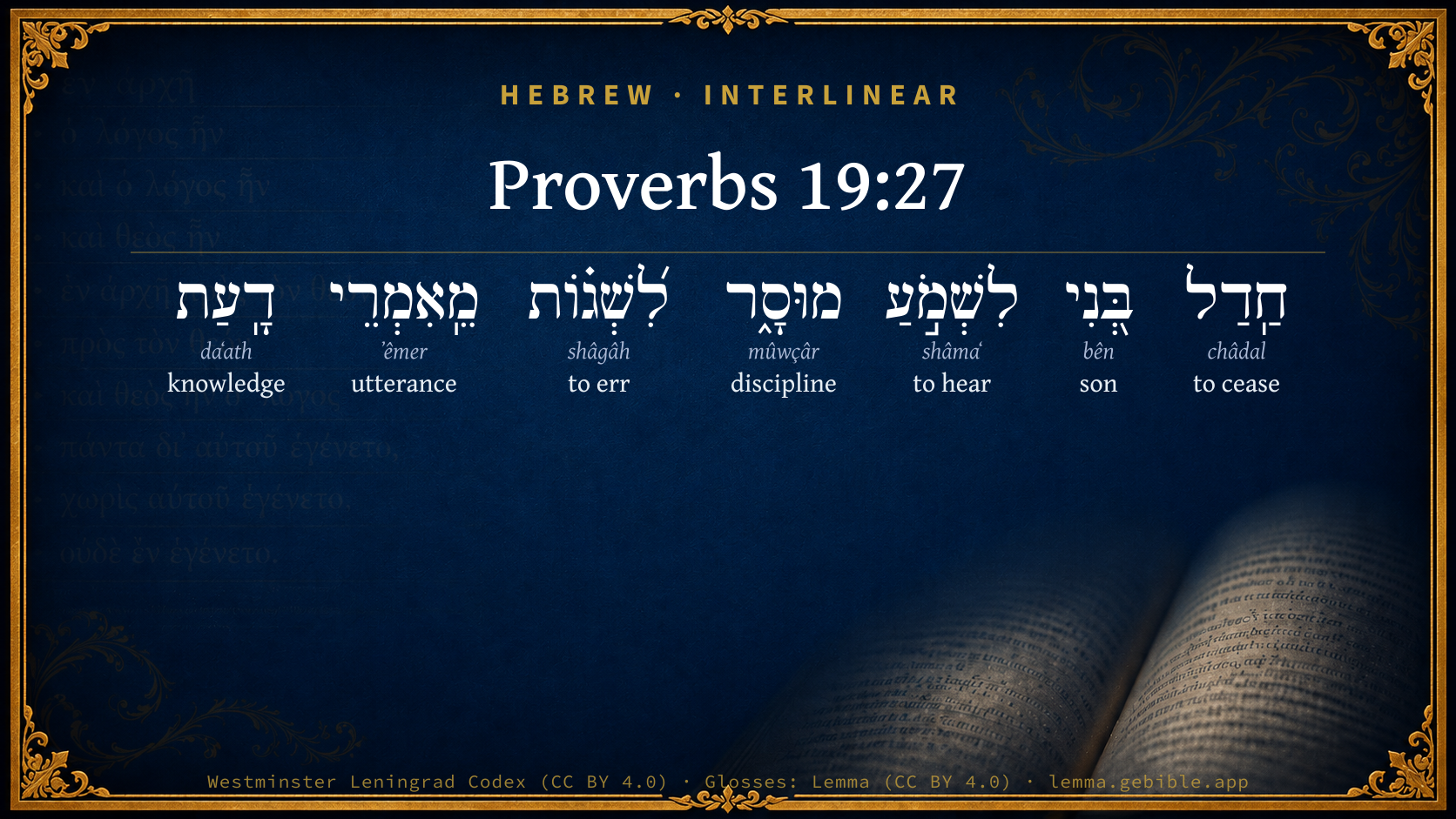
Hebrew (Westminster Leningrad Codex) Proverbs 19:27 appears in the Hebrew Old Testament. The text above is from the Westminster Leningrad Codex. Each word links to its Strong’s number, a concise gloss, and parsing drawn from the Open Scriptures Hebrew Bible morphology. Click any word for its full Brown-Driver-Briggs (BDB) entry.
Download image
Cite this verse

Proverbs 19:27 (World English Bible). Public Domain. Lemma interlinear Bible study tool, https://lemma.gebible.app/v/proverbs/19/27.

Show BibTeX & RIS
BibTeX
RIS
English Translation
If you stop listening to instruction, my son, You will stray from the words of knowledge.
World English Bible · Public Domain
Download a study sheet

One document with this verse’s original text, its word-by-word gloss line, the meaning frame, cross-references with their text, attributed commentary, and full source and license credits — printable, and it pastes into notes with its structure intact.

This verse Autodidact and up

Study sheet (.html) Plain text (.txt)

A passage Seminary Student

Up to 50 verses in one chapter. A passage sheet keeps up to 6 commentary sources and 12 cross-references per verse, in the order this page ranks them, and says so on the sheet whenever that leaves anything out. Ask for a single verse and you get the Autodidact verse sheet above.

Everything on this page stays free to read, with no account — the sheet is a download of what is already on screen, not access to it.

Want to remove ads? Support Godless Engineer
Compare translations 3

The same verse in 3 English versions, stacked beneath the original-language interlinear above. Click any original word for its lexicon entry.

Each is an independent rendering of the whole verse — the interlinear is not word-aligned to these translations.

Highlighted words mark where these versions differ — a whole-verse word diff, not a word-by-word alignment.

  • World English Bible Public Domain
    If you stop listening to instruction, my son, You will stray from the words of knowledge.
  • King James Version Public Domain
    Cease, my son, to hear the instruction that causeth to err from the words of knowledge.
  • unfoldingWord Literal Text CC BY-SA 4.0
    My son, cease to hear instruction to stray from the words of knowledge.

unfoldingWord Literal Text — © unfoldingWord, licensed CC BY-SA 4.0. Word-aligned USFM3 via Door43 (git.door43.org/unfoldingWord/en_ult).

Versions to compare (up to 4)

3 of 4 selected

Show all 18 translations

Every available English version of this verse, each an independent rendering of the whole verse.

  • World English Bible Public Domain
    If you stop listening to instruction, my son, You will stray from the words of knowledge.
  • Berean Standard Bible Public Domain
    If you cease to hear instruction, my son, you will stray from the words of knowledge.
  • Majority Standard Bible Public Domain
    If you cease to hear instruction, my son, you will stray from the words of knowledge.
  • King James Version Public Domain
    Cease, my son, to hear the instruction that causeth to err from the words of knowledge.
  • American Standard Version (1901) Public Domain
    Cease, my son, to hear instruction `Only' to err from the words of knowledge.
  • Revised Version (1885) Public Domain
    Cease, my son, to hear instruction only to err from the words of knowledge.
  • Geneva Bible (1599) Public Domain
    My sonne, heare no more the instruction, that causeth to erre from ye words of knowledge.
  • Douay-Rheims (1899) Public Domain
    Cease not, O my son, to hear instruction, and be not ignorant of the words of knowledge.
  • Young's Literal Translation Public Domain
    Cease, my son, to hear instruction -- To err from sayings of knowledge.
  • Literal Standard Version CC BY-SA 4.0
    Cease, my son, to hear instruction—To err from sayings of knowledge.
  • Unlocked Literal Bible CC BY-SA 4.0
    If you cease to hear instruction, my son, you will stray from the words of knowledge.
  • unfoldingWord Literal Text CC BY-SA 4.0
    My son, cease to hear instruction to stray from the words of knowledge.
  • Darby Bible Public Domain
    Cease, my son, to hear the instruction which causeth to stray from the words of knowledge.
  • World Messianic Bible Public Domain
    If you stop listening to instruction, my son, you will stray from the words of knowledge.
  • Webster's Bible Public Domain
    Cease, my son, to hear the instruction that causeth to err from the words of knowledge.
  • Free Bible Version CC BY-SA 4.0
    My son, stop listening to my instruction and you'll soon give up following wisdom.
  • Bible in Basic English Public Domain
    A son who no longer gives attention to teaching is turned away from the words of knowledge.
  • JPS Tanakh (1917) Public Domain
    Cease, my son, to hear the instruction that causeth to err from the words of knowledge.

Literal Standard Version (2020), Covenant Press — licensed CC BY-SA 4.0. Text via the HelloAO Bible API (eBible.org). Unlocked Literal Bible (unfoldingWord) — licensed CC BY-SA 4.0. Text via the HelloAO Bible API (eBible.org). unfoldingWord Literal Text — © unfoldingWord, licensed CC BY-SA 4.0. Word-aligned USFM3 via Door43 (git.door43.org/unfoldingWord/en_ult). Free Bible Version, Dr. Jonathan Gallagher — licensed CC BY-SA 4.0. Text via the HelloAO Bible API (eBible.org).

Word by word

More ways to search: Search by grammar → Find every occurrence → Compare this word →

Practice this passage: Drill this verse → Learn its vocabulary →

לִ֝שְׁג֗וֹת
shâgâh
H7686
“to err”
Preposition + Verb, Qal, Infinitive Construct
Part of Speech
Preposition + Verb
Stem
Qal
Form
Infinitive Construct
Full BDB Definition

Origin: a primitive root

TWOT: 2325

to go astray, stray, err - (Qal) - to err, stray - to swerve, meander, reel, roll, be intoxicated, err (in drunkenness) - to go astray (morally) - to commit sin of ignorance or inadvertence, err (ignorantly) - (Hiphil) - to lead astray - to lead astray, mislead (mentally) - to lead astray (morally)
  1. חַֽדַל châdal H2308 “cease” Verb, Qal, Imperative, 2nd Person, Masculine, Singular
  2. בְּ֭נִי bên H1121 “son · my” Noun, Common, Masculine, Singular, Construct + Suffix, Personal, 1st Person, Common, Singular
  3. לִשְׁמֹ֣עַ shâmaʻ H8085 “to hear” Preposition + Verb, Qal, Infinitive Construct
  4. מוּסָ֑ר mûwçâr H4148 “discipline” Noun, Common, Masculine, Singular, Absolute
  5. מֵֽאִמְרֵי ʼêmer H561 “from · utterances of” Preposition + Noun, Common, Masculine, Plural, Construct
  6. דָֽעַת daʻath H1847 “knowledge” Noun, Common, Feminine, Singular, Absolute

About this verse

These counts appear in no published source. They are computed here, from the morphology-tagged text and Lemma’s own curated glosses. What Lemma adds →

7
words
7
distinct lemmas
Wisdom
section

Notable vocabulary

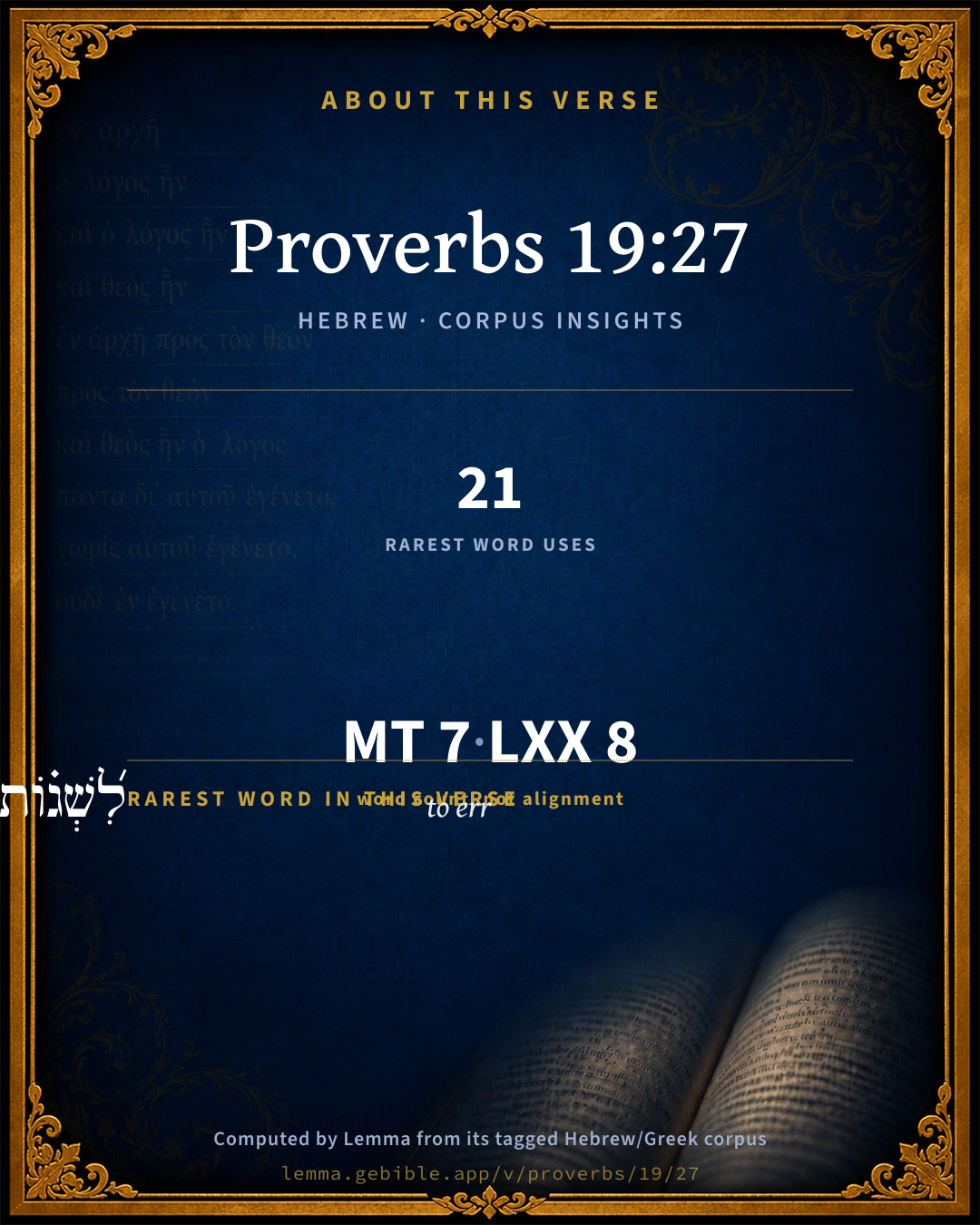
The rarest word here is לִ֝שְׁג֗וֹת to err H7686 — appearing just 21 times in the whole Hebrew Bible.

Shared distinctive vocabulary

לִ֝שְׁג֗וֹת to err H7686 occurs in 19 verses of the Hebrew Bible. Also found in:

Grammatical profile

  • 3 verbs
  • 4 nouns

Verb forms

  • חַֽדַל Qal · Imperative
  • לִשְׁמֹ֣עַ Qal · Infinitive Construct
  • לִ֝שְׁג֗וֹת Qal · Infinitive Construct

Hebrew & Septuagint length

In English translation the verse runs 16 words from the Hebrew and 16 from the Septuagint (LXX English) — the same length.

A rough comparison of the two English renderings, which tokenize alike — not a word-level alignment.

Word counts can differ between the Hebrew and the Greek without any difference in meaning — e.g. the Hebrew direct-object marker אֵת has no separate Greek word, and Greek often adds the article ὁ.

In the original languages it is 7 Hebrew tokens and 8 Greek tokens — but the two are counted differently (Hebrew bundles its prefixes and suffixes into one token; the Greek is in lemma form), so that isn’t a like-for-like length.

Cross-references

17

Topical passages linked to Proverbs 19:27 in the Treasury of Scripture Knowledge — connected by theme and wording, ordered by reader-vote popularity; previews shown in the World English Bible.

  • 1 Timothy 6:3–5 If anyone teaches a different doctrine, and doesn't consent to sound words, the words of our Lord Jesus Christ, and to the doctrine which is according to godliness,
  • Mark 4:24 He said to them, "Take heed what you hear. With whatever measure you measure, it will be measured to you, and more will be given to you who hear.
  • Proverbs 14:7 Stay away from a foolish man, For you won't find knowledge on his lips.
  • Matthew 7:15 "Beware of false prophets, who come to you in sheep's clothing, but inwardly are ravening wolves.
  • 1 John 4:1 Beloved, don't believe every spirit, but test the spirits, whether they are of God, because many false prophets have gone out into the world.
  • 2 Corinthians 11:13–15 For such men are false apostles, deceitful workers, masquerading as Christ's apostles.
  • 2 John 1:10 If anyone comes to you, and doesn't bring this teaching, don't receive him into your house, and don't welcome him,
  • Deuteronomy 13:1–4 If there arise in the midst of you a prophet, or a dreamer of dreams, and he give you a sign or a wonder,
  • 1 Kings 22:22–28 Yahweh said to him, 'How?' He said, 'I will go forth, and will be a lying spirit in the mouth of all his prophets.' He said, 'You shall entice him, and shall prevail also: go forth, and do so.'
  • Matthew 16:6 Jesus said to them, "Take heed and beware of the yeast of the Pharisees and Sadducees."
  • Matthew 16:12 Then they understood that he didn't tell them to beware of the yeast of bread, but of the teaching of the Pharisees and Sadducees.
  • Mark 7:6–14 He answered them, "Well did Isaiah prophesy of you hypocrites, as it is written, 'This people honors me with their lips, But their heart is far from me.
  • John 10:5 They will by no means follow a stranger, but will flee from him; for they don't know the voice of strangers."
  • Ephesians 4:14 that we may no longer be children, tossed back and forth and carried about with every wind of doctrine, by the trickery of men, in craftiness, after the wiles of error;
  • 1 Timothy 4:7 But refuse profane and old wives' fables. Exercise yourself toward godliness.
  • 2 Peter 2:1–2 But there also arose false prophets among the people, as among you also there will be false teachers, who will secretly bring in destructive heresies, denying even the Master who bought them, bringing on themselves swift destruction.
  • Revelation 2:2 "I know your works, and your toil and perseverance, and that you can't tolerate evil men, and have tested those who call themselves apostles, and they are not, and found them false.

Cross-references courtesy of OpenBible.info (CC BY 4.0).

Hebrew and Greek witnesses Masoretic Hebrew ↔ Greek Septuagint

The same verse in the two great witnesses to the Old Testament, shown verse-for-verse.

These are two independent witnesses, not word-aligned to each other, and the Septuagint is shown in lemma (dictionary) form.

Hebrew Proverbs 19:27 Masoretic · Westminster Leningrad Codex

חַֽדַל בְּ֭נִי לִשְׁמֹ֣עַ מוּסָ֑ר לִ֝שְׁג֗וֹת מֵֽאִמְרֵי דָֽעַת

If you stop listening to instruction, my son, You will stray from the words of knowledge.

World English Bible · Public Domain

Greek LXX Proverbs 19:27 Septuagint · lemma form

υἱός ἀπολείπω φυλάσσω παιδεία πατήρ μελετάω ῥῆσις κακός

A son who ceases to attend to the instruction of a father will cherish evil designs.

LXX2012 (modern English Septuagint) · Public Domain

On this verse, Haydock's Catholic Bible Commentary discusses the Septuagint’s reading. Read the note in Commentary ↓

Hebrew: Westminster Leningrad Codex (CC BY 4.0). Greek: Septuagint (public domain); English from LXX2012 (modern English Septuagint) (Public Domain). How the Septuagint differs from the Hebrew →

Commentary

Notes on Proverbs 19:27 from classic Christian and Jewish commentators (each source and its license shown beneath its notes). The classic Christian expositions comment on the surrounding passage and are grouped to its opening verse, so a note may address several verses; the Jewish commentaries on the Tanakh (Rashi and others) are per-verse, so they appear only where the commentator wrote on this verse.

Lemma curates 59 commentaries, every one of them public domain or Creative Commons licensed, each selected and text-cleaned for this edition rather than reprinted as found. About our sources →

Trapp's Complete Commentary

John Trapp

Pro 19:27 Cease, my son, to hear the instruction [that causeth] to err from the words of knowledge.

Ver. 27. Cease, my son, to hear the instruction.] "Beware of false prophets." {Mat 7:15} {See Trapp on "Mat 7:15"} Take heed also what books ye read; for as water relisheth of the soil it runs through, so doth the soul of the authors that a man readeth.

John Trapp, A Commentary or Exposition upon All the Books of the Old and New Testament (1647–1656) — public domain. Text from a community e-Sword module.

The Biblical Illustrator

Joseph S. Exell

Pro_19:27

Cease, my son, to hear the instruction that causeth to err from the words of knowledge.

Temptation to perilous listening

By the words of knowledge understand the principles and dictates of virtue and religion. The wise mans advice amounts to this--That we should be careful to guard against the arts and insinuations of such as set up for teachers of infidelity and irreligion.

I. The several temptations which men lie under to listen to such instructors. It is one step toward security to see the dangers we are exposed to. Since the fears and apprehensions of guilt are such strong motives to infidelity, the innocence of the heart is absolutely necessary to preserve the freedom of the mind. In the most unhappy circumstances of sin and guilt, religion opens to us a much safer and more certain retreat than infidelity can possibly afford. Vice is not the only root from which infidelity springs. Reason itself is betrayed by the vanity of our hearts, and sinks under the pride and affectation of knowledge. All kinds of laudable ambition grow to be vicious and despicable when, instead of pursuing the real good which is their true object, they seek only to make a show of an appearance of it. Thus it is that ambition for virtue produces hypocrisy; ambition for courage, boastings and unreasonable resentments; ambition for learning and knowledge, pedantry and paradoxes. Another sort of temptation is a kind of false shame, which often, in young people especially, prevails over the fear of God and the sense of religion. When religion suffers under the hard names of ignorance and superstition, they grow ashamed of their profession, and by degrees harden into denying God.

II. The danger that lies in listening to these instructors. Here only speak to such as have not yet made shipwreck of reason and conscience. It is an unpardonable folly and inexcusable perverseness for men to forsake religion out of vanity and ostentation; as if irreligion were a mark of honour and a noble distinction from the rest of mankind. We must answer for the vanity of our reasoning as well as for the vanity of our actions. If the punishments of another life be, what we have too much reason to fear they will be, what words can then express the folly of sin? Consider, therefore, with yourselves, that when you judge of religion, something more depends upon your choice than the credit of your judgment or the opinion of the world. Religion is so serious a thing as to deserve your coolest thoughts, and it is not fit to be determined in your hours of gaiety and leisure, or in the accidental conversation of public places. Trust yourself with yourself; retreat from the influence of dissolute companions, and take the advice of the psalmist, Commune with your own heart. (T. Sherlock, D. D.)

Avoid false books and teachers

The enemies of religion now say that every man in search of truth ought to put himself in a way to hear both sides. Lay it down as a general rule that men ought not to read those books or hear those preachers that inculcate gross errors, i.e., essential errors. The popular pretence that men must hear both sides is an insidious attack on the Bible, a covered insinuation that the Bible is insufficient to enlighten. Every one should early settle his belief in the leading doctrines of the gospel. Why need such an one expose himself to the infection of error. Men are naturally so averse to the truth that it is infinitely dangerous for those not fully confirmed in it to expose themselves to the contagion of error. They ought not to presume so much on their own stability. Men cannot parley with error and be safe. And if the man himself is safe, he ought to consider the injury he may do to others by encouraging the promulgation of dangerous errors. The encouragement of erroneous teachers and books is conspiring against God. Popularly it is said that truth will recommend itself to every mans conscience, and none can be injured by seeing it compared with error. In answer, it may be said--

1. This is founded on a principle which men would not admit in any other case.

2. The objection would be less deceptive if in matters of religion men were more inclined to truth than to error.

3. The retailers of false doctrine do not state things candidly.

4. The antidote to error does not always go along with the error itself.

5. Facts speak decisively against the encouragement of false books and teachers, under the pretence mentioned in the objection.

Apply--

1. To those who profess to be the friends of God and established in the truth. Do not encourage the promulgation of known errors.

2. To such as are not established in religious opinions. Get established without delay. Error in every form is couching to make you his prey. Beware of an indiscreet desire to read every new book and to hear every new preacher. (E. D. Griffin, D. D.)

A protest against the immoral

Socrates often frequented the theatre, which brought a great many thither out of a desire to see him. On which occasion it is recorded of him that he sometimes stood to make himself the more conspicuous, and to satisfy the curiosity of the beholders. He was one day present at the first representation of a tragedy of Euripides, who was his intimate friend, and whom he is said to have assisted in several of his plays. In the midst of the tragedy, which had met with very great success, there chanced to be a line that seemed to encourage vice and immorality. This was no sooner spoken, but Socrates rose from his seat, and without any regard to his affection for his friend or to the success of the play, showed himself displeased at what was said, and walked out of the assembly. (The Tatler.)

.

The Biblical Illustrator, edited by Joseph S. Exell (c. 1880s–1900s) — public domain. Text from a community e-Sword module.

Joseph Benson's Commentary

Pro 19:27. Cease, my son, to hear the instruction, &c. — If thou hast done it formerly, yet do not now, any longer, hearken to those false doctrines, or evil counsels, which tend to withdraw thee from the belief or practice of God’s holy word. Or, as Bishop Patrick interprets the verse, “My son, beware of their discourse, who, under the show of greater learning, seduce thee from the plain doctrines of virtue; or, if thou hast been unhappily engaged in such company, quit it presently, and stick to those that honestly instruct thee; for, remember this, to leave off hearing the instruction of good men, is the first step toward a departure from all religion.”

Joseph Benson's Commentary on the Old and New Testaments (1811–1818) — public domain. Text from a community e-Sword module.

Matthew Henry's Commentary

This is a good caution to those that have had a good education to take heed of hearkening to those who, under pretence of instructing them, draw them off from those good principles under the influence of which they were trained up. Observe, 1. There is that which seems designed for instruction, but really tends to the destruction of young men. The factors for vice will undertake to teach them free thoughts and a fashionable conversation, how to palliate the sins they have a mind to and stop the mouth of their own consciences, how to get clear of the restraints of their education and to set up for wits and beaux. This is the instruction which causes to err from the forms of sound words, which should be held fast in faith and love. 2. It is the wisdom of young men to turn a deaf ear to such instructions, as the adder does to the charms that are designed to ensnare her. "Dread hearing such talk as tends top instil loose principles into the mind; and, if thou art linked in with such, break off from them; thou hast heard enough, or too much, and therefore hear no more of the evil communication which corrupts good manners."

Matthew Henry's Commentary on the Whole Bible (1708–1710) — public domain (CC PDM 1.0). Text via the HelloAO Bible API.

Jamieson, Fausset & Brown

Robert Jamieson, A. R. Fausset & David Brown

Avoid whatever leads from truth.

Jamieson, Fausset & Brown — Commentary Critical and Explanatory on the Whole Bible (1871) — public domain (CC PDM 1.0). Text via the HelloAO Bible API.

Adam Clarke's Commentary

Verse 27. Cease, my son] Hear nothing that would lead thee away from God and his truth.

Adam Clarke's Commentary on the Bible (1810–1826) — public domain. Text from a community e-Sword/MySword module.

Ellicott's Commentary for English Readers

(27) Cease, my son, to hear the instruction that causeth to err . . .—Or the passage may mean, Cease to hear instruction if you are only going to err afterwards—Make up your mind what you are intending to do hereafter, and act now accordingly; better not know the truth than learn it only to desert it. (Comp. 2Pe_2:21.)

A Bible Commentary for English Readers, edited by Charles John Ellicott (1878–1897) — public domain. Text from a community e-Sword module.

The Cambridge Bible for Schools and Colleges

gen. ed. J. J. S. Perowne

27. That causeth to err] The Heb. is simply, Cease to hear instruction to err. This may mean either, with A.V., Do not listen to instruction which if you follow it will lead you astray; or better, with R.V., Do not listen to (good) instruction, only to neglect it, and err in spite of it. Comp. Jas_1:22; Mat_7:26-27.

The Cambridge Bible for Schools and Colleges (gen. ed. J. J. S. Perowne; Cambridge University Press, 1878–1918) — public domain. Text from a community e-Sword module.

John Gill's Exposition

Cease, my son, to hear the instruction,.... The counsel of bad men, or the doctrine of false teachers. The words are spoken either by Solomon to his son; or by Wisdom, that is, Christ, to everyone of his children, to beware of false prophets, and take heed what they hear; see Mat 7:15; such as the doctrines of the church of Rome; concerning the Scriptures, forbidding the people to read them; setting unwritten traditions upon a level with them, and making the pope an infallible interpreter of them; concerning merit, works of supererogation, indulgences, pardons, penance, purgatory, &c. such as the instruction of the Arians, Sabellians, Socinians, Pelagians, and Arminians, concerning the Trinity, the deity of Christ, his satisfaction, imputed righteousness, the power and purity of human nature, and man's free will;

that causeth to err from the words of knowledge; the words of the living God, the Scriptures of truth; which communicate knowledge, and are profitable for instruction in righteousness; are the means of the true knowledge of God; that there is one, and that he is possessed of all perfections: particularly that he is gracious and merciful, and pardons all manner of sin; that he is in Christ, the God of all grace; that he is the God and Father of Christ, and the covenant God and Father of all his people in him; they give knowledge of his mind and will concerning the salvation of men, and of his ways and worship. The wholesome words of our Lord Jesus, the salutary doctrines of the Gospel, may be here meant; those words of grace, wisdom, and knowledge, which come from him, and give knowledge of his person, offices, relations, incarnation, and blessings of grace by him; from whence they are called the word of peace and reconciliation, the word of righteousness, the word of life, and the word of salvation. Now these are all words of knowledge; and are the means of a spiritual, experimental, and fiducial knowledge of Christ, which is preferable to all other knowledge, and even to everything in the world; and therefore care should be taken, and everything avoided that tends to cause to err from these words and doctrines, which convey, promote, and improve this knowledge. Jarchi and Aben Ezra transpose the words, thus;

"cease, my son, to err from the words of knowledge, to or that thou mayest hear instruction and the latter makes mention of such an interpretation, cease, my son, from the words of knowledge, if thou wouldest hear instruction, and after that err:''

that is, better never hear and know at all, than to turn from those doctrines and instructions; see Pe2 2:20.

John Gill's Exposition of the Whole Bible (1746–1763) — public domain (CC PDM 1.0). Text via the HelloAO Bible API.

Albert Barnes' Notes on the Bible

literally, Cease, my son, to hear instruction, that thou mayest err from the words of knowledge; advice given ironically to do that to which his weakness leads him, with a clear knowledge of the evil to which he is drifting.

Albert Barnes' Notes on the Bible (1834–1885) — public domain. Text from a community e-Sword/MySword module.

Haydock's Catholic Bible Commentary

Not. Hebrew seems to say the reverse. (Calmet) --- But we may read it with an interrogation. "Wilt thou cease?" &c. Or the instruction here meant is of a dangerous nature. Protestants, "that causeth to err from the words of knowledge." Septuagint, "a son who neglects to keep the instruction of his father, shall muse on bad sayings." (Haydock)

George Leo Haydock (1774–1849), Haydock's Catholic Family Bible and Commentary, 1859 edition — public domain. Excludes Psalms (Douay-Rheims chapter numbering differs from Protestant) and Deuterocanonical books (Catholic canon only).

Matthew Poole's English Annotations

If thou hast formerly, yet do not now any longer hearken to those false doctrines or evil counsels which tend to withdraw thee from the belief or practice of God’s holy word.

Matthew Poole's English Annotations on the Holy Bible (1683–1685) — public domain. Text from a community e-Sword/MySword module.

Whedon's Commentary on the Bible

Daniel D. Whedon

27. Cease… to hear the instruction that causeth to err — The verse is difficult. Leaving out the italics, it would be, “Cease, my son, to hear the instruction to err from the words of knowledge.” Conant renders: “So as to err.” Miller: “With the result of wandering.” Acken, in Zockler: “To depart from.” “Cease to hear instruction which leads thee to err.” — Rosenmuller. It is probable that our Version has given the true sense. The Septuagint has: “A son who ceases to attend to the instruction of a father will cherish evil designs.” The Douay: “Cease not, my son, to hear instruction, and be not ignorant of the words of knowledge.”

Daniel D. Whedon (gen. ed.), Commentary on the Old and New Testaments (1874–1909) — public domain. Text from a community e-Sword module.

The Pulpit Commentary

Cease, my son, to hear the instruction that causeth to err from the words of knowledge. This version fairly represents the terse original, if musar, "instruction," be taken in a bad sense, like the "profane and vain babblings and oppositions of the knowledge which is falsely so called," censured by St. Paul. (1Ti_6:20) But as musar is used in a good sense throughout this book, it is better to regard the injunction as warning against listening to wise teaching with no intention of profiting by it: "Cease to hear instruction in order to err," etc.; i.e. if you are only going to continue your evil doings. You will only increase your guilt by knowing tile way of righteousness perfectly, while you refuse to walk therein. The Vulgate inserts a negation, "Cease not to hear doctrine, and be not ignorant of the war, is of knowledge;" Septuagint, "A son who fails to keep the instruction of his father will meditate evil sayings." Solomon"s son Rehoboam greatly needed the admonition contained in this verse.

The Pulpit Commentary (1880–1919), ed. H.D.M. Spence-Jones & Joseph S. Exell — public domain. Text from a community e-Sword module.

Keil & Delitzsch

C. F. Keil & F. Delitzsch

27 Cease, my son, to hear instruction,

To depart from the words of knowledge.

Oetinger correctly: cease from hearing instruction if thou wilt make no other use of it than to depart, etc., i.e., cease to learn wisdom and afterwards to misuse it. The proverb is, as Ewald says, as "bloody irony;" but it is a dissuasive from hypocrisy, a warning against the self-deception of which Jam 1:22-24 speaks, against heightening one's own condemnation, which is the case of that servant who knows his lord's will and does it not, Luk 12:47. חדל, in the meaning to leave off doing something further, is more frequently construed with ל seq. infin. than with מן (cf. e.g., Gen 11:8 with Kg1 15:21); but if we mean the omission of a thing which has not yet been begun, then the construction is with ל, Num 9:13, Instead of לשׁגּות, there might have been also used מלּשׁגּות (omit rather ... than...), and למען שׁגות would be more distinct; but as the proverb is expressed, לשׁגות is not to be mistaken as the subord. infin. of purpose. The lxx, Syr., Targ., and Jerome do violence to the proverb. Luther, after the example of older interpreters: instruction, that which leads away from prudent learning; but musar always means either discipline weaning from evil, or education leading to good.

Keil & Delitzsch — Biblical Commentary on the Old Testament (1861–1891) — public domain (CC PDM 1.0). Text via the HelloAO Bible API. (Old Testament only.)

Bridges on Proverbs

Charles Bridges

27 Cease, my son, to hear the instruction that causeth to err from the words of knowledge.†a

Hear the same caution from the lips of our Divine Master — "Beware of false prophets. Take heed what ye hear." (Mat 7:15 . Mar 4:24 .) All instruction is not to life. Teachers of evil, "Ministers of Satan,"†1 abound. And their instruction, causing to err from the words of knowledge, is more palatable to the perverseness of the heart; more alluring to the inexperience of the young, than solid Scriptural teaching.†2 The Apostle reproved the Galatian Church for listening to teachers, causing them to err fatally from the words of knowledge.†3 And would he not have warned us against the same teaching, so fearfully prevalent: placing ordinances in the stead of Christ, or conjoined with him; man’s proud work of "voluntary humility" and external service in the room of pure simplicity of reliance on the Redeemer’s work? When the soul has thus "fallen from grace" (Gal 5:4 ), what ground of confidence can we bring before God? What is his service, but the bondage of outward ceremonies, leading to cheerless despondency?

This instruction is not generally a bold and direct departure from truth. But, as in the first temptation (Gen 3:1-6 ), it caused to err so gradually, that the deviation from the straight line is scarcely perceptible, till the mischief has been accomplished. Had Eve at once ceased to hear, she would not have erred from the words of knowledge. But the success of the first attempt has emboldened the seducer to deal out his deadly poison to her enfeebled children. And what faithful pastor does not feel a "godly jealousy" for his flock, lest by the same beguilement "they should be corrupted from the simplicity that is in Christ"? (2Co 11:3 .)

Insinuating infidels, who endeavour to shake the principles of young persons under the pretense of removing needless scruples, and enlarging their minds, and delivering them from the shackles of bigotry — such persons shun them as the plague. Let us sound a caution also against false teachers of a more plausible, and therefore more dangerous character. Let their devices and disguises be fully laid open. It is the "wolf," not in his native dress, but "in sheep’s clothing." (Mat 7:15 .) "Cunning craftiness" is the distinctive character of the instruction. (Eph 4:14 .) All that is pleasing is brought out as a cover for the delusion. Perhaps never was the poison commended in so attractive a form. All the charms of elegant fiction are employed to give effect to it. A lovely picture of practical religion is exhibited. Or the deliverance from the fowler’s open snare is portrayed with glowing color of interest. Superficial readers are captivated by the external loveliness. Parents — sometimes even Christian parents — commend to their children these pictures as models of domestic religion or Church orthodoxy. But the wise watchman would raise his warning voice — Cease, my son, from hearing. — To hear — to regard — is to err. All these beauteous sketches of fancy are the framework, that conceal principles most unscriptural. Weigh them in the balances of the sanctuary, and they will be found wanting. Trace them to their source, and it will be found to be a corrupt fountain. The Church, not Christ, is the foundation principle. A human standard, not the word of God, is the rule. Cease from hearing.†4

Indeed everywhere we would give the warning, that needlessly to tamper with error, is "entering into temptation." Nay, it is most hazardous to deal with it at all, ere our minds are thoroughly grounded in the truth, and we have obtained "the good thing of the heart established with grace."†5 Yet we have senses given for discernment. Use increaseth this discernment.†6 Increasing clearness should be the matter of daily supplication.†7 We are bound therefore to exercise our senses by the plainest commands.†8 Our Divine Master distinctly rebukes indolence.†9 When the words came with the stamp of an apostle, the appeal to the unerring standard was highly commended.†10 Should we give up our judgment to the Church, be it remembered, that "every one of us shall bear his own burden, and shall give an account of himself to God."†11 Be the son, not the slave, of the Church. Reverence her just authority; but maintain that right of private judgment, which constitutes our personal responsibility.

This Christian independence however must be held with humility and simplicity. The duty of private judgment must be felt as one’s own burden, to be cast on none but God. Hence we must carefully restrain self-will. We must attend the ordinances in the spirit of learners rather than as judges; desiring to gather instruction in child-like simplicity, and watching lest the appetite for wholesome food should give place to a spiritual lust. (See 2Ti 4:3 .) While the right of judgment is our great privilege, never let us forget, that the licentiousness of it is a cankering evil. If the Romanist enslave the right, let the sound Protestant discipline its exercise.

But what — if our lot be manifestly cast, and our sphere of Christian obligation opened, where words of knowledge are not found? We would suggest at commencement, that particular cases require particular application. There may be cases, when the call would be direct to cease from hearing. If the teaching be heretical, or wholly unevangelical, if the teacher’s life be immoral or scandalously worldly; if the children and servants of the family are manifestly in danger of being caused to err, the path may be made plain to depart. And yet in this case much exercise of mind, much personal sacrifice would be called for to separate from the Minister, not from the Church. And under no circumstances let the ungodliness of the Minister be an excuse for the neglect of Christian ordinances. At the same time, in many more cases than are ordinarily supposed, the mature Christian will remain in his place, continue in prayer, abound in labour of love, meekly use, as occasion may allow, the weapons of admonition and reproof, display a consistent example, and take up his appointed cross. In some cases, when the offense is open, and the error manifest, sound discipline may bring the heretical or ungodly teacher to punishment, and thus open the way for better instruction.

To the mass — who are mainly dependent upon the Ministry for instruction, some forbearance must be admitted, even should they be constrained by hunger to cease from hearing those, who would give them a stone for bread. At least the main guilt lies on "the stranger," not on them, that flee from him, for they "know not his voice." (Joh 10:5 .) Fearful indeed will be the witness of many a soul neglected, if not "destroyed, for lack" of hearing the words of knowledge. Assured as we are, that the preaching of Christ is the alone preservation from this tremendous evil, if Christ be preached, and sinners are converted to him by other less accredited teachers, "we do rejoice, yea, and we will rejoice." (Php 1:18 .) Yet where Christians can abide, let them do so — Let them "trust in the LORD, and do good."†12 The words of knowledge always, will they hear from the Church, if not from her Ministers. The deficiency in privilege will be abundantly supplied. Christian activity will be a quickening means of grace. The constant application of the touchstone will be a preservation from error. The food of the word will be more precious. And who knows but an enlightened Minister may be given to the power of believing prayer, and to the living influence of godly meekness, patience, and consistency?

Footnotes:

†a There is some difficulty upon the rendering of this verse — but Holden concludes the ’least interpretation to be that of our Translators.’ Mr. Scott adds, that ’this translation is of so much importance, that it should not be lightly departed from.’

†1 2Co 11:13-15 .

†2 Isa 30:10. Jer 5:31 .

†3 Gal 1:6-7; Gal 3:1-4 ; Gal 5:7-8 .

†4 Rom 16:17-18. 1Ti 6:3-5 . 2Ti 2:16-17 .

†5 Heb 13:9.

†6 Heb 5:14.

†7 Php 1:9-10. M.R.={judgment: or, sense}

†8 1Th 5:21 . 1Jn 4:1 .

†9 Luk 12:57.

†10 Act 17:11. Compare Isa 8:20 .

†11 Gal 6:5. Rom 14:12 .

†12 Psa 37:3. See a remarkable instance in the Life of Mr. Walker of Truro.

Charles Bridges, An Exposition of the Book of Proverbs (1846) — public domain. Text from a community e-Sword module.

Kretzmann's Popular Commentary

Paul E. Kretzmann

v. 27. Cease, my son, to hear the instruction that causeth to err from the words of knowledge, rather, "to depart from the sayings of understanding," for teaching which is not wholesome and in accord with the Word of God leads to destruction.

Paul E. Kretzmann, Popular Commentary of the Bible (1921–1924) — public domain. Text from a community e-Sword module.

Rashi

Rabbi Shlomo Yitzchaki (Rashi)

My son, cease to stray, etc. This is an elliptical verse, and this is its explanation: My son, cease to stray from words of knowledge in order to hear discipline.

cease to stray Heb. לשגות, like מלשגות, from straying. Likewise, (Num. 9:13): “and refrains (וחדל) from performing (לעשות) the Passover service.” Also, (Gen. 41:49): “they stopped counting (לספר).”

Rashi on the Tanakh — English translations: “The Judaica Press complete Tanach with Rashi, translated by A. J. Rosenberg” (CC BY 4.0); “Pentateuch with Rashi's commentary by M. Rosenbaum and A.M. Silbermann, 1929-1934” (public domain); “The Metsudah Tanach series, Lakewood, N.J” (CC BY 4.0); and “The Book of Joshua, Metsudah Publications, 1997” (CC BY 4.0). Text via Sefaria.

Lesson kit

Teaching starters — assembled from the data on this page, not authored interpretation. Every prompt links to the verse data it draws on. Edit before teaching.

Proverbs, in the Wisdom, opens this verse with 7 words (7 distinct Hebrew lemmas). Its most distinctive word is shâgâh (“to err”). A historical commentator’s framing appears above. Read the whole chapter for the surrounding context.

Discussion questions

  1. What does “to err” (shâgâh) contribute to the verse as a whole?
  2. Leviticus 4:13 shares the word «to err» with this verse. How do the two illuminate each other?
  3. These translations render this verse differently; the difference is in the English rendering, not the original. What questions does that raise?
  4. The verb «חַֽדַל» is Qal Imperative. How does its form color the action?
  5. Reading how Trapp's Complete Commentary and The Biblical Illustrator read this verse, where do the two commentators agree and where do they part?

Things to notice

Reading settings

Reading text

Shown beneath each verse's original-language words.

Old Testament
Old Testament edition

Read the OT as the Masoretic Hebrew (MT) or the Greek Septuagint (LXX).

English shown for the Greek Septuagint (in the Hebrew ↔ Greek comparison).

Comparing translations? Open the Compare panel on any verse page to stack up to four side by side.