
Proverbs 23:4

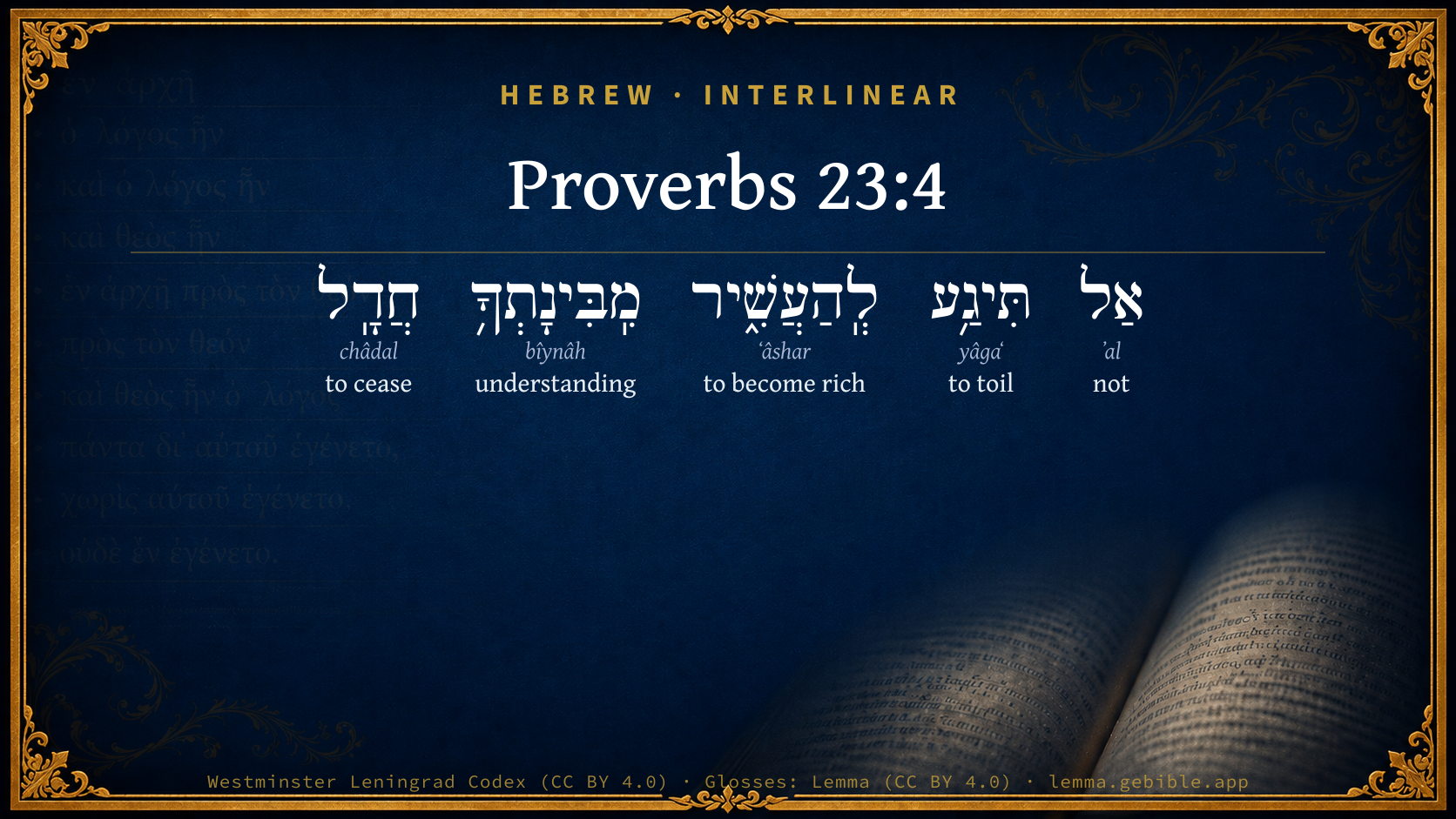
Hebrew (Westminster Leningrad Codex) Proverbs 23:4 appears in the Hebrew Old Testament. The text above is from the Westminster Leningrad Codex. Each word links to its Strong’s number, a concise gloss, and parsing drawn from the Open Scriptures Hebrew Bible morphology. Click any word for its full Brown-Driver-Briggs (BDB) entry.
Download image
Cite this verse

Proverbs 23:4 (World English Bible). Public Domain. Lemma interlinear Bible study tool, https://lemma.gebible.app/v/proverbs/23/4.

Show BibTeX & RIS
BibTeX
RIS
English Translation
Don't weary yourself to be rich. In your wisdom, show restraint.
World English Bible · Public Domain
Download a study sheet

One document with this verse’s original text, its word-by-word gloss line, the meaning frame, cross-references with their text, attributed commentary, and full source and license credits — printable, and it pastes into notes with its structure intact.

This verse Autodidact and up

Study sheet (.html) Plain text (.txt)

A passage Seminary Student

Up to 50 verses in one chapter. A passage sheet keeps up to 6 commentary sources and 12 cross-references per verse, in the order this page ranks them, and says so on the sheet whenever that leaves anything out. Ask for a single verse and you get the Autodidact verse sheet above.

Everything on this page stays free to read, with no account — the sheet is a download of what is already on screen, not access to it.

Want to remove ads? Support Godless Engineer
Compare translations 3

The same verse in 3 English versions, stacked beneath the original-language interlinear above. Click any original word for its lexicon entry.

Each is an independent rendering of the whole verse — the interlinear is not word-aligned to these translations.

Highlighted words mark where these versions differ — a whole-verse word diff, not a word-by-word alignment.

  • World English Bible Public Domain
    Don't weary yourself to be rich. In your wisdom, show restraint.
  • King James Version Public Domain
    Labour not to be rich: cease from thine own wisdom.
  • unfoldingWord Literal Text CC BY-SA 4.0
    Do not weary yourself to gain riches; from your understanding, cease.

unfoldingWord Literal Text — © unfoldingWord, licensed CC BY-SA 4.0. Word-aligned USFM3 via Door43 (git.door43.org/unfoldingWord/en_ult).

Versions to compare (up to 4)

3 of 4 selected

Show all 18 translations

Every available English version of this verse, each an independent rendering of the whole verse.

  • World English Bible Public Domain
    Don't weary yourself to be rich. In your wisdom, show restraint.
  • Berean Standard Bible Public Domain
    Do not wear yourself out to get rich; be wise enough to restrain yourself.
  • Majority Standard Bible Public Domain
    Do not wear yourself out to get rich; be wise enough to restrain yourself.
  • King James Version Public Domain
    Labour not to be rich: cease from thine own wisdom.
  • American Standard Version (1901) Public Domain
    Weary not thyself to be rich; Cease from thine own wisdom.
  • Revised Version (1885) Public Domain
    Weary not thyself to be rich; cease from thine own wisdom.
  • Geneva Bible (1599) Public Domain
    Trauaile not too much to be rich: but cease from thy wisdome.
  • Douay-Rheims (1899) Public Domain
    Labour not to be rich: but set bounds to thy prudence.
  • Young's Literal Translation Public Domain
    Labour not to make wealth, From thine own understanding cease, Dost thou cause thine eyes to fly upon it? Then it is not.
  • Literal Standard Version CC BY-SA 4.0
    Do not labor to make wealth, || Cease from your own understanding, || Do you cause your eyes to fly on it? Then it is not.
  • Unlocked Literal Bible CC BY-SA 4.0
    Do not work too hard to gain wealth; be wise enough to know when to stop.
  • unfoldingWord Literal Text CC BY-SA 4.0
    Do not weary yourself to gain riches; from your understanding, cease.
  • Darby Bible Public Domain
    Weary not thyself to become rich; cease from thine own intelligence:
  • World Messianic Bible Public Domain
    Don’t weary yourself to be rich. In your wisdom, show restraint.
  • Webster's Bible Public Domain
    Labor not to be rich: cease from thy own wisdom.
  • Free Bible Version CC BY-SA 4.0
    Don't wear yourself out trying to get rich—be wise enough not to bother!
  • Bible in Basic English Public Domain
    Take no care to get wealth; let there be an end to your desire for money.
  • JPS Tanakh (1917) Public Domain
    Weary not thyself to be rich; cease from thine own wisdom.

Literal Standard Version (2020), Covenant Press — licensed CC BY-SA 4.0. Text via the HelloAO Bible API (eBible.org). Unlocked Literal Bible (unfoldingWord) — licensed CC BY-SA 4.0. Text via the HelloAO Bible API (eBible.org). unfoldingWord Literal Text — © unfoldingWord, licensed CC BY-SA 4.0. Word-aligned USFM3 via Door43 (git.door43.org/unfoldingWord/en_ult). Free Bible Version, Dr. Jonathan Gallagher — licensed CC BY-SA 4.0. Text via the HelloAO Bible API (eBible.org).

Word by word

More ways to search: Search by grammar → Find every occurrence → Compare this word →

Practice this passage: Drill this verse → Learn its vocabulary →

About this verse

These counts appear in no published source. They are computed here, from the morphology-tagged text and Lemma’s own curated glosses. What Lemma adds →

5
words
5
distinct lemmas
Wisdom
section

Notable vocabulary

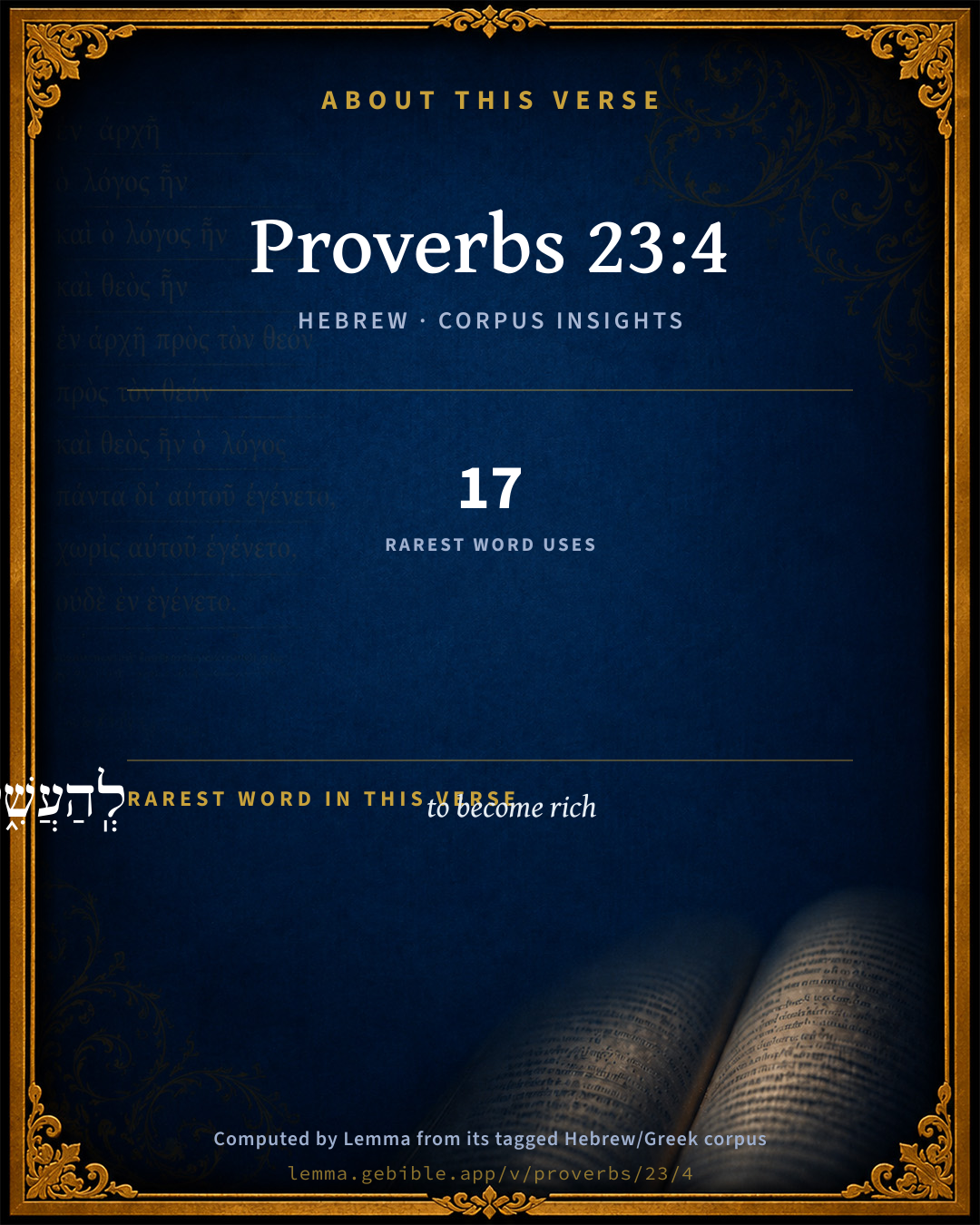
The rarest word here is לְֽהַעֲשִׁ֑יר to become rich H6238 — appearing just 17 times in the whole Hebrew Bible.

Shared distinctive vocabulary

לְֽהַעֲשִׁ֑יר to become rich H6238 occurs in 17 verses of the Hebrew Bible. Also found in:

Grammatical profile

  • 3 verbs
  • 1 noun
  • 1 particle

Verb forms

  • תִּיגַ֥ע Qal · Jussive
  • לְֽהַעֲשִׁ֑יר Hiphil · Infinitive Construct
  • חֲדָֽל Qal · Imperative

Hebrew & Septuagint length

In English translation the verse runs 11 words from the Hebrew and 17 from the Septuagint (LXX English) — the Septuagint runs noticeably longer here. See the side-by-side →

A rough comparison of the two English renderings, which tokenize alike — not a word-level alignment.

Word counts can differ between the Hebrew and the Greek without any difference in meaning — e.g. the Hebrew direct-object marker אֵת has no separate Greek word, and Greek often adds the article ὁ.

Cross-references

12

Topical passages linked to Proverbs 23:4 in the Treasury of Scripture Knowledge — connected by theme and wording, ordered by reader-vote popularity; previews shown in the World English Bible.

  • Hebrews 13:5 Be free from the love of money, content with such things as you have, for he has said, "I will in no way leave you, neither will I in any way forsake you."
  • Proverbs 28:20 A faithful man is rich with blessings; But one who is eager to be rich will not go unpunished.
  • Matthew 6:19 "Don't lay up treasures for yourselves on the earth, where moth and rust consume, and where thieves break through and steal;
  • 1 Timothy 6:8–10 But having food and clothing, we will be content with that.
  • Proverbs 3:5 Trust in Yahweh with all your heart, And don't lean on your own understanding.
  • John 6:27 Don't work for the food which perishes, but for the food which remains to eternal life, which the Son of Man will give to you. For God the Father has sealed him."
  • Proverbs 15:27 He who is greedy for gain troubles his own house, But he who hates bribes will live.
  • Romans 12:16 Be of the same mind one toward another. Don't set your mind on high things, but associate with the humble. Don't be wise in your own conceits.
  • Isaiah 5:21 Woe to those who are wise in their own eyes, And prudent in their own sight!
  • Proverbs 26:12 Do you see a man wise in his own eyes? There is more hope for a fool than for him.
  • Proverbs 3:7 Don't be wise in your own eyes. Fear Yahweh, and depart from evil.
  • Romans 11:25 For I don't desire, brothers, to have you ignorant of this mystery, so that you won't be wise in your own conceits, that a partial hardening has happened to Israel, until the fullness of the Gentiles has come in,

Cross-references courtesy of OpenBible.info (CC BY 4.0).

Hebrew and Greek witnesses Masoretic Hebrew ↔ Greek Septuagint

The same verse in the two great witnesses to the Old Testament, shown verse-for-verse.

Here the Septuagint runs noticeably longer than the Hebrew — LXX2012 (modern English Septuagint) 17 words vs World English Bible 11. A rough length comparison of the two English translations, not a word-level alignment — read both below.

These are two independent witnesses, not word-aligned to each other, and the Septuagint is shown in lemma (dictionary) form.

Hebrew Proverbs 23:4 Masoretic · Westminster Leningrad Codex

אַל תִּיגַ֥ע לְֽהַעֲשִׁ֑יר מִֽבִּינָתְךָ֥ חֲדָֽל

Don't weary yourself to be rich. In your wisdom, show restraint.

World English Bible · Public Domain

Greek LXX Proverbs 23:4 Septuagint · lemma form

μή παρα ἐκτείνω πένης εἰμί πλούσιος ὁ δέ σός ἐννοία ἀποἔχω

If you are poor, measure not yourself with a rich man; but refrain yourself in your wisdom.

LXX2012 (modern English Septuagint) · Public Domain

On this verse, Keil & Delitzsch discusses the Septuagint’s reading. Read the note in Commentary ↓

Hebrew: Westminster Leningrad Codex (CC BY 4.0). Greek: Septuagint (public domain); English from LXX2012 (modern English Septuagint) (Public Domain). How the Septuagint differs from the Hebrew →

Commentary

Notes on Proverbs 23:4 from classic Christian and Jewish commentators (each source and its license shown beneath its notes). The classic Christian expositions comment on the surrounding passage and are grouped to its opening verse, so a note may address several verses; the Jewish commentaries on the Tanakh (Rashi and others) are per-verse, so they appear only where the commentator wrote on this verse.

Lemma curates 59 commentaries, every one of them public domain or Creative Commons licensed, each selected and text-cleaned for this edition rather than reprinted as found. About our sources →

Matthew Henry's Commentary

As some are given to appetite (Pro 23:2) so others to covetousness, and those Solomon here takes to task. Men cheat themselves as much by setting their hearts on money (though it seems most substantial) as by setting them on dainties. Observe,

I. How he dissuades the covetous man from toiling and tormenting himself (Pro 23:4). "Do not aim to be rich, to raise an estate, and to make what thou hast in abundance more than it is." We must endeavor to live comfortably, and provide for our children and families, according as our rank and condition are, but we must not seek great things. Be not of those that will be rich, that desire it as their chief good and design it as their highest end, Ti1 6:9. Covetous men think it is their wisdom, imagining that if they be rich to such a degree they shall be completely happy. Cease from that wisdom, for it is a mistake; a man's life consists not in the abundance of the things which he possesses, Luk 12:15. 1. Those that aim at great things fill their hands with business more than they can grasp, so that their life is both a perfect drudgery and a perpetual hurry; but be not thou such a fool; labour not to be rich. What thou hast, or doest, be master of it, and not a slave to it as those that rise up early, sit up late, and eat the bread of carefulness, and all to be rich. Moderate labour, that we may have to give, is our wisdom and duty, Eph 4:28. Immoderate labour, that we may have to hoard, is our sin and folly. 2. They fill their heads with projects more than they understand, so that their life is a constant toss of care and fear; but do not thou thus vex thyself: Cease from thy own wisdom; go on quietly in the way of thy business, not contriving new ways and setting thy wits to work to find out new inventions. Acquiesce in God's wisdom, and cease from thy own, Pro 3:5, Pro 3:6.

II. How he dissuades the covetous man from cheating and deceiving himself by an inordinate love and pursuit of that which is vanity and vexation of spirit; for,

1. It is not substantial and satisfying: "Wilt thou be such a fool as to set thy eyes, to cause thy eyes to fly with eagerness and violence, upon that which is not?" Note, (1.) The things of this world are things that are not. They have a real existence in nature and are the real gifts of Providence, but in the kingdom of grace they are things that are not; they are not a happiness and portion for a soul, are not what they promise to be nor what we expect them to be; they are a show, a shadow, a sham upon the soul that trusts to them. They are not, for in a little while they will not be, they will not be ours; they perish in the using; the fashion of them passes away. (2.) It is therefore folly for us to set our eyes upon them, to admire them as the best things, to appropriate them to ourselves as our good things, and to aim at them as our mark at which all our actions are levelled, to fly upon them as the eagle upon her prey. "Wilt thou do a thing so absurd in itself? What thou, a reasonable creature, wilt thou dote upon shadows? The eyes are put for rational and intellectual powers; wilt thou throw those away upon such undeserving objects? To set the hands and feet upon the world is well enough, but not the eyes, the eyes of the mind; those were made to contemplate better things. Wilt thou, my son, that professest religion, put such an affront upon God (towards whom the eyes should ever be) and such an abuse upon thy soul?"

2. It is not durable and abiding. Riches are very uncertain things; certainly they are so: They make themselves wings, and fly away. The more we cause our eyes to fly upon them the more likely they are to fly away from us. (1.) Riches will leave us. Those that hold them ever so fast cannot hold them long; either they must be taken from us or we must be taken from them. The goods are said to flow away as a stream (Job 20:28), here to flee as a bird. (2.) Perhaps they may leave us suddenly, when we have taken a great deal of pains for them and begin to take a great deal of pride and pleasure in them. The covetous man sits hatching upon his wealth, and brooding over it, till it is fledged, as the young ones under the hen, and then it is gone. Or, as if a man should be fond of a flight of wild-fowl that light in his field, and call them his own because they are upon his ground, whereas, if he offers to come near them, they take wing immediately and are gone to another man's field. (3.) The wings they fly away upon are of their own making. They have in themselves the principles of their own corruption, their own moth and rust. They are wasting in their own nature, and like a handful of dust, which, if it be grasped, slips through the fingers. Snow will last awhile, and look pretty, if it be left to lie on the ground where it fell, but, if gathered up and laid in the bosom, it is dissolved and gone immediately. (4.) They go irresistibly and irrecoverably, as an eagle toward heaven, that flies strongly (there is no stopping her), and flies out of sight and out of call (there is no bringing her back); thus do riches leave men, and leave them in grief and vexation if they set their hearts upon them.

Matthew Henry's Commentary on the Whole Bible (1708–1710) — public domain (CC PDM 1.0). Text via the HelloAO Bible API.

Trapp's Complete Commentary

John Trapp

Pro 23:4 Labour not to be rich: cease from thine own wisdom.

Ver. 4. Labour not to be rich.] The courtier is still at his lesson. Many have gotten into princes’ palaces, into places of profit, fat offices, mind nothing more than the feathering of their own nests, raising of their own houses, filling of their own coffers. Such were Shebna, Haman, Sejanus, of whom Tacitus makes this report: Palam compositus pudor, intus summa adipiscendi libido, that he made show of modesty, but was extremely covetous; insomuch, saith Seneca, {a} that he thought all to be lost that he got not for himself. How much better Joseph, Nehemiah, Daniel, &c., who, being wholly for the public, as they had nothing to lose, so they had as little to get, but were above all price or sale.

Cease from thine own wisdom.] Cast away that carnal policy that would prompt thee to get rem, rem, quocunque modo rem, wealth of any fashion. This wisdom is by St James fitly styled "earthly, sensual, devilish." "Earthly," managing the lusts of the eye to the ends of gain; "sensual," managing the lusts of the eye to the ends of pleasure; and "devilish," managing the pride of life unto ends of power (Jas 3:15 1Jn 2:14-15}

{a} Quicquid non acquiritur damnum est. - Sen.

John Trapp, A Commentary or Exposition upon All the Books of the Old and New Testament (1647–1656) — public domain. Text from a community e-Sword module.

The Biblical Illustrator

Joseph S. Exell

Pro_23:4

Labour not to be rich: cease from thine own wisdom.

Mammon

All the precepts of Scripture have their origin in the benevolence of God. Man labours to be rich because he is voluntarily ignorant or forgetful of the requirements of his nature.

I. Labouring to be rich implies the consecration of our powers to that one object in particular. But this is not the end for which we are endowed with an intellectual faculty and all the susceptibilities of a moral nature. The accumulation of riches as an end is no more worthy the noble powers of man than building a pyramid of sand. Infinitely beneath the dignity and Divine origin of man is the labouring to be rich.

II. Whatever tends to widen the distance between God and man must be regarded as an aggravation of our fallen and ruined condition. We are so constituted that we cannot be engrossed with the successful pursuit of two objects at once. You cannot be labouring to be rich, and to be wise unto salvation at the same time. By our own wilful act to alienate the heart from God must be the most inconceivable of all misfortunes, since the highest object of mans existence is to hold communion with God. For this his nature was originally framed, and in this alone will his nature ever find contentment or repose.

III. The ruinous effects that the passion under notice occasions in all the moral powers of its victim. People imagine that riches confer greatness. A man is honoured according to the abundance of his capital. The tendency of this is to inflate the mammon-worshipper with personal vanity. But the greatness which is the exclusive offspring of opulence is a hollow, spurious, and mere visionary greatness. Unsanctified riches tend to render their possessor vain, proud, impatient of restraint, forgetful of the sources of true greatness, and insensible to the wants or respect that is due to others. And the pursuit of riches always ends in disappointment. Godliness with contentment is great gain. The true riches, like an overflowing stream, irrigate the heart, and make it bear fruit for eternity, but avarice of gold rushes like a torrent of scorching lava--it may excite the wonder and attract the common attention of mankind, but it leaves behind its devastating march a solitude, and barrenness, and ruin, and death. (W. H. Hill, M.A.)

The Biblical Illustrator, edited by Joseph S. Exell (c. 1880s–1900s) — public domain. Text from a community e-Sword module.

Joseph Benson's Commentary

Pro 23:4-5. Labour not — Hebrew, אל תיגע, Do not weary thyself, namely, with immoderate cares and labours, as many covetous men do; to be rich — To raise an estate, and make thy property abundantly more than it is. Solomon does not forbid all labour, nor a provident care, which he commends in other places; but only represents how vain and foolish it is to be over solicitous, and to carry our cares and labours to such excess as to injure, if not our health of body, yet our peace and serenity of mind, and to endanger or even preclude our everlasting salvation. Cease from thine own wisdom — From that carnal wisdom which is natural to man in his corrupt estate, and which persuades men to believe that it is their interest to use all possible means to get riches, and that the happiness of their lives consists in the abundance of their possessions, directly contrary to the assertion of our blessed Lord, Luk 12:15. Wilt thou set thine eyes — Wilt thou look with earnestness and eager desire; Hebrew, Wilt thou cause thine eyes to fly; upon that which is not — Which has no solid and settled existence; which is thine to have, but not to hold; which is always upon the wing, and ofttimes gone in the twinkling of an eye. For riches certainly make themselves wings — The wings on which they fly away are of their own making: like the wings of a fowl, they grow out of themselves. They have in themselves the principles of their own corruption, their own moth and rust. They are wasting in their own nature, and like a handful of sand, which, when griped, slips through the fingers. “The covetous man,” says Henry, “sits hatching and brooding over his wealth till it be fledged, as the chickens under the hen, and then it is gone. Or, as if a man should be enamoured with a flight of wild fowl that light in his field, and call them his own, because they are upon his ground; whereas, if he happen to come near them, they take wing immediately, and are gone to another man’s field.” They fly away as an eagle — Swiftly, strongly, and irrecoverably. We quickly lose the sight and the possession of them. Their flying away from us is elegantly opposed to our eyes being set, or flying upon them, in the beginning of the verse.

Joseph Benson's Commentary on the Old and New Testaments (1811–1818) — public domain. Text from a community e-Sword module.

The Preacher's Complete Homiletical Commentary

Joseph S. Exell (gen. ed.)

CRITICAL NOTES.—

Pro_23:5. Wilt thou set thine eyes? etc. Rather “Wilt thou look eagerly after it, and it is gone?”

MAIN HOMILETICS OF Pro_23:4-5

THE DECEITFULNESS OF RICHES

In order to get the true meaning of this proverb it is necessary to define what Solomon understands by labouring to be rich. We call the possessor of vast estates or a large account at the bank a rich man, and so he is, if he lives within his income, paying his way and having a surplus to bestow upon the needy. But so is the village smith, who with less than a hundredth part of the income of the nobleman or merchant prince “looks the whole world in the face and owes not any man.” Riches and poverty are but relative terms, and when we consider how indispensable it is that some men should possess more than a mere sufficiency for their personal needs, we may be sure that the wise man did not mean to discourage all effort to gain even more than enough for our daily needs. But the labour which is here forbidden is evidently that all-absorbing pursuit of wealth which engrosses the entire man to the exclusion of higher claims. When men make gold their god instead of their servant it is obvious that the boundary line of lawful pursuit is passed, and that deprecated in the proverb is entered upon. The text—

I. Condemns all following after wealth under the inspiration of the natural heart. Man’s “own wisdom” is an insufficient and dangerous guide in this matter as in all others. The unrenewed heart of man is selfish and sordid, prone to think only of its own desires and to set up a false standard of happiness. Only the wisdom that cometh from above can show men what is worth striving after, what will really bless the present and afford satisfaction in the future. If a man buys and sells and gets gain with a constant reference to the will of God, and in dependence upon Him, he will not labour to be rich—in other words, he will, with Paul, learn in whatsoever state he is to be content, and will know how to fulfil the duties which come with abundance and how to exhibit the graces which can only be manifested in poverty.

II. Teaches that only those who do not trust in riches can really enjoy their possession, or escape bitter sorrow in their loss. Every rich man knows that it is possible that his wealth may leave him, and that it is certain that he must leave his wealth. The uncertainty of retaining them through life, and the certainty of losing them at death, are two thorns which must be found in the pillow of everyone who makes riches the chief good of his existence, and must surely deprive him of any heartfelt satisfaction from their possession. The soul of man is made for something higher and more lasting than any earthly good, and of all that men call good, and esteem precious, there is nothing which has less to satisfy the cravings of the soul than mere material wealth, or that is more easily and quickly lost. The only way, therefore, to get any present satisfaction in it, and to ensure oneself against future disappointment from it, is to follow the Apostolic injunction, and “trust not in uncertain riches, but in the living God.” (1Ti_6:17.)

OUTLINES AND SUGGESTIVE COMMENTS

Not like a tame bird, that returns; nor like a hawk, that will show where she is by her bells; but like an eagle, whose wings thou canst neither clip nor pinion. All their certainty is in their uncertainty, and they are only stable in this, that they cannot be stable.… Wealth is like a bird; it hops all day from man to man, as that doth from tree to tree; and none can say where it will roost or rest at night. It is like a vagrant fellow, which, because he is big-boned, and able to work, a man taketh in a-doors, and cherisheth; and perhaps for a while he takes pains; but when he spies opportunity the fugitive servant is gone, and takes away more with him than all his service came to.—T. Adams.

What a startling interdict this! What an immense proportion of the world’s toil, and especially in such a community as our own, does it bring under condemnation and proscription! Were all the labour directed to this forbidden end to cease,—How little would be left!—what a sudden stagnation would there be of the turmoil of busy activity with which we are daily surrounded! What are the great majority of men about,—in our city and in our country? What keeps them all astir? What is the prevailing impulse of all the incessant bustle and eager competition of our teeming population? Are not all,—with a wider or a narrower estimate of what riches mean,—“labouring to be rich?”—The love of fame has been called the universal passion. Is not the love of money quite as much, if not more, entitled to the designation? Yes; and many a time does the wisdom of the world set itself to the defence of the world’s toil and the world’s aim—alleging many plausible, and some more than plausible, things in its pleadings. “Riches,” say they, “keep a man and his family from dependence. Riches enable a man to enjoy many comforts that are in themselves lawful and desirable. Riches procure a man distinction and influence in society. By this and other means, riches put it in a man’s power to do good:—why should we not ‘labour to be rich?’ ” It is all true; and the plea is in part quite legitimate. Yet Solomon, by the Spirit, with the authority, and in the kindness of God, enjoins—“labour not to be rich.”—Wardlaw.

It were a most strange folly to fall passionately in love with a bird upon the wing.… How much better were it, since riches will fly, for thyself to direct their flight towards heaven, by relieving the necessitous servants and members of Jesus Christ.—Bishop Hopkins.

The Preacher's Complete Homiletical Commentary (gen. ed. Joseph S. Exell; Funk & Wagnalls, c. 1892) — public domain (pre-1929). A full-Bible homiletical/sermon-outline anthology covering 65 of 66 books (2 John is absent from the source module). Text from a community e-Sword module.

Keil & Delitzsch

C. F. Keil & F. Delitzsch

All the forms of proverbs run through these appended proverbs. There now follows a pentastich:

4 Do not trouble thyself to become rich;

Cease from such thine own wisdom.

5 Wilt thou let thine eyes fly after it, and it is gone?

For it maketh itself, assuredly it maketh itself wings,

Like an eagle which fleeth toward the heavens.

The middle state, according to Pro 30:8, is the best: he who troubleth himself (cf. Pro 28:20, hasteth) to become rich, placeth before himself a false, deceitful aim. יגע is essentially one with (Arab.) waji'a, to experience sorrow, dolere, and then signifies, like πονεῖν and κάμνειν, to become or to be wearied, to weary or trouble oneself, to toil and moil (Fleischer). The בּינה (cf. Pro 3:5) is just wisdom, prudence directed towards becoming rich; for striving of itself alone does not accomplish it, unless wisdom is connected with it, which is not very particular in finding out means in their moral relations; but is so much the more crafty, and, as we say, speculative. Rightly Aquila, the Venet., Jerome, and Luther: take not pains to become rich. On the contrary, the lxx reads אל תיגע להעשׁיר, stretch not thyself (if thou art poor) after a rich man; and the Syr. and Targ. אל תּגּע להעשׁיר, draw not near to the rich man; but, apart from the uncertainty of the expression and the construction in both cases, poetry, and proverbial poetry too, does not prefer the article; it never uses it without emphasis, especially as here must be the case with it not elided. These translators thought that 'בּו וגו, Pro 23:5, presupposed a subject expressed in Pro 23:4; but the subject is not העשׁיר, but the עשׁר [riches] contained in להעשׁיר. The self-intelligible it in "it maketh wings," etc. is that about which trouble has been taken, about which there has been speculation. That is a deceitful possession; for what has been gained by many years of labour and search, often passes away suddenly, is lost in a moment. To let the eyes fly after anything, is equivalent to, to direct a (flying) look toward it: wilt thou let thine eyes rove toward the same, and it is gone? i.e., wilt thou expose thyself to the fate of seeing that which was gained with trouble and craft torn suddenly away from thee? Otherwise Luther, after Jerome: Let not thine eyes fly after that which thou cast not have; but apart from the circumstance that בּו ואיננּוּ cannot possibly be understood in the sense of ad opes quas non potes habere (that would have required באשׁר איננו), in this sense after the analogy of (ל) נשׂא נפשׁ אל, the end aimed at would have been denoted by לו and not by בו. Better Immanuel, after Rashi: if thou doublest, i.e., shuttest (by means of the two eyelids) thine eyes upon it, it is gone, i.e., has vanished during the night; but עוף, duplicare, is Aram. and not Heb. Rather the explanation is with Chajg, after Isa 8:22.: if thou veilest (darkenest) thine eyes, i.e., yieldest thyself over to carelessness; but the noun עפעפּה shows that עוף, spoken of the eyes, is intended to signify to fly (to rove, flutter). Hitzig too artificially (altering the expression to להעשׁיר): if thou faintest, art weary with the eyes toward him (the rich patron), he is gone - which cannot be adopted, because the form of a question does not accord with it. Nor would it accord if ואיננו were thought of as a conclusion: "dost thou let thy look fly toward it? It is gone;" for what can this question imply? The ו of ואיננו shows that this word is a component part of the question; it is a question lla nakar, i.e., in rejection of the subject of the question: wilt thou cast thy look upon it, and it is gone? i.e., wilt thou experience instant loss of that which is gained by labour and acquired by artifice? On בו, cf. Job 7:8. 'עיניך וגו, "thou directest thine eyes to me: I am no more." We had in Pro 12:19 another mode of designating viz. till I wink again an instant. The Chethı̂b 'התעוּף וגו is syntactically correct (cf. Pro 15:22; Pro 20:30), and might remain. The Kerı̂ is mostly falsely accentuated התּעיף, doubly incorrectly; for (1) the tone never retreats from a shut syllable terminating in , e.g., להכין, Isa 40:20; בהכין, Ch1 1:4; אבין, Job 23:8; and (2) there is, moreover, wanting here any legitimate occasion for the retrogression of the tone; thus much rather the form התּעיף (with Mehuppach of the last, and Zinnorith of the preceding open syllable) is to be adopted, as it is given by Opitz, Jablonsky, Michaelis, and Reineccius.

The subject of 5b is, as of 5a, riches. That riches take wings and flee away, is a more natural expression than that the rich patron flees away - a quaint figure, appropriate however at Nah 3:16, where the multitude of craftsmen flee out of Nineveh like a swarm of locusts. עשׂה has frequently the sense of acquirere, Gen 12:5, with לו, sibi acquirere, Sa1 15:1; Kg1 1:15; Hitzig compares Silius Ital. xvi. 351: sed tum sibi fecerat alas. The inf. intensivus strengthens the assertion: it will certainly thus happen.

In 5c all unnecessary discussion regarding the Chethı̂b ועיף is to be avoided, for this Chethı̂b does not exist; the Masora here knows only of a simple Chethı̂b and Kerı̂, viz., ועוּף (read יעוּף), not of a double one (ועיּף), and the word is not among those which have in the middle a י, which is to be read like ו. The manuscripts (e.g., also the Bragadin. 1615) have ועוּף, and the Kerı̂ יעוּף; it is one of the ten words registered in the Masora, at the beginning of which a י is to be read instead of the written ו. Most of the ancients translate with the amalgamation of the Kerı̂ and the Chethı̂b: and he (the rich man, or better: the riches) flees heavenwards (Syr., Aquila, Symmachus, Theodotion, Jerome, and Luther). After the Kerı̂ the Venet. renders: ὡς ἀετὸς πτήσεται τοῖς οὐρανοῖς (viz., ὁ πλοῦτος). Rightly the Targ.: like an eagle which flies to heaven (according to which also it is accentuated), only it is not to be translated "am Himmel" [to heaven], but "gen Himmel" [towards heaven]: השּׁמים is the accusative of direction - the eagle flies heavenward. Bochart, in the Hierozocon, has collected many parallels to this comparison, among which is the figure in Lucian's Timon, where Pluto, the god of wealth, comes to one limping and with difficulty; but going away, outstrips in speed the flight of all birds. The lxx translates ὥσπερ ἀετοῦ καὶ ὑποστρέφει εἰς τὸν οἶκον τοῦ προεστηκότος αὐτοῦ. Hitzig accordingly reads שׁבו לבית משׂגּבּו, and he (the rich patron) withdraws from thee to his own steep residence. But ought not οἶκος τοῦ προεστηκότος αὐτοῦ to be heaven, as the residence of Him who administers wealth, i.e., who gives and again takes it away according to His free-will?

Keil & Delitzsch — Biblical Commentary on the Old Testament (1861–1891) — public domain (CC PDM 1.0). Text via the HelloAO Bible API. (Old Testament only.)

Tyndale Open Study Notes

Tyndale Open Resources

23:4-5 Saying 7: Riches can be God’s blessing (3:9-10, 15-16; 10:22), but there are other things in life that are more important.

Tyndale Open Study Notes — © Tyndale Open Resources, licensed CC BY-SA 4.0. Text via the HelloAO Bible API.

Geneva Bible (1599)

Geneva Bible translators

Bestow not the gifts that God hath given thee, to get worldly riches.

Geneva Bible (1599) marginal notes — public domain. Text via Bolls.life.

Jamieson, Fausset & Brown

Robert Jamieson, A. R. Fausset & David Brown

(Compare Ti1 6:9-10).

thine own wisdom--which regards riches intrinsically as a blessing.

Jamieson, Fausset & Brown — Commentary Critical and Explanatory on the Whole Bible (1871) — public domain (CC PDM 1.0). Text via the HelloAO Bible API.

Adam Clarke's Commentary

Verse 4. Labour not to be rich] Let not this be thy object. Labour to provide things honest in the sight of God and all men; and if thou get wealth, do not forget the poor, else God's curse will be a canker even in thy gold.

Cease from thine own wisdom.] בינתך binathecha, thy own understanding or prudence. The world says, "Get rich if thou canst, and how thou canst." Rem, si possis, recte; si non, quocunque modo rem; "Get a fortune honestly if thou canst; but if not, get one at all events." This is the devil's counsel, and well it is followed; but Solomon says, and God says, "Cease from thine own counsel." Thou hast an immortal soul, and shalt shortly appear before God. Lay up treasure for heaven, and be rich towards God.

Adam Clarke's Commentary on the Bible (1810–1826) — public domain. Text from a community e-Sword/MySword module.

Ellicott's Commentary for English Readers

(4) Cease from thine own wisdom.—Cleverness shewn in piling up wealth.

A Bible Commentary for English Readers, edited by Charles John Ellicott (1878–1897) — public domain. Text from a community e-Sword module.

The Cambridge Bible for Schools and Colleges

gen. ed. J. J. S. Perowne

4. Labour not] Rather, Weary not thyself, R.V., as the same Heb. word is rendered “till his hand was weary,” 2Sa_23:10; “be weary,” Isa_40:30-31. Comp. Joh_6:27; 1Ti_6:9-10.

cease from thine own wisdom] from the wisdom, namely, of becoming rich. Prudentiae tuae pone modum, set a limit to thy prudence in acquiring wealth. Vulg.

We may, however, render cease of thine own wisdom, “by reason of thine own understanding,” R.V. marg. Let thine own sense teach thee better. τῇ δὲ σῇ ἐννοίᾳ ἀπόσχου, LXX.

The Cambridge Bible for Schools and Colleges (gen. ed. J. J. S. Perowne; Cambridge University Press, 1878–1918) — public domain. Text from a community e-Sword module.

John Gill's Exposition

Labour not to be rich,.... In an immoderate over anxious way and manner, to a weariness, as the word (u) signifies, and even as to gape for breath men ought to labour, that they may have wherewith to support themselves and families, and give to others and: if they can, lay up for their children; but then persons should not toil and weary themselves to heap up riches when they know not who shall gather them and much less make use of indirect and illicit methods to obtain them; resolving to be rich at any rate: rather men should labour for durable riches, lay up treasure in heaven, seek those things which are above, and labour to be accepted of God both here and hereafter; which only is in Christ. The Targum is,

"do not draw nigh to a rich man;''

and so the Syriac version; to which agree the Septuagint and Arabic versions;

cease from thine own wisdom; worldly wisdom in getting; riches, as if this was the highest point of wisdom; do not be always laying schemes, forming projects, inventing new things in order to get money; or do not depend upon thine own wisdom and understanding and expect to be rich by means thereof; for bread is not always to the wise, nor riches to men of understanding, Ecc 9:11. The Targum is,

"but by thine understanding depart from him;''

the rich man; and to the same purpose the Syriac and Arabic versions.

(u) "ne fatiges", Mercerus, Junius & Tremellius; "ne hiascas", Schultens.

John Gill's Exposition of the Whole Bible (1746–1763) — public domain (CC PDM 1.0). Text via the HelloAO Bible API.

Albert Barnes' Notes on the Bible

Cease from thine own wisdom - i. e., “Cease from the use of what is in itself most excellent, if it only serves to seek after wealth, and so ministers to evil.” There is no special contrast between “thine own wisdom” and that given from above, though it is of course implied that in ceasing from his own prudence the man is on the way to attain a higher wisdom.

Albert Barnes' Notes on the Bible (1834–1885) — public domain. Text from a community e-Sword/MySword module.

Haydock's Catholic Bible Commentary

Prudence. Be more solicitous for this, than to acquire riches. (Calmet) --- Yet this wisdom must be sober, Romans xii. 3., and 1 Timothy vi. 9. Septuagint, "being poor, do not stretch forth thyself to the rich, but prudently retire,["] ver. 2. (Haydock)

George Leo Haydock (1774–1849), Haydock's Catholic Family Bible and Commentary, 1859 edition — public domain. Excludes Psalms (Douay-Rheims chapter numbering differs from Protestant) and Deuterocanonical books (Catholic canon only).

Matthew Poole's English Annotations

Labour not, Heb. Do not weary thyself with immoderate cares and labours, as many covetous men do.

From thine own wisdom; from that carnal wisdom which is natural to man in his corrupt estate, which persuades men to believe that it is their interest to use all possible means to get riches, and that the happiness of their lives consists in the abundance of their possessions, directly contrary to the assertion of our blessed Lord, Luk 12:15.

Matthew Poole's English Annotations on the Holy Bible (1683–1685) — public domain. Text from a community e-Sword/MySword module.

Whedon's Commentary on the Bible

Daniel D. Whedon

4. Labour not to be rich — Be not over anxious for wealth, nor use improper or dishonourable means to obtain it. Depend less upon thy own sagacity than upon the blessing of God. This applies well to those who stand before kings or occupy high places. 1Ti_6:9-10.

Daniel D. Whedon (gen. ed.), Commentary on the Old and New Testaments (1874–1909) — public domain. Text from a community e-Sword module.

The Pulpit Commentary

Vers. 4, 5. These form a pentastich.

Labour not weary not thyself to be rich. Joh_6:27, "Labour not for the meat that perisheth," where the warning is against that absorbing eagerness for wealth which leads to evil doing and neglect of all higher interests. Cease from thine own wisdom. The wisdom (binah, Pro_3:5) is that which is necessary for making and keeping wealth. Vulgate, Prudentiae tuae pone modum. This is not the highest form of wisdom (chochmah), but rather the faculty of distinguishing one thing from another, mere discernment, which may exist without any religious or keen moral sense. (see note on Pro_16:16, where possibly the contrast is expressed) Talmud, "He who augments his riches augments his cares." Erasmus, "Adag," quotes or writes"Jupiter ementitur opes mortalibus ipse, Sic visum ut fuerit, cuicunque, bonove, malove? Septuagint, "If thou art poor, measure not thyself (mh parekteinou ) with a rich man, but in thy wisdom refrain thyself.

Labouring to be rich.

Never was the advice of the wise man more appropriate than it is in the present day; but never were people more slow to accept it. Let us consider the grounds on which is based the warning, "Labour not to be rich.

I IT IS IMPOSSIBLE FOR MOST PEOPLE TO BECOME RICH. In the lottery of life the prizes are few and the blanks many. If the race for wealth is accelerated, the stakes are not multiplied. Or, if it be by production rather than by commerce that the riches are to he got, so that greater industry may actually create more wealth, still each of the multitude of the toilers can share but a fraction of the total produce. Riches only fall into the hands of a very small number of persons. Consequently, labouring to be rich often becomes just a species of gambling. It frequently partakes of the selfish, cruel character of gambling, the few fortunate persons enriching themselves at the expense of the large number of unfortunate persons. If a man can be content to work with his fellows and share with them, he will be saved from a multitude of anxieties that must besiege him the moment he enters the exciting race for riches.

II THE COST OF LABOURING TO BE RICH IS EXORBITANT.

1. In energy. The fierce battle of life tries a man who only strives to keep his ground. They who would force their way on to marked success must toil with double effort. Rising early, sitting up late, taking no holidays, working at high pressure, they must put out every effort if they would pass equally eager competitors.

2. In time. The riches are not usually reached soon. As a rule, it takes many years to pile up a great fortune, and when the coveted end is attained, the tired toiler is too old and weary to enjoy it.

3. In higher riches. The wealth- seeker sinks into a low materialism. He becomes a mere machine for coining guineas, and his soul is ground to dust in the money making mill.

III WHEN THE PURSUIT OF RICHES IS SUCCESSFUL, THE ATTAINMENT IS DISAPPOINTING. Riches bring new cares. There is an anxiety to retain what has been won at so great a cost. They may make themselves wings, and "fly away as an eagle toward heaven" (ver. 5). If no fear is felt on this account, wealth itself is found to be unsatisfactory. The mere money seeker has not cultivated any taste for the finer enjoyments which his wealth could buy him. He cannot satisfy his soul with money; he has no soul to enjoy the best things in art, etc., which money can purchase. But even if he could enjoy those things, they would not satisfy; for man has deep wants which neither money nor its purchases can ever meet. Riches are a poor salve for a breaking heart.

IV LABOURING TO BE RICH LEADS TO THE NEGLECT OF THE NOBLER PURSUITS OF LIFE.

1. Mind culture. It might be better to be more poor and to have time for reading, music, meditation.

2. Social intercourse. Buried in business, the fierce toiler after money has no leisure or h, art for cultivating the friendship of his neighbours.

3. The service of God. "Life is more than meat;" "Seek first the kingdom of God and his righteousness." Labouring to be rich too often means working for self and toiling for earth. Men sometimes make family claims an excuse for doing nothing directly in the service of Christ; when, if they were honest, they would confess that they are simply labouring to be rich. The family, which in this case is a larger self, becomes a shield for selfishness.

Vers. 4, 5. The worthelessness of wealth.

Wealth is not, indeed, absolutely worthless; it has a distinct value of its own; but relatively to man"s deeper necessities, and to his other, spiritual resources, it is to be held in slight esteem.

I THE UNSUBSTANTIAL AS DISTINGUISHED FROM THE REAL. "Wilt thou set thine eyes upon that which is not?" Money regarded as that which purchases food, clothing. shelter, books, etc., has a certain value not easily overstated. But mere wealth, as wealth, has but a fictitious and unreal virtue. A man may have it and have it not at the same time. A rich man may be, to all intents and purposes, a very poor one. He may own land the scenery upon which he is wholly unable to appreciate; soil which he has not the spirit or the wisdom to cultivate; houses which he neither inhabits nor causes to be inhabited; gardens whose paths no feet are treading, and whose beauty no eyes are admiring; books which he has not the taste or even the power to read, etc. In fact, his wealth is only a possibility and not a reality to him. Practically, he "sets his eyes upon that which is not." And it is quite a common thing for men to be wealthy far beyond their capacity of enjoyment; their riches do not serve them any real purpose; they remain unused, and are as if they were not at all. (see Mat_25:29 Luk_8:18) On the other hand, knowledge, wisdom, pure and holy love, a generous interest in the welfare of others, joy in God and in the friendship of the good, these are real blessings. A man who has these must be and is enriched thereby.

II THE TRANSIENT AS DISTINGUISHED FROM THE ABIDING. "Riches certainly make themselves wings," etc.

1. They are insecure. It is impossible to mention any "investment" that is absolutely secure. Even "real property" has been found to become depreciated and even positively worthless in the market. And of the more ordinary sources of wealth, it is proverbial that they have all a limited, and many of them but a slight, security. A revolution in government, in trade, even in fashion or in taste, and the ample means are reduced to nothing, the millionaire is brought down to bankruptcy. A poor foundation, indeed, on which to build the structure of human happiness and well being is the possession of riches.

2. They must soon be laid down.

III THE HUMAN AS DISTINGUISHED FROM THE DIVINE. To "labour to be rich" is of man. To work for wealth, and even to live for it is to be borne along on the current of human energy, is to breathe the atmosphere which human society is throwing round him. It is "our own wisdom." But it is not the wisdom of God. That says to us, "Labour not for the meat which perisheth;" "Lay not up for yourselves treasures on earth;" "A man"s life does not consist in the abundance of the things which he possesseth." The wisdom which is from above speaks to us of "forsaking all to follow Christ;" of parting with everything for one inestimable pearl; of agonizing to enter in at the strait gate. It tells us that the service of God, the friendship of Jesus Christ, the life of holy usefulness, the life testimony to a Divine Redeemer, the rest of soul which comes with spiritual rectitude, the inheritance which is incorruptible and undefiled and which fadeth not away, that all this is not only more precious than gold, it is absolutely priceless; it is the one thing for which it is worth our while to labour with all our strength, to sacrifice all that we have. C.

The Pulpit Commentary (1880–1919), ed. H.D.M. Spence-Jones & Joseph S. Exell — public domain. Text from a community e-Sword module.

John Wesley's Explanatory Notes

Thine own wisdom - From worldly wisdom, which persuades men to use all possible means to get riches.

John Wesley, Explanatory Notes Upon the Whole Bible (1754–1765) — public domain. Text via the GEBible commentary corpus.

Bridges on Proverbs

Charles Bridges

We have now a warning against covetousness. If riches come from the blessing of God, receive them thankfully,†1 and consecrate them wisely and freely for him. But to labor to be rich, is the dictate of our own wisdom, not of that "which is from above." ’Let them be gotten if they can, and how they can,’ without needless scrupulosity.†2 Solomon, however, describes by a beautiful figure their true nature — a mere nonentity, and illusion — that which is not. Folly indeed then is it to set the eyes (to cause them to fly, like a ravenous bird upon his prey†3) upon this nullity. One moment it seems to be within reach. The next it has eluded our grasp, and flown away as an eagle towards heaven.†4

And yet practically to acknowledge the stamp of vanity upon this idolized treasure, is a lesson not learnt in a day; learnt only in the school of discipline. The eagerness for the earthly, and the neglect of the heavenly, object shew, either that eternity is a delusion, or that the world is mad. For were the things of eternity really believed, would not the thoughts be fixed, and the heart be filled with them, with but little time or room for the engrossing vanities of life? As to intrinsic value, Luther not less truly than boldly declared — that ’the whole Turkish empire in all its vastness was only a crust, which the great Father of the family cast to the dogs.’ And then — as to abiding, there is no need to invent wings. Riches make them to themselves. The man who concentrates all his wisdom, talents, and energy, who sacrifices all his peace; "rising up early, and late taking rest" (Psa 127:2 ), in the labor after riches, often has been at one stroke deprived of all, just when he supposed himself to be secure of all. Divine chastisement,†5 indolence,†6 extravagance,†7 injustice,†8 robbery, — bring to the lowest poverty.†9 Their longest stay is but a moment. Eternity is at the door;†10 and naked shall we go out of the world, as we came into it.†11 Yet even this palpable consciousness fails to teach men the lessons, to cease from their own wisdom, to seek true substance on earth,†12 and in God’s wisdom to lay up enduring "treasures in heaven."†13

Here then lies the contrast. The world apprehends realities only in the objects before them; the Christian only in invisible things. Therefore if our judgment looks upon the one as a shadow, and the other as a substance; let us see that we proportion our affections accordingly; giving the shadow of love to the things of earth, the marrow and substance of the heart to the things of eternity. Thank our God for the present possession of "a better and an enduring substance." (Heb 10:34 .) But are there not moments of rest and indulgence, when "uncertain riches" become our confidence (1Ti 6:17 ), and we need a sharp lesson to remind us, how certainly they make to themselves wings, and flee away? Oh! think — Christian — of thy heavenly birth, thine eternal expectations; what manner of man thou wilt be in a short moment, when the false pageant shall have given way to the real manifestation of the Son of God, and thou shalt be on the throne with him for ever!†14 With this glory in prospect, what a degradation is it to set thine eyes upon a "fashion that passeth away!"†15

Footnotes:

†1 Pro 10:22. Gen 31:9 .

†2 Pro 28:20, Pro 28:22 . Eze 28:4-5 . Luk 16:4-8 .

†3 Jer 22:17. Hos 9:11 .

†4 A frequent Scripture illustration of a speedy flight. Compare Deu 28:49 . 2Sa 1:23 . Lam 4:19 .

†5 Gen 13:5-11; Gen 14:12 .

†6 Pro 6:9-11.

†7 Luk 15:12-16.

†8 Pro 20:21; Pro 21:6 . Jas 5:2-3.

†9 Job 1:14-17.

†10 Luk 12:20.

†11 Job 1:21. Psa 49:17 .

†12 Pro 8:18-21.

†13 Mat 6:20.

†14 Php 4:5. Col 3:1-4 .

†15 1Co 7:29-31 . It is a fine remark of a Heathen philosopher - ’Nothing can be called great, which to despise is great. Thus riches, honors, dignities, authorities, and whatever besides may have the outward pomp of this world’s theater, cannot be to a wise man pre-eminent blessings, since the contempt of them is a blessing of no mean order. Indeed those who enjoy them are not so much entitled to admiration, as those who can look down upon them with a noble superiority of mind.’ - Longin. De Sublim, sect. vii. The Roman Satirist adverts to Solon ’s warning to Crœsus, when he refused to admire his immense riches (a warning despised at the same time, but remembered when he was bound to the stake) -

-- Crœsum, quem vox justi facunda Solonis

Respicere ad longæ jussit spatia ultima vitæ. Juv. x. 274.

Charles Bridges, An Exposition of the Book of Proverbs (1846) — public domain. Text from a community e-Sword module.

Kretzmann's Popular Commentary

Paul E. Kretzmann

v. 4. Labor not to be rich, the vanity of such an ambition being obvious; cease from thine own wisdom, having enough common sense not to make the acquisition of riches the chief aim in life.

Paul E. Kretzmann, Popular Commentary of the Bible (1921–1924) — public domain. Text from a community e-Sword module.

unfoldingWord translationNotes

Door43 World Missions Community

General Information:

These verses continue the "thirty sayings" (Proverbs 22:20).

Do not work too hard

"Do not work so much that you are always tired"

light upon it

land like a bird upon the wealth (verse 4). This is a metaphor for looking at the wealth for a short time. (See: Metaphor)

it will surely take up wings like an eagle and fly off

A person losing his wealth is spoken of as if the wealth were a bird. AT: "the wealth will disappear as quickly as an eagle can fly away" (See: Metaphor)

wings like an eagle

wings like an eagle's wings

translationWords

wise

heaven

eagle

unfoldingWord translationNotes — © Distant Shores Media and the Door43 World Missions Community, licensed CC BY-SA 4.0. Source: git.door43.org/Door43/en_tn.

Rashi

Rabbi Shlomo Yitzchaki (Rashi)

Do not weary yourself to grow rich To make your learning into bundles because you will ultimately forget it.

Rashi on the Tanakh — English translations: “The Judaica Press complete Tanach with Rashi, translated by A. J. Rosenberg” (CC BY 4.0); “Pentateuch with Rashi's commentary by M. Rosenbaum and A.M. Silbermann, 1929-1934” (public domain); “The Metsudah Tanach series, Lakewood, N.J” (CC BY 4.0); and “The Book of Joshua, Metsudah Publications, 1997” (CC BY 4.0). Text via Sefaria.

Lesson kit

Teaching starters — assembled from the data on this page, not authored interpretation. Every prompt links to the verse data it draws on. Edit before teaching.

Proverbs, in the Wisdom, opens this verse with 5 words (5 distinct Hebrew lemmas). Its most distinctive word is ʻâshar (“to become rich”). The Greek Septuagint runs longer here. A historical commentator’s framing appears above. Read the whole chapter for the surrounding context.

Discussion questions

  1. How does “to become rich” (ʻâshar) shape what this verse is saying?
  2. Genesis 14:23 shares the word «to become rich» with this verse. How do the two illuminate each other?
  3. Compared with the Hebrew, the Septuagint runs longer here. What questions does that raise?
  4. The translations on this page render this verse differently — a whole-verse word diff, not a word-by-word alignment. What might account for the different wordings?
  5. The verb «תִּיגַ֥ע» is Qal Jussive. How does its form color the action?
  6. Reading how Matthew Henry's Commentary and Trapp's Complete Commentary read this verse, where do the two commentators agree and where do they part?

Things to notice

Reading settings

Reading text

Shown beneath each verse's original-language words.

Old Testament
Old Testament edition

Read the OT as the Masoretic Hebrew (MT) or the Greek Septuagint (LXX).

English shown for the Greek Septuagint (in the Hebrew ↔ Greek comparison).

Comparing translations? Open the Compare panel on any verse page to stack up to four side by side.