
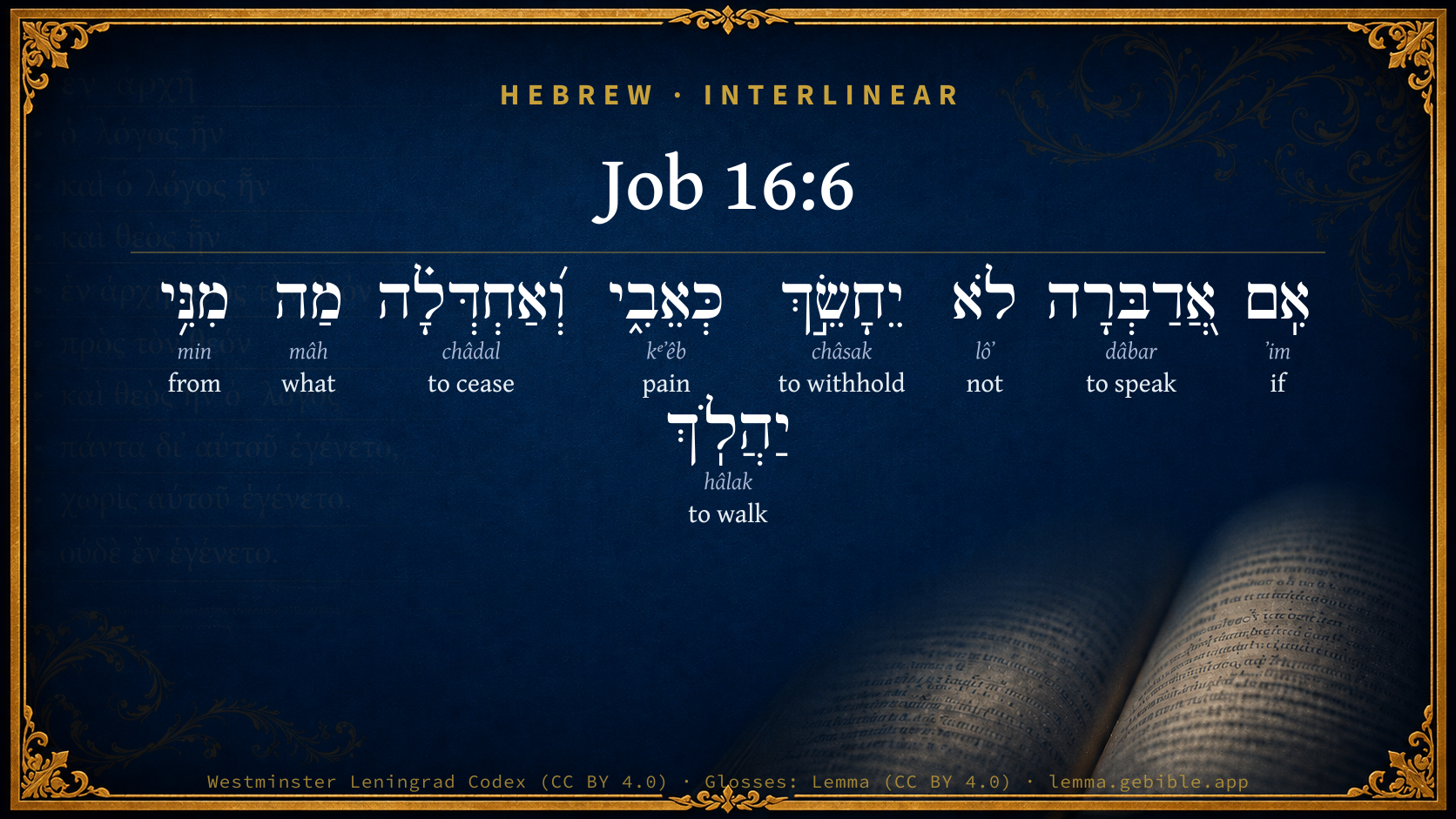
Job 16:6

Hebrew (Westminster Leningrad Codex) Job 16:6 appears in the Hebrew Old Testament. The text above is from the Westminster Leningrad Codex. Each word links to its Strong’s number, a concise gloss, and parsing drawn from the Open Scriptures Hebrew Bible morphology. Click any word for its full Brown-Driver-Briggs (BDB) entry.
Download image
Cite this verse

Job 16:6 (World English Bible). Public Domain. Lemma interlinear Bible study tool, https://lemma.gebible.app/v/job/16/6.

Show BibTeX & RIS
BibTeX
RIS
English Translation
"Though I speak, my grief is not subsided. Though I forbear, what am I eased?
World English Bible · Public Domain
Download a study sheet

One document with this verse’s original text, its word-by-word gloss line, the meaning frame, cross-references with their text, attributed commentary, and full source and license credits — printable, and it pastes into notes with its structure intact.

This verse Autodidact and up

Study sheet (.html) Plain text (.txt)

A passage Seminary Student

Up to 50 verses in one chapter. A passage sheet keeps up to 6 commentary sources and 12 cross-references per verse, in the order this page ranks them, and says so on the sheet whenever that leaves anything out. Ask for a single verse and you get the Autodidact verse sheet above.

Everything on this page stays free to read, with no account — the sheet is a download of what is already on screen, not access to it.

Want to remove ads? Support Godless Engineer
Compare translations 3

The same verse in 3 English versions, stacked beneath the original-language interlinear above. Click any original word for its lexicon entry.

Each is an independent rendering of the whole verse — the interlinear is not word-aligned to these translations.

Highlighted words mark where these versions differ — a whole-verse word diff, not a word-by-word alignment.

  • World English Bible Public Domain
    "Though I speak, my grief is not subsided. Though I forbear, what am I eased?
  • King James Version Public Domain
    Though I speak, my grief is not asswaged: and though I forbear, what am I eased?
  • unfoldingWord Literal Text CC BY-SA 4.0
    If I speak, my pain is not relieved, but I refrain, what goes from me?

unfoldingWord Literal Text — © unfoldingWord, licensed CC BY-SA 4.0. Word-aligned USFM3 via Door43 (git.door43.org/unfoldingWord/en_ult).

Versions to compare (up to 4)

3 of 4 selected

Show all 18 translations

Every available English version of this verse, each an independent rendering of the whole verse.

  • World English Bible Public Domain
    "Though I speak, my grief is not subsided. Though I forbear, what am I eased?
  • Berean Standard Bible Public Domain
    Even if I speak, my pain is not relieved, and if I hold back, how will it go away?
  • Majority Standard Bible Public Domain
    Even if I speak, my pain is not relieved, and if I hold back, how will it go away?
  • King James Version Public Domain
    Though I speak, my grief is not asswaged: and though I forbear, what am I eased?
  • American Standard Version (1901) Public Domain
    Though I speak, my grief is not assuaged; And though I forbear, what am I eased?
  • Revised Version (1885) Public Domain
    Though I speak, my grief is not assuaged: and though I forbear, what am I eased?
  • Geneva Bible (1599) Public Domain
    Though I speake, my sorow can not be asswaged: though I cease, what release haue I?
  • Douay-Rheims (1899) Public Domain
    I would strengthen you with my mouth, and would move my lips, as sparing you.
  • Young's Literal Translation Public Domain
    If I speak, my pain is not restrained, And I cease -- what goeth from me?
  • Literal Standard Version CC BY-SA 4.0
    If I speak, my pain is not restrained, || And I cease—what goes from me?
  • Unlocked Literal Bible CC BY-SA 4.0
    If I speak, my grief is not lessened; if I keep from speaking, how am I helped?
  • unfoldingWord Literal Text CC BY-SA 4.0
    If I speak, my pain is not relieved, but I refrain, what goes from me?
  • Darby Bible Public Domain
    If I speak, my pain is not assuaged; and if I forbear, what am I eased?
  • World Messianic Bible Public Domain
    “Though I speak, my grief is not subsided. Though I forbear, what am I eased?
  • Webster's Bible Public Domain
    Though I speak, my grief is not assuaged: and though I forbear, what am I eased?
  • Free Bible Version CC BY-SA 4.0
    For me, if I speak it doesn't ease my pain, and if I don't speak the pain is still there.
  • Bible in Basic English Public Domain
    If I say what is in my mind, my pain becomes no less: and if I keep quiet, how much of it goes from me?
  • JPS Tanakh (1917) Public Domain
    Though I speak, my pain is not assuaged; and though I forbear, what am I eased?

Literal Standard Version (2020), Covenant Press — licensed CC BY-SA 4.0. Text via the HelloAO Bible API (eBible.org). Unlocked Literal Bible (unfoldingWord) — licensed CC BY-SA 4.0. Text via the HelloAO Bible API (eBible.org). unfoldingWord Literal Text — © unfoldingWord, licensed CC BY-SA 4.0. Word-aligned USFM3 via Door43 (git.door43.org/unfoldingWord/en_ult). Free Bible Version, Dr. Jonathan Gallagher — licensed CC BY-SA 4.0. Text via the HelloAO Bible API (eBible.org).

Word by word

More ways to search: Search by grammar → Find every occurrence → Compare this word →

Practice this passage: Drill this verse → Learn its vocabulary →

About this verse

These counts appear in no published source. They are computed here, from the morphology-tagged text and Lemma’s own curated glosses. What Lemma adds →

9
words
9
distinct lemmas
Wisdom
section

Notable vocabulary

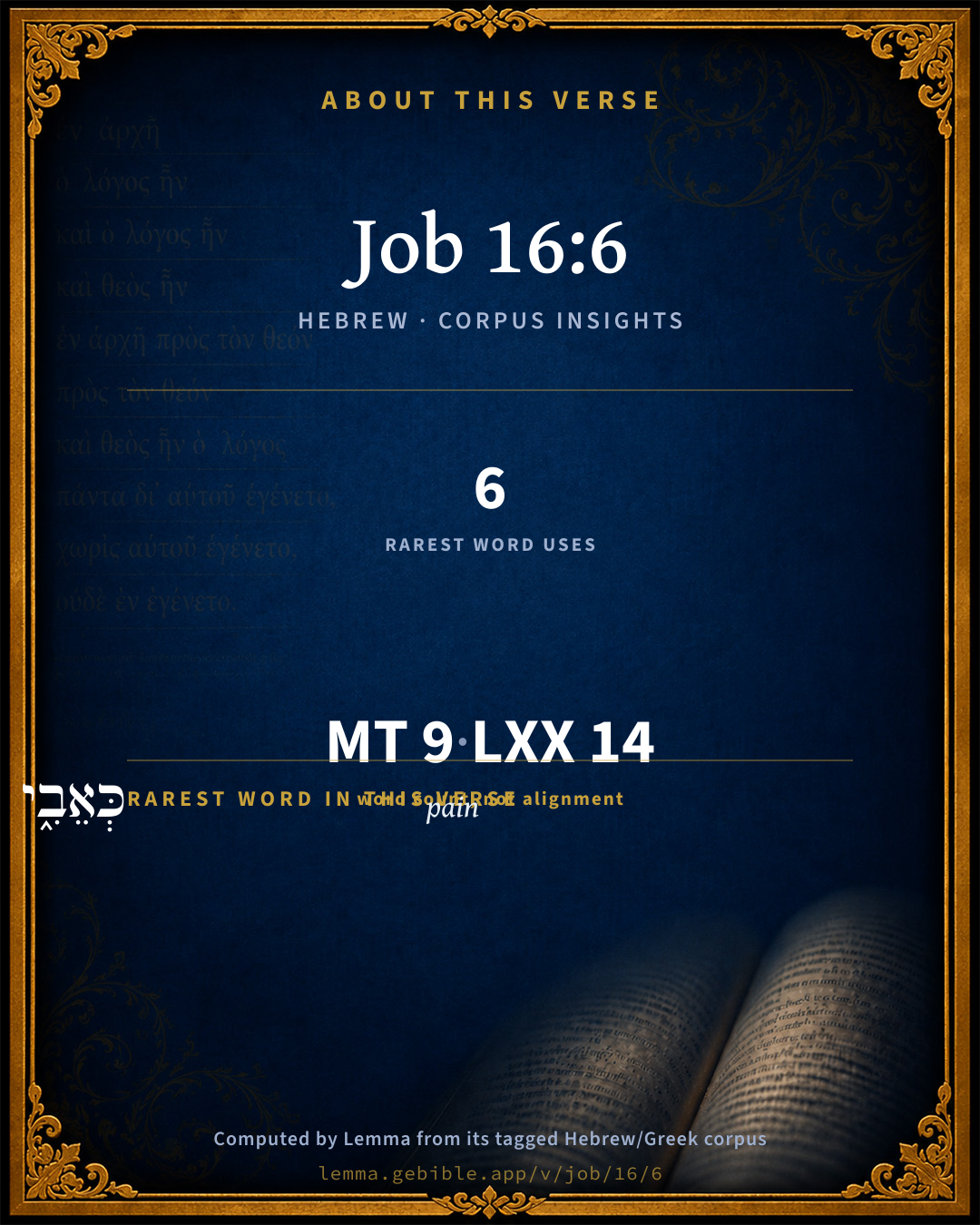
The rarest word here is כְּאֵבִ֑י pain H3511 — appearing just 6 times in the whole Hebrew Bible.

Shared distinctive vocabulary

כְּאֵבִ֑י pain H3511 occurs in 6 verses of the Hebrew Bible. Also found in:

Grammatical profile

  • 4 verbs
  • 1 noun
  • 1 preposition
  • 1 conjunction
  • 2 particles

Verb forms

  • אֲ֭דַבְּרָה Piel · Cohortative
  • יֵחָשֵׂ֣ךְ Niphal · Imperfect
  • וְ֝אַחְדְּלָ֗ה Qal · Cohortative
  • יַהֲלֹֽךְ Qal · Imperfect

Hebrew & Septuagint length

In English translation the verse runs 15 words from the Hebrew and 18 from the Septuagint (LXX English) — closely comparable.

A rough comparison of the two English renderings, which tokenize alike — not a word-level alignment.

Word counts can differ between the Hebrew and the Greek without any difference in meaning — e.g. the Hebrew direct-object marker אֵת has no separate Greek word, and Greek often adds the article ὁ.

In the original languages it is 9 Hebrew tokens and 14 Greek tokens — but the two are counted differently (Hebrew bundles its prefixes and suffixes into one token; the Greek is in lemma form), so that isn’t a like-for-like length.

Cross-references

3

Topical passages linked to Job 16:6 in the Treasury of Scripture Knowledge — connected by theme and wording, ordered by reader-vote popularity; previews shown in the World English Bible.

  • Job 10:1 "My soul is weary of my life; I will give free course to my complaint. I will speak in the bitterness of my soul.
  • Psalms 88:15–18 I am afflicted and ready to die from my youth up. While I suffer your terrors, I am distracted.
  • Psalms 77:1–9 My cry goes to God! Indeed, I cry to God for help, And for him to listen to me.

Cross-references courtesy of OpenBible.info (CC BY 4.0).

Hebrew and Greek witnesses Masoretic Hebrew ↔ Greek Septuagint

The same verse in the two great witnesses to the Old Testament, shown verse-for-verse.

These are two independent witnesses, not word-aligned to each other, and the Septuagint is shown in lemma (dictionary) form.

Hebrew Job 16:6 Masoretic · Westminster Leningrad Codex

אִֽם אֲ֭דַבְּרָה לֹא יֵחָשֵׂ֣ךְ כְּאֵבִ֑י וְ֝אַחְדְּלָ֗ה מַה מִנִּ֥י יַהֲלֹֽךְ

"Though I speak, my grief is not subsided. Though I forbear, what am I eased?

World English Bible · Public Domain

Greek LXX Job 16:6 Septuagint · lemma form

ἐάν γάρ λαλέω οὐ ἀλγέω ὁ τραῦμα ἐάν δέ καί σιωπάω τίς ἐλάττων τιτρώσκω

And would there were strength in my mouth, and I would not spare the movement of my lips.

LXX2012 (modern English Septuagint) · Public Domain

On this verse, Keil & Delitzsch discusses the Septuagint’s reading. Read the note in Commentary ↓

Hebrew: Westminster Leningrad Codex (CC BY 4.0). Greek: Septuagint (public domain); English from LXX2012 (modern English Septuagint) (Public Domain). How the Septuagint differs from the Hebrew →

Commentary

Notes on Job 16:6 from classic Christian and Jewish commentators (each source and its license shown beneath its notes). The classic Christian expositions comment on the surrounding passage and are grouped to its opening verse, so a note may address several verses; the Jewish commentaries on the Tanakh (Rashi and others) are per-verse, so they appear only where the commentator wrote on this verse.

Lemma curates 59 commentaries, every one of them public domain or Creative Commons licensed, each selected and text-cleaned for this edition rather than reprinted as found. About our sources →

Matthew Henry's Commentary

Job's complaint is here as bitter as any where in all his discourses, and he is at a stand whether to smother it or to give it vent. Sometimes the one and sometimes the other is a relief to the afflicted, according as the temper or the circumstances are; but Job found help by neither, Job 16:6. 1. Sometimes giving vent to grief gives ease; but, "Though I speak" (says Job), "my grief is not assuaged, my spirit is never the lighter for the pouring out of my complaint; nay, what I speak is so misconstrued as to be turned to the aggravation of my grief." 2. At other times keeping silence makes the trouble the easier and the sooner forgotten; but (says Job) though I forbear I am never the nearer; what am I eased? If he complained he was censured as passionate; if not, as sullen. If he maintained his integrity, that was his crime; if he made no answer to their accusations, his silence was taken for a confession of his guilt.

Here is a doleful representation of Job's grievances. O what reason have we to bless God that we are not making such complaints! He complains,

I. That his family was scattered (Job 16:7): "He hath made me weary, weary of speaking, weary of forbearing, weary of my friends, weary of life itself; my journey through the world proves so very uncomfortable that I am quite tired with it." This made it as tiresome as any thing, that all his company was made desolate, his children and servants being killed and the poor remains of his great household dispersed. The company of good people that used to meet at his house for religious worship, was now scattered, and he spent his sabbaths in silence and solitude. He had company indeed, but such as he would rather have been without, for they seemed to triumph in his desolation. If lovers and friends are put far from us, we must see and own God's hand in it, making our company desolate.

II. That his body was worn away with diseases and pains, so that he had become a perfect skeleton, nothing but skin and bones, Job 16:8. His face was furrowed, not with age, but sickness: Thou hast filled me with wrinkles. His flesh was wasted with the running of his sore boils, so that his leanness rose up in him, that is, his bones, that before were not seen, stuck out, Job 33:21. These are called witnesses against him, witnesses of God's displeasure against him, and such witnesses as his friends produced against him to prove him a wicked man. Or, "They are witnesses for me, that my complaint is not causeless," or "witnesses to me, that I am a dying man, and must be gone shortly."

III. That his enemy was a terror to him, threatened him, frightened him, looked sternly upon him, and gave all the indications of rage against him (Job 16:9): He tears me in his wrath. But who is this enemy? 1. Eliphaz, who showed himself very much exasperated against him, and perhaps had expressed himself with such marks of indignation as are here mentioned: at least, what he said tore Job's good name and thundered nothing but terror to him; his eyes were sharpened to spy out matter of reproach against Job, and very barbarously both he and the rest of them used him. Or, 2. Satan. He was his enemy that hated him, and perhaps, by the divine permission, terrified him with apparitions, as (some think) he terrified our Saviour, which put him into his agonies in the garden; and thus he aimed to make him curse God. It is not improbable that this is the enemy he means. Or, (3.) God himself. If we understand it of him, the expressions are indeed as rash as any he used. God hates none of his creatures; but Job's melancholy did thus represent to him the terrors of the Almighty: and nothing can be more grievous to a good man than to apprehend God to be his enemy. If the wrath of a king be as messengers of death, what is the wrath of the King of kings!

IV. That all about him were abusive to him, Job 16:10. They came upon him with open mouth to devour him, as if they would swallow him alive, so terrible were their threats and so scornful was their conduct to him. They offered him all the indignities they could invent, and even smote him on the cheek; and herein many were confederate. They gathered themselves together against him, even the abjects, Psa 35:15. Herein Job was a type of Christ, as many of the ancients make him: these very expressions are used in the predictions of his sufferings, Psa 22:13, They gaped upon me with their mouths; and (Mic 5:1), They shall smite the Judge of Israel with a rod upon the cheek, which was literally fulfilled, Mat 26:67. How were those increased that troubled him!

V. That God, instead of delivering him out of their hands, as he hoped, delivered him into their hands (Job 16:11): He hath turned me over into the hands of the wicked. They could have had no power against him if it had not been given them from above. He therefore looks beyond them to God who gave them their commission, as David did when Shimei cursed him; but he thinks it strange, and almost thinks it hard, that those should have power against him who were God's enemies as much as his. God sometimes makes use of wicked men as his sword to one another (Psa 17:13) and his rod to his own children, Isa 10:5. Herein also Job was a type of Christ, who was delivered into wicked hands, to be crucified and slain, by the determinate counsel and fore-knowledge of God, Act 2:23.

VI. That God not only delivered him into the hands of the wicked, but took him into his own hands too, into which it is a fearful thing to fall (Job 16:12): "I was at ease in the comfortable enjoyment of the gifts of God's bounty, not fretting and uneasy, as some are in the midst of their prosperity, who thereby provoke God to strip them; yet he has broken me asunder, put me upon the rack of pain, and torn me limb from limb." God, in afflicting him, had seemed, 1. As if he were furious. Though fury is not in God, he thought it was, when he took him by the neck (as a strong man in a passion would take a child) and shook him to pieces, triumphing in the irresistible power he had to do what he would with him. 2. As if he were partial. "He has distinguished me from the rest of mankind by this hard usage of me: He has set me up for his mark, the butt at which he is pleased to let fly all his arrows: at me they are directed, and they come not by chance; against me they are levelled, as if I were the greatest sinner of all the men of the east or were singled out to be made an example." When God set him up for a mark his archers presently compassed him round. God has archers at command, who will be sure to hit the mark that he sets up. Whoever are our enemies, we must look upon them as God's archers, and see him directing the arrow. It is the Lord; let him do what seemeth him good. 3. As if he were cruel, and his wrath as relentless as his power was resistless. As if he contrived to touch him in the tenderest part, cleaving his reins asunder with acute pains; perhaps they were nephritic pains, those of the stone, which lie in the region of the kidneys. As if he had no mercy in reserve for him, he does not spare nor abate any thing of the extremity. And as if he aimed at nothing but his death, and his death in the midst of the most grievous tortures: He pours out my gall upon the ground, as when men have taken a wild beast, and killed it, they open it, and pour out the gall with a loathing of it. He thought his blood was poured out, as if it were not only not precious, but nauseous. 4. As if he were unreasonable and insatiable in his executions (Job 16:14): "He breaketh me with breach upon breach, follows me with one wound after another." So his troubles came at first; while one messenger of evil tidings was speaking another came: and so it was still; new boils were rising every day, so that he had no prospect of the end of his troubles. Thus he thought that God ran upon him like a giant, whom he could not possibly stand before or confront; as the giants of old ran down all their poor neighbours, and were too hard for them. Note, Even good men, when they are in great and extraordinary troubles, have much ado not to entertain hard thoughts of God.

VII. That he had divested himself of all his honour, and all his comfort, in compliance with the afflicting providences that surrounded him. Some can lessen their own troubles by concealing them, holding their heads as high and putting on as good a face as ever; but Job could not do so: he received the impressions of them, and, as one truly penitent and truly patient, he humbled himself under the mighty hand of God, Job 16:15, Job 16:16. 1. He now laid aside all his ornaments and soft clothing, consulted not either his ease or finery in his dress, but sewed sackcloth upon his skin; that clothing he thought good enough for such a defiled distempered body as he had. Silks upon sores, such sores, he thought, would be unsuitable; sackcloth would be more becoming. Those are fond indeed of gay clothing that will not be weaned from it by sickness and old age, and, as Job was (Job 16:8), by wrinkles and leanness. He not only put on sackcloth, but sewed it on, as one that resolved to continue his humiliation as long as the affliction continued. 2. He insisted not upon any points of honour, but humbled himself under humbling providences: He defiled his horn in the dust, and refused the respect that used to be paid to his dignity, power, and eminency. Note, When God brings down our condition, that should bring down our spirits. Better lay the horn in the dust than lift it up in contradiction to the designs of Providence and have it broken at last. Eliphaz had represented Job as high and haughty, and unhumbled under his affliction. "No," says Job, "I know better things; the dust is now the fittest place for me." 3. He banished mirth as utterly unseasonable, and set himself to sow in tears (Job 16:16): "My face is foul with weeping so constantly for my sins, for God's displeasure against me, and for my friends unkindness: this has brought a shadow of death upon my eyelids." He had not only wept away all his beauty, but almost wept his eyes out. In this also he was a type of Christ, who was a man of sorrows, and much in tears, and pronounced those blessed that mourn, for they shall be comforted.

Matthew Henry's Commentary on the Whole Bible (1708–1710) — public domain (CC PDM 1.0). Text via the HelloAO Bible API.

The Cambridge Bible for Schools and Colleges

gen. ed. J. J. S. Perowne

6. my grief] i. e. my pain; see on ch. Job_2:13.

what am I eased] lit. as margin, what (of my pain or trouble) goeth from me?

6–17. Job realizes to himself his new condition: God and men combine to pursue him with their enmity, though he is innocent of all wrong

In Job_16:5 Job flung back with scorn the “comforts of God” which the friends proffered him. And now there seems to occur a pause, and the excited sufferer looks about him and realizes both the extremity of the evil in which he is held, and the new and unexpected trial, added to all others, of the judgment of men being against him. And he hardly knows whether he shall speak or be silent, so overcome is he and so unavailing to help him or make men judge truly of him are both speech and silence—if I speak my grief is not assuaged, and if I forbear what am I eased? Job_16:6.

Yet this new condition in which he realizes that he is, which makes speech useless, forces him to speak, and he sets before himself in an excited soliloquy the combined enmity to him of men and God.

First, Job_16:7-11, he realizes to himself the complete estrangement from him of all familiar friends; God’s enmity to him has turned men also into foes (Job_16:7-8). This combined enmity of God and men is represented under what seems the figure of a creature hunted by one great lion-like assailant, leading on a host of minor, ignobler foes. The chief adversary is first described, his rending anger, and gnashing teeth, and flashing eyes (Job_16:9); and then the pell-mell rout of baser foes that howled behind him, their open mouth and shameless gestures, and full cry after the prey, which is flung over into their hands (Job_16:10-11).

Second, Job_16:12-17, then the hostility of God Himself is particularly dwelt upon in graphic figures, which express its unexpected suddenness, its violence and destructiveness. One figure is that of a man suddenly grasped by another of overwhelming strength and tossed about and dashed to pieces (Job_16:12). Then the figure changes, and this shattered frame is set up as a mark, and God’s arrows hiss around him and split his reins and pour out his life to the ground (Job_16:13). Again the figure changes, and this body seems some fair edifice or fort which God dismantles by breach upon breach till it lies a sorrowful ruin (Job_16:14). And finally the condition of humiliation to which the sufferer is brought is described; and all this befell him though he had done no wrong (Job_16:15-17).

The Cambridge Bible for Schools and Colleges (gen. ed. J. J. S. Perowne; Cambridge University Press, 1878–1918) — public domain. Text from a community e-Sword module.

John Gill's Exposition

But now he hath made me weary,.... Or "it hath made me weary" (u), that is, "my grief", as it may be supplied from Job 16:6; or rather God, as appears from the next clause, and from the following verse, where he is manifestly addressed; who by afflicting him had made him weary of the world, and all things in it, even of his very life, Job 10:1; his afflictions were so heavy upon him, and pressed him so hard, that his life was a burden to him; they were heavier than the sand of the sea, and his strength was not equal to them; he could scarcely drag along, was ready to sink and lie down under the weight of them:

thou hast made desolate all my company, or "congregation" (w); the congregation of saints that met at his house for religious worship, as some think, which now through his affliction was broke up, whom Eliphaz had called a congregation of hypocrites, Job 15:34; which passage Job may have respect unto; or rather his family, his children, which were taken away from him: the Jews say (x), ten persons in any place make a congregation; this was just the number of Job's children, seven sons and three daughters; or it may be he may have respect to his friends, that came to visit him, who were moved and stupefied as it were at the sight of him and his afflictions, as the word (y) is by some translated, and who were alienated from him; were not friendly to him, nor administered to him any comfort; so that they were as if he had none, or worse.

(u) "Dolor meus", V. L. so Aben Ezra & Cocceius. (w) "meam congregationem", Pagninus; "conventum meum", Montanus, Bolducius. (x) Vid. Drusium in loc. (y) "Stupefe isti", Tigurine version; so Jarchi.

John Gill's Exposition of the Whole Bible (1746–1763) — public domain (CC PDM 1.0). Text via the HelloAO Bible API.

Trapp's Complete Commentary

John Trapp

Job 16:6 Though I speak, my grief is not asswaged: and [though] I forbear, what am I eased?

Ver. 6. Though I speak, my grief is not assuaged] Heb. If I speak; sc. to bewail my misery, or to maintain mine innocence, ye say it is good enough for me, and how can I be but wicked who am so punished? As,

If I forbear, what am I eased?] Heb. What goeth from me? q.d. Ye conclude me guilty, because silent; as if I had nothing to say for myself. Some make the words to refer to God; as if Job had said, Whether I speak, or whether I forbear, God doth not come in to my help, I find no comfort from him, &c., and by the next verse it should seem that this is the right sense.

John Trapp, A Commentary or Exposition upon All the Books of the Old and New Testament (1647–1656) — public domain. Text from a community e-Sword module.

Joseph Benson's Commentary

Job 16:6. Though I speak — To God by prayer, or to you in the way of discourse; my grief is not assuaged — I find no relief or comfort. Job, having reproved his friends for their unkind behaviour toward him, and aggravated it by contrasting therewith his resolutions to have acted in a more friendly manner toward them, if they had been in his case; now returns to his main business, namely, to describe his miseries, in order that, if possible, he might move his friends to pity and comfort him. Though I forbear, what am I eased? — What portion of my grief departs from me? I receive not one grain of ease or comfort. Neither speech nor silence does me any good.

Joseph Benson's Commentary on the Old and New Testaments (1811–1818) — public domain. Text from a community e-Sword module.

Whedon's Commentary on the Bible

Daniel D. Whedon

First division — A HIGH-WROUGHT DESCRIPTION OF JOB’S SORROWS, DESERTED AND PERSECUTED BY GOD, AND PREYED UPON BY FRIENDS, Job_16:6-17.

First strophe — Destitute of friends in God or man, he is forced back upon his own lamentable condition to feel that even his disease bears false witness against him, leading God to give him over into the power of his enemies, who gather around him like beasts of prey, Job_16:6-11.

6. Though — If. He communes with himself as to whether he will continue the colloquy further. To speak or not to speak is all one, so far as consolation is concerned.

What am I eased — Literally, what goes forth from me? that is, his grief does not depart.

Daniel D. Whedon (gen. ed.), Commentary on the Old and New Testaments (1874–1909) — public domain. Text from a community e-Sword module.

Keil & Delitzsch

C. F. Keil & F. Delitzsch

6 If I speak, my pain is not soothed;

And if I forbear, what alleviation do I experience?

7 Nevertheless now hath He exhausted me;

Thou hast desolated all my household,

8 And Thou filledst me with wrinkles - for a witness was it,

And my leanness rose up against me

Complaining to my face.

9 His wrath tore me, and made war upon me;

He hath gnashed upon me with His teeth,

As mine enemy He sharpeneth His eyes against me.

אם stands with the cohortative in the hypothetical antecedent clause Job 16:6, and in 6b the cohortative stands alone as Job 11:17; Psa 73:16; Psa 139:8, which is more usual, and more in accordance with the meaning which the cohortative has in itself, Ngelsbach, 89, 3. The interrogative, What goes from me? is equivalent to, what (= nothing) of pain forsakes me. The subject of the assertion which follows (Job 16:7) is not the pain - Aben-Ezra thinks even that this is addressed in v. 7b - still less Eliphaz, whom some think, particularly on account of the sharp expressions which follow, must be understood, but God, whose wrath Job regards as the cause of his suffering, and feels as the most intolerable part of it. A strained connection is obtained by taking אך either in an affirmative sense (Ew.: surely), as Job 18:21, or in a restrictive sense: only (= entirely) He has now exhausted me (Hirz., Hahn, also Schlottm.: only I feel myself oppressed, at least to express this), by which interpretation the עתּה, which stands between אך and the verb, is in the way. We render it therefore in the adversative signification: nevertheless (verum tamen) now he seeks neither by speaking to alleviate his pain, nor by silence to control himself; God has placed him in a condition in which all his strength is exhausted. He is absolutely incapable of offering any resistance to his pain, and care has also been taken that no solacing word shall come to him from any quarter: Thou hast made all my society desolate (Carey: all my clan); עדה of the household, as in Job 15:34. Jerome: in nihilum redacti sunt omnes artus mei (כל אברי, as explained by the Jewish expositors, e.g., Ralbag), as though the human organism could be called עדה. Hahn: Thou hast destroyed all my testimony, which must have been אדתי (from עוּד, whereas עדה, from ועד, has a changeable Ssere). He means to say that he stands entirely alone, and neither sees nor hears anything consolatory, for he does not count his wife. He is therefore completely shut up to himself; God has shrivelled him up; and this suffering form to which God has reduced him, is become an evidence, i.e., for himself and for others, as the three friends, an accusation de facto, which puts him down as a sinner, although his self-consciousness testifies the opposite to him.

Job 16:8

The verb קמט (Aram. קמט), which occurs only once beside (Job 22:16), has, like Arab. qmṭ (in Gecatilia's transl.), the primary meaning of binding and grasping firmly (lxx ἐπελάβου, Symm. κατέδησας, Targ. for לכד, תּמך, lengthened to a quadriliteral in Arab. qmṭr, cogn. קמץ),

(Note: On the other hand, קטם, Arab. qṭm, abscindere, praemordere, has no connection with קמט, with which Kimchi and Reiske confuse it. This is readily seen from the opposite primary distinction of the two roots, קם and קט, of which the former expresses union, the latter separation.)

constringere, from which the significations comprehendere and corrugare have branched off; the signification, to wrinkle (make wrinkled), to shrivel up, is the most common, and the reference which follows, to his emaciation, and the lines which occur further on from the picture of one sick with elephantiasis, show that the poet here has this in his mind. Ewald's conjecture, which changes היה into היּה, Job 6:2; Job 30:13 = הוּה, as subject to ותקמטני (calamity seizes me as a witness), deprives the thought contained in לעד, which renders the inferential clause לעד היה prominent, of much of its force and emphasis. In Job 16:8 this thought is continued: כּחשׁ signifies here, according to Psa 109:24 (which see), a wasting away; the verb-group כחשׁ, כחד, Arab. jḥd, kḥt, qḥṭ, etc., has the primary meaning of taking away and decrease: he becomes thin from whom the fat begins to fail; to disown is equivalent to holding back recognition and admission; the metaphor, water that deceives = dries up, is similar. His wasted, emaciated appearance, since God has thus shrivelled him up, came forth against him, told him to his face, i.e., accused him not merely behind his back, but boldly and directly, as a convicted criminal. God has changed himself in relation to him into an enraged enemy. Schlottm. wrongly translates: one tears and tortures me fiercely; Raschi erroneously understands Satan by צרי. In general, it is the wrath of God whence Job thinks his suffering proceeds. It was the wrath of God which tore him so (like Hos 6:1, comp. Amo 1:11), and pursued him hostilely (as he says with the same word in Job 30:21); God has gnashed against him with His teeth; God drew or sharpened (Aq., Symm., Theod., ὤξυνεν לטשׁ like Psa 7:13). His eyes or looks like swords (Targ. as a sharp knife, אזמל, σμίλη) for him, i.e., to pierce him through. Observe the aorr. interchanging with perff. and imperff. He describes the final calamity which has made him such a piteous form with the mark of the criminal. His present suffering is only the continuation of the decree of wrath which is gone forth concerning him.

Keil & Delitzsch — Biblical Commentary on the Old Testament (1861–1891) — public domain (CC PDM 1.0). Text via the HelloAO Bible API. (Old Testament only.)

Geneva Bible (1599)

Geneva Bible translators

If they would say, Why dost thou not then comfort thyself? he answereth, that the judgments of God are more heavy than he is able to assuage either by words or silence.

Geneva Bible (1599) marginal notes — public domain. Text via Bolls.life.

Jamieson, Fausset & Brown

Robert Jamieson, A. R. Fausset & David Brown

eased--literally, "What (portion of my sufferings) goes from me?"

Jamieson, Fausset & Brown — Commentary Critical and Explanatory on the Whole Bible (1871) — public domain (CC PDM 1.0). Text via the HelloAO Bible API.

Adam Clarke's Commentary

Verse 6. Though I speak] But it will be of no avail thus to speak; for reprehensions of your conduct will not serve to mitigate my sufferings.

Adam Clarke's Commentary on the Bible (1810–1826) — public domain. Text from a community e-Sword/MySword module.

Ellicott's Commentary for English Readers

(6) Though I speak . . .—“I cannot but reply, though to reply gives me no relief.”

A Bible Commentary for English Readers, edited by Charles John Ellicott (1878–1897) — public domain. Text from a community e-Sword module.

Albert Barnes' Notes on the Bible

Though I speak, my grief is not assuaged - “But for me, it makes now no difference whether I speak or am silent. My sufferings continue. If I attempt to vindicate myself before people, I am reproached; and equally so if I am silent. If I maintain my cause before God, it avails me nothing, for my sufferings continue. If I am silent, and submit without a complaint, they are the same. Neither silence, nor argument, nor entreaty, avail me before God or man. I am doomed to suffering.”

What am I eased? - Margin. “Goeth from me.” Literally, “what goeth from me?” The sense is, that it all availed nothing.

Albert Barnes' Notes on the Bible (1834–1885) — public domain. Text from a community e-Sword/MySword module.

Matthew Poole's English Annotations

Though I speak to God by prayer, or to you in way of discourse, I find no relief. Job having reproved his friends for their unkind carriage towards him, and aggravated it by his resolutions to have dealt more friendly with them, if they had been in his case; now he returns to his main business, to describe and aggravate his miseries, if by any means he could move his friends to pity and help him.

What am I eased? or, what part or grain of my grief or misery departeth from me? I receive not one jot of ease. Neither speech nor silence do me any good.

Matthew Poole's English Annotations on the Holy Bible (1683–1685) — public domain. Text from a community e-Sword/MySword module.

The Pulpit Commentary

Though I speak, my grief is not assuaged: and though I forbear, what am I eased! As it is, nor speech nor silence are of any avail. Neither of them brings me any relief. My sufferings continue as before, whichever course I take.

The Pulpit Commentary (1880–1919), ed. H.D.M. Spence-Jones & Joseph S. Exell — public domain. Text from a community e-Sword module.

unfoldingWord translationNotes

Door43 World Missions Community

grief

Job has experienced great loss of family and health that is unexplained and therefore causes him "great sorrow and emotional pain."

how am I helped?

Job uses this rhetorical question to express that keeping quiet does not lessen his grief. This question can be written as a statement. AT: "it does not help me at all." (See: Rhetorical Question)

But now, God, you

Job now turns his complaining to God.

made all my family desolate

"destroyed all my family"

You have made me dry up

This means that Job's body has shriveled and become wrinkled. AT: "You have made my body shrivel up" (See: Assumed Knowledge and Implicit Information)

which itself is a witness against me

Job describes the shriveling of his body as if it were an accuser against him. AT: "and people think that shows me to be a sinner" (See: Personification)

the leanness of my body rises up against me, and it testifies against

Job describes the thinness of his body as if it were accuser against him. AT: "They see how thin my body is, and they think that proves that I am guilty" (See: Personification)

against my face

Here Job is referred to by his "face." AT: "against me" (See: Synecdoche)

translationWords

God

desolate

testimony

body

testimony

unfoldingWord translationNotes — © Distant Shores Media and the Door43 World Missions Community, licensed CC BY-SA 4.0. Source: git.door43.org/Door43/en_tn.

Rashi

Rabbi Shlomo Yitzchaki (Rashi)

Should I speak etc.

Rashi on the Tanakh — English translations: “The Judaica Press complete Tanach with Rashi, translated by A. J. Rosenberg” (CC BY 4.0); “Pentateuch with Rashi's commentary by M. Rosenbaum and A.M. Silbermann, 1929-1934” (public domain); “The Metsudah Tanach series, Lakewood, N.J” (CC BY 4.0); and “The Book of Joshua, Metsudah Publications, 1997” (CC BY 4.0). Text via Sefaria.

Lesson kit

Teaching starters — assembled from the data on this page, not authored interpretation. Every prompt links to the verse data it draws on. Edit before teaching.

Job, in the Wisdom, opens this verse with 9 words (9 distinct Hebrew lemmas). Its most distinctive word is kᵉʼêb (“pain”). A historical commentator’s framing appears above. Read the whole chapter for the surrounding context.

Discussion questions

  1. How does “pain” (kᵉʼêb) shape what this verse is saying?
  2. Job 2:13 shares the word «pain» with this verse. How do the two illuminate each other?
  3. These translations render this verse differently. What is at stake in choosing one wording over another?
  4. The verb «אֲ֭דַבְּרָה» is Piel Cohortative. How does its form color the action?
  5. Reading how Matthew Henry's Commentary and The Cambridge Bible for Schools and Colleges read this verse, where do the two commentators agree and where do they part?

Things to notice

Reading settings

Reading text

Shown beneath each verse's original-language words.

Old Testament
Old Testament edition

Read the OT as the Masoretic Hebrew (MT) or the Greek Septuagint (LXX).

English shown for the Greek Septuagint (in the Hebrew ↔ Greek comparison).

Comparing translations? Open the Compare panel on any verse page to stack up to four side by side.