
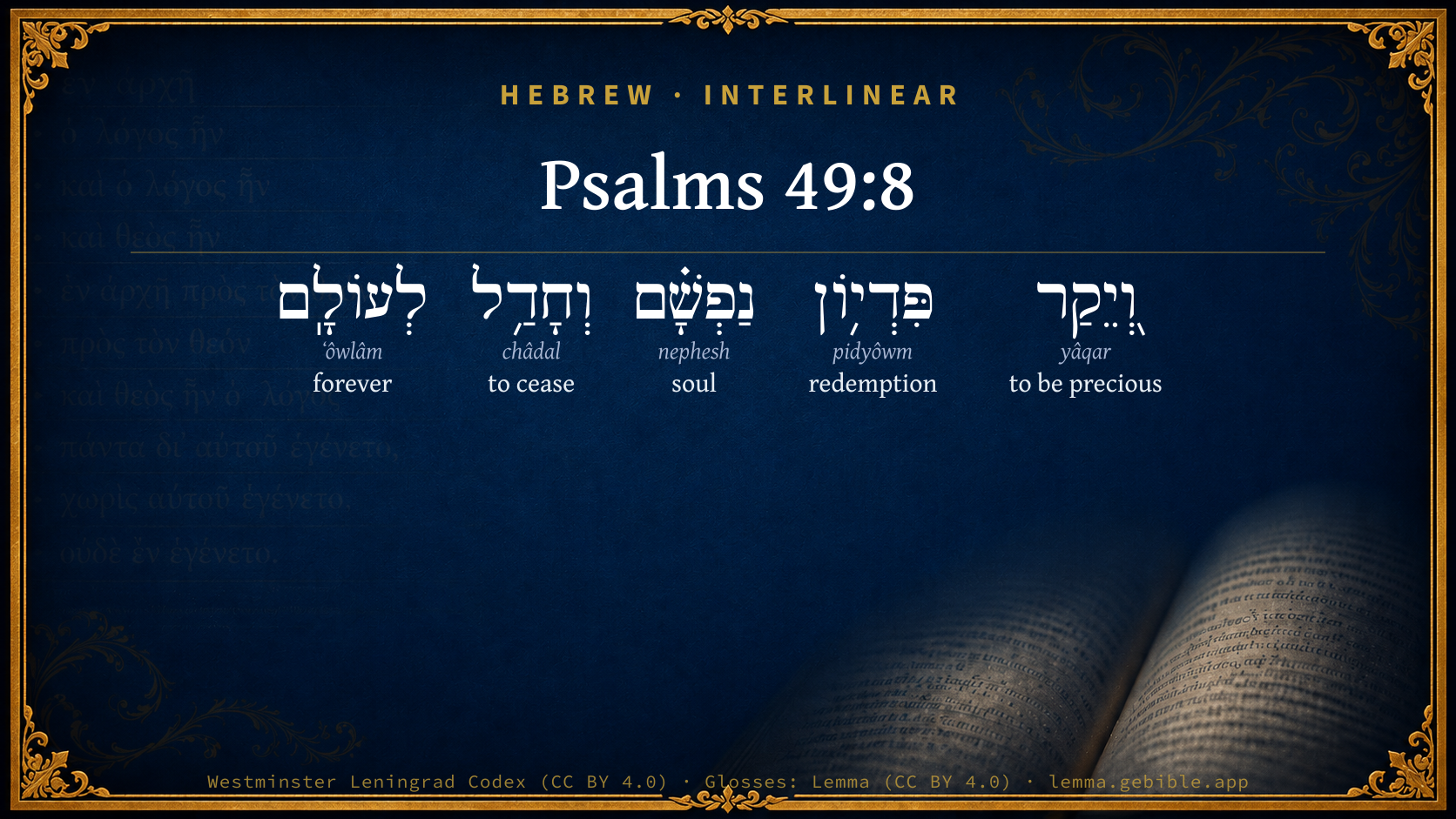
Psalms 49:8

Hebrew (Westminster Leningrad Codex) Psalms 49:8 appears in the Hebrew Old Testament. The text above is from the Westminster Leningrad Codex. Each word links to its Strong’s number, a concise gloss, and parsing drawn from the Open Scriptures Hebrew Bible morphology. Click any word for its full Brown-Driver-Briggs (BDB) entry.
Download image
Cite this verse

Psalms 49:8 (World English Bible). Public Domain. Lemma interlinear Bible study tool, https://lemma.gebible.app/v/psalms/49/8.

Show BibTeX & RIS
BibTeX
RIS
English Translation
For the redemption of their life is costly, No payment is ever enough,
World English Bible · Public Domain
Download a study sheet

One document with this verse’s original text, its word-by-word gloss line, the meaning frame, cross-references with their text, attributed commentary, and full source and license credits — printable, and it pastes into notes with its structure intact.

This verse Autodidact and up

Study sheet (.html) Plain text (.txt)

A passage Seminary Student

Up to 50 verses in one chapter. A passage sheet keeps up to 6 commentary sources and 12 cross-references per verse, in the order this page ranks them, and says so on the sheet whenever that leaves anything out. Ask for a single verse and you get the Autodidact verse sheet above.

Everything on this page stays free to read, with no account — the sheet is a download of what is already on screen, not access to it.

Want to remove ads? Support Godless Engineer
Compare translations 3

The same verse in 3 English versions, stacked beneath the original-language interlinear above. Click any original word for its lexicon entry.

Each is an independent rendering of the whole verse — the interlinear is not word-aligned to these translations.

Highlighted words mark where these versions differ — a whole-verse word diff, not a word-by-word alignment.

  • World English Bible Public Domain
    For the redemption of their life is costly, No payment is ever enough,
  • King James Version Public Domain
    (For the redemption of their soul is precious, and it ceaseth for ever:)
  • unfoldingWord Literal Text CC BY-SA 4.0
    For the redemption of their life is costly, and it ceases forever,

unfoldingWord Literal Text — © unfoldingWord, licensed CC BY-SA 4.0. Word-aligned USFM3 via Door43 (git.door43.org/unfoldingWord/en_ult).

Versions to compare (up to 4)

3 of 4 selected

Show all 18 translations

Every available English version of this verse, each an independent rendering of the whole verse.

  • World English Bible Public Domain
    For the redemption of their life is costly, No payment is ever enough,
  • Berean Standard Bible Public Domain
    For the redemption of his soul is costly, and never can payment suffice,
  • Majority Standard Bible Public Domain
    For the redemption of his soul is costly, and never can payment suffice,
  • King James Version Public Domain
    (For the redemption of their soul is precious, and it ceaseth for ever:)
  • American Standard Version (1901) Public Domain
    (For the redemption of their life is costly, And it faileth for ever;)
  • Revised Version (1885) Public Domain
    (For the redemption of their soul is costly, and must be let alone for ever:)
  • Geneva Bible (1599) Public Domain
    (So precious is the redemption of their soules, and the continuance for euer)
  • Douay-Rheims (1899) Public Domain
    No brother can redeem, nor shall man redeem: he shall not give to God his ransom,
  • Young's Literal Translation Public Domain
    And precious `is' the redemption of their soul, And it hath ceased -- to the age.
  • Literal Standard Version CC BY-SA 4.0
    And precious [is] the redemption of their soul, || And it has ceased for all time.
  • Unlocked Literal Bible CC BY-SA 4.0
    For the redemption of one's life is costly, and no one can pay what we owe.
  • unfoldingWord Literal Text CC BY-SA 4.0
    For the redemption of their life is costly, and it ceases forever,
  • Darby Bible Public Domain
    (For the redemption of their soul is costly, and must be given up for ever,)
  • World Messianic Bible Public Domain
    For the redemption of their life is costly, no payment is ever enough,
  • Webster's Bible Public Domain
    \\49:7\\None of them can by any means redeem his brother, nor give to God a ransom for him:
  • Free Bible Version CC BY-SA 4.0
    Redemption is beyond price; no one could ever pay enough
  • Bible in Basic English Public Domain
    (Because it takes a great price to keep his soul from death, and man is not able to give it.)
  • JPS Tanakh (1917) Public Domain
    (49-9) For too costly is the redemption of their soul, and must be let alone for ever —

Literal Standard Version (2020), Covenant Press — licensed CC BY-SA 4.0. Text via the HelloAO Bible API (eBible.org). Unlocked Literal Bible (unfoldingWord) — licensed CC BY-SA 4.0. Text via the HelloAO Bible API (eBible.org). unfoldingWord Literal Text — © unfoldingWord, licensed CC BY-SA 4.0. Word-aligned USFM3 via Door43 (git.door43.org/unfoldingWord/en_ult). Free Bible Version, Dr. Jonathan Gallagher — licensed CC BY-SA 4.0. Text via the HelloAO Bible API (eBible.org).

Word by word

More ways to search: Search by grammar → Find every occurrence → Compare this word →

Practice this passage: Drill this verse → Learn its vocabulary →

About this verse

These counts appear in no published source. They are computed here, from the morphology-tagged text and Lemma’s own curated glosses. What Lemma adds →

5
words
5
distinct lemmas
Wisdom
section

Notable vocabulary

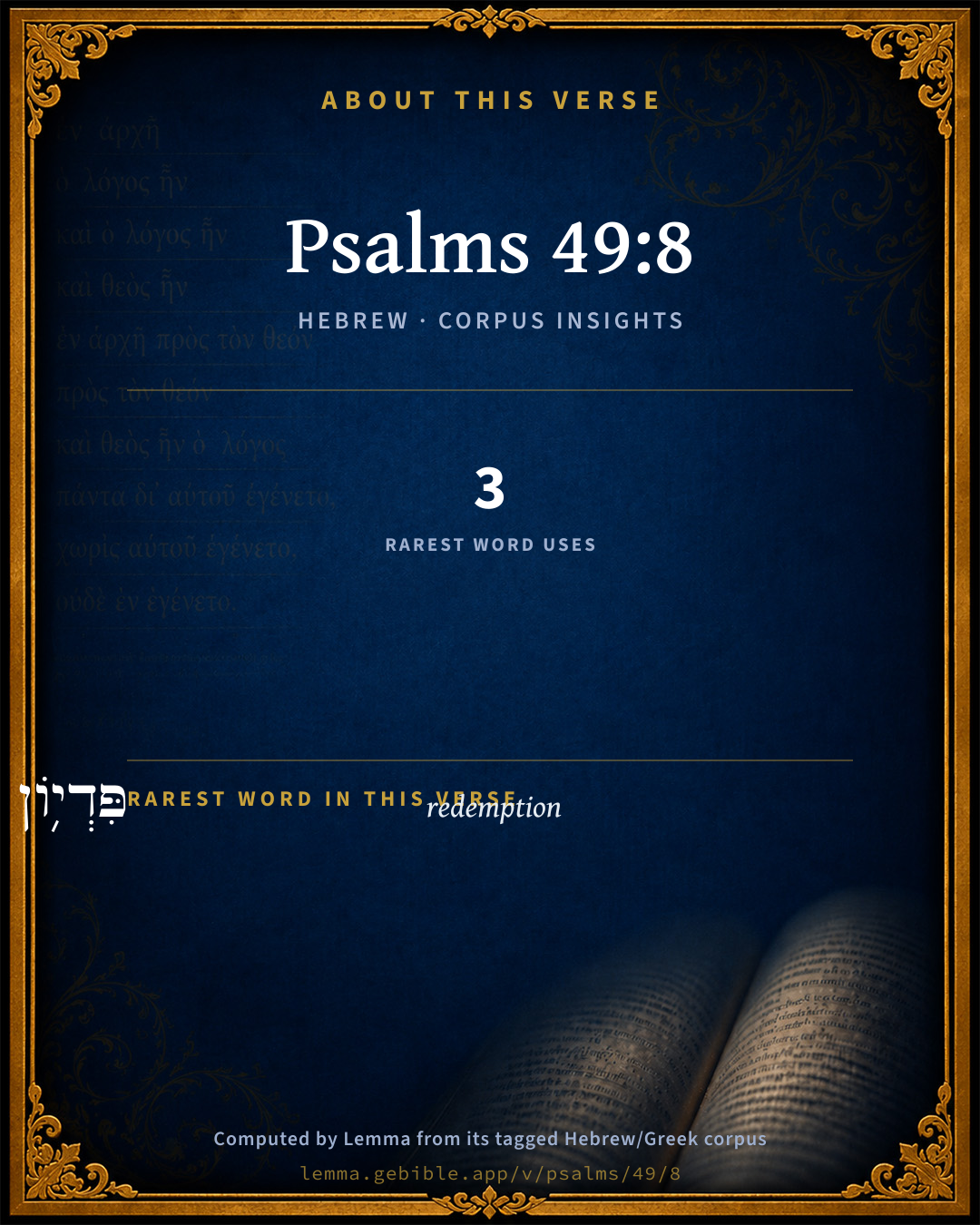
The rarest word here is פִּדְי֥וֹן redemption H6306 — appearing just 3 times in the whole Hebrew Bible.

Shared distinctive vocabulary

פִּדְי֥וֹן redemption H6306 occurs in 3 verses of the Hebrew Bible. Also found in:

Grammatical profile

  • 2 verbs
  • 3 nouns

Verb forms

  • וְ֭יֵקַר Qal · Imperfect
  • וְחָדַ֥ל Qal · Sequential Perfect

Hebrew & Septuagint length

In English translation the verse runs 13 words from the Hebrew and 14 from the Septuagint (LXX English) — closely comparable.

A rough comparison of the two English renderings, which tokenize alike — not a word-level alignment.

Word counts can differ between the Hebrew and the Greek without any difference in meaning — e.g. the Hebrew direct-object marker אֵת has no separate Greek word, and Greek often adds the article ὁ.

Cross-references

2

Topical passages linked to Psalms 49:8 in the Treasury of Scripture Knowledge — connected by theme and wording, ordered by reader-vote popularity; previews shown in the World English Bible.

  • Matthew 16:26 For what will it profit a man, if he gains the whole world, and forfeits his life? Or what will a man give in exchange for his life?
  • Job 36:18–19 Don't let riches entice you to wrath, Neither let the great size of a bribe turn you aside.

Cross-references courtesy of OpenBible.info (CC BY 4.0).

Hebrew and Greek witnesses Masoretic Hebrew ↔ Greek Septuagint

The same verse in the two great witnesses to the Old Testament, shown verse-for-verse.

You’re reading Greek Psalm 48 (Hebrew Psalm 49). The Septuagint counts the superscription, so verse numbers can differ from the Hebrew — chapter-level alignment, not verse-by-verse. Numbering follows Rahlfs.

These are two independent witnesses, not word-aligned to each other, and the Septuagint is shown in lemma (dictionary) form.

Hebrew Psalms 49:8 Masoretic · Westminster Leningrad Codex

וְ֭יֵקַר פִּדְי֥וֹן נַפְשָׁ֗ם וְחָדַ֥ל לְעוֹלָֽם

For the redemption of their life is costly, No payment is ever enough,

World English Bible · Public Domain

Greek LXX Greek Psalm 48:8 Septuagint · lemma form

ἀδελφός οὐ λυτρόω λυτρόω ἄνθρωπος οὐ δίδωμι ὁ θεός ἐξίλασμα αὐτός

or the price of the redemption of his soul, though he labor for ever,

LXX2012 (modern English Septuagint) · Public Domain

Hebrew: Westminster Leningrad Codex (CC BY 4.0). Greek: Septuagint (public domain); English from LXX2012 (modern English Septuagint) (Public Domain). How the Septuagint differs from the Hebrew →

Commentary

Notes on Psalms 49:8 from classic Christian and Jewish commentators (each source and its license shown beneath its notes). The classic Christian expositions comment on the surrounding passage and are grouped to its opening verse, so a note may address several verses; the Jewish commentaries on the Tanakh (Rashi and others) are per-verse, so they appear only where the commentator wrote on this verse.

Lemma curates 59 commentaries, every one of them public domain or Creative Commons licensed, each selected and text-cleaned for this edition rather than reprinted as found. About our sources →

Trapp's Complete Commentary

John Trapp

Psa 49:8 (For the redemption of their soul [is] precious, and it ceaseth for ever:)

Ver. 8. For the redemption of their soul is precious] i.e. The price of life is greater than that any man, how wealthy soever, can compass it. Money is the monarch of this world, but not of the next.

And it ceaseth for ever] i.e. The purchase of a longer life ceaseth, there is no such thing, believe it, Job 36:18-19 Deu 23:22 Zec 11:12. To blame, then, were the Agrigentines, who did eat, build, plant, &c., as though they should live for ever.

John Trapp, A Commentary or Exposition upon All the Books of the Old and New Testament (1647–1656) — public domain. Text from a community e-Sword module.

The Biblical Illustrator

Joseph S. Exell

Psa_49:8

For the redemption of their soul is precious, and it ceaseth for ever.

Redemption

I. Its subject--the soul of man. Think--

1. Of its powers.

2. Of its affections.

3. Of its duration.

II. Its price--the precious blood of Christ.

III. The period of its accomplishment. It is limited; it ceaseth for ever. How precious is time! what eternal results binge upon its right employment or neglect! (D. MAllum, M. D.)

The preciousness of redemption

I. The subject of redeeming love--the soul. We cannot question its existence. Reflect upon--

1. Its origin.

2. Its prodigious faculties.

3. Its duration. The soul is a flower that always blooms, a fountain which ever flows, a seed which never dies, a plant which never withers; that mysterious flame which, once kindled, nought can ever quench.

4. Its last and rescued state.

II. The value of this redemption. It is precious. For consider--

1. From what the soul of man is redeemed.

2. To what the soul is redeemed. Some of you have already tasted something of the pleasure which arises to the soul that has been sensibly freed from the trammels of sin and of Satan, and which anticipates the blessedness reserved in heaven for those who love God.

3. By what the soul is redeemed--the precious blood of Christ.

III. The limits within which alone the benefits of this redemption are to be obtained. It ceaseth for ever. Consider, then--

1. The uncertainty of life.

2. How this world deceives us.

3. And Satan also deceives.

4. The positive evil which springs from delay. (John Gasken, M. A.)

The preciousness of the human soul

I. The soul of man is precious. For--

1. How high was the origin of the soul. See the history of its creation.

2. How vast its capacities. Small is the power of the human body, but the soul of man gives him a might and mastery all his own.

3. How eternal its duration.

II. Its redemption is precious.

1. See the greatness of the Author of Redemption.

2. The price that was paid to redeem us.

3. The stupendous nature of its results. These may affect the whole intelligent universe, and not this world alone. We are brought into a new relationship with God. Eternal woe is escaped and eternal blessedness gained. All this will be seen fully when the whole work of redemption is accomplished. How precious, then, must this work be. How important not to neglect it. (Hugh Stowell, M. A.)

The redemption of the soul precious

I. The worth of the soul. The soul is precious to God, for it is His own workmanship--the end of creation, for which all earthly things were made, which received His blessing and obtained dominion over everything below. It is precious to the angels, for there is joy in heaven over one sinner that repenteth. It is precious to all Christians upon earth. How fervently and with what an undying flame did the love of it burn in the hearts of the apostles; and in how many forms did it show itself--in preaching, in writing, in continual prayer. And are not our souls precious to ourselves? If we find the soul to be precious, let us act as if it were so: if we discover that it is valueless, let us snatch the pleasures of life while they last. But the soul is precious. It must be so--

1. From the statements of Gods Word;

2. From its nature;

3. From the value of that which has been given for it;

4. From the means used to save it.

II. The impossibility of recovering the soul when it is lost. Our conduct in this world will determine our fate in the next.

1. The soul may be lost.

2. The soul must be lost, unless it be redeemed.

3. When once lost, the soul can never be regained.

4. The soul may be soon lost. It well becomes us, then, to improve our brief existence by endeavouring to secure the salvation of our souls; for in the future all is uncertainty but this one thing, that the wicked are driven away in their wickedness, but the righteous hath hope in his death. (W. Dickson.)

The value of a soul

When Sir John Franklin was lost, the most extraordinary measures were set on foot to recover him and his party. The British and American governments combined together to save him if he should be yet living. Nearly a million pounds were spent in the search. Besides money, good and fearless men were ready to expose their life in the distant hope of finding, and relieving their missing brothers. The exceeding value of mans soul is seen in what Jesus has done for it. Men often put forth great efforts for very insignificant objects; but when we think of Christ leaving His bright throne in the heavens, and becoming a homeless wanderer upon the earth, that He might save lost souls, we are able to form some estimate of the souls value. This was the life, the spiritual being, the deathless power breathed into man by the breath of God when he was made. It is our greatest gift, and that over which we should exercise the most sacred care,

The Biblical Illustrator, edited by Joseph S. Exell (c. 1880s–1900s) — public domain. Text from a community e-Sword module.

J. A. Alexander on Psalms

Joseph Addison Alexander

9. (Psa 49:8). And costly is the ransom of their soul, and he (or it) ceases for ever. This obscure verse admits of several constructions. Their soul refers most probably to the rich man and his brother. The soul or life of both requires so much to ransom it, that neither can redeem the other. The verb in the last clause may mean ceases to live, perishes, and agree with either or with each of the subjects previously mentioned. The ransom of their life is so costly, that neither can be saved. Or the verb may agree with ransom, as in the English Bible; it is too costly to be paid, and therefore ceases, or remains unpaid, for ever. The same sense substantially may be obtained by making cease mean cease (or fail) to pay, and construing it with one of the preceding nouns. The ransom is so costly that he fails to pay it, or ceases to attempt it, for ever. Upon any of these various suppositions, the essential idea is that the ransom of their life is too expensive to be paid.

Joseph Addison Alexander, The Psalms Translated and Explained (1850) — public domain. Text from a community e-Sword module.

Geneva Bible (1599)

Geneva Bible translators

That is, so rare or not to be found, as prophecy was precious in the days of Eli, 1 Sam. 3:1.

Meaning, it is impossible to live forever: also that life and death are only in God’s hands.

Geneva Bible (1599) marginal notes — public domain. Text via Bolls.life.

Jamieson, Fausset & Brown

Robert Jamieson, A. R. Fausset & David Brown

it ceaseth for ever--that is, the ransom fails, the price is too precious, costly.

Jamieson, Fausset & Brown — Commentary Critical and Explanatory on the Whole Bible (1871) — public domain (CC PDM 1.0). Text via the HelloAO Bible API.

Adam Clarke's Commentary

Verse 8. For the redemption of their soul is precious] It is of too high a price to be redeemed with corruptible things, such as silver or gold, and has required the sacrificial death of Christ.

And it ceaseth for ever] This is very obscure, and may apply to the ransom which riches could produce. That ransom must be for ever unavailable, because of the value of the soul. Or this clause should be added to the following verse, and read thus: "And though he cease to be, (וחדל vechadal,) during the hidden time, (לעולם leolam;) yet he shall live on through eternity, (ויחי עוד לנצח vichi od lanetsach,) and not see corruption." This is probably the dark saying which it was the design of the author to utter in a parable, and leave it to the ingenuity of posterity to find it out. The verb חדל chadal signifies a cessation of being or action, and עולם olam often signifies hidden time, that which is not defined, and the end of which is not ascertained, though it is frequently used to express endless duration. This translation requires no alteration of the original text, and conveys a precise and consistent meaning.

Adam Clarke's Commentary on the Bible (1810–1826) — public domain. Text from a community e-Sword/MySword module.

Ellicott's Commentary for English Readers

(8) For.—This verse is rightly placed in a parenthesis. “Soul” is the animal life, as generally, and here necessarily from the context. There is no anticipation of the Christian scheme of redemption from sin. A ransom which could buy a man from death, as one redeems a debtor or prisoner, would be beyond the means of the wealthiest, even if nature allowed such a bargain.

It ceaseth for ever.—This is obscure. It may mean, either the ransom utterly fails, or the life utterly perishes, and so cannot be ransomed. Or, as in the Prayer Book version, the verb may be taken transitively, “he lets that alone for ever.” The first of these is the simplest, and most agreeable to the context.

A Bible Commentary for English Readers, edited by Charles John Ellicott (1878–1897) — public domain. Text from a community e-Sword module.

The Cambridge Bible for Schools and Colleges

gen. ed. J. J. S. Perowne

8. Render:

For too costly is the redemption of their life,

And he must let it alone for ever.

The sum to be paid by the man whose life was forfeit was to be assessed, probably in proportion to his culpability and his means: but there is no ransom which can be paid to God; it is hopeless to think of attempting it. Cp. Mat_5:26. Their refers to brother, regarded generically; or, if the reading But is adopted, to the rich men.

The Cambridge Bible for Schools and Colleges (gen. ed. J. J. S. Perowne; Cambridge University Press, 1878–1918) — public domain. Text from a community e-Sword module.

John Gill's Exposition

For the redemption of their soul is precious,.... Or "heavy" (s); it is, as Jarchi observes, "heavier than their substance": it is too weighty a matter for the richest man in the world to engage in; he is not equal to it; his riches are not an equivalent to the redemption of a soul which has sinned, and which is of more worth than the whole world: "what shall a man give in exchange for his soul?" or another for him? all the substance of his house would be utterly despised. It requires a greater price for the redemption of it than gold and silver, and therefore it is impossible to be obtained by any such means; and which may be the sense of the word here, as Jarchi and Kimchi interpret it; and so it is used for that which is "rare", "difficult", yea, "impossible", not to be found or come at, in Sa1 3:1. The only price of redemption of the soul is the precious blood of Christ; his life is the ransom price, yea, he himself, Pe1 1:18, Ti1 2:6; nor is the redemption of the soul possible upon any other ground;

and it ceaseth for ever; that is, the redemption of the soul; it must have ceased, it could never have been accomplished, had not Christ undertook it and performed it; he has obtained eternal redemption, and in him we have it, and in no other. Or the words may be rendered, "and he ceaseth for ever"; the brother, whose soul or life is to be redeemed, he dies; see Psa 12:1; and dies the second and eternal death, for aught his brother can do for him, with all his riches: or he that attempts to redeem him, "he leaves off for ever" (t); see Psa 36:3; whether he will or not, as Jarchi observes; he ceases from redeeming his brother; he finds he cannot do it; his endeavours are vain and fruitless. Some join and connect these words with the following, "and it ceaseth for ever, that he should still live for ever", &c. that is, it is impossible that such an one by such means should live for ever. Gussetius (u) renders and interprets the words quite to another sense, "but the redemption of their soul shall come": the true redemption price by Christ; and which, being once paid and perfectly done, "ceaseth for ever", and shall never be required more; so that he for whom it is made "shall live for ever", as in Psa 49:9, which is a truly evangelic sense.

(s) "gravis", De Dieu, Michaelis. (t) "definet", Montanus, Vatablus. (u) Ebr. Comment. p. 345.

John Gill's Exposition of the Whole Bible (1746–1763) — public domain (CC PDM 1.0). Text via the HelloAO Bible API.

Albert Barnes' Notes on the Bible

For the redemption of their soul is precious - The word “soul” here means “life,” and not the immortal part. The only question which the psalmist here considers is the value of wealth in preserving “life,” or in saving man from the grave. The phrase, ““their” soul,” refers doubtless to the man and his brother, as alluded to in the previous verse. The idea is that neither can the man of wealth ransom his own life from the grave, nor the life of his brother. Wealth can save neither of them. The word “precious” means “costly,” “valuable.” The word is applied 1Ki 10:2, 1Ki 10:10-11 to gems, and then to the costlier kinds of stones employed in building, as marble and hewn-stones, 2Ch 3:6. Compare the notes at Psa 36:7. The idea here is, that the rescue of the life, or the saving from the grave, would be too “costly;” it would be beyond the power of all wealth to purchase it; no amount of silver or gold, or raiment, or precious stones, could “constitute” a sufficient “price” to secure it.

And it ceaseth for ever - That is, Wealth forever comes short of the power necessary to accomplish this. It has always been insufficient; it always “will” be. There is no hope that it “ever” will be sufficient; that by any increase in the amount - or by any change in the conditions of the bargain - property or riches can avail for this. The whole matter is perfectly “hopeless” as to the power of wealth in saving one human being from the grave. It must always “fail” in saving a man from death. The word rendered “ceaseth” - חדל châdal - means “to leave off, to desist, to fail,” Gen 11:8; Exo 9:34; Isa 2:22. As there is no allusion here to the redemption of the “soul” - the immortal part - this passage affirms nothing in regard to the fact that the work of redemption by the Saviour is completed or finished, and that an atonement cannot be made again, which is true; nor to the fact that when salvation through that atonement is rejected, all hope of redemption is at an end, which is also true. But though there is, originally, no such reference here, the “language” is such as is “adapted” to express that idea. In a much higher and more important sense than any which pertains to the power of wealth in saving from the grave, it is true tint the work of the atonement ceased for ever when the Redeemer expired on the cross, and that all hope of salvation ceases forever when the atonement is rejected, and when man refuses to be saved by his blood; nothing then can save the soul. No other sacrifice will be made, and when a man has finally rejected the Saviour, it may be said in the highest sense of the term, that the redemption of the soul is too costly to be effected by any other means, and that all hope of its salvation “has ceased” forever.

Albert Barnes' Notes on the Bible (1834–1885) — public domain. Text from a community e-Sword/MySword module.

Matthew Poole's English Annotations

Of their soul, i.e. of their life, as soul is commonly used.

Is precious, i.e. rare, as the word is used, 1Sa 3:1; Dan 2:11, hard to be obtained. But he doth not call it simply impossible, because Christ hath purchased this privilege for his true disciples, that in some sense they shall not see death, Joh 8:51.

It ceaseth for ever, i.e. it is never to be accomplished, to wit, by any mere man, for himself or for his brother.

Matthew Poole's English Annotations on the Holy Bible (1683–1685) — public domain. Text from a community e-Sword/MySword module.

The Treasury of David

Charles H. Spurgeon

Ver. 8. For the redemption of their soul is precious, and it ceaseth for ever. Too great is the price, the purchase is hopeless. For ever must the attempt to redeem a soul with money remain a failure. Death comes and wealth cannot bribe him; hell follows and no golden key can unlock its dungeon. Vain, then, are your threatenings, ye possessors of the yellow clay; your childish toys are despised by men who estimate the value of possessions by the shekel of the sanctuary.

Ver. 8. For the redemption of their soul is precious, and it ceaseth for ever. In this judgment tears will not prevail, prayers will not be heard, promises will not be admitted, repentance will be too late, and as for riches, honourable titles, sceptres, and diadems, these will profit much less, and the inquisition shall be so curious and diligent, that not one light thought, not one idle word (not repented of in thy life past) shall be forgotten, for truth itself hath said, not in jest, but in earnest, of every idle word which men have spoken, they shall give an account in the day of judgment. Oh, how many which now sin with great delight, yea, even with greediness (as if we served a god of wood or of stone which seeth nothing nor can do nothing) will be then astonished, ashamed, and silent. Then shall the days of thy mirth be ended, and thou shalt be overwhelmed with everlasting darkness, and instead of thy pleasures thou shalt have everlasting torments. Thomas Tymme.

Ver. 8. For it cost more to redeem their souls: so that he must let that alone forever. Prayer book Version.

Ver. 8. It ceaseth for ever. That is, wealth for ever comes short of the power necessary to accomplish this. It has always been insufficient; it always will be. There is no hope that it ever will be sufficient, that by any increase in the amount, or by any change in the conditions of the bargain, property or riches can avail for this. The whole matter is perfectly hopeless as to the power of wealth is saving one human being from the grave. It must always fail in saving a man from death. The word rendered ceaseth (ldx), khadal, means to leave off, to desist, to fail. Ge 11:8 Ex 9:34 Isa 2:22. Albert Barnes.

None.

Psalms 49:9*

Charles H. Spurgeon's The Treasury of David (1869–1885) — public domain. Psalms only. Text from a community e-Sword/MySword module.

The Pulpit Commentary

For the redemption of their soul is precious; or, costly too costly, i.e. , for them, however rich they may be, to be able to effect it. (comp. Job_36:18, Job_36:19) And it ceaseth for ever; rather, and one must let that aloes for ever (Cheyne, Kay, Hengstenberg, Revised Version).

Infinite redemption.

"The redemption," etc. The same astonishing spectacle presents itself to this unknown psalmist which so sorely perplexed his brother psalmist, Asaph prosperity of the wicked." But instead of being "envious at the foolish," or finding a painful enigma in their wealth and pride, he summons men of all lands rich or poor, high or lowly to listen while he "opens his dark saying," expounds the riddle. The world"s pageant is transparent to the prophet"s eye. Behind it are eternal realities. The shadow of death dims its glory. Death, like a spectral shepherd, waits by the grave"s mouth to gather his flock. What can, then, the rich man"s wealth avail (vers. 7-9)? Primarily, then, these words refer to the present life the impotence of wealth and earthly glory to ward off death. But in ver. 15 clearly "soul" means more than the life that now is even a life of which this is but shadow and prelude, and a "second death." Following out, therefore, the thought of the text, we have

(1) the infinite value of the soul, and its need of redemption;

(2) the infinite cost at which it has been redeemed;

(3) the infinite issues of the redemption of a soul.

I GOD BESTOWED IN THE BEGINNING AN INFINITE VALUE ON THE SOUL OF MAN. Man was made in the image of God, capable of knowing, loving, obeying, resembling his Maker. His complex nature has its lower side the earth, earthy." His animal frame allies him to the lower creatures (vers. 12, 20). Learned leaders of science in our day are labouring to emphasize this side of humanity. Man, they say, has grown up from lower forms is but a glorified, highly developed ape. "But there is a spirit in man". (Job_32:8) This spiritual nature laughs to scorn the attempt to class it with "beasts that perish," and claims its Divine birthright. (Act_17:29) Enoch and Abraham, David, Isaiah, John, Paul, had something within them of which there is no trace, no speck or germ, in the lower ranks of life. So, too, has the humblest Christian nay, the lowest savage, if but his heart will open to the message of God in Jesus.

1. God loves the soul fallen, sinful, at enmity with him though it is, and justly condemned yea, with infinite love. (Joh_3:16) It is in ruins; but these are the ruins of God"s temple. It is lost, but not irredeemably. He has "found a ransom". (cf. Luk_15:24)

2. The greatness of man"s nature is proved by the very greatness of his ruin. Only from an exalted height could he fall so terribly. Beasts are not capable of sin. Low, materialistic views of our nature necessarily involve slight views of sin. God"s great love, in place of implying indulgence or indifference to sin, is the very measure of his abhorrence, because sin has

a. defaced his likeness;

b. robbed him of men"s love and trust;

c. broken his highest law;

d. destroyed man"s happiness.

II THEREFORE "THE REDEMPTION OF THE SOUL IS PRECIOUS;" AND AT AN INFINITE COST IT HAS BEEN EFFECTED. That there is such redemption the psalmist was assured. The faith of Old Testament saints was no doubt imperfect. The guiding light shone dimly. Yet now and then flashes out a gleam of startling brightness. (Job_33:23-28) For us the light shines clear. (Mat_20:28) Cast away from these words "cost," "price," and the like all narrow (and as it were commercial) associations. Remember the Father not only accepts, but provides, the propitiation; the atonement is his eternal purpose; "the Lamb of God" is "his unspeakable Gift". (1Jn_4:9, 1Jn_4:10)

III THE ISSUES OF THIS REDEMPTION ARE INFINITE. "It ceaseth for ever;" or else "endures for ever". (Heb_9:12 Heb_10:26 Joh_10:27, 28 Rom_8:35-39 Joh_3:18, Joh_3:19, Joh_3:36) Every preacher must judge for himself whether to bring into the pulpit one of the most serious controversies of the day the ultimate fate of those whom Scripture describes as "lost," "perishing." Who would not wish to entertain, if he could, what is called "the larger hope"? But if it is to be realized, it must be by means unrevealed in Scripture, and upon principles and laws contrary to those which in this life form and fix character for good or evil The soul which is hardened in hatred to God and goodness, gnawed with the feverish thirst of depraved appetites, and bound in the fetters of vicious habit, carries within it the elements of a present hell. The danger is real and great, that in peering into the far-off future, beyond the day of judgment, attention should be diverted from such plain warnings as Mat_10:28 Joh_8:24.

The Pulpit Commentary (1880–1919), ed. H.D.M. Spence-Jones & Joseph S. Exell — public domain. Text from a community e-Sword module.

John Wesley's Explanatory Notes

Soul - Of their life. Precious - Hard to be obtained. Ceaseth - It is never to be accomplished, by any mere man, for himself or for his brother.

John Wesley, Explanatory Notes Upon the Whole Bible (1754–1765) — public domain. Text via the GEBible commentary corpus.

Scofield Reference Notes

C. I. Scofield

redemption

(See Scofield "Isa 59:20"). See Scofield "Exo 14:30".

The Scofield Reference Bible (1917 edition), notes by C. I. Scofield — public domain. Text from a community e-Sword module.

Rashi

Rabbi Shlomo Yitzchaki (Rashi)

A brother cannot ransom his brother with money because the ransom of their soul is dearer than any possession. Therefore, perforce, his redemption is forever unattainable.

Rashi on the Tanakh — English translations: “The Judaica Press complete Tanach with Rashi, translated by A. J. Rosenberg” (CC BY 4.0); “Pentateuch with Rashi's commentary by M. Rosenbaum and A.M. Silbermann, 1929-1934” (public domain); “The Metsudah Tanach series, Lakewood, N.J” (CC BY 4.0); and “The Book of Joshua, Metsudah Publications, 1997” (CC BY 4.0). Text via Sefaria.

Lesson kit

Teaching starters — assembled from the data on this page, not authored interpretation. Every prompt links to the verse data it draws on. Edit before teaching.

Psalms, in the Wisdom, opens this verse with 5 words (5 distinct Hebrew lemmas). Its most distinctive word is pidyôwm (“redemption”). A historical commentator’s framing appears above. Read the whole chapter for the surrounding context.

Discussion questions

  1. How does “redemption” (pidyôwm) shape what this verse is saying?
  2. How does Exodus 21:30, which shares the word «redemption», read alongside this verse?
  3. These translations render this verse differently. What is at stake in choosing one wording over another?
  4. «וְ֭יֵקַר» is a Qal Imperfect verb. How does that grammatical form shape the action described?
  5. Compare how Trapp's Complete Commentary and The Biblical Illustrator read this verse. Where do they agree or differ?

Things to notice

Reading settings

Reading text

Shown beneath each verse's original-language words.

Old Testament
Old Testament edition

Read the OT as the Masoretic Hebrew (MT) or the Greek Septuagint (LXX).

English shown for the Greek Septuagint (in the Hebrew ↔ Greek comparison).

Comparing translations? Open the Compare panel on any verse page to stack up to four side by side.