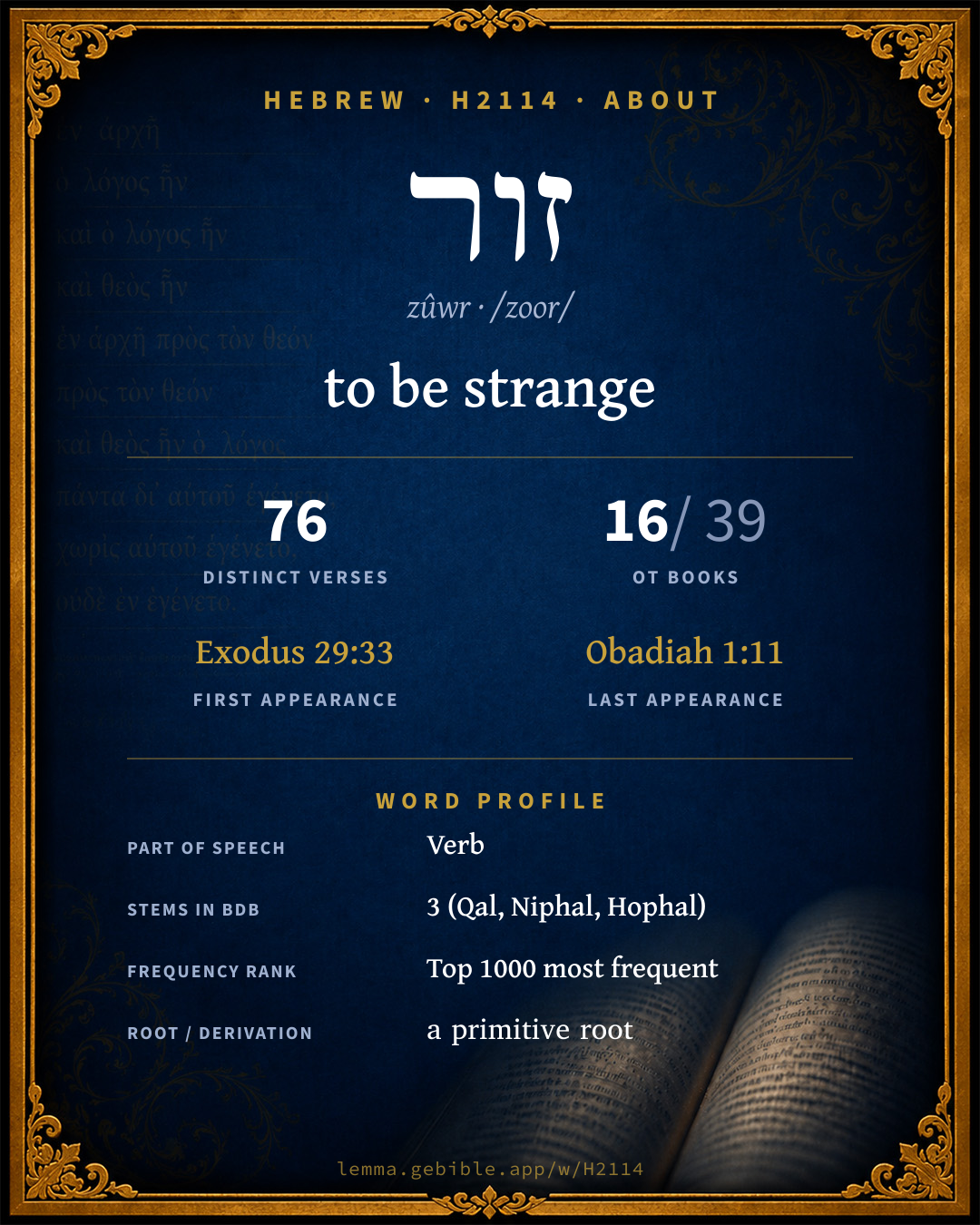
זוּר
to be strange
‘to be strange’ is one of 3 main senses fuller range ↓
Full lexicon entry — Brown-Driver-Briggs (BDB)
From Brown-Driver-Briggs (BDB)
Where this word appears
Grammar key — what these labels mean
Part of speech
- Adjective
- A word that describes or qualifies a noun.
- Verb
- An action or state-of-being word.
Stem
- Qal
- The basic, simple active stem — the plain form of the verb (“he wrote”). Here: ‘become estranged ψ 58’
- Niphal
- Usually the simple passive or reflexive of the Qal (“he was written”).
- Hophal
- The passive counterpart of the Hiphil (“he was caused to…”).
Form
- Perfect
- A completed action or state — Hebrew marks aspect (completeness) more than strict tense (“he wrote”).
- Participle Passive
- A verbal adjective expressing action received (“written”).
State
- Absolute
- The independent form of a noun, not bound to a following word.
- Construct
- A noun bound to a following noun in a possessive / “of” relationship (the construct chain).
Person
- 3rd Person
- The one spoken about (“he / she / it / they”).
Gender
- Masculine
- Grammatically masculine.
- Feminine
- Grammatically feminine.
- Common
- Either gender — not distinguished for this form.
Number
- Plural
- More than one (in Hebrew, generally three or more).
- Singular
- One.
Every verse where H2114 appears in the Book of Proverbs — 14 distinct verses. Click any verse to open its interlinear word-by-word view. Verse text shown in the World English Bible for context — . Each verse’s Hebrew form is shown with its reference; the English is not keyword-highlighted, since the data carries no word-level English alignment. Use “Compare translations” on any verse to read it across multiple English versions. This concordance covers the Hebrew Bible; Septuagint (Greek Old Testament) occurrences are not indexed here.
Proverbs
- Proverbs 2:16 זָרָ֑ה adj Adjective fs To deliver you from the strange woman, Even from the foreigner who flatters with her words;
- Proverbs 5:3 זָרָ֑ה adj Adjective fs For the lips of an adulteress drip honey. Her mouth is smoother than oil,
- Proverbs 5:10 זָרִ֣ים adj Adjective mp Lest strangers feast on your wealth, And your labors enrich another man's house.
- Proverbs 5:17 לְ/זָרִ֣ים prep + Adjective Adjective mp Let them be for yourself alone, Not for strangers with you.
- Proverbs 5:20 בְ/זָרָ֑ה prep + Adjective Adjective fs For why should you, my son, be captivated with an adulteress? Why embrace the bosom of another?
- Proverbs 6:1 לַ/זָּ֣ר prep det + Adjective Adjective ms My son, if you have become collateral for your neighbor, If you have struck your hands in pledge for a stranger;
- Proverbs 7:5 זָרָ֑ה adj Adjective fs That they may keep you from the strange woman, From the foreigner who flatters with her words.
- Proverbs 11:15 זָ֑ר adj Adjective ms He who is collateral for a stranger will suffer for it, But he who refuses pledges of collateral is secure.
- Proverbs 14:10 זָֽר adj Adjective ms The heart knows its own bitterness and joy; He will not share these with a stranger.
- Proverbs 20:16 זָ֑ר adj Adjective ms Take the garment of one who puts up collateral for a stranger; And hold him in pledge for a wayward woman.
- Proverbs 22:14 זָר֑וֹת adj Adjective fp The mouth of an adulteress is a deep pit: He who is under Yahweh's wrath will fall into it.
- Proverbs 23:33 זָר֑וֹת adj Adjective fp Your eyes will see strange things, And your mind will imagine confusing things.
- Proverbs 27:2 זָ֣ר adj Adjective ms Let another man praise you, And not your own mouth; A stranger, and not your own lips.
- Proverbs 27:13 זָ֑ר adj Adjective ms Take his garment when he puts up collateral for a stranger; Hold it for a wayward woman!
About this entry
At a glance — auto-summarized from this page’s data, not written by a person. Every figure links to its source below. This summary describes the numbers; it doesn’t interpret them.
“to be strange” is the headline sense of the Hebrew verb זור (zûwr). Older and newer Bibles part ways — “strangers” in the King James Version, “foreigners” (Berean Standard Bible) in modern versions. See the renderings breakdown. It appears 76 verses across 16 books of the Hebrew Bible, among its moderately common vocabulary. Scripture first uses it in Exodus 29:33. Read the stem: it spans 3 stems, including Qal and Niphal. The sections below give every sense, occurrence, and version rendering.
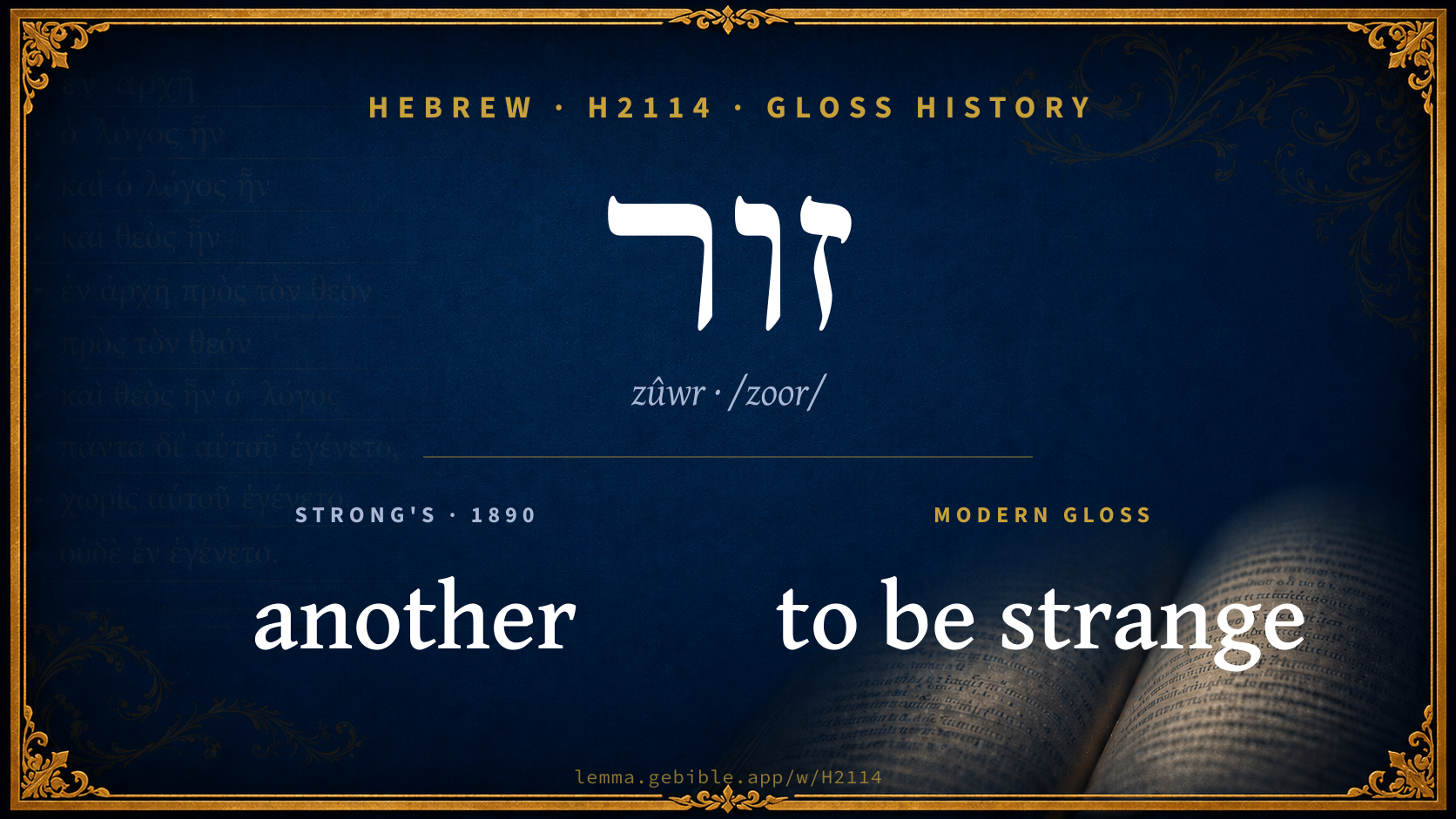
Gloss history
Strong's 1890 vs modern scholarship
About this word
Strong's H2114 catalogs a Hebrew word from the Hebrew Old Testament.
These counts are not copied from any lexicon or concordance. They are computed here, from the morphology-tagged Hebrew Old Testament. What Lemma adds →
- 76
- distinct verses
- The word appears in 76 distinct verses.
- 16 / 39
- OT books
- The word appears in 16 of 39 Old Testament books.
- #519
- by frequency
- Top 1000 most frequent Hebrew words (rank 519 of 8,640 Hebrew words by occurrence).
View all 76 occurrences in the concordance →
By section of the Old Testament
By traditional corpus
Conventional, traditional groupings — biblical authorship is debated, so this is a traditional corpus grouping, not an authorship claim. Each share is this word’s portion of its verses in that division of the Hebrew canon. Each figure is a share of the word’s 76 distinct verses.
- Prophets (Nevi'im) 32 verses · 42%
- Writings (Ketuvim) 27 verses · 36%
- Torah (Pentateuch) 17 verses · 22%
How translations render this word
Counts come from each version’s own published word-to-Strong’s tagging or interlinear alignment — an approximate guide to how each version renders this word, not a word-level alignment the data otherwise carries. Because each total is that version’s own tagged count, the per-version totals vary from one another and need not match the appearance or distinct-verse counts above. These counts may also differ from a printed concordance because Lemma counts each distinctly tagged rendering and does not collapse phrase taggings into a single head-word total. This is a fixed set of word-tagged versions (KJV, ASV, BSB, ULT) and does not change with the reading translation you choose elsewhere. Each version’s license is shown beside its name below (and on Sources).
BDB lists this Strong’s number as 3 distinct words (homographs). Each count above pools all of them and is not split by sense — see the Senses section below. A low-frequency rendering may belong to a different one of those words, not the primary meaning.
- King James Version†: Strangers 23×, Stranger 13×, Strange 10×
- American Standard Version†: Strangers 20×, Stranger 13×, Strange 9×
- Berean Standard Bible†: Foreigners 13×, Strangers 11×, Stranger 8×
- unfoldingWord Literal Text†: Stranger 21×, Strangers 18×, Strange 12×
King James Version Public Domain
Renders H2114 across 74† tagged occurrences — most commonly:
Plus 20 renderings that appear only once — usually multi-word phrases or single function words the recovered tagging swept in, not distinct renderings. Not rendered by a distinct English word in 3 further occurrences.
American Standard Version Public Domain
Renders H2114 across 74† tagged occurrences — most commonly:
Plus 28 renderings that appear only once — usually multi-word phrases or single function words the recovered tagging swept in, not distinct renderings.
Berean Standard Bible Public Domain
Renders H2114 across 76† tagged occurrences — most commonly:
Plus 22 renderings that appear only once — usually multi-word phrases or single function words the recovered tagging swept in, not distinct renderings.
unfoldingWord Literal Text CC BY-SA 4.0
Renders H2114 across 76† tagged occurrences — most commonly:
Plus 10 renderings that appear only once — usually multi-word phrases or single function words the recovered tagging swept in, not distinct renderings.
11 senses and sub-senses in the full BDB
Hebrew verbs can shift meaning by stem (binyan): Qal is the basic action, Niphal is often passive or reflexive, Piel often intensifies or makes it factitive, and Hiphil is typically causative. The senses below are grouped under the stem BDB assigns to each. This entry also uses Hophal (the passive of Hiphil).
What do BDB’s symbols mean?
BDB uses these scholarly abbreviations:
| Symbol | Meaning |
|---|---|
| 𝔊 | the Septuagint (the ancient Greek translation, LXX) |
| 𝔙 | the Vulgate (the Latin translation) |
| 𝔖 | the Syriac version (the Peshitta) |
| 𝔗 | the Targum (the Aramaic translation) |
| ψ | the Psalms |
| √ | root (the underlying root or stem) |
| ‖ | parallel passage (a synonymous or contrasted parallel) |
| † | the dagger: every passage where the word occurs is cited |
The 11 senses and sub-senses the full Brown-Driver-Briggs lexicon distinguishes for this word, in lexicon order (not ranked by frequency), with BDB’s own verbatim wording and sub-sense lettering. Shown in Hebrew script with BDB’s own scholarly abbreviations. The condensed entry is in the Lexicon Entry tab. See also the Forms in the corpus table below.
זור I be a stranger (Arabic زَارَ (med. و incline toward, repair to, visit
Qal
- Pf. 3 pl. זֹר֫וּ ψ 58:4 (Köi 445), זָ֫רוּ ψ 78:30 Jb 19:13; Pt. זָר Ex 30:33 + 27 times; f. זָרָה Ex 30:9 + 7 times; mpl. זָרִים Ho 5:7 + 30 times; fpl. זָרוֹת Pr 22:14; 23:33; sf. זָרָ֑יִךְ Is 29:5; e.g. Psalms 58:4
- 1. Pf. become estranged ψ 58:4, c. מן from Jb 19:13 ψ 78:30. e.g. Psalms 58:4
- 2. Pt. as adj. strange, or as noun stranger:
- a. to the family, of another household, אִישׁ זָר Dt 25:5, elsewhere זָר 1 K 3:18 Jb 19:15 Pr 6:1; 11:15; 20:16; 27:13; זָרִים ψ 109:11 Pr 5:10, 17; בנים זרים, children of another household than God’s Ho 5:7; especially of another family than priests’ אִישׁ זֶר Lv 22:12 (H) Nu 17:5 (P); זָר Lv 22:10, 13 (H) Ex 29:33; 30:33 Nu 3:10, 38; 18:7 (P); not belonging to the tribe of Levi, Nu 1:51; 18:4 (P). e.g. Deuteronomy 25:5
- b. to the person, another Jb 19:27 Pr 14:10; 27:2; זָרָה (אִשָּׁה) strange woman, harlot Pr 2:16; 5:3, 20; 7:5; 22:14; 23:33. e.g. Job 19:27
- c. to the land, foreign, זָרִים foreigners (as such usually enemies) Ho 7:9; 8:7 Is 1:7(×2); 25:2, 5; 29:5; 61:5 Je 5:19; 30:8; 51:2, 51 La 5:2 Ez 7:21; 11:9; 16:32; 28:7, 10; 30:12; 31:12 Jo 4:17 Ob 11 Jb 15:19 ψ 54:5; אֵל זָר foreign god ψ 44:21; 81:10 = זָר Is 43:12; so זָרִים Dt 32:16 and (in fig.) Je 2:25; 3:13; מַיִם זָרִים foreign waters 2 K 19:24 Je 18:14; זְמֹרַת זָר Is 17:10 vine-slip of a stranger; כְּמוֹ־זָר נֶחְשָׁ֑בוּ Ho 8:12 they are regarded as foreign; מַעֲשֵׂהוּ זָר Is 28:21 his work is foreign (as if dealing with enemies). e.g. Hosea 7:9
- d. strange to the law; קְטֹרֶת זָרָה strange incense Ex 30:9 (P); אֵשׁ זָרָה strange fire Lv 10:1 Nu 3:4; 26:61 (P). e.g. Exodus 30:9
Niphal
- Pf. נָזֹ֫רוּ Is 1:4 Ez 14:5; be estranged Is 1:4, pregn., sq. אָחוֹר (cf. RV); מֵעַל Ez 14:5. e.g. Isaiah 1:4
Hophal
- Pt. מוּזָר estranged ψ 69:9. e.g. Psalms 69:9
זור II be loathsome, Bö§ 1142 (Arabic ذَارَ fastidivit, abhorruit
Qal
- 3 fs. זָ֫רָה Jb 19:17 רוּחִי זָ֫רָה לְאִשְׁתִּי my breath is loathsome to my wife (וְחַנֹּתִי לְ in ‖ cl.); > most, who derive from i. זוּר, become strange and so repugnant. e.g. Job 19:17
זור III ess down and out (Aramaic זִיר press together, Syriac ܙܘܰܪ, ܙܳܪ compress
Qal
- Pf. 3 pl. זֹ֫רוּ Is 1:6 (pass.; > √ זרר, Arabic زَرَّ draw forcibly together Ol§ 233c, 2451 Köi 333); Impf. 3 ms. וַיָּ֫וַר Ju 6:38, 3 fs. sf. תְּזוּרֶהָ Jb 39:15; Pt. pass. f. זוּרֶה (= זוּרָה Ges§ 80 i) Is 59:5;—press (twist or wring) out a fleece Ju 6:38; not pressed out, of sore (fig. of continued disaster) Is 1:6; press under foot an egg, Jb 39:15 (‖ דּוּשׁ), Is 59:5 (pass.) e.g. Isaiah 1:6
Senses from the full Brown-Driver-Briggs lexicon (Brown, Driver, Briggs; Oxford 1906 — public domain), digitized via Sefaria, supplemented by the OpenScriptures HebrewLexicon (CC BY 4.0). Full attribution on Sources.
Word origin
I. vb. be a stranger (Arabic زَارَ (med. و incline toward, repair to, visit; ii. honour as visitor or guest; ix. decline, turn aside; زَاىِٔرٌ visitor; Aramaic זוּר, often = Heb. סוּר turn aside, turn aside to visit)—
II. vb. be loathsome, Bö§ 1142 (Arabic ذَارَ fastidivit, abhorruit; Assyrian zâru, hate Impf. izîru, DlPr 65 SchrCOT Gloss)—only
III. vb. press down and out (Aramaic זִיר press together, Syriac ܙܘܰܪ, ܙܳܪ compress; cf. Arabic زَيَّرَ twist the lip of a beast)—
— Brown-Driver-Briggs (Oxford 1906, public domain), digitized via Sefaria, supplemented by the OpenScriptures HebrewLexicon (CC BY 4.0). See Sources.
Origin: a primitive root
Jastrow Dictionary
A second Hebrew/Aramaic lexicon for comparison, covering Aramaic and post-biblical (Talmudic, Targumic, Midrashic) usage that the biblical-Hebrew BDB does not. Matched by lemma rather than by Strong’s number, so a lemma may carry more than one Jastrow headword (shown separately below), and the entries cover usage well beyond the Bible.
זוּר I
- to go around, with מ־ or הימ־ to turn away, be estranged; to deviate. Yoma 72ᵇ זָרָה הימנו the Law departs from him (is forgotten); v. זָר. Midr. Till. to Ps. XC, 5 (play on ז̇ר̇מ̇ת̇ם̇, ib.) זָֹר̇וּ מ̇תו ות̇מ̇ו they deviated (from the Law) &c.; זרו מתורתיך וכ׳; Yalk. Ps. 841.
זוּר
- 1. (with מ־) to turn away. Targ. Num. XVI, 26 (h. text סור); a. e.
- 2. (with ל־) [to turn from the road to,] to enter as a guest, to lodge. Targ. Gen. XIX, 2, sq.; a. fr.
- to turn, roll.—Part. pass. מְזַוַּור. Bekh. 44ᵃ דמְזַוְּורָן עיניה Ar. (ed. דמְזַוֵּר עיניה, Rashi דמזורדן, read: דמזוורן) one whose eyes are rolled about (ed. who rolls his eyes); v. זִיּוֵּר.—2) זַיֵּיר (cmp. צוּר, זרר) to tie up, keep (as a pledge); to press. B. Mets. 16ᵇ אפשיטי … ז׳ ליה he keeps the document until the writer’s fee is paid. V. זַיָּירָא, מְזוֹרָה, זוּרְיָא &c.
זוּר II
- (preced. v. זֵיר) crown, wreath; (bot.) capsule. Tosef. Maasr. III, 14 כל שאין לו אלא ז׳ אחד המקיף וכ׳ (ed. Zuck. דֵּיר I) (a garlick plant) which has only one capsule of seeds crowning the stem; Y. ib. V, end, 52ᵃ חור (corr. acc.).
A Dictionary of the Targumim, the Talmud Babli and Yerushalmi, and the Midrashic Literature (Marcus Jastrow; London, Luzac, 1903) — Public Domain. Digitized via Sefaria. Digitized via Sefaria. Full attribution on Sources.
Forms in the corpus
The 40 distinct written forms H2114 takes in the Hebrew Bible, most frequent first — each parse links to that state’s occurrences in the concordance. Hebrew forms include their vowel points and cantillation, so a single lemma takes many written forms.
Same root — word family
Other BDB entries built from the same root as H2114, grouped by Strong’s listed origin. These share a root / origin per the lexicon — not necessarily a shared meaning. Each links to that word’s own entry.
Derived from this word
Compare all same-root words → Showing 4 of 5 — not the complete family. They share a root, not necessarily a meaning.
Septuagint verse parallels
This word appears in 68 verses that also exist in the Greek Old Testament (Septuagint), out of the 76 Hebrew verses it occurs in. You can read those verses in Greek by switching the Old Testament edition to the Septuagint.
Read these verses in the Septuagint
- Exodus 29:33
- Leviticus 10:1
- Numbers 1:51
- Deuteronomy 25:5
- 1 Kings 3:18
- 2 Kings 19:24
- Job 15:19
- Psalms 54:3
- Proverbs 2:16
- Isaiah 1:4
- Jeremiah 2:25
- Lamentations 5:2
This is a verse-level parallel only — the same verses exist in both the Hebrew and Greek Old Testaments. No word-level Hebrew↔Greek correspondence is claimed: the data carries no such alignment, so no Greek word is shown as this Hebrew word’s translation. Coverage is not total — the Septuagint omits the deuterocanon and renumbers the Psalms, so some Hebrew verses have no direct Greek parallel.