
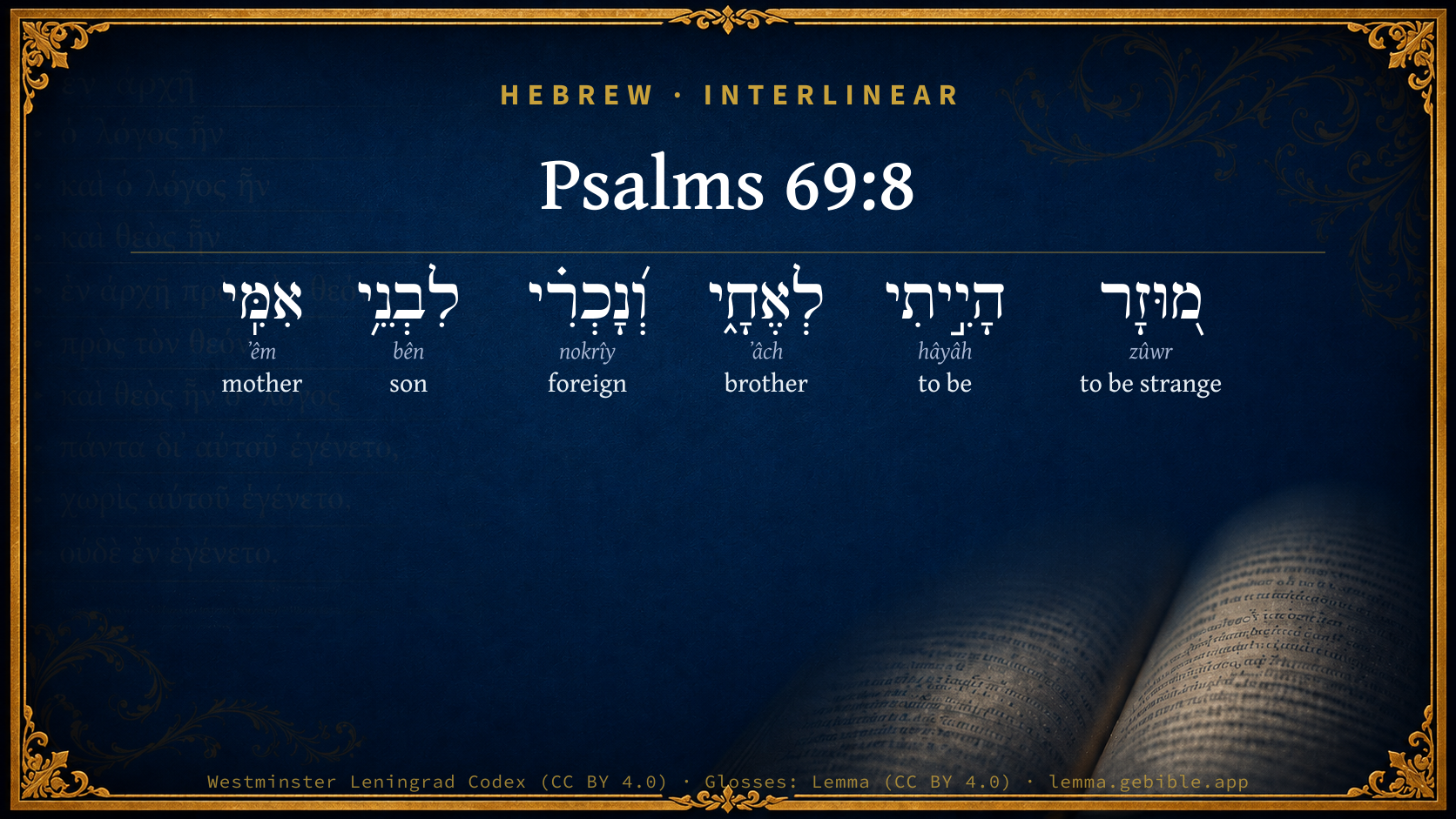
Psalms 69:8

Hebrew (Westminster Leningrad Codex) Psalms 69:8 appears in the Hebrew Old Testament. The text above is from the Westminster Leningrad Codex. Each word links to its Strong’s number, a concise gloss, and parsing drawn from the Open Scriptures Hebrew Bible morphology. Click any word for its full Brown-Driver-Briggs (BDB) entry.
Download image
Cite this verse

Psalms 69:8 (World English Bible). Public Domain. Lemma interlinear Bible study tool, https://lemma.gebible.app/v/psalms/69/8.

Show BibTeX & RIS
BibTeX
RIS
English Translation
I have become a stranger to my brothers, An alien to my mother's children.
World English Bible · Public Domain
Download a study sheet

One document with this verse’s original text, its word-by-word gloss line, the meaning frame, cross-references with their text, attributed commentary, and full source and license credits — printable, and it pastes into notes with its structure intact.

This verse Autodidact and up

Study sheet (.html) Plain text (.txt)

A passage Seminary Student

Up to 50 verses in one chapter. A passage sheet keeps up to 6 commentary sources and 12 cross-references per verse, in the order this page ranks them, and says so on the sheet whenever that leaves anything out. Ask for a single verse and you get the Autodidact verse sheet above.

Everything on this page stays free to read, with no account — the sheet is a download of what is already on screen, not access to it.

Want to remove ads? Support Godless Engineer
Compare translations 3

The same verse in 3 English versions, stacked beneath the original-language interlinear above. Click any original word for its lexicon entry.

Each is an independent rendering of the whole verse — the interlinear is not word-aligned to these translations.

Highlighted words mark where these versions differ — a whole-verse word diff, not a word-by-word alignment.

  • World English Bible Public Domain
    I have become a stranger to my brothers, An alien to my mother's children.
  • King James Version Public Domain
    I am become a stranger unto my brethren, and an alien unto my mother's children.
  • unfoldingWord Literal Text CC BY-SA 4.0
    I have become a stranger to my brothers and a foreigner to the sons of my mother.

unfoldingWord Literal Text — © unfoldingWord, licensed CC BY-SA 4.0. Word-aligned USFM3 via Door43 (git.door43.org/unfoldingWord/en_ult).

Versions to compare (up to 4)

3 of 4 selected

Show all 18 translations

Every available English version of this verse, each an independent rendering of the whole verse.

  • World English Bible Public Domain
    I have become a stranger to my brothers, An alien to my mother's children.
  • Berean Standard Bible Public Domain
    I have become a stranger to my brothers and a foreigner to my mother’s sons,
  • Majority Standard Bible Public Domain
    I have become a stranger to my brothers and a foreigner to my mother’s sons,
  • King James Version Public Domain
    I am become a stranger unto my brethren, and an alien unto my mother's children.
  • American Standard Version (1901) Public Domain
    I am become a stranger unto my brethren, And an alien unto my mother's children.
  • Revised Version (1885) Public Domain
    I am become a stranger unto my brethren, and an alien unto my mother’s children.
  • Geneva Bible (1599) Public Domain
    I am become a stranger vnto my brethren, euen an aliant vnto my mothers sonnes.
  • Douay-Rheims (1899) Public Domain
    Because for thy sake I have borne reproach; shame hath covered my face.
  • Young's Literal Translation Public Domain
    A stranger I have been to my brother, And a foreigner to sons of my mother.
  • Literal Standard Version CC BY-SA 4.0
    I have been a stranger to my brother, || And a foreigner to sons of my mother.
  • Unlocked Literal Bible CC BY-SA 4.0
    I have become a stranger to my brothers, an alien to my mother's children.
  • unfoldingWord Literal Text CC BY-SA 4.0
    I have become a stranger to my brothers and a foreigner to the sons of my mother.
  • Darby Bible Public Domain
    I am become a stranger unto my brethren, and an alien unto my mother's sons;
  • World Messianic Bible Public Domain
    I have become a stranger to my brothers, an alien to my mother’s children.
  • Webster's Bible Public Domain
    \\69:7\\Because for thy sake I have borne reproach; shame hath covered my face.
  • Free Bible Version CC BY-SA 4.0
    I have become a foreigner to my brother Israelites; a stranger to my very own brothers.
  • Bible in Basic English Public Domain
    I have become strange to my brothers, and like a man from a far country to my mother's children.
  • JPS Tanakh (1917) Public Domain
    (69-9) I am become a stranger unto my brethren, and an alien unto my mother's children.

Literal Standard Version (2020), Covenant Press — licensed CC BY-SA 4.0. Text via the HelloAO Bible API (eBible.org). Unlocked Literal Bible (unfoldingWord) — licensed CC BY-SA 4.0. Text via the HelloAO Bible API (eBible.org). unfoldingWord Literal Text — © unfoldingWord, licensed CC BY-SA 4.0. Word-aligned USFM3 via Door43 (git.door43.org/unfoldingWord/en_ult). Free Bible Version, Dr. Jonathan Gallagher — licensed CC BY-SA 4.0. Text via the HelloAO Bible API (eBible.org).

Word by word

More ways to search: Search by grammar → Find every occurrence → Compare this word →

Practice this passage: Drill this verse → Learn its vocabulary →

About this verse

These counts appear in no published source. They are computed here, from the morphology-tagged text and Lemma’s own curated glosses. What Lemma adds →

6
words
6
distinct lemmas
Wisdom
section

Shared distinctive vocabulary

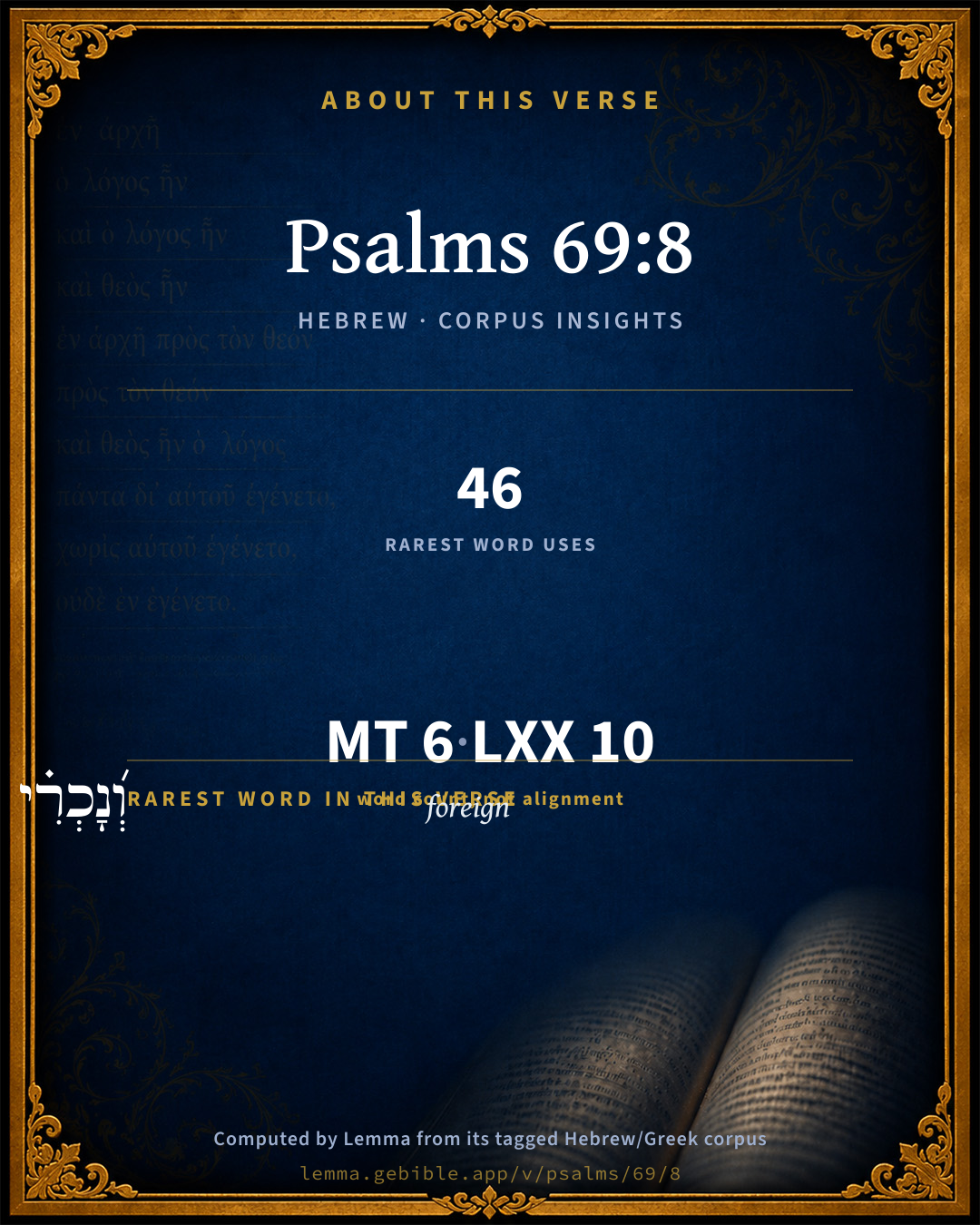
וְ֝נָכְרִ֗י foreign H5237 occurs in 45 verses of the Hebrew Bible. Also found in:

Grammatical profile

  • 2 verbs
  • 3 nouns
  • 1 adjective

Verb forms

  • מ֭וּזָר Hophal · Participle Passive
  • הָיִ֣יתִי Qal · Perfect

Hebrew & Septuagint length

In English translation the verse runs 14 words from the Hebrew and 13 from the Septuagint (LXX English) — closely comparable.

A rough comparison of the two English renderings, which tokenize alike — not a word-level alignment.

Word counts can differ between the Hebrew and the Greek without any difference in meaning — e.g. the Hebrew direct-object marker אֵת has no separate Greek word, and Greek often adds the article ὁ.

In the original languages it is 6 Hebrew tokens and 10 Greek tokens — but the two are counted differently (Hebrew bundles its prefixes and suffixes into one token; the Greek is in lemma form), so that isn’t a like-for-like length.

Cross-references

13

Topical passages linked to Psalms 69:8 in the Treasury of Scripture Knowledge — connected by theme and wording, ordered by reader-vote popularity; previews shown in the World English Bible.

  • Psalms 31:11 Because of all my adversaries I have become utterly contemptible to my neighbors, A fear to my acquaintances. Those who saw me on the street fled from me.
  • John 1:11 He came to his own, and those who were his own didn't receive him.
  • John 7:5 For even his brothers didn't believe in him.
  • Psalms 38:11 My lovers and my friends stand aloof from my plague. My kinsmen stand far away.
  • Micah 7:5–6 Don't trust in a neighbor. Don't put confidence in a friend. With the woman lying in your embrace, Be careful of the words of your mouth!
  • Matthew 10:35–36 For I came to set a man at odds against his father, and a daughter against her mother, and a daughter-in-law against her mother-in-law.
  • Matthew 26:70–74 But he denied it before them all, saying, "I don't know what you are talking about."
  • 1 Samuel 17:28 Eliab his eldest brother heard when he spoke to the men; and Eliab's anger was kindled against David, and he said, Why are you come down? and with whom have you left those few sheep in the wilderness? I know your pride, and the naughtiness of your heart; for you have come down that you might see the battle.
  • Job 19:13–19 "He has put my brothers far from me. My acquaintances are wholly estranged from me.
  • Isaiah 53:3 He was despised, and rejected by men; a man of suffering, and acquainted with disease: and as one from whom men hide their face he was despised; and we didn't respect him.
  • Matthew 10:21–22 "Brother will deliver up brother to death, and the father his child. Children will rise up against parents, and cause them to be put to death.
  • Matthew 26:48–50 Now he who betrayed him gave them a sign, saying, "Whoever I kiss, he is the one. Seize him."
  • Matthew 26:56 But all this has happened, that the Scriptures of the prophets might be fulfilled." Then all the disciples left him, and fled.

Cross-references courtesy of OpenBible.info (CC BY 4.0).

Hebrew and Greek witnesses Masoretic Hebrew ↔ Greek Septuagint

The same verse in the two great witnesses to the Old Testament, shown verse-for-verse.

You’re reading Greek Psalm 68 (Hebrew Psalm 69). The Septuagint counts the superscription, so verse numbers can differ from the Hebrew — chapter-level alignment, not verse-by-verse. Numbering follows Rahlfs.

These are two independent witnesses, not word-aligned to each other, and the Septuagint is shown in lemma (dictionary) form.

Hebrew Psalms 69:8 Masoretic · Westminster Leningrad Codex

מ֭וּזָר הָיִ֣יתִי לְאֶחָ֑י וְ֝נָכְרִ֗י לִבְנֵ֥י אִמִּֽי

I have become a stranger to my brothers, An alien to my mother's children.

World English Bible · Public Domain

Greek LXX Greek Psalm 68:8 Septuagint · lemma form

ὅτι ἕνεκα σύ ὑποφέρω ὀνειδισμός καλύπτω ἐντροπή ὁ πρόσωπον ἐγώ

I became strange to my brethren, and a stranger to my mother's children.

LXX2012 (modern English Septuagint) · Public Domain

Hebrew: Westminster Leningrad Codex (CC BY 4.0). Greek: Septuagint (public domain); English from LXX2012 (modern English Septuagint) (Public Domain). How the Septuagint differs from the Hebrew →

Commentary

Notes on Psalms 69:8 from classic Christian and Jewish commentators (each source and its license shown beneath its notes). The classic Christian expositions comment on the surrounding passage and are grouped to its opening verse, so a note may address several verses; the Jewish commentaries on the Tanakh (Rashi and others) are per-verse, so they appear only where the commentator wrote on this verse.

Lemma curates 59 commentaries, every one of them public domain or Creative Commons licensed, each selected and text-cleaned for this edition rather than reprinted as found. About our sources →

Trapp's Complete Commentary

John Trapp

Psa 69:8 I am become a stranger unto my brethren, and an alien unto my mother’s children.

Ver. 8. I am become a stranger unto my brethren] No otherwise than as if I were a mamzer (so the Hebrews call a bastard), that is, a strange blot to the family. Christ came to his own, but they received him not; yea, his own brethren believed not on him, Joh 7:5 This, when the Turks read in our Gospel, they wonder; and the Jews, therefore, slander his miracles, for not so manifest as we conceive.

John Trapp, A Commentary or Exposition upon All the Books of the Old and New Testament (1647–1656) — public domain. Text from a community e-Sword module.

J. A. Alexander on Psalms

Joseph Addison Alexander

9. (Psa 69:8). I am become a stranger unto my brethren, and an alien unto the sons of my mother. The literal meaning of the first clause is, I have been estranged to (or as to) my brothers. There may be an allusion to the envious treatment of David by the other sons of Jesse. See 1Sa 17:28. The loss or alienation of the nearest friends is spoken of as one of the severest trials in Psa 27:10.

10 (Psa 69:9). For the zeal of thine house, jealous regard for the honour of the sanctuary, as the visible centre of the true religion, has consumed me, implying an extreme intensity of feeling ; and in consequence of this zeal, the revilings of thy revilers have fallen upon me. That such revilers did exist in David's time, we learn from 2Sa 12:14. The first clause of the verse before us is applied to Christ in Joh 2:17, and the second in Rom 15:3.

Joseph Addison Alexander, The Psalms Translated and Explained (1850) — public domain. Text from a community e-Sword module.

Ellicott's Commentary for English Readers

(8) Mother’s children.—See Note Son_1:6.

A Bible Commentary for English Readers, edited by Charles John Ellicott (1878–1897) — public domain. Text from a community e-Sword module.

The Cambridge Bible for Schools and Colleges

gen. ed. J. J. S. Perowne

8. Even his nearest relations treat him as a stranger and a foreigner. Cp. Psa_38:11; Job_19:13 ff.; Jer_12:6.

my mother’s children] The sons of my own mother expresses a closer degree of relationship than my brethren, the children of the same mother being always regarded as bound to one another by a closer tie than those of the same father by different mothers. Cp. Psa_50:20.

The Cambridge Bible for Schools and Colleges (gen. ed. J. J. S. Perowne; Cambridge University Press, 1878–1918) — public domain. Text from a community e-Sword module.

John Gill's Exposition

I am become a stranger unto my brethren,.... Not only to the Jews in general, who were his own people and nation, to whom he came, and of whom he came; who received him not, hid as it were their faces from him, and rejected him as the Messiah; but also to such who were still nearer akin to him, according to the flesh, who did not believe in him, Joh 7:5; and even in some sense to his disciples and followers; some of which having heard some doctrines delivered by him not agreeable to them, withdrew from him, and walked no more with him, Joh 6:60; yea, to his apostles, whom he often called his brethren: one of these betrayed him, another denied him with oaths and cursing, and all of them forsook him and fled, when he was taken by his enemies, and about to suffer death;

and an alien unto my mother's children; which is the same as before, in other words. The Targum is,

"as the son of the Gentiles to my mother's children;''

that is, as an Heathen to them; see Mat 18:17.

John Gill's Exposition of the Whole Bible (1746–1763) — public domain (CC PDM 1.0). Text via the HelloAO Bible API.

Albert Barnes' Notes on the Bible

I am become a stranger unto my brethren - That is, They treat me as they would a stranger; as one in whom they have no interest, and whom they regard with no friendship. Compare the notes at Psa 31:11.

And an alien unto my mother’s children - A foreigner; one of another tribe or nation; one to whom they were bound by no tie of relationship. The allusion in the language “unto my mother’s children” is intended to denote the most intimate relationship. In families where a man had many wives, as was common among the Hebrews, the nearest relationship would be denoted by being of the same “mother” rather than of the same “father.” See the notes at Psa 50:20. The same thing occurs also where polygamy is not practiced, in cases where a man has married more wives than one. The idea of the psalmist here, therefore, is, that his nearest relatives treated him as if he were a stranger and a foreigner. Compare Job 19:13-19.

Albert Barnes' Notes on the Bible (1834–1885) — public domain. Text from a community e-Sword/MySword module.

Matthew Poole's English Annotations

My nearest kinsmen estranged themselves from me; partly out of fear, test they should be involved in my sufferings; and chiefly out of dislike of his piety and excessive zeal in religion, as it here follows.

Matthew Poole's English Annotations on the Holy Bible (1683–1685) — public domain. Text from a community e-Sword/MySword module.

The Treasury of David

Charles H. Spurgeon

Ver. 8. I am become a stranger unto my brethren. The Jews his brethren in race rejected him, his family his brethren by blood were offended at him, his disciples his brethren in spirit forsook him and fled; one of them sold him, and another denied him with oaths and cursings. Alas, my Lord, what pangs must have smitten thy loving heart to be thus forsaken by those who should have loved thee, defended thee, and, if need be, died for thee.

And an alien unto my mother's children. These were the nearest of relatives, the children of a father with many wives felt the tie of consanguinity but loosely, but children of the same mother owned the band of love; yet our Lord found his nearest and dearest ones ashamed to own him. As David's brethren envied him, and spake evil of him, so our Lord's relatives by birth were jealous of him, and his best beloved followers in the hour of his agony were afraid to be known as having any connection with him. These were sharp arrows of the mighty in the soul of Jesus, the most tender of friends. May none of us ever act as if we were strangers to him; never may we treat him as if he were an alien to us: rather let us resolve to be crucified with him, and may grace turn the resolve into fact.

Ver. 8. A stranger unto my brethren. Unless this aversion of his brethren had pained him, he would not have complained of it. It would not have pained him unless he had felt a special affection for them. Musculus.

Ver. 8. In the east where polygamy prevails, the husband is a stern and unfeeling despot; his harem a group of trembling slaves; and the children, while they regard their common father with indifference or terror, cling to their own mother with the fondest affection, as the only part, as the only parent, in whom they feel an interest. Hence it greatly aggravated the affliction of David that he had become an alien unto his mother's children: the enmity of the other children of his father, the children of his father's other wives, gave him less concern. W. Greenfield, in Comprehensive Bible.

Ver. 8-9.

I. A grievous trial.

II. An honourable reason for it: for Christ's sake.

III. Consoling supports under it.

Psalms 69:9*

Ver. 8-9.

I. A grievous trial.

II. An honourable reason for it: for Christ's sake.

III. Consoling supports under it.

Charles H. Spurgeon's The Treasury of David (1869–1885) — public domain. Psalms only. Text from a community e-Sword/MySword module.

Whedon's Commentary on the Bible

Daniel D. Whedon

8. A stranger unto my brethren—Historically, no doubt, the statement might measurably be applied to David, but prophetically and more emphatically to Christ. Mar_3:21; Joh_7:5

Daniel D. Whedon (gen. ed.), Commentary on the Old and New Testaments (1874–1909) — public domain. Text from a community e-Sword module.

The Pulpit Commentary

I am become a stranger unto my brethren, and an alien unto my mother"s children. The preference of David over all his elder brethren was calculated to arouse their jealousy; (1Sa_16:6-13) and Eliab"s hostile feeling is distinctly shown in 1Sa_17:28. We may gather from Ps 38, as well as from the present passage, that the alienation continued, and was not confined to Eliab.

The Pulpit Commentary (1880–1919), ed. H.D.M. Spence-Jones & Joseph S. Exell — public domain. Text from a community e-Sword module.

Lesson kit

Teaching starters — assembled from the data on this page, not authored interpretation. Every prompt links to the verse data it draws on. Edit before teaching.

Psalms, in the Wisdom, opens this verse with 6 words (6 distinct Hebrew lemmas). Its most distinctive word is nokrîy (“foreign”). A historical commentator’s framing appears above. Read the whole chapter for the surrounding context.

Discussion questions

  1. How does “foreign” (nokrîy) shape what this verse is saying?
  2. How does Genesis 31:15, which shares the word «foreign», read alongside this verse?
  3. These translations render this verse differently. What is at stake in choosing one wording over another?
  4. «מ֭וּזָר» is a Hophal Participle Passive verb. How does that grammatical form shape the action described?
  5. Compare how Trapp's Complete Commentary and J. A. Alexander on Psalms read this verse. Where do they agree or differ?

Things to notice

Reading settings

Reading text

Shown beneath each verse's original-language words.

Old Testament
Old Testament edition

Read the OT as the Masoretic Hebrew (MT) or the Greek Septuagint (LXX).

English shown for the Greek Septuagint (in the Hebrew ↔ Greek comparison).

Comparing translations? Open the Compare panel on any verse page to stack up to four side by side.