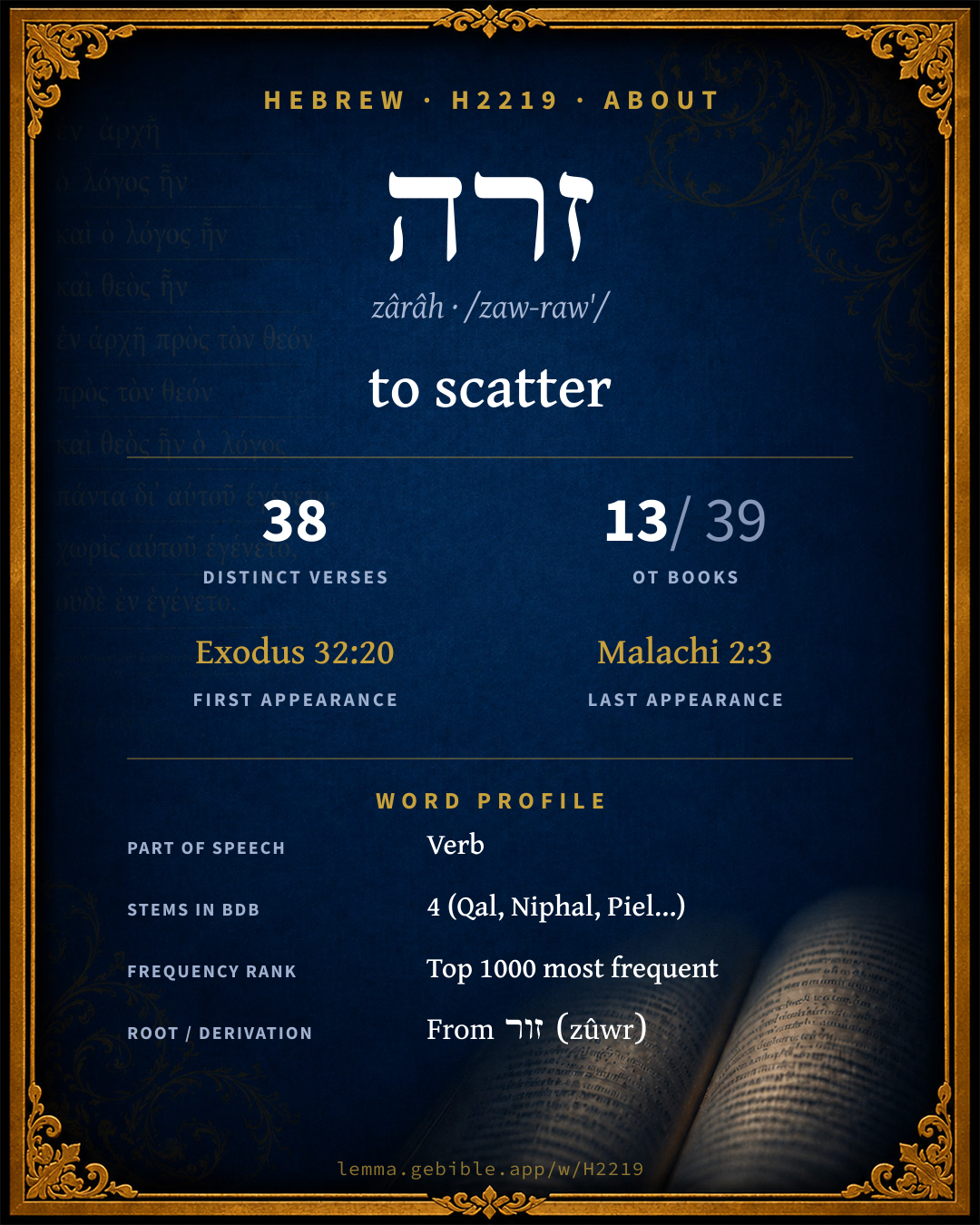
זָרָה
to scatter
also: fan, cast away, winnow, disperse fuller range ↓
Full lexicon entry — Brown-Driver-Briggs (BDB)
From Brown-Driver-Briggs (BDB)
Where this word appears
See every Piel verb in the Hebrew Bible →
Grammar key — what these labels mean
Part of speech
- Verb
- An action or state-of-being word.
Stem
- Piel
- An intensive or resultative active stem. Here: ‘winnow’
- Qal
- The basic, simple active stem — the plain form of the verb (“he wrote”). Here: ‘scatter’
- Niphal
- Usually the simple passive or reflexive of the Qal (“he was written”).
- Pual
- The passive counterpart of the Piel. Here: ‘be scattered’
Form
- Sequential Perfect
- A perfect with prefixed waw continuing a preceding imperfect or command (waw-consecutive perfect).
- Imperfect
- An incomplete, ongoing, or future action (“he will / would write”).
- Perfect
- A completed action or state — Hebrew marks aspect (completeness) more than strict tense (“he wrote”).
- Participle Active
- A verbal adjective expressing ongoing or characteristic action (“writing / one who writes”).
- Infinitive Construct
- A bound verbal noun, frequently with prepositions (“to write / in writing”).
- Sequential Imperfect
- An imperfect with prefixed waw — the standard past-narrative form (waw-consecutive imperfect).
- Participle Passive
- A verbal adjective expressing action received (“written”).
- Imperative
- A direct command (“write!”).
State
- Absolute
- The independent form of a noun, not bound to a following word.
- Construct
- A noun bound to a following noun in a possessive / “of” relationship (the construct chain).
Person
- 1st Person
- The speaker (“I / we”).
- 3rd Person
- The one spoken about (“he / she / it / they”).
- 2nd Person
- The one addressed (“you”).
Gender
- Common
- Either gender — not distinguished for this form.
- Masculine
- Grammatically masculine.
- Feminine
- Grammatically feminine.
Number
- Singular
- One.
- Plural
- More than one (in Hebrew, generally three or more).
Grammatical forms 20 distinct
- Verb, Piel, Sequential Perfect, 1st Person, Common, Singular 10 times (26%)
- Verb, Piel, Imperfect, 1st Person, Common, Singular 3 times (8%)
- Verb, Qal, Imperfect, 2nd Person, Masculine, Singular 3 times (8%)
- Verb, Piel, Infinitive Construct 3 times (8%)
- Verb, Piel, Perfect, 3rd Person, Common, Plural 2 times (5%)
- Verb, Piel, Participle Active, Masculine, Singular, Absolute 2 times (5%)
- Verb, Qal, Participle Active, Masculine, Singular, Absolute 2 times (5%)
- Verb, Piel, Perfect, 2nd Person, Masculine, Singular 2 times (5%)
+12 more forms (12 occurrences)
Parsed forms decoded from the imported morphology (morphhb / Westminster Leningrad Codex — WLC text public domain, morphhb tagging CC BY 4.0), counted across 39 parsed occurrences — not distinct verses.
Every verse where H2219 appears — 38 distinct verses across 13 books. Click any verse to open its interlinear word-by-word view. Verse text shown in the World English Bible for context — . Each verse’s Hebrew form is shown with its reference; the English is not keyword-highlighted, since the data carries no word-level English alignment. Use “Compare translations” on any verse to read it across multiple English versions. This concordance covers the Hebrew Bible; Septuagint (Greek Old Testament) occurrences are not indexed here.
Exodus 1 verse
Leviticus 1 verse
Numbers 1 verse
Ruth 1 verse
1 Kings 1 verse
Job 1 verse
Psalms 3 verses
- Psalms 44:11 זֵרִיתָֽ/נוּ Piel pf 2ms + sfx pers 1cp You have made us like sheep for food, And have scattered us among the nations.
- Psalms 106:27 וּ֝/לְ/זָרוֹתָ֗/ם conj + prep + Piel inf.cs + sfx pers 3mp That he would overthrow their seed among the nations, And scatter them in the lands.
- Psalms 139:3 זֵרִ֑יתָ Piel pf 2ms You search out my path and my lying down, And are acquainted with all my ways.
Proverbs 4 verses
- Proverbs 1:17 מְזֹרָ֣ה Pual ptcp.pass fs For in vain is the net spread in the sight of any bird:
- Proverbs 15:7 יְזָ֣רוּ Piel impf 3mp The lips of the wise spread knowledge; Not so with the heart of fools.
- Proverbs 20:8 מְזָרֶ֖ה Piel ptcp.act ms A king who sits on the throne of judgment Scatters away all evil with his eyes.
- Proverbs 20:26 מְזָרֶ֣ה Piel ptcp.act ms A wise king winnows out the wicked, And drives the threshing wheel over them.
Isaiah 3 verses
- Isaiah 30:22 תִּזְרֵ/ם֙ Qal impf 2ms + sfx pers 3mp You shall defile the overlaying of your engraved images of silver, and the plating of your molten images of gold: you shall cast them away as an unclean thing; you shall tell it, Get you hence.
- Isaiah 30:24 זֹרֶ֥ה Qal ptcp.act ms the oxen likewise and the young donkeys that till the ground shall eat savory provender, which has been winnowed with the shovel and with the fork.
- Isaiah 41:16 תִּזְרֵ/ם֙ Qal impf 2ms + sfx pers 3mp You shall winnow them, and the wind shall carry them away, and the whirlwind shall scatter them; and you shall rejoice in Yahweh, you shall glory in the Holy One of Israel.
Jeremiah 6 verses
- Jeremiah 4:11 לִ/זְר֖וֹת prep + Qal inf.cs At that time shall it be said to this people and to Jerusalem, A hot wind from the bare heights in the wilderness toward the daughter of my people, not to winnow, nor to cleanse;
- Jeremiah 15:7 וָ/אֶזְרֵ֥/ם conj + Qal wimpf 1cs + sfx pers 3mp I have winnowed them with a fan in the gates of the land; I have bereaved [them] of children, I have destroyed my people; they didn't return from their ways.
- Jeremiah 31:10 מְזָרֵ֤ה Piel ptcp.act ms cs Hear the word of Yahweh, you nations, and declare it in the isles afar off; and say, He who scattered Israel will gather him, and keep him, as shepherd does his flock.
- Jeremiah 49:32 וְ/זֵרִתִ֥י/ם conj + Piel wpf 1cs + sfx pers 3mp Their camels shall be a booty, and the multitude of their cattle a spoil: and I will scatter to all winds those who have the corners [of their hair] cut off; and I will bring their calamity from every side of them, says Yahweh.
- Jeremiah 49:36 וְ/זֵ֣רִתִ֔י/ם conj + Piel wpf 1cs + sfx pers 3mp On Elam will I bring the four winds from the four quarters of the sky, and will scatter them toward all those winds; and there shall be no nation where the outcasts of Elam shall not come.
- Jeremiah 51:2 וְ/זֵר֔וּ/הָ conj + Piel wpf 3cp + sfx pers 3fs I will send to Babylon strangers, who shall winnow her; and they shall empty her land: for in the day of trouble they shall be against her round about.
Ezekiel 13 verses
- Ezekiel 5:2 תִּזְרֶ֣ה Qal impf 2ms A third part shall you burn in the fire in the midst of the city, when the days of the siege are fulfilled; and you shall take a third part, and strike with the sword round about it; and a third part you shall scatter to the wind, and I will draw out a sword after them.
- Ezekiel 5:10 וְ/זֵרִיתִ֥י conj + Piel wpf 1cs Therefore the fathers shall eat the sons in the midst of you, and the sons shall eat their fathers; and I will execute judgments on you; and the whole remnant of you will I scatter to all the winds.
- Ezekiel 5:12 אֱזָרֶ֔ה Piel impf 1cs A third part of you shall die with the pestilence, and with famine shall they be consumed in the midst of you; and a third part shall fall by the sword round about you; and a third part I will scatter to all the winds, and will draw out a sword after them.
- Ezekiel 6:5 וְ/זֵרִיתִי֙ conj + Piel wpf 1cs I will lay the dead bodies of the children of Israel before their idols; and I will scatter your bones round about your altars.
- Ezekiel 6:8 בְּ/הִזָּרֽוֹתֵי/כֶ֖ם prep + Niphal inf.cs + sfx pers 2mp Yet will I leave a remnant, in that you shall have some that escape the sword among the nations, when you shall be scattered through the countries.
- Ezekiel 12:14 אֱזָרֶ֣ה Piel impf 1cs I will scatter toward every wind all who are round about him to help him, and all his bands; and I will draw out the sword after them.
- Ezekiel 12:15 וְ/זֵרִיתִ֥י conj + Piel wpf 1cs They shall know that I am Yahweh, when I shall disperse them among the nations, and scatter them through the countries.
- Ezekiel 20:23 וּ/לְ/זָר֥וֹת conj + prep + Piel inf.cs Moreover I swore to them in the wilderness, that I would scatter them among the nations, and disperse them through the countries;
- Ezekiel 22:15 וְ/זֵרִיתִ֖י/ךְ conj + Piel wpf 1cs + sfx pers 2fs I will scatter you among the nations, and disperse you through the countries; and I will consume your filthiness out of you.
- Ezekiel 29:12 וְֽ/זֵרִיתִ֖י/ם conj + Piel wpf 1cs + sfx pers 3mp I will make the land of Egypt a desolation in the midst of the countries that are desolate; and her cities among the cities that are laid waste shall be a desolation forty years; and I will scatter the Egyptians among the nations, and will disperse them through the countries.
- Ezekiel 30:23 וְ/זֵרִיתִ֖/ם conj + Piel wpf 1cs + sfx pers 3mp I will scatter the Egyptians among the nations, and will disperse them through the countries.
- Ezekiel 30:26 וְ/זֵרִיתִ֥י conj + Piel wpf 1cs I will scatter the Egyptians among the nations, and disperse them through the countries; and they shall know that I am Yahweh.
- Ezekiel 36:19 וַ/יִּזָּר֖וּ conj + Niphal wimpf 3mp and I scattered them among the nations, and they were dispersed through the countries: according to their way and according to their doings I judged them.
Zechariah 2 verses
- Zechariah 1:19 זֵר֣וּ Piel pf 3cp I asked the angel who talked with me, "What are these?" He answered me, "These are the horns which have scattered Judah, Israel, and Jerusalem."
- Zechariah 1:21 זֵ֣רוּ לְ/זָרוֹתָֽ/הּ Piel pf 3cp prep + Piel inf.cs + sfx pers 3fs Then I asked, "What are these coming to do?" He said, "These are the horns which scattered Judah, so that no man lifted up his head; but these have come to terrify them, to cast down the horns of the nations, which lifted up their horn against the land of Judah to scatter it."
Malachi 1 verse
About this entry
At a glance — auto-summarized from this page’s data, not written by a person. Every figure links to its source below. This summary describes the numbers; it doesn’t interpret them.
זרה — transliterated zârâh — is a Hebrew verb carrying the sense “to scatter.” Where the King James Version says “disperse,” newer translations reach for “scatter” (Berean Standard Bible); the renderings breakdown has the detail. It appears 38 verses across 13 books of the Hebrew Bible, among its moderately common vocabulary. More than a third of its appearances fall in Ezekiel. Different stems carry different senses — BDB groups them under 4 stems, among them Qal and Niphal. Each statement above links to its evidence; the full detail follows below.
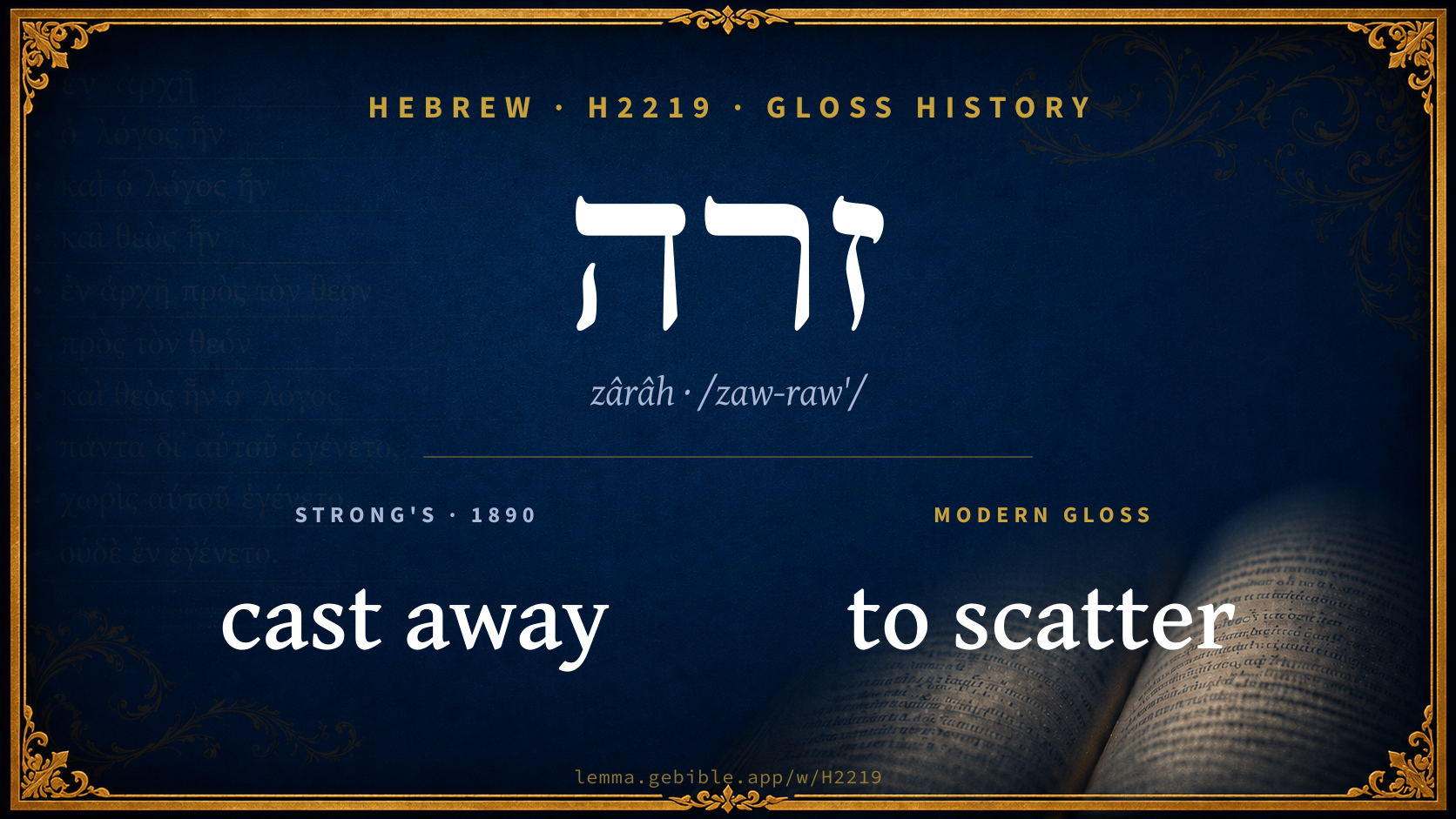
Gloss history
Strong's 1890 vs modern scholarship
About this word
Strong's H2219 catalogs a Hebrew word from the Hebrew Old Testament.
These counts are not copied from any lexicon or concordance. They are computed here, from the morphology-tagged Hebrew Old Testament. What Lemma adds →
- 38
- distinct verses
- The word appears in 38 distinct verses.
- 13 / 39
- OT books
- The word appears in 13 of 39 Old Testament books.
- #922
- by frequency
- Top 1000 most frequent Hebrew words (rank 922 of 8,640 Hebrew words by occurrence).
View all 38 occurrences in the concordance →
By section of the Old Testament
By traditional corpus
Conventional, traditional groupings — biblical authorship is debated, so this is a traditional corpus grouping, not an authorship claim. Each share is this word’s portion of its verses in that division of the Hebrew canon. Each figure is a share of the word’s 38 distinct verses.
- Prophets (Nevi'im) 26 verses · 68%
- Writings (Ketuvim) 9 verses · 24%
- Torah (Pentateuch) 3 verses · 8%
How translations render this word
Counts come from each version’s own published word-to-Strong’s tagging or interlinear alignment — an approximate guide to how each version renders this word, not a word-level alignment the data otherwise carries. Because each total is that version’s own tagged count, the per-version totals vary from one another and need not match the appearance or distinct-verse counts above. These counts may also differ from a printed concordance because Lemma counts each distinctly tagged rendering and does not collapse phrase taggings into a single head-word total. This is a fixed set of word-tagged versions (KJV, ASV, BSB, ULT) and does not change with the reading translation you choose elsewhere. Each version’s license is shown beside its name below (and on Sources).
- King James Version: Disperse 5×, I will scatter 4×, Scatter 3×
- American Standard Version: Disperse 4×, I will scatter 3×, Scatter 2×
- Berean Standard Bible: Scatter 5×, I will scatter 4×, Scatter them 3×
- unfoldingWord Literal Text: Scatter 6×, I will scatter 4×, Scattered 3×
King James Version Public Domain
Renders H2219 across 39 tagged occurrences — most commonly:
Plus 23 renderings that appear only once — usually multi-word phrases or single function words the recovered tagging swept in, not distinct renderings.
American Standard Version Public Domain
Renders H2219 across 39 tagged occurrences — most commonly:
Plus 26 renderings that appear only once — usually multi-word phrases or single function words the recovered tagging swept in, not distinct renderings.
Berean Standard Bible Public Domain
Renders H2219 across 39 tagged occurrences — most commonly:
Plus 21 renderings that appear only once — usually multi-word phrases or single function words the recovered tagging swept in, not distinct renderings.
unfoldingWord Literal Text CC BY-SA 4.0
Renders H2219 across 37 tagged occurrences — most commonly:
Plus 22 renderings that appear only once — usually multi-word phrases or single function words the recovered tagging swept in, not distinct renderings.
8 senses and sub-senses in the full BDB
Hebrew verbs can shift meaning by stem (binyan): Qal is the basic action, Niphal is often passive or reflexive, Piel often intensifies or makes it factitive, and Hiphil is typically causative. The senses below are grouped under the stem BDB assigns to each. This entry also uses Pual (the passive of Piel).
What do BDB’s symbols mean?
BDB uses these scholarly abbreviations:
| Symbol | Meaning |
|---|---|
| 𝔊 | the Septuagint (the ancient Greek translation, LXX) |
| 𝔙 | the Vulgate (the Latin translation) |
| 𝔖 | the Syriac version (the Peshitta) |
| 𝔗 | the Targum (the Aramaic translation) |
| ψ | the Psalms |
| √ | root (the underlying root or stem) |
| ‖ | parallel passage (a synonymous or contrasted parallel) |
| † | the dagger: every passage where the word occurs is cited |
The 8 senses and sub-senses the full Brown-Driver-Briggs lexicon distinguishes for this word, in lexicon order (not ranked by frequency), with BDB’s own verbatim wording and sub-sense lettering. Shown in Hebrew script with BDB’s own scholarly abbreviations. The condensed entry is in the Lexicon Entry tab. See also the Forms in the corpus table below.
Qal
- Impf. וַיִּ֫זֶר Ex 32:20; 2 ms. תִּזְרֶה Ez 5:2; sf. תִּזְרֵם Is 30:22; 41:16; וָאֶזְרֵם Je 15:7; Imv. זְרֵה Nu 17:2; Inf. לִזְרוֹת Je 4:11; Pt. זֹרֶה Ru 3:2 Is 30:24;— e.g. Exodus 32:20
- 1. scatter, the powder into which golden calf was ground Ex 32:20 (E, obj. not expr.); c. acc. (strange) fire from censers Nu 17:2 (P); hair (symbol. act) Ez 5:2; Is 30:22. e.g. Exodus 32:20
- 2. fan, winnow, obj. גֹּרֶן הַשְּׂעוֹרִים Ru 3:2 Is 30:24 (where pt. has indef. subj.), 41:16 metaph., obj. mountains and hills, fig. of winnowing; fig. fan, winnow, in purification Je 4:11 (‖ לְהָכַ֑ר); in chastisement Je 15:7 (ז׳ בְּמִזְרֶה). e.g. Ruth 3:2
Niphal
- Impf. וַיִּזָּרוּ Ez 36:19 be scattered, dispersed, of Israel; Inf. בְּהִזָּרוֹתֵיכֶם Ez 6:8 when ye shall be dispersed (on pl. sf. Ew§ 259 b, but Co del. י). e.g. Ezekiel 36:19
Piel
- Pf. sf. וְזֵרָם 1 K 14:15; זֵרִ֑יתָ ψ 139:3, sf. זֵרִיתָ֫נוּ ψ 44:12; וְזֵרִיתִ֫י Ez 5:10 etc.; Inf. זָרוֹת Ez 20:23 etc.;— e.g. 1 Kings 14:15
- 1. (intens. of Qal) scatter, disperse, especially of peoples, c. acc. (Israel and Judah) 1 K 14:15 Lv 26:33 (H), ψ 44:12 Je 31:10 Ez 5:10, 12; 12:14, 15; 20:23; 22:15 cf. Zc 2:2, 4(×2) ψ 106:27; bones of Israel Ez 6:5; people of Hazor Je 49:32; of Elam 49:36; of Babylon 51:2 (זָרִים = strangers?); Egyptians Ez 29:12; 30:26 + 30:23 (del. Co, intern. grounds); in general the wicked Pr 20:26; evil 20:8; pt. מְזָרִים = subst. scatterers, epith. of winds Jb 37:9 (cf. Qor 51:1); וְזֵרִיתִי פֶּרֶשׁ על־פניכם Mal 2:3 scatter dung on your faces (token of shame and curse); fig. disperse knowledge (of lips) Pr 15:7. e.g. 1 Kings 14:15
- 2. winnow, sift (cf. Qal 2) only fig. אָרְחִי וְרִבְעִי זֵרִ֑יתָ ψ 139:3 my path and my couch thou siftest (Che; BaZMG 1887, 607 measurest, determinest, whence זֶרֶת, q.v.) e.g. Psalms 139:3
Pual
- be scattered, Impf. יְזֹרֶה Jb 18:15, subj. גָּפְרִית, sq. עַל; Pt. f. מְזֹרָה (agreeing with רָ֑שֶׁת net) Pr 1:17. e.g. Job 18:15
Senses from the full Brown-Driver-Briggs lexicon (Brown, Driver, Briggs; Oxford 1906 — public domain), digitized via Sefaria, supplemented by the OpenScriptures HebrewLexicon (CC BY 4.0). Full attribution on Sources.
Word origin
vb. scatter, fan, winnow (Arabic ذَرَا cause to fly, scatter (of wind), winnow; Aramaic דְּרָא, ܕܪܳܐ; Ethiopic ዘረወ: )—
— Brown-Driver-Briggs (Oxford 1906, public domain), digitized via Sefaria, supplemented by the OpenScriptures HebrewLexicon (CC BY 4.0). See Sources.
Derived from זור (zûwr) (H2114) — to be strange.
Jastrow Dictionary
A second Hebrew/Aramaic lexicon for comparison, covering Aramaic and post-biblical (Talmudic, Targumic, Midrashic) usage that the biblical-Hebrew BDB does not. Matched by lemma rather than by Strong’s number, so a lemma may carry more than one Jastrow headword (shown separately below), and the entries cover usage well beyond the Bible.
זָרָה
- , fem. of זָר q. v.
זָרָה I, II
- , v. זרי I, II.
זרי
- (b. h.) to scatter, to winnow. Sabb. VII, 2 הזוֹרֶה he who winnows (on the Sabbath).—Ib. 73ᵇ היינו זורה וכ׳ is not winnowing the same process as sifting &c.?—Ab. Zar. III, 3 שוחק וזורה לרוח he must grind it and cast it to the wind; a. fr.—Euphem. to emit semen. Gen. R. s. 85, v. דּוּשׁ.
- same, also to sift, select. Pesik. R. s. 10 שיחקו וזי׳ וכ׳ he ground and scattered it &c.—Nidd. 31ᵃ; Yoma 47ᵃ (ref. to ותזרני II Sam. XXII, 40, a. ותאזרני Ps. XVIII, 40) זֵירִיתָנִי וזרזתני thou didst sift me (select the best semen for embryonic formation, cmp. זָרַד) and make me healthy. e.g. 2 Samuel 22:40
זרי ³
- (sec. r. of זוּר) to deviate, to do wrong. Midr. Till. to Ps. LVIII, 4 (ref. to זֹרוּ ib.) מרחם זְרִיתֶם while in the womb you were wrong-doers; Yalk. Ps. 776. Midr. Till. to Ps. XC, 5, v. זוּר I.
A Dictionary of the Targumim, the Talmud Babli and Yerushalmi, and the Midrashic Literature (Marcus Jastrow; London, Luzac, 1903) — Public Domain. Digitized via Sefaria. Digitized via Sefaria. Full attribution on Sources.
Forms in the corpus
The 35 distinct written forms H2219 takes in the Hebrew Bible, most frequent first — each parse links to that stem’s occurrences in the concordance. Hebrew forms include their vowel points and cantillation, so a single lemma takes many written forms.
Same root — word family
Other BDB entries built from the same root as H2219, grouped by Strong’s listed origin. These share a root / origin per the lexicon — not necessarily a shared meaning. Each links to that word’s own entry.
Derives from
Shares the same root
Derived from this word
Compare all same-root words → Showing 4 of 8 — not the complete family. They share a root, not necessarily a meaning.
Septuagint verse parallels
This word appears in 31 verses that also exist in the Greek Old Testament (Septuagint), out of the 38 Hebrew verses it occurs in. You can read those verses in Greek by switching the Old Testament edition to the Septuagint.
Read these verses in the Septuagint
- Exodus 32:20
- Leviticus 26:33
- Ruth 3:2
- Job 18:15
- Psalms 44:11
- Proverbs 1:17
- Isaiah 30:22
- Jeremiah 4:11
- Ezekiel 5:2
- Malachi 2:3
This is a verse-level parallel only — the same verses exist in both the Hebrew and Greek Old Testaments. No word-level Hebrew↔Greek correspondence is claimed: the data carries no such alignment, so no Greek word is shown as this Hebrew word’s translation. Coverage is not total — the Septuagint omits the deuterocanon and renumbers the Psalms, so some Hebrew verses have no direct Greek parallel.