
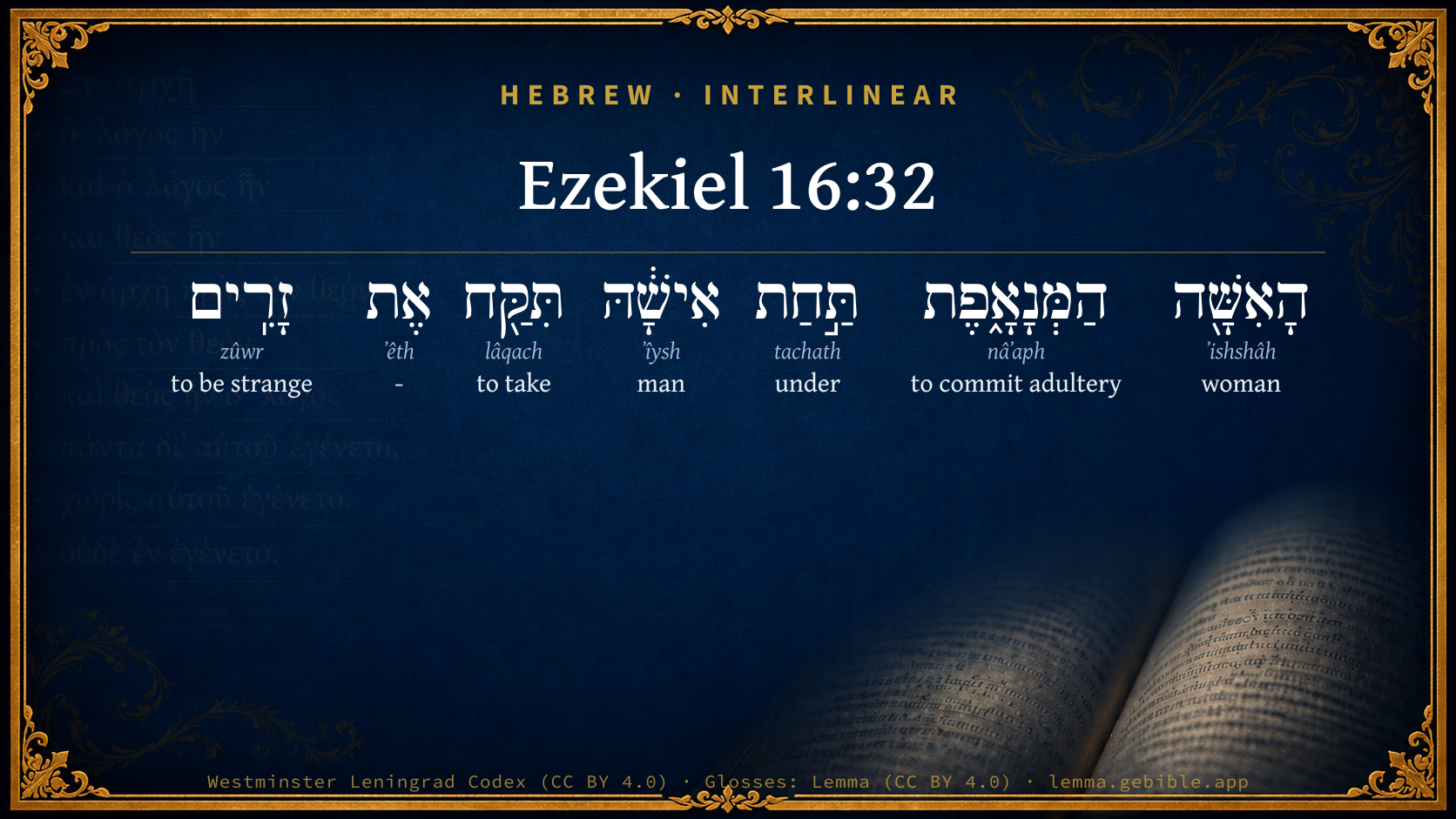
Ezekiel 16:32

Hebrew (Westminster Leningrad Codex) Ezekiel 16:32 appears in the Hebrew Old Testament. The text above is from the Westminster Leningrad Codex. Each word links to its Strong’s number, a concise gloss, and parsing drawn from the Open Scriptures Hebrew Bible morphology. Click any word for its full Brown-Driver-Briggs (BDB) entry.
Download image
Cite this verse

Ezekiel 16:32 (World English Bible). Public Domain. Lemma interlinear Bible study tool, https://lemma.gebible.app/v/ezekiel/16/32.

Show BibTeX & RIS
BibTeX
RIS
English Translation
A wife who commits adultery! who takes strangers instead of her husband!
World English Bible · Public Domain
Download a study sheet

One document with this verse’s original text, its word-by-word gloss line, the meaning frame, cross-references with their text, attributed commentary, and full source and license credits — printable, and it pastes into notes with its structure intact.

This verse Autodidact and up

Study sheet (.html) Plain text (.txt)

A passage Seminary Student

Up to 50 verses in one chapter. A passage sheet keeps up to 6 commentary sources and 12 cross-references per verse, in the order this page ranks them, and says so on the sheet whenever that leaves anything out. Ask for a single verse and you get the Autodidact verse sheet above.

Everything on this page stays free to read, with no account — the sheet is a download of what is already on screen, not access to it.

Want to remove ads? Support Godless Engineer
Compare translations 3

The same verse in 3 English versions, stacked beneath the original-language interlinear above. Click any original word for its lexicon entry.

Each is an independent rendering of the whole verse — the interlinear is not word-aligned to these translations.

Highlighted words mark where these versions differ — a whole-verse word diff, not a word-by-word alignment.

  • World English Bible Public Domain
    A wife who commits adultery! who takes strangers instead of her husband!
  • King James Version Public Domain
    But as a wife that committeth adultery, which taketh strangers instead of her husband!
  • unfoldingWord Literal Text CC BY-SA 4.0
    You adulterous woman, you accept strangers instead of your husband.

unfoldingWord Literal Text — © unfoldingWord, licensed CC BY-SA 4.0. Word-aligned USFM3 via Door43 (git.door43.org/unfoldingWord/en_ult).

Versions to compare (up to 4)

3 of 4 selected

Show all 18 translations

Every available English version of this verse, each an independent rendering of the whole verse.

  • World English Bible Public Domain
    A wife who commits adultery! who takes strangers instead of her husband!
  • Berean Standard Bible Public Domain
    You adulterous wife! You receive strangers instead of your own husband!
  • Majority Standard Bible Public Domain
    You adulterous wife! You receive strangers instead of your own husband!
  • King James Version Public Domain
    But as a wife that committeth adultery, which taketh strangers instead of her husband!
  • American Standard Version (1901) Public Domain
    A wife that committeth adultery! that taketh strangers instead of her husband!
  • Revised Version (1885) Public Domain
    A wife that committeth adultery! that taketh strangers instead of her husband!
  • Geneva Bible (1599) Public Domain
    But as a wife that playeth the harlot, and taketh others for her husband:
  • Douay-Rheims (1899) Public Domain
    But as an adulteress, that bringeth in strangers over her husband.
  • Young's Literal Translation Public Domain
    The wife who committeth adultery -- Under her husband -- doth receive strangers.
  • Literal Standard Version CC BY-SA 4.0
    The wife who commits adultery—Under her husband—receives strangers.
  • Unlocked Literal Bible CC BY-SA 4.0
    You adulterous woman, you accept strangers instead of your husband.
  • unfoldingWord Literal Text CC BY-SA 4.0
    You adulterous woman, you accept strangers instead of your husband.
  • Darby Bible Public Domain
    O adulterous wife, that taketh strangers instead of her husband.
  • World Messianic Bible Public Domain
    “‘“Adulterous wife, who takes strangers instead of her husband!
  • Webster's Bible Public Domain
    But as a wife that committeth adultery, who taketh strangers instead of her husband!
  • Free Bible Version CC BY-SA 4.0
    You're a wife that loves adultery! You sleep with strangers instead of your husband!
  • Bible in Basic English Public Domain
    The untrue wife who takes strange lovers in place of her husband!
  • JPS Tanakh (1917) Public Domain
    Thou wife that committest adultery, that takest strangers instead of thy husband —

Literal Standard Version (2020), Covenant Press — licensed CC BY-SA 4.0. Text via the HelloAO Bible API (eBible.org). Unlocked Literal Bible (unfoldingWord) — licensed CC BY-SA 4.0. Text via the HelloAO Bible API (eBible.org). unfoldingWord Literal Text — © unfoldingWord, licensed CC BY-SA 4.0. Word-aligned USFM3 via Door43 (git.door43.org/unfoldingWord/en_ult). Free Bible Version, Dr. Jonathan Gallagher — licensed CC BY-SA 4.0. Text via the HelloAO Bible API (eBible.org).

Word by word

More ways to search: Search by grammar → Find every occurrence → Compare this word →

Practice this passage: Drill this verse → Learn its vocabulary →

הַמְּנָאָ֑פֶת
nâʼaph
H5003
“the · committing adultery”
Particle, Definite Article + Verb, Piel, Participle Active, Feminine, Singular, Absolute
Part of Speech
Particle + Verb
Stem
Piel
Form
Participle Active
Gender
Feminine
Number
Singular
State
Absolute
Full BDB Definition

Origin: a primitive root

TWOT: 1273

to commit adultery - (Qal) - to commit adultery - usually of man - always with wife of another - adultery (of women) (participle) - idolatrous worship (figuratively) - (Piel) - to commit adultery - of man - adultery (of women) (participle) - idolatrous worship (figuratively)
  1. הָאִשָּׁ֖ה ʼishshâh H802 “the · woman” Particle, Definite Article + Noun, Common, Feminine, Singular, Absolute
  2. תַּ֣חַת tachath H8478 “under” Preposition
  3. אִישָׁ֔הּ ʼîysh H376 “man · her” Noun, Common, Masculine, Singular, Construct + Suffix, Personal, 3rd Person, Feminine, Singular
  4. תִּקַּ֖ח lâqach H3947 “to take” Verb, Qal, Imperfect, 3rd Person, Feminine, Singular
  5. אֶת ʼêth H853 “-” Particle, Direct Object
  6. זָרִֽים zûwr H2114 “strange” Adjective, Adjective, Masculine, Plural, Absolute

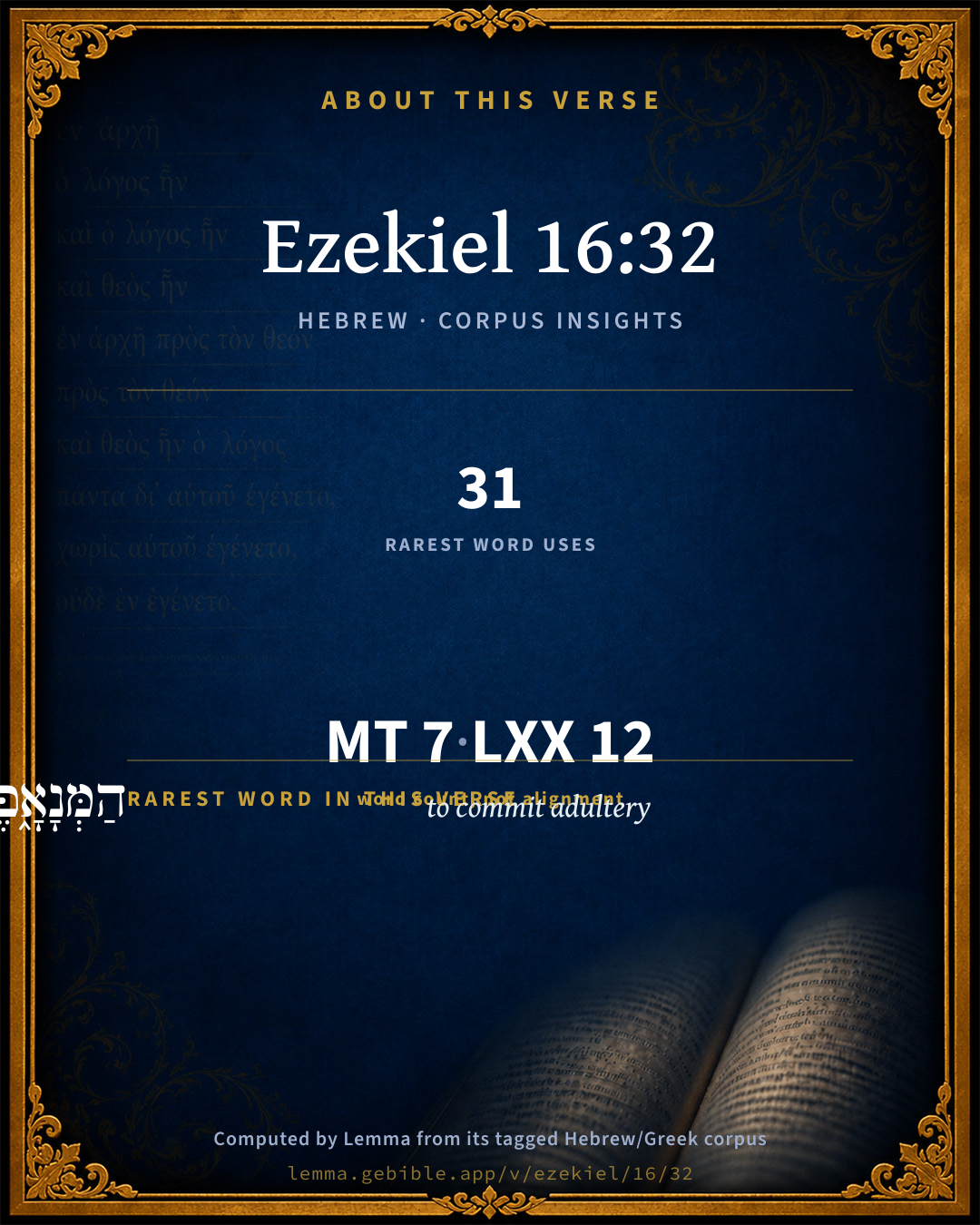
About this verse

These counts appear in no published source. They are computed here, from the morphology-tagged text and Lemma’s own curated glosses. What Lemma adds →

7
words
7
distinct lemmas
Prophets
section

Shared distinctive vocabulary

הַמְּנָאָ֑פֶת to commit adultery H5003 occurs in 26 verses of the Hebrew Bible. Also found in:

Grammatical profile

  • 2 verbs
  • 2 nouns
  • 1 adjective
  • 1 preposition
  • 1 particle

Verb forms

  • הַמְּנָאָ֑פֶת Piel · Participle Active
  • תִּקַּ֖ח Qal · Imperfect

Hebrew & Septuagint length

In English translation the verse runs 12 words from the Hebrew and 9 from the Septuagint (LXX English) — closely comparable.

A rough comparison of the two English renderings, which tokenize alike — not a word-level alignment.

Word counts can differ between the Hebrew and the Greek without any difference in meaning — e.g. the Hebrew direct-object marker אֵת has no separate Greek word, and Greek often adds the article ὁ.

In the original languages it is 7 Hebrew tokens and 12 Greek tokens — but the two are counted differently (Hebrew bundles its prefixes and suffixes into one token; the Greek is in lemma form), so that isn’t a like-for-like length.

Cross-references

11

Topical passages linked to Ezekiel 16:32 in the Treasury of Scripture Knowledge — connected by theme and wording, ordered by reader-vote popularity; previews shown in the World English Bible.

  • Jeremiah 2:28 But where are your gods that you have made you? let them arise, if they can save you in the time of your trouble: for according to the number of your cities are your gods, Judah.
  • Jeremiah 2:25 Withhold your foot from being unshod, and your throat from thirst: but you said, It is in vain; no, for I have loved strangers, and after them will I go.
  • Jeremiah 3:8–9 I saw, when, for this very cause that backsliding Israel had committed adultery, I had put her away and given her a bill of divorce, yet treacherous Judah, her sister, didn't fear; but she also went and played the prostitute.
  • Jeremiah 3:20 Surely as a wife treacherously departs from her husband, so have you dealt treacherously with me, house of Israel, says Yahweh.
  • Ezekiel 16:8 Now when I passed by you, and looked at you, behold, your time was the time of love; and I spread my skirt over you, and covered your nakedness: yes, I swore to you, and entered into a covenant with you, says the Lord Yahweh, and you became mine.
  • Ezekiel 23:37 For they have committed adultery, and blood is in their hands; and with their idols have they committed adultery; and they have also caused their sons, whom they bore to me, to pass through [the fire] to them to be devoured.
  • Ezekiel 23:45 Righteous men, they shall judge them with the judgment of adulteresses, and with the judgment of women who shed blood; because they are adulteresses, and blood is in their hands.
  • Hosea 2:2 Contend with your mother! Contend, for she is not my wife, Neither am I her husband; And let her put away her prostitution from her face, And her adulteries from between her breasts;
  • Hosea 3:1 Yahweh said to me, "Go again, love a woman loved by another, and an adulteress, even as Yahweh loves the children of Israel, though they turn to other gods, and love cakes of raisins."
  • 2 Corinthians 11:2–3 For I am jealous over you with a godly jealousy. For I married you to one husband, that I might present you as a pure virgin to Christ.
  • Jeremiah 3:1 They say, If a man put away his wife, and she go from him, and become another man's, will he return to her again? Won't that land be greatly polluted? But you have played the prostitute with many lovers; yet return again to me, says Yahweh.

Cross-references courtesy of OpenBible.info (CC BY 4.0).

Hebrew and Greek witnesses Masoretic Hebrew ↔ Greek Septuagint

The same verse in the two great witnesses to the Old Testament, shown verse-for-verse.

These are two independent witnesses, not word-aligned to each other, and the Septuagint is shown in lemma (dictionary) form.

Hebrew Ezekiel 16:32 Masoretic · Westminster Leningrad Codex

הָאִשָּׁ֖ה הַמְּנָאָ֑פֶת תַּ֣חַת אִישָׁ֔הּ תִּקַּ֖ח אֶת זָרִֽים

A wife who commits adultery! who takes strangers instead of her husband!

World English Bible · Public Domain

Greek LXX Ezekiel 16:32 Septuagint · lemma form

ὁ γυνή ὁ μοιχάομαι ὅμοιος σύ παρά ὁ ἀνήρ αὐτός λαμβάνω μίσθωμα

An adulteress resembles you, taking rewards of her husband.

LXX2012 (modern English Septuagint) · Public Domain

On this verse, The Cambridge Bible for Schools and Colleges discusses the Septuagint’s reading. Read the note in Commentary ↓

Hebrew: Westminster Leningrad Codex (CC BY 4.0). Greek: Septuagint (public domain); English from LXX2012 (modern English Septuagint) (Public Domain). How the Septuagint differs from the Hebrew →

Targum (Aramaic paraphrase)

1

The Targum is the ancient Jewish Aramaic paraphrase of the Hebrew Scriptures — an interpretive translation, not the Hebrew text itself. Onkelos (literal) and Pseudo-Jonathan (expansive) render the Torah, and Jonathan the Prophets. Coverage is partial: where no permissively-licensed English translation exists for a verse, only the Aramaic is shown. This is verse-level text, not a word-by-word alignment to the Hebrew.

  1. Targum Jonathan Prophets (Joshua–Malachi)
    כְּנִשְׁתָא דְיִשְׂרָאֵל דַמְיָא לְאִתְּתָא דִרְחִימָא עַל בַּעְלָהּ וּמְזַנְיָא עֲלוֹהִי שָׁבְקַת יַת בַּעְלָהּ וּטְעַת בָּתַר נוּכְרָאִין:

    (no public-domain English translation for this verse)

    Targum Jonathan — Aramaic: “Mikraot Gedolot” (public domain). English: “Sefaria Community Translation” (CC0 1.0 (public-domain dedication)); “London "Chaldee Paraphrase," 1871” (public domain). Text via Sefaria.

Commentary

Notes on Ezekiel 16:32 from classic Christian and Jewish commentators (each source and its license shown beneath its notes). The classic Christian expositions comment on the surrounding passage and are grouped to its opening verse, so a note may address several verses; the Jewish commentaries on the Tanakh (Rashi and others) are per-verse, so they appear only where the commentator wrote on this verse.

Lemma curates 59 commentaries, every one of them public domain or Creative Commons licensed, each selected and text-cleaned for this edition rather than reprinted as found. About our sources →

Trapp's Complete Commentary

John Trapp

Eze 16:32 [But as] a wife that committeth adultery, [which] taketh strangers instead of her husband!

Ver. 32. Which taketh strangers instead of her husband.] This is a foul mistake; wedlock should be chaste. The window of the ark shut, that the waters of the flood enter not into it.

John Trapp, A Commentary or Exposition upon All the Books of the Old and New Testament (1647–1656) — public domain. Text from a community e-Sword module.

Jamieson, Fausset & Brown

Robert Jamieson, A. R. Fausset & David Brown

instead of her husband--referring to Num 5:19-20, Num 5:29. FAIRBAIRN translates, "whilst under her husband."

Jamieson, Fausset & Brown — Commentary Critical and Explanatory on the Whole Bible (1871) — public domain (CC PDM 1.0). Text via the HelloAO Bible API.

John Calvin's Commentaries

Some translate it an adulteress under her husband’s roof, and תחת, thecheth, signifies “instead of:” and they explain it thus, that adulteresses do not divorce themselves from their husbands when they violate the marriage bond, but always remain at home for the purpose of admitting strangers; and they think the people’s crime increased by this comparison, that they not only acted deceitfully towards God, but openly revolted from him, and left his home; for many shameless women remain at home, and hide their crimes as far as they can; but when a woman deserts her husband and children, then her case is most deplorable: they think, therefore, that the Prophet is here exaggerating the divorce or revolt of the people from God; but the sense seems better simply to compare them to an adulteress who admits strangers in her husband’s stead: thou art says he, an adulteress who has sent for strange lovers instead of thy husband: for a woman married to a liberal husband is treated by him honorably; and if she seeks lovers from all sides, she is induced by neither avarice nor covetousness, but by her own lusts. In fine, as the Prophet lately said that they despised all gain through being blinded by their appetites, so he now says they were like an adulteress who rejects her husband; and not only so, but throws herself into the protection of others, while she has an honorable and happy home.

John Calvin's Commentaries (1540-1563) — public domain. Text from the Calvin Translation Society English edition (1840s-50s) via the Christian Classics Ethereal Library (ccel.org). Calvin's coverage is partial (roughly two-thirds of the Bible); uncommented books and verses are honest gaps, never fabricated. The 19th-century editor's footnotes and remarks are omitted so the notes are faithfully Calvin's own voice.

The Cambridge Bible for Schools and Colleges

gen. ed. J. J. S. Perowne

32. Seems to break the connexion and has been regarded as a gloss. The words “instead of her husband” should be “under her husband,” though her husband’s (cf. Eze_23:5, when she was mine; Num_5:19). The clauses are probably exclamatory: A wife that committeth adultery! though her husband’s (though married) she taketh strangers! It is also possible to take the language as an apostrophe: O adulterous wife, &c. LXX. read differently, and the verse is not without suspicion.

The Cambridge Bible for Schools and Colleges (gen. ed. J. J. S. Perowne; Cambridge University Press, 1878–1918) — public domain. Text from a community e-Sword module.

John Gill's Exposition

They give gifts to all whores,.... Gifts are usually given to whores, by those who commit whoredom with them; it is for the sake of these they prostitute their bodies, nor will they do this without gain; see Gen 38:16;

but thou givest thy gifts to all thy lovers; the Jews gave the Egyptians and Assyrians money, to gain their friendship, and procure alliances with them; see Kg2 16:8; and were at great expenses with their idols, and in support of their idolatrous worship:

and hirest them, that they may come unto thee on every side for thy whoredom; they courted the nations all around them for their favour and friendship, and bribed them into it, as the word (n) signifies.

(n) "munerans eos", Junius & Tremellius, Polanus; "et muneratis eos", Piscator; "et largita es ipsis", Cocceius; "donasti illis", Starckius.

John Gill's Exposition of the Whole Bible (1746–1763) — public domain (CC PDM 1.0). Text via the HelloAO Bible API.

Matthew Poole's English Annotations

Here begins the antithesis. A wife, adulteress, such as the prophet compareth this nation to, which hath a most rich, bountiful, and kind husband, she differs from common harlots in this point, she hunts not rewards, but forbidden pleasures.

Matthew Poole's English Annotations on the Holy Bible (1683–1685) — public domain. Text from a community e-Sword/MySword module.

Whedon's Commentary on the Bible

Daniel D. Whedon

32. Many authorities omit this verse. Though the reading is difficult, if not a gloss, the meaning is probably, “O adulterous wife, who, though she is under her husband, yet taketh strangers.” (See Eze_16:8; Eze_23:5.)

Daniel D. Whedon (gen. ed.), Commentary on the Old and New Testaments (1874–1909) — public domain. Text from a community e-Sword module.

The Pulpit Commentary

The shameful sin of apostasy.

Apostasy is repeatedly compared to adultery by the Old Testament prophets, but the comparison is nowhere so full and powerful and even appalling as in this long sixteenth chapter of Ezekiel, which consists in an elaborate indictment of Israel on that terrible charge. A mealy mouthed modern fastidiousness resents this style of describing sin as though to name it were more shameful than to commit it, for the fact of apostasy from God is by no means excluded when the old name for it is condemned as too coarse for polite society. It may be well for us to brace up our nerves to endure the strong words on the sin of unfaithfulness to God which the inspired messengers of Jehovah felt themselves impelled to utter. In what respects, then, may apostasy be compared to that shameful thing, adultery?

I IT PRESUPPOSES A MARRIAGE RELATION BETWEEN GOD AND HIS PEOPLE. That relation has been described with graphic pictures in the preceding verses. God had. chosen Israel in her forlorn condition as a miserable castaway chard, reared her in kindness, and then adorned her with splendour and taken her home to himself as his bride. In like manner, all God"s people have been first found by him, and then brought into the closest bonds of union with himself. Such a union with God is like marriage, because it implies

(1) love;

(2) close fellowship;

(3) a sacred and indissoluble tie.

II IT CONSISTS IN UNFAITHFULNESS TO GOD. The people of God are not at liberty to leave him whenever they choose.

1. Love should bind them. There is no such thing as innocent "free love" under any circumstances; for love always implies obligations. Its bonds may be soft and silken, but they are strong and sacred. God"s love to us, accepted by us, carries with it a duty of gratitude and loyalty.

2. The pledges of faith must ever bind God"s people to the duty of cleaving to him. When we accept the blessings of the gospel we enter into a covenant relation like that of marriage vows.

III IT SPRINGS FROM YIELDING TO A LOWER LOVE. God"s people do not forsake him from weariness or without motive. But some fatal fascination lures the heart of the foolish wife from her true husband. In the case of Israel this was the sensuous and florid idolatry of the Canaanites, with its coarse, cruel, lustful charms. Anything that draws us from God by counter attractions is an "idol of the heart." Money, pleasure, power, success, may thus deceive and destroy. Yet a prior condition of unfaithfulness is the failing of love to God. "How weak is thine heart!

IV IT IS A GREAT SIN. Adultery is confessedly a black and awful sin, standing side by side with murder, as a horror of great wickedness. So, according to the Hebrew prophets, is unfaithfulness to God. As we are not free to forsake hint who has inn chased us at the great cost of his own Son, and to whom we are doubly bound by the ties of our own vows, to "change our mind" in this matter and fling up our religion is not a light affair of private convenience. In the sight of God it is adultery.

V IT IS A PECULIAR SOURCE OF SHAME AND SORROW. No sin is so shameful as that of adultery, and none brings in its train such heartrending sorrow.

1. It is shameful to be unfaithful to God; for it outrages the deepest instincts of the soul and violates the secret sanctuary of life.

2. It is certainly a source of bitter sorrow, if not now, yet hereafter; for it means banishment from the home of heaven, with the pangs of remorse to gnaw like a worm, long after the short pleasures of sin have sunk to ashes.

The Pulpit Commentary (1880–1919), ed. H.D.M. Spence-Jones & Joseph S. Exell — public domain. Text from a community e-Sword module.

unfoldingWord translationNotes

Door43 World Missions Community

General Information:

Yahweh continues to speak about Jerusalem as if the city were his unfaithful wife. The city represents the people who live there. (See: Metaphor and Metonymy)

you accept strangers instead of your husband

This refers to accepting someone to sleep with her. AT: "you accept strangers into your bed instead of your husband" (See: Euphemism and Assumed Knowledge and Implicit Information)

translationWords

adultery

prostitute

bribe

unfoldingWord translationNotes — © Distant Shores Media and the Door43 World Missions Community, licensed CC BY-SA 4.0. Source: git.door43.org/Door43/en_tn.

Rashi

Rabbi Shlomo Yitzchaki (Rashi)

the adulterous wife You are the adulterous wife.

who, under her husband, takes strangers While she is under her husband, [she] casts her eyes on others.

Rashi on the Tanakh — English translations: “The Judaica Press complete Tanach with Rashi, translated by A. J. Rosenberg” (CC BY 4.0); “Pentateuch with Rashi's commentary by M. Rosenbaum and A.M. Silbermann, 1929-1934” (public domain); “The Metsudah Tanach series, Lakewood, N.J” (CC BY 4.0); and “The Book of Joshua, Metsudah Publications, 1997” (CC BY 4.0). Text via Sefaria.

Lesson kit

Teaching starters — assembled from the data on this page, not authored interpretation. Every prompt links to the verse data it draws on. Edit before teaching.

Ezekiel, in the Prophets, opens this verse with 7 words (7 distinct Hebrew lemmas). Its most distinctive word is nâʼaph (“to commit adultery”). A historical commentator’s framing appears above. Read the whole chapter for the surrounding context.

Discussion questions

  1. The word nâʼaph carries the sense “to commit adultery.” How does it shape the verse?
  2. How does Exodus 20:14, which shares the word «to commit adultery», read alongside this verse?
  3. The translations on this page render this verse differently — a whole-verse word diff, not a word-by-word alignment. What might account for the different wordings?
  4. «הַמְּנָאָ֑פֶת» is a Piel Participle Active verb. How does that grammatical form shape the action described?
  5. Compare how Trapp's Complete Commentary and Jamieson, Fausset & Brown read this verse. Where do they agree or differ?

Things to notice

Reading settings

Reading text

Shown beneath each verse's original-language words.

Old Testament
Old Testament edition

Read the OT as the Masoretic Hebrew (MT) or the Greek Septuagint (LXX).

English shown for the Greek Septuagint (in the Hebrew ↔ Greek comparison).

Comparing translations? Open the Compare panel on any verse page to stack up to four side by side.