
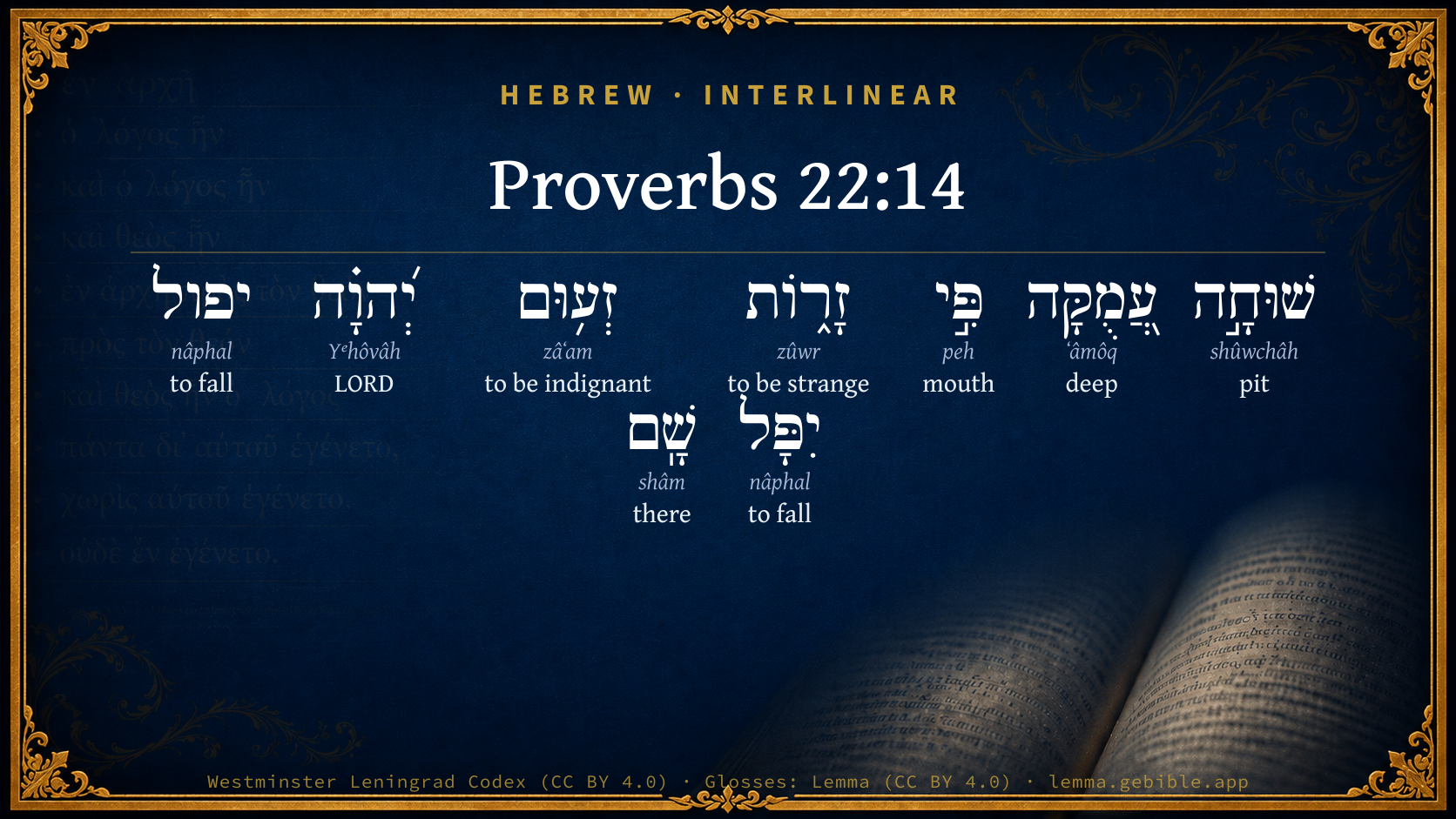
Proverbs 22:14

Hebrew (Westminster Leningrad Codex) Proverbs 22:14 appears in the Hebrew Old Testament. The text above is from the Westminster Leningrad Codex. Each word links to its Strong’s number, a concise gloss, and parsing drawn from the Open Scriptures Hebrew Bible morphology. Click any word for its full Brown-Driver-Briggs (BDB) entry.
Download image
Cite this verse

Proverbs 22:14 (World English Bible). Public Domain. Lemma interlinear Bible study tool, https://lemma.gebible.app/v/proverbs/22/14.

Show BibTeX & RIS
BibTeX
RIS
English Translation
The mouth of an adulteress is a deep pit: He who is under Yahweh's wrath will fall into it.
World English Bible · Public Domain
Highlights Full analysis ↓
Download a study sheet

One document with this verse’s original text, its word-by-word gloss line, the meaning frame, cross-references with their text, attributed commentary, and full source and license credits — printable, and it pastes into notes with its structure intact.

This verse Autodidact and up

Study sheet (.html) Plain text (.txt)

A passage Seminary Student

Up to 50 verses in one chapter. A passage sheet keeps up to 6 commentary sources and 12 cross-references per verse, in the order this page ranks them, and says so on the sheet whenever that leaves anything out. Ask for a single verse and you get the Autodidact verse sheet above.

Everything on this page stays free to read, with no account — the sheet is a download of what is already on screen, not access to it.

Want to remove ads? Support Godless Engineer
Compare translations 3

The same verse in 3 English versions, stacked beneath the original-language interlinear above. Click any original word for its lexicon entry.

Each is an independent rendering of the whole verse — the interlinear is not word-aligned to these translations.

Highlighted words mark where these versions differ — a whole-verse word diff, not a word-by-word alignment.

  • World English Bible Public Domain
    The mouth of an adulteress is a deep pit: He who is under Yahweh's wrath will fall into it.
  • King James Version Public Domain
    The mouth of strange women is a deep pit: he that is abhorred of the LORD shall fall therein.
  • unfoldingWord Literal Text CC BY-SA 4.0
    The mouth of a strange woman a deep pit; one who is cursed of Yahweh will fall there.

unfoldingWord Literal Text — © unfoldingWord, licensed CC BY-SA 4.0. Word-aligned USFM3 via Door43 (git.door43.org/unfoldingWord/en_ult).

Versions to compare (up to 4)

3 of 4 selected

Show all 18 translations

Every available English version of this verse, each an independent rendering of the whole verse.

  • World English Bible Public Domain
    The mouth of an adulteress is a deep pit: He who is under Yahweh's wrath will fall into it.
  • Berean Standard Bible Public Domain
    The mouth of an adulteress is a deep pit; he who is under the wrath of the LORD will fall into it.
  • Majority Standard Bible Public Domain
    The mouth of an adulteress is a deep pit; he who is under the wrath of the LORD will fall into it.
  • King James Version Public Domain
    The mouth of strange women is a deep pit: he that is abhorred of the LORD shall fall therein.
  • American Standard Version (1901) Public Domain
    The mouth of strange women is a deep pit: He that is abhorred of Jehovah shall fall therein.
  • Revised Version (1885) Public Domain
    The mouth of strange women is a deep pit: he that is abhorred of the LORD shall fall therein.
  • Geneva Bible (1599) Public Domain
    The mouth of strage women is as a deepe pit: he with whom the Lord is angry, shall fall therein.
  • Douay-Rheims (1899) Public Domain
    The mouth of a strange woman is a deep pit: he whom the Lord is angry with, shall fall into it.
  • Young's Literal Translation Public Domain
    A deep pit `is' the mouth of strange women, The abhorred of Jehovah falleth there.
  • Literal Standard Version CC BY-SA 4.0
    The mouth of strange women [is] a deep pit, || The abhorred of YHWH falls there.
  • Unlocked Literal Bible CC BY-SA 4.0
    The mouth of an adulteress is a deep pit; Yahweh's anger is stirred up against anyone who falls into it.
  • unfoldingWord Literal Text CC BY-SA 4.0
    The mouth of a strange woman a deep pit; one who is cursed of Yahweh will fall there.
  • Darby Bible Public Domain
    The mouth of strange women is a deep ditch: he with whom Jehovah is displeased shall fall therein.
  • World Messianic Bible Public Domain
    The mouth of an adulteress is a deep pit. He who is under the LORD’s wrath will fall into it.
  • Webster's Bible Public Domain
    The mouth of strange women is a deep pit: he that is abhorred by the LORD shall fall therein.
  • Free Bible Version CC BY-SA 4.0
    The seductive words of an immoral woman are a dangerous trap—if the Lord's angry with you, then you'll fall right in.
  • Bible in Basic English Public Domain
    The mouth of strange women is a deep hole: he with whom the Lord is angry will go down into it.
  • JPS Tanakh (1917) Public Domain
    The mouth of strange women is a deep pit: he that is abhorred of the LORD shall fall therein.

Literal Standard Version (2020), Covenant Press — licensed CC BY-SA 4.0. Text via the HelloAO Bible API (eBible.org). Unlocked Literal Bible (unfoldingWord) — licensed CC BY-SA 4.0. Text via the HelloAO Bible API (eBible.org). unfoldingWord Literal Text — © unfoldingWord, licensed CC BY-SA 4.0. Word-aligned USFM3 via Door43 (git.door43.org/unfoldingWord/en_ult). Free Bible Version, Dr. Jonathan Gallagher — licensed CC BY-SA 4.0. Text via the HelloAO Bible API (eBible.org).

Word by word

More ways to search: Search by grammar → Find every occurrence → Compare this word →

Practice this passage: Drill this verse → Learn its vocabulary →

About this verse

These counts appear in no published source. They are computed here, from the morphology-tagged text and Lemma’s own curated glosses. What Lemma adds →

9
words
8
distinct lemmas
Wisdom
section

Notable vocabulary

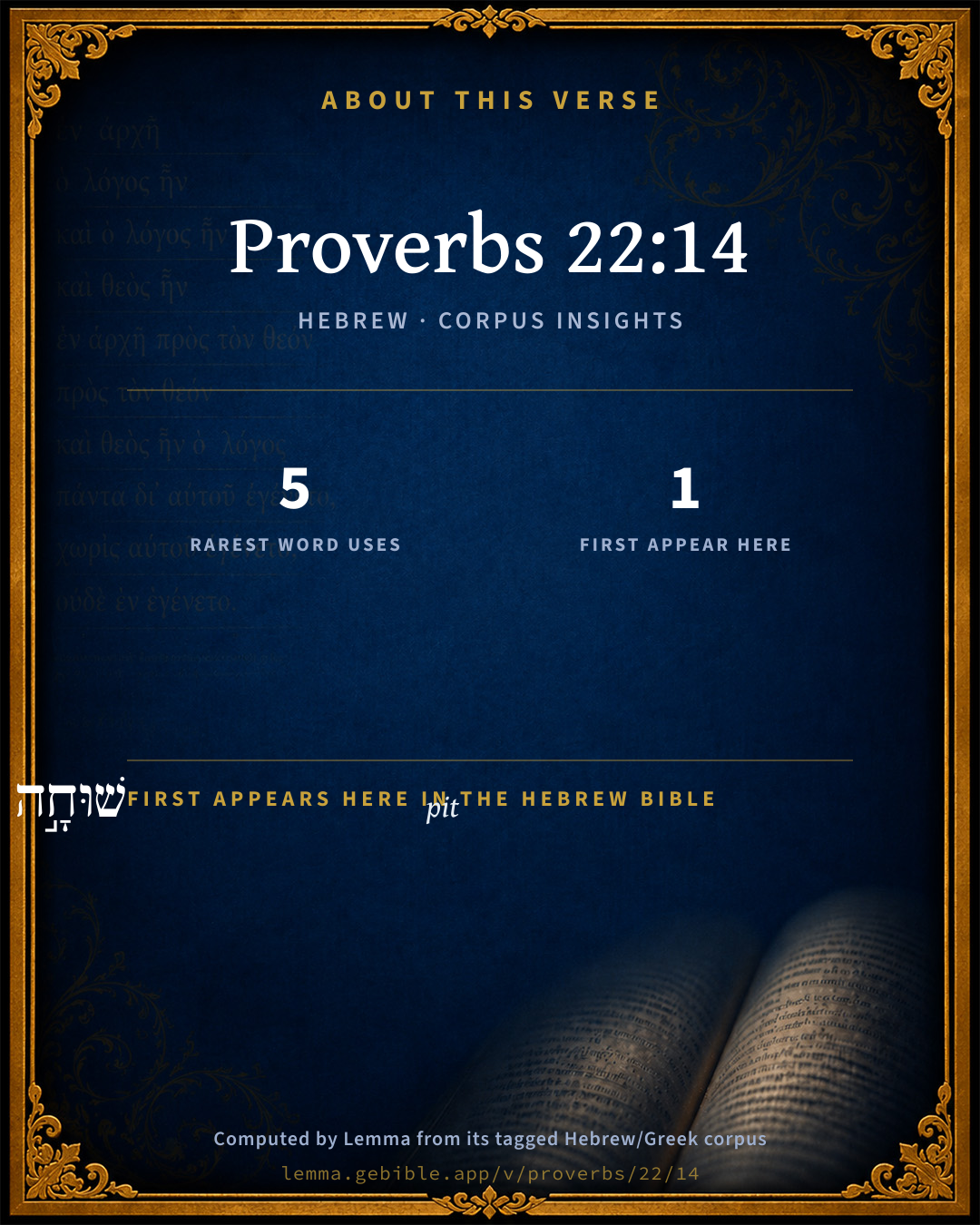
The rarest word here is שׁוּחָ֣ה pit H7745 — appearing just 5 times in the whole Hebrew Bible.

First appearance in Scripture

This word makes its first canonical appearance in the Hebrew Bible here:

  • שׁוּחָ֣ה pit H7745

Shared distinctive vocabulary

שׁוּחָ֣ה pit H7745 occurs in 5 verses of the Hebrew Bible. Also found in:

Grammatical profile

  • 3 verbs
  • 3 nouns
  • 2 adjectives
  • 1 adverb

Verb forms

  • זְע֥וּם Qal · Participle Passive
  • יפול Qal · Imperfect
  • יִפָּל Qal · Imperfect

Repetition

A word recurs within this verse — often emphatic in Hebrew:

  • יפול to fall H5307 ×2

Hebrew & Septuagint length

In English translation the verse runs 19 words from the Hebrew and 50 from the Septuagint (LXX English) — the Septuagint runs noticeably longer here. See the side-by-side →

A rough comparison of the two English renderings, which tokenize alike — not a word-level alignment.

Word counts can differ between the Hebrew and the Greek without any difference in meaning — e.g. the Hebrew direct-object marker אֵת has no separate Greek word, and Greek often adds the article ὁ.

Cross-references

10

Topical passages linked to Proverbs 22:14 in the Treasury of Scripture Knowledge — connected by theme and wording, ordered by reader-vote popularity; previews shown in the World English Bible.

  • Ecclesiastes 7:26 I find more bitter than death the woman whose heart is snares and traps, whose hands are chains. Whoever pleases God shall escape from her; but the sinner will be ensnared by her.
  • Proverbs 23:27 For a prostitute is a deep pit; And a wayward wife is a narrow well.
  • Proverbs 6:24–29 To keep you from the immoral woman, From the flattery of the wayward wife's tongue.
  • Nehemiah 13:26 Did not Solomon king of Israel sin by these things? yet among many nations was there no king like him, and he was beloved of his God, and God made him king over all Israel: nevertheless even him did foreign women cause to sin.
  • Proverbs 7:5–27 That they may keep you from the strange woman, From the foreigner who flatters with her words.
  • Judges 16:20–21 She said, The Philistines are on you, Samson. He awoke out of his sleep, and said, I will go out as at other times, and shake myself free. But he didn't know that Yahweh had departed from him.
  • Proverbs 2:16–19 To deliver you from the strange woman, Even from the foreigner who flatters with her words;
  • Deuteronomy 32:19 Yahweh saw [it], and abhorred [them], Because of the provocation of his sons and his daughters.
  • Psalms 81:12 So I let them go after the stubbornness of their hearts, That they might walk in their own counsels.
  • Proverbs 5:3–23 For the lips of an adulteress drip honey. Her mouth is smoother than oil,

Cross-references courtesy of OpenBible.info (CC BY 4.0).

Hebrew and Greek witnesses Masoretic Hebrew ↔ Greek Septuagint

The same verse in the two great witnesses to the Old Testament, shown verse-for-verse.

Here the Septuagint runs noticeably longer than the Hebrew — LXX2012 (modern English Septuagint) 50 words vs World English Bible 19. A rough length comparison of the two English translations, not a word-level alignment — read both below.

These are two independent witnesses, not word-aligned to each other, and the Septuagint is shown in lemma (dictionary) form.

Hebrew Proverbs 22:14 Masoretic · Westminster Leningrad Codex

שׁוּחָ֣ה עֲ֭מֻקָּה פִּ֣י זָר֑וֹת זְע֥וּם יְ֝הוָ֗ה יפול יִפָּל שָֽׁם

The mouth of an adulteress is a deep pit: He who is under Yahweh's wrath will fall into it.

World English Bible · Public Domain

Greek LXX Proverbs 22:14 Septuagint · lemma form

βόθρος βαθύς στόμα παράνομος ὁ δέ μισέω ὑπό κύριος ἐνπίπτω εἰς αὐτός εἰμί ὁδός κακός ἐνώπιον ἀνήρ καί οὐ ἀγαπάω ὁ ἀποστρέφω ἀπό αὐτός ἀποστρέφω δέ δέω ἀπό ὁδός σκολιός καί κακός

The mouth of a transgressor is a deep pit; and he that is hated of the Lord shall fall into it. Evil ways are before a man, and he does not like to turn away from them; but it is needful to turn aside from a perverse and bad way.

LXX2012 (modern English Septuagint) · Public Domain

On this verse, Keil & Delitzsch discusses the Septuagint’s reading. Read the note in Commentary ↓

Hebrew: Westminster Leningrad Codex (CC BY 4.0). Greek: Septuagint (public domain); English from LXX2012 (modern English Septuagint) (Public Domain). How the Septuagint differs from the Hebrew →

Commentary

Notes on Proverbs 22:14 from classic Christian and Jewish commentators (each source and its license shown beneath its notes). The classic Christian expositions comment on the surrounding passage and are grouped to its opening verse, so a note may address several verses; the Jewish commentaries on the Tanakh (Rashi and others) are per-verse, so they appear only where the commentator wrote on this verse.

Lemma curates 59 commentaries, every one of them public domain or Creative Commons licensed, each selected and text-cleaned for this edition rather than reprinted as found. About our sources →

Trapp's Complete Commentary

John Trapp

Pro 22:14 The mouth of strange women [is] a deep pit: he that is abhorred of the LORD shall fall therein.

Ver. 14. The month of a strange woman.] Diabolus capite blanditur, ventre oblectat, cauda ligat, saith Rupertus. These she sinners, as their gallants call them, are most dangerous. {See Trapp on "Pro 2:16"} {See Trapp on "Pro 5:3"} Solomon had the woeful experience of it; {Ecc 7:26} and Samson, {Jdg 16:18-21} who

“Lenam non potuit, potuit superare lesenam,

Quem fera non potuit vincere, vicit hera.”

How did David muddy himself in this deep pit, and there might have stuck in the mire, had not God drawn him out by a merciful violence, and purged him with hyssop from that abhorred filth? {Psa 51:7}

He that is abhorred of the Lord shall fall therein.] As the Jesuits, those odious Connubisanctifugae Commeretricitegae, too often do; though they boast that they can talk and dally with the fairest women without danger, and the people must believe no otherwise, but that when they are kissing a woman, they are giving her good counsel. David George, that execrable heretic, was so far from accounting adulteries, fornications, incests, &c., for being any sins, that he did recommend them to his most perfect scholars as acts of grace and mortification; and was confident that the whole world would submit to his doctrine. {a} Peccatum peccatum trahit, as the Hebrew proverb hath it. One sin draws on another, and the latter is oft a punishment of the former; God, by a peculiar kind of revenge, delivering up such to a reprobate sense, or a mind disallowed or abhorred of God, as the apostle’s word {b} {Rom 1:28} signifies.

{a} Hist. David. Georgii.

{b} εις νουν αδοκιμον.

John Trapp, A Commentary or Exposition upon All the Books of the Old and New Testament (1647–1656) — public domain. Text from a community e-Sword module.

Joseph Benson's Commentary

Pro 22:14. The mouth of strange women — Their fair and flattering speeches, wherewith they entice men into sin, as is observed Pro 7:21, into which it is easy to fall, but out of which it is hard, if not impossible, to be rescued. For it is a rare thing for any person, who has once entered into a course of lewdness: to recover himself from it, Pro 2:19. He that is abhorred of the Lord — Namely, in a high and singular manner; who by his former impieties, and contempt of God and his grace, hath provoked God to leave him to his own heart’s lusts, and to punish one sin with another; shall fall therein — And, without a miracle of grace, shall perish everlastingly.

Joseph Benson's Commentary on the Old and New Testaments (1811–1818) — public domain. Text from a community e-Sword module.

The Preacher's Complete Homiletical Commentary

Joseph S. Exell (gen. ed.)

MAIN HOMILETICS OF Pro_22:14

A DEEP PIT

This verse treats of two classes of character, both of which have been depicted before. (See on chaps. Pro_2:16-19, page 24, Pro_6:24, page 89, Pro_6:6-27, page 15).

I. The tempter. The strange woman—the woman who has been so deaf to the voice of all that is womanly as no longer to be worthy of the name, who instead of being man’s helpmeet and endeavouring to win him to tread the path to heaven, is his curse and makes it her aim to drag him down to hell. Notice the main instrument of her destructive power—the mouth. It is by her words of flattery and deception and persuasion that she ensnares her victim and compasses his ruin. History and experience confirm Solomon’s words, for, although external beauty is often a powerful ingredient in the temptation, it is not always so, and counts for very little if it is unaccompanied by that fascination of manner and of speech which have been used by so many bad women with such fatal effect. If we look at the portraits of some of those women who have exerted so mighty a power for evil in the world, we can seldom see sufficient beauty to account for the spell which they seemed to cast around their victims, and we must conclude therefore that it was rather to he found where Solomon puts it,—who may be here speaking from bitter personal experience—viz., in the tongue. This proverb adds one more testimony to the many that have gone before of the immense power for evil or for good that is exerted by that “little member” of our bodily organism.

II. The tempted. He is here depicted as an unwary traveller along life’s highway easily deceived by the appearance of things, and, too careless or too unsuspecting to look beneath the surface, following the bent of his inclination and yielding to the voice of the charmer until he finds the ground giving way beneath his feet, and darkness and hopelessness all around him. Notice the fearful name here given to such an one—to one who is led away by such a tempter. He is abhorred of the Lord. Here is full evidence that God does not look upon human creatures with indifference as to their moral character—that merciful Father though He is, He does not extend to men that indiscriminating and therefore worthless tenderness which some would have us believe is His main attribute—that if men look upon sin as mere obedience to the dictates of nature, and therefore blameless, He does not so regard it. And if men will not attach any weight to the words of Scripture—not believing them to be infallible—they can read the same truth in their every-day experience. The terrible retribution which comes upon those who listen to the words of the “strange woman” is a sufficient testimony to the abhorrence in which the Creator of men holds the sin to which she allures the unwary and the licentious man.

OUTLINES AND SUGGESTIVE COMMENTS

To what do the fearful words amount? To this: that in His righteous displeasure, there is not a heavier curse which an offended God can allow to fall upon the object of His wrath, than leaving him to be a prey to the seductive blandishments of an unprincipled woman:—that if God held any one in abhorrence, this would be the severest vengeance He could take on him.—Wardlaw.

The mouth of a strange woman is but the mouth of a far deeper pit, the pit of hell into which it openeth. The one is digged by the wickedness of men, the other by the justice of God.—Jermin.

The Preacher's Complete Homiletical Commentary (gen. ed. Joseph S. Exell; Funk & Wagnalls, c. 1892) — public domain (pre-1929). A full-Bible homiletical/sermon-outline anthology covering 65 of 66 books (2 John is absent from the source module). Text from a community e-Sword module.

Keil & Delitzsch

C. F. Keil & F. Delitzsch

14 A deep pit is the mouth of a strange woman;

He that is cursed of God falleth therein.

The first line appears in a different form as a synonymous distich, Pro 23:27. The lxx translate στόμα παρανόμου without certainly indicating which word they here read, whether רע (Pro 4:14), or רשׁע (Pro 29:12), or נלוז (Pro 3:32). Pro 23:27 is adduced in support of זרות (vid., Pro 2:16); זנות (harlots) are meant, and it is not necessary thus to read with Ewald. The mouth of this strange woman or depraved Israelitess is a deep ditch (שׁוּחה עמקּה, otherwise עמקה, as Pro 23:27, where also occurs עמוּקה

(Note: The text to Immanuel's Comment. (Naples 1487) has in both instances עמוּקה.)

namely, a snare-pit into which he is enticed by her wanton words; the man who stands in fellowship with God is armed against this syren voice; but the 'זעוּם ה, i.e., he who is an object of the divine זעם (Venet. κεχολωμένος τῷ ὀντωτῇ), indignation, punishing evil with evil, falls into the pit, yielding to the seduction and the ruin. Schultens explains 'זעום ה by, is in quem despumat indignabundus; but the meaning despumat is not substantiated; זעם, cf. Arab. zaghm, is probably a word which by its sound denoted anger as a hollow roaring, and like pealing thunder. The lxx has, after Pro 22:14, three tedious moralizing lines.

Keil & Delitzsch — Biblical Commentary on the Old Testament (1861–1891) — public domain (CC PDM 1.0). Text via the HelloAO Bible API. (Old Testament only.)

Tyndale Open Study Notes

Tyndale Open Resources

22:14 An immoral woman, using flattery and seduction, tries to trap a young man to commit sin.

Tyndale Open Study Notes — © Tyndale Open Resources, licensed CC BY-SA 4.0. Text via the HelloAO Bible API.

Geneva Bible (1599)

Geneva Bible translators

So God punisheth one sin by another, when he suffereth the wicked to fall into the acquaintance of an harlot.

Geneva Bible (1599) marginal notes — public domain. Text via Bolls.life.

Matthew Henry's Commentary

This is designed to warn all young men against the lusts of uncleanness. As they regard the welfare of their souls, let them take heed of strange women, lewd women, whom they ought to be strange to, of the mouth of strange women, of the kisses of their lips (Pro 7:13), of the words of their lips, their charms and enticements. Dread them; have nothing to do with them; for, 1. Those who abandon themselves to that sin give proof that they are abandoned of God: it is a deep pit, which those fall into that are abhorred of the Lord, who leaves them to themselves to enter into that temptation, and takes off the bridle of his restraining grace, to punish them for other sins. Value not thyself upon thy being in favour with such women, when it proclaims thee under the wrath of God. 2. It is seldom that they recover themselves, for it is a deep pit; it will be hard getting out of it, it so besots the mind and debauches the conscience, by pleasing the flesh.

Matthew Henry's Commentary on the Whole Bible (1708–1710) — public domain (CC PDM 1.0). Text via the HelloAO Bible API.

Jamieson, Fausset & Brown

Robert Jamieson, A. R. Fausset & David Brown

The mouth--or flattering speeches (Pro 5:3; Pro 7:5) ensnare man, as pits, beasts. God makes their own sin their punishment.

Jamieson, Fausset & Brown — Commentary Critical and Explanatory on the Whole Bible (1871) — public domain (CC PDM 1.0). Text via the HelloAO Bible API.

Adam Clarke's Commentary

Verse 14. The mouth of strange women is a deep pit] In Pr 23:27, he says, A whore is a DEEP DITCH:, and a strange woman is a NARROW PIT. The allusions in these three places are too plain to be misunderstood. Virgil's hell has been adduced in illustration: -

----------------Sate sanguine Divum,

Tros Anchisiade, facilis decensus Averni;

Noctes atque dies patet atri janua Ditis:

Sed revocare gradum, superasque evadere ad auras,

HOC OPUS, hic LABOR est. Pauci quos aequus amavit

Jupiter, aut ardens evexit ad aethera virtus,

Dis geniti potuere.

VIRG. AEn. lib. vi., ver. 125.

"O glorious prince of brave Anchises' line!

Great godlike hero! sprung from seed divine,

Smooth lies the road to Pluto's gloomy shade;

And hell's black gates for ever stand display'd:

But 'tis a long unconquerable pain,

To climb to these ethereal realms again.

The choice-selected few, whom favouring Jove,

Or their own virtue, rais'd to heaven above,

From these dark realms emerged again to day;

The mighty sons of gods, and only they.

PITT.

Adam Clarke's Commentary on the Bible (1810–1826) — public domain. Text from a community e-Sword/MySword module.

Ellicott's Commentary for English Readers

(14) Strange women.—See above on Pro_2:16.

A Bible Commentary for English Readers, edited by Charles John Ellicott (1878–1897) — public domain. Text from a community e-Sword module.

The Cambridge Bible for Schools and Colleges

gen. ed. J. J. S. Perowne

14. a deep pit] such as is dug by a hunter for his prey. Comp. Pro_23:27.

The Cambridge Bible for Schools and Colleges (gen. ed. J. J. S. Perowne; Cambridge University Press, 1878–1918) — public domain. Text from a community e-Sword module.

John Gill's Exposition

The mouth of strange women is a deep pit,.... The mouth of harlots; the kisses of their mouth, their fair speech and flattering words, their amorous talk, and lascivious and wanton language, ensnare and draw unwary persons to commit lewdness with them, which bring them into a pit of ruin and destruction; a filthy one, and very deep, out of which it is not easy nor usual to be extricated: the allusion is to beasts taken in a pit dug for them; and these are as natural brute beasts, made to be taken and destroyed;

he that is abhorred of the Lord shall fall therein; who has been guilty of other sins, and such as have caused the Lord to abhor him, and therefore leaves him to fall into this: one sin not only leads on to another, but is the punishment of another; men are seldom guilty of this sin of whoredom, but who have been first abandoned to other vices very provoking to. God; see Ecc 7:26. Jarchi interprets all this of idolatry; and it may be very well applied to the whore of Rome, and the harlots she is mother of; who, by her fair words and false doctrines, by her mouth speaking blasphemies and lies in hypocrisy, by her golden cup in her hand full of abomination and filthiness of fornication, and by her sorceries, have deceived many, and brought them into the pit of perdition and ruin: and these are such whose names are not written in the Lamb's book of life; but are rejected of God, and given up to believe a lie, that they might be damned, Rev 17:4.

John Gill's Exposition of the Whole Bible (1746–1763) — public domain (CC PDM 1.0). Text via the HelloAO Bible API.

Albert Barnes' Notes on the Bible

The fall of the man into the snare of the harlot seems to be the consequence of the abhorrence or wrath of Yahweh. That abhorrence is, however, the result of previous evil. The man is left to himself, and sin becomes the penalty of sin.

Albert Barnes' Notes on the Bible (1834–1885) — public domain. Text from a community e-Sword/MySword module.

Haydock's Catholic Bible Commentary

It. Debauchery resembles hell, chap. xxiii. 23. (Calmet) --- Facilis descensus Averni, &c. (Virgil, Æneid vi.)

George Leo Haydock (1774–1849), Haydock's Catholic Family Bible and Commentary, 1859 edition — public domain. Excludes Psalms (Douay-Rheims chapter numbering differs from Protestant) and Deuterocanonical books (Catholic canon only).

Matthew Poole's English Annotations

The mouth; her fair and flattering speeches, wherewith she enticeth him to gross filthiness, as it is noted, Pro 7:21.

A deep pit; into which it is easy to fall, but hard, if not impossible, to get out of it. It is a rare thing for any person, once entered into the course of whoredom, sincerely to repent of it, and turn from it. See Pro 2:19.

That is abhorred of the Lord, to wit, in a high and singular manner; who by his former impieties, and contempt of God and of his grace, hath provoked God to leave and loathe him, and to punish one sin with another; for otherwise all sinners, as such, are abhorred by God.

Matthew Poole's English Annotations on the Holy Bible (1683–1685) — public domain. Text from a community e-Sword/MySword module.

Whedon's Commentary on the Bible

Daniel D. Whedon

14. Mouth of strange women is a deep pit — What their mouth utters is as dangerous and destructive to the unwary youth as a deep pit into which he is liable to fall. The difficulty, perhaps impossibility, of escaping from a deep pit, suggests also what is taught elsewhere in the book — the hopelessness of those who form licentious habits. The fall of a man into the snare of a harlot is conceived of as a curse from Jehovah. He is given over to destruction. Compare Pro_2:16; Pro_5:3; Pro_6:24; Pro_7:5, et seq.; Pro_23:27.

Daniel D. Whedon (gen. ed.), Commentary on the Old and New Testaments (1874–1909) — public domain. Text from a community e-Sword module.

The Pulpit Commentary

The mouth of strange women is a deep pit. The hemistich reappears in a slightly altered form at Pro_23:27. (For "strange woman" as equivalent to "a harlot" or "adulteress," see note on Pro_2:16) By her "mouth" is meant her wanton, seductive words, which entice a man to destruction of body and soul. It may be that theology rather than morals is signified here rather false doctrines than evil practice. In this ease the mention of the strange or foreign woman is very appropriate, seeing that perversions of belief and worship were always introduced into Israel from external sources. He that is abhorred of the Lord shall fall therein. He who has incurred the width of God by previous unfaithfulness and sin is left to himself to fall a prey to the allurements of the wicked woman. (comp. Ecc_7:26) Septuagint, "The mouth of a transgressor (paranomou ) is a deep ditch; and he that is hated of the Lord shall fall therein." Then are added three lines not in the Hebrew, which, however, seem to be reminiscences of other passages: "There are evil ways before a man, and be loveth not to turn away from them; but it is needful to turn away item a perverse and evil way."

The Pulpit Commentary (1880–1919), ed. H.D.M. Spence-Jones & Joseph S. Exell — public domain. Text from a community e-Sword module.

John Wesley's Explanatory Notes

The mouth - Her fair and flattering speeches.

John Wesley, Explanatory Notes Upon the Whole Bible (1754–1765) — public domain. Text via the GEBible commentary corpus.

Bridges on Proverbs

Charles Bridges

This fearful temptation has been already frequently opened.†1 But in a book specially for the young, who that knows the power of "youthful lusts" (2Ti 2:22 ), and the seductive witcheries of sin, will deem a fresh warning needless? Is it not the voice of mercy? For what but unbounded compassion could stand as it were at the edge of the pit, and unfold to the unwary its awful peril? A deep pit indeed it is,†2 easy to fall into; hard, next to impossible, to get out of.†3 So besotting is this sin to the flesh, to the mind, and to the conscience!†4 It is the mouth of a pit far deeper. "For her feet go down to death; her steps take hold on hell."†5 What more humbling proof can there be of the total depravity of the nature, than the fact, that those affections, originally given as the purest enjoyments of life, should become the corrupt spring of such a defilement. The sin and snare would seem to be a judicial infliction for those, whose willful rejection of God has made them abhorred of him.†6 They have turned away from instruction, hated reproof, resisted conviction, been given up to their abomination; they give therefore too plain proof that they are abandoned by God, (Rom 1:28 ) — abhorred of the LORD! Is the embrace of the strange woman a compensation for such a judgment? Every curse, eternal frown and banishment, the weight of infinite unmingled wrath, is involved in this awful name. Not that he willeth the death of the vilest sinner. (Eze 18:32 .) But must not his justice and his holiness be in array against those, who of their own will choose evil, and reject alike the warnings of his wrath, and the invitations of his love?

Footnotes:

†1 Pro 2:16-19; Pro 5:3 ; Pro 6:24-29 ; Pro 7:5, &c. Pro 9:16-18 .

†2 Pro 23:27.

†3 Pro 2:19. Ecc 7:26 .

†4 Jdg 16:19-20. Neh 13:26 . Hos 4:11 .

†5 Pro 5:5; 2Pe 2:10-12 . Rev 21:8 .

†6 Rom 1:28. Psa 81:11-12.

Charles Bridges, An Exposition of the Book of Proverbs (1846) — public domain. Text from a community e-Sword module.

Kretzmann's Popular Commentary

Paul E. Kretzmann

v. 14. The mouth of strange women, for so the harlots were commonly designated in the midst of God’s people, is a deep pit, on account of the alluring and seductive language which they use in pursuing their intended victims; he that is abhorred of the Lord shall fall therein, in just punishment of his wickedness, the curse of Jehovah thereby going into effect.

Paul E. Kretzmann, Popular Commentary of the Bible (1921–1924) — public domain. Text from a community e-Sword module.

Rashi

Rabbi Shlomo Yitzchaki (Rashi)

The mouth of strange women is [like] a deep pit An idolatress.

the one abhorred by the Lord Heb. זעום. He whom the Holy One, blessed be He, hates, falls and stumbles upon her.

the one abhorred rebuked from before Him.

Rashi on the Tanakh — English translations: “The Judaica Press complete Tanach with Rashi, translated by A. J. Rosenberg” (CC BY 4.0); “Pentateuch with Rashi's commentary by M. Rosenbaum and A.M. Silbermann, 1929-1934” (public domain); “The Metsudah Tanach series, Lakewood, N.J” (CC BY 4.0); and “The Book of Joshua, Metsudah Publications, 1997” (CC BY 4.0). Text via Sefaria.

Lesson kit

Teaching starters — assembled from the data on this page, not authored interpretation. Every prompt links to the verse data it draws on. Edit before teaching.

Proverbs, in the Wisdom, opens this verse with 9 words (8 distinct Hebrew lemmas). Its most distinctive word is shûwchâh (“pit”). The Greek Septuagint runs longer here. A historical commentator’s framing appears above. Read the whole chapter for the surrounding context.

Discussion questions

  1. The word shûwchâh carries the sense “pit.” How does it shape the verse?
  2. The word “pit” first appears here in Scripture. What is being introduced at this debut?
  3. Proverbs 23:27 shares the word «pit» with this verse. How do the two illuminate each other?
  4. “to fall” occurs 2× in this one verse. What is the effect of the repetition?
  5. Compared with the Hebrew, the Septuagint runs longer here. What questions does that raise?
  6. The translations on this page render this verse differently — a whole-verse word diff, not a word-by-word alignment. What might account for the different wordings?
  7. The verb «זְע֥וּם» is Qal Participle Passive. How does its form color the action?
  8. Reading how Trapp's Complete Commentary and Joseph Benson's Commentary read this verse, where do the two commentators agree and where do they part?

Things to notice

  • 1 word makes its first canonical appearance in Scripture here.
  • These translations choose different wording for 18 words in this verse.
  • “to fall” occurs 2× in this single verse.
  • 8 distinct Hebrew lemmas span 9 words in this verse.

Reading settings

Reading text

Shown beneath each verse's original-language words.

Old Testament
Old Testament edition

Read the OT as the Masoretic Hebrew (MT) or the Greek Septuagint (LXX).

English shown for the Greek Septuagint (in the Hebrew ↔ Greek comparison).

Comparing translations? Open the Compare panel on any verse page to stack up to four side by side.