
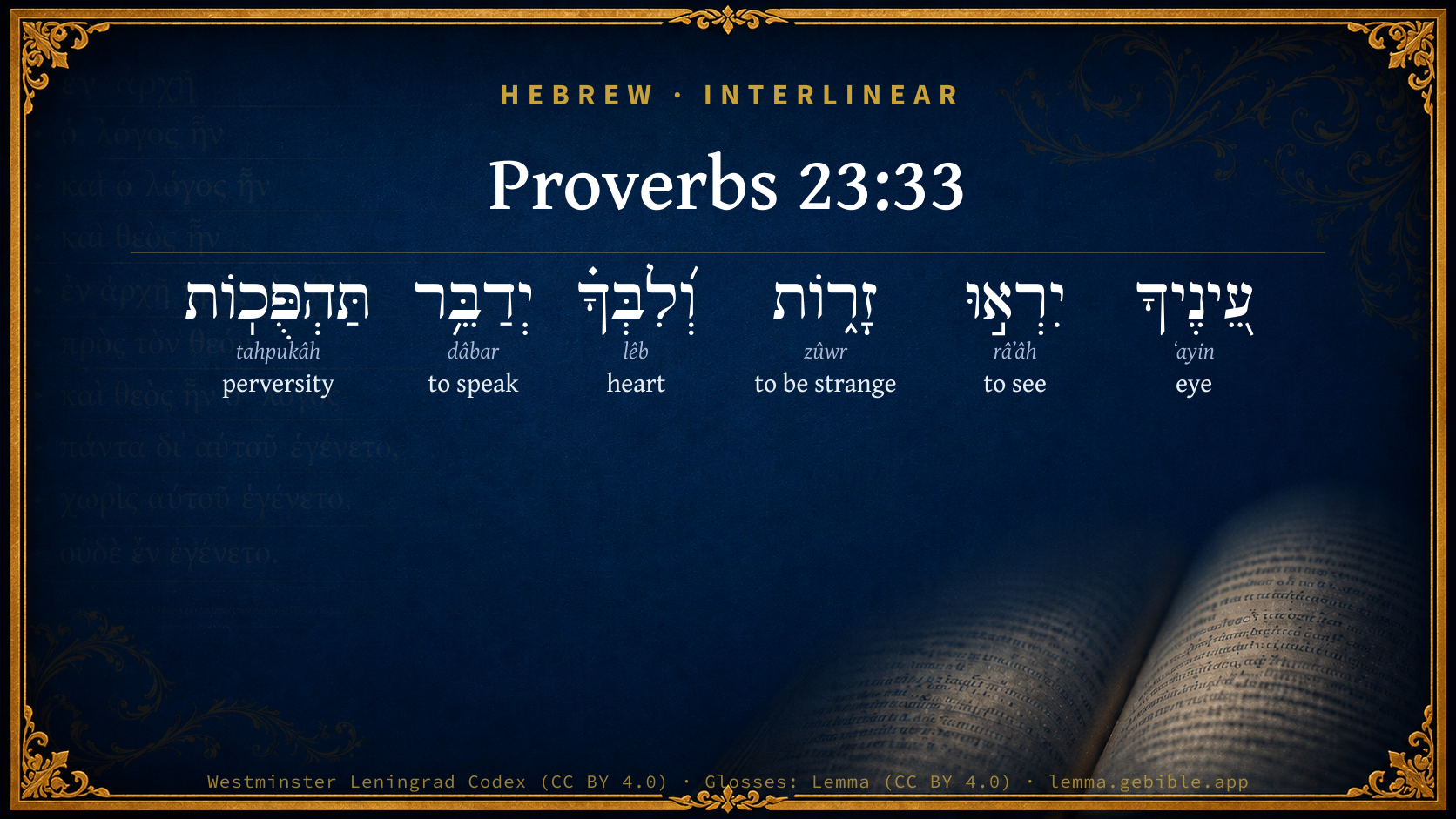
Proverbs 23:33

Hebrew (Westminster Leningrad Codex) Proverbs 23:33 appears in the Hebrew Old Testament. The text above is from the Westminster Leningrad Codex. Each word links to its Strong’s number, a concise gloss, and parsing drawn from the Open Scriptures Hebrew Bible morphology. Click any word for its full Brown-Driver-Briggs (BDB) entry.
Download image
Cite this verse

Proverbs 23:33 (World English Bible). Public Domain. Lemma interlinear Bible study tool, https://lemma.gebible.app/v/proverbs/23/33.

Show BibTeX & RIS
BibTeX
RIS
English Translation
Your eyes will see strange things, And your mind will imagine confusing things.
World English Bible · Public Domain
Download a study sheet

One document with this verse’s original text, its word-by-word gloss line, the meaning frame, cross-references with their text, attributed commentary, and full source and license credits — printable, and it pastes into notes with its structure intact.

This verse Autodidact and up

Study sheet (.html) Plain text (.txt)

A passage Seminary Student

Up to 50 verses in one chapter. A passage sheet keeps up to 6 commentary sources and 12 cross-references per verse, in the order this page ranks them, and says so on the sheet whenever that leaves anything out. Ask for a single verse and you get the Autodidact verse sheet above.

Everything on this page stays free to read, with no account — the sheet is a download of what is already on screen, not access to it.

Want to remove ads? Support Godless Engineer
Compare translations 3

The same verse in 3 English versions, stacked beneath the original-language interlinear above. Click any original word for its lexicon entry.

Each is an independent rendering of the whole verse — the interlinear is not word-aligned to these translations.

Highlighted words mark where these versions differ — a whole-verse word diff, not a word-by-word alignment.

  • World English Bible Public Domain
    Your eyes will see strange things, And your mind will imagine confusing things.
  • King James Version Public Domain
    Thine eyes shall behold strange women, and thine heart shall utter perverse things.
  • unfoldingWord Literal Text CC BY-SA 4.0
    Your eyes will see strange things, and your heart will speak perverse things.

unfoldingWord Literal Text — © unfoldingWord, licensed CC BY-SA 4.0. Word-aligned USFM3 via Door43 (git.door43.org/unfoldingWord/en_ult).

Versions to compare (up to 4)

3 of 4 selected

Show all 18 translations

Every available English version of this verse, each an independent rendering of the whole verse.

  • World English Bible Public Domain
    Your eyes will see strange things, And your mind will imagine confusing things.
  • Berean Standard Bible Public Domain
    Your eyes will see strange things, and your mind will utter perversities.
  • Majority Standard Bible Public Domain
    Your eyes will see strange things, and your mind will utter perversities.
  • King James Version Public Domain
    Thine eyes shall behold strange women, and thine heart shall utter perverse things.
  • American Standard Version (1901) Public Domain
    Thine eyes shall behold strange things, And thy heart shall utter perverse things.
  • Revised Version (1885) Public Domain
    Thine eyes shall behold strange things, and thine heart shall utter froward things.
  • Geneva Bible (1599) Public Domain
    Thine eyes shall looke vpon strange women, and thine heart shall speake lewde things.
  • Douay-Rheims (1899) Public Domain
    Thy eyes shall behold strange women, and thy heart shall utter perverse things.
  • Young's Literal Translation Public Domain
    Thine eyes see strange women, And thy heart speaketh perverse things.
  • Literal Standard Version CC BY-SA 4.0
    Your eyes see strange women, || And your heart speaks perverse things.
  • Unlocked Literal Bible CC BY-SA 4.0
    Your eyes will see strange things and your heart will utter perverse things.
  • unfoldingWord Literal Text CC BY-SA 4.0
    Your eyes will see strange things, and your heart will speak perverse things.
  • Darby Bible Public Domain
    Thine eyes shall behold strange women, and thy heart shall speak froward things;
  • World Messianic Bible Public Domain
    Your eyes will see strange things, and your mind will imagine confusing things.
  • Webster's Bible Public Domain
    Thy eyes shall behold strange women, and thy heart shall utter perverse things.
  • Free Bible Version CC BY-SA 4.0
    You'll hallucinate, seeing strange things, and your confused mind will make you say all kinds of craziness.
  • Bible in Basic English Public Domain
    Your eyes will see strange things, and you will say twisted things.
  • JPS Tanakh (1917) Public Domain
    Thine eyes shall behold strange things, and thy heart shall utter confused things.

Literal Standard Version (2020), Covenant Press — licensed CC BY-SA 4.0. Text via the HelloAO Bible API (eBible.org). Unlocked Literal Bible (unfoldingWord) — licensed CC BY-SA 4.0. Text via the HelloAO Bible API (eBible.org). unfoldingWord Literal Text — © unfoldingWord, licensed CC BY-SA 4.0. Word-aligned USFM3 via Door43 (git.door43.org/unfoldingWord/en_ult). Free Bible Version, Dr. Jonathan Gallagher — licensed CC BY-SA 4.0. Text via the HelloAO Bible API (eBible.org).

Word by word

More ways to search: Search by grammar → Find every occurrence → Compare this word →

Practice this passage: Drill this verse → Learn its vocabulary →

About this verse

These counts appear in no published source. They are computed here, from the morphology-tagged text and Lemma’s own curated glosses. What Lemma adds →

6
words
6
distinct lemmas
Wisdom
section

Notable vocabulary

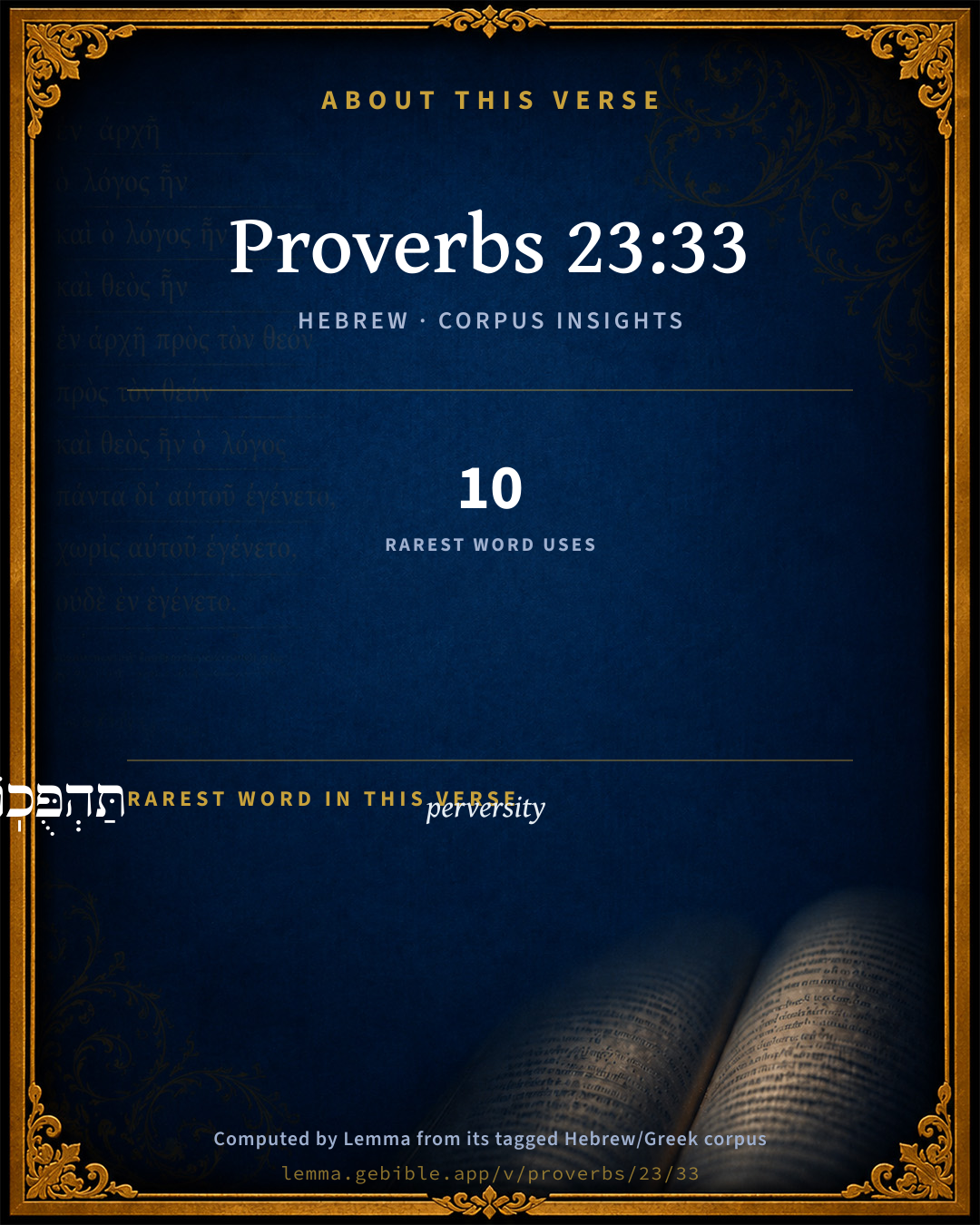
The rarest word here is תַּהְפֻּכֽוֹת perversity H8419 — appearing just 10 times in the whole Hebrew Bible.

Shared distinctive vocabulary

תַּהְפֻּכֽוֹת perversity H8419 occurs in 10 verses of the Hebrew Bible. Also found in:

Grammatical profile

  • 2 verbs
  • 3 nouns
  • 1 adjective

Verb forms

  • יִרְא֣וּ Qal · Imperfect
  • יְדַבֵּ֥ר Piel · Imperfect

Hebrew & Septuagint length

In English translation the verse runs 13 words from the Hebrew and 15 from the Septuagint (LXX English) — closely comparable.

A rough comparison of the two English renderings, which tokenize alike — not a word-level alignment.

Word counts can differ between the Hebrew and the Greek without any difference in meaning — e.g. the Hebrew direct-object marker אֵת has no separate Greek word, and Greek often adds the article ὁ.

Cross-references

7

Topical passages linked to Proverbs 23:33 in the Treasury of Scripture Knowledge — connected by theme and wording, ordered by reader-vote popularity; previews shown in the World English Bible.

  • Jude 1:12–13 These are hidden rocky reefs in your love feasts when they feast with you, shepherds who without fear feed themselves; clouds without water, carried along by winds; autumn leaves without fruit, twice dead, plucked up by the roots;
  • Proverbs 2:12 To deliver you from the way of evil, From the men who speak perverse things;
  • Proverbs 31:5 Lest they drink, and forget the law, And pervert the justice due to anyone who is afflicted.
  • Hosea 7:5 On the day of our king, the princes made themselves sick with the heat of wine. He joined his hand with mockers.
  • Genesis 19:32–38 Come, let's make our father drink wine, and we will lie with him, that we may preserve our father's seed."
  • Psalms 69:12 Those who sit in the gate talk about me. I am the song of the drunkards.
  • Daniel 5:4 They drank wine, and praised the gods of gold, and of silver, of brass, of iron, of wood, and of stone.

Cross-references courtesy of OpenBible.info (CC BY 4.0).

Hebrew and Greek witnesses Masoretic Hebrew ↔ Greek Septuagint

The same verse in the two great witnesses to the Old Testament, shown verse-for-verse.

These are two independent witnesses, not word-aligned to each other, and the Septuagint is shown in lemma (dictionary) form.

Hebrew Proverbs 23:33 Masoretic · Westminster Leningrad Codex

עֵ֭ינֶיךָ יִרְא֣וּ זָר֑וֹת וְ֝לִבְּךָ֗ יְדַבֵּ֥ר תַּהְפֻּכֽוֹת

Your eyes will see strange things, And your mind will imagine confusing things.

World English Bible · Public Domain

Greek LXX Proverbs 23:33 Septuagint · lemma form

ὁ ὀφθαλμός σύ ὅταν ὁράω ἀλλότριος ὁ στόμα σύ τότε λαλέω σκολιός

Whenever your eyes shall behold a strange woman, then your mouth shall speak perverse things.

LXX2012 (modern English Septuagint) · Public Domain

On this verse, The Cambridge Bible for Schools and Colleges discusses the Septuagint’s reading. Read the note in Commentary ↓

Hebrew: Westminster Leningrad Codex (CC BY 4.0). Greek: Septuagint (public domain); English from LXX2012 (modern English Septuagint) (Public Domain). How the Septuagint differs from the Hebrew →

Commentary

Notes on Proverbs 23:33 from classic Christian and Jewish commentators (each source and its license shown beneath its notes). The classic Christian expositions comment on the surrounding passage and are grouped to its opening verse, so a note may address several verses; the Jewish commentaries on the Tanakh (Rashi and others) are per-verse, so they appear only where the commentator wrote on this verse.

Lemma curates 59 commentaries, every one of them public domain or Creative Commons licensed, each selected and text-cleaned for this edition rather than reprinted as found. About our sources →

Trapp's Complete Commentary

John Trapp

Pro 23:33 Thine eyes shall behold strange women, and thine heart shall utter perverse things.

Ver. 33. Thine eyes shall behold strange women.] {See Trapp on "Pro 23:29"} Venter aestuans mero, spumat in libidinem, saith Jerome. A belly filled with wine, foameth out filthiness. Wine is the milk of Venus, {a} saith another. Drunkenness is the gallery that lechery walketh through, saith a third. {b}

Thine heart shall utter perverse things.] Preposterous, distorted, dislocated matters: soliciting thy neighbour’s wife to wickedness; or otherwise vomiting out that which God hateth, and godly men abhor.

{a} Aφροδιτης γαλα. - Arist.

{b} Vina parent animos Veneri. - Ovid.

John Trapp, A Commentary or Exposition upon All the Books of the Old and New Testament (1647–1656) — public domain. Text from a community e-Sword module.

Joseph Benson's Commentary

Pro 23:33-34. Thine eyes shall behold strange women — With evil intent: lustful, nay, adulterous desires will be excited in thee, which thou wilt neither have inclination nor power to restrain and govern; and thy heart shall utter perverse things — Will discover its wickedness by unseemly and perverse, perhaps, even by filthy, scurrilous, and blasphemous speeches. Thou shalt be as he that lieth down — To sleep; in the midst of the sea — That is, in a ship in the midst of the sea; as he that lieth upon the top of the mast — The worst part of a ship to lie down upon, because of its perpetual tossings, and the hazard of him that sleeps upon it. “Thou wilt grow so perfectly senseless, that not only thy most important business will be neglected, but thou wilt un-thinkingly run thyself into the extremest hazards, without any apprehension of danger: being no more able to direct thy course, than a pilot who sleeps when a ship is tossed in the midst of the sea; or to take notice of the peril thou art in, than he that falls asleep on the top of a mast, where he was set to keep the watch.”

Joseph Benson's Commentary on the Old and New Testaments (1811–1818) — public domain. Text from a community e-Sword module.

Geneva Bible (1599)

Geneva Bible translators

That is, drunkenness shall bring thee to whoredom.

Geneva Bible (1599) marginal notes — public domain. Text via Bolls.life.

Jamieson, Fausset & Brown

Robert Jamieson, A. R. Fausset & David Brown

The moral effects: it inflames passion (Gen 19:31, Gen 19:35), lays open the heart, produces insensibility to the greatest dangers, and debars from reformation, under the severest sufferings.

Jamieson, Fausset & Brown — Commentary Critical and Explanatory on the Whole Bible (1871) — public domain (CC PDM 1.0). Text via the HelloAO Bible API.

Adam Clarke's Commentary

Verse 33. Thine eyes shall behold strange women] Evil concupiscence is inseparable from drunkenness. Mr. Herbert shows these effects well: -

He that is drunken may his mother kill,

Big with his sister: he hath lost the reins;

Is outlawed by himself. All kinds of ill

Did, with his liquor, slide into his veins.

The drunkard forfeits man; and doth divest

All worldly right, save what he hath by beast.

HERBERT'S Poems. - The Church Porch.

Adam Clarke's Commentary on the Bible (1810–1826) — public domain. Text from a community e-Sword/MySword module.

Ellicott's Commentary for English Readers

(33) Thine eyes shall behold strange women.—i.e., look out for them, impurity being the constant attendant of drunkenness. Or, the word may be translated “strange things,” referring to the strange fancies of a drunkard, the horrible and fantastic visions present to his disordered brain.

Perverse things.—His notions of right and wrong being completely distorted.

A Bible Commentary for English Readers, edited by Charles John Ellicott (1878–1897) — public domain. Text from a community e-Sword module.

The Cambridge Bible for Schools and Colleges

gen. ed. J. J. S. Perowne

33. strange women] This rendering, which is retained in R.V. marg. (comp. ἀλλοτρίαν, LXX.; extraneas, Vulg.), is in keeping with the usage of the word in this Book, and with the undoubted connection between excess of wine and lust; but strange things, R.V. text, preserves the parallelism better: the eye of the drunkard is haunted by strange visions; his mouth utters perverse words.

The Cambridge Bible for Schools and Colleges (gen. ed. J. J. S. Perowne; Cambridge University Press, 1878–1918) — public domain. Text from a community e-Sword module.

John Gill's Exposition

Thine eyes shall behold strange women,.... Being inflamed with wine, shall look upon women, other men's wives, and lust after them; or harlots, whom seeking after or meeting with, when in their cups, are drawn into their embraces; excess of wine leads to whoredom (w). So Aben Ezra supplies the word "women", and Jarchi interprets it to this sense; but the Targum renders it, "strange things"; and so many others: a drunken man, through the lunges and vapours that ascend into his brain, fancies he sees strange sights; he sees things double; imagines that he sees trees walk, and many such like absurd and monstrous things;

and thine heart shall utter perverse things; or the mouth, from the abundance of the heart, and imagination of it, shall utter things contrary to sense and reason, contrary to truth and righteousness, contrary to chastity and good manners, contrary to their own honour and credit, contrary to God and men; the mouth then utters all that is in the heart, which it at other times conceals. It may have a particular respect to the unchaste, filthy, and obscene words, uttered to strange women, into whose company men fall when in liquor.

(w) "Vina parant animos Veneri", Ovid. de Arte Amandi, l. 1.

John Gill's Exposition of the Whole Bible (1746–1763) — public domain (CC PDM 1.0). Text via the HelloAO Bible API.

Haydock's Catholic Bible Commentary

Women. Wine excites to lust. (Calmet) See chap. xx. 1. --- Shall. Septuagint, "shall these." (Haydock)

George Leo Haydock (1774–1849), Haydock's Catholic Family Bible and Commentary, 1859 edition — public domain. Excludes Psalms (Douay-Rheims chapter numbering differs from Protestant) and Deuterocanonical books (Catholic canon only).

Matthew Poole's English Annotations

Behold, with evil intent, or lustfully, which is the effect of drinking much wine, as is noted in Scripture, Gen 19:31,35; Ho 4:18, and other authors.

Thine heart shall utter perverse things; thine heart, which, when thou hadst the use of thy wit, concealed, will then discover its wickedness by filthy and perverse speeches.

Matthew Poole's English Annotations on the Holy Bible (1683–1685) — public domain. Text from a community e-Sword/MySword module.

Whedon's Commentary on the Bible

Daniel D. Whedon

33. Eyes… heart — Intoxicating drinks inflame lust, and produce all manner of improper language. Zockler renders: “Thine eye shall see strange things; not strange women, but strange things, the objects of a drunken man’s vision, as the doubling of certain objects, their inversion, their tremulous or swaying motion,” etc. So, also, Miller. Is there here a reference to the delerium tremens, which Miller calls “the nightmare of the vice?” — the horrible imagery and spectral terrors conjured up under the influence of mania a potu!

34

Lieth down… top of a mast — Like the sailor who goes to sleep at the masthead, he is in imminent peril but knows it not. It may be questioned whether ראשׁ חבל, (rosh hhibbel,) means “masthead,”

especially as on eastern ships men do not mount aloft,but work the sails by ropes from the deck.

Daniel D. Whedon (gen. ed.), Commentary on the Old and New Testaments (1874–1909) — public domain. Text from a community e-Sword module.

The Pulpit Commentary

The excitement occasioned by wine is now described. Thine eyes shall behold strange women. Ewald, Delitzsch, and others take twOdz to mean "strange things," as affording a better parallel to the "perverse things" of the next clause. In this case the writer intends to denote the fantastic, often dreadful, images produced on the brain by the feverish condition of the inebriated. But the often denounced connection between drunkenness and incontinence, the constant reference to "strange women" in this book, and the general consensus of the versions, lead one to uphold the rendering of the Authorized Version. It seems, too, somewhat meagre to note these illusions as one of the terrible effects of intemperance, omitting all mention of the unbridling of lust, when the eyes look out for and rove after unchaste women. Thine heart shall utter perverse things. (comp Pro_15:28 Mat_15:19) The drunkard"s notions are distorted, and his words partake of the same character; he confuses right and wrong; he says things which he would never speak if he were in full possession of his senses. Septuagint, "When thine eyes shall see a strange woman, then thy mouth shall speak perverse things."

The Pulpit Commentary (1880–1919), ed. H.D.M. Spence-Jones & Joseph S. Exell — public domain. Text from a community e-Sword module.

Kretzmann's Popular Commentary

Paul E. Kretzmann

v. 33. Thine eyes, under the influence of the liquor, as it clouds the senses, shall behold strange women, rather, strange things, all objects being doubled, or uncertain, or swaying, in the vision of the drunken man, and thine heart shall utter perverse things, foolish talk.

Paul E. Kretzmann, Popular Commentary of the Bible (1921–1924) — public domain. Text from a community e-Sword module.

Rashi

Rabbi Shlomo Yitzchaki (Rashi)

Your eyes will see strange women When you will become drunk, they will burn in you and entice you to ogle harlots.

Rashi on the Tanakh — English translations: “The Judaica Press complete Tanach with Rashi, translated by A. J. Rosenberg” (CC BY 4.0); “Pentateuch with Rashi's commentary by M. Rosenbaum and A.M. Silbermann, 1929-1934” (public domain); “The Metsudah Tanach series, Lakewood, N.J” (CC BY 4.0); and “The Book of Joshua, Metsudah Publications, 1997” (CC BY 4.0). Text via Sefaria.

Lesson kit

Teaching starters — assembled from the data on this page, not authored interpretation. Every prompt links to the verse data it draws on. Edit before teaching.

Proverbs, in the Wisdom, opens this verse with 6 words (6 distinct Hebrew lemmas). Its most distinctive word is tahpukâh (“perversity”). A historical commentator’s framing appears above. Read the whole chapter for the surrounding context.

Discussion questions

  1. How does “perversity” (tahpukâh) shape what this verse is saying?
  2. Deuteronomy 32:20 shares the word «perversity» with this verse. How do the two illuminate each other?
  3. These translations render this verse differently. What is at stake in choosing one wording over another?
  4. The verb «יִרְא֣וּ» is Qal Imperfect. How does its form color the action?
  5. Reading how Trapp's Complete Commentary and Joseph Benson's Commentary read this verse, where do the two commentators agree and where do they part?

Things to notice

Reading settings

Reading text

Shown beneath each verse's original-language words.

Old Testament
Old Testament edition

Read the OT as the Masoretic Hebrew (MT) or the Greek Septuagint (LXX).

English shown for the Greek Septuagint (in the Hebrew ↔ Greek comparison).

Comparing translations? Open the Compare panel on any verse page to stack up to four side by side.