Hosea 5:7

Hebrew (Westminster Leningrad Codex) Hosea 5:7 appears in the Hebrew Old Testament. The text above is from the Westminster Leningrad Codex. Each word links to its Strong’s number, a concise gloss, and parsing drawn from the Open Scriptures Hebrew Bible morphology. Click any word for its full Brown-Driver-Briggs (BDB) entry.
Download image
Cite this verse

Hosea 5:7 (World English Bible). Public Domain. Lemma interlinear Bible study tool, https://lemma.gebible.app/v/hosea/5/7.

Show BibTeX & RIS
BibTeX
RIS
English Translation
They are unfaithful to Yahweh; For they have borne illegitimate children. Now the new moon will devour them with their fields.
World English Bible · Public Domain
Download a study sheet

One document with this verse’s original text, its word-by-word gloss line, the meaning frame, cross-references with their text, attributed commentary, and full source and license credits — printable, and it pastes into notes with its structure intact.

This verse Autodidact and up

Study sheet (.html) Plain text (.txt)

A passage Seminary Student

Up to 50 verses in one chapter. A passage sheet keeps up to 6 commentary sources and 12 cross-references per verse, in the order this page ranks them, and says so on the sheet whenever that leaves anything out. Ask for a single verse and you get the Autodidact verse sheet above.

Everything on this page stays free to read, with no account — the sheet is a download of what is already on screen, not access to it.

Want to remove ads? Support Godless Engineer
Compare translations 3

The same verse in 3 English versions, stacked beneath the original-language interlinear above. Click any original word for its lexicon entry.

Each is an independent rendering of the whole verse — the interlinear is not word-aligned to these translations.

Highlighted words mark where these versions differ — a whole-verse word diff, not a word-by-word alignment.

  • World English Bible Public Domain
    They are unfaithful to Yahweh; For they have borne illegitimate children. Now the new moon will devour them with their fields.
  • King James Version Public Domain
    They have dealt treacherously against the LORD: for they have begotten strange children: now shall a month devour them with their portions.
  • unfoldingWord Literal Text CC BY-SA 4.0
    They have betrayed Yahweh, for they have borne strange children. Now the new moon he will devour them with their portions.

unfoldingWord Literal Text — © unfoldingWord, licensed CC BY-SA 4.0. Word-aligned USFM3 via Door43 (git.door43.org/unfoldingWord/en_ult).

Versions to compare (up to 4)

3 of 4 selected

Show all 18 translations

Every available English version of this verse, each an independent rendering of the whole verse.

  • World English Bible Public Domain
    They are unfaithful to Yahweh; For they have borne illegitimate children. Now the new moon will devour them with their fields.
  • Berean Standard Bible Public Domain
    They have been unfaithful to the LORD; for they have borne illegitimate children. Now the New Moon will devour them along with their land.
  • Majority Standard Bible Public Domain
    They have been unfaithful to the LORD; for they have borne illegitimate children. Now the New Moon will devour them along with their land.
  • King James Version Public Domain
    They have dealt treacherously against the LORD: for they have begotten strange children: now shall a month devour them with their portions.
  • American Standard Version (1901) Public Domain
    They have dealt treacherously against Jehovah; for they have borne strange children: now shall the new moon devour them with their fields.
  • Revised Version (1885) Public Domain
    They have dealt treacherously against the LORD; for they have borne strange children: now shall the new moon devour them with their fields.
  • Geneva Bible (1599) Public Domain
    They haue transgressed against the Lord: for they haue begotte strange children: now shall a moneth deuoure them with their portions.
  • Douay-Rheims (1899) Public Domain
    They have transgressed against the Lord, for they have begotten children that are strangers: now shall a month devour them with their portions.
  • Young's Literal Translation Public Domain
    Against Jehovah they dealt treacherously, For strange sons they have begotten, Now consume them doth a month `with' their portions.
  • Literal Standard Version CC BY-SA 4.0
    Against YHWH they dealt treacherously, || For they have begotten strange sons, || Now a month consumes them [with] their portions.
  • Unlocked Literal Bible CC BY-SA 4.0
    They were unfaithful to Yahweh, for they have borne illegitimate children. Now the new moon festivals will devour them with their fields.
  • unfoldingWord Literal Text CC BY-SA 4.0
    They have betrayed Yahweh, for they have borne strange children. Now the new moon he will devour them with their portions.
  • Darby Bible Public Domain
    They have dealt treacherously against Jehovah; for they havebegotten strange children: now shall the new moon devour them, with their allotted possessions.
  • World Messianic Bible Public Domain
    They are unfaithful to the LORD; for they have borne illegitimate children. Now the new moon will devour them with their fields.
  • Webster's Bible Public Domain
    They have dealt treacherously against the LORD: for they have begotten strange children: now shall a month devour them with their portions.
  • Free Bible Version CC BY-SA 4.0
    They have been unfaithful to the Lord and have had children that are not his. Now the New Moon will destroy them along with their fields.
  • Bible in Basic English Public Domain
    They have been false to the Lord; they have given birth to strange children; now the new moon will make them waste with their fields.
  • JPS Tanakh (1917) Public Domain
    They have dealt treacherously against the LORD, for they have begotten strange children; now shall the new moon devour them with their portions.

Literal Standard Version (2020), Covenant Press — licensed CC BY-SA 4.0. Text via the HelloAO Bible API (eBible.org). Unlocked Literal Bible (unfoldingWord) — licensed CC BY-SA 4.0. Text via the HelloAO Bible API (eBible.org). unfoldingWord Literal Text — © unfoldingWord, licensed CC BY-SA 4.0. Word-aligned USFM3 via Door43 (git.door43.org/unfoldingWord/en_ult). Free Bible Version, Dr. Jonathan Gallagher — licensed CC BY-SA 4.0. Text via the HelloAO Bible API (eBible.org).

Word by word

More ways to search: Search by grammar → Find every occurrence → Compare this word →

Practice this passage: Drill this verse → Learn its vocabulary →

בָּגָ֔דוּ
bâgad
H898
“to betray”
Verb, Qal, Perfect, 3rd Person, Common, Plural
Part of Speech
Verb
Stem
Qal
Form
Perfect
Person
3rd Person
Gender
Common
Number
Plural
Full BDB Definition

Origin: a primitive root

TWOT: 198

to act treacherously, deceitfully, deal treacherously - (Qal) to act or deal treacherously, faithlessly, deceitfully, offend
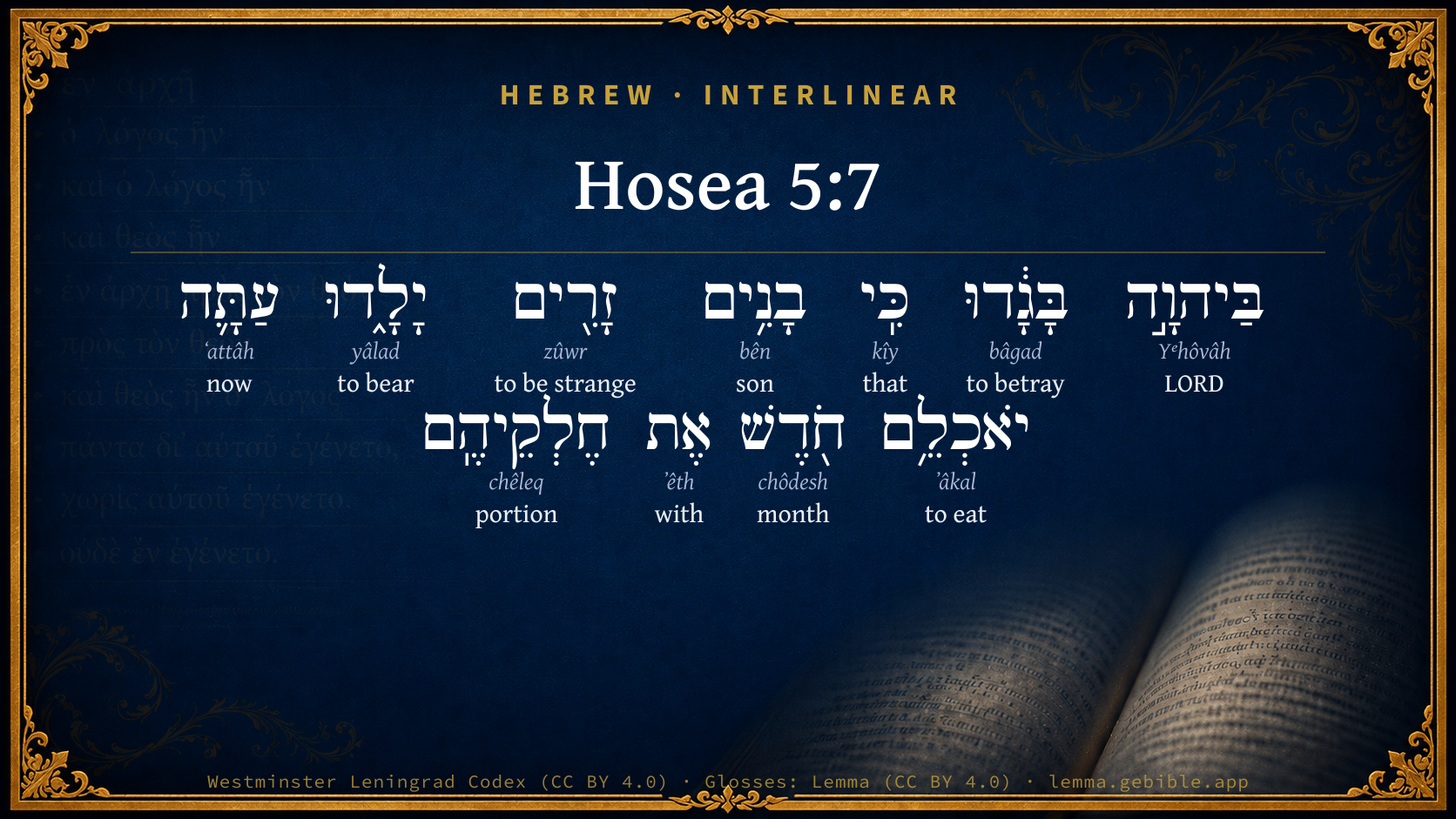
  1. בַּיהוָ֣ה Yᵉhôvâh H3068 “in/at · LORD” Preposition + Noun, Proper
  2. כִּֽי kîy H3588 “that” Conjunction
  3. בָנִ֥ים bên H1121 “sons” Noun, Common, Masculine, Plural, Absolute
  4. זָרִ֖ים zûwr H2114 “strange” Adjective, Adjective, Masculine, Plural, Absolute
  5. יָלָ֑דוּ yâlad H3205 “to bear” Verb, Qal, Perfect, 3rd Person, Common, Plural
  6. עַתָּ֛ה ʻattâh H6258 “now” Adverb
  7. יֹאכְלֵ֥ם ʼâkal H398 “to eat · them” Verb, Qal, Imperfect, 3rd Person, Masculine, Singular + Suffix, Personal, 3rd Person, Masculine, Plural
  8. חֹ֖דֶשׁ chôdesh H2320 “month” Noun, Common, Masculine, Singular, Absolute
  9. אֶת ʼêth H854 “with” Preposition
  10. חֶלְקֵיהֶֽם chêleq H2506 “portions · their” Noun, Common, Masculine, Plural, Construct + Suffix, Personal, 3rd Person, Masculine, Plural

About this verse

These counts appear in no published source. They are computed here, from the morphology-tagged text and Lemma’s own curated glosses. What Lemma adds →

11
words
11
distinct lemmas
Prophets
section

Shared distinctive vocabulary

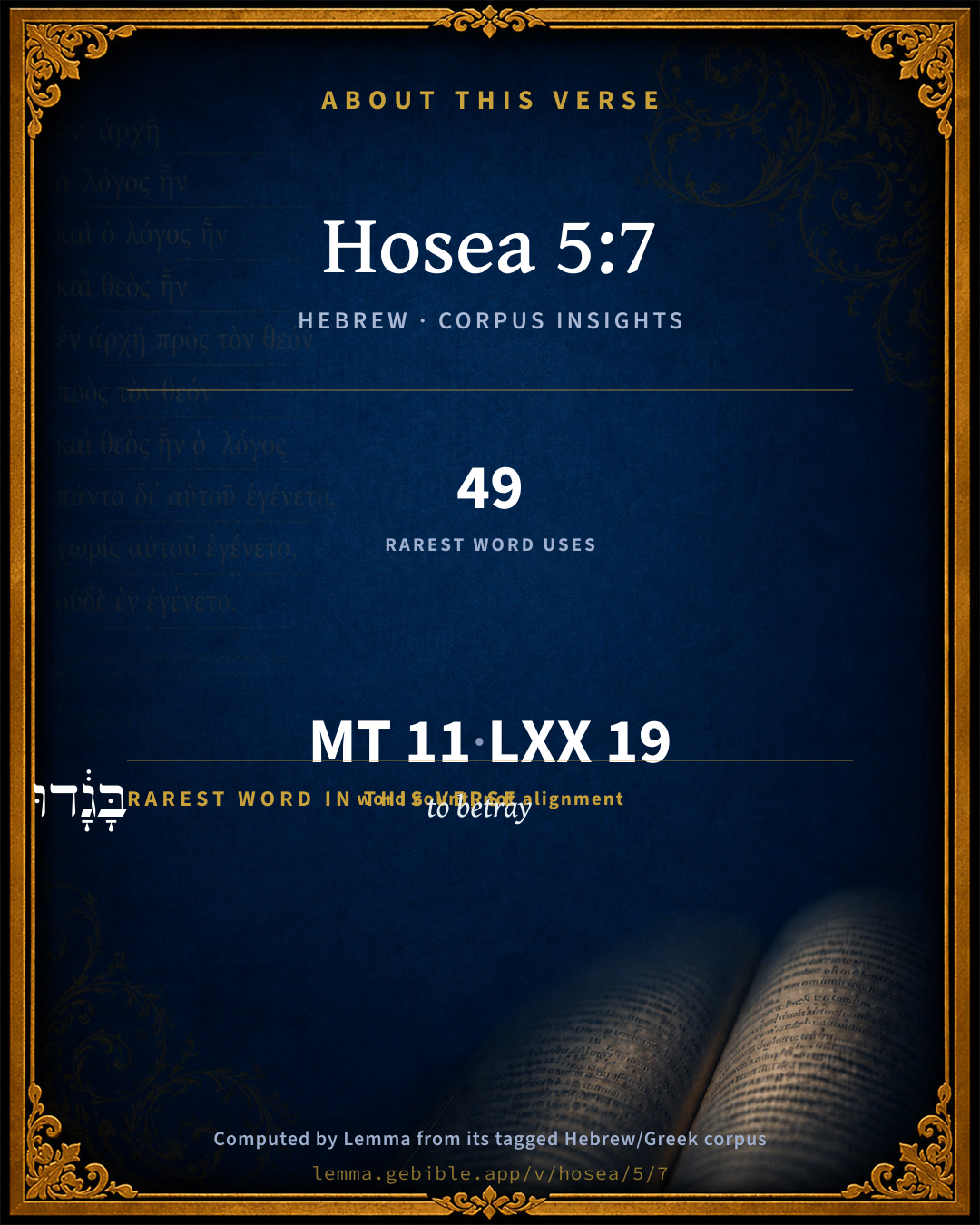
בָּגָ֔דוּ to betray H898 occurs in 39 verses of the Hebrew Bible. Also found in:

Grammatical profile

  • 3 verbs
  • 4 nouns
  • 1 adjective
  • 1 preposition
  • 1 conjunction
  • 1 adverb

Verb forms

  • בָּגָ֔דוּ Qal · Perfect
  • יָלָ֑דוּ Qal · Perfect
  • יֹאכְלֵ֥ם Qal · Imperfect

Hebrew & Septuagint length

In English translation the verse runs 21 words from the Hebrew and 23 from the Septuagint (LXX English) — closely comparable.

A rough comparison of the two English renderings, which tokenize alike — not a word-level alignment.

Word counts can differ between the Hebrew and the Greek without any difference in meaning — e.g. the Hebrew direct-object marker אֵת has no separate Greek word, and Greek often adds the article ὁ.

In the original languages it is 11 Hebrew tokens and 19 Greek tokens — but the two are counted differently (Hebrew bundles its prefixes and suffixes into one token; the Greek is in lemma form), so that isn’t a like-for-like length.

Cross-references

13

Topical passages linked to Hosea 5:7 in the Treasury of Scripture Knowledge — connected by theme and wording, ordered by reader-vote popularity; previews shown in the World English Bible.

  • Hosea 6:7 But they, like Adam, have broken the covenant. They were unfaithful to me, there.
  • Psalms 144:7 Stretch out your hand from above, Rescue me, and deliver me out of great waters, Out of the hands of foreigners;
  • Psalms 144:11 Rescue me, and deliver me out of the hands of foreigners, Whose mouths speak deceit, Whose right hand is a right hand of falsehood.
  • Isaiah 48:8 Yes, you didn't hear; yes, you didn't know; yes, from of old your ear was not opened: for I knew that you did deal very treacherously, and was called a transgressor from the womb.
  • Jeremiah 3:20 Surely as a wife treacherously departs from her husband, so have you dealt treacherously with me, house of Israel, says Yahweh.
  • Ezekiel 12:28 Therefore tell them, Thus says the Lord Yahweh: There shall none of my words be deferred any more, but the word which I shall speak shall be performed, says the Lord Yahweh.
  • Hosea 2:4 Indeed, on her children I will have no mercy; For they are children of unfaithfulness;
  • Nehemiah 13:23–24 In those days also saw I the Jews who had married women of Ashdod, of Ammon, [and] of Moab:
  • Isaiah 59:13 transgressing and denying Yahweh, and turning away from following our God, speaking oppression and revolt, conceiving and uttering from the heart words of falsehood.
  • Jeremiah 5:11 For the house of Israel and the house of Judah have dealt very treacherously against me, says Yahweh.
  • Hosea 2:11 I will also cause all her celebrations to cease: Her feasts, her new moons, her Sabbaths, and all her solemn assemblies.
  • Zechariah 11:8 I cut off the three shepherds in one month; for my soul was weary of them, and their soul also loathed me.
  • Malachi 2:11–15 Judah has dealt treacherously, and an abomination is committed in Israel and in Jerusalem; for Judah has profaned the holiness of Yahweh which he loves, and has married the daughter of a foreign god.

Cross-references courtesy of OpenBible.info (CC BY 4.0).

Hebrew and Greek witnesses Masoretic Hebrew ↔ Greek Septuagint

The same verse in the two great witnesses to the Old Testament, shown verse-for-verse.

These are two independent witnesses, not word-aligned to each other, and the Septuagint is shown in lemma (dictionary) form.

Hebrew Hosea 5:7 Masoretic · Westminster Leningrad Codex

בַּיהוָ֣ה בָּגָ֔דוּ כִּֽי בָנִ֥ים זָרִ֖ים יָלָ֑דוּ עַתָּ֛ה יֹאכְלֵ֥ם חֹ֖דֶשׁ אֶת חֶלְקֵיהֶֽם

They are unfaithful to Yahweh; For they have borne illegitimate children. Now the new moon will devour them with their fields.

World English Bible · Public Domain

Greek LXX Hosea 5:7 Septuagint · lemma form

ὅτι ὁ κύριος ἐν καταλείπω ὅτι τέκνον ἀλλότριος γεννάω αὐτός νῦν καταἐσθίω αὐτός ὁ ἐρυσίβη καί ὁ κλῆρος αὐτός

For they have forsaken the Lord; for strange children have been born to them: now shall the cankerworm devour them and their heritages.

LXX2012 (modern English Septuagint) · Public Domain

On this verse, Haydock's Catholic Bible Commentary discusses the Septuagint’s reading. Read the note in Commentary ↓

Hebrew: Westminster Leningrad Codex (CC BY 4.0). Greek: Septuagint (public domain); English from LXX2012 (modern English Septuagint) (Public Domain). How the Septuagint differs from the Hebrew →

Targum (Aramaic paraphrase)

1

The Targum is the ancient Jewish Aramaic paraphrase of the Hebrew Scriptures — an interpretive translation, not the Hebrew text itself. Onkelos (literal) and Pseudo-Jonathan (expansive) render the Torah, and Jonathan the Prophets. Coverage is partial: where no permissively-licensed English translation exists for a verse, only the Aramaic is shown. This is verse-level text, not a word-by-word alignment to the Hebrew.

  1. Targum Jonathan Prophets (Joshua–Malachi)
    בְּמֵימְרָא דַייָ שַׁקָרוּ אֲרֵי בְנִין מִבְּנַת עַמְמַיָא קַיְמוּ לְהוֹן כְּעַן אַיְתֵי עֲלֵיהוֹן עַמְמִין יְרַח בִּירֵחַ וְיִבְזוּן יַת פֵּירֵי אַרְעֲהוֹן:

    (no public-domain English translation for this verse)

    Targum Jonathan — Aramaic: “Mikraot Gedolot” (public domain). English: “Sefaria Community Translation” (CC0 1.0 (public-domain dedication)); “London "Chaldee Paraphrase," 1871” (public domain). Text via Sefaria.

Commentary

Notes on Hosea 5:7 from classic Christian and Jewish commentators (each source and its license shown beneath its notes). The classic Christian expositions comment on the surrounding passage and are grouped to its opening verse, so a note may address several verses; the Jewish commentaries on the Tanakh (Rashi and others) are per-verse, so they appear only where the commentator wrote on this verse.

Lemma curates 59 commentaries, every one of them public domain or Creative Commons licensed, each selected and text-cleaned for this edition rather than reprinted as found. About our sources →

Trapp's Complete Commentary

John Trapp

Hos 5:7 They have dealt treacherously against the LORD: for they have begotten strange children: now shall a month devour them with their portions.

Ver. 7. They have dealt treacherously against the Lord] They have dealt deceitfully in the covenant, they are a perfidious cursed crew of them; this I see well enough, saith God, though they may think to darken my eyesight with the smoke of their many sacrifices, or to stop my mouth with their great presents. See how he complaineth, as in this prophecy often, so Jer 3:20, "Surely as a wife treacherously departeth from her husband, so have you dealt treacherously with me, O house of Israel." Now in such a case a man will not regard any ransom; neither will he rest content, though thou givest many gifts; he will not be a pander to his own bed unless he be very base indeed, Pro 6:35. Most certain it is, that God will not endure any such doings; but though he loves his spouse never so well, yet if she plays false with him, and admit any other into the bridal bed, he will forsake his house that has been so dishonest, he will leave his heritage that has been so embased, he will give the dearly beloved of his soul into the hand of her enemies, Jer 12:7, who shall hate her more than ever they loved her, as Amnon did Tamar, and deal cruelly with her, as Eze 16:1-63 is at large discoursed. The wickedness of this people was the greater, for that they pretended religion {as in Hos 5:6} to their base beastly practices. Dissembled sanctity is double iniquity. See how heinously God takes it, Jer 7:9-10. And when others deal treacherously and unworthily with you, see whether you have not done as badly and worse against the Lord, Alphonsus, king of Aragon, in a speech to the pope’s ambassador, professed that he did not so much wonder at his courtiers’ ingratitude to him (who had raised various of them from mean to great estates) as at his own to God.

For they have begotten strange children] Bastards, such as the Jews call Mamzer, as ye would say, aliena labes, a strange blot. They call them also brambles, such as was Abimelech, who grew in the hedge row of a harlot, and scratched and drew blood to purpose, Jdg 9:14. That which is here charged upon the Israelites is, that they had not only taken to wife the daughters of a strange god, or begotten bastards of harlots, but they had muzzled up their children in idolatry, and so made them sevenfold worse the children of the devil than before. This was a very great aggravation of their treachery, that they should empoison their posterity and propagate their wickedness from one generation to another; that there should be a line and a succession of it from their loins. None are so ready to drink in false principles and corrupt practices as young ones. Such parents as have a hand in undoing their children, either by ill counsel or example, are peremptores potius quam parentes, saith Bernard, rather parricides than parents. They shall give a heavy account to God for their children’s misdeeds. Let it therefore be the care of parents, as to keep themselves pure, so to see to their little ones, that they be not corrupted. Satan bears an implacable spite and hatred to them, as the seedplot of heaven; and hath his emissaries abroad to mar them. Such was Protagoras, of whom Plato reporteth, that he gloried of this, that whereas he had lived sixty years in all, forty of them he had spent in corrupting young people (Plato in Menone). Of Julian the apostate it is reported, that being of excellent parts and proof, both in learning and religion, while he was young, he was afterwards corrupted by his two heathenish tutors, Libanius and Jamblichus, through the carelessness of Eusebius, bishop of Nicomedia, who should have seen better to it and that this was a main cause of his apostasy.

Now shall a month devour them with their portions] Some read it thus, Now shall the enemy devour them month after month; others put menses for menstrua, and give this sense. Like as this people make no bones to break their faith with God by spiritual fornication, mingling as it were their seed with strange gods and foreign people; so shall it come to them which happeneth to women worn with adulteries (as Ezekiel speaketh), that their monthly diseases, procured by inordinate lust, shall eat up and consume their bodies. (See Tremel. and Jun. Annot.) For confirmation, they allege (but not so properly) Jer 2:24. I willingly concur with those that by a month understand a little short time. How soon is a month run out And yet what havoc will an enemy make in a month’s time! as we have had woeful experience in these late stripping and killing times. Them and their portions shall one month make an end of. Death heweth its way through a wood of men in a minute of time from the mouth of a murdering piece. "The sword contemneth the rod," Eze 21:13, as if it should say, What doth this silly rod do here? Let me come; I will quickly make work among them. I will dung the land with their carcases, &c., with their portions, the lots of their inheritance. Wicked men also have their portions in this life, Psa 17:14, they live in pleasure on the earth, and are wanton, Jas 5:5, but their portion is none other but a month may devour it: their pleasure none other but one drop of an evil conscience may damp and dissweeten it. But if God be thy portion, &c.

John Trapp, A Commentary or Exposition upon All the Books of the Old and New Testament (1647–1656) — public domain. Text from a community e-Sword module.

Joseph Benson's Commentary

Hos 5:7. They have dealt treacherously against the Lord — The word בגד, rendered, to deal treacherously, signifies properly, a wife’s being false to her husband; see Jer 3:20; from whence it is applied to the sin of idolatry, which was being false to the true God, or giving to creatures, or mere imaginary beings, the affection and regard due to him, and therefore it is often in Scripture styled spiritual whoredom. For they have begotten strange children — A race of aliens, as Bishop Horsley renders it: that is, children trained from their earliest infancy in the habits and principles of idolatry, and growing up aliens with respect to God, (for all are not Israel that are of Israel,) alienated from him in their affections, and in their sentiments and practice mere heathen. The expression alludes to children not lawfully begotten, or not born in wedlock. Now shall a month devour them — A very short time shall complete their destruction. It shall be sudden and unexpected. With their portions — That is, their allotments. “They shall be now totally dispossessed of their country, and the boundaries of the separate allotments of the several tribes shall be confounded and obliterated, and new partitions of the land into districts shall be made, from time to time, at the pleasure of its successive masters. The captivity of the ten tribes was completed soon after Hezekiah’s attempted reformation, and the kingdom of Judah not long survived Josiah’s.” It is probable the month alludes to these events.

Joseph Benson's Commentary on the Old and New Testaments (1811–1818) — public domain. Text from a community e-Sword module.

Geneva Bible (1599)

Geneva Bible translators

Their destruction is not far off.

That is, their children are degenerate, so that there is no hope in them.

Geneva Bible (1599) marginal notes — public domain. Text via Bolls.life.

Jamieson, Fausset & Brown

Robert Jamieson, A. R. Fausset & David Brown

treacherously--as to the marriage covenant (Jer 3:20).

strange children--alluding to "children of whoredoms" (Hos 1:2; Hos 2:4). "Strange" or foreign implies that their idolatry was imported from abroad [HENDERSON]. Or rather, "regarded by God as strangers, not His," as being reared in idolatry. The case is desperate, when not only the existing, but also the rising, generation is reared in apostasy.

a month--a very brief space of time shall elapse, and then punishment shall overtake them (Zac 11:8). The allusion seems to be to money loans, which were by the month, not as with us by the year. You cannot put it off; the time of your destruction is immediately and suddenly coming on you; just as the debtor must meet the creditor's demand at the expiration of the month. The prediction is of the invasion of Tiglath-pileser, who carried away Reuben, Gad, Naphtali, and the half tribe of Manasseh.

portions--that is, possessions. Their resources and garrisons will not avail to save them. HENDERSON explains from Isa 57:6, "portions" as their idols; the context favors this, "the Lord" the true "portion of His people" (Deu 32:9), being in antithesis to "their portions," the idols.

Jamieson, Fausset & Brown — Commentary Critical and Explanatory on the Whole Bible (1871) — public domain (CC PDM 1.0). Text via the HelloAO Bible API.

Adam Clarke's Commentary

Verse 7. Now shall a month devour them] In a month's time the king of Assyria shall be upon them, and oblige them to purchase their lives and liberties by a grievous tax of fifty shekels per head. This Menahem, king of Israel, gave to Pul, king of Assyria, 2Kg 15:16-20. Instead of month, some translate the original locust. "The locusts shall devour them."

Adam Clarke's Commentary on the Bible (1810–1826) — public domain. Text from a community e-Sword/MySword module.

John Calvin's Commentaries

He says that they had acted perfidiously with God, for they had violated his covenant. We must bear in mind what I have said before of the mutual faith which God stipulates with us, when he binds himself to us. God then covenants with us on this condition, that he will be our Father and Husband; but he requires from us such obedience as a son ought to render to his father; he requires from us that chastity which a wife owes to her husband. The Prophet now charges the people with unfaithfulness, because they had despised the true God, and prostituted themselves to idols.

And he also aggravates this crime by saying, that they had begotten strange children: for he intimates, that their condition had become so vitiated, that there remained no better hope as to their posterity. Some explain the words, that they had begotten strange children, in this way, — that they had taken wives from heathen nations, contrary to the law. But this sense is very frigid. Others understand, that they had begotten spurious children, because they brought up their children badly, having, from their infancy, attached them to depraved superstitions. This is indeed true, but the prophet, as I have already said, looked further; he meant that the Israelites had not only become alienated from God, but had also taken away every hope as to the future. It may indeed be, and it sometimes happens, that men for a time abandon themselves to many vices, and afterwards return to the right way; but when corruption has so prevailed that the children are infected with the same vices, and impiety itself takes full possession of them, then the state of things is past recovery. We now then see that the Prophet means, that the Israelites were not only covenant-breakers with respect to God, but that they had also led their children into the same perfidy, so that there was no hope of repentance.

He therefore subjoins the punishment, Devour them shall a month together with their portions Some restrict the word, month, to the times of the new moon, or to the new moons; and these days, we know, were festivals among the Jews: but this seems too far-fetched and strained. The Prophet therefore, I doubt not, takes here a month for a short time; and so the Hebrew scholars explain it, and yet they do not sufficiently unfold this form of speaking. Now, the Prophets are wont to use various figures, when they intend to mark out a short time. Isaiah says, ‘Yet for three years, as the time of a hireling:’ for hirelings were wont to hire themselves for three years; hence he says, This is the time fixed by the Lord as the appointed day. Contracts, also, we know, were then monthly, as they are at this day yearly, both with reference to the interest of money and other exchanges. Since, then, they usually made agreements for single months, the Prophet here, I have no doubt, takes a month metaphorically for a certain and fixed time. I do not therefore agree with the Hebrew scholars, who say that only a short time is expressed by the Prophet, but he expresses not only a short, but also a fixed time; and he did this that the Israelites might not vainly look for any deferring or respite, for hypocrites ever procrastinate and extend time by vain delusions. The Prophet therefore says here, A month shall devour them, which means, “Vengeance is now suspended over their heads, and this they shall not escape.”

And he says, “with their portions”. He intimates here, no doubt, that though they then overflowed with abundance, yet nothing would be a help to them to keep them from being destroyed, for the hand of God was against them. We indeed know, that as long as men are well furnished with provisions and protection, they are not very solicitous about their state, but heedlessly despise whatever dangers there may be in the world: therefore the Prophet says, that though they were opulent and well supplied, though they possessed every kind of defense, yet nothing would avail for their safety, but a month should devour them, together with all their wealth. It follows —

John Calvin's Commentaries (1540-1563) — public domain. Text from the Calvin Translation Society English edition (1840s-50s) via the Christian Classics Ethereal Library (ccel.org). Calvin's coverage is partial (roughly two-thirds of the Bible); uncommented books and verses are honest gaps, never fabricated. The 19th-century editor's footnotes and remarks are omitted so the notes are faithfully Calvin's own voice.

Ellicott's Commentary for English Readers

(7) Strange children refers to offspring that followed in the ways of their mother. (Comp. Hosea 1) Some reference is involved to the consequences of intermarriage with heathen. The “month” may be a personification of the period of a month (Henderson), during which takes place the now closely impending (perhaps already commenced) invasion by Tiglathpileser (2Ki_15:29; 2 Chron. 19:21). This invasion was due in part to Ahaz having sought the aid of Assyria against Pekah and Rezin.

A Bible Commentary for English Readers, edited by Charles John Ellicott (1878–1897) — public domain. Text from a community e-Sword module.

The Cambridge Bible for Schools and Colleges

gen. ed. J. J. S. Perowne

7. Why Jehovah has withdrawn himself, dealt treacherously] i.e. faithlessly. The word is used of an adulteress, Jer_3:20.

they have begotten strange children] The subject of the verb are the Israelites individually, of whom the same statement is made which we have already met with respecting the nation in Hos_2:4-5.

now shall a month devour them] The time for punishment has arrived. Instead of watching gladly for the new moon to fix the various hallowed festivals (comp. Hos_2:11), they should have a ‘fearful looking for of judgment’ increasing as each new moon arose. If not this, then perhaps the next would bring with it a slaughtering, plundering horde of invaders. ‘Month’ should rather be new moon (as nothing is added to qualify the sense).

with their portions] i.e. the lands assigned to the several tribes and families (comp. ‘the portion of Jezreel,’ 2Ki_9:10).

The Cambridge Bible for Schools and Colleges (gen. ed. J. J. S. Perowne; Cambridge University Press, 1878–1918) — public domain. Text from a community e-Sword module.

John Gill's Exposition

They have dealt treacherously against the Lord,.... Which was the reason of his departure from them; as a woman deals treacherously with her husband when she is unfaithful to him, and commits adultery; so Israel and Judah dealt treacherously with the Lord, who stood in the relation of a husband to them in covenant, by committing idolatry;

for they have begotten strange children; either of strange women, the daughters of idolatrous Heathens they married, so the Targum, Jarchi, and Kimchi; or rather their natural children, though born of Israelitish or Jewish parents, both such; yet being educated by them in an idolatrous way, and brought up in the commission of the evils their parents were guilty of, are said to be strange children to the Lord, alienated from him and his worship, and as such to be begotten:

now shall a month devour them with their portions; the Jews understand this literally of the month Ab, the time of Jerusalem's destruction, so Jarchi and R. Jeshuah in Aben Ezra and Ben Melech; or the month Tammuz, in which the city was broke up, and the month Ab, in which it was destroyed, as Kimchi; or rather, which is also a sense he mentions, it signifies a short time, a very little while before the destruction should come; and compares it with Zac 11:8; though, according to the Targum, it is to be understood of every month; and so denotes the continual desolation that should be made, until they were utterly destroyed; but others seem better to interpret it of their new moon, or first day of the month, which they observed in a religious way, by offering sacrifice, &c. and on which they depended; but this should be so far from being of any service to them, that it should turn against them; and, because of the idolatry committed in them, the Lord would hate them, and destroy them on account of them; even their farms, and fields, and vineyards, which were their portions and inheritances; see Isa 1:13; unless it is rather to be understood of the parts of the beasts slain in sacrifice on those days, to appease the Lord; which would be so far from doing it, that they would provoke him yet more to wrath, and slay them.

John Gill's Exposition of the Whole Bible (1746–1763) — public domain (CC PDM 1.0). Text via the HelloAO Bible API.

Albert Barnes' Notes on the Bible

They have dealt treacherously - Literally, “have cloaked,” and so, acted deceitfully. The word is used of treachery of friend toward his friend, of the husband to his wife, or the wife husband. “Surely as a wife treacherously departeth from her husband, so have ye dealt treacherously with Me, O house of Israel, saith the Lord” Jer 3:20. God, even in His upbraiding, speaks very tenderly to them, as having been in the closest, dearest relation to Himself.

For they have begotten strange children - God had made it a ground of the future blessing of Abraham, “I know him, that he will command his children and his household after him, and they shall keep the way of the Lord, to do justice and judgment” Gen 18:19. But these, contrariwise, themselves being idolaters and estranged from God, had children, who fell away like themselves, strangers to God, and looked upon as strangers by Him. The children too of the forbidden marriages with the pagan were, by their birth, strange or foreign children, even before they became so in act; and they became so the more in act, because they were so by birth. The next generation then growing up more estranged from God than themselves, what hope of amendment was there?

Now shall a month devour - The word now denotes the nearness and suddenness of God’s judgments; the term “month,” their rapidity. A “month” is not only a brief time, but is almost visibly passing away; the moon, which measures it, is never at one stay, waxing until it is full, then waning until it disappears. Night by night bears witness to the month’s decay. The iniquity was full; the harvest was ripe; “now,” suddenly, rapidly, completely, the end should come. One month should “devour them with their portions.” God willed to be the Portion of His people; He had said, “the Lord’s portion is His people; Jacob is the lot of His inheritance” Deu 32:9. To Himself He had given the title, “the protion of Jacob” Jer 10:16. Israel had chosen to himself “other portions” out of God, for these, he had forsaken his God; therefore he should be consumed with them. “All that they had, all that they possessed, enjoyed, trusted in, all, at once, shall that short space, suddenly and certainly to come; devour, deprive and bereave them of; none of them shall remain with them or profit them in the day of wrath.”

Albert Barnes' Notes on the Bible (1834–1885) — public domain. Text from a community e-Sword/MySword module.

Haydock's Catholic Bible Commentary

Strangers. That is, aliens form God: and therefore they are threatened with speedy destruction. (Challoner) --- Their offspring is rebellious, and deserves no longer to be called my people, chap. i. 9. --- Month. Every month the Assyrians shall come upon them; (Chaldean; St. Jerome) or, in the space of one month, they shall perish. (Calmet) --- Septuagint, "the mildew shall eat them and their portions." (Haydock)

George Leo Haydock (1774–1849), Haydock's Catholic Family Bible and Commentary, 1859 edition — public domain. Excludes Psalms (Douay-Rheims chapter numbering differs from Protestant) and Deuterocanonical books (Catholic canon only).

Matthew Poole's English Annotations

They, the whole house of Israel, priests, people, and princes, and their kings with them,

have dealt treacherously; have falsified their word and promise of fidelity and constancy, of love and affection, when they entered covenant with me; have turned idolaters, and worshipped and relied on false gods.

They have begotten strange children; as if it were not enough that they were idolaters, they have trained up their children in the same idolatry, partly by their instruction, and more by their examples.

Now, or therefore, or ere long, as Hos 2:10.

A month; either the new moon, one particular species of ceremonial, superstitious worship put for all the rest, as some interpret, or rather, a time not long (as an age); not as to the old world, nor as to Nineveh, forty days, but a shorter time: possibly it may refer to Shallum’s short time of usurpation, which lasted but a month; a month shall devour them, the Assyrians shall make a speedy conquest over you.

With their portions; not only persons, but their goods and chattels, are exposed to speediest spoiling; and as a token of such future speedy desolation, the prophet points out a short reign of one of the usurpers, and foretells the precise time of his continuance, that when they shall see this come to pass. They might believe the rest foretold by the prophet should also come to pass. Nor is this conjecture without some ground, since we know that Shallum slew Zachariah before the people, 2Ki 15:10, implying the people’s concurrence herein, and their accepting of Shallum with expectation of peace and prosperity, to the increase of their portion under his government, all which was blasted at the month’s end.

Matthew Poole's English Annotations on the Holy Bible (1683–1685) — public domain. Text from a community e-Sword/MySword module.

The Pulpit Commentary

They have dealt treacherously against the Lord: for they have begotten strange children. This may refer to inter. marriages with idolaters, when the offspring of such forbidden unions departed still further from the worship of Jehovah; or the children of godless Jewish parents reflected yet more the wicked works and ways of such parents. In consequence of the infidelity of the wife, the children were not the offspring of lawful wedlock or conjugal union; in other words, they were children of whoredom an adulterous generation. Lord"s infidelity to the holy covenant had as its result a graceless, godless race children strange and suppositions in the spiritual sense. Now shall a month devour them with their portions. If

(1) "month" be the right rendering, it is a note of time like "the day of the Lord;" and the sense is that a short time shall see the end of them not only of their persons, but their properties, that is, their hereditary portions in Palestine. But

(2) if "new moon" be the correct translation, the new moon, or sacrificial feasts celebrated at that season, will only rut, not relieve, them. Their sinful sacrifices and vain oblations, on which they now placed their reliance, will procure, not their salvation, but perdition.

Human treachery.

Israel"s idolatry was unfaithfulness and treason to Jehovah. And every one who does wickedly in departing from God is similarly guilty, and is similarly marked by Divine omniscience and regarded with Divine displeasure.

I THE PROOFS OF TREACHERY. The main principle of infidelity and traitorousness is the preference of another for God. Whether our own carnal gratification, or the applause of men, or the wealth of this world, be desired rather than the service and favor of God, in every such case treason, spiritual treason, has been committed. This is shown by idolatry, by sensuality, by worldliness, by pride; all of which are evidences of a treasonable intent.

II THE SIN OF TREACHERY. This appears when we consider:

1. God"s claim upon our fidelity. In calling us his and treating us as his, in providing for all our wants, our Divine Lord has established and exhibited his right to our loyal subjection and service.

2. God"s grace and indulgence. He has shown His affection by his considerate care for our happiness. To be disloyal to him is base insensibility and ingratitude.

III THE CONSEQUENCES OF TREACHERY. God is as a king, who cannot be indifferent to the treason, the rebellion, of his subjects; he is as a husband, who cannot pass over the infidelity of his wife. He will exercise his sovereign power, vindicate his righteous claims, and punish the disloyal and the traitorous. To avoid a doom so awful, "kiss the Son, lest he be angry, and ye perish from the way. T.

The Pulpit Commentary (1880–1919), ed. H.D.M. Spence-Jones & Joseph S. Exell — public domain. Text from a community e-Sword module.

John Wesley's Explanatory Notes

Have begotten - They have trained up their children in the same idolatry. A month - Possibly it may refer to Shallum's short time of usurpation, which lasted but a month; the Assyrians shall make a speedy conquest over you. With their portions - With all their substance.

John Wesley, Explanatory Notes Upon the Whole Bible (1754–1765) — public domain. Text via the GEBible commentary corpus.

Rashi

Rabbi Shlomo Yitzchaki (Rashi)

for they begot strange children for they intermarried among the nations.

a month shall consume them The month of Av.

Rashi on the Tanakh — English translations: “The Judaica Press complete Tanach with Rashi, translated by A. J. Rosenberg” (CC BY 4.0); “Pentateuch with Rashi's commentary by M. Rosenbaum and A.M. Silbermann, 1929-1934” (public domain); “The Metsudah Tanach series, Lakewood, N.J” (CC BY 4.0); and “The Book of Joshua, Metsudah Publications, 1997” (CC BY 4.0). Text via Sefaria.

Lesson kit

Teaching starters — assembled from the data on this page, not authored interpretation. Every prompt links to the verse data it draws on. Edit before teaching.

Hosea, in the Prophets, opens this verse with 11 words (11 distinct Hebrew lemmas). Its most distinctive word is bâgad (“to betray”). A historical commentator’s framing appears above. Read the whole chapter for the surrounding context.

Discussion questions

  1. The word bâgad carries the sense “to betray.” How does it shape the verse?
  2. Exodus 21:8 shares the word «to betray» with this verse. How do the two illuminate each other?
  3. These translations render this verse differently; the difference is in the English rendering, not the original. What questions does that raise?
  4. The verb «בָּגָ֔דוּ» is Qal Perfect. How does its form color the action?
  5. Reading how Trapp's Complete Commentary and Joseph Benson's Commentary read this verse, where do the two commentators agree and where do they part?

Things to notice

Reading settings

Reading text

Shown beneath each verse's original-language words.

Old Testament
Old Testament edition

Read the OT as the Masoretic Hebrew (MT) or the Greek Septuagint (LXX).

English shown for the Greek Septuagint (in the Hebrew ↔ Greek comparison).

Comparing translations? Open the Compare panel on any verse page to stack up to four side by side.