
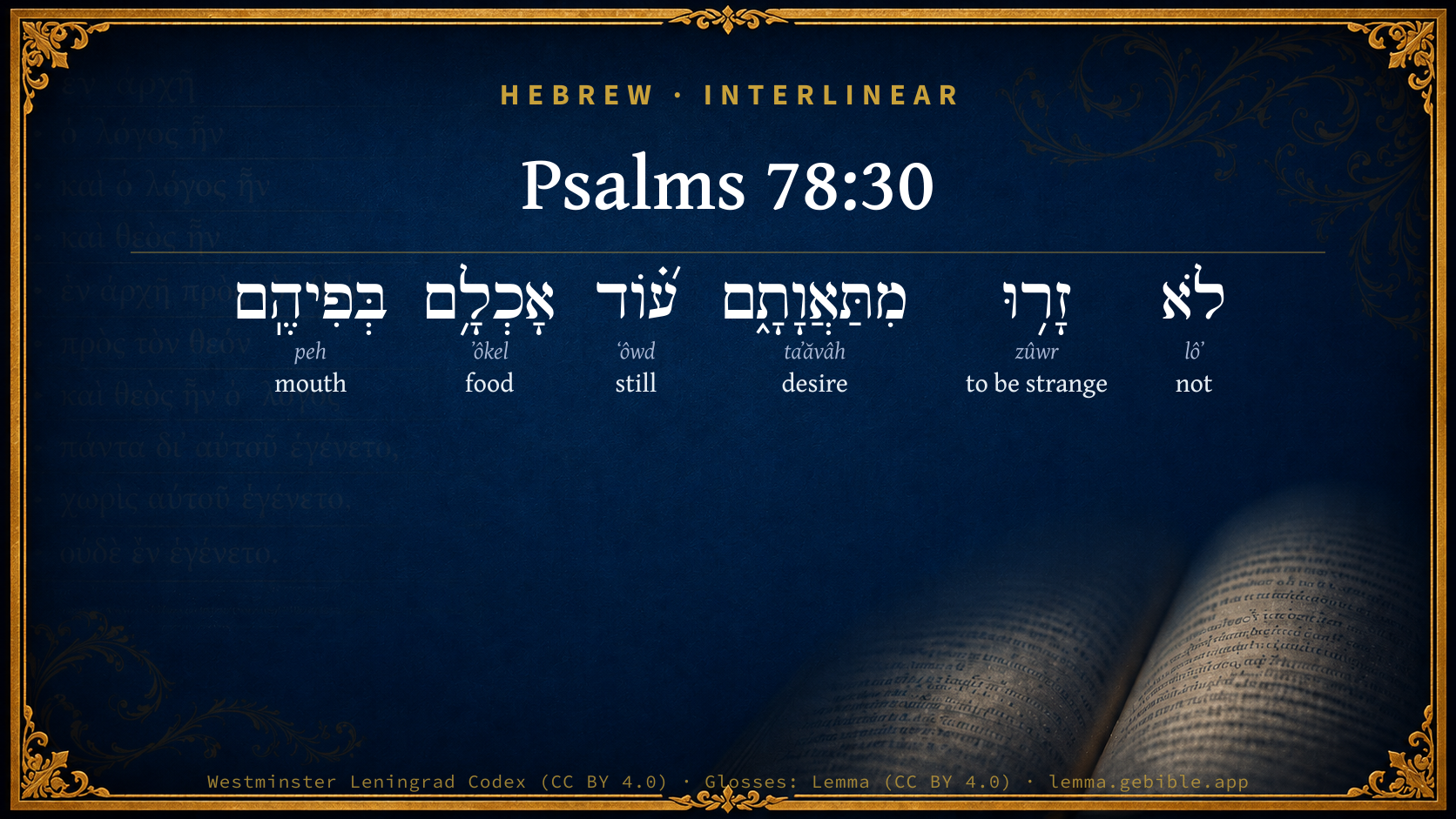
Psalms 78:30

Hebrew (Westminster Leningrad Codex) Psalms 78:30 appears in the Hebrew Old Testament. The text above is from the Westminster Leningrad Codex. Each word links to its Strong’s number, a concise gloss, and parsing drawn from the Open Scriptures Hebrew Bible morphology. Click any word for its full Brown-Driver-Briggs (BDB) entry.
Download image
Cite this verse

Psalms 78:30 (World English Bible). Public Domain. Lemma interlinear Bible study tool, https://lemma.gebible.app/v/psalms/78/30.

Show BibTeX & RIS
BibTeX
RIS
English Translation
They didn't turn from their cravings. Their food was yet in their mouths,
World English Bible · Public Domain
Download a study sheet

One document with this verse’s original text, its word-by-word gloss line, the meaning frame, cross-references with their text, attributed commentary, and full source and license credits — printable, and it pastes into notes with its structure intact.

This verse Autodidact and up

Study sheet (.html) Plain text (.txt)

A passage Seminary Student

Up to 50 verses in one chapter. A passage sheet keeps up to 6 commentary sources and 12 cross-references per verse, in the order this page ranks them, and says so on the sheet whenever that leaves anything out. Ask for a single verse and you get the Autodidact verse sheet above.

Everything on this page stays free to read, with no account — the sheet is a download of what is already on screen, not access to it.

Want to remove ads? Support Godless Engineer
Compare translations 3

The same verse in 3 English versions, stacked beneath the original-language interlinear above. Click any original word for its lexicon entry.

Each is an independent rendering of the whole verse — the interlinear is not word-aligned to these translations.

Highlighted words mark where these versions differ — a whole-verse word diff, not a word-by-word alignment.

  • World English Bible Public Domain
    They didn't turn from their cravings. Their food was yet in their mouths,
  • King James Version Public Domain
    They were not estranged from their lust. But while their meat was yet in their mouths,
  • unfoldingWord Literal Text CC BY-SA 4.0
    They were not separated from their craving, their food was still in their mouth,

unfoldingWord Literal Text — © unfoldingWord, licensed CC BY-SA 4.0. Word-aligned USFM3 via Door43 (git.door43.org/unfoldingWord/en_ult).

Versions to compare (up to 4)

3 of 4 selected

Show all 18 translations

Every available English version of this verse, each an independent rendering of the whole verse.

  • World English Bible Public Domain
    They didn't turn from their cravings. Their food was yet in their mouths,
  • Berean Standard Bible Public Domain
    Yet before they had filled their desire, with the food still in their mouths,
  • Majority Standard Bible Public Domain
    Yet before they had filled their desire, with the food still in their mouths,
  • King James Version Public Domain
    They were not estranged from their lust. But while their meat was yet in their mouths,
  • American Standard Version (1901) Public Domain
    They were not estranged from that which they desired, Their food was yet in their mouths,
  • Revised Version (1885) Public Domain
    They were not estranged from their lust, their meat was yet in their mouths,
  • Geneva Bible (1599) Public Domain
    They were not turned from their lust, but the meate was yet in their mouthes,
  • Douay-Rheims (1899) Public Domain
    they were not defrauded of that which they craved. As yet their meat was in their mouth:
  • Young's Literal Translation Public Domain
    They have not been estranged from their desire, Yet `is' their food in their mouth,
  • Literal Standard Version CC BY-SA 4.0
    They have not been estranged from their desire, || Their food [is] yet in their mouth,
  • Unlocked Literal Bible CC BY-SA 4.0
    But they had not yet filled up; their food was still in their mouths.
  • unfoldingWord Literal Text CC BY-SA 4.0
    They were not separated from their craving, their food was still in their mouth,
  • Darby Bible Public Domain
    They were not alienated from their lust, their meat was yet in their mouths,
  • World Messianic Bible Public Domain
    They didn’t turn from their cravings. Their food was yet in their mouths,
  • Webster's Bible Public Domain
    They were not estranged from their desire: but while their meat was yet in their mouths,
  • Free Bible Version CC BY-SA 4.0
    But before they satisfied their appetite, while the meat was still in their mouths,
  • Bible in Basic English Public Domain
    But they were not turned from their desires; and while the food was still in their mouths,
  • JPS Tanakh (1917) Public Domain
    They were not estranged from their craving, their food was yet in their mouths,

Literal Standard Version (2020), Covenant Press — licensed CC BY-SA 4.0. Text via the HelloAO Bible API (eBible.org). Unlocked Literal Bible (unfoldingWord) — licensed CC BY-SA 4.0. Text via the HelloAO Bible API (eBible.org). unfoldingWord Literal Text — © unfoldingWord, licensed CC BY-SA 4.0. Word-aligned USFM3 via Door43 (git.door43.org/unfoldingWord/en_ult). Free Bible Version, Dr. Jonathan Gallagher — licensed CC BY-SA 4.0. Text via the HelloAO Bible API (eBible.org).

Word by word

More ways to search: Search by grammar → Find every occurrence → Compare this word →

Practice this passage: Drill this verse → Learn its vocabulary →

About this verse

These counts appear in no published source. They are computed here, from the morphology-tagged text and Lemma’s own curated glosses. What Lemma adds →

6
words
6
distinct lemmas
Wisdom
section

Notable vocabulary

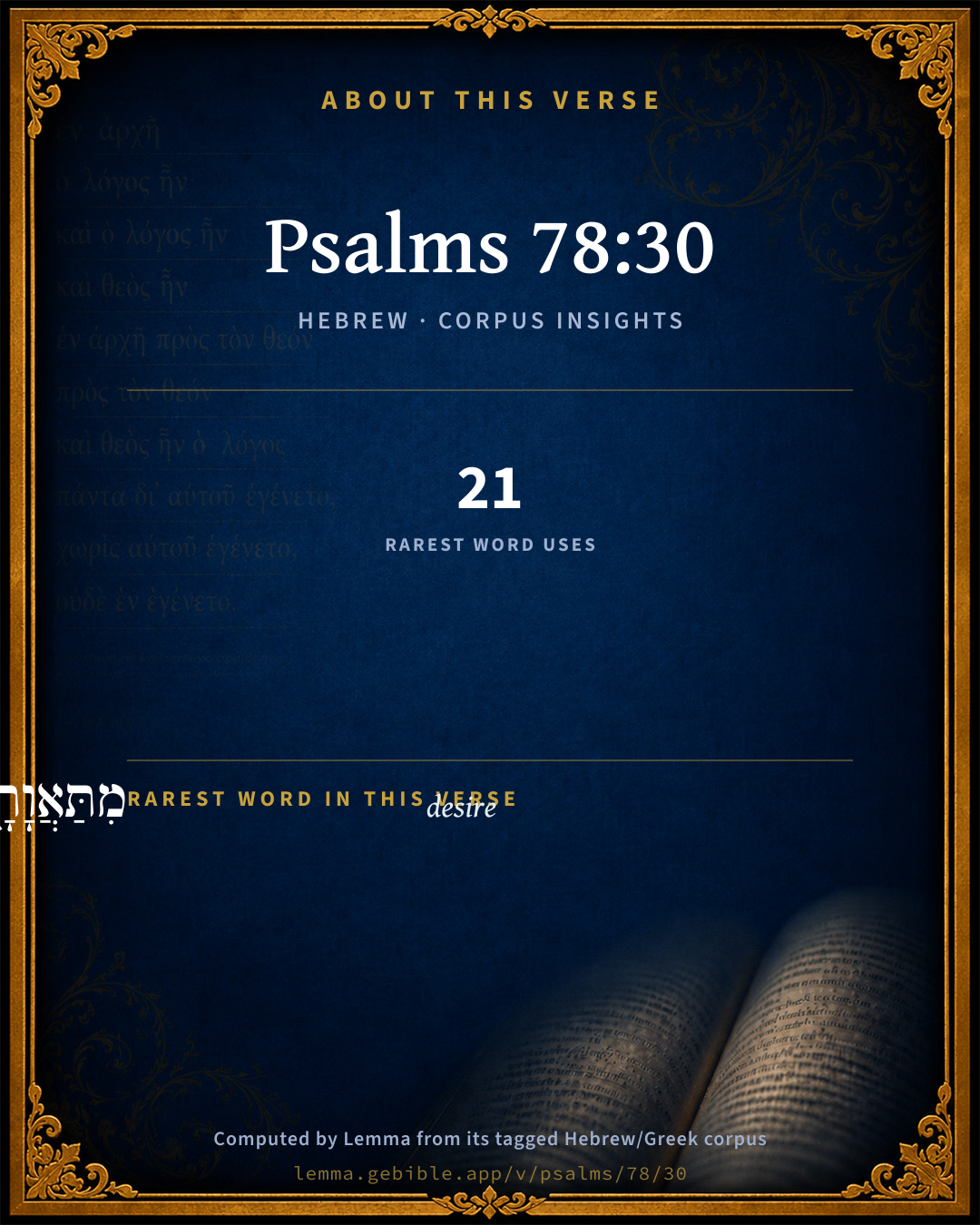
The rarest word here is מִתַּאֲוָתָ֑ם desire H8378 — appearing just 21 times in the whole Hebrew Bible.

Shared distinctive vocabulary

מִתַּאֲוָתָ֑ם desire H8378 occurs in 21 verses of the Hebrew Bible. Also found in:

Grammatical profile

  • 1 verb
  • 3 nouns
  • 1 adverb
  • 1 particle

Verb forms

  • זָר֥וּ Qal · Perfect

Hebrew & Septuagint length

In English translation the verse runs 13 words from the Hebrew and 16 from the Septuagint (LXX English) — closely comparable.

A rough comparison of the two English renderings, which tokenize alike — not a word-level alignment.

Word counts can differ between the Hebrew and the Greek without any difference in meaning — e.g. the Hebrew direct-object marker אֵת has no separate Greek word, and Greek often adds the article ὁ.

Cross-references

4

Topical passages linked to Psalms 78:30 in the Treasury of Scripture Knowledge — connected by theme and wording, ordered by reader-vote popularity; previews shown in the World English Bible.

  • Numbers 11:33–34 While the flesh was yet between their teeth, before it was chewed, the anger of Yahweh was kindled against the people, and Yahweh struck the people with a very great plague.
  • Numbers 22:20–22 God came to Balaam at night, and said to him, If the men are come to call you, rise up, go with them; but only the word which I speak to you, that shall you do.
  • Proverbs 1:32 For the backsliding of the simple will kill them. The careless ease of fools will destroy them.
  • Luke 16:19–23 "Now there was a certain rich man, and he was clothed in purple and fine linen, living in luxury every day.

Cross-references courtesy of OpenBible.info (CC BY 4.0).

Hebrew and Greek witnesses Masoretic Hebrew ↔ Greek Septuagint

The same verse in the two great witnesses to the Old Testament, shown verse-for-verse.

You’re reading Greek Psalm 77 (Hebrew Psalm 78). The Septuagint counts the superscription, so verse numbers can differ from the Hebrew — chapter-level alignment, not verse-by-verse. Numbering follows Rahlfs.

These are two independent witnesses, not word-aligned to each other, and the Septuagint is shown in lemma (dictionary) form.

Hebrew Psalms 78:30 Masoretic · Westminster Leningrad Codex

לֹא זָר֥וּ מִתַּאֲוָתָ֑ם ע֝֗וֹד אָכְלָ֥ם בְּפִיהֶֽם

They didn't turn from their cravings. Their food was yet in their mouths,

World English Bible · Public Domain

Greek LXX Greek Psalm 77:30 Septuagint · lemma form

οὐ στερέω ἀπό ὁ ἐπιθυμία αὐτός ἔτι ὁ βρῶσις αὐτός εἰμί ἐν ὁ στόμα αὐτός

They were not disappointed of their desire: but when their food was yet in their mouth,

LXX2012 (modern English Septuagint) · Public Domain

Hebrew: Westminster Leningrad Codex (CC BY 4.0). Greek: Septuagint (public domain); English from LXX2012 (modern English Septuagint) (Public Domain). How the Septuagint differs from the Hebrew →

Commentary

Notes on Psalms 78:30 from classic Christian and Jewish commentators (each source and its license shown beneath its notes). The classic Christian expositions comment on the surrounding passage and are grouped to its opening verse, so a note may address several verses; the Jewish commentaries on the Tanakh (Rashi and others) are per-verse, so they appear only where the commentator wrote on this verse.

Lemma curates 59 commentaries, every one of them public domain or Creative Commons licensed, each selected and text-cleaned for this edition rather than reprinted as found. About our sources →

Trapp's Complete Commentary

John Trapp

Psa 78:30 They were not estranged from their lust. But while their meat [was] yet in their mouths,

Ver. 30. They were not estranged from their lust] Satiated they were, but not satisfied. It is as easy to quench the fire of Aetna as the thoughts set on fire by lust.

John Trapp, A Commentary or Exposition upon All the Books of the Old and New Testament (1647–1656) — public domain. Text from a community e-Sword module.

The Biblical Illustrator

Joseph S. Exell

Psa_78:30-31

They were not estranged from their lust.

Dissatisfaction with plenty

God gave them plenty, and they ate and were filled. He gave them what they sought, flesh; feathered birds came in abundance. Notwithstanding, they were not satisfied, were not estranged from their lust; they had still a craving for something more. Here is dissatisfaction with plenty.

I. This is a very prevalent experience. Men in plenty are everywhere in dissatisfaction. Where there is

(1) Plenty of food,

(2) Plenty of money,

(3) Plenty of books,

(4) Plenty of popularity,

(5) Plenty of amusements, men cry everywhere, Who will show us any good?

II. This is a very suggestive experience. It implies--

1. Something bad that is existing. Conflicting passions, compunctive consciences, moral forebodings within, prevent the possibility of satisfaction.

2. Something good that is lacking. What is the deep hunger of the soul? God. (Homilist.)

But while their meat was yet in their mouths, the wrath of God came upon them, and slew the fattest of them.

Kibroth Hattaavah

Fleshly lust not only wars against but kills men.

I. Slays physically. An inordinate gratification of animal appetites saps the constitution and brings the body to a premature grave.

II. Slays intellectually. It slays the elasticity, the freedom, the vigour of the intellect. How often, in the case of the gourmand and the voluptuary, does the brain run into fat, and the whole intellect into greasy mud.

III. Slays morally. It slays--

1. Purity of love.

2. Tenderness of conscience.

3. Force of moral purpose. (Homilist.)

The Biblical Illustrator, edited by Joseph S. Exell (c. 1880s–1900s) — public domain. Text from a community e-Sword module.

The Treasury of David

Charles H. Spurgeon

Ver. 30-31. They were not estranged from their lust. Lust grows upon that which it feeds on. If sick of too much flesh, yet men grow not weary of lust, they change the object, and go on lusting still. When one sin is proved to be a bitterness, men do not desist, but pursue another iniquity. If, like Jehu, they turn from Baal, they fall to worshipping the calves of Bethel.

But while their meat was yet in their mouths, before they could digest their coveted meat, it turned to their destruction.

The wrath of God came upon them before they could swallow their first meal of flesh. Short was the pleasure, sudden was the doom. The festival ended in a funeral.

And slew the fattest of them, and smote down the chosen men of Israel. Perhaps these were the ringleaders in the lusting; they are first in the punishment. God's justice has no respect of persons, the strong and the valiant fall as well as the weak and the mean. What they ate on earth they digested in hell, as many have done since. How soon they died, though they felt not the edge of the sword! How terrible was the havoc, though not amid the din of battle! My soul, see here the danger of gratified passions; they are the janitors of hell. When the Lord's people hunger God loves them; Lazarus is his beloved, though he pines upon crumbs; but when he fattens the wicked he abhors them; Dives is hated of heaven when he fares sumptuously every day. We must never dare to judge men's happiness by their tables, the heart is the place to look at. The poorest starveling believer is more to be envied than the most full fleshed of the favourites of the world. Better be God's dog than the devil's darling.

Ver. 30. They were not estranged from their lust. This implies, that they were still burning with their lust. If it is objected that this does not agree with the preceding sentence, where it is said, that "they did eat, and were thoroughly filled, "I would answer, that if, as is well known, the minds of men are not kept within the bounds of reason and temperance, they become insatiable; and, therefore, a great abundance will not extinguish the fire of a depraved appetite. John Calvin.

Ver. 30. They were not estranged from their lust. Satiated they were, but not satisfied. It is as easy to quench the fire of Etna, as the thoughts set on fire by lust. John Trapp.

Ver. 30. They were not estranged from their lust. Consider that there is more real satisfaction in mortifying lusts than in making provision for them or in fulfilling them: there's more true pleasure in crossing and pinching our flesh than in gratifying it; were there any true pleasure in sin, hell would not be hell, for the more sin, the more joy. You cannot satisfy one lust if you would do your utmost, and make yourself never so absolute a slave to it; you think if you had your heart's desire you would be at rest: you much mistake; they had it. Alexander Carmichael.

Ver. 30-31. They were not estranged from their lust. See Psalms on "Ps 78:30" for further information.

Charles H. Spurgeon's The Treasury of David (1869–1885) — public domain. Psalms only. Text from a community e-Sword/MySword module.

Joseph Benson's Commentary

Psa 78:30-31. They were not estranged from their lust, &c. — Green translates the verse, But before they were averse to what they had desired, and while their meat was still in their mouths, the wrath of God, &c. The sense is, either, 1st, While their greedy appetite yet continued, and was not fully satisfied; before they began to loathe the meat, as they did afterward, Num 11:20. Or, 2d, Before they were deprived of their desired food; while they enjoyed it, and were still feeding upon it, as the next clause explains this, the wrath of God came upon them — His patience did not wait till that food was spent, but he instantly let loose his wrath to punish them; and slew the fattest of them — The Hebrew word is rendered by Green, the wealthiest of them. Or, it may mean, the most healthy and strong, who probably were most desirous of this food, fed most eagerly upon it, and least suspected their own danger. And smote down — By a very great pestilence, the chosen men of Israel — The strongest and goodliest persons that were in Israel.

Joseph Benson's Commentary on the Old and New Testaments (1811–1818) — public domain. Text from a community e-Sword module.

J. A. Alexander on Psalms

Joseph Addison Alexander

30. (Psa 78:30) They were not (yet) estranged from their desire; still (was) their food in their mouth. This is merely the protasis or conditional clause of the sentence completed in the next verse. The first clause does not mean that the food had not begun to pall upon their appetite, but, as the other clause explains it, that it was still in their possession, in their very mouths, when God smote them. Compare Num 11:33.

Joseph Addison Alexander, The Psalms Translated and Explained (1850) — public domain. Text from a community e-Sword module.

Geneva Bible (1599)

Geneva Bible translators

Such is the nature of concupiscence, that the more it hath, the more it lusteth.

Geneva Bible (1599) marginal notes — public domain. Text via Bolls.life.

John Calvin's Commentaries

The Psalmist expresses this still more clearly, by adding immediately after, (verses 30, 31,) that this pampering proved fatal to them, as if with the meat they had swallowed the flame of the divine wrath. When he says that they were not estranged from their lust, this implies, that they were still burning with their lust. If it is objected that this does not agree with the preceding sentence, where it is said, that “they did eat, and were thoroughly filled,” I would answer, that if, as is well known, the minds of men are not kept within the bounds of reason and temperance, they become insatiable; and, therefore, a great abundance will not extinguish the fire of a depraved appetite. Some translate the clause, They were not disappointed, and others, They did not yet loathe their meat. This last translation brings out the meaning very well; but it is too far removed from the signification of the Hebrew word זור, zur, which I have rendered estranged. The prophet intended to express in two words a present felt pleasure; for when God executed vengeance upon the people, they still indulged in the excessive gratification of the palate. The wrath of God is said metaphorically to ascend, when he suddenly rises up to execute judgment; for when he apparently shuts his eyes and takes no notice of our sins, he seems, so to speak, to be asleep. The punishment was felt by persons of every condition among the Israelites; but the fat ones and the chosen are expressly named, in order to exhibit the judgment of God in a light still more conspicuous. It did not happen by chance that the most robust and vigorous were attacked and cut off by the plague. As the strong are commonly deceived by their strength, and proudly exalt themselves against God, forgetting their own weakness, and thinking that they may do whatever they please, it is not surprising to find that the wrath of God burned more fiercely against such persons than against others.

John Calvin's Commentaries (1540-1563) — public domain. Text from the Calvin Translation Society English edition (1840s-50s) via the Christian Classics Ethereal Library (ccel.org). Calvin's coverage is partial (roughly two-thirds of the Bible); uncommented books and verses are honest gaps, never fabricated. The 19th-century editor's footnotes and remarks are omitted so the notes are faithfully Calvin's own voice.

Ellicott's Commentary for English Readers

(30, 31) Evidently from Num_11:33, They did not yet loath in consequence of their lusts, the meat was yet in their mouths when, &c. For the expression, comp. the Latin alienari ab aliqua re, to be disinclined to a thing, and our own “stranger to fear,” &c

A Bible Commentary for English Readers, edited by Charles John Ellicott (1878–1897) — public domain. Text from a community e-Sword module.

The Cambridge Bible for Schools and Colleges

gen. ed. J. J. S. Perowne

30. They were not estranged from their lust,

Their food was yet in their mouth,

The Cambridge Bible for Schools and Colleges (gen. ed. J. J. S. Perowne; Cambridge University Press, 1878–1918) — public domain. Text from a community e-Sword module.

John Gill's Exposition

The wrath of God came upon them,.... Either by causing fire to come down from heaven, or by suffering them to be surfeited by excessive eating, or by sending a plague among them; see Num 11:33,

and slew the fattest of them; such perhaps who had been most guilty of the sin of gluttony, and had fed the most inordinately upon the flesh that was sent them; or this designs the chief among their princes and nobles, though not only them, but them as well as the common people; so the Targum,

"and slew their mighty ones:''

or the words may be rendered, "and slew them among their fatness", or "fat things" (o); while they were feeding on their feast of fat things, the fat quails, which were brought among them, in such plenty; for the quail is a very fat bird, as Kimchi observes (p):

and smote down the chosen men of Israel; or the young men, as the Targum, who were within the twentieth and fiftieth year of their age; who were chosen and fit for war within that time, as well as were the choicest for comeliness, strength, and service; or "made" them "to bow" (q) to death and the grave; whose power they could not withstand, though in the prime and vigour of youth, and while they were freely and heartily feeding upon the food they lusted after.

(o) "in opimis ipsorum", Cocceius; "inter pinguedines eorum", Michaelis. (p) In Sepher Shorashim, rad. (q) "incurvavit", Pagninus, Montanus.

John Gill's Exposition of the Whole Bible (1746–1763) — public domain (CC PDM 1.0). Text via the HelloAO Bible API.

Albert Barnes' Notes on the Bible

They were not estranged from their lust - literally, “They were not made strangers to;” that is, in regard to their lusts or desires they were not in the condition of “foreigners” or aliens; they were not separated from them. The word “lusts” here means “desires, wishes.” It is not used here in the restricted sense in which it is now with us. The reference is to their desire for food different from manna - for flesh; and the idea is, that they did not restrain their intense desire even when it should have been fully satisfied. They indulged to excess, and the consequence was that many of them perished.

But while their meat was yet in their mouths - Even while they were eating, and were indulging in this unrestrained manner.

Albert Barnes' Notes on the Bible (1834–1885) — public domain. Text from a community e-Sword/MySword module.

Matthew Poole's English Annotations

The sense is either,

1. Whilst their greedy appetite yet continued, and was not fully satisfied, before, they began to loathe it, as they did afterwards, Num 11:20. Or,

2. Before they were deprived or destitute of their desired food, whim they enjoyed it, and were still feeding upon it, as the next clause explains this. God’s patience did not wait upon them till that food was spent, but fell upon them instantly.

Matthew Poole's English Annotations on the Holy Bible (1683–1685) — public domain. Text from a community e-Sword/MySword module.

Whedon's Commentary on the Bible

Daniel D. Whedon

30. They were not estranged from their lust—Indulgence never cures unlawful appetites, nor awakens gratitude to God.

Daniel D. Whedon (gen. ed.), Commentary on the Old and New Testaments (1874–1909) — public domain. Text from a community e-Sword module.

The Pulpit Commentary

They were not estranged from their lust; i.e. their lust was not yet satiated they were still indulging it. The meat was yet in their mouths, still undergoing mastication, when

The Pulpit Commentary (1880–1919), ed. H.D.M. Spence-Jones & Joseph S. Exell — public domain. Text from a community e-Sword module.

Rashi

Rabbi Shlomo Yitzchaki (Rashi)

They were not estranged from their desire They did not become estranged from their desire, for they achieved all their desire.

Another explanation: לא זרוּ מתאותם They were not distanced from their desire until the retribution came upon them. “While their food was still in their mouth, the wrath of the Lord (sic), etc.”

Rashi on the Tanakh — English translations: “The Judaica Press complete Tanach with Rashi, translated by A. J. Rosenberg” (CC BY 4.0); “Pentateuch with Rashi's commentary by M. Rosenbaum and A.M. Silbermann, 1929-1934” (public domain); “The Metsudah Tanach series, Lakewood, N.J” (CC BY 4.0); and “The Book of Joshua, Metsudah Publications, 1997” (CC BY 4.0). Text via Sefaria.

Lesson kit

Teaching starters — assembled from the data on this page, not authored interpretation. Every prompt links to the verse data it draws on. Edit before teaching.

Psalms, in the Wisdom, opens this verse with 6 words (6 distinct Hebrew lemmas). Its most distinctive word is taʼăvâh (“desire”). A historical commentator’s framing appears above. Read the whole chapter for the surrounding context.

Discussion questions

  1. How does “desire” (taʼăvâh) shape what this verse is saying?
  2. Genesis 3:6 shares the word «desire» with this verse. How do the two illuminate each other?
  3. These translations render this verse differently. What is at stake in choosing one wording over another?
  4. The verb «זָר֥וּ» is Qal Perfect. How does its form color the action?
  5. Reading how Trapp's Complete Commentary and The Biblical Illustrator read this verse, where do the two commentators agree and where do they part?

Things to notice

Reading settings

Reading text

Shown beneath each verse's original-language words.

Old Testament
Old Testament edition

Read the OT as the Masoretic Hebrew (MT) or the Greek Septuagint (LXX).

English shown for the Greek Septuagint (in the Hebrew ↔ Greek comparison).

Comparing translations? Open the Compare panel on any verse page to stack up to four side by side.