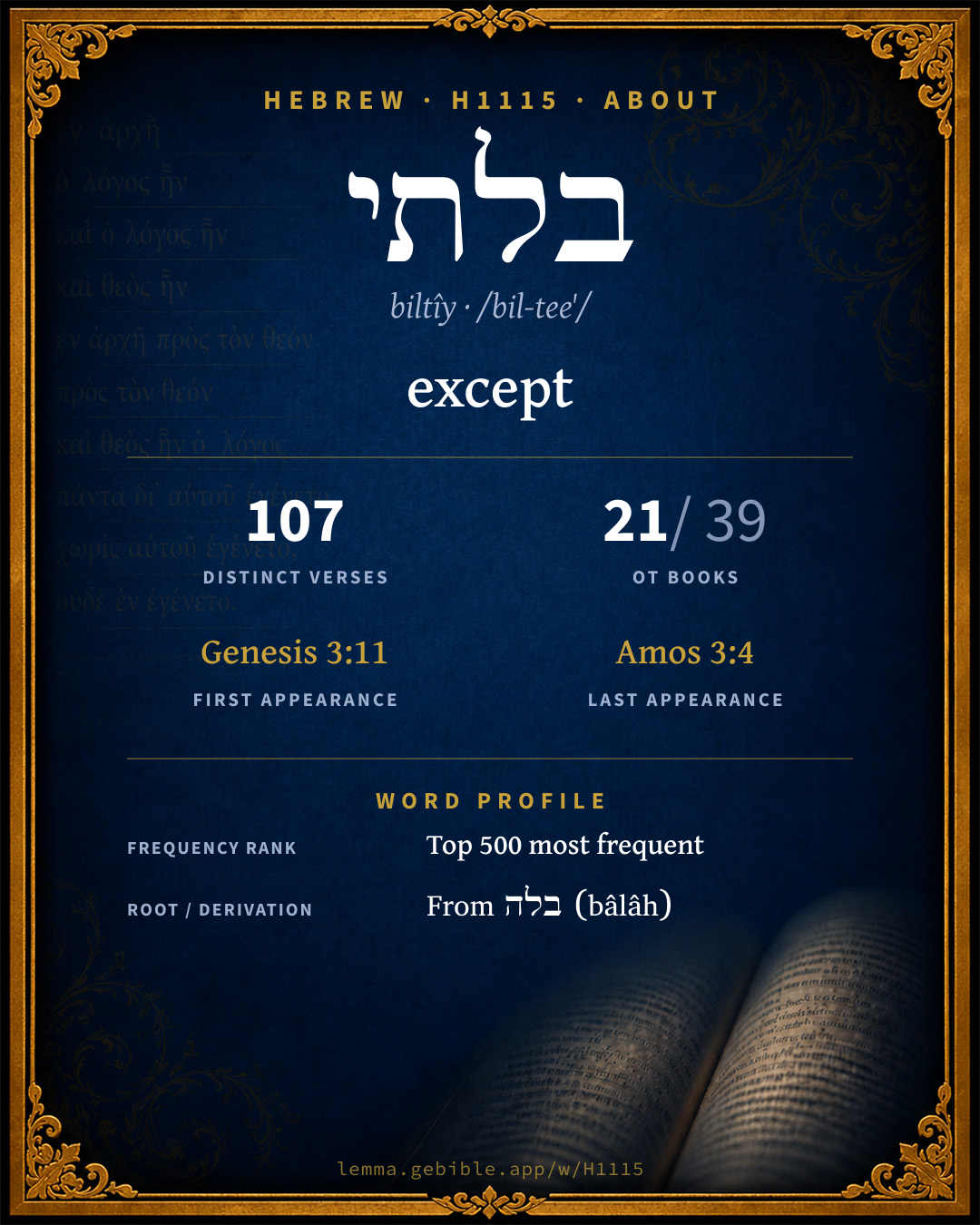
בִּלְתִּי
except
‘except’ is one of 7 main senses fuller range ↓
Full lexicon entry — Brown-Driver-Briggs (BDB)
From Brown-Driver-Briggs (BDB)
Where this word appears
Grammar key — what these labels mean
Part of speech
- Conjunction
- A joining word (e.g. “and,” “but”) linking words or clauses.
- Preposition
- A relational word (e.g. “in,” “to,” “from”) governing a noun.
Every verse where H1115 appears in the Book of Ezekiel — 14 distinct verses. Click any verse to open its interlinear word-by-word view. Verse text shown in the World English Bible for context — . Each verse’s Hebrew form is shown with its reference; the English is not keyword-highlighted, since the data carries no word-level English alignment. Use “Compare translations” on any verse to read it across multiple English versions. This concordance covers the Hebrew Bible; Septuagint (Greek Old Testament) occurrences are not indexed here.
Ezekiel
- Ezekiel 3:21 לְ/בִלְתִּ֥י prep + conj Nevertheless if you warn the righteous man, that the righteous not sin, and he does not sin, he shall surely live, because he took warning; and you have delivered your soul.
- Ezekiel 13:3 וּ/לְ/בִלְתִּ֥י conj + prep + ptcl neg Thus says the Lord Yahweh, Woe to the foolish prophets, who follow their own spirit, and have seen nothing!
- Ezekiel 13:22 לְ/בִלְתִּי prep + conj Because with lies you have grieved the heart of the righteous, whom I have not made sad; and strengthened the hands of the wicked, that he should not return from his wicked way, and be saved alive:
- Ezekiel 16:28 מִ/בִּלְתִּ֖י prep + ptcl neg You have played the prostitute also with the Assyrians, because you were insatiable; yes, you have played the prostitute with them, and yet you weren't satisfied.
- Ezekiel 17:14 לְ/בִלְתִּ֖י prep + conj that the kingdom might be base, that it might not lift itself up, but that by keeping his covenant it might stand.
- Ezekiel 20:9 לְ/בִלְתִּ֥י prep + conj But I worked for my name's sake, that it should not be profaned in the sight of the nations, among which they were, in whose sight I made myself known to them, in bringing them forth out of the land of Egypt.
- Ezekiel 20:14 לְ/בִלְתִּ֤י prep + conj But I worked for my name's sake, that it should not be profaned in the sight of the nations, in whose sight I brought them out.
- Ezekiel 20:15 לְ/בִלְתִּי֩ prep + conj Moreover also I swore to them in the wilderness, that I would not bring them into the land which I had given them, flowing with milk and honey, which is the glory of all lands;
- Ezekiel 20:22 לְ/בִלְתִּ֤י prep + conj Nevertheless I withdrew my hand, and worked for my name's sake, that it should not be profaned in the sight of the nations, in whose sight I brought them forth.
- Ezekiel 22:30 לְ/בִלְתִּ֣י prep + conj I sought for a man among them, who should build up the wall, and stand in the gap before me for the land, that I should not destroy it; but I found none.
- Ezekiel 24:8 לְ/בִלְתִּ֖י prep + conj That it may cause wrath to come up to take vengeance, I have set her blood on the bare rock, that it should not be covered.
- Ezekiel 29:15 לְ/בִלְתִּ֖י prep + conj It shall be the base of the kingdoms; neither shall it any more lift itself up above the nations: and I will diminish them, that they shall no more rule over the nations.
- Ezekiel 33:15 לְ/בִלְתִּ֖י prep + conj if the wicked restore the pledge, give again that which he had taken by robbery, walk in the statutes of life, committing no iniquity; he shall surely live, he shall not die.
- Ezekiel 46:20 לְ/בִלְתִּ֥י prep + conj He said to me, This is the place where the priests shall boil the trespass-offering and the sin-offering, [and] where they shall bake the meal-offering; that they not bring them forth into the outer court, to sanctify the people.
About this entry
At a glance — auto-summarized from this page’s data, not written by a person. Every figure links to its source below. This summary describes the numbers; it doesn’t interpret them.
בלתי — transliterated biltîy — is a Hebrew word carrying the sense “except.” BDB distinguishes 7 senses for it. Spanning 107 verses in 21 books, it ranks among the common words of the Hebrew Bible. Its earliest occurrence is Genesis 3:11. Sharing its root, it stands alongside בלה, בל and בלא. Each statement above links to its evidence; the full detail follows below.
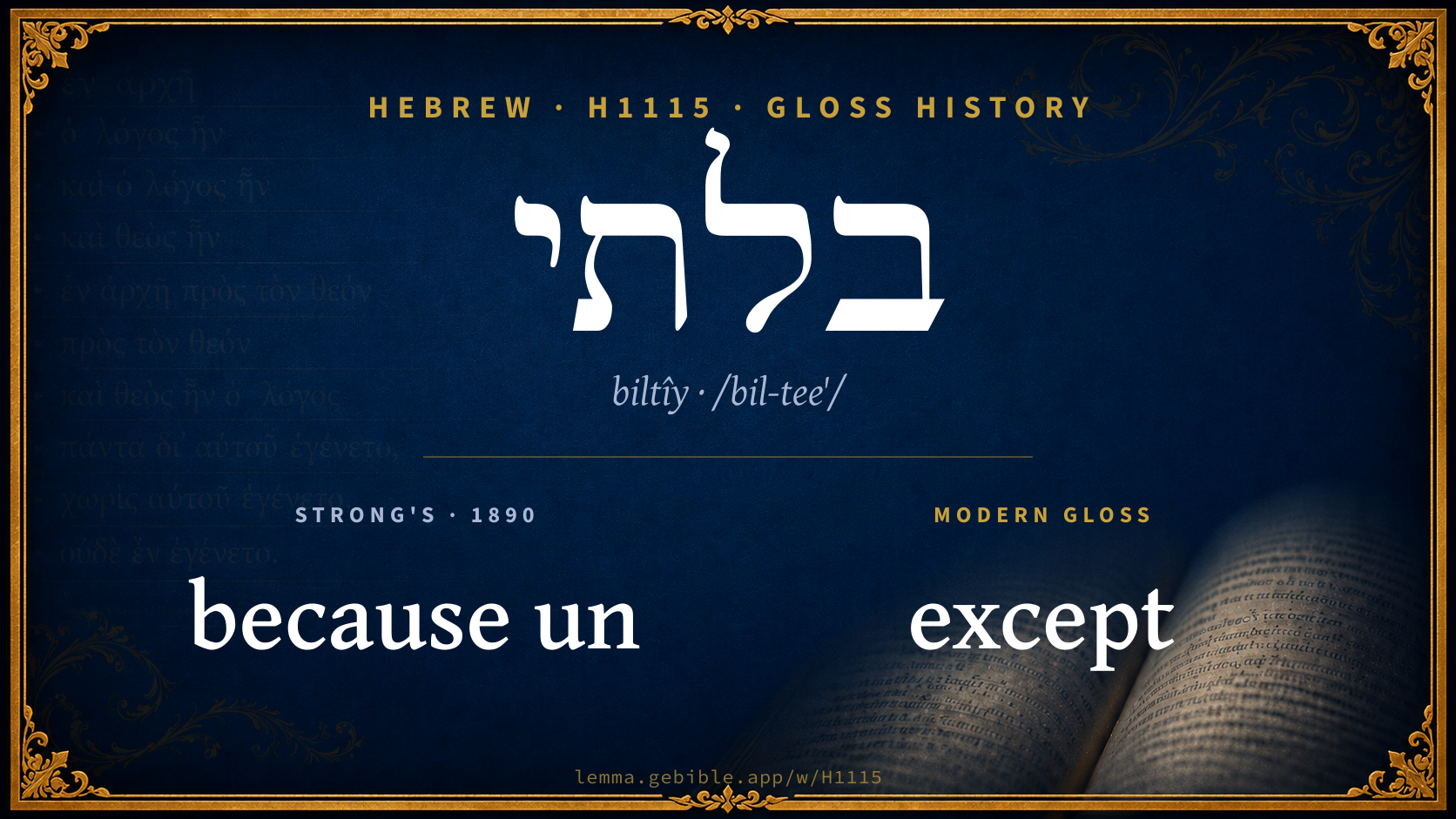
Gloss history
Strong's 1890 vs modern scholarship
About this word
Strong's H1115 catalogs a Hebrew word from the Hebrew Old Testament.
These counts are not copied from any lexicon or concordance. They are computed here, from the morphology-tagged Hebrew Old Testament. What Lemma adds →
- 107
- distinct verses
- The word appears in 107 distinct verses.
- 21 / 39
- OT books
- The word appears in 21 of 39 Old Testament books.
- #387
- by frequency
- Top 500 most frequent Hebrew words (rank 387 of 8,640 Hebrew words by occurrence).
View all 107 occurrences in the concordance →
By section of the Old Testament
By traditional corpus
Conventional, traditional groupings — biblical authorship is debated, so this is a traditional corpus grouping, not an authorship claim. Each share is this word’s portion of its verses in that division of the Hebrew canon. Each figure is a share of the word’s 107 distinct verses.
- Prophets (Nevi'im) 70 verses · 65%
- Torah (Pentateuch) 28 verses · 26%
- Writings (Ketuvim) 9 verses · 8%
How translations render this word
Counts come from each version’s own published word-to-Strong’s tagging or interlinear alignment — an approximate guide to how each version renders this word, not a word-level alignment the data otherwise carries. Because each total is that version’s own tagged count, the per-version totals vary from one another and need not match the appearance or distinct-verse counts above. These counts may also differ from a printed concordance because Lemma counts each distinctly tagged rendering and does not collapse phrase taggings into a single head-word total. This is a fixed set of word-tagged versions (KJV, ASV, BSB, ULT) and does not change with the reading translation you choose elsewhere. Each version’s license is shown beside its name below (and on Sources).
- King James Version: No 3×, Not 3×, Except 2×
- American Standard Version: No 3×, Except 2×, Lest 2×
- Berean Standard Bible: Not 16×, No 12×, Nothing 4×
- unfoldingWord Literal Text: Not 50×, That 10×, Except 6×
King James Version Public Domain
Renders H1115 across 30 tagged occurrences — most commonly:
Plus 16 renderings that appear only once — usually multi-word phrases or single function words the recovered tagging swept in, not distinct renderings.
American Standard Version Public Domain
Renders H1115 across 30 tagged occurrences — most commonly:
Plus 19 renderings that appear only once — usually multi-word phrases or single function words the recovered tagging swept in, not distinct renderings.
Berean Standard Bible Public Domain
Renders H1115 across 104 tagged occurrences — most commonly:
Plus other, less common renderings. Plus 46 renderings that appear only once — usually multi-word phrases or single function words the recovered tagging swept in, not distinct renderings. Not rendered by a distinct English word in 4 further occurrences.
unfoldingWord Literal Text CC BY-SA 4.0
Renders H1115 across 113 tagged occurrences — most commonly:
Plus 20 renderings that appear only once — usually multi-word phrases or single function words the recovered tagging swept in, not distinct renderings.
7 senses in BDB, in lexicon order
The 7 senses BDB distinguishes for this word, in lexicon order (not ranked by frequency or importance). The full entry — with sub-senses — is in the Lexicon Entry tab.
- not, except (substantive)
- not (adverb)
- except (after preceding negation) (adverb)
- except (after an implied or expressed negation) (conjunction)
- so as not, in order not (with preposition)
- an account of not, because...not (with preposition)
- until not (with preposition)
Word origin
Derived from בלה (bâlâh) (H1086) — to wear out.
Jastrow Dictionary
A second Hebrew/Aramaic lexicon for comparison, covering Aramaic and post-biblical (Talmudic, Targumic, Midrashic) usage that the biblical-Hebrew BDB does not. Matched by lemma rather than by Strong’s number, so a lemma may carry more than one Jastrow headword (shown separately below), and the entries cover usage well beyond the Bible.
בַּלְתִּי
- Beth-Baltin &c., v. בִּירָם. R. Hash. II, 4 (22ᵇ; Ms. M. בילתי, בלתי; v. Rabb. D. S. c. l. note). Ib. 23ᵃ bot. מאי בית ב׳ (Ms. M. 1 בילתי, 2 בלחי, Ms. L. בילתין) what is B. B.? Answ. בירם.
A Dictionary of the Targumim, the Talmud Babli and Yerushalmi, and the Midrashic Literature (Marcus Jastrow; London, Luzac, 1903) — Public Domain. Digitized via Sefaria. Digitized via Sefaria. Full attribution on Sources.
Forms in the corpus
The 28 distinct written forms H1115 takes in the Hebrew Bible, most frequent first — each parse links to that state’s occurrences in the concordance. Hebrew forms include their vowel points and cantillation, so a single lemma takes many written forms.
| Form | Parsing | Example | Uses |
|---|---|---|---|
| לְ/בִלְתִּ֖י | Conjunction | Daniel 9:11 | 19 |
| לְ/בִלְתִּ֥י | Conjunction | Exodus 8:22 | 15 |
| בִּלְתִּ֥י | Conjunction | Daniel 11:18 | 12 |
| לְ/בִלְתִּ֤י | Conjunction | Deuteronomy 4:21 | 8 |
| לְ/בִלְתִּ֣י | Conjunction | Ezekiel 22:30 | 7 |
| לְ/בִלְתִּ֛י | Conjunction | Genesis 19:21 | 6 |
| בִּלְתִּ֖י | Conjunction | Amos 3:3 | 5 |
| לְ/בִלְתִּי | Conjunction | Ezekiel 13:22 | 5 |
| לְ/בִלְתִּ֨י | Conjunction | Deuteronomy 8:11 | 4 |
| וּ/לְ/בִלְתִּ֛י | Preposition | Jeremiah 33:20 | 3 |
| לְ/בִלְתִּ֗י | Conjunction | 1 Kings 15:17 | 3 |
| לְ/בִלְתִּ֧י | Conjunction | 2 Samuel 14:7 | 3 |
| לְ/בִלְתִּי֙ | Conjunction | Deuteronomy 12:23 | 3 |
| בִּלְתִּ֣י | Conjunction | Isaiah 14:6 | 2 |
| וּ/לְ/בִלְתִּ֥י | Particle, Negative | Ezekiel 13:3 | 2 |
| לְ/בִ֨לְתִּי | Conjunction | 1 Kings 11:10 | 2 |
| לְ/בִלְתִּ֞י | Conjunction | Job 42:8 | 2 |
| בִּלְתִּ֗י | Conjunction | Judges 7:14 | 1 |
| בִּלְתִּ֞י | Conjunction | Numbers 32:12 | 1 |
| בִּלְתִּ֤י | Conjunction | Isaiah 10:4 | 1 |
| בִּלְתִּֽ/י | Preposition | Hosea 13:4 | 1 |
| בִּלְתֶּ֑/ךָ | Conjunction | 1 Samuel 2:2 | 1 |
| וּ/לְ/בִלְתִּ֖י | Particle, Negative | Jeremiah 17:23 | 1 |
| וּ/לְ/בִלְתִּ֣י | Particle, Negative | Jeremiah 17:27 | 1 |
| וּ/לְ/בִלְתִּי | Conjunction | Deuteronomy 4:21 | 1 |
| לְ/בִלְתִּי֩ | Conjunction | Ezekiel 20:15 | 1 |
| מִ/בִּלְתִּ֖י | Particle, Negative | Ezekiel 16:28 | 1 |
| מִ/בִּלְתִּ֞י | Particle, Negative | Numbers 14:16 | 1 |
Same root — word family
Other BDB entries built from the same root as H1115, grouped by Strong’s listed origin. These share a root / origin per the lexicon — not necessarily a shared meaning. Each links to that word’s own entry.
Derives from
Shares the same root
- בל bal H1077 not
- בלא bᵉlâʼ H1080 to wear out
- בלה bâleh H1087 worn out
- בלו bᵉlôw H1093 tribute
- בלוא bᵉlôwʼ H1094 rags
- בלי bᵉlîy H1097 without
- תבלית tablîyth H8399 destruction
Compare all same-root words → Showing 4 of 9 — not the complete family. They share a root, not necessarily a meaning.
Septuagint verse parallels
This word appears in 104 verses that also exist in the Greek Old Testament (Septuagint), out of the 107 Hebrew verses it occurs in. You can read those verses in Greek by switching the Old Testament edition to the Septuagint.
Read these verses in the Septuagint
- Genesis 3:11
- Exodus 8:22
- Leviticus 18:30
- Numbers 9:7
- Deuteronomy 3:3
- Joshua 5:6
- Judges 2:23
- Ruth 1:13
- 1 Samuel 2:2
- 2 Samuel 14:7
- 1 Kings 6:6
- 2 Kings 10:11
This is a verse-level parallel only — the same verses exist in both the Hebrew and Greek Old Testaments. No word-level Hebrew↔Greek correspondence is claimed: the data carries no such alignment, so no Greek word is shown as this Hebrew word’s translation. Coverage is not total — the Septuagint omits the deuterocanon and renumbers the Psalms, so some Hebrew verses have no direct Greek parallel.