
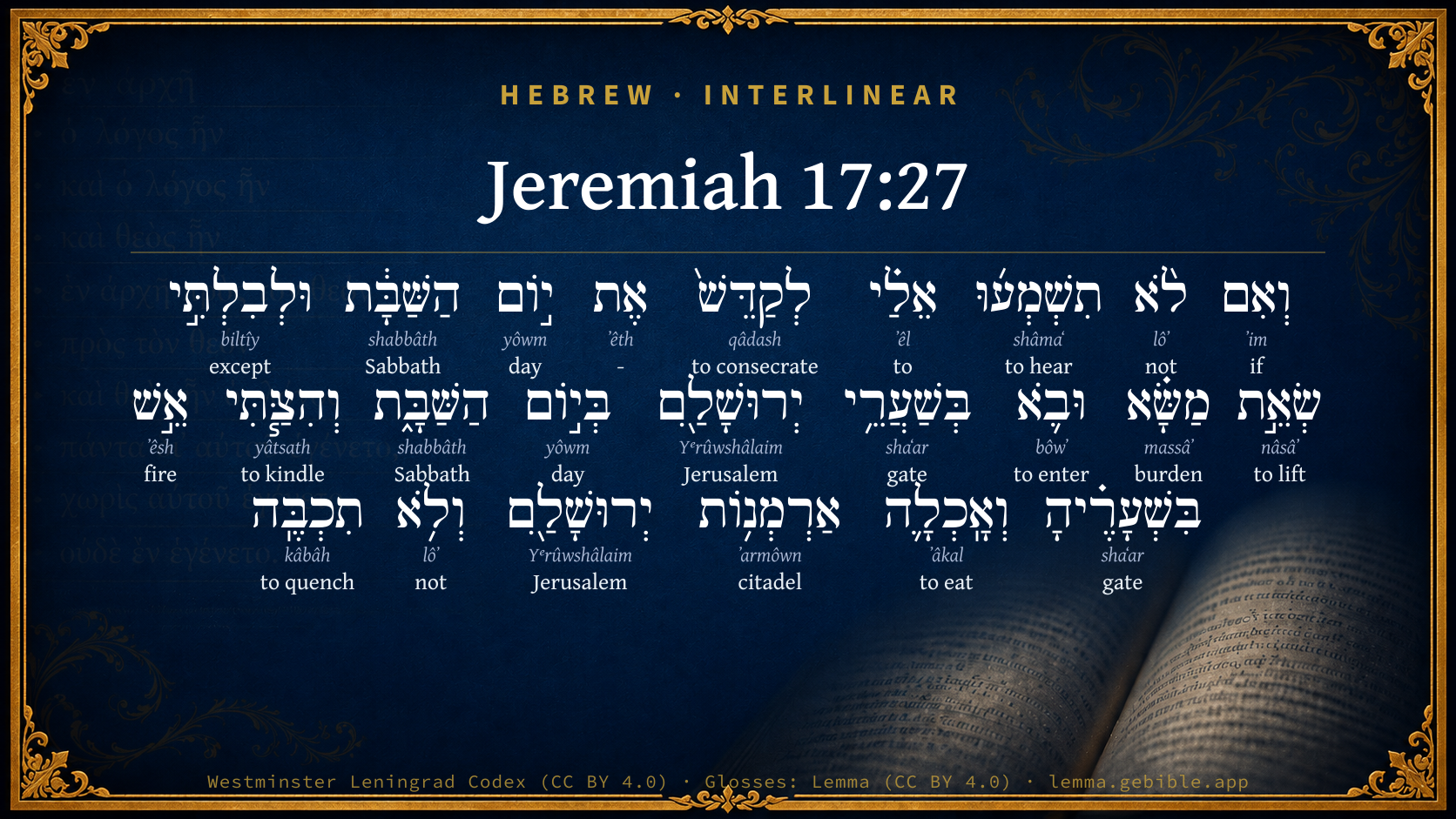
Jeremiah 17:27

Hebrew (Westminster Leningrad Codex) Jeremiah 17:27 appears in the Hebrew Old Testament. The text above is from the Westminster Leningrad Codex. Each word links to its Strong’s number, a concise gloss, and parsing drawn from the Open Scriptures Hebrew Bible morphology. Click any word for its full Brown-Driver-Briggs (BDB) entry.
Download image
Cite this verse

Jeremiah 17:27 (World English Bible). Public Domain. Lemma interlinear Bible study tool, https://lemma.gebible.app/v/jeremiah/17/27.

Show BibTeX & RIS
BibTeX
RIS
English Translation
But if you will not listen to me to make the Sabbath day holy, and not to bear a burden and enter in at the gates of Jerusalem on the Sabbath day; then will I kindle a fire in the gates of it, and it shall devour the palaces of Jerusalem, and it shall not be quenched.
World English Bible · Public Domain
Download a study sheet

One document with this verse’s original text, its word-by-word gloss line, the meaning frame, cross-references with their text, attributed commentary, and full source and license credits — printable, and it pastes into notes with its structure intact.

This verse Autodidact and up

Study sheet (.html) Plain text (.txt)

A passage Seminary Student

Up to 50 verses in one chapter. A passage sheet keeps up to 6 commentary sources and 12 cross-references per verse, in the order this page ranks them, and says so on the sheet whenever that leaves anything out. Ask for a single verse and you get the Autodidact verse sheet above.

Everything on this page stays free to read, with no account — the sheet is a download of what is already on screen, not access to it.

Want to remove ads? Support Godless Engineer
Compare translations 3

The same verse in 3 English versions, stacked beneath the original-language interlinear above. Click any original word for its lexicon entry.

Each is an independent rendering of the whole verse — the interlinear is not word-aligned to these translations.

Highlighted words mark where these versions differ — a whole-verse word diff, not a word-by-word alignment.

  • World English Bible Public Domain
    But if you will not listen to me to make the Sabbath day holy, and not to bear a burden and enter in at the gates of Jerusalem on the Sabbath day; then will I kindle a fire in the gates of it, and it shall devour the palaces of Jerusalem, and it shall not be quenched.
  • King James Version Public Domain
    But if ye will not hearken unto me to hallow the sabbath day, and not to bear a burden, even entering in at the gates of Jerusalem on the sabbath day; then will I kindle a fire in the gates thereof, and it shall devour the palaces of Jerusalem, and it shall not be quenched.
  • unfoldingWord Literal Text CC BY-SA 4.0
    But if you do not listen to me, to make holy the day of the Sabbath and to not bear a burden nor enter by the gates of Jerusalem on the day of the Sabbath, then I will kindle a fire in her gates, and it shall consume the palaces of Jerusalem, and it shall not be quenched.”’”

unfoldingWord Literal Text — © unfoldingWord, licensed CC BY-SA 4.0. Word-aligned USFM3 via Door43 (git.door43.org/unfoldingWord/en_ult).

Versions to compare (up to 4)

3 of 4 selected

Show all 18 translations

Every available English version of this verse, each an independent rendering of the whole verse.

  • World English Bible Public Domain
    But if you will not listen to me to make the Sabbath day holy, and not to bear a burden and enter in at the gates of Jerusalem on the Sabbath day; then will I kindle a fire in the gates of it, and it shall devour the palaces of Jerusalem, and it shall not be quenched.
  • Berean Standard Bible Public Domain
    But if you do not listen to Me to keep the Sabbath day holy by not carrying a load while entering the gates of Jerusalem on the Sabbath day, then I will kindle an unquenchable fire in its gates to consume the citadels of Jerusalem.’”
  • Majority Standard Bible Public Domain
    But if you do not listen to Me to keep the Sabbath day holy by not carrying a load while entering the gates of Jerusalem on the Sabbath day, then I will kindle an unquenchable fire in its gates to consume the citadels of Jerusalem.’”
  • King James Version Public Domain
    But if ye will not hearken unto me to hallow the sabbath day, and not to bear a burden, even entering in at the gates of Jerusalem on the sabbath day; then will I kindle a fire in the gates thereof, and it shall devour the palaces of Jerusalem, and it shall not be quenched.
  • American Standard Version (1901) Public Domain
    But if ye will not hearken unto me to hallow the sabbath day, and not to bear a burden and enter in at the gates of Jerusalem on the sabbath day; then will I kindle a fire in the gates thereof, and it shall devour the palaces of Jerusalem, and it shall not be quenched.
  • Revised Version (1885) Public Domain
    But if ye will not hearken unto me to hallow the sabbath day, and not to bear a burden and enter in at the gates of Jerusalem on the sabbath day; then will I kindle a fire in the gates thereof, and it shall devour the palaces of Jerusalem, and it shall not be quenched.
  • Geneva Bible (1599) Public Domain
    But if ye will not heare me to sanctifie the Sabbath day, and not to beare a burden nor to go through the gates of Ierusalem in the Sabbath day, then will I kindle a fire in the gates thereof, and it shall deuoure the palaces of Ierusalem, and it shall not be quenched.
  • Douay-Rheims (1899) Public Domain
    But if you will not hearken to me, to sanctify the sabbath day, and not to carry burdens, and not to bring them in by the gates of Jerusalem on the sabbath day: I will kindle a fire in the gates thereof, and it shall devour the houses of Jerusalem, and it shall not be quenched.
  • Young's Literal Translation Public Domain
    And if ye do not hearken unto me to sanctify the day of rest, And so as not to bear a burden, And to come in at the gates of Jerusalem on the day of rest, Then I have kindled a fire in its gates, And it hath consumed the high places of Jerusalem, And it is not quenched!'
  • Literal Standard Version CC BY-SA 4.0
    And if you do not listen to Me to sanctify the day of rest, || And so as not to bear a burden, || And to come in at the gates of Jerusalem on the day of rest, || Then I have kindled a fire in its gates, || And it has consumed the high places of Jerusalem, || And it is not quenched!”
  • Unlocked Literal Bible CC BY-SA 4.0
    But if you do not listen to me—to set apart the Sabbath day and to not carry heavy loads and to not enter the gates of Jerusalem on the Sabbath day—then I will light a fire in its gates, and it will consume the fortresses of Jerusalem, and it cannot be put out.”
  • unfoldingWord Literal Text CC BY-SA 4.0
    But if you do not listen to me, to make holy the day of the Sabbath and to not bear a burden nor enter by the gates of Jerusalem on the day of the Sabbath, then I will kindle a fire in her gates, and it shall consume the palaces of Jerusalem, and it shall not be quenched.”’”
  • Darby Bible Public Domain
    But if ye will not hearken unto me, to hallow the sabbath day and not to bear a burden and enter in through the gates of Jerusalem on the sabbath day, then will I kindle a fire in the gates thereof, and it shall devour the palaces of Jerusalem, and it shall not be quenched.
  • World Messianic Bible Public Domain
    But if you will not listen to me to make the Sabbath day holy, and not to bear a burden and enter in at the gates of Jerusalem on the Sabbath day, then I will kindle a fire in its gates, and it will devour the palaces of Jerusalem. It will not be quenched.”’”
  • Webster's Bible Public Domain
    But if ye will not hearken to me to hallow the sabbath day, and not to bear a burden, even entering at the gates of Jerusalem on the sabbath day; then will I kindle a fire in its gates, and it shall devour the palaces of Jerusalem, and it shall not be quenched.
  • Free Bible Version CC BY-SA 4.0
    But if you refuse to listen to me and keep the Sabbath day holy by not carrying a load while entering the gates of Jerusalem on the Sabbath day, then I will set its gates alight with a fire that can't be put out, and it will burn down Jerusalem's fortresses.
  • Bible in Basic English Public Domain
    But if you do not give ear to me, to keep the Sabbath day holy, and to let no weight be lifted and taken through the doors of Jerusalem on the Sabbath day: then I will put a fire in its doorways, burning up the great houses of Jerusalem, and it will never be put out.
  • JPS Tanakh (1917) Public Domain
    But if ye will not hearken unto Me to hallow the sabbath day, and not to bear a burden and enter in at the gates of Jerusalem on the sabbath day; then will I kindle a fire in the gates thereof, and it shall devour the palaces of Jerusalem, and it shall not be quenched.

Literal Standard Version (2020), Covenant Press — licensed CC BY-SA 4.0. Text via the HelloAO Bible API (eBible.org). Unlocked Literal Bible (unfoldingWord) — licensed CC BY-SA 4.0. Text via the HelloAO Bible API (eBible.org). unfoldingWord Literal Text — © unfoldingWord, licensed CC BY-SA 4.0. Word-aligned USFM3 via Door43 (git.door43.org/unfoldingWord/en_ult). Free Bible Version, Dr. Jonathan Gallagher — licensed CC BY-SA 4.0. Text via the HelloAO Bible API (eBible.org).

Word by word

More ways to search: Search by grammar → Find every occurrence → Compare this word →

Practice this passage: Drill this verse → Learn its vocabulary →

תִכְבֶּֽה
kâbâh
H3518
“to quench”
Verb, Qal, Imperfect, 3rd Person, Feminine, Singular
Part of Speech
Verb
Stem
Qal
Form
Imperfect
Person
3rd Person
Gender
Feminine
Number
Singular
Full BDB Definition

Origin: a primitive root

TWOT: 944

to quench, put out, be put out, be quenched, be extinguished - (Qal) to be quenched, be extinguished - (Piel) to quench, extinguish
  1. וְאִם ʼim H518 “and · if” Conjunction + Conjunction
  2. לֹ֨א lôʼ H3808 “not” Particle, Negative
  3. תִשְׁמְע֜וּ shâmaʻ H8085 “to hear” Verb, Qal, Imperfect, 2nd Person, Masculine, Plural
  4. אֵלַ֗י ʼêl H413 “to · me” Preposition + Suffix, Personal, 1st Person, Common, Singular
  5. לְקַדֵּשׁ֙ qâdash H6942 “to consecrate” Preposition + Verb, Piel, Infinitive Construct
  6. אֶת ʼêth H853 “-” Particle, Direct Object
  7. י֣וֹם yôwm H3117 “day of” Noun, Common, Masculine, Singular, Construct
  8. הַשַּׁבָּ֔ת shabbâth H7676 “the · Sabbath” Particle, Definite Article + Noun, Common, Both, Singular, Absolute
  9. וּלְבִלְתִּ֣י biltîy H1115 “and · to/for · except” Conjunction + Preposition + Particle, Negative
  10. שְׂאֵ֣ת nâsâʼ H5375 “to lift” Verb, Qal, Infinitive Construct
  11. מַשָּׂ֗א massâʼ H4853 “burden” Noun, Common, Masculine, Singular, Absolute
  12. וּבֹ֛א bôwʼ H935 “and · to enter” Conjunction + Verb, Qal, Infinitive Construct
  13. בְּשַׁעֲרֵ֥י shaʻar H8179 “in/at · gates of” Preposition + Noun, Common, Masculine, Plural, Construct
  14. יְרוּשָׁלִַ֖ם Yᵉrûwshâlaim H3389 “Jerusalem” Noun, Proper
  15. בְּי֣וֹם yôwm H3117 “in/at · day of” Preposition + Noun, Common, Masculine, Singular, Construct
  16. הַשַּׁבָּ֑ת shabbâth H7676 “the · Sabbath” Particle, Definite Article + Noun, Common, Both, Singular, Absolute
  17. וְהִצַּ֧תִּי yâtsath H3341 “and · to kindle” Conjunction + Verb, Hiphil, Sequential Perfect, 1st Person, Common, Singular
  18. אֵ֣שׁ ʼêsh H784 “fire” Noun, Common, Both, Singular, Absolute
  19. בִּשְׁעָרֶ֗יהָ shaʻar H8179 “in/at · gates · her” Preposition + Noun, Common, Masculine, Plural, Construct + Suffix, Personal, 3rd Person, Feminine, Singular
  20. וְאָֽכְלָ֛ה ʼâkal H398 “and · to eat” Conjunction + Verb, Qal, Sequential Perfect, 3rd Person, Feminine, Singular
  21. אַרְמְנ֥וֹת ʼarmôwn H759 “citadels of” Noun, Common, Masculine, Plural, Construct
  22. יְרוּשָׁלִַ֖ם Yᵉrûwshâlaim H3389 “Jerusalem” Noun, Proper
  23. וְלֹ֥א lôʼ H3808 “and · not” Conjunction + Particle, Negative

About this verse

These counts appear in no published source. They are computed here, from the morphology-tagged text and Lemma’s own curated glosses. What Lemma adds →

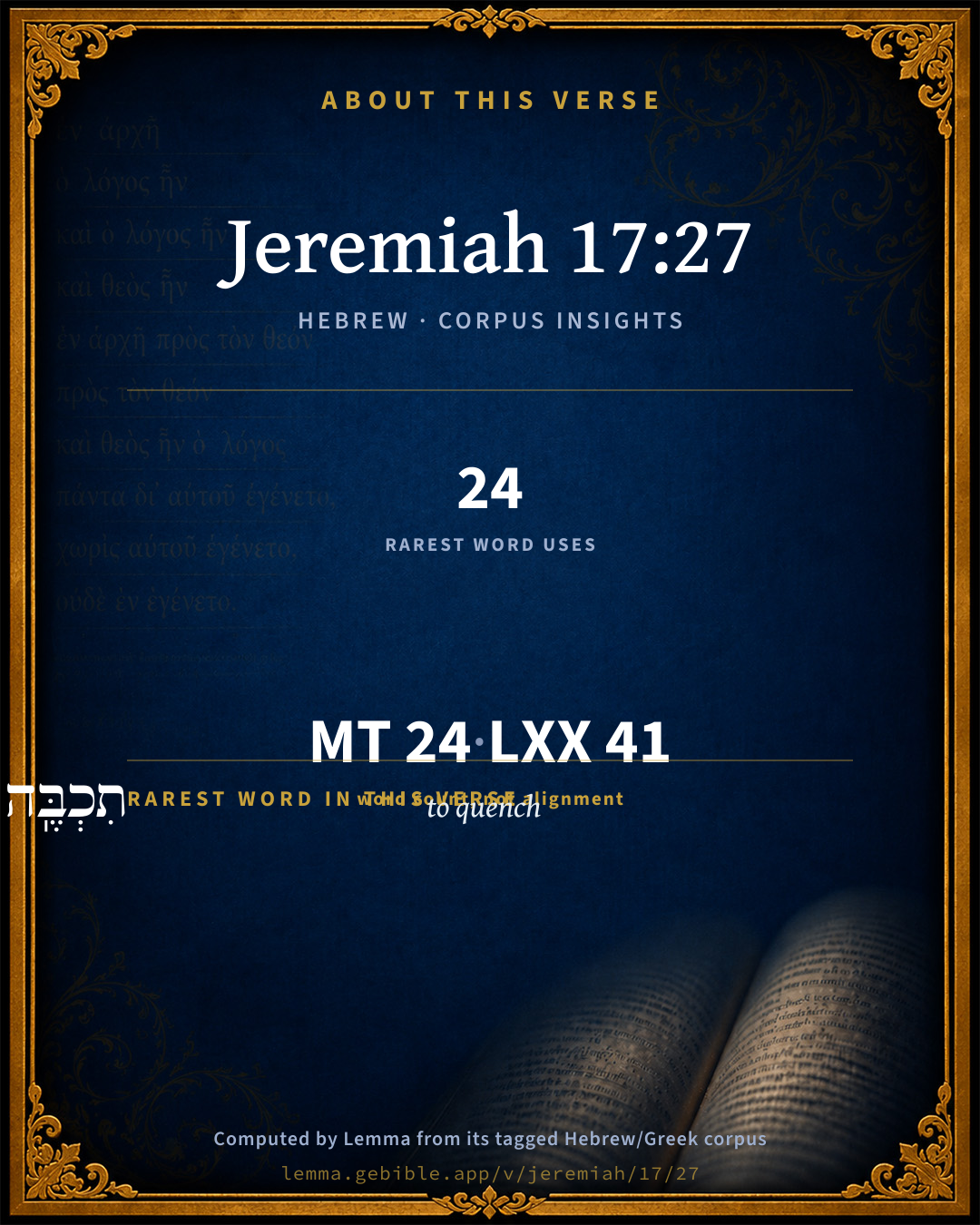
24
words
19
distinct lemmas
Prophets
section

Notable vocabulary

The rarest word here is תִכְבֶּֽה to quench H3518 — appearing just 24 times in the whole Hebrew Bible.

Shared distinctive vocabulary

תִכְבֶּֽה to quench H3518 occurs in 24 verses of the Hebrew Bible. Also found in:

Grammatical profile

  • 7 verbs
  • 11 nouns
  • 1 preposition
  • 1 conjunction
  • 4 particles

Verb forms

  • תִשְׁמְע֜וּ Qal · Imperfect
  • לְקַדֵּשׁ֙ Piel · Infinitive Construct
  • שְׂאֵ֣ת Qal · Infinitive Construct
  • וּבֹ֛א Qal · Infinitive Construct
  • וְהִצַּ֧תִּי Hiphil · Sequential Perfect
  • וְאָֽכְלָ֛ה Qal · Sequential Perfect
  • תִכְבֶּֽה Qal · Imperfect

Repetition

Words recur within this verse — often emphatic in Hebrew:

  • י֣וֹם day H3117 ×2
  • הַשַּׁבָּ֔ת Sabbath H7676 ×2
  • בְּשַׁעֲרֵ֥י gate H8179 ×2
  • יְרוּשָׁלִַ֖ם Jerusalem H3389 ×2
  • לֹ֨א not H3808 ×2

Hebrew & Septuagint length

In the original languages it is 24 Hebrew tokens and 41 Greek tokens — but the two are counted differently (Hebrew bundles its prefixes and suffixes into one token; the Greek is in lemma form), so that isn’t a like-for-like length.

Cross-references

36

Topical passages linked to Jeremiah 17:27 in the Treasury of Scripture Knowledge — connected by theme and wording, ordered by reader-vote popularity; previews shown in the World English Bible.

  • 2 Kings 25:9 He burnt the house of Yahweh, and the king's house; and all the houses of Jerusalem, even every great house, burnt he with fire.
  • Jeremiah 7:20 Therefore thus says the Lord Yahweh: Behold, my anger and my wrath shall be poured out on this place, on man, and on animal, and on the trees of the field, and on the fruit of the ground; and it shall burn, and shall not be quenched.
  • Jeremiah 21:14 I will punish you according to the fruit of your doings, says Yahweh; and I will kindle a fire in her forest, and it shall devour all that is round about her.
  • Ezekiel 22:8 You have despised my holy things, and have profaned my Sabbaths.
  • Amos 1:14 But I will kindle a fire in the wall of Rabbah, And it will devour its palaces, With shouting in the day of battle, With a tempest in the day of the whirlwind;
  • Amos 2:4–5 Thus says Yahweh: "For three transgressions of Judah, yes, for four, I will not turn away its punishment; Because they have rejected Yahweh's law, And have not kept his statutes, And their lies have led them astray, After which their fathers walked;
  • Jeremiah 52:13 and he burned the house of Yahweh, and the king's house; and all the houses of Jerusalem, even every great house, burned he with fire.
  • Lamentations 4:11 Yahweh has accomplished his wrath, he has poured out his fierce anger; He has kindled a fire in Zion, which has devoured the foundations of it.
  • Zechariah 7:11–14 But they refused to listen, and turned their backs, and stopped their ears, that they might not hear.
  • Isaiah 1:20 But if you refuse and rebel, you shall be devoured with the sword; For the mouth of Yahweh has spoken it."
  • Jeremiah 17:21–22 Thus says Yahweh, Take heed to yourselves, and bear no burden on the Sabbath day, nor bring it in by the gates of Jerusalem;
  • Jeremiah 39:8 The Chaldeans burned the king's house, and the houses of the people, with fire, and broke down the walls of Jerusalem.
  • Jeremiah 49:27 I will kindle a fire in the wall of Damascus, and it shall devour the palaces of Ben Hadad.
  • Deuteronomy 32:22 For a fire is kindled in my anger, Burns to the lowest Sheol, Devours the earth with its increase, Sets on fire the foundations of the mountains.
  • 2 Kings 22:17 Because they have forsaken me, and have burned incense to other gods, that they might provoke me to anger with all the work of their hands, therefore my wrath shall be kindled against this place, and it shall not be quenched.
  • 2 Chronicles 36:19 They burnt the house of God, and broke down the wall of Jerusalem, and burnt all the palaces of it with fire, and destroyed all the goodly vessels of it.
  • Isaiah 1:31 The strong will be like tinder, And his work like a spark. They will both burn together, And no one will quench them."
  • Isaiah 9:18–19 For wickedness burns as the fire; it devours the briers and thorns; yes, it kindles in the thickets of the forest, and they roll upward in a column of smoke.
  • Jeremiah 6:17 I set watchmen over you, [saying], Listen to the sound of the trumpet; but they said, We will not listen.
  • Jeremiah 17:4 You, even of yourself, shall discontinue from your heritage that I gave you; and I will cause you to serve your enemies in the land which you don't know: for you have kindled a fire in my anger which shall burn forever.
  • Jeremiah 17:24 It shall happen, if you diligently listen to me, says Yahweh, to bring in no burden through the gates of this city on the Sabbath day, but to make the Sabbath day holy, to do no work therein;
  • Jeremiah 21:12 House of David, thus says Yahweh, Execute justice in the morning, and deliver him who is robbed out of the hand of the oppressor, lest my wrath go forth like fire, and burn so that none can quench it, because of the evil of your doings.
  • Jeremiah 22:5 But if you will not hear these words, I swear by myself, says Yahweh, that this house shall become a desolation.
  • Jeremiah 26:4–6 You shall tell them, Thus says Yahweh: If you will not listen to me, to walk in my law, which I have set before you,
  • Jeremiah 32:29 and the Chaldeans, who fight against this city, shall come and set this city on fire, and burn it, with the houses, on whose roofs they have offered incense to Baal, and poured out drink-offerings to other gods, to provoke me to anger.
  • Jeremiah 38:21–23 But if you refuse to go forth, this is the word that Yahweh has shown me:
  • Jeremiah 44:16 As for the word that you have spoken to us in the name of Yahweh, we will not listen to you.
  • Ezekiel 16:41 They shall burn your houses with fire, and execute judgments on you in the sight of many women; and I will cause you to cease from playing the prostitute, and you shall also give no hire any more.
  • Ezekiel 20:47–48 and tell the forest of the South, Hear the word of Yahweh: Thus says the Lord Yahweh, Behold, I will kindle a fire in you, and it shall devour every green tree in you, and every dry tree: the flaming flame shall not be quenched, and all faces from the south to the north shall be burnt thereby.
  • Amos 1:4 But I will send a fire into the house of Hazael, And it will devour the palaces of Ben Hadad.
  • Amos 1:7 But I will send a fire on the wall of Gaza, And it will devour its palaces.
  • Amos 1:10 But I will send a fire on the wall of Tyre, And it will devour its palaces."
  • Amos 1:12 But I will send a fire on Teman, And it will devour the palaces of Bozrah."
  • Amos 2:2 But I will send a fire on Moab, And it will devour the palaces of Kerioth; And Moab will die with tumult, with shouting, and with the sound of the trumpet;
  • Mark 9:43–48 If your hand causes you to stumble, cut it off. It is better for you to enter into life maimed, rather than having your two hands to go into Gehenna, into the unquenchable fire,
  • Hebrews 12:25 See that you don't refuse him who speaks. For if they didn't escape when they refused him who warned on the Earth, how much more will we not escape who turn away from him who warns from heaven,

Cross-references courtesy of OpenBible.info (CC BY 4.0).

Hebrew and Greek witnesses Masoretic Hebrew ↔ Greek Septuagint

The same verse in the two great witnesses to the Old Testament, shown verse-for-verse.

These are two independent witnesses, not word-aligned to each other, and the Septuagint is shown in lemma (dictionary) form.

Hebrew Jeremiah 17:27 Masoretic · Westminster Leningrad Codex

וְאִם לֹ֨א תִשְׁמְע֜וּ אֵלַ֗י לְקַדֵּשׁ֙ אֶת י֣וֹם הַשַּׁבָּ֔ת וּלְבִלְתִּ֣י שְׂאֵ֣ת מַשָּׂ֗א וּבֹ֛א בְּשַׁעֲרֵ֥י יְרוּשָׁלִַ֖ם בְּי֣וֹם הַשַּׁבָּ֑ת וְהִצַּ֧תִּי אֵ֣שׁ בִּשְׁעָרֶ֗יהָ וְאָֽכְלָ֛ה אַרְמְנ֥וֹת יְרוּשָׁלִַ֖ם וְלֹ֥א תִכְבֶּֽה

But if you will not listen to me to make the Sabbath day holy, and not to bear a burden and enter in at the gates of Jerusalem on the Sabbath day; then will I kindle a fire in the gates of it, and it shall devour the palaces of Jerusalem, and it shall not be quenched.

World English Bible · Public Domain

Greek LXX Structure differs

In the Septuagint, Jeremiah is about an eighth shorter than the Hebrew and arranges its material differently — the Oracles Against the Nations (Hebrew chapters 46–51) appear in the middle of the Greek book, after 25:13. Because the chapter and verse boundaries do not line up, a verse-for-verse comparison with the Hebrew is not shown.

A verse-for-verse comparison isn’t shown here because the chapters and verses don’t line up. Switch to the LXX edition with the MT / LXX toggle above to read the Greek directly.

Hebrew: Westminster Leningrad Codex (CC BY 4.0). Greek: Septuagint (public domain); English from a public-domain English Septuagint. How the Septuagint differs from the Hebrew →

Targum (Aramaic paraphrase)

1

The Targum is the ancient Jewish Aramaic paraphrase of the Hebrew Scriptures — an interpretive translation, not the Hebrew text itself. Onkelos (literal) and Pseudo-Jonathan (expansive) render the Torah, and Jonathan the Prophets. Coverage is partial: where no permissively-licensed English translation exists for a verse, only the Aramaic is shown. This is verse-level text, not a word-by-word alignment to the Hebrew.

  1. Targum Jonathan Prophets (Joshua–Malachi)
    וְאִם לָא תְקַבְּלוּן לְמֵימְרִי לְקַדְשָׁא יַת יוֹמָא דְשַׁבְּתָא וּבְדִיל דְלָא לְמִטַל מַטוּל וּמֵיעַל בְּתַרְעֵי יְרוּשְׁלֵם בְּיוֹמָא דְּשַׁבְּתָא וְאַדְלִיק אֶשְׁתָּא בְּתַרְעָהָא וּתְשֵׁיצֵי בִּירְנְיַת יְרוּשְׁלֵם וְלָא תִטְפֵי:

    (no public-domain English translation for this verse)

    Targum Jonathan — Aramaic: “Mikraot Gedolot” (public domain). English: “Sefaria Community Translation” (CC0 1.0 (public-domain dedication)); “London "Chaldee Paraphrase," 1871” (public domain). Text via Sefaria.

Commentary

Notes on Jeremiah 17:27 from classic Christian and Jewish commentators (each source and its license shown beneath its notes). The classic Christian expositions comment on the surrounding passage and are grouped to its opening verse, so a note may address several verses; the Jewish commentaries on the Tanakh (Rashi and others) are per-verse, so they appear only where the commentator wrote on this verse.

Lemma curates 59 commentaries, every one of them public domain or Creative Commons licensed, each selected and text-cleaned for this edition rather than reprinted as found. About our sources →

Trapp's Complete Commentary

John Trapp

Jer 17:27 But if ye will not hearken unto me to hallow the sabbath day, and not to bear a burden, even entering in at the gates of Jerusalem on the sabbath day; then will I kindle a fire in the gates thereof, and it shall devour the palaces of Jerusalem, and it shall not be quenched.

Ver. 27. Then will I kindle a fire.] That furious element, whereby God hath so oft punished this sin, as is to be seen in the Practice of Piety, Denison’s Wolf in Sheep’s Clothing, Mr Clark’s Examples, &c.

John Trapp, A Commentary or Exposition upon All the Books of the Old and New Testament (1647–1656) — public domain. Text from a community e-Sword module.

Tyndale Open Study Notes

Tyndale Open Resources

17:27 I will set fire to these gates: This event occurred in 586 BC (2 Kgs 25:9).

Tyndale Open Study Notes — © Tyndale Open Resources, licensed CC BY-SA 4.0. Text via the HelloAO Bible API.

Jamieson, Fausset & Brown

Robert Jamieson, A. R. Fausset & David Brown

burden . . . in . . . gates . . . fire in the gates--retribution answering to the sin. The scene of their sin shall be the scene of their punishment (Jer 52:13; Kg2 25:9).

Next: Jeremiah Chapter 18

Jamieson, Fausset & Brown — Commentary Critical and Explanatory on the Whole Bible (1871) — public domain (CC PDM 1.0). Text via the HelloAO Bible API.

Adam Clarke's Commentary

Verse 27. But if ye will not hearken] Then their sin lay at their own door. How fully were they warned; and how basely did they reject the counsel of God against themselves!

Adam Clarke's Commentary on the Bible (1810–1826) — public domain. Text from a community e-Sword/MySword module.

John Calvin's Commentaries

Now, on the other hand, the Prophet terrifies them, if they hearkened not to the promises of God. God first kindly allures us; but when he sees us to be refractory, he deals with us according to the hardness of our hearts. He therefore now adds threatenings to promises. He had said, that the Jews would be happy, if they worshipped and served God faithfully; for their priesthood and their kingdom would be continued to them.

But he now adds, If ye will not obey, so as to sanctify the sabbath-day, and not to carry a burden on it, and not to enter through the gates of Jerusalem, that is, for the purpose of doing business (for it was lawful for them, as it is well known, to go out of the city, but by entering he means the transaction of business) — If then ye will not hearken to me in this respect, then, he says, I will kindle a fire in the gates of this city. We see the design of the Prophet, — that he would have the Jews to entertain a sure hope of their safety, provided they repented, and provided the pure and uncorrupted worship of God prevailed among them; but that, on the other hand, he wished to fill them with terror, if they went on in their obstinacy.

No doubt this commination greatly offended them; for we know how self-confident they were, and how foolishly they boasted that the city, in which God had his habitation, could not be demolished; and yet the Prophet declares here that the destruction of the holy city was nigh at hand, if they violated the sabbath-day as they had been accustomed to do. But that this punishment might not seem to be too severe, he shews that the people were inexcusable, if they rejected these plain warnings: he says, If ye will not hearken to me; for they might have otherwise objected and said, that they had been deceived, as they did not think that there was so great a sin in violating the Sabbath. Jeremiah now excludes all such evasions, for he says in effect, “Behold I am present with you by God’s authority; if ye will violate the Sabbath as hitherto, what excuse can you make? Have you not been proved guilty of open impiety? for God has spoken; and how is it that ye reject his teaching?” We thus see that this, If ye will not hearken to me so as to sanctify the Sabbath, was said to anticipate an objection.

He then adds, Devour shall the fire the gates of the city, and shall not be extinguished, that is, shall not be extinguished until it shall consume the whole city and its gates. We indeed know that assemblies were then held at the gates, and that they were therefore places of great importance. As to the fire it is to be taken metaphorically for destruction; and yet we know that even fire was kindled by the Chaldeans; for they deemed it not enough to demolish the city, but proceeded still farther: hence the Temple was burnt, and the houses were consumed by fire. We ought however to explain the word of the Prophet as meaning simply this — that God’s vengeance would be like fire, destroying and consuming all things, so that not even the gates would remain. Something usually remains when cities are demolished to the foundations; but God threatens the Jews with something more grievous — that the city would not be in a common way destroyed, but be so wholly consumed that nothing would remain. We shall proceed to-morrow.

John Calvin's Commentaries (1540-1563) — public domain. Text from the Calvin Translation Society English edition (1840s-50s) via the Christian Classics Ethereal Library (ccel.org). Calvin's coverage is partial (roughly two-thirds of the Bible); uncommented books and verses are honest gaps, never fabricated. The 19th-century editor's footnotes and remarks are omitted so the notes are faithfully Calvin's own voice.

Ellicott's Commentary for English Readers

(27) Then will I kindle a fire . . .—The fire is figurative rather than literal: the “fierce anger” of the Lord which man cannot quench, and which brings destruction in its train, of which an actual conflagration may have been the instrument (Hos_8:14; Amo_1:14). Compare Jer_7:20; Jer_21:14.

A Bible Commentary for English Readers, edited by Charles John Ellicott (1878–1897) — public domain. Text from a community e-Sword module.

The Cambridge Bible for Schools and Colleges

gen. ed. J. J. S. Perowne

27. will I kindle … Jerusalem] These words are based on the refrain Amo_1:3 to Amo_2:5, where they occur seven times. They are found three times later in Jeremiah (Jer_21:14, Jer_49:27, Jer_50:32). Cp. Hos_8:14.

palaces] See on Jer_6:5.

The Cambridge Bible for Schools and Colleges (gen. ed. J. J. S. Perowne; Cambridge University Press, 1878–1918) — public domain. Text from a community e-Sword module.

John Gill's Exposition

But if ye will not hearken unto me,.... With respect to this particular point, more especially:

to hallow the sabbath day; to keep it holy to the Lord in a religious way, in the exercise of the duties of religion, both public and private:

and not to bear a burden, even entering in at the gates of Jerusalem on the sabbath day; or, "and go through"; or, so as "to go through" (l) &c. and may intend either one and the same thing, namely entering in at the gates with a burden upon the shoulders; or two things, bearing a burden, and carrying it any where in or out of the city; and an unnecessary passing and repassing through the gates of the city, whether a man has or has not a burden upon him, since the sabbath might be violated either way:

then will I kindle a fire in the gates thereof; where the prophet was to publish all this, and where the people sinned by passing and repassing, and carrying burdens in and out on the sabbath day:

and it shall devour the palaces of Jerusalem; the king's palace, and the palaces of the princes and nobles, as well as the cottages of the poorer sort:

and it shall not be quenched; until it has utterly destroyed the city: this was fulfilled by the Chaldeans, Jer 52:13. The Jews say there is no fire kindled but where the sabbath is profaned; and that Jerusalem was destroyed because they profaned the sabbath (m).

(l) "et intretis per portas", Cocceius, Schmidt. (m) T. Bab. Sabbat, fol. 119. 2.

Next: Jeremiah Chapter 18

John Gill's Exposition of the Whole Bible (1746–1763) — public domain (CC PDM 1.0). Text via the HelloAO Bible API.

Haydock's Catholic Bible Commentary

Fire, by means of Nabuzardan. (Menochius) --- The city shall be entirely destroyed. (Calmet)

George Leo Haydock (1774–1849), Haydock's Catholic Family Bible and Commentary, 1859 edition — public domain. Excludes Psalms (Douay-Rheims chapter numbering differs from Protestant) and Deuterocanonical books (Catholic canon only).

Matthew Poole's English Annotations

A threatening quite contrary to the former promise, upon their acting contrary to the duty to which that promise was annexed. God would destroy their city; it should be burned with fire, and the highest and noblest structures should be burned; and though the hand of the enemy should do this, yet God should order them to do it, so as it should be a fire of his kindling, and therefore not like to be quenched, till it had effected that thing for which God so kindled it.

Matthew Poole's English Annotations on the Holy Bible (1683–1685) — public domain. Text from a community e-Sword/MySword module.

Whedon's Commentary on the Bible

Daniel D. Whedon

27. I kindle a fire in the gates — The very places mentioned as those of disobedience and profanation. God’s punitive judgments always move in the precise path of sin, and will follow it out in all its windings and ramifications.

Daniel D. Whedon (gen. ed.), Commentary on the Old and New Testaments (1874–1909) — public domain. Text from a community e-Sword module.

Rashi

Rabbi Shlomo Yitzchaki (Rashi)

and to come like וְלָבֹא.

Rashi on the Tanakh — English translations: “The Judaica Press complete Tanach with Rashi, translated by A. J. Rosenberg” (CC BY 4.0); “Pentateuch with Rashi's commentary by M. Rosenbaum and A.M. Silbermann, 1929-1934” (public domain); “The Metsudah Tanach series, Lakewood, N.J” (CC BY 4.0); and “The Book of Joshua, Metsudah Publications, 1997” (CC BY 4.0). Text via Sefaria.

Lesson kit

Teaching starters — assembled from the data on this page, not authored interpretation. Every prompt links to the verse data it draws on. Edit before teaching.

Jeremiah, in the Prophets, opens this verse with 24 words (19 distinct Hebrew lemmas). Its most distinctive word is kâbâh (“to quench”). A historical commentator’s framing appears above. Read the whole chapter for the surrounding context.

Discussion questions

  1. The word kâbâh carries the sense “to quench.” How does it shape the verse?
  2. Leviticus 6:12 shares the word «to quench» with this verse. How do the two illuminate each other?
  3. “day” occurs 2× in this one verse. What is the effect of the repetition?
  4. These translations render this verse differently. What is at stake in choosing one wording over another?
  5. The verb «תִשְׁמְע֜וּ» is Qal Imperfect. How does its form color the action?
  6. Reading how Trapp's Complete Commentary and Tyndale Open Study Notes read this verse, where do the two commentators agree and where do they part?

Things to notice

Reading settings

Reading text

Shown beneath each verse's original-language words.

Old Testament
Old Testament edition

Read the OT as the Masoretic Hebrew (MT) or the Greek Septuagint (LXX).

English shown for the Greek Septuagint (in the Hebrew ↔ Greek comparison).

Comparing translations? Open the Compare panel on any verse page to stack up to four side by side.