
Ezekiel 20:15

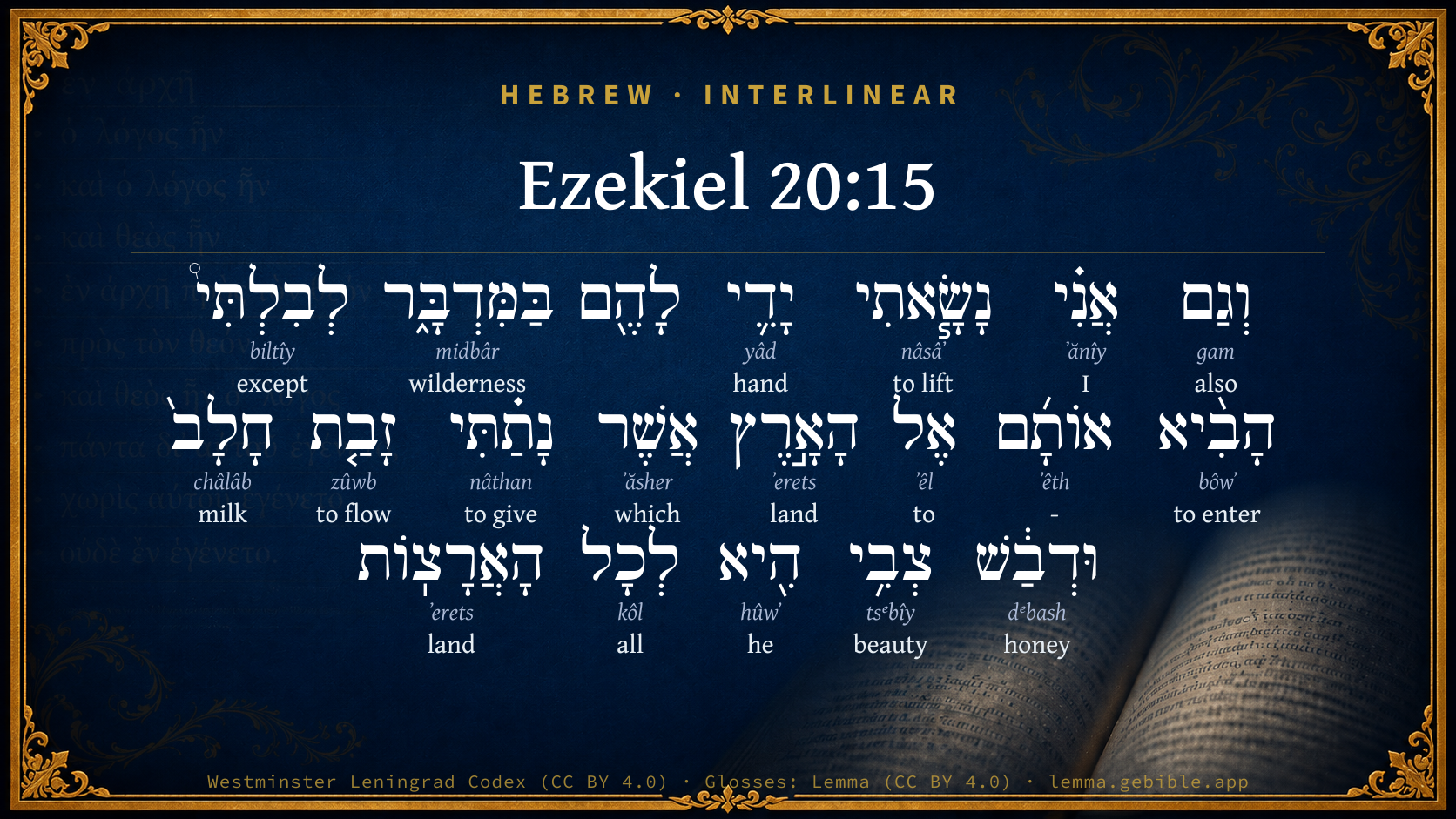
Hebrew (Westminster Leningrad Codex) Ezekiel 20:15 appears in the Hebrew Old Testament. The text above is from the Westminster Leningrad Codex. Each word links to its Strong’s number, a concise gloss, and parsing drawn from the Open Scriptures Hebrew Bible morphology. Click any word for its full Brown-Driver-Briggs (BDB) entry.
Download image
Cite this verse

Ezekiel 20:15 (World English Bible). Public Domain. Lemma interlinear Bible study tool, https://lemma.gebible.app/v/ezekiel/20/15.

Show BibTeX & RIS
BibTeX
RIS
English Translation
Moreover also I swore to them in the wilderness, that I would not bring them into the land which I had given them, flowing with milk and honey, which is the glory of all lands;
World English Bible · Public Domain
Download a study sheet

One document with this verse’s original text, its word-by-word gloss line, the meaning frame, cross-references with their text, attributed commentary, and full source and license credits — printable, and it pastes into notes with its structure intact.

This verse Autodidact and up

Study sheet (.html) Plain text (.txt)

A passage Seminary Student

Up to 50 verses in one chapter. A passage sheet keeps up to 6 commentary sources and 12 cross-references per verse, in the order this page ranks them, and says so on the sheet whenever that leaves anything out. Ask for a single verse and you get the Autodidact verse sheet above.

Everything on this page stays free to read, with no account — the sheet is a download of what is already on screen, not access to it.

Want to remove ads? Support Godless Engineer
Compare translations 3

The same verse in 3 English versions, stacked beneath the original-language interlinear above. Click any original word for its lexicon entry.

Each is an independent rendering of the whole verse — the interlinear is not word-aligned to these translations.

Highlighted words mark where these versions differ — a whole-verse word diff, not a word-by-word alignment.

  • World English Bible Public Domain
    Moreover also I swore to them in the wilderness, that I would not bring them into the land which I had given them, flowing with milk and honey, which is the glory of all lands;
  • King James Version Public Domain
    Yet also I lifted up my hand unto them in the wilderness, that I would not bring them into the land which I had given them, flowing with milk and honey, which is the glory of all lands;
  • unfoldingWord Literal Text CC BY-SA 4.0
    So I myself also raised my hand to swear an oath to them in the wilderness not to bring them into the land that I had been going to give them, a land flowing with milk and honey, which was the most beautiful ornament among all the lands.

unfoldingWord Literal Text — © unfoldingWord, licensed CC BY-SA 4.0. Word-aligned USFM3 via Door43 (git.door43.org/unfoldingWord/en_ult).

Versions to compare (up to 4)

3 of 4 selected

Show all 18 translations

Every available English version of this verse, each an independent rendering of the whole verse.

  • World English Bible Public Domain
    Moreover also I swore to them in the wilderness, that I would not bring them into the land which I had given them, flowing with milk and honey, which is the glory of all lands;
  • Berean Standard Bible Public Domain
    Moreover, with an uplifted hand I swore to them in the wilderness that I would not bring them into the land that I had given them—a land flowing with milk and honey, the glory of all lands—
  • Majority Standard Bible Public Domain
    Moreover, with an uplifted hand I swore to them in the wilderness that I would not bring them into the land that I had given them—a land flowing with milk and honey, the glory of all lands—
  • King James Version Public Domain
    Yet also I lifted up my hand unto them in the wilderness, that I would not bring them into the land which I had given them, flowing with milk and honey, which is the glory of all lands;
  • American Standard Version (1901) Public Domain
    Moreover also I sware unto them in the wilderness, that I would not bring them into the land which I had given them, flowing with milk and honey, which is the glory of all lands;
  • Revised Version (1885) Public Domain
    Moreover also I lifted up my hand unto them in the wilderness, that I would not bring them into the land which I had given them, flowing with milk and honey, which is the glory of all lands;
  • Geneva Bible (1599) Public Domain
    Yet neuerthelesse, I lift vp mine hande vnto them in the wildernes that I would not bring them into the lande, which I had giuen them, flowing with milke and hony, which was pleasant aboue all landes,
  • Douay-Rheims (1899) Public Domain
    So I lifted up my hand over them in the desert, not to bring them into the land which I had given them flowing with milk and honey, the best of all lands.
  • Young's Literal Translation Public Domain
    And also, I, I have lifted up My hand to them in the wilderness, Not to bring them in to the land that I had given, Flowing with milk and honey, A beauty it `is' to all the lands,
  • Literal Standard Version CC BY-SA 4.0
    And also, I have lifted up My hand to them in the wilderness, || Not to bring them into the land that I had given, || Flowing with milk and honey, || It [is] a beauty to all the lands,
  • Unlocked Literal Bible CC BY-SA 4.0
    So I myself also raised my hand to swear an oath to them in the wilderness not to bring them into the land that I had been going to give them, a land flowing with milk and honey, which was the most beautiful ornament among all the lands.
  • unfoldingWord Literal Text CC BY-SA 4.0
    So I myself also raised my hand to swear an oath to them in the wilderness not to bring them into the land that I had been going to give them, a land flowing with milk and honey, which was the most beautiful ornament among all the lands.
  • Darby Bible Public Domain
    And I also lifted up my hand unto them in the wilderness, that I would not bring them into the land that I had given [them], flowing with milk and honey, which is the ornament of all lands;
  • World Messianic Bible Public Domain
    Moreover also I swore to them in the wilderness that I would not bring them into the land which I had given them, flowing with milk and honey, which is the glory of all lands,
  • Webster's Bible Public Domain
    Yet also I lifted up my hand to them in the wilderness, that I would not bring them into the land which I had given them, flowing with milk and honey, which is the glory of all lands;
  • Free Bible Version CC BY-SA 4.0
    So I held up my hand and vowed to them in the desert that I wouldn't take them into the land that I had given them, a land flowing with milk and honey—better than any other country—
  • Bible in Basic English Public Domain
    And further, I gave my oath to them in the waste land, that I would not take them into the land which I had given them, a land flowing with milk and honey, the glory of all lands;
  • JPS Tanakh (1917) Public Domain
    Yet also I lifted up My hand unto them in the wilderness, that I would not bring them into the land which I had given them, flowing with milk and honey, which is the beauty of all lands;

Literal Standard Version (2020), Covenant Press — licensed CC BY-SA 4.0. Text via the HelloAO Bible API (eBible.org). Unlocked Literal Bible (unfoldingWord) — licensed CC BY-SA 4.0. Text via the HelloAO Bible API (eBible.org). unfoldingWord Literal Text — © unfoldingWord, licensed CC BY-SA 4.0. Word-aligned USFM3 via Door43 (git.door43.org/unfoldingWord/en_ult). Free Bible Version, Dr. Jonathan Gallagher — licensed CC BY-SA 4.0. Text via the HelloAO Bible API (eBible.org).

Word by word

More ways to search: Search by grammar → Find every occurrence → Compare this word →

Practice this passage: Drill this verse → Learn its vocabulary →

צְבִ֥י
tsᵉbîy
H6643
“beauty”
Noun, Common, Masculine, Singular, Absolute
Part of Speech
Noun
Type
Common
Gender
Masculine
Number
Singular
State
Absolute
Full BDB Definition

Origin: from H6638 in the sense of prominence

TWOT: 1869a , 1870a

beauty, glory, honour - beauty, decoration - honour - roebuck, gazelle - perhaps an extinct animal, exact meaning unknown
  1. וְגַם gam H1571 “and · also” Conjunction + Particle, Accusative
  2. אֲנִ֗י ʼănîy H589 “I” Pronoun, Personal, 1st Person, Common, Singular
  3. נָשָׂ֧אתִי nâsâʼ H5375 “to lift” Verb, Qal, Perfect, 1st Person, Common, Singular
  4. יָדִ֛י yâd H3027 “hand · my” Noun, Common, Both, Singular, Construct + Suffix, Personal, 1st Person, Common, Singular
  5. בַּמִּדְבָּ֑ר midbâr H4057 “in/at the · wilderness” Preposition, Determined + Noun, Common, Masculine, Singular, Absolute
  6. לְבִלְתִּי֩ biltîy H1115 “to/for · except” Preposition + Conjunction
  7. הָבִ֨יא bôwʼ H935 “to enter” Verb, Hiphil, Infinitive Construct
  8. אוֹתָ֜ם ʼêth H853 “- · them” Particle, Direct Object + Suffix, Personal, 3rd Person, Masculine, Plural
  9. אֶל ʼêl H413 “to” Preposition
  10. הָאָ֣רֶץ ʼerets H776 “the · land” Particle, Definite Article + Noun, Common, Both, Singular, Absolute
  11. אֲשֶׁר ʼăsher H834 “which” Particle, Relative
  12. נָתַ֗תִּי nâthan H5414 “to give” Verb, Qal, Perfect, 1st Person, Common, Singular
  13. זָבַ֤ת zûwb H2100 “flowing” Verb, Qal, Participle Active, Feminine, Singular, Construct
  14. חָלָב֙ châlâb H2461 “milk” Noun, Common, Masculine, Singular, Absolute
  15. וּדְבַ֔שׁ dᵉbash H1706 “and · honey” Conjunction + Noun, Common, Masculine, Singular, Absolute
  16. הִ֖יא hûwʼ H1931 “he” Pronoun, Personal, 3rd Person, Feminine, Singular
  17. לְכָל kôl H3605 “to/for · all of” Preposition + Noun, Common, Masculine, Singular, Construct
  18. הָאֲרָצֽוֹת ʼerets H776 “the · lands” Particle, Definite Article + Noun, Common, Both, Plural, Absolute

About this verse

These counts appear in no published source. They are computed here, from the morphology-tagged text and Lemma’s own curated glosses. What Lemma adds →

20
words
18
distinct lemmas
Prophets
section

Shared distinctive vocabulary

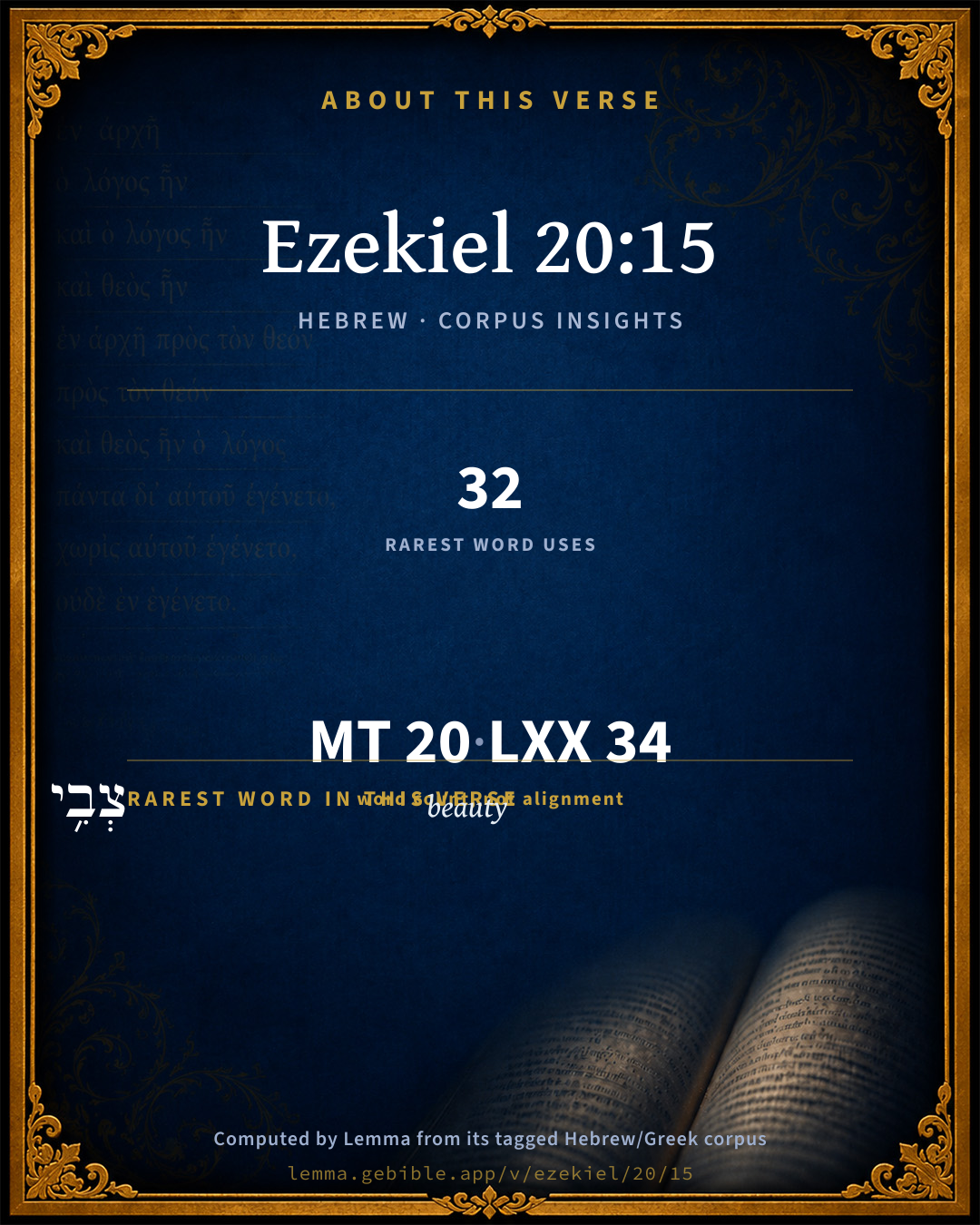
צְבִ֥י beauty H6643 occurs in 32 verses of the Hebrew Bible. Also found in:

Grammatical profile

  • 4 verbs
  • 8 nouns
  • 2 pronouns
  • 2 prepositions
  • 1 conjunction
  • 3 particles

Verb forms

  • נָשָׂ֧אתִי Qal · Perfect
  • הָבִ֨יא Hiphil · Infinitive Construct
  • נָתַ֗תִּי Qal · Perfect
  • זָבַ֤ת Qal · Participle Active

Repetition

A word recurs within this verse — often emphatic in Hebrew:

  • הָאָ֣רֶץ land H776 ×2

Hebrew & Septuagint length

In English translation the verse runs 35 words from the Hebrew and 40 from the Septuagint (LXX English) — closely comparable.

A rough comparison of the two English renderings, which tokenize alike — not a word-level alignment.

Word counts can differ between the Hebrew and the Greek without any difference in meaning — e.g. the Hebrew direct-object marker אֵת has no separate Greek word, and Greek often adds the article ὁ.

In the original languages it is 20 Hebrew tokens and 34 Greek tokens — but the two are counted differently (Hebrew bundles its prefixes and suffixes into one token; the Greek is in lemma form), so that isn’t a like-for-like length.

Cross-references

9

Topical passages linked to Ezekiel 20:15 in the Treasury of Scripture Knowledge — connected by theme and wording, ordered by reader-vote popularity; previews shown in the World English Bible.

  • Psalms 95:11 Therefore I swore in my wrath, "They won't enter into my rest."
  • Psalms 106:26 Therefore he swore to them That he would overthrow them in the wilderness,
  • Numbers 14:23–30 surely they shall not see the land which I swore to their fathers, neither shall any of those who despised me see it:
  • Numbers 26:64–65 But among these there was not a man of them who were numbered by Moses and Aaron the priest, who numbered the children of Israel in the wilderness of Sinai.
  • Deuteronomy 1:34–35 Yahweh heard the voice of your words, and was angry, and swore, saying,
  • Ezekiel 20:23 Moreover I swore to them in the wilderness, that I would scatter them among the nations, and disperse them through the countries;
  • Hebrews 3:11 As I swore in my wrath, 'They will not enter into my rest.'"
  • Hebrews 3:18 To whom did he swear that they wouldn't enter into his rest, but to those who were disobedient?
  • Hebrews 4:3 For we who have believed do enter into that rest, even as he has said, "As I swore in my wrath, they will not enter into my rest;" although the works were finished from the foundation of the world.

Cross-references courtesy of OpenBible.info (CC BY 4.0).

Hebrew and Greek witnesses Masoretic Hebrew ↔ Greek Septuagint

The same verse in the two great witnesses to the Old Testament, shown verse-for-verse.

These are two independent witnesses, not word-aligned to each other, and the Septuagint is shown in lemma (dictionary) form.

Hebrew Ezekiel 20:15 Masoretic · Westminster Leningrad Codex

וְגַם אֲנִ֗י נָשָׂ֧אתִי יָדִ֛י לָהֶ֖ם בַּמִּדְבָּ֑ר לְבִלְתִּי֩ הָבִ֨יא אוֹתָ֜ם אֶל הָאָ֣רֶץ אֲשֶׁר נָתַ֗תִּי זָבַ֤ת חָלָב֙ וּדְבַ֔שׁ צְבִ֥י הִ֖יא לְכָל הָאֲרָצֽוֹת

Moreover also I swore to them in the wilderness, that I would not bring them into the land which I had given them, flowing with milk and honey, which is the glory of all lands;

World English Bible · Public Domain

Greek LXX Ezekiel 20:15 Septuagint · lemma form

καί ἐγώ ἐκαἴρω ὁ χείρ ἐγώ ἐπί αὐτός ἐν ὁ ἔρημος ὁ παράπαν ὁ μή εἰςἄγω αὐτός εἰς ὁ γῆ ὅς δίδωμι αὐτός γῆ ῥέω γάλα καί μέλι κηρίον εἰμί παρά πᾶς ὁ γῆ

But I lifted up my hand against them in the wilderness once for all, that I would not bring them into the land which I gave them, a land flowing with milk and honey, it is sweeter than all lands:

LXX2012 (modern English Septuagint) · Public Domain

Hebrew: Westminster Leningrad Codex (CC BY 4.0). Greek: Septuagint (public domain); English from LXX2012 (modern English Septuagint) (Public Domain). How the Septuagint differs from the Hebrew →

Targum (Aramaic paraphrase)

1

The Targum is the ancient Jewish Aramaic paraphrase of the Hebrew Scriptures — an interpretive translation, not the Hebrew text itself. Onkelos (literal) and Pseudo-Jonathan (expansive) render the Torah, and Jonathan the Prophets. Coverage is partial: where no permissively-licensed English translation exists for a verse, only the Aramaic is shown. This is verse-level text, not a word-by-word alignment to the Hebrew.

  1. Targum Jonathan Prophets (Joshua–Malachi)
    וְאַף אֲנָא קַיְמֵת בְּמֵימְרִי לְהוֹן בְּמַדְבְּרָא בְּדִיל דְלָא לְאָעֲלָא יַתְהוֹן לְאַרְעָא דִי יְהָבֵית עָבְדָא חֲלַב וּדְבַשׁ תּוּשְׁבְּחָא הִיא לְכָל מְדִינָתָא:

    (no public-domain English translation for this verse)

    Targum Jonathan — Aramaic: “Mikraot Gedolot” (public domain). English: “Sefaria Community Translation” (CC0 1.0 (public-domain dedication)); “London "Chaldee Paraphrase," 1871” (public domain). Text via Sefaria.

Commentary

Notes on Ezekiel 20:15 from classic Christian and Jewish commentators (each source and its license shown beneath its notes). The classic Christian expositions comment on the surrounding passage and are grouped to its opening verse, so a note may address several verses; the Jewish commentaries on the Tanakh (Rashi and others) are per-verse, so they appear only where the commentator wrote on this verse.

Lemma curates 59 commentaries, every one of them public domain or Creative Commons licensed, each selected and text-cleaned for this edition rather than reprinted as found. About our sources →

Trapp's Complete Commentary

John Trapp

Eze 20:15 Yet also I lifted up my hand unto them in the wilderness, that I would not bring them into the land which I had given [them], flowing with milk and honey, which [is] the glory of all lands;

Ver. 15. Yet also I lifted up mine hand.] Here we have an epitome of Exodus and Numbers.

Flowing with milk and honey.] See on Eze 20:6. If it be not so fertile and desirable now, it is for the Jews’ inexpiable guilt in crucifying the Lord of glory. The like befell Sodom - once as the garden of God, now a dead sea, where nothing can live.

John Trapp, A Commentary or Exposition upon All the Books of the Old and New Testament (1647–1656) — public domain. Text from a community e-Sword module.

Jamieson, Fausset & Brown

Robert Jamieson, A. R. Fausset & David Brown

I swore against them (Psa 95:11; Psa 106:26) that I would not permit the generation that came out of Egypt to enter Canaan.

Jamieson, Fausset & Brown — Commentary Critical and Explanatory on the Whole Bible (1871) — public domain (CC PDM 1.0). Text via the HelloAO Bible API.

Adam Clarke's Commentary

Verse 15. I lifted up my hand] Their provocations in the wilderness were so great, that I vowed never to bring them into the promised land. I did not consume them, but I disinherited them. See Clarke on Eze 20:5.

Adam Clarke's Commentary on the Bible (1810–1826) — public domain. Text from a community e-Sword/MySword module.

John Calvin's Commentaries

God here shows that his threats were ineffectual, even when he inflicted severe punishment, yet the people were not broken down and subdued: and this is a sign of a most perverse disposition. The foolish are at length corrected with rods, but when those who are chastised become worse instead of repenting, they betray their desperate character. God therefore here signifies that the Israelites were of an abandoned disposition, because there were no means of bringing them back to good conduct. At first he enticed them by his mercy, then gave them the law, and added a sacrament, as we have seen; but this proved wholly useless: what remained then, except to terrify them partly by threats and partly by punishments? He tried both, for he threatened them when they sinned, without any advantage: then he showed them in reality that theirs was no vain terror, since all those died in the desert who had refused to go forward when he called them into the land of Canaan. (Numbers 32:10.) Since, they were not bent by those signs of God’s wrath, their contumacy appears so great, that they ought to perish a hundred times over. I also, says he, raised my hand; he doubtless means that he swore, as we gather from Moses and from the Psalms, I swore in my wrath if they should enter into my rest. (Psalm 95:11.) He says then that he raised his hand; we have explained whence the simile is taken, that I would not bring them into the land which I had given them. Here God emphatically shows how formidable that punishment was, as it deprived them of that sure heritage which he had bestowed on them: for before they were born they were lords of the land of Canaan — since four hundred years before it was promised to Abraham in their name. Since they cast themselves off from this inheritance, they plainly displayed their slothfulness: I had given them an inheritance, says he, for they compelled me to swear: I swore that they should not reach it. He adds, a land flowing with milk and honey, desired by all nations. By these words he enlarges upon the people’s ingratitude, since they despised no mean benefit, but a land in which they might dwell happily. For God had so enriched it with his gifts, that they might have been as it were in paradise. Since then such fertility did not attract them to obey God, hence it appears, that they were in every way refractory. It afterwards follows —

John Calvin's Commentaries (1540-1563) — public domain. Text from the Calvin Translation Society English edition (1840s-50s) via the Christian Classics Ethereal Library (ccel.org). Calvin's coverage is partial (roughly two-thirds of the Bible); uncommented books and verses are honest gaps, never fabricated. The 19th-century editor's footnotes and remarks are omitted so the notes are faithfully Calvin's own voice.

Ellicott's Commentary for English Readers

(15) I would not bring them into the land.—Num_14:28-29. In consequence of their rebellion and want of faith, all the men above twenty years old when they came out of Egypt were doomed by the Divine oath to perish in the wilderness. Yet He did not utterly take His mercy from them, but promised that their children should be brought into the land, as is set forth in Eze_20:17.

A Bible Commentary for English Readers, edited by Charles John Ellicott (1878–1897) — public domain. Text from a community e-Sword module.

John Gill's Exposition

Yet also I lifted up mine hand unto them in the wilderness,.... Swore unto them, as in Eze 20:5;

that I would not bring them into the land which I had given them; by promise to their fathers, and to them. This is to be understood of the generation that came out of Egypt, that received the ill report the spies made, and murmured against the Lord; wherefore he swore in his wrath that they should not enter into his rest; or he would not bring them into the land of Canaan, save Caleb and Joshua; and accordingly none else entered but them, though their posterity did; and so both his oath to them, that they should not enter, and his oath to Abraham, that he would give to his seed the land, had their accomplishment, Num 14:23; a land

flowing with milk and honey, which is the glory of all lands; See Gill on Eze 20:6.

John Gill's Exposition of the Whole Bible (1746–1763) — public domain (CC PDM 1.0). Text via the HelloAO Bible API.

Matthew Poole's English Annotations

Yet also; moreover also, as the same particles are rendered, Eze 20:12.

I lifted up my hand unto them; see Eze 20:5; sware in his wrath against them, Psa 95:11.

In the wilderness of Paran, where the Israelites pitched and abode in several parts of it many days, during which time they lust for flesh, Num 11:4,5, and murmur against the Lord, Moses, and the two faithful spies, who had searched out the land: here it was they would make them a captain and return to Egypt, Num 14:4.

That I would not bring them, & c: so it is recorded, Num 14:11,12,22,23,28-32; so all the murmuring, disobedient, unbelieving generation was excluded, and their children were brought in; which, well noted, reconcileth the seeming contrariety between the oaths of God.

Them; those rebellious and murmuring ones.

Given them; promised to the seed of Abraham, but not confined to that generation; the promise was made good, though to the next generation.

Flowing with milk and honey: see Eze 20:6.

Matthew Poole's English Annotations on the Holy Bible (1683–1685) — public domain. Text from a community e-Sword/MySword module.

John Wesley's Explanatory Notes

I lifted up my hand - I swear. Them - So all the murmuring, disobedient, unbelieving generation was excluded, and their children were brought in.

John Wesley, Explanatory Notes Upon the Whole Bible (1754–1765) — public domain. Text via the GEBible commentary corpus.

unfoldingWord translationNotes

Door43 World Missions Community

General Information:

Yahweh continues giving Ezekiel his message to the elders of Israel.

I myself also raised my hand to swear an oath

Here "raised my hand" is a symbolic action that shows he will truly do what he has sworn to do. See how you translated this in Ezekiel 20:5. AT: "I myself also solemnly swore an oath" (See: Symbolic Action)

to them

"to the house of Israel"

a land flowing with milk and honey

"a land where plenty of milk and honey flowed." Yahweh speaks of the land being good for animals and plants as if the milk and honey from those animals and plants were flowing through the land. See how you translated this in Ezekiel 20:6. AT: "a land that was excellent for raising livestock and growing crops" (See: Metaphor and Metonymy)

the most beautiful ornament among all the lands

The lands in which people live are spoken of as if they are jewelry or other things that are pleasant to look at. See how you translated this in Ezekiel 20:6. AT: "the most beautiful of all lands" (See: Metaphor)

did not walk in my statutes

Yahweh speaks of obeying his statutes as if they were a path along which a person walks. AT: "did not obey my statutes" (See: Metaphor)

their hearts walked after their idols

Here the word "heart" represents the person's thoughts and emotions. Yahweh speaks of being dedicated to idols as if a person's heart walked after them. AT: "they were dedicated to worshiping their idols" (See: Metonymy and Metaphor)

my eye spared them

Here the word "eye" represents Yahweh. AT: "I spared them" (See: Synecdoche)

translationWords

oath

heart

false god

compassion

unfoldingWord translationNotes — © Distant Shores Media and the Door43 World Missions Community, licensed CC BY-SA 4.0. Source: git.door43.org/Door43/en_tn.

Lesson kit

Teaching starters — assembled from the data on this page, not authored interpretation. Every prompt links to the verse data it draws on. Edit before teaching.

Ezekiel, in the Prophets, opens this verse with 20 words (18 distinct Hebrew lemmas). Its most distinctive word is tsᵉbîy (“beauty”). A historical commentator’s framing appears above. Read the whole chapter for the surrounding context.

Discussion questions

  1. The word tsᵉbîy carries the sense “beauty.” How does it shape the verse?
  2. How does Deuteronomy 12:15, which shares the word «beauty», read alongside this verse?
  3. What does the repetition of “land” (2× in this one verse) do in this verse?
  4. These translations render this verse differently. What is at stake in choosing one wording over another?
  5. «נָשָׂ֧אתִי» is a Qal Perfect verb. How does that grammatical form shape the action described?
  6. Compare how Trapp's Complete Commentary and Jamieson, Fausset & Brown read this verse. Where do they agree or differ?

Things to notice

Reading settings

Reading text

Shown beneath each verse's original-language words.

Old Testament
Old Testament edition

Read the OT as the Masoretic Hebrew (MT) or the Greek Septuagint (LXX).

English shown for the Greek Septuagint (in the Hebrew ↔ Greek comparison).

Comparing translations? Open the Compare panel on any verse page to stack up to four side by side.