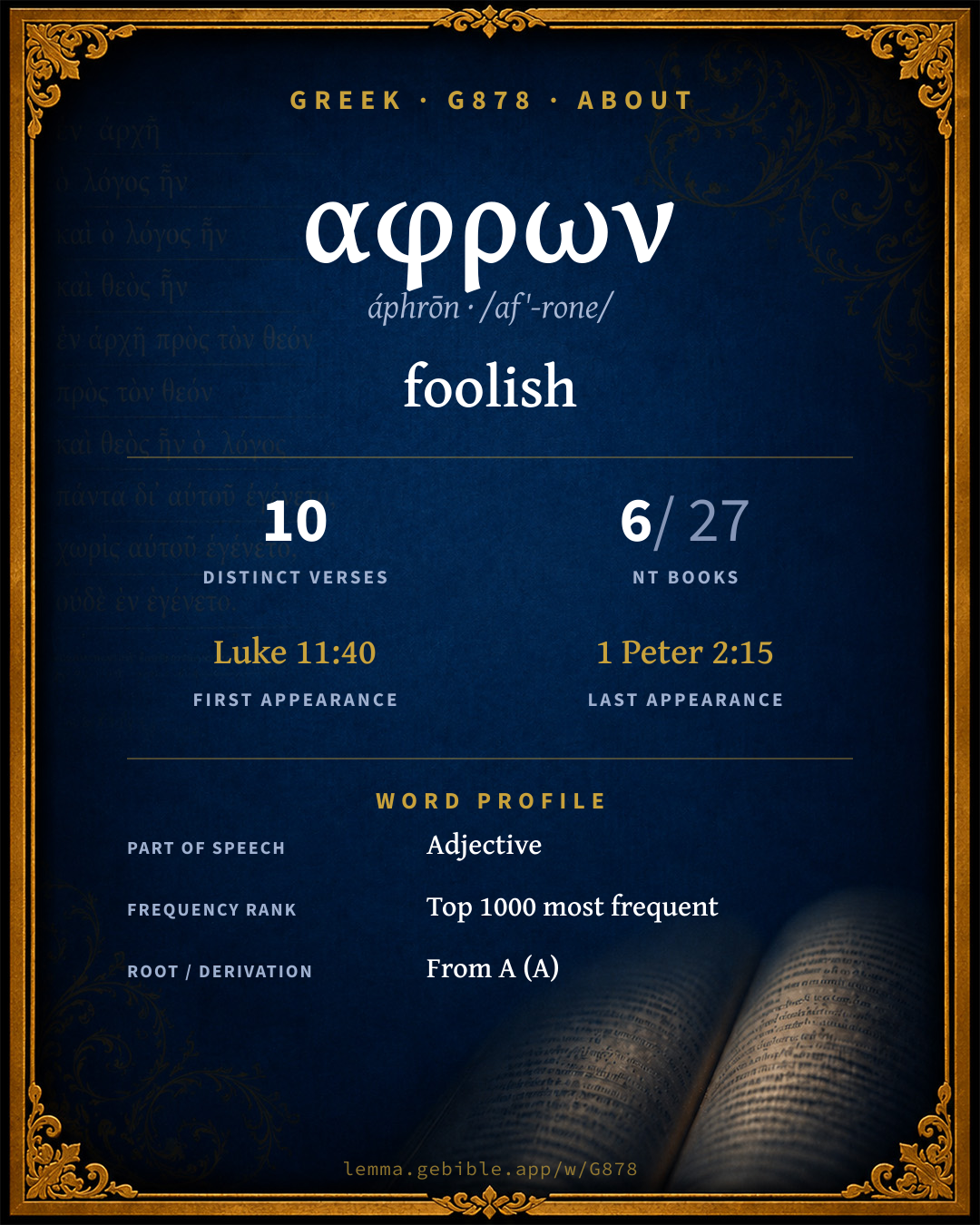
ἄφρων
foolish
‘foolish’ is one of 3 main senses fuller range ↓
Full lexicon entry — Thayer's Greek Lexicon
From Thayer's Greek Lexicon
Where this word appears
See every Nominative-case word in the Greek New Testament →
Grammar key — what these labels mean
Part of speech
- Adjective
- A word that describes or qualifies a noun.
Case
- Genitive
- The case of source, possession, or “of” — answers “whose / from what.”
- Accusative
- The case of the direct object and of extent.
- Nominative
- The case of the subject (and the predicate nominative).
- Vocative
- The case of direct address (“O Lord”).
Gender
- Masculine
- Grammatically masculine.
Number
- Plural
- More than one.
- Singular
- One.
Every verse where G878 appears in the Book of 2 Corinthians — 4 distinct verses. Click any verse to open its interlinear word-by-word view. Verse text shown in the World English Bible for context — . Each verse’s Greek form is shown with its reference; the English is not keyword-highlighted, since the data carries no word-level English alignment. Use “Compare translations” on any verse to read it across multiple English versions. This concordance covers the Greek New Testament; Septuagint (Greek Old Testament) occurrences of this word are not indexed here.
2 Corinthians
- 2 Corinthians 11:16 ἄφρονα ἄφρονα adj acc sg masc adj acc sg masc I say again, let no one think me foolish. But if so, yet receive me as foolish, that I also may boast a little.
- 2 Corinthians 11:19 ἀφρόνων adj gen pl masc For you bear with the foolish gladly, being wise.
- 2 Corinthians 12:6 ἄφρων adj nom sg masc For if I would desire to boast, I will not be foolish; for I will speak the truth. But I forbear, so that no man may account of me above that which he sees in me, or hears from me.
- 2 Corinthians 12:11 ἄφρων adj nom sg masc I have become foolish in boasting. You compelled me, for I ought to have been commended by you, for in nothing was I inferior to the very best apostles, though I am nothing.
About this entry
At a glance — auto-summarized from this page’s data, not written by a person. Every figure links to its source below. This summary describes the numbers; it doesn’t interpret them.
αφρων (áphrōn) is a Greek adjective most often rendered “foolish.” Debuting at Luke 11:40, it then recurs through the corpus. The Greek New Testament uses it across 10 verses — uncommon. 2 Corinthians dominates its distribution — 4 of 10 verses. Its lexical range runs to 3 senses. The sections below give every sense, occurrence, and version rendering.
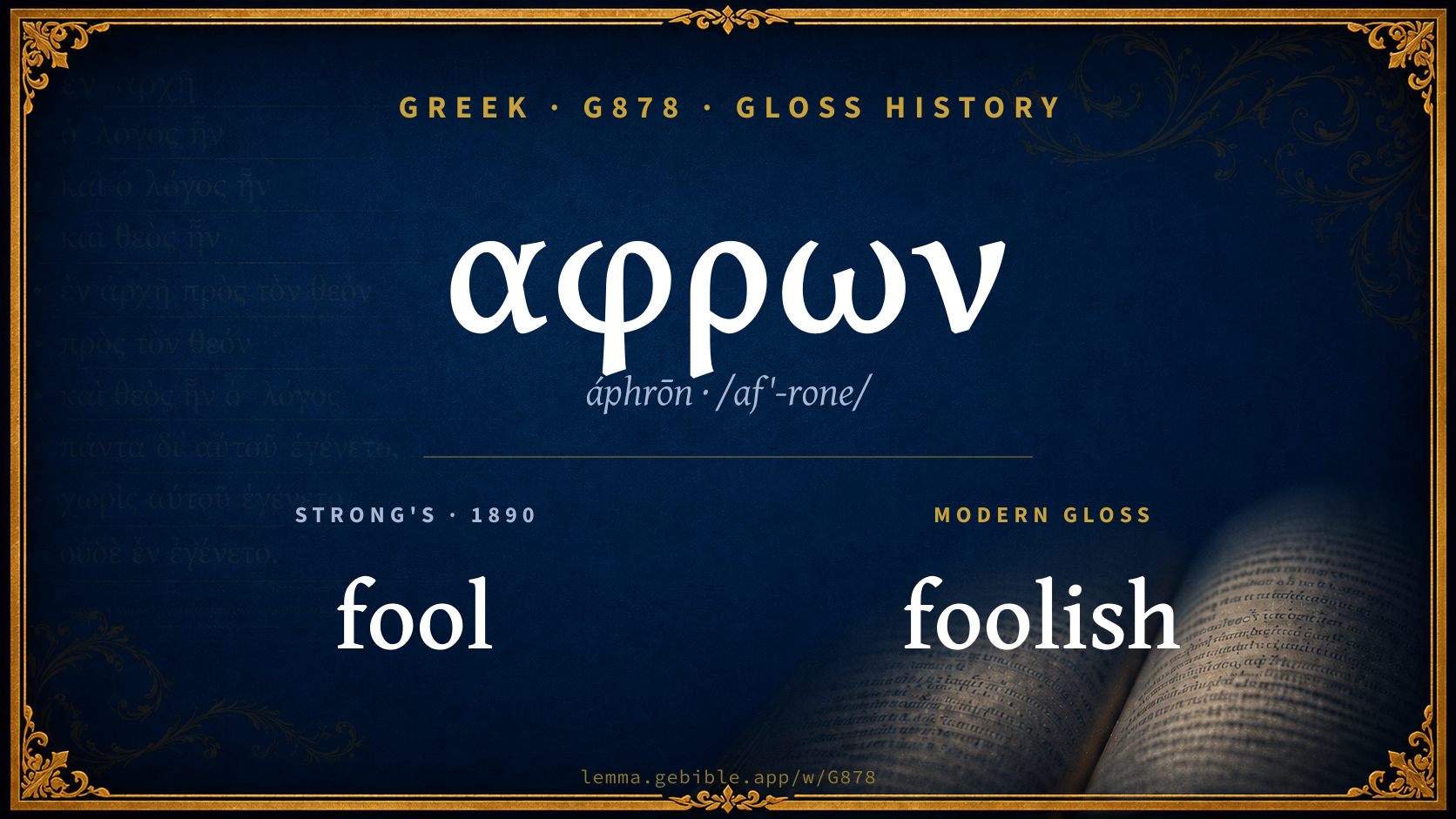
Gloss history
Strong's 1890 vs modern scholarship
About this word
Strong's G878 catalogs a Greek word from the Greek New Testament.
These counts are not copied from any lexicon or concordance. They are computed here, from the morphology-tagged Greek New Testament. What Lemma adds →
- 10
- distinct verses
- The word appears in 10 distinct verses.
- 6 / 27
- NT books
- The word appears in 6 of 27 New Testament books.
- #978
- by frequency
- Top 1000 most frequent Greek words (rank 978 of 5,347 Greek words by occurrence).
View all 10 occurrences in the concordance →
Most concentrated in
- 2 Corinthians 4 verses 40%
- Luke 2 verses 20%
- Romans 1 verse 10%
By section of the New Testament
By traditional corpus
Conventional, traditional groupings — biblical authorship is debated, so this is a traditional corpus grouping, not an authorship claim. Some books belong to more than one corpus (Luke is in both the Gospels and the Lukan corpus, and so on), so these shares overlap and need not total 100%. Each figure is a share of the word’s 10 distinct verses.
- Pauline corpus 7 verses · 70%
- Gospels 2 verses · 20%
- Lukan (Luke–Acts) 2 verses · 20%
- General (Catholic) Epistles 1 verse · 10%
How translations render this word
Counts come from each version’s own published word-to-Strong’s tagging or interlinear alignment — an approximate guide to how each version renders this word, not a word-level alignment the data otherwise carries. Because each total is that version’s own tagged count, the per-version totals vary from one another and need not match the appearance or distinct-verse counts above. These counts may also differ from a printed concordance because Lemma counts each distinctly tagged rendering and does not collapse phrase taggings into a single head-word total. This is a fixed set of word-tagged versions (KJV, ASV, BSB, ULT) and does not change with the reading translation you choose elsewhere. Each version’s license is shown beside its name below (and on Sources).
- King James Version: Fool 4×, Foolish 2×, Thou fool 2×
- American Standard Version: Foolish 8×, Thou foolish 2×
- Berean Standard Bible: Fool 6×, Foolish 3×, Fools 2×
- unfoldingWord Literal Text: Foolish 5×, Fool 2×, Foolish one 2×
King James Version Public Domain
Renders G878 across 11 tagged occurrences — most commonly:
Plus 3 renderings that appear only once — usually multi-word phrases or single function words the recovered tagging swept in, not distinct renderings.
American Standard Version Public Domain
Renders G878 across 11 tagged occurrences — most commonly:
Plus 1 rendering that appears only once — usually multi-word phrases or single function words the recovered tagging swept in, not distinct renderings.
Berean Standard Bible Public Domain
Renders G878 across 11 tagged occurrences — most commonly:
unfoldingWord Literal Text CC BY-SA 4.0
Renders G878 across 11 tagged occurrences — most commonly:
Plus 2 renderings that appear only once — usually multi-word phrases or single function words the recovered tagging swept in, not distinct renderings.
Senses in Thayer's
The 3 senses Thayer's distinguishes for this word, in lexicon order (not ranked by frequency or importance). The full entry — with sub-senses — is in the Lexicon Entry tab.
- without reason
- senseless, foolish, stupid
- without reflection or intelligence, acting rashly
Word origin
Derived from Α (A) (G1) — alpha.
Forms in the corpus
The 4 distinct written forms G878 takes in the Greek New Testament, most frequent first — each parse links to that case’s occurrences in the concordance.
| Form | Parsing | Example | Uses |
|---|---|---|---|
| ἄφρων áphrōn | Adjective, Nominative, Singular, Masculine | 2 Corinthians 12:6 | 4 |
| ἀφρόνων aphrónōn | Adjective, Genitive, Plural, Masculine | Romans 2:20 | 3 |
| ἄφρονες áphrones | Adjective, Nominative, Plural, Masculine | Ephesians 5:17 | 2 |
| ἄφρονα áphrona | Adjective, Accusative, Singular, Masculine | 2 Corinthians 11:16 | 2 |
Same root — word family
Other Thayer's entries built from the same root as G878, grouped by Strong’s listed origin. These share a root / origin per the lexicon — not necessarily a shared meaning. Each links to that word’s own entry.
Derives from
Shares the same root
- αβαρης abarḗs G4 light
- αβυσσος ábyssos G12 abyss
- αγαμος ágamos G22 unmarried
- αγενεαλογητος agenealógētos G35 without genealogy
- αγενης agenḗs G36 ignoble
- αγναφος ágnaphos G46 unprocessed
- αγνοεω agnoéō G50 to be ignorant
- αγνωσια agnōsía G56 ignorance
- αγνωστος ágnōstos G57 unknown
- αγραμματος agrámmatos G62 unlearned
- αγρυπνεω agrypnéō G69 to watch
- αδαπανος adápanos G77 free
- αδελφος adelphós G80 brother
- αδηλος ádēlos G82 obscure
- αδης háidēs G86 hell
- αδιακριτος adiákritos G87 clear
- αδιαλειπτος adiáleiptos G88 continual
- αδικος ádikos G94 unjust
- αδοκιμος adókimos G96 unapproved
- αδολος ádolos G97 guileless
- αδυνατος adýnatos G102 weak
- αζυμος ázymos G106 unleavened
- αθανασια athanasía G110 immortal
- αθεμιτος athémitos G111 unlawful
+149 more words share this root (not shown).
Derived from this word
Proper names from this root
People and places named from this root — a name, not an additional meaning of the word.
Compare all same-root words → Showing 4 of 177 — not the complete family. 1 of the same-root words is a proper name (a person or place). They share a root, not necessarily a meaning.
Septuagint usage
The same Greek word αφρων appears 112 times in the Greek Old Testament (Septuagint), across 110 verses in 7 books.
- 112
- LXX occurrences
- Tagged occurrences of this Greek word in the Septuagint.
- 110
- verses
- Distinct Septuagint verses containing this word.
- 7 / 39
- OT books
- The word appears in 7 of the 39 Old Testament books.
Sample Septuagint occurrences
- 2 Samuel 13:13 ἄφρων
- Job 2:10 ἄφρων
- Psalms 13:1 ἄφρων
- Proverbs 1:22 ἄφρων
- Ecclesiastes 2:14 ἄφρων
- Isaiah 59:7 ἄφρων
- Jeremiah 4:22 ἄφρων
Septuagint occurrences (same lexeme)
Every verse where the same Strong’s number (G878) appears in the Greek Septuagint — showing the first 50 of 110. Verse text shown in the World English Bible for context; the Greek form is the matched word — the English is not keyword-highlighted.
- 2 Samuel 13:13 ἄφρων I, where shall I carry my shame? and as for you, you will be as one of the fools in Israel. Now therefore, please speak to the king; for he will not withhold me from you.
- Job 2:10 ἄφρων But he said to her, "You speak as one of the foolish women would speak. What? Shall we receive good at the hand of God, and shall we not receive evil?" In all this Job didn't sin with his lips.
- Job 5:2 ἄφρων For resentment kills the foolish man, And jealousy kills the simple.
- Job 5:3 ἄφρων I have seen the foolish taking root, But suddenly I cursed his habitation.
- Job 30:8 ἄφρων They are children of fools, yes, children of base men. They were flogged out of the land.
- Job 34:36 ἄφρων I wish that Job were tried to the end, Because of his answering like wicked men.
- Psalms 13:1 ἄφρων How long, Yahweh? Will you forget me forever? How long will you hide your face from me?
- Psalms 38:9 ἄφρων Lord, all my desire is before you. My groaning is not hidden from you.
- Psalms 48:11 ἄφρων Let Mount Zion be glad! Let the daughters of Judah rejoice, Because of your judgments.
- Psalms 52:2 ἄφρων Your tongue plots destruction, Like a sharp razor, working deceitfully.
- Psalms 73:18 ἄφρων Surely you set them in slippery places. You throw them down to destruction.
- Psalms 73:22 ἄφρων I was so senseless and ignorant. I was a brute beast before you.
- Psalms 91:7 ἄφρων A thousand may fall at your side, And ten thousand at your right hand; But it will not come near you.
- Psalms 93:8 ἄφρων
- Proverbs 1:22 ἄφρων "How long, you simple ones, will you love simplicity? How long will mockers delight themselves in mockery, And fools hate knowledge?
- Proverbs 6:12 ἄφρων A worthless person, a man of iniquity, Is he who walks with a perverse mouth;
- Proverbs 7:7 ἄφρων I saw among the simple ones. I discerned among the youths a young man void of understanding,
- Proverbs 9:4 ἄφρων "Whoever is simple, let him turn in here!" As for him who is void of understanding, she says to him,
- Proverbs 9:13 ἄφρων The foolish woman is loud, Undisciplined, and knows nothing.
- Proverbs 9:16 ἄφρων "Whoever is simple, let him turn in here." As for him who is void of understanding, she says to him,
- Proverbs 10:1 ἄφρων The proverbs of Solomon. A wise son makes a glad father; But a foolish son brings grief to his mother.
- Proverbs 10:4 ἄφρων He becomes poor who works with a lazy hand, But the hand of the diligent brings wealth.
- Proverbs 10:18 ἄφρων He who hides hatred has lying lips. He who utters a slander is a fool.
- Proverbs 10:21 ἄφρων The lips of the righteous feed many, But the foolish die for lack of understanding.
- Proverbs 10:23 ἄφρων It is a fool's pleasure to do wickedness, But wisdom is a man of understanding's pleasure.
- Proverbs 11:29 ἄφρων He who troubles his own house shall inherit the wind. The foolish shall be servant to the wise of heart.
- Proverbs 12:1 ἄφρων Whoever loves correction loves knowledge, But he who hates reproof is stupid.
- Proverbs 12:15 ἄφρων The way of a fool is right in his own eyes, But he who is wise listens to counsel.
- Proverbs 12:16 ἄφρων A fool shows his annoyance the same day, But one who overlooks an insult is prudent.
- Proverbs 12:23 ἄφρων A prudent man keeps his knowledge, But the hearts of fools proclaim foolishness.
- Proverbs 13:16 ἄφρων Every prudent man acts from knowledge, But a fool exposes folly.
- Proverbs 13:20 ἄφρων One who walks with wise men grows wise, But a companion of fools suffers harm.
- Proverbs 14:1 ἄφρων Every wise woman builds her house, But the foolish one tears it down with her own hands.
- Proverbs 14:3 ἄφρων The fool's talk brings a rod to his back, But the lips of the wise protect them.
- Proverbs 14:7 ἄφρων Stay away from a foolish man, For you won't find knowledge on his lips.
- Proverbs 14:8 ἄφρων The wisdom of the prudent is to think about his way, But the folly of fools is deceit.
- Proverbs 14:16 ἄφρων A wise man fears, and shuns evil, But the fool is hotheaded and reckless.
- Proverbs 14:18 ἄφρων The simple inherit folly, But the prudent are crowned with knowledge.
- Proverbs 14:24 ἄφρων The crown of the wise is their riches, But the folly of fools crowns them with folly.
- Proverbs 14:29 ἄφρων He who is slow to anger has great understanding, But he who has a quick temper displays folly.
- Proverbs 14:33 ἄφρων Wisdom rests in the heart of one who has understanding, And is even made known in the inward part of fools.
- Proverbs 15:2 ἄφρων The tongue of the wise commends knowledge, But the mouth of fools gush out folly.
- Proverbs 15:5 ἄφρων A fool despises his father's correction, But he who heeds reproof shows prudence.
- Proverbs 15:7 ἄφρων The lips of the wise spread knowledge; Not so with the heart of fools.
- Proverbs 15:20 ἄφρων A wise son makes a father glad, But a foolish man despises his mother.
- Proverbs 16:18 ἄφρων Pride goes before destruction, And a haughty spirit before a fall.
- Proverbs 16:23 ἄφρων The heart of the wise instructs his mouth, And adds learning to his lips.
- Proverbs 17:2 ἄφρων A servant who deals wisely will rule over a son who causes shame, And shall have a part in the inheritance among the brothers.
- Proverbs 17:7 ἄφρων Arrogant speech isn't fitting for a fool, Much less do lying lips fit a prince.
- Proverbs 17:10 ἄφρων A rebuke enters deeper into one who has understanding Than a hundred lashes into a fool.
These are occurrences of the same Greek lexeme (G878) in the Septuagint — not a translation of any one Hebrew word. The store carries no word-level Hebrew↔Greek alignment, so no Hebrew original is asserted here. Counts come from the recovered LXX Strong's tagging — high-frequency vocabulary is well covered, while rare or late forms may be untagged — so they reflect tagged occurrences and may slightly undercount.