
Psalms 73:22

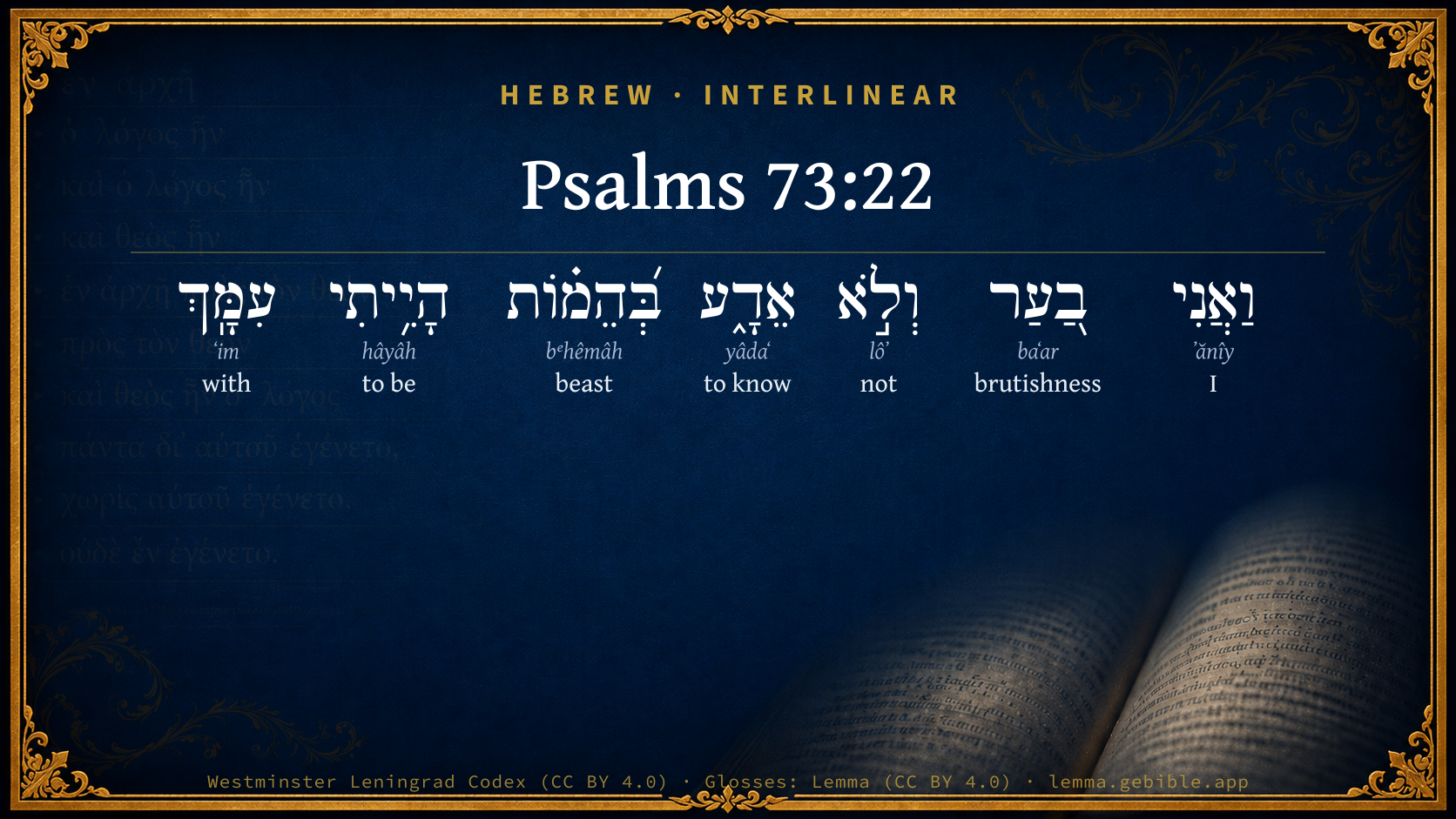
Hebrew (Westminster Leningrad Codex) Psalms 73:22 appears in the Hebrew Old Testament. The text above is from the Westminster Leningrad Codex. Each word links to its Strong’s number, a concise gloss, and parsing drawn from the Open Scriptures Hebrew Bible morphology. Click any word for its full Brown-Driver-Briggs (BDB) entry.
Download image
Cite this verse

Psalms 73:22 (World English Bible). Public Domain. Lemma interlinear Bible study tool, https://lemma.gebible.app/v/psalms/73/22.

Show BibTeX & RIS
BibTeX
RIS
English Translation
I was so senseless and ignorant. I was a brute beast before you.
World English Bible · Public Domain
Download a study sheet

One document with this verse’s original text, its word-by-word gloss line, the meaning frame, cross-references with their text, attributed commentary, and full source and license credits — printable, and it pastes into notes with its structure intact.

This verse Autodidact and up

Study sheet (.html) Plain text (.txt)

A passage Seminary Student

Up to 50 verses in one chapter. A passage sheet keeps up to 6 commentary sources and 12 cross-references per verse, in the order this page ranks them, and says so on the sheet whenever that leaves anything out. Ask for a single verse and you get the Autodidact verse sheet above.

Everything on this page stays free to read, with no account — the sheet is a download of what is already on screen, not access to it.

Want to remove ads? Support Godless Engineer
Compare translations 3

The same verse in 3 English versions, stacked beneath the original-language interlinear above. Click any original word for its lexicon entry.

Each is an independent rendering of the whole verse — the interlinear is not word-aligned to these translations.

Highlighted words mark where these versions differ — a whole-verse word diff, not a word-by-word alignment.

  • World English Bible Public Domain
    I was so senseless and ignorant. I was a brute beast before you.
  • King James Version Public Domain
    So foolish was I, and ignorant: I was as a beast before thee.
  • unfoldingWord Literal Text CC BY-SA 4.0
    I stupid and I was not knowing; I was an animal with you.

unfoldingWord Literal Text — © unfoldingWord, licensed CC BY-SA 4.0. Word-aligned USFM3 via Door43 (git.door43.org/unfoldingWord/en_ult).

Versions to compare (up to 4)

3 of 4 selected

Show all 18 translations

Every available English version of this verse, each an independent rendering of the whole verse.

  • World English Bible Public Domain
    I was so senseless and ignorant. I was a brute beast before you.
  • Berean Standard Bible Public Domain
    I was senseless and ignorant; I was a brute beast before You.
  • Majority Standard Bible Public Domain
    I was senseless and ignorant; I was a brute beast before You.
  • King James Version Public Domain
    So foolish was I, and ignorant: I was as a beast before thee.
  • American Standard Version (1901) Public Domain
    So brutish was I, and ignorant; I was `as' a beast before thee.
  • Revised Version (1885) Public Domain
    So brutish was I, and ignorant; I was as a beast before thee.
  • Geneva Bible (1599) Public Domain
    So foolish was I and ignorant: I was a beast before thee.
  • Douay-Rheims (1899) Public Domain
    and I am brought to nothing, and I knew not.
  • Young's Literal Translation Public Domain
    And I am brutish, and do not know. A beast I have been with Thee.
  • Literal Standard Version CC BY-SA 4.0
    And I am brutish, and do not know. I have been a beast with You.
  • Unlocked Literal Bible CC BY-SA 4.0
    I was ignorant and lacked insight; I was like a senseless animal before you.
  • unfoldingWord Literal Text CC BY-SA 4.0
    I stupid and I was not knowing; I was an animal with you.
  • Darby Bible Public Domain
    Then I was brutish and knew nothing; I was [as] a beast with thee.
  • World Messianic Bible Public Domain
    I was so senseless and ignorant. I was a brute beast before you.
  • Webster's Bible Public Domain
    So foolish was I, and ignorant: I was as a beast before thee.
  • Free Bible Version CC BY-SA 4.0
    I was stupid and ignorant. I was like a brute beast to you.
  • Bible in Basic English Public Domain
    As for me, I was foolish, and without knowledge; I was like a beast before you.
  • JPS Tanakh (1917) Public Domain
    But I was brutish, and ignorant; I was as a beast before Thee.

Literal Standard Version (2020), Covenant Press — licensed CC BY-SA 4.0. Text via the HelloAO Bible API (eBible.org). Unlocked Literal Bible (unfoldingWord) — licensed CC BY-SA 4.0. Text via the HelloAO Bible API (eBible.org). unfoldingWord Literal Text — © unfoldingWord, licensed CC BY-SA 4.0. Word-aligned USFM3 via Door43 (git.door43.org/unfoldingWord/en_ult). Free Bible Version, Dr. Jonathan Gallagher — licensed CC BY-SA 4.0. Text via the HelloAO Bible API (eBible.org).

Word by word

More ways to search: Search by grammar → Find every occurrence → Compare this word →

Practice this passage: Drill this verse → Learn its vocabulary →

About this verse

These counts appear in no published source. They are computed here, from the morphology-tagged text and Lemma’s own curated glosses. What Lemma adds →

7
words
7
distinct lemmas
Wisdom
section

Notable vocabulary

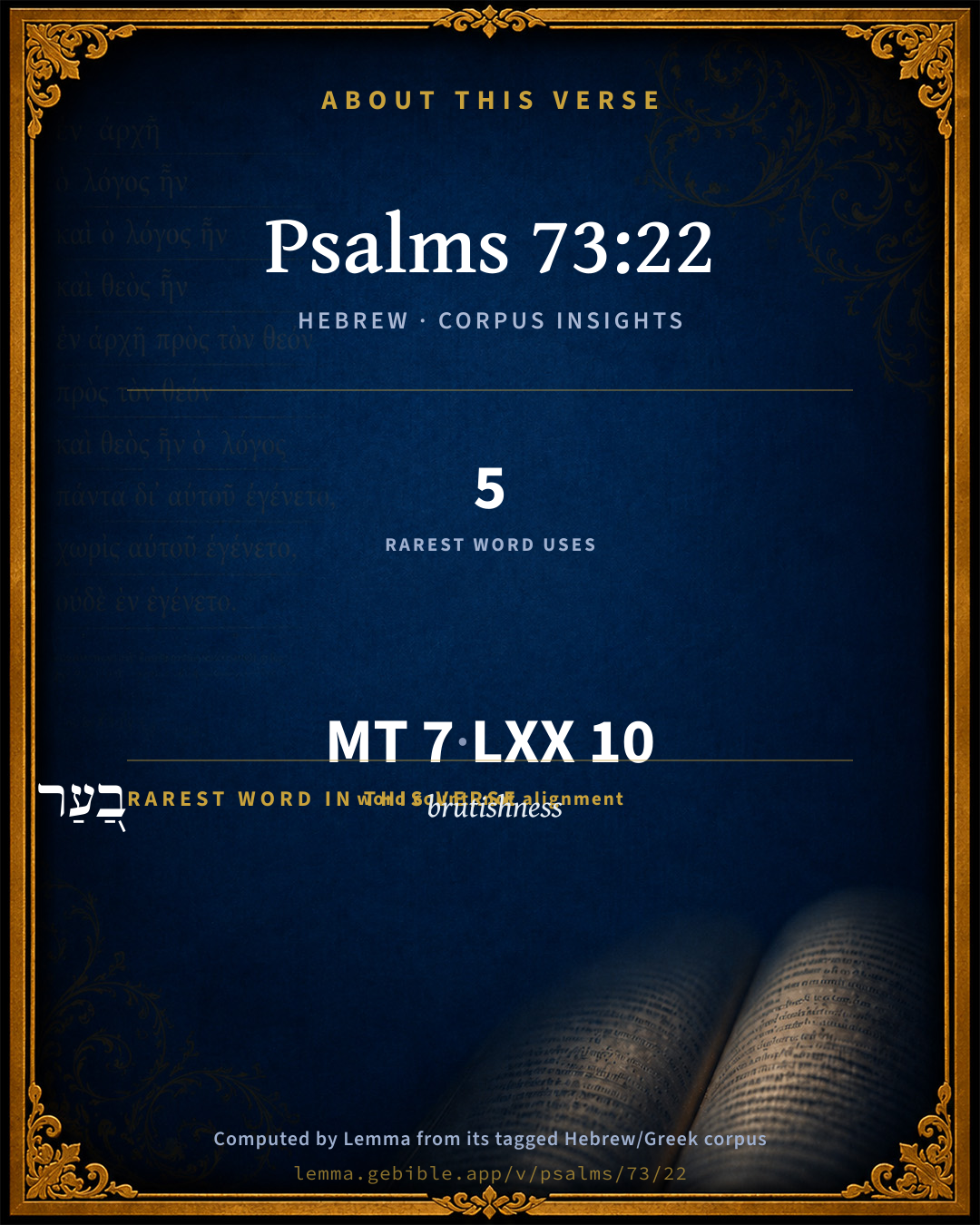
The rarest word here is בַ֭עַר brutishness H1198 — appearing just 5 times in the whole Hebrew Bible.

Shared distinctive vocabulary

בַ֭עַר brutishness H1198 occurs in 5 verses of the Hebrew Bible. Also found in:

Grammatical profile

  • 2 verbs
  • 1 noun
  • 1 adjective
  • 1 pronoun
  • 1 preposition
  • 1 particle

Verb forms

  • אֵדָ֑ע Qal · Imperfect
  • הָיִ֥יתִי Qal · Perfect

Hebrew & Septuagint length

In English translation the verse runs 13 words from the Hebrew and 12 from the Septuagint (LXX English) — closely comparable.

A rough comparison of the two English renderings, which tokenize alike — not a word-level alignment.

Word counts can differ between the Hebrew and the Greek without any difference in meaning — e.g. the Hebrew direct-object marker אֵת has no separate Greek word, and Greek often adds the article ὁ.

In the original languages it is 7 Hebrew tokens and 10 Greek tokens — but the two are counted differently (Hebrew bundles its prefixes and suffixes into one token; the Greek is in lemma form), so that isn’t a like-for-like length.

Cross-references

8

Topical passages linked to Psalms 73:22 in the Treasury of Scripture Knowledge — connected by theme and wording, ordered by reader-vote popularity; previews shown in the World English Bible.

  • Ecclesiastes 3:18 I said in my heart, "As for the sons of men, God tests them, so that they may see that they themselves are like animals.
  • Psalms 92:6 A senseless man doesn't know, Neither does a fool understand this:
  • Psalms 49:10 For he sees that wise men die; Likewise the fool and the senseless perish, And leave their wealth to others.
  • Isaiah 1:3 The ox knows his owner, And the donkey his master's crib; But Israel doesn't know, My people don't consider.
  • Psalms 32:9 Don't be like the horse, or like the mule, which have no understanding, Who are controlled by bit and bridle, or else they will not come near to you.
  • Proverbs 30:2 "Surely I am the most ignorant man, And don't have a man's understanding.
  • Job 18:3 Why are we counted as animals, Which have become unclean in your sight?
  • Psalms 69:5 God, you know my foolishness. My sins aren't hidden from you.

Cross-references courtesy of OpenBible.info (CC BY 4.0).

Hebrew and Greek witnesses Masoretic Hebrew ↔ Greek Septuagint

The same verse in the two great witnesses to the Old Testament, shown verse-for-verse.

You’re reading Greek Psalm 72 (Hebrew Psalm 73). The Septuagint counts the superscription, so verse numbers can differ from the Hebrew — chapter-level alignment, not verse-by-verse. Numbering follows Rahlfs.

These are two independent witnesses, not word-aligned to each other, and the Septuagint is shown in lemma (dictionary) form.

Hebrew Psalms 73:22 Masoretic · Westminster Leningrad Codex

וַאֲנִי בַ֭עַר וְלֹ֣א אֵדָ֑ע בְּ֝הֵמ֗וֹת הָיִ֥יתִי עִמָּֽךְ

I was so senseless and ignorant. I was a brute beast before you.

World English Bible · Public Domain

Greek LXX Greek Psalm 72:22 Septuagint · lemma form

καί ἐγώ ἐκοὐδενόω καί οὐ γιγνώσκω κτηνώδης γίγνομαι παρά σύ

But I was vile and knew not: I became brutish before you.

LXX2012 (modern English Septuagint) · Public Domain

Hebrew: Westminster Leningrad Codex (CC BY 4.0). Greek: Septuagint (public domain); English from LXX2012 (modern English Septuagint) (Public Domain). How the Septuagint differs from the Hebrew →

Commentary

Notes on Psalms 73:22 from classic Christian and Jewish commentators (each source and its license shown beneath its notes). The classic Christian expositions comment on the surrounding passage and are grouped to its opening verse, so a note may address several verses; the Jewish commentaries on the Tanakh (Rashi and others) are per-verse, so they appear only where the commentator wrote on this verse.

Lemma curates 59 commentaries, every one of them public domain or Creative Commons licensed, each selected and text-cleaned for this edition rather than reprinted as found. About our sources →

Trapp's Complete Commentary

John Trapp

Psa 73:22 So foolish [was] I, and ignorant: I was [as] a beast before thee.

Ver. 22. So foolish was I and ignorant] By this befooling and be beasting himself, he retracteth and bewaileth his former fluctuation and folly, Psa 73:2-3. This is the proper fruit of his godly sorrow, Psa 73:12.

I was as a beast before thee] Heb. Behemoth, as a great beast, or as many beasts in one. Thus he aggravateth and layeth load upon his sin, and so must we.

John Trapp, A Commentary or Exposition upon All the Books of the Old and New Testament (1647–1656) — public domain. Text from a community e-Sword module.

The Biblical Illustrator

Joseph S. Exell

Psa_73:22-25

So foolish was I, and ignorant: I was as a beast before Thee.

Flesh and spirit a riddle

What secrets of inward experience we have in our text. Consider--

I. The confessions concerning the flesh. David was a great saint, yet he tells God--So foolish was I. . . beast before Thee.

1. Foolish. It was sinful folly, not to be excused by frailty, but perverse and wilful. And is not this true of us?

2. Ignorant. Surely after all his experience he ought to have known better than to be envious of the wicked. And how often we have to make the like confession. If we could but see ourselves we should see our knowledge to be nothing and our ignorance to he all. Then--

3. As a beast before Thee. The Hebrew is, I was a very beast before Thee. It means, so worldly-minded, so empty of all holy desire, so short-sighted, so full of animal passions. But turn to--

II. The expressions of the spirit.

1. He is conscious of Divine regard. Nevertheless I am, etc. Upon His mind, before His eye, in His hand.

2. Of Divine help. Thou hast holden me.

3. Of Divine guidance. Thou shalt guide, etc.

4. Of Divine reception. Receive me to glory.

III. To the conclusion of the whole. Whom have I in heaven but Thee, etc. I have known men lose their property, and what is dearer than property, but they have not said, Whom have I in heaven, etc. The confessions of our text will be heard in the adoring gratitude of the redeemed in glory. That Christ should have saved them--the foolish, the ignorant, and who had been as a beast before Him. But this He will do for all who believe. (C. H. Spurgeon.)

A pilgrims progress

I. The pilgrims character and condition before he was turned to the Lord. So foolish . . . beast before Thee. What a hearty and thorough confession this is! Probably it was not so made at first. Men never accurately measure the depth of the pit they lay in until they are out of it. Note the terms he uses in this confession. See the cattle browsing on the grass. It is no shame to them to be beasts; but it is a shame for a man to be as a beast, for he was made in Gods image. The beast never had a soul; and I have quenched the life of mine--put out its light. I was like a beast in having a body and life and appetites, and stopping short with these, as if these were all! They knew not a God to live for; and I lived without God. Being a man, I became as a beast.

II. His present nearness and peace. Nevertheless I am continually with Thee. What a difference--I was as a beast; but I am with Thee. Transformations unknown in nature are accomplished in grace. The man has become new. How has it been brought about? There has been reconciliation; the saved are made nigh through the blood of Christ. And this nearness continues.

III. The cause and manner of this great deliverance. Thou hast holden me by my right hand. It is Gods doing, not his own. The picture represents a father leading his strayed child home.

IV. The course through life which the penitent now expects to keep. thou shalt guide me, etc.

V. The issue of all in eternity. Look to the last three points, that we may mark their order and their relations.

1. Salvation accomplished by almighty grace: Thou hast holden me.

2. New obedience now, according to the Word of God: Thou shalt guide me with Thy counsel.

3. Hope of glory afterward: Thou shalt receive me. In the middle is the actual holiness--the new obedience of the saved man, and on either side of a strong one on whom it may lean. On the one side is salvation already accomplished; on the other is the hope of glory yet to come. (W. Arnot.)

The Biblical Illustrator, edited by Joseph S. Exell (c. 1880s–1900s) — public domain. Text from a community e-Sword module.

J. A. Alexander on Psalms

Joseph Addison Alexander

Psa 73:22. And I (am) brutish and know not (the true state of the case); a beast have I been with thee. The last noun is in the plural number (beasts), as if to signify a beast by way of eminence, in which sense it is literally applied to one of the wonders of the animal kingdom (Job 40:15). With the first clause compare Prov. xxx. 2, and see above, on Psa 49:10. These strong expressions contain an acknowledgment of his own irrationality in questioning God's faithfulness and kindness. In this verse there is an insensible transition from the present to the past, from the ideal to the real time of the events in question. With thee suggests an aggravating circumstance, to wit, that this folly was committed in the presence of God, and as it were in his society. See above, on Psa 18:25-26.

Joseph Addison Alexander, The Psalms Translated and Explained (1850) — public domain. Text from a community e-Sword module.

Geneva Bible (1599)

Geneva Bible translators

For the more that man goeth about by his own reason to seek out God’s judgments, the more doth he declare himself a beast.

Geneva Bible (1599) marginal notes — public domain. Text via Bolls.life.

John Calvin's Commentaries

22. And I was foolish and ignorant. David here rebuking himself sharply, as it became him to do, in the first place declares that he was foolish; secondly, he charges himself with ignorance; and, thirdly, he affirms that he resembled the brutes. Had he only acknowledged his ignorance, it might have been asked, Whence this vice or fault of ignorance proceeded? He therefore ascribes it to his own folly; and the more emphatically to express his folly, he compares himself to the lower animals. The amount is, that the perverse envy of which he has spoken arose from ignorance and error, and that the blame of having thus erred was to be imputed wholly to himself, inasmuch as he had lost a sound judgment and understanding, and that not after an ordinary manner, but even the length of being reduced to a state of brutish stupidity. What we have previously stated is undoubtedly true, that men never form a right judgment of the works of God; for when they apply their minds to consider them, all their faculties fail, being inadequate to the task; yet David justly lays the blame of failure upon himself, because, having lost the judgment of a man, he had fallen as it were into the rank of the brute creatures. Whenever we are dissatisfied with the manner of God’s providence in governing the world, let us remember that this is to be traced to the perversity of our understanding. The Hebrew word עמך, immach, which we have translated with thee, is here to be taken by way of comparison for before thee; as if David had said, — Lord, although I have seemed in this world to be endued with superior judgment and reason, yet in respect of thy celestial wisdom, I have been as one of the lower animals. It is with the highest propriety that he has inserted this particle. To what is it owing, that men are so deceived by their own folly, as we find them to be, if it is not to this, that while they look at each other, they all inwardly flatter themselves? Among the blind, each thinks that he has one eye, in other words, that he excels the rest; or, at least, he pleases himself with the reflection, that his fellows are in no respect superior to himself in wisdom. But when persons come to God, and compare themselves with him, this prevailing error, in which all are fast asleep, can find no place.

John Calvin's Commentaries (1540-1563) — public domain. Text from the Calvin Translation Society English edition (1840s-50s) via the Christian Classics Ethereal Library (ccel.org). Calvin's coverage is partial (roughly two-thirds of the Bible); uncommented books and verses are honest gaps, never fabricated. The 19th-century editor's footnotes and remarks are omitted so the notes are faithfully Calvin's own voice.

Ellicott's Commentary for English Readers

(22) Foolish.—Better, brutish.

A Bible Commentary for English Readers, edited by Charles John Ellicott (1878–1897) — public domain. Text from a community e-Sword module.

John Gill's Exposition

So foolish was I,.... To envy the prosperity of the wicked, which is of so short a continuance; to arraign the providence and perfections of God, and to conclude so hastily that there was nothing in religion:

and ignorant; or, "I knew not" (w); what he attempted to know, Psa 73:16, nor the end of the wicked, till he went into the sanctuary of the Lord; nor the counsel and design of God, in his methods of providence towards wicked men:

I was as a beast before thee, or "with thee" (x); in the knowledge of the ways and works of God, even those of providence; see Psa 92:5, unteachable, untractable, kicking against God and his providential dispensations; not behaving like a man, much, less like a saint; but even as the worst of brutes, as the behemoth in Job 40:15, for the same word is here used; he concluded that God, who saw all the wickedness of his heart, the workings and reasonings of his mind, which were so vain and foolish, could esteem him no other than as a beast; so the Targum,

"as a beast I am accounted with thee:''

the words may be rendered, "I was the veriest beast before thee"; there being no note of similitude in the text; the word for "beast" being in the plural number, may be used for a superlative; Plautus (y) uses the word "bellua", beast, for a stupid man.

(w) "nescivi", V. L. "non cognoscebam", Pagninus, Montanus; "nec sciebam", Piscator; "non noveram", Cocceius. (x) "apud te", V. L. Pagninus, Montanus, &c. (y) Trinum. Act. 4. Sc. 2. v. 110.

John Gill's Exposition of the Whole Bible (1746–1763) — public domain (CC PDM 1.0). Text via the HelloAO Bible API.

Albert Barnes' Notes on the Bible

So foolish was I, and ignorant - Such low and imperfect views did I take of the subject. The margin is, “I knew not.” So the Hebrew: “And I am brutish, and know not;” that is, I did not understand the case; I had no correct views in regard to it.

I was as a beast before thee - Margin, as in Hebrew, “with thee.” That is, in thy very presence; or, I was guilty of such foolishness in the very presence of my Maker. If it had been when I was alone, or when no one saw me, the folly would not have been so aggravated, and so much to be regretted, but it was when the very eye of God was upon me. Compare Isa 1:7; Jer 7:30; Jer 18:10; Psa 51:4. When he says that he was as a beast, he means that he was stupid and senseless; he had no proper understanding of the case; he did not take any just views of it.

Albert Barnes' Notes on the Bible (1834–1885) — public domain. Text from a community e-Sword/MySword module.

Matthew Poole's English Annotations

As a beast. Heb. beasts, which may signify a great beast; a most stupid and sottish creature, like one not only void of grace, but of reason too; for reason itself, especially assisted by the Holy Scriptures, did sufficiently discover that, all things considered, I had no sufficient cause to envy the prosperity of wicked men. I minded only present things, as the brutes do. and did not consider things to come, as reasonable creatures do, and ought to do.

Before thee; in thy sight or judgment, and therefore in truth, Rom 2:2, howsoever I seemed to myself or others to have some degree of reason and discretion.

Matthew Poole's English Annotations on the Holy Bible (1683–1685) — public domain. Text from a community e-Sword/MySword module.

The Treasury of David

Charles H. Spurgeon

Ver. 22. So foolish was I. He, though a saint of God, had acted as if he had been one of the fools whom God abhorreth. Had he not even envied them? --and what is that but to aspire to be like them? The wisest of men have enough folly in them to ruin them unless grace prevents.

And ignorant. He had acted as if he knew nothing, had babbled like an idiot, had uttered the very drivel of a witless loon. He did not know how sufficiently to express his sense of his own fatuity.

I was as a beast before thee. Even in God's presence he had been brutish, and worse than a beast. As the grass eating ox has but this present life, and can only estimate things thereby, and by the sensual pleasure which they afford, even so had the psalmist judged happiness by this mortal life, by outward appearances, and by fleshly enjoyments. Thus he had, for the time, renounced the dignity of an immortal spirit, and, like a mere animal, judged after the sight of the eyes. We should be very loath to call an inspired man a beast, and yet, penitence made him call himself so; nay, he uses the plural, by way of emphasis, and as if he were worse than any one beast. It was but an evidence of his true wisdom that he was so deeply conscious of his own folly. We see how bitterly good men bewail mental wanderings; they make no excuses for themselves, but set their sins in the pillory, and cast the vilest reproaches upon them. O for grace to detest the very appearance of evil!

Ver. 22. So foolish was I, and ignorant, etc. Is not a cavilling spirit at the Lord's dispensations bad, both in its roots and fruits? What are the roots of it but (1) ignorance; (2) pride, this lifteth up (Heb 2:4); (3) impatience, or want of waiting on God to see the issues of matters; so in Jon 4:8-11; (4) forgetfulness who the Lord is, and who man is that grumbles at his Maker, La 3:39, Ro 9:20. And as for the fruits, they are none of the best, but bad enough. Men are ready to flag in duty, yea, to throw it off, Ro 9:13, and Mal 3:14; yea, in the way to blaspheme God; see Job 2:9 Mal 3:13 Re 16:9. Thomas Crane, in "A Prospect of Divine Providence." 1672.

Ver. 22. I was as a beast before thee. I permitted my mind to be wholly occupied with sensible things, like the beasts that perish, and did not look into a future state, nor did I consider nor submit to the wise designs of an unerring providence. Adam Clarke.

Ver. 22. I was as a beast before thee. The original has in it no word of comparison; it ought to be rather translated, I was a very beast before thee, and we are told that the Hebrew word being in the plural number, gives it a peculiar emphasis, indicating some monstrous or astonishing beast. It is the word used by Job which is interpreted "behemoth, "--"I was a very monster before thee, "not only a beast, but one of the most brutish of all beasts, one of the most stubborn and intractable of all beasts. I think no man can go much lower than this in humble confession. This is a description of human nature, and of the old man in the renewed saint which is not to be excelled. C.H.S.

Ver. 22. Among the many arguments to prove the penman of the Scripture inspired by the Spirit of God, this is not the last and least--that the penmen of holy writ do record their own faults and the faults of their dearest and nearest relatives. For instance hereof, how coarsely doth David speak of himself: So foolish was I, and ignorant: I was as a beast before thee. And do you think that the face of St. Paul did look the more foul by being drawn with his own pencil, when he says, "I was a murderer, a persecutor, the greatest of sinners, "etc? This is not usual in the writings of human authors, who praise themselves to the utmost of what they could, and rather than lose a drop of applause they will lick it up with their own tongues. Tully writes very copiously in setting forth the good service which he did the Roman state, but not a word of his covetousness, of his affecting popular applause, of his pride and vain glory, of his mean extraction and the like. Whereas, clean contrary, Moses sets down the sin and punishment of his own sister, the idolatry and superstition of Aaron his brother, and his own fault in his preposterous striking the rock, for which he was excluded the land of Canaan. Thomas Fuller.

Ver. 22. Our folly, ignorance, and brutishness. When displayed. What effect the fact should have upon us; and how greatly it illustrates divine grace.

Ver. 22-25.

1. The psalmist's confession concerning the flesh.

2. The faithful expressions of the spirit.

3. The conclusion of the whole matter. See "Spurgeon's Sermons, "No. 467.

Psalms 73:23*

Ver. 22-25.

I. The psalmist's confession concerning the flesh.

II. The faithful expressions of the spirit.

III. The conclusion of the whole matter. See "Spurgeon's

Sermons, "No. 467.

Ver. 22-25.

I. The psalmist's confession concerning the flesh.

II. The faithful expressions of the spirit.

III. The conclusion of the whole matter. See "Spurgeon's

Sermons, "No. 467.

Ver. 22-25.

I. The psalmist's confession concerning the flesh.

II. The faithful expressions of the spirit.

III. The conclusion of the whole matter. See "Spurgeon's

Sermons, "No. 467.

Charles H. Spurgeon's The Treasury of David (1869–1885) — public domain. Psalms only. Text from a community e-Sword/MySword module.

Whedon's Commentary on the Bible

Daniel D. Whedon

22. Foolish… ignorant… as a beast—Strong terms, expressive of his blindness and stupidity in his deceived and doubting state.

Daniel D. Whedon (gen. ed.), Commentary on the Old and New Testaments (1874–1909) — public domain. Text from a community e-Sword module.

The Pulpit Commentary

So foolish was I, and ignorant: I was as a beast before thee. I had no more intelligence than the brute beasts; I was wholly unable to reason aright. (comp. Psa_32:9 Psa_92:7 Pro_30:2)

The Pulpit Commentary (1880–1919), ed. H.D.M. Spence-Jones & Joseph S. Exell — public domain. Text from a community e-Sword module.

John Wesley's Explanatory Notes

Nevertheless - Although I gave thee just cause to cast me off, yet thou didst continue thy care and kindness to me. Hast held - That my faith might not fail.

John Wesley, Explanatory Notes Upon the Whole Bible (1754–1765) — public domain. Text via the GEBible commentary corpus.

Rashi

Rabbi Shlomo Yitzchaki (Rashi)

But I was brutish, and I did not know what this manner was, and I was as a beast with You.

Rashi on the Tanakh — English translations: “The Judaica Press complete Tanach with Rashi, translated by A. J. Rosenberg” (CC BY 4.0); “Pentateuch with Rashi's commentary by M. Rosenbaum and A.M. Silbermann, 1929-1934” (public domain); “The Metsudah Tanach series, Lakewood, N.J” (CC BY 4.0); and “The Book of Joshua, Metsudah Publications, 1997” (CC BY 4.0). Text via Sefaria.

Lesson kit

Teaching starters — assembled from the data on this page, not authored interpretation. Every prompt links to the verse data it draws on. Edit before teaching.

Psalms, in the Wisdom, opens this verse with 7 words (7 distinct Hebrew lemmas). Its most distinctive word is baʻar (“brutishness”). A historical commentator’s framing appears above. Read the whole chapter for the surrounding context.

Discussion questions

  1. What does “brutishness” (baʻar) contribute to the verse as a whole?
  2. Psalms 49:10 shares the word «brutishness» with this verse. How do the two illuminate each other?
  3. These translations render this verse differently; the difference is in the English rendering, not the original. What questions does that raise?
  4. The verb «אֵדָ֑ע» is Qal Imperfect. How does its form color the action?
  5. Reading how Trapp's Complete Commentary and The Biblical Illustrator read this verse, where do the two commentators agree and where do they part?

Things to notice

Reading settings

Reading text

Shown beneath each verse's original-language words.

Old Testament
Old Testament edition

Read the OT as the Masoretic Hebrew (MT) or the Greek Septuagint (LXX).

English shown for the Greek Septuagint (in the Hebrew ↔ Greek comparison).

Comparing translations? Open the Compare panel on any verse page to stack up to four side by side.