
Job 34:36

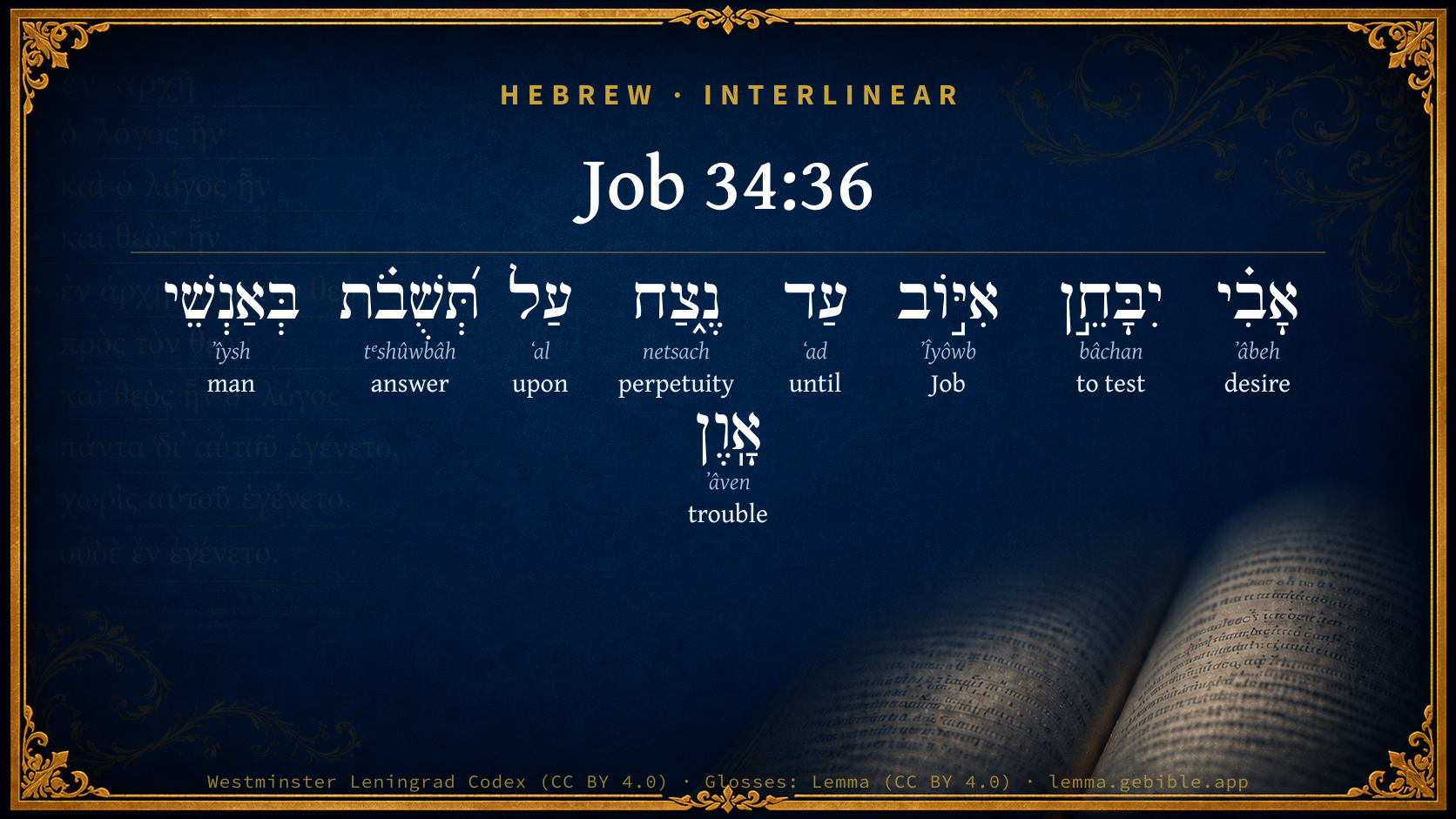
Hebrew (Westminster Leningrad Codex) Job 34:36 appears in the Hebrew Old Testament. The text above is from the Westminster Leningrad Codex. Each word links to its Strong’s number, a concise gloss, and parsing drawn from the Open Scriptures Hebrew Bible morphology. Click any word for its full Brown-Driver-Briggs (BDB) entry.
Download image
Cite this verse

Job 34:36 (World English Bible). Public Domain. Lemma interlinear Bible study tool, https://lemma.gebible.app/v/job/34/36.

Show BibTeX & RIS
BibTeX
RIS
English Translation
I wish that Job were tried to the end, Because of his answering like wicked men.
World English Bible · Public Domain
Highlights
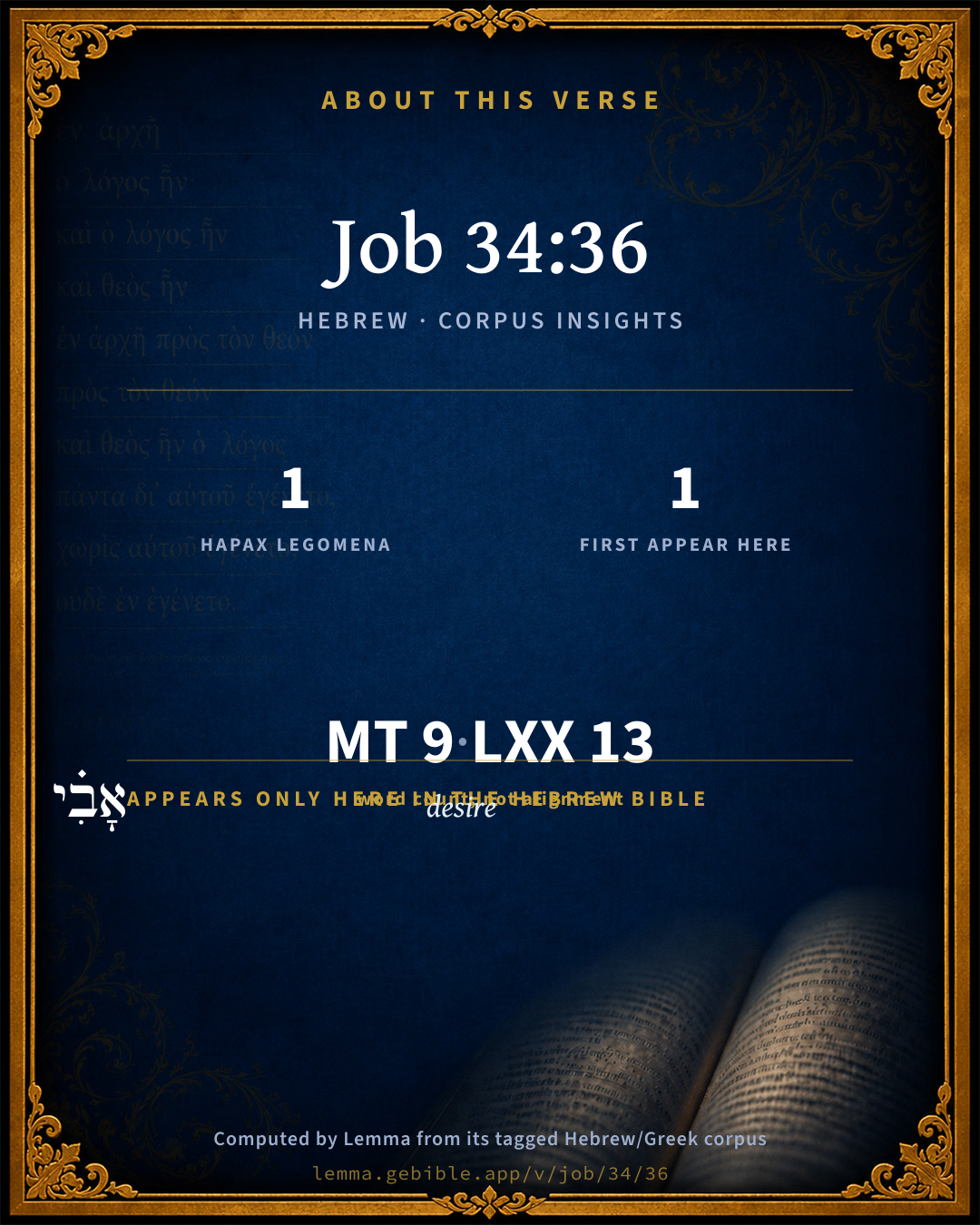
  • 1 hapax legomenon — only here in the Hebrew Bible
  • 1 first appearance in the Hebrew Bible
Full analysis ↓
Download a study sheet

One document with this verse’s original text, its word-by-word gloss line, the meaning frame, cross-references with their text, attributed commentary, and full source and license credits — printable, and it pastes into notes with its structure intact.

This verse Autodidact and up

Study sheet (.html) Plain text (.txt)

A passage Seminary Student

Up to 50 verses in one chapter. A passage sheet keeps up to 6 commentary sources and 12 cross-references per verse, in the order this page ranks them, and says so on the sheet whenever that leaves anything out. Ask for a single verse and you get the Autodidact verse sheet above.

Everything on this page stays free to read, with no account — the sheet is a download of what is already on screen, not access to it.

Want to remove ads? Support Godless Engineer
Compare translations 3

The same verse in 3 English versions, stacked beneath the original-language interlinear above. Click any original word for its lexicon entry.

Each is an independent rendering of the whole verse — the interlinear is not word-aligned to these translations.

Highlighted words mark where these versions differ — a whole-verse word diff, not a word-by-word alignment.

  • World English Bible Public Domain
    I wish that Job were tried to the end, Because of his answering like wicked men.
  • King James Version Public Domain
    My desire is that Job may be tried unto the end because of his answers for wicked men.
  • unfoldingWord Literal Text CC BY-SA 4.0
    If only Job were tested to the end upon answers among men of iniquity.

unfoldingWord Literal Text — © unfoldingWord, licensed CC BY-SA 4.0. Word-aligned USFM3 via Door43 (git.door43.org/unfoldingWord/en_ult).

Versions to compare (up to 4)

3 of 4 selected

Show all 18 translations

Every available English version of this verse, each an independent rendering of the whole verse.

  • World English Bible Public Domain
    I wish that Job were tried to the end, Because of his answering like wicked men.
  • Berean Standard Bible Public Domain
    If only Job were tried to the utmost for answering like a wicked man.
  • Majority Standard Bible Public Domain
    If only Job were tried to the utmost for answering like a wicked man.
  • King James Version Public Domain
    My desire is that Job may be tried unto the end because of his answers for wicked men.
  • American Standard Version (1901) Public Domain
    Would that Job were tried unto the end, Because of his answering like wicked men.
  • Revised Version (1885) Public Domain
    Would that Job were tried unto the end, because of his answering like wicked men.
  • Geneva Bible (1599) Public Domain
    I desire that Iob may be tryed, vnto the ende touching the answeres for wicked men.
  • Douay-Rheims (1899) Public Domain
    My father, let Job be tried even to the end: cease not from the man of iniquity.
  • Young's Literal Translation Public Domain
    My Father! let Job be tried -- unto victory, Because of answers for men of iniquity,
  • Literal Standard Version CC BY-SA 4.0
    My Father! Let Job be tried—to victory, || Because of answers for men of iniquity,
  • Unlocked Literal Bible CC BY-SA 4.0
    If only Job were put on trial in the smallest details of his case because of his talking like wicked men.
  • unfoldingWord Literal Text CC BY-SA 4.0
    If only Job were tested to the end upon answers among men of iniquity.
  • Darby Bible Public Domain
    Would that Job may be tried unto the end, because of [his] answers after the manner of evil men!
  • World Messianic Bible Public Domain
    I wish that Job were tried to the end, because of his answering like wicked men.
  • Webster's Bible Public Domain
    My desire is that Job may be tried to the end, because of his answers for wicked men.
  • Free Bible Version CC BY-SA 4.0
    If only Job were thoroughly condemned because he speaks like evil people do.
  • Bible in Basic English Public Domain
    May Job be tested to the end, because his answers have been like those of evil men.
  • JPS Tanakh (1917) Public Domain
    Would that Job were tried unto the end, because of his answering like wicked men.

Literal Standard Version (2020), Covenant Press — licensed CC BY-SA 4.0. Text via the HelloAO Bible API (eBible.org). Unlocked Literal Bible (unfoldingWord) — licensed CC BY-SA 4.0. Text via the HelloAO Bible API (eBible.org). unfoldingWord Literal Text — © unfoldingWord, licensed CC BY-SA 4.0. Word-aligned USFM3 via Door43 (git.door43.org/unfoldingWord/en_ult). Free Bible Version, Dr. Jonathan Gallagher — licensed CC BY-SA 4.0. Text via the HelloAO Bible API (eBible.org).

Word by word

More ways to search: Search by grammar → Find every occurrence → Compare this word →

Practice this passage: Drill this verse → Learn its vocabulary →

About this verse

These counts appear in no published source. They are computed here, from the morphology-tagged text and Lemma’s own curated glosses. What Lemma adds →

9
words
9
distinct lemmas
Wisdom
section

Notable vocabulary

1 hapax legomenon — a word that appears only here in the entire Hebrew Bible:

  • אָבִ֗י desire H15

First appearance in Scripture

This word makes its first canonical appearance in the Hebrew Bible here:

  • אָבִ֗י desire H15

Shared distinctive vocabulary

תְּ֝שֻׁבֹ֗ת answer H8666 occurs in 8 verses of the Hebrew Bible. Also found in:

Grammatical profile

  • 1 verb
  • 5 nouns
  • 2 prepositions
  • 1 particle

Verb forms

  • יִבָּחֵ֣ן Niphal · Imperfect

Hebrew & Septuagint length

In English translation the verse runs 16 words from the Hebrew and 12 from the Septuagint (LXX English) — closely comparable.

A rough comparison of the two English renderings, which tokenize alike — not a word-level alignment.

Word counts can differ between the Hebrew and the Greek without any difference in meaning — e.g. the Hebrew direct-object marker אֵת has no separate Greek word, and Greek often adds the article ὁ.

In the original languages it is 9 Hebrew tokens and 13 Greek tokens — but the two are counted differently (Hebrew bundles its prefixes and suffixes into one token; the Greek is in lemma form), so that isn’t a like-for-like length.

Cross-references

9

Topical passages linked to Job 34:36 in the Treasury of Scripture Knowledge — connected by theme and wording, ordered by reader-vote popularity; previews shown in the World English Bible.

  • Job 12:6 The tents of robbers prosper, Those who provoke God are secure; Who carry their God in their hands.
  • Job 21:7 "Why do the wicked live, Become old, yes, and grow mighty in power?
  • Job 22:15 Will you keep the old way Which wicked men have trodden,
  • Job 23:16 For God has made my heart faint. The Almighty has terrified me.
  • Job 24:1 "Why aren't times laid up by the Almighty? Why don't those who know him see his days?
  • Job 34:8–9 Who goes in company with the workers of iniquity, And walks with wicked men?
  • Psalms 17:3 You have proved my heart; you have visited me in the night; You have tried me, and found nothing; I have resolved that my mouth shall not disobey.
  • Psalms 26:2 Examine me, Yahweh, and prove me. Try my heart and my mind.
  • James 5:11 Behold, we call them blessed who endured. You have heard of the patience of Job, and have seen the Lord in the outcome, and how the Lord is full of compassion and mercy.

Cross-references courtesy of OpenBible.info (CC BY 4.0).

Hebrew and Greek witnesses Masoretic Hebrew ↔ Greek Septuagint

The same verse in the two great witnesses to the Old Testament, shown verse-for-verse.

These are two independent witnesses, not word-aligned to each other, and the Septuagint is shown in lemma (dictionary) form.

Hebrew Job 34:36 Masoretic · Westminster Leningrad Codex

אָבִ֗י יִבָּחֵ֣ן אִיּ֣וֹב עַד נֶ֑צַח עַל תְּ֝שֻׁבֹ֗ת בְּאַנְשֵׁי אָֽוֶן

I wish that Job were tried to the end, Because of his answering like wicked men.

World English Bible · Public Domain

Greek LXX Job 34:36 Septuagint · lemma form

οὐ μήν δέ ἀλλά μανθάνω ιωβ μή δίδωμι ἔτι ἀνταπόκρισις ὥσπερ ὁ ἄφρων

Howbeit do you learn, Job: no longer make answer as the foolish:

LXX2012 (modern English Septuagint) · Public Domain

On this verse, Albert Barnes' Notes on the Bible discusses the Septuagint’s reading. Read the note in Commentary ↓

Hebrew: Westminster Leningrad Codex (CC BY 4.0). Greek: Septuagint (public domain); English from LXX2012 (modern English Septuagint) (Public Domain). How the Septuagint differs from the Hebrew →

Commentary

Notes on Job 34:36 from classic Christian and Jewish commentators (each source and its license shown beneath its notes). The classic Christian expositions comment on the surrounding passage and are grouped to its opening verse, so a note may address several verses; the Jewish commentaries on the Tanakh (Rashi and others) are per-verse, so they appear only where the commentator wrote on this verse.

Lemma curates 59 commentaries, every one of them public domain or Creative Commons licensed, each selected and text-cleaned for this edition rather than reprinted as found. About our sources →

The Cambridge Bible for Schools and Colleges

gen. ed. J. J. S. Perowne

36. It is not certain whether Job_34:36 be a continuation of the judgment of Elihu’s hearers or be his own words. The sentiment is excessively harsh, and probably Elihu, though of course concurring in it, puts it forth indirectly as the judgment of others. The wish is expressed that Job might be tried unto the end, constantly—that his afflictions might be continued till he should give over answering in the manner of wicked men. His “answers” are his speeches in reply to the three friends, which are characterized as such as only ungodly men would utter.

The Cambridge Bible for Schools and Colleges (gen. ed. J. J. S. Perowne; Cambridge University Press, 1878–1918) — public domain. Text from a community e-Sword module.

Trapp's Complete Commentary

John Trapp

Job 34:36 My desire [is that] Job may be tried unto the end because of [his] answers for wicked men.

Ver. 36. My desire is that Job may be tried unto the end] Or, unto victory, till he be vanquished and set down, Usque ad victoriam (Trem). It is conceived that Job, by clapping his hands, as Job 34:37, or by the set of his countenance, or some other way, had discovered his dislike of and discontent at that which Elihu had spoken. He therefore begs of God to continue afflicting him, till he be in a better mind, Crux sancta est et salubris. This he doth by a special instinct for Job’s good, and not out of any desire for revenge. So Farel pronounced a curse upon young Calvin’s studies, in case he should refuse to join with him in the Lord’s work at Geneva, where a Church had been newly planted; this so thunderstruck him, that he dared not stir from there to his dying day, At ego tibi studia tua praetexenti denuncio Omnipotentis Dei nomine, &c. (Calv. Vit.). Some read it, My Father, let Job be tried. It is not to be doubted but those ancients also called God by this sweet name of Father. See Joh 8:41. Beza makes Elihu thus bespeaking Job, for honour’s sake, O my Father, Job shall be yet still tried. The Tigurines read, Haec autem in medium affero, These things I produce, that Job’s things may be most exactly discussed, and wicked men’s mouths stopped.

Because of his answers for wicked men] Who will take liberty by him to excuse their iniquity, and speak dishonourably of God, as he hath done.

John Trapp, A Commentary or Exposition upon All the Books of the Old and New Testament (1647–1656) — public domain. Text from a community e-Sword module.

Tyndale Open Study Notes

Tyndale Open Resources

34:36 deserve the maximum penalty: Zophar had also said that Job was being punished less than he deserved (11:6).

Tyndale Open Study Notes — © Tyndale Open Resources, licensed CC BY-SA 4.0. Text via the HelloAO Bible API.

Geneva Bible (1599)

Geneva Bible translators

That he may speak as much as he can, that we may answer him and all the wicked that shall use such arguments.

Geneva Bible (1599) marginal notes — public domain. Text via Bolls.life.

Jamieson, Fausset & Brown

Robert Jamieson, A. R. Fausset & David Brown

Margin, not so well, "My father," Elihu addressing God. This title does not elsewhere occur in Job.

tried--by calamities.

answers for wicked men--(See on Job 34:8). Trials of the godly are not removed until they produce the effect designed.

Jamieson, Fausset & Brown — Commentary Critical and Explanatory on the Whole Bible (1871) — public domain (CC PDM 1.0). Text via the HelloAO Bible API.

Adam Clarke's Commentary

Verse 36. My desire is that Job may be tried unto the end] אבי יבחן איוב abi yibbachen Aiyob, "My father, let Job be tried." So the VULGATE, Pater mi, probetur Job. But it may be as in the common translation, I wish Job to be tried; or, as Mr. Good renders it, Verily, let Job be pursued to conquest for replying like wicked men.

This is a very harsh wish: but the whole chapter is in the same spirit; nearly destitute of mildness and compassion. Who could suppose that such arguings could come out of the mouth of the loving Saviour of mankind? The reader will recollect that a very pious divine has supposed Elihu to be Jesus Christ!

Adam Clarke's Commentary on the Bible (1810–1826) — public domain. Text from a community e-Sword/MySword module.

Ellicott's Commentary for English Readers

(36) My desire is that Job may be tried.—There seems to be reason to prefer the marginal rendering, and consider the words as addressed to God: “Oh my Father, let Job be tried, &c.” “Pater mi probetur Job,” Vulg. Elihu’s words cannot have fallen upon Job with more acceptance or with lighter weight than those of his other friends. He must have felt, however, that his cause was safe with God, whatever the misunderstanding of men.

Because of his answers for wicked men. Rather, his answering like wicked men.

A Bible Commentary for English Readers, edited by Charles John Ellicott (1878–1897) — public domain. Text from a community e-Sword module.

Albert Barnes' Notes on the Bible

My desire is - Margin, “or, “my father, let Job be tried.”” This variation between the text and the margin, arises from the different interpretations affixed to the Hebrew word אבי 'âbiy. The Hebrew word commonly means “father,” and some have supposed that that sense is to be retained here, and then it would be a solemn appeal to God as his Father - expressing the earnest prayer of Elihu that Job might be fully tried. But the difficulties in this interpretation are obvious:

(1) Such a mode of appeal to God occurs nowhere else in the book, and it is little in the spirit of the poem. No particular reason can be assigned why that solemn appeal should be made here, rather than in many other places.

(2) The name “Father,” though often given to God in the Scriptures, is not elsewhere given to him in this book.

The probability is, therefore, that the word is from אבה 'âbâh - “to breathe after, to desire,” and means that Elihu “desired” that Job should have a fair trial. No other similar form of the word, however, occurs The Vulgate renders it, “Pater mi, my father;” the Septuagint, “But learn, Job, no more to make reply like the foolish;” the Chaldee, צבינא - “I desire.”

May be tried - That his views may be fully canvassed and examined. He had expressed sentiments which Elihu thought should not be allowed to pass without the most careful examination into their truth and bearing. “Unto the end.” In the most full and free manner; that the matter should be pursued as far as possible, so that it might be wholly understood. Literally, it means “forever” - עד־נצח ‛ad-netsach.

Because of his answers for wicked men - Because of the views which he has expressed, which seem to favor the wicked. Elihu refers to the opinions advanced by Job that God did not punish people in this life, or did not deal with them according to their characters, which “he” interpreted as giving countenance to wickedness, or as affirming the God was not the enemy of impiety. The Vulgate renders this, “My Father, let Job be tried to the end; do not cease from the man of iniquity;” but the true meaning doubtless is, that Job had uttered sentiments which Elihu understood to favor the wicked, and he was desirous that every trial should be applied to him which would tend to correct his erroneous views.

Albert Barnes' Notes on the Bible (1834–1885) — public domain. Text from a community e-Sword/MySword module.

Haydock's Catholic Bible Commentary

Father. From God all the rights of a father spring, Ephesians iii. 15. (Calmet) --- Septuagint, "No indeed: but learn Job, answer not like fools." Protestants, "my desire is, (marginal note, my father) that Job may be tried unto the end, because of his answers for the wicked." (Haydock) --- He has imitated their wicked discourses; let his chastisement deter others. (Calmet) --- The sequel seems to intimate, that Eliphaz is here styled Father. (Menochius)

George Leo Haydock (1774–1849), Haydock's Catholic Family Bible and Commentary, 1859 edition — public domain. Excludes Psalms (Douay-Rheims chapter numbering differs from Protestant) and Deuterocanonical books (Catholic canon only).

Matthew Poole's English Annotations

Either,

1. That he may be further tried by God, or exercised with afflictions, till he be thoroughly convinced or humbled. But it seems harsh that he should pray for the continuance or increase of Job’s afflictions. Or rather,

2. That his words and cause which I am now debating may be examined and sifted, that you that are here present, or any other wise men, may consider and judge thereof, as he desired above, Job 34:2,10,34.

Unto the end, i.e. thoroughly and exactly, till the cause be brought to an issue. Or, unto victory, i.e. till judgment be brought forth unto victory.

Because of his answers; or, concerning his answers, or replies, or discourses; for answering is oft used in Scripture, both in the Old and New Testament, for speaking. So he limits and changeth the state of the controversy: I do not meddle with Job’s former life, nor charge him with hypocrisy, as his three friends have done; but I justly reprove him for his hard speeches against God, whereby he hath reproached his justice and goodness.

For wicked men, i.e. on their behalf, or for their use. He hath put arguments into their mouths against God and his providence. Or, with or among wicked men; as if he were one of them; or such answers as they use to make, which therefore are very unbecoming such a man as Job is, or pretends to be.

Matthew Poole's English Annotations on the Holy Bible (1683–1685) — public domain. Text from a community e-Sword/MySword module.

Whedon's Commentary on the Bible

Daniel D. Whedon

36. My desire — The word אבי, which also signifies “my father,” is probably cognate with the root, אבה, “to desire,” and is correctly rendered in the text. In the Arabic, to the present time, the vernacular abi is an expression for importunate imploring, and is kindred to abghi, a word used to express more moderate desire. Delitzsch, in loc., devotes some five pages to a learned treatise on this word.

Unto the end — The phrase עד נצח may express either duration or degree of trial, or both; in the same manner as εις το παντελες, “to the uttermost,” of Heb_7:25, may be interpreted either of completeness or duration.

For — After the manner of wicked men. They use the same arguments, and utter the same complaints.

Daniel D. Whedon (gen. ed.), Commentary on the Old and New Testaments (1874–1909) — public domain. Text from a community e-Sword module.

The Pulpit Commentary

My desire is that Job may be tried unto the end; literally, Would that Job were tested to the uttermost! i.e. , as gold is tested, by the touchstone, and "to the uttermost," so that there should be no doubt as to the result. Elihu had his wish. Job was tried as severely as possible, and the issue was pronounced by God himself. "Ye have not spoken of me the thing that is right, as my servant Job hath". (Job_42:8, Revised Version) Because of his answers for wicked men; rather, after the manner of wicked men (comp. above, vers. 5, 6, 9). This was the view which Elihu took of Job"s rash words.

The completion of trial.

Elihu wishes Job to be "tried unto the end." His desire strikes us as cruel. Yet, perhaps unknown to himself, great good may come out of the fulfilment of it.

I THERE IS AN END OF TRIAL. As we look down the long vista of troubles we can see no terminus; it seems to run on for ever into the darkness. But whatever may be the appearance, the reality is not everlasting. "Weeping may endure for a night, but joy cometh in the morning." Never was night more long. Its slow hours drag on wearily; yet they must pass, and day must come in God"s good time. The long life of trouble will end at last in the peace of the grave. But many earthly troubles pass like stormy noons, and there is "light at eventide.

II A GOOD USE OF TRIAL MAY HASTEN THE END OF IT. So long as we fret against it God may find it necessary to keep it with us. If we are slow in learning our lesson we must be kept long at school. But when the lesson is learnt the school may be broken up.

III THE COMPLETION OF TRIAL IS SEEN IN ITS FRUITS The fire has not done its work if the dross has not been separated from the metal. Only when the crucible shows the required chemical change is the test complete. Therefore we should be watching for results. Great troubles are wasted on men who will not submit to them, so that they may bear their de. signed fruits in patience, humility, contrition, amendment, etc.

IV WE CANNOT JUDGE OF TRIAL TILL WE HAVE SEEN THE END OF IT. We have to read to the end of the story of Job before we can discover for what he is being led through the deep waters. The rounded life shows the place and purpose of its several episodes, but those episodes by themselves look fragmentary and meaningless. Therefore we have to "wait for the end." When this arrives many a riddle will be solved, many a hard experience will be explained, many a black cloud will be glorified into golden splendour.

V GOD MAY DISPENSE WITH THE NATURAL COMPLETION OF TRIAL. Trouble is not like a tunnel, from which there is no exit except at its ends. It is a burden which may be lifted whenever God sees fit. The object of trial may be obtained by other means, and it is possible that gentler methods may bring about the same results. Thus God leads to repentance by his goodness as well as by purgatorial afflictions. Therefore we should not live as though some iron fate held us to a certain amount of trial. God is a living Spirit and a loving Father; and he will nut permit his children to suffer, when peaceable methods of discipline will do the desired work for them. Our part is to take patiently what God sends, and to use it profitably, trusting God to cut short the trouble or lengthen it as he sees best. W.F.A.

The Pulpit Commentary (1880–1919), ed. H.D.M. Spence-Jones & Joseph S. Exell — public domain. Text from a community e-Sword module.

John Wesley's Explanatory Notes

End - Throughly and exactly, 'till the cause be brought to an issue. Wicked men - On their behalf; he hath put arguments into their mouths against God and his providence.

John Wesley, Explanatory Notes Upon the Whole Bible (1754–1765) — public domain. Text via the GEBible commentary corpus.

unfoldingWord translationNotes

Door43 World Missions Community

If only Job were put on trial in

This can be stated in active form. AT: "If only we could put Job on trial in" or "If only we could take Job to court so a judge could listen to" (See: Active or Passive)

in the smallest details of his case

This is an idiom. AT: "to listen to his case thoroughly" or "to hear all of the details of his case" (See: Idiom)

of his talking like wicked men

"of how he has spoken like a wicked man"

he adds rebellion

This refers to rebellion against God. AT: "he adds rebellion against God" (See: Assumed Knowledge and Implicit Information)

he claps his hands in mockery in our midst

In this accusation, this means that Job clapped his hands to strengthen his mockery of God. AT: "he claps his hands as he mocks God in our midst" or "he mocks God right in front of us" (See: Assumed Knowledge and Implicit Information and Symbolic Action)

he piles up words against God

Elihu speaks of "words" as if they were objects, and of speaking many words as if it were piling those objects one on top of the other. AT: "he speaks many words against God" (See: Metaphor)

translationWords

trial

rebel

mock

unfoldingWord translationNotes — © Distant Shores Media and the Door43 World Missions Community, licensed CC BY-SA 4.0. Source: git.door43.org/Door43/en_tn.

Rashi

Rabbi Shlomo Yitzchaki (Rashi)

My Father! May [Job] be tried You are my Father. The Holy One, blessed be He, is the Father of all. If only Job were tried to eternity, in order that there be repentance among men of iniquity. And also to men Scripture speaks in this manner (II Kings 5:13): “‘Master (אבי), if the prophet spoke to you to do a difficult thing etc.’” Another explanation: אבי is like (Ecc. 12:5), “and the sexual desire (האביונה) will fail,” an expression of desire. Menachem (Machbereth p. 11) associated it in this manner, and this is its interpretation: אָבִי יִבָּחֵן אִיוֹב עַד נֶצַח, my wish and my desire are that Job should be tried to eternity (omitted in some editions).

Rashi on the Tanakh — English translations: “The Judaica Press complete Tanach with Rashi, translated by A. J. Rosenberg” (CC BY 4.0); “Pentateuch with Rashi's commentary by M. Rosenbaum and A.M. Silbermann, 1929-1934” (public domain); “The Metsudah Tanach series, Lakewood, N.J” (CC BY 4.0); and “The Book of Joshua, Metsudah Publications, 1997” (CC BY 4.0). Text via Sefaria.

Lesson kit

Teaching starters — assembled from the data on this page, not authored interpretation. Every prompt links to the verse data it draws on. Edit before teaching.

Job, in the Wisdom, opens this verse with 9 words (9 distinct Hebrew lemmas). Its most distinctive word is ʼâbeh (“desire”). A historical commentator’s framing appears above. Read the whole chapter for the surrounding context.

Discussion questions

  1. How does “desire” (ʼâbeh) shape what this verse is saying?
  2. 1 word here appears nowhere else in the Hebrew Bible. Why might the author reach for such rare wording?
  3. This is the first place “desire” appears in Scripture (first appears here). What does its debut here establish?
  4. How does 1 Samuel 7:17, which shares the word «answer», read alongside this verse?
  5. These translations render this verse differently. What is at stake in choosing one wording over another?
  6. «יִבָּחֵ֣ן» is a Niphal Imperfect verb. How does that grammatical form shape the action described?
  7. Compare how The Cambridge Bible for Schools and Colleges and Trapp's Complete Commentary read this verse. Where do they agree or differ?

Things to notice

Reading settings

Reading text

Shown beneath each verse's original-language words.

Old Testament
Old Testament edition

Read the OT as the Masoretic Hebrew (MT) or the Greek Septuagint (LXX).

English shown for the Greek Septuagint (in the Hebrew ↔ Greek comparison).

Comparing translations? Open the Compare panel on any verse page to stack up to four side by side.