
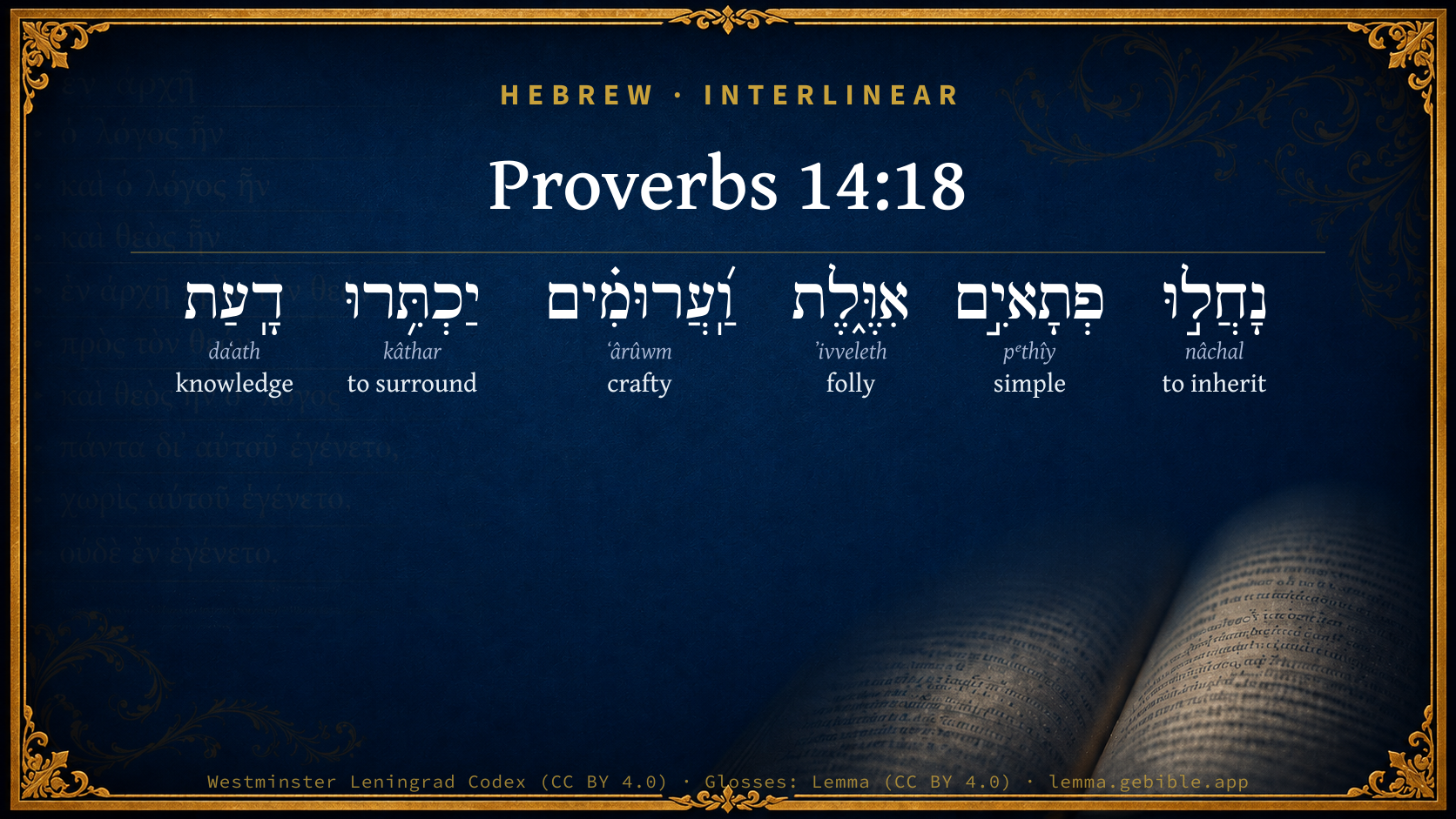
Proverbs 14:18

Hebrew (Westminster Leningrad Codex) Proverbs 14:18 appears in the Hebrew Old Testament. The text above is from the Westminster Leningrad Codex. Each word links to its Strong’s number, a concise gloss, and parsing drawn from the Open Scriptures Hebrew Bible morphology. Click any word for its full Brown-Driver-Briggs (BDB) entry.
Download image
Cite this verse

Proverbs 14:18 (World English Bible). Public Domain. Lemma interlinear Bible study tool, https://lemma.gebible.app/v/proverbs/14/18.

Show BibTeX & RIS
BibTeX
RIS
English Translation
The simple inherit folly, But the prudent are crowned with knowledge.
World English Bible · Public Domain
Download a study sheet

One document with this verse’s original text, its word-by-word gloss line, the meaning frame, cross-references with their text, attributed commentary, and full source and license credits — printable, and it pastes into notes with its structure intact.

This verse Autodidact and up

Study sheet (.html) Plain text (.txt)

A passage Seminary Student

Up to 50 verses in one chapter. A passage sheet keeps up to 6 commentary sources and 12 cross-references per verse, in the order this page ranks them, and says so on the sheet whenever that leaves anything out. Ask for a single verse and you get the Autodidact verse sheet above.

Everything on this page stays free to read, with no account — the sheet is a download of what is already on screen, not access to it.

Want to remove ads? Support Godless Engineer
Compare translations 3

The same verse in 3 English versions, stacked beneath the original-language interlinear above. Click any original word for its lexicon entry.

Each is an independent rendering of the whole verse — the interlinear is not word-aligned to these translations.

Highlighted words mark where these versions differ — a whole-verse word diff, not a word-by-word alignment.

  • World English Bible Public Domain
    The simple inherit folly, But the prudent are crowned with knowledge.
  • King James Version Public Domain
    The simple inherit folly: but the prudent are crowned with knowledge.
  • unfoldingWord Literal Text CC BY-SA 4.0
    Simpletons inherit folly, but the prudent will wear a crown of knowledge.

unfoldingWord Literal Text — © unfoldingWord, licensed CC BY-SA 4.0. Word-aligned USFM3 via Door43 (git.door43.org/unfoldingWord/en_ult).

Versions to compare (up to 4)

3 of 4 selected

Show all 18 translations

Every available English version of this verse, each an independent rendering of the whole verse.

  • World English Bible Public Domain
    The simple inherit folly, But the prudent are crowned with knowledge.
  • Berean Standard Bible Public Domain
    The simple inherit folly, but the prudent are crowned with knowledge.
  • Majority Standard Bible Public Domain
    The simple inherit folly, but the prudent are crowned with knowledge.
  • King James Version Public Domain
    The simple inherit folly: but the prudent are crowned with knowledge.
  • American Standard Version (1901) Public Domain
    The simple inherit folly; But the prudent are crowned with knowledge.
  • Revised Version (1885) Public Domain
    The simple inherit folly: but the prudent are crowned with knowledge.
  • Geneva Bible (1599) Public Domain
    The foolish do inherite follie: but the prudent are crowned with knowledge.
  • Douay-Rheims (1899) Public Domain
    The childish shall possess folly, and the prudent, shall look for knowledge.
  • Young's Literal Translation Public Domain
    The simple have inherited folly, And the prudent are crowned `with' knowledge.
  • Literal Standard Version CC BY-SA 4.0
    The simple have inherited folly, || And the prudent are crowned [with] knowledge.
  • Unlocked Literal Bible CC BY-SA 4.0
    The naive inherit foolishness, but prudent people are crowned with knowledge.
  • unfoldingWord Literal Text CC BY-SA 4.0
    Simpletons inherit folly, but the prudent will wear a crown of knowledge.
  • Darby Bible Public Domain
    The simple inherit folly; but the prudent are crowned with knowledge.
  • World Messianic Bible Public Domain
    The simple inherit folly, but the prudent are crowned with knowledge.
  • Webster's Bible Public Domain
    The simple inherit folly: but the prudent are crowned with knowledge.
  • Free Bible Version CC BY-SA 4.0
    The inheritance of stupid people is stupidity, but sensible people are rewarded with knowledge.
  • Bible in Basic English Public Domain
    Foolish behaviour is the heritage of the simple, but men of good sense are crowned with knowledge.
  • JPS Tanakh (1917) Public Domain
    The thoughtless come into possession of folly; but the prudent are crowned with knowledge.

Literal Standard Version (2020), Covenant Press — licensed CC BY-SA 4.0. Text via the HelloAO Bible API (eBible.org). Unlocked Literal Bible (unfoldingWord) — licensed CC BY-SA 4.0. Text via the HelloAO Bible API (eBible.org). unfoldingWord Literal Text — © unfoldingWord, licensed CC BY-SA 4.0. Word-aligned USFM3 via Door43 (git.door43.org/unfoldingWord/en_ult). Free Bible Version, Dr. Jonathan Gallagher — licensed CC BY-SA 4.0. Text via the HelloAO Bible API (eBible.org).

Word by word

More ways to search: Search by grammar → Find every occurrence → Compare this word →

Practice this passage: Drill this verse → Learn its vocabulary →

About this verse

These counts appear in no published source. They are computed here, from the morphology-tagged text and Lemma’s own curated glosses. What Lemma adds →

6
words
6
distinct lemmas
Wisdom
section

Notable vocabulary

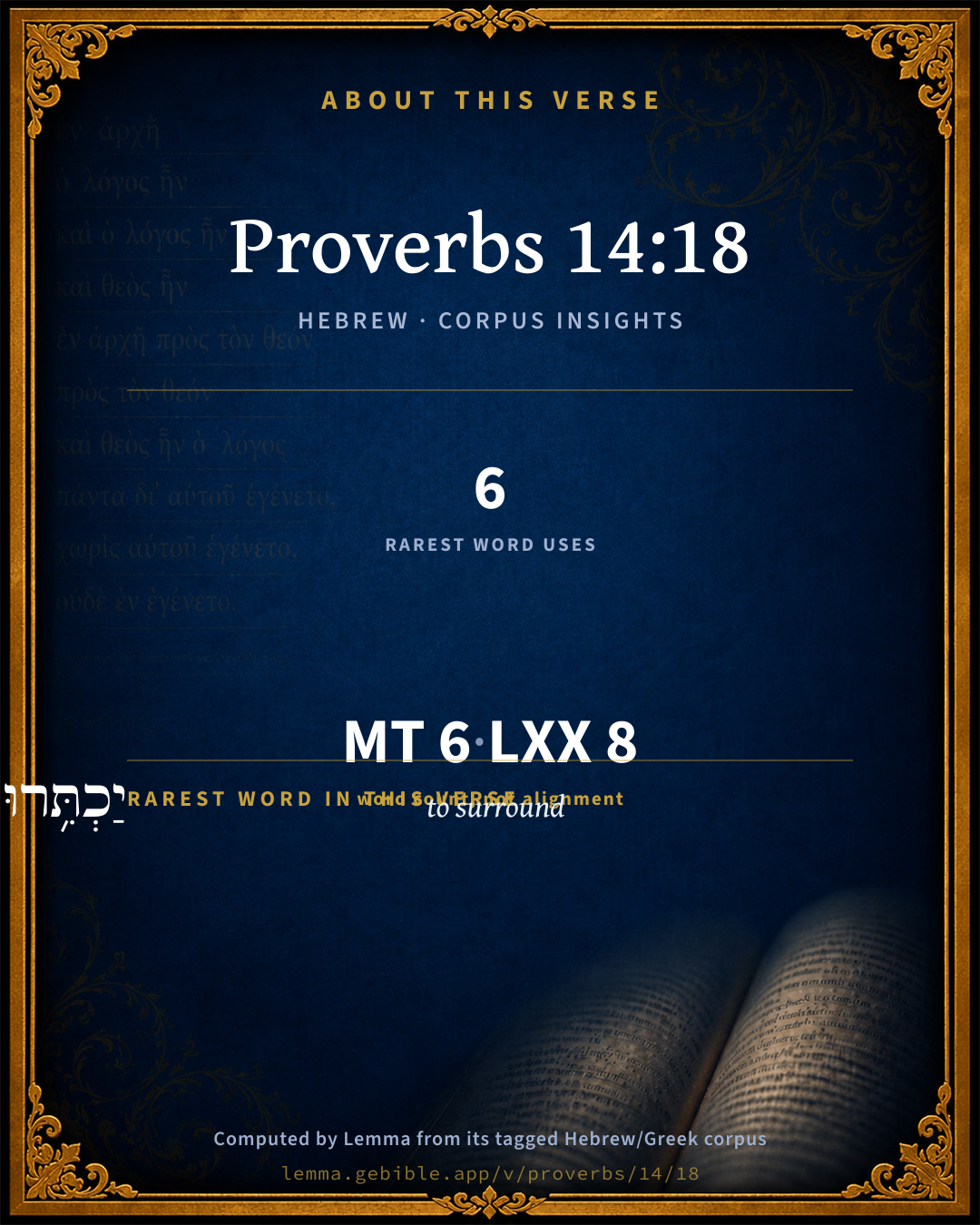
The rarest word here is יַכְתִּ֥רוּ to surround H3803 — appearing just 6 times in the whole Hebrew Bible.

Shared distinctive vocabulary

יַכְתִּ֥רוּ to surround H3803 occurs in 6 verses of the Hebrew Bible. Also found in:

Grammatical profile

  • 2 verbs
  • 3 nouns
  • 1 adjective

Verb forms

  • נָחֲל֣וּ Qal · Perfect
  • יַכְתִּ֥רוּ Hiphil · Imperfect

Hebrew & Septuagint length

In English translation the verse runs 11 words from the Hebrew and 16 from the Septuagint (LXX English) — the Septuagint runs noticeably longer here. See the side-by-side →

A rough comparison of the two English renderings, which tokenize alike — not a word-level alignment.

Word counts can differ between the Hebrew and the Greek without any difference in meaning — e.g. the Hebrew direct-object marker אֵת has no separate Greek word, and Greek often adds the article ὁ.

In the original languages it is 6 Hebrew tokens and 8 Greek tokens — but the two are counted differently (Hebrew bundles its prefixes and suffixes into one token; the Greek is in lemma form), so that isn’t a like-for-like length.

Cross-references

10

Topical passages linked to Proverbs 14:18 in the Treasury of Scripture Knowledge — connected by theme and wording, ordered by reader-vote popularity; previews shown in the World English Bible.

  • 1 Peter 1:18 knowing that you were redeemed, not with corruptible things, with silver or gold, from the useless way of life handed down from your fathers,
  • 1 Peter 5:4 When the chief Shepherd is revealed, you will receive the crown of glory that doesn't fade away.
  • Proverbs 3:35 The wise will inherit glory, But shame will be the promotion of fools.
  • Proverbs 4:7–9 Wisdom is supreme. Get wisdom. Yes, though it costs all your possessions, get understanding.
  • Proverbs 11:29–30 He who troubles his own house shall inherit the wind. The foolish shall be servant to the wise of heart.
  • Jeremiah 16:19 Yahweh, my strength, and my stronghold, and my refuge in the day of affliction, to you shall the nations come from the ends of the earth, and shall say, Our fathers have inherited nothing but lies, [even] vanity and things in which there is no profit.
  • Jeremiah 44:17 But we will certainly perform every word that is gone forth out of our mouth, to burn incense to the queen of the sky, and to pour out drink-offerings to her, as we have done, we and our fathers, our kings and our princes, in the cities of Judah, and in the streets of Jerusalem; for then had we plenty of food, and were well, and saw no evil.
  • Daniel 12:3 Those who are wise shall shine as the brightness of the expanse; and those who turn many to righteousness as the stars forever and ever.
  • Matthew 23:29–32 "Woe to you, scribes and Pharisees, hypocrites! For you build the tombs of the prophets, and decorate the tombs of the righteous,
  • 2 Timothy 4:8 From now on, there is stored up for me the crown of righteousness, which the Lord, the righteous judge, will give to me on that day; and not to me only, but also to all those who have loved his appearing.

Cross-references courtesy of OpenBible.info (CC BY 4.0).

Hebrew and Greek witnesses Masoretic Hebrew ↔ Greek Septuagint

The same verse in the two great witnesses to the Old Testament, shown verse-for-verse.

Here the Septuagint runs noticeably longer than the Hebrew — LXX2012 (modern English Septuagint) 16 words vs World English Bible 11. A rough length comparison of the two English translations, not a word-level alignment — read both below.

These are two independent witnesses, not word-aligned to each other, and the Septuagint is shown in lemma (dictionary) form.

Hebrew Proverbs 14:18 Masoretic · Westminster Leningrad Codex

נָחֲל֣וּ פְתָאיִ֣ם אִוֶּ֑לֶת וַֽ֝עֲרוּמִ֗ים יַכְתִּ֥רוּ דָֽעַת

The simple inherit folly, But the prudent are crowned with knowledge.

World English Bible · Public Domain

Greek LXX Proverbs 14:18 Septuagint · lemma form

μερίζω ἄφρων κακία ὁ δέ πανοῦργος κρατέω αἴσθησις

Fools shall have mischief for their portion; but the prudent shall take fast hold of understanding.

LXX2012 (modern English Septuagint) · Public Domain

On this verse, The Pulpit Commentary discusses the Septuagint’s reading. Read the note in Commentary ↓

Hebrew: Westminster Leningrad Codex (CC BY 4.0). Greek: Septuagint (public domain); English from LXX2012 (modern English Septuagint) (Public Domain). How the Septuagint differs from the Hebrew →

Commentary

Notes on Proverbs 14:18 from classic Christian and Jewish commentators (each source and its license shown beneath its notes). The classic Christian expositions comment on the surrounding passage and are grouped to its opening verse, so a note may address several verses; the Jewish commentaries on the Tanakh (Rashi and others) are per-verse, so they appear only where the commentator wrote on this verse.

Lemma curates 59 commentaries, every one of them public domain or Creative Commons licensed, each selected and text-cleaned for this edition rather than reprinted as found. About our sources →

Trapp's Complete Commentary

John Trapp

Pro 14:18 The simple inherit folly: but the prudent are crowned with knowledge.

Ver. 18. The simple inherit folly.] Acceperunt per successionem seu haereditario iure, so one renders it; they are as wise as their forefathers, and they are resolved to be no wiser. Me ex ea opinione quam a maioribus accepi de cultu deorum, nullius unquam movebit oratio, said Cicero; I will never forsake that way of divine service that I have received from my forefathers, for any man’s pleasure, or by any man’s persuasion. The monarch of Morocco told the English ambassador for King John that he had recently read St Paul’s epistles, which he liked so well, that were he now to choose his religion he would, before any other, embrace Christianity. But everyone ought, saith he, to die in the religion received from his ancestors, and the leaving of the faith wherein he was born was the only thing that he disliked in that apostle. {a}

But the prudent are crowned with knowledge.] They know that dies diem docet: and therefore are not so wedded to their old principles, superstitions, and fopperies, but that they can, as right reason requires, relinquish and abjure them, glorifying the word, {Act 13:48} and "receiving the truth in love," {2Th 2:10} whereby it soon comes to pass, that they get "good repute and report of all men, as Demetrius had, yea, and of the truth itself," {3Jn 1:12} which is the crown of all commendation, Haud velim Erasmi gloria aut nomine vehi, saith Luther: I care not to be praised as Erasmus is, &c.

{a} Heyl. Geog.

John Trapp, A Commentary or Exposition upon All the Books of the Old and New Testament (1647–1656) — public domain. Text from a community e-Sword module.

Joseph Benson's Commentary

Pro 14:18. The simple inherit folly — Possess it as their inheritance, or portion; holding it fast, improving it, and delighting in it; but the prudent are crowned with knowledge — They place their honour and happiness in a sound, practical, and saving knowledge of God, and of their duty; and therefore earnestly pursue it, and heartily embrace it.

Joseph Benson's Commentary on the Old and New Testaments (1811–1818) — public domain. Text from a community e-Sword module.

Tyndale Open Study Notes

Tyndale Open Resources

14:18 are clothed with foolishness: One’s true nature and heart attitude will eventually show in one’s demeanor.

Tyndale Open Study Notes — © Tyndale Open Resources, licensed CC BY-SA 4.0. Text via the HelloAO Bible API.

Matthew Henry's Commentary

Note, 1. Sin is the shame of sinners: The simple, who love simplicity, get nothing by it; they inherit folly. They have it by inheritance, so some. This corruption of nature is derived from our first parents, and all the calamities that attend it we have by kind; it was the inheritance they transmitted to their degenerate race, an hereditary disease. They are as fond of it as a man of his inheritance, hold it as fast, and are as loth to part with it. What they value themselves upon is really foolish; and what will be the issue of their simplicity but folly? They will for ever rue their own foolish choice. 2. Wisdom is the honour of the wise: The prudent crown themselves with knowledge, they look upon it as their brightest ornament, and there is nothing they are so ambitious of; they bind it to their heads as a crown, which they will by no means part with; they press towards the top and perfection of knowledge, which will crown their beginnings and progress. They shall have the praise of it; wise heads shall be respected as if they were crowned heads. They crown knowledge (so some read it); they are a credit to their profession. Wisdom is not only justified, but glorified, of all her children.

Matthew Henry's Commentary on the Whole Bible (1708–1710) — public domain (CC PDM 1.0). Text via the HelloAO Bible API.

Jamieson, Fausset & Brown

Robert Jamieson, A. R. Fausset & David Brown

inherit--as a portion (compare Pro 3:35).

are crowned--literally, "are surrounded with it," abound in it.

Jamieson, Fausset & Brown — Commentary Critical and Explanatory on the Whole Bible (1871) — public domain (CC PDM 1.0). Text via the HelloAO Bible API.

Ellicott's Commentary for English Readers

(18) The simple inherit folly.—As weeds spring up in unoccupied soil, so “simple” (Pro_1:22) persons, whose minds are unoccupied with good, often become self-willed; while the knowledge which the “prudent” gain by looking well to their steps (Pro_14:15) adorns them as a crown.

A Bible Commentary for English Readers, edited by Charles John Ellicott (1878–1897) — public domain. Text from a community e-Sword module.

John Gill's Exposition

The simple inherit folly,.... It is natural and hereditary to them, they are born like wild asses colts; the foolish sayings and proverbs, customs and practices, of their ancestors, though they have been demonstrated to be mere folly, yet these, their posterity, approve them; they love, like, and retain them as their patrimony, Job 11:12. Such are the foolish traditions, customs, principles, and doctrines, of the church of Rome, handed down from father to son; and because Popery is the religion they have been bred and brought up in, though so foolish and absurd, they will not relinquish it;

but the prudent are crowned with knowledge; natural, civil, and spiritual, especially the latter; evangelical knowledge, the knowledge of Christ, and of God in Christ, and of Gospel truths; they are honoured with an acquaintance with them; and they esteem the knowledge of these above all things else, and reckon all things else but loss and dung in comparison of them; they are as a crown unto them, and the knowledge of them is the way to the crown of life; yea, is itself life eternal, Phi 3:8. Or, they "crown themselves with knowledge" (p); they labour after it, pursue it with eagerness, follow on to know the Lord, and attain to a large share of it; surround, encompass, and lay hold upon it, and gird themselves about with this girdle of truth. Or, "they crown knowledge" (q); do honour to that, by putting it in practice; by adding to it temperance, and every virtue, and by bringing others to it; and are an ornament to it in their lives and conversation; they adorn the doctrine of God their Saviour.

(p) "imponent coronam sibi scientiam", Montanus; "coronant se scientia", Piscator, so Ben Melech. (q) "Coronabunt scientiam", Baynus; "ornant scientiam", Drusius.

John Gill's Exposition of the Whole Bible (1746–1763) — public domain (CC PDM 1.0). Text via the HelloAO Bible API.

Albert Barnes' Notes on the Bible

Crowned - The teacher anticipates the truth, and the paradox, of the Stoic saying, “The wise is the only king.”

Albert Barnes' Notes on the Bible (1834–1885) — public domain. Text from a community e-Sword/MySword module.

Matthew Poole's English Annotations

Inherit folly; they possess it as their inheritance or portion, holding it fast, improving it, delighting and glorying in it. In like manner David took God’s

testimonies for his heritage, Psa 119:111, where the word is the same; withal he may imply that folly is natural and hereditary to them.

Are crowned with knowledge; they place their honour and happiness in a sound, and practical, and saving knowledge of God, and of their own duty, and therefore earnestly pursue after it, and heartily embrace it.

Matthew Poole's English Annotations on the Holy Bible (1683–1685) — public domain. Text from a community e-Sword/MySword module.

Whedon's Commentary on the Bible

Daniel D. Whedon

18. Inherit — Not specifically; rather, acquire, get, gain. Folly is their acquisition.

Are crowned with knowledge — Acquire a crown of knowledge; knowledge attained is their glory, ornament, and power. “They embrace knowledge.” — Zockler. “Crown themselves.” — Furst. Stuart says: “Gather wisdom around them; make a crown of knowledge.”

Daniel D. Whedon (gen. ed.), Commentary on the Old and New Testaments (1874–1909) — public domain. Text from a community e-Sword module.

The Pulpit Commentary

The simple inherit folly. The credulous simpleton naturally falls into possession of folly, feeds upon it, and enjoys it. The LXX regards the simple as communicating their folly to others, and translates, "Fools will divide malice." But the prudent are crowned with knowledge; put on knowledge as a crown of glory, in accordance with the Stoic saying, quoted in the "Speaker"s Commentary," "The wise is the only king." Nowack thinks the above translation and the idea alike belong to later times, and prefers to render, "The prudent embrace knowledge," which is parallel to the sentiment of ver. 6. The word is found only in Psa_142:3, where it is translated either "shall compass me about" or "crown themselves through me." The Vulgate has expectabunt, i.e. "wait for it patiently," as the fruit of labour and perseverance. Septuagint, "The wise shall get possession of (krathsousin ) knowledge."

The Pulpit Commentary (1880–1919), ed. H.D.M. Spence-Jones & Joseph S. Exell — public domain. Text from a community e-Sword module.

John Wesley's Explanatory Notes

Inherit - They possess it as their inheritance, holding it fast, and glorying in it. Knowledge - The saving knowledge of God and of their own duty.

John Wesley, Explanatory Notes Upon the Whole Bible (1754–1765) — public domain. Text via the GEBible commentary corpus.

Keil & Delitzsch

C. F. Keil & F. Delitzsch

18 The simple have obtained folly as an inheritance;

But the prudent put on knowledge as a crown.

As a parallel word to נחלוּ, יכתּרוּ (after the Masora defective), also in the sense of Arab. âkthar, multiplicare, abundare (from Arab. kathura, to be much, perhaps

(Note: According to rule the Hebr. ש becomes in Arab. ṯ, as in Aram. ת; but kthar might be from ktar, an old verb rarely found, which derivata with the idea of encircling (wall) and of rounding (bunch) point to.)

properly comprehensive, encompassing), would be appropriate, but it is a word properly Arabic. On the other hand, inappropriate is the meaning of the Heb.-Aram. כּתּר, to wait (properly waiting to surround, to go round any one, cf. manere aliquem or aliquod), according to which Aquila, ἀναμενούσιν, and Jerome, expectabunt. Also הכתּיר, to encompass in the sense of to embrace (lxx κρατήσουσιν), does not suffice, since in the relation to נחלו one expects an idea surpassing this. Certainly there is a heightening of the idea in this, that the Hiph. in contradistinction to נחל would denote an object of desire spontaneously sought for. But far stronger and more pointed is the heightening of the idea when we take יכתרו as the denom. of כּרת (Gr. κίταρις, κίδαρις, Babyl. כדר, cudur, cf. כּדּוּר, a rounding, sphaera). Thus Theodotion, στεφθήσονται. The Venet. better actively, ἐστέψαντο (after Kimchi: ישׂימו הדעת ככתר על ראשם), the Targ., Jerome, Luther (but not the Syr., which translates נחלו by "to inherit," but יכתרו by μεριοῦνται, which the lxx has for נחלו). The bibl. language has also (Ps. 142:8) הכתיר in the denom. signification of to place a crown, and that on oneself; the non-bibl. has מכתיר (like the bibl. מעטיר) in the sense of distributor of crowns,

(Note: Vid., Wissenschaft, Kunst, Judenthum (1838), p. 240.)

and is fond of the metaphor כתר הדעת, crown of knowledge. With those not self-dependent (vid., regarding the plur. form of פּתי, p. 56), who are swayed by the first influence, the issue is, without their willing it, that they become habitual fools: folly is their possession, i.e., their property. The prudent, on the contrary, as Pro 14:15 designates them, have thoughtfully to ponder their step to gain knowledge as a crown (cf. העשׁיר, to gain riches, הפריח, 11b, to gain flowers, Gesen. 53, 2). Knowledge is to them not merely an inheritance, but a possession won, and as such remains with them a high and as it were a kingly ornament.

Keil & Delitzsch — Biblical Commentary on the Old Testament (1861–1891) — public domain (CC PDM 1.0). Text via the HelloAO Bible API. (Old Testament only.)

Bridges on Proverbs

Charles Bridges

The simple and the prudent are again contrasted. The child of Adam is born to folly. (Job 11:12 .) That is his inheritance. He "received it by tradition from his fathers" (1Pe 1:18 ): yea, from his first father. (Gen 5:3 . Psa 51:5 .) So long as he remains simple, he confirms his title. Unlike an earthly inheritance, he cannot relinquish it. He holds it in life; and, when he "returns naked to the earth, from whence he came" (Job 1:21 . 1Ti 6:7 ), he still holds it firm in death, and reaps its bitter fruits throughout eternity. Here is no injustice, no just cause of complaint. Sinner! is not wisdom freely offered to thee in asking for it? (Jas 1:5 .) Dost not thou therefore continue simple only by thy willful neglect? If knowledge is at hand, to be satisfied with ignorance, is to throw away a talent of inestimable price. ’I confess’ — says Doctor South — ’God has no need of any man’s learning; but certainly then he has much less need of his ignorance.’†1 The prudent, instructed in heavenly knowledge, are enabled to behold Divine objects in a Divine light. Is not this knowledge therefore their crown, the light, holiness, joy, and glory of life eternal? This is not that religion of eccentric singularities, which obscures the glory of the Divine image. Steady consistency is stamped upon it, such as enthrones its possessor in the conviction and regard even of those, who are unfriendly to his principles. (1Pe 2:12 .) Thus "the wise" in this life "inherit glory." (Pro 3:35 .) What shall be their glory in eternity, sitting on the throne of God, crowned with the hand of God himself!

Footnotes:

†1 1Ki 13:33-34 . Vol. i.

Charles Bridges, An Exposition of the Book of Proverbs (1846) — public domain. Text from a community e-Sword module.

Kretzmann's Popular Commentary

Paul E. Kretzmann

v. 18. The simple inherit folly, that is the portion of those who will not learn wisdom, who will not be guided by the experiences of others; but the prudent are crowned with knowledge, they embrace, they accumulate, knowledge as a precious possession.

Paul E. Kretzmann, Popular Commentary of the Bible (1921–1924) — public domain. Text from a community e-Sword module.

Rashi

Rabbi Shlomo Yitzchaki (Rashi)

make knowledge a crown Heb. יכתרו, they make it a crown for their head, and ultimately...

Rashi on the Tanakh — English translations: “The Judaica Press complete Tanach with Rashi, translated by A. J. Rosenberg” (CC BY 4.0); “Pentateuch with Rashi's commentary by M. Rosenbaum and A.M. Silbermann, 1929-1934” (public domain); “The Metsudah Tanach series, Lakewood, N.J” (CC BY 4.0); and “The Book of Joshua, Metsudah Publications, 1997” (CC BY 4.0). Text via Sefaria.

Lesson kit

Teaching starters — assembled from the data on this page, not authored interpretation. Every prompt links to the verse data it draws on. Edit before teaching.

Proverbs, in the Wisdom, opens this verse with 6 words (6 distinct Hebrew lemmas). Its most distinctive word is kâthar (“to surround”). The Greek Septuagint runs longer here. A historical commentator’s framing appears above. Read the whole chapter for the surrounding context.

Discussion questions

  1. How does “to surround” (kâthar) shape what this verse is saying?
  2. How does Judges 20:43, which shares the word «to surround», read alongside this verse?
  3. The Septuagint runs longer here than the Hebrew. What might account for the difference?
  4. These translations render this verse differently; the difference is in the English rendering, not the original. What questions does that raise?
  5. «נָחֲל֣וּ» is a Qal Perfect verb. How does that grammatical form shape the action described?
  6. Compare how Trapp's Complete Commentary and Joseph Benson's Commentary read this verse. Where do they agree or differ?

Things to notice

Reading settings

Reading text

Shown beneath each verse's original-language words.

Old Testament
Old Testament edition

Read the OT as the Masoretic Hebrew (MT) or the Greek Septuagint (LXX).

English shown for the Greek Septuagint (in the Hebrew ↔ Greek comparison).

Comparing translations? Open the Compare panel on any verse page to stack up to four side by side.