2 Corinthians 11:19

Greek (Tischendorf 8th ed.) 2 Corinthians 11:19 appears in the Greek New Testament. The text above is from the Tischendorf 8th edition. Each word links to its Strong’s number and a concise gloss. Click any word for its full Thayer’s Greek Lexicon entry.
Download image
Cite this verse

2 Corinthians 11:19 (World English Bible). Public Domain. Lemma interlinear Bible study tool, https://lemma.gebible.app/v/2-corinthians/11/19.

Show BibTeX & RIS
BibTeX
RIS
English Translation
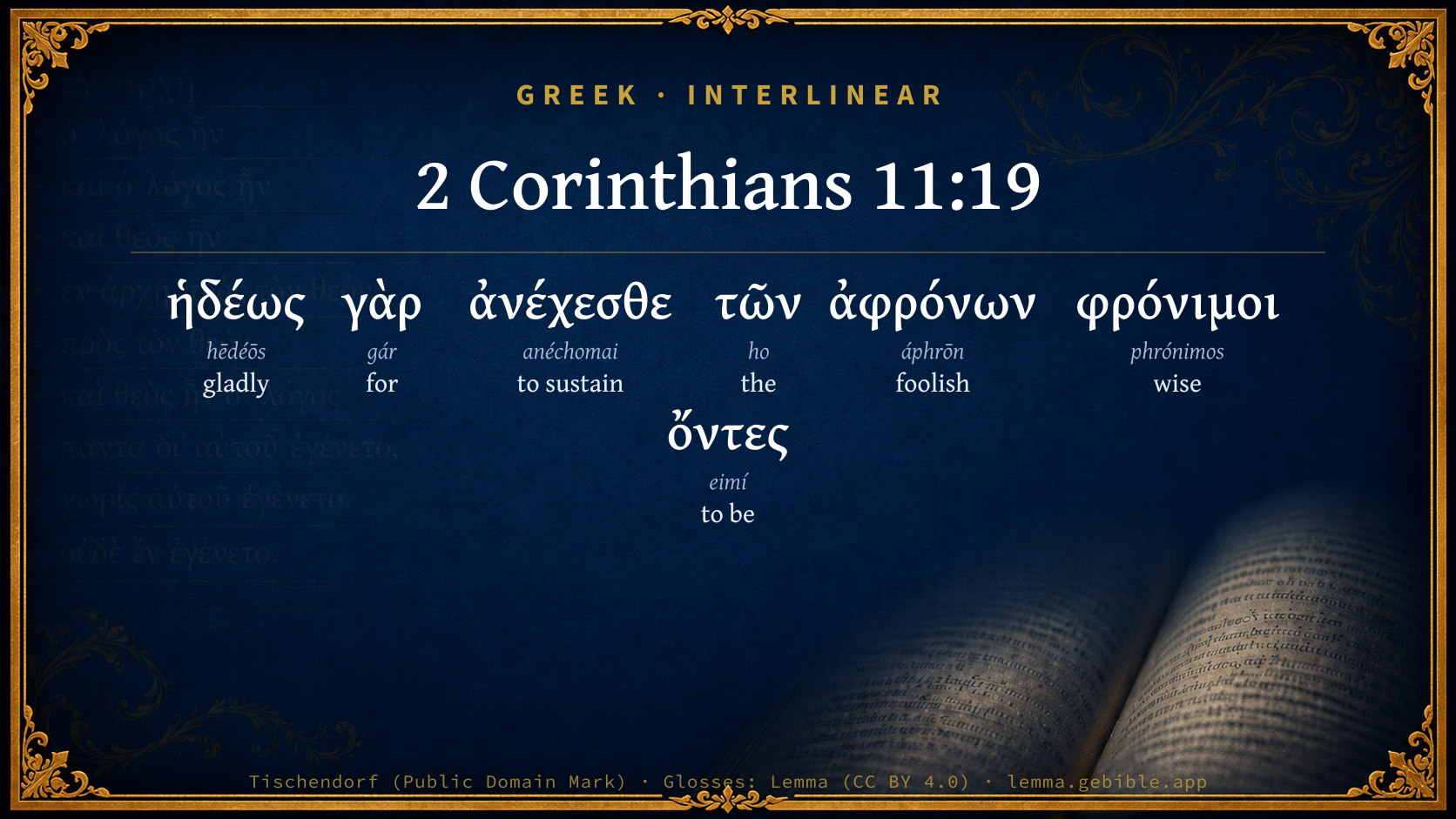
For you bear with the foolish gladly, being wise.
World English Bible · Public Domain
Download a study sheet

One document with this verse’s original text, its word-by-word gloss line, the meaning frame, cross-references with their text, attributed commentary, and full source and license credits — printable, and it pastes into notes with its structure intact.

This verse Autodidact and up

Study sheet (.html) Plain text (.txt)

A passage Seminary Student

Up to 50 verses in one chapter. A passage sheet keeps up to 6 commentary sources and 12 cross-references per verse, in the order this page ranks them, and says so on the sheet whenever that leaves anything out. Ask for a single verse and you get the Autodidact verse sheet above.

Everything on this page stays free to read, with no account — the sheet is a download of what is already on screen, not access to it.

Want to remove ads? Support Godless Engineer
Compare translations 3

The same verse in 3 English versions, stacked beneath the original-language interlinear above. Click any original word for its lexicon entry.

Each is an independent rendering of the whole verse — the interlinear is not word-aligned to these translations.

Highlighted words mark where these versions differ — a whole-verse word diff, not a word-by-word alignment.

  • World English Bible Public Domain
    For you bear with the foolish gladly, being wise.
  • King James Version Public Domain
    For ye suffer fools gladly, seeing ye yourselves are wise.
  • unfoldingWord Literal Text CC BY-SA 4.0
    For gladly you bear with the foolish, being wise.

unfoldingWord Literal Text — © unfoldingWord, licensed CC BY-SA 4.0. Word-aligned USFM3 via Door43 (git.door43.org/unfoldingWord/en_ult).

Versions to compare (up to 4)

3 of 4 selected

Show all 19 translations

Every available English version of this verse, each an independent rendering of the whole verse.

  • World English Bible Public Domain
    For you bear with the foolish gladly, being wise.
  • Berean Standard Bible Public Domain
    For you gladly tolerate fools, since you are so wise.
  • Majority Standard Bible Public Domain
    For you gladly put up with fools, since you are so wise.
  • King James Version Public Domain
    For ye suffer fools gladly, seeing ye yourselves are wise.
  • American Standard Version (1901) Public Domain
    For ye bear with the foolish gladly, being wise `yourselves'.
  • Revised Version (1885) Public Domain
    For ye bear with the foolish gladly, being wise yourselves.
  • Geneva Bible (1599) Public Domain
    For ye suffer fooles gladly, because that yee are wise.
  • Douay-Rheims (1899) Public Domain
    For you gladly suffer the foolish; whereas yourselves are wise.
  • Young's Literal Translation Public Domain
    for gladly do ye bear with the fools -- being wise,
  • Literal Standard Version CC BY-SA 4.0
    for you gladly bear with the fools—being wise,
  • Unlocked Literal Bible CC BY-SA 4.0
    For you gladly put up with fools. You are wise yourselves!
  • unfoldingWord Literal Text CC BY-SA 4.0
    For gladly you bear with the foolish, being wise.
  • Darby Bible Public Domain
    For ye bear fools readily, being wise.
  • World Messianic Bible Public Domain
    For you bear with the foolish gladly, being wise.
  • Webster's Bible Public Domain
    For ye suffer fools gladly, seeing ye yourselves are wise.
  • Free Bible Version CC BY-SA 4.0
    (You're happy to put up with fools, since you are so wise!)
  • Bible in Basic English Public Domain
    For you put up with the foolish gladly, being wise yourselves.
  • Text-Critical English NT CC BY 4.0
    For you gladly bear with fools since you are so wise!
  • Tyndale New Testament (1534) Public Domain
    For ye suffre foles gladly be cause that ye youre selves are wyse.

Literal Standard Version (2020), Covenant Press — licensed CC BY-SA 4.0. Text via the HelloAO Bible API (eBible.org). Unlocked Literal Bible (unfoldingWord) — licensed CC BY-SA 4.0. Text via the HelloAO Bible API (eBible.org). unfoldingWord Literal Text — © unfoldingWord, licensed CC BY-SA 4.0. Word-aligned USFM3 via Door43 (git.door43.org/unfoldingWord/en_ult). Free Bible Version, Dr. Jonathan Gallagher — licensed CC BY-SA 4.0. Text via the HelloAO Bible API (eBible.org).

Word by word

More ways to search: Search by grammar → Find every occurrence → Compare this word →

Practice this passage: Drill this verse → Learn its vocabulary →

About this verse

These counts appear in no published source. They are computed here, from the morphology-tagged text and Lemma’s own curated glosses. What Lemma adds →

7
words
7
distinct lemmas
Pauline Epistles
section

Notable vocabulary

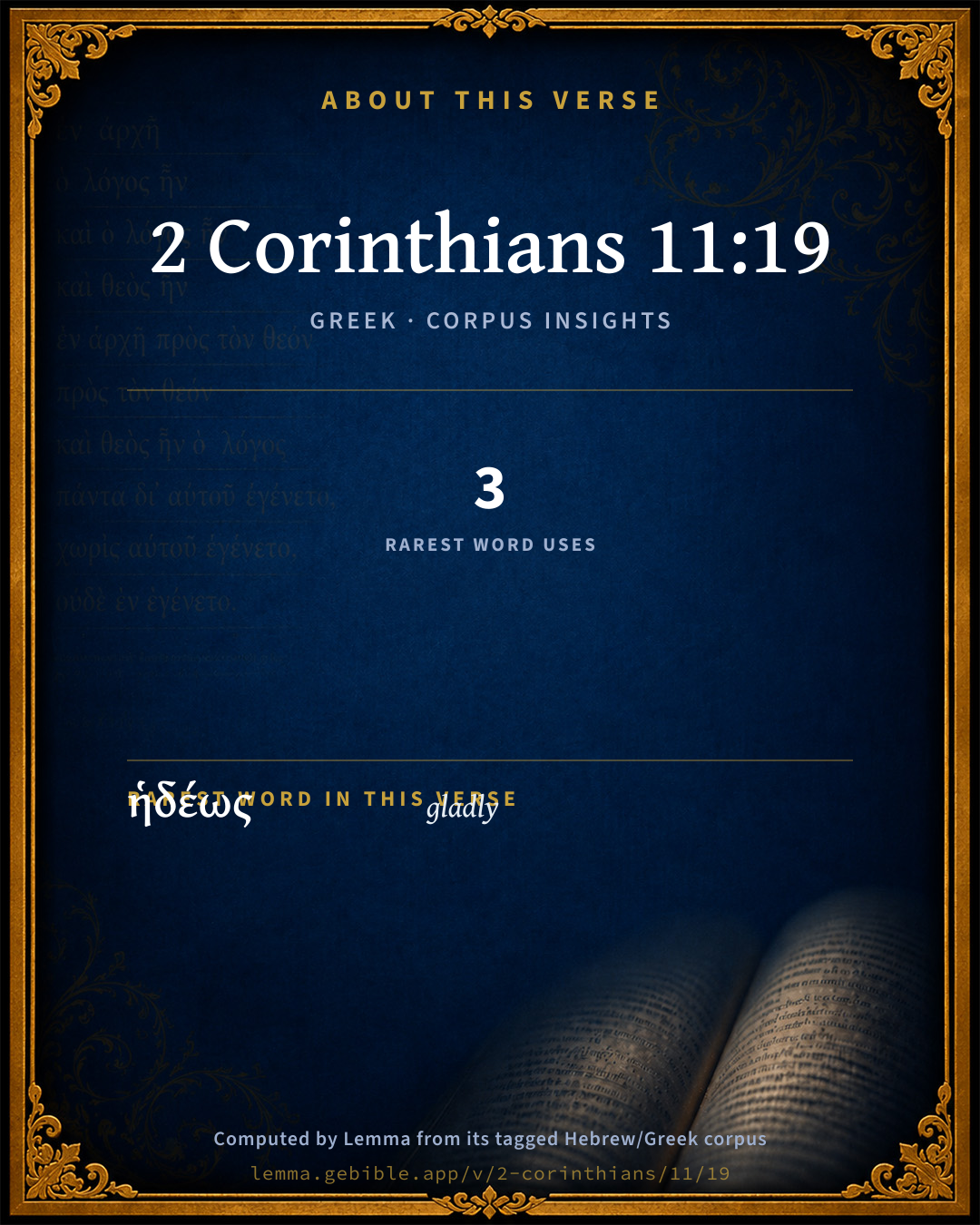
The rarest word here is ἡδέως gladly G2234 — appearing just 3 times in the whole Greek New Testament.

Shared distinctive vocabulary

ἡδέως gladly G2234 occurs in 3 verses of the Greek New Testament. Also found in:

Cross-references

4

Topical passages linked to 2 Corinthians 11:19 in the Treasury of Scripture Knowledge — connected by theme and wording, ordered by reader-vote popularity; previews shown in the World English Bible.

  • 1 Corinthians 4:10 We are fools for Christ's sake, but you are wise in Christ. We are weak, but you are strong. You have honor, but we have dishonor.
  • 1 Corinthians 8:1 Now concerning things sacrificed to idols: We know that we all have knowledge. Knowledge puffs up, but love builds up.
  • 1 Corinthians 10:15 I speak as to wise men. Judge what I say.
  • Revelation 3:17 Because you say, 'I am rich, and have gotten riches, and have need of nothing;' and don't know that you are the wretched one, miserable, poor, blind, and naked;

Cross-references courtesy of OpenBible.info (CC BY 4.0).

Commentary

Notes on 2 Corinthians 11:19 from classic Christian and Jewish commentators (each source and its license shown beneath its notes). The classic Christian expositions comment on the surrounding passage and are grouped to its opening verse, so a note may address several verses; the Jewish commentaries on the Tanakh (Rashi and others) are per-verse, so they appear only where the commentator wrote on this verse.

Lemma curates 59 commentaries, every one of them public domain or Creative Commons licensed, each selected and text-cleaned for this edition rather than reprinted as found. About our sources →

Tyndale Open Study Notes

Tyndale Open Resources

11:19 The Corinthians were proud of their capacity to understand deep religious issues, and they valued teachers who made a pretense of learning. Paul came with a different agenda (1 Cor 2:1-16).

Tyndale Open Study Notes — © Tyndale Open Resources, licensed CC BY-SA 4.0. Text via the HelloAO Bible API.

Bengel's Gnomon

Johann Albrecht Bengel

2Co 11:19. Ἡδέως) [gladly] willingly.

Bengel's Gnomon of the New Testament — English translation (T&T Clark, Edinburgh, 1860) — public domain. Text from a community e-Sword module.

Meyer's Critical & Exegetical Commentary

Heinrich August Wilhelm Meyer

2Co_11:19. Not the motive inducing, but an ironical ground encouraging, the just said κἀγὼ καυχήσομαι: For willingly you are patient with the irrational (to whom I with my καυχᾶσθαι belong), since ye are rational people! The more rational person is on that account the more tolerant toward fools. Hence not: although you are rational (Ewald and the older commentators).

Meyer — Critical and Exegetical Commentary on the New Testament — English translation by Peter Christie, edited by Frederick Crombie (T&T Clark, 1880) — public domain. Text from a community e-Sword module.

Expositor's Greek Testament

ed. W. Robertson Nicoll

2Co 11:19 . ἡδέως γὰρ ἀνέχεσθε κ . τ . λ .: for ye bear with the foolish, i.e. , the false teachers, gladly, being wise yourselves , the latter clause being, of course, ironical, although (see reff.) it was true that φρόνησις was a quality which he had seriously ascribed to the Corinthians in a former letter. His point is that, as they have borne with the self-commendation of the pseudo-apostles, they should extend the same indulgent toleration to him. He then goes on to remind them of the insolence and ill-treatment which they had endured at the hands of these self-constituted spiritual guides.

The Expositor's Greek Testament, edited by W. Robertson Nicoll (1897–1910) — public domain. Text from a community e-Sword module.

Jamieson, Fausset & Brown

Robert Jamieson, A. R. Fausset & David Brown

gladly--willingly. Irony. A plea why they should "bear with" (Co2 11:1) him in his folly, that is, boasting; ye are, in sooth, so "wise" (Co1 4:8, Co1 4:10; Paul's real view of their wisdom was very different, Co1 3:1-4) yourselves that ye can "bear with" the folly of others more complacently. Not only can ye do so, but ye are actually doing this and more.

Jamieson, Fausset & Brown — Commentary Critical and Explanatory on the Whole Bible (1871) — public domain (CC PDM 1.0). Text via the HelloAO Bible API.

Adam Clarke's Commentary

Verse 19. Ye suffer fools gladly, seeing ye yourselves are wise.] A very fine irony. Ye are so profoundly wise as to be able to discern that I am a fool. Well, it would be dishonourable to you as wise men to fall out with a fool; you will therefore gladly bear with his impertinence and foolishness because of your own profound wisdom.

Adam Clarke's Commentary on the Bible (1810–1826) — public domain. Text from a community e-Sword/MySword module.

John Calvin's Commentaries

19. For ye bear with fools willingly. He calls them wise — in my opinion, ironically. He was despised by them, which could not have been, had they not been puffed up with the greatest arrogance He says, therefore — “Since you are so wise, act the part of wise men in bearing with me, whom you treat with contempt, as you would a fool.” Hence I infer, that this discourse is not addressed to all indiscriminately, but some particular persons are reproved, who conducted themselves in an unkind manner.

John Calvin's Commentaries (1540-1563) — public domain. Text from the Calvin Translation Society English edition (1840s-50s) via the Christian Classics Ethereal Library (ccel.org). Calvin's coverage is partial (roughly two-thirds of the Bible); uncommented books and verses are honest gaps, never fabricated. The 19th-century editor's footnotes and remarks are omitted so the notes are faithfully Calvin's own voice.

Ellicott's Commentary for English Readers

(19) Ye suffer fools gladly, seeing ye yourselves are wise.—He falls back into the strain of irony of 1Co_4:8-10, to which, indeed, the whole passage presents a striking parallelism. He assumes that in their serene, self-complacent wisdom they will be willing to tolerate even those whom they look upon as half-insane. He drives the sarcasm home by urging that they tolerate those who are morally in a far worse condition.

A Bible Commentary for English Readers, edited by Charles John Ellicott (1878–1897) — public domain. Text from a community e-Sword module.

The Cambridge Bible for Schools and Colleges

gen. ed. J. J. S. Perowne

19. For ye suffer fools gladly, seeing ye yourselves are wise] Literally, For gladly do ye tolerate men without understanding, being prudent (or perhaps better sensible men). The word here translated suffer is translated bear with in 2Co_11:4. The translation here is Wiclif’s. It is a question (see next note) whether either of the two members of this sentence is to be taken literally. But that its general purpose is ironical there can be no doubt. Cf. 1Co_4:10.

The Cambridge Bible for Schools and Colleges (gen. ed. J. J. S. Perowne; Cambridge University Press, 1878–1918) — public domain. Text from a community e-Sword module.

John Gill's Exposition

For ye suffer fools gladly,.... They bore with the false apostles, who were fools; were continually proclaiming their folly, boasting of themselves, ascribing that to themselves which did not belong to them, and were puffed up by their fleshly minds; they indulged these men in their folly, and that with pleasure and delight; they not only winked at it, and overlooked it, but were pleased with it: seeing ye yourselves are wise; acting like men who count themselves wise, and keep fools for their pleasure, diversion, and sport. These words may be considered either as spoken seriously by the apostle, and as wondering that they should suffer such fools to go on in their vain boasts, and especially with pleasure; since they were men of wisdom, who were otherwise taught of God, and by the word; they had been made wise unto salvation, and were enriched in all utterance, and in all knowledge; they had been instructed by the spirit of wisdom and revelation in the knowledge of Christ, and in the mysteries of his Gospel; and therefore it was surprising that they could bear with such vain and foolish men, and especially with delight; for though it is the part of a wise man to bear with fools, yet not with pleasure; so that this carries in it a tacit reproof to them: or else the last clause may be considered as spoken ironically, and as a severe jibe upon their folly for tolerating such a parcel of fools among them; as if he should say, you show yourselves to be men of wisdom, as you would be thought to be; you act the wise part, do not you, in suffering such empty headed men to converse with you, and delight in their vain talk and conversation? however, the whole furnishes out an argument for the apostle, and which he means to improve; that if they could suffer and bear with such fools, and so many of them, and that gladly, then they might and ought to bear a little with him in his folly, which is what he entreats of them.

For ye suffer fools gladly,.... They bore with the false apostles, who were fools; were continually proclaiming their folly, boasting of themselves, ascribing that to themselves which did not belong to them, and were puffed up by their fleshly minds; they indulged these men in their folly, and that with pleasure and delight; they not only winked at it, and overlooked it, but were pleased with it: seeing ye yourselves are wise; acting like men who count themselves wise, and keep fools for their pleasure, diversion, and sport. These words may be considered either as spoken seriously by the apostle, and as wondering that they should suffer such fools to go on in their vain boasts, and especially with pleasure; since they were men of wisdom, who were otherwise taught of God, and by the word; they had been made wise unto salvation, and were enriched in all utterance, and in all knowledge; they had been instructed by the spirit of wisdom and revelation in the knowledge of Christ, and in the mysteries of his Gospel; and therefore it was surprising that they could bear with such vain and foolish men, and especially with delight; for though it is the part of a wise man to bear with fools, yet not with pleasure; so that this carries in it a tacit reproof to them: or else the last clause may be considered as spoken ironically, and as a severe jibe upon their folly for tolerating such a parcel of fools among them; as if he should say, you show yourselves to be men of wisdom, as you would be thought to be; you act the wise part, do not you, in suffering such empty headed men to converse with you, and delight in their vain talk and conversation? however, the whole furnishes out an argument for the apostle, and which he means to improve; that if they could suffer and bear with such fools, and so many of them, and that gladly, then they might and ought to bear a little with him in his folly, which is what he entreats of them.

2 Corinthians 11:20

co2 11:20

co2 11:20

co2 11:20For ye suffer if a man bring you into bondage,.... They not only suffered and tolerated the foolish boasting of these men with pleasure, but patiently and stupidly bore their oppressions, injuries, and insults, things that were intolerable, which no man of any sense and wisdom would ever suffer; and yet they took all quietly from them, made no objection, but patiently submitted to them, and therefore might well bear a little with him; they were voluntarily led captive, and brought into bondage by them, to the yoke of the ceremonial law, to the observance of circumcision, meats and drinks, days, months, times and years; and to the yoke of human doctrines, traditions, tenets, laws, and rules: if a man devour or eat; though they devoured their houses, as the Pharisees did; ate up their substance, were insatiable in their covetousness; were greedy dogs that could never have enough, could not satisfy their voracious appetites, without devouring and consuming all they had, yet they took it patiently:

if a man take of you; not food and raiment, or a proper stipend, or wages which might be voluntarily raised, and cheerfully given; but they took away their goods from them by force, as the Arabic version reads it, whether they would or not, to which they quietly submitted:

if a man exalt himself; as these men did, extolling their nation, their descent and lineage, their parentage and education, and fleshly privileges; in suiting the Corinthians as persons of a mean and base extraction, as having been Heathens and sinners of the Gentiles, yet not a word was returned in answer thereunto:

if a man smite you on the face; though they gave them very opprobrious language, vilifying and reproaching them as uncircumcised persons, upbraiding and hitting them on the teeth with their former idolatries and manners of life; yet all was taken in good part, so much were they under the government and influence of these men.

John Gill's Exposition of the Whole Bible (1746–1763) — public domain (CC PDM 1.0). Text via the HelloAO Bible API.

Trapp's Complete Commentary

John Trapp

19 For ye suffer fools gladly, seeing ye yourselves are wise.

Ver. 19. For ye suffer fools] Inter indoctos etiam Corydus sonat. (Quintilian.) Wise men hold them for fools whom fools admire for wise men. As one saith of attorneys, Quod inter opiliones se iactitent iurisperitos, inter iurisperitos ne opilionum quidem aestimatione habeantur. (Rex Platonicus.)

John Trapp, A Commentary or Exposition upon All the Books of the Old and New Testament (1647–1656) — public domain. Text from a community e-Sword module.

Albert Barnes' Notes on the Bible

For ye suffer fools gladly - You tolerate or endure those who are really fools. This is perhaps, says Dr. Bloomfield, the most sarcastic sentence ever penned by the apostle Paul. Its sense is, “You profess to be wondrous wise. And yet you who are so wise a people, freely tolerate those who are foolish in their boasting; who proclaim their own merits and attainments. You may allow me, therefore, to come in for my share, and boast also, and thus obtain your favor.” Or it may mean, “You are so profoundly wise as easily to see who are fools. You have great power of discernment in this, and have found out that I am a fool, and also that other boasters are fools. Yet knowing this, you bear patiently with such fools; have admitted them to your favor and friendship, and I may come in among the rest of the fools, and partake also of your favors.” They had borne with the false apostles who had boasted of their endowments, and yet they claimed to be eminent for wisdom and discernment.

Albert Barnes' Notes on the Bible (1834–1885) — public domain. Text from a community e-Sword/MySword module.

Haydock's Catholic Bible Commentary

I trust that you will permit me to speak in my own praise, since as wise as you are, you have permitted others, who have not greater wisdom than myself. And if it be folly to praise one’s self, as you have pardoned them, I trust you will also pardon me. (Calmet)

George Leo Haydock (1774–1849), Haydock's Catholic Family Bible and Commentary, 1859 edition — public domain. Excludes Psalms (Douay-Rheims chapter numbering differs from Protestant) and Deuterocanonical books (Catholic canon only).

Matthew Poole's English Annotations

Ye freely suffer others foolishly glorying and boasting of themselves, therefore do ye suffer me therein to judge yourselves wise, and it belongs to the wise to bear with such as are not so wise as themselves.

Matthew Poole's English Annotations on the Holy Bible (1683–1685) — public domain. Text from a community e-Sword/MySword module.

Whedon's Commentary on the Bible

Daniel D. Whedon

19. Ye… are wise—Severe irony, preparatory to giving, next verse, the most eminent instance of their said wisdom!

Daniel D. Whedon (gen. ed.), Commentary on the Old and New Testaments (1874–1909) — public domain. Text from a community e-Sword module.

The Pulpit Commentary

Seeing you yourselves are wise; ye gladly tolerate the senseless, being intellectual. (comp. 1Co_4:10) The irony would be very scathing to those whose minds and consciences were sufficiently humble and delicate to feel it.

The Pulpit Commentary (1880–1919), ed. H.D.M. Spence-Jones & Joseph S. Exell — public domain. Text from a community e-Sword module.

John Wesley's Explanatory Notes

Being wise - A beautiful irony.

John Wesley, Explanatory Notes Upon the Whole Bible (1754–1765) — public domain. Text via the GEBible commentary corpus.

McGarvey & Pendleton's Commentaries

J. W. McGarvey

For ye bear with the foolish gladly, being wise yourselves .

J. W. McGarvey (with Philip Y. Pendleton), Commentaries on the New Testament (The Fourfold Gospel, 1914; Acts; and the epistles) — public domain. Text from a community e-Sword/MySword module.

The People's New Testament

B. W. Johnson

19. For ye suffer fools gladly. See 1 Cor. 4:10. It was a part of their superior wisdom to tolerate fools. This is perhaps said in derision. It is explained in the next verse.

B. W. Johnson's The People's New Testament with Notes (1889–1891) — public domain. Electronic text from the Christian Classics Ethereal Library (CCEL) ThML edition.

unfoldingWord translationNotes

Door43 World Missions Community

put up with fools

"accept me when I act like a fool." See how a similar phrase was translated in 2 Corinthians 11:1.

You are wise yourselves!

Paul is shaming the Corinthians by using irony. AT: "You think you are wise, but you are not!" (See: Irony)

enslaves you

Paul uses exaggeration when he speaks of some people forcing others to obey rules as if they were forcing them to be slaves. AT: "makes you follow rules they have thought of" (See: Metaphor and Hyperbole and Generalization)

he consumes you

Paul speaks of the super-apostles' taking people's material resources as if they were eating the people themselves. AT: "he takes all your property" (See: Metaphor)

takes advantage of you

A person takes advantage of another person by knowing things that the other person does not and using that knowledge to help himself and harm the other person.

I will say to our shame that we were too weak to do that

"I shamefully admit that we were not bold enough to treat you like that." Paul is using irony to tell the Corinthians that it was not because he was weak that he treated them well. AT: "I am not ashamed to say that we had the power to harm you, but we treated you well" (See: Irony)

Yet if anyone boasts ... I too will boast

"Whatever anyone boasts about ... I will dare to boast about it also"

translationWords

fool

wise

enslave

shame

boast

unfoldingWord translationNotes — © Distant Shores Media and the Door43 World Missions Community, licensed CC BY-SA 4.0. Source: git.door43.org/Door43/en_tn.

Cambridge Greek Testament for Schools and Colleges

19. ἡδέως γὰρ ἀνέχεσθε τῶν ἀφρόνων φρόνιμοι ὄντες. The ἡδέως is emphatic by position, and τῶν ἀφρόνων and φρόνιμοι are in emphatic juxtaposition. For gladly ye bear with (as in 2Co 11:1; 2Co 11:4) the foolish, because ye are wise. They were so sure of their own wisdom, that they could be serenely tolerant of what they considered folly. This of course is sarcasm. To translate ‘although ye are wise’ removes the irony and makes the φρόνιμοι ὅντες a rather pointless addition. The verbal opposition between ἄφρονες and φρόνιμοι can be preserved with ‘senseless’ and ‘sensible’; but ‘sensible’ is too weak for φρόνιμος: comp. 1Co 10:15; Rom 11:25; Rom 12:16. For the irony comp. 1Co 4:10.

Cambridge Greek Testament for Schools and Colleges (Cambridge University Press, 1896; 21 vols, various authors incl. Carr, Maclear, Plummer, Farrar, Lumby, Moule, M. R. James, Simcox) — public domain. Text from a community e-Sword module.

Alford’s Greek Testament

Henry Alford

19.] Bitterly ironical. They were φρόνιμοι—as 1Co 4:8, κεκορεσμένοι—so full of wisdom as to be able to tolerate complacently, looking down from the ‘sapientum templa serena,’ the follies of others. This, forsooth, encourages him to hope for their forbearance and patronage. Compare the earnestness of 1Co 3:1-4. And the irony does not stop here: it is not only matter of presumption that they would tolerate fools with complacency, but the matter of fact testified it: they were doing this: and more.

Henry Alford, The Greek Testament (1849–1861) — public domain. Text from a community e-Sword module.

International Critical Commentary

19. ἡδέως γὰρ ἀνέχεσθε τῶν ἀφρόνων φρόνιμοι ὄντες. ‘For gladly ye bear with the foolish,—you who are so wise.’ The ἡδέως is emphatic, and the contrast between ἀφρόνων and φρόνιμοι is emphasized by juxtaposition. The verbal contrast might be preserved with ‘senseless’ and ‘sensible,’ but φρόνιμος means a good deal more than ‘sensible’ (Rom 11:25, Rom 11:12:16; Gen 41:39). Here, no doubt, φρὀνιμοι ὄντες is ironical, even more so than 1Co 4:10, 1Co 4:8:1; it means ‘because ye are wise’ rather than ‘although ye are wise,’ which would be very insipid in so vigorous a passage. ‘You have got such a large supply of wisdom yourselves that you can even take a pleasure in putting up with fools.’ In 8:7, as in 1Co 1:5, 1Co 10:15, he admits that the Corinthians have great intellectual gifts, and states this without any sarcasm; but here the point is that they are content to tolerate the outrageous conduct of his opponents—no doubt because they are so serenely conscious of their own superiority.

International Critical Commentary — older volumes (1896–1929), various authors — public domain. Text from a community e-Sword module.

Lesson kit

Teaching starters — assembled from the data on this page, not authored interpretation. Every prompt links to the verse data it draws on. Edit before teaching.

2 Corinthians, in the Pauline Epistles, opens this verse with 7 words (7 distinct Greek lemmas). Its most distinctive word is hēdéōs (“gladly”). A historical commentator’s framing appears above. Read the whole chapter for the surrounding context.

Discussion questions

  1. How does “gladly” (hēdéōs) shape what this verse is saying?
  2. Mark 6:20 shares the word «gladly» with this verse. How do the two illuminate each other?
  3. These translations render this verse differently. What is at stake in choosing one wording over another?
  4. Reading how Tyndale Open Study Notes and Bengel's Gnomon read this verse, where do the two commentators agree and where do they part?

Things to notice

Reading settings

Reading text

Shown beneath each verse's original-language words.

Old Testament
Old Testament edition

Read the OT as the Masoretic Hebrew (MT) or the Greek Septuagint (LXX).

English shown for the Greek Septuagint (in the Hebrew ↔ Greek comparison).

Comparing translations? Open the Compare panel on any verse page to stack up to four side by side.