
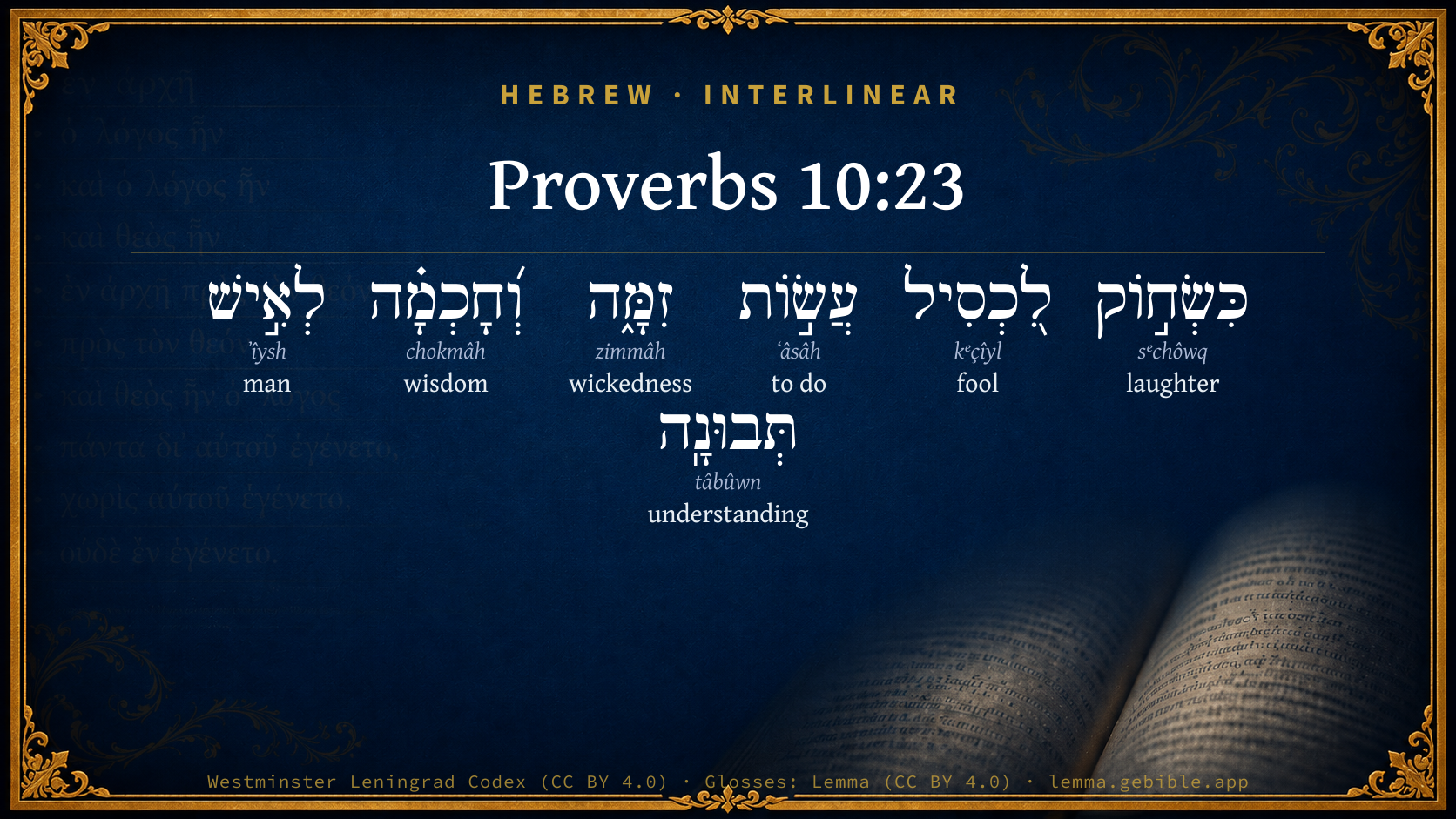
Proverbs 10:23

Hebrew (Westminster Leningrad Codex) Proverbs 10:23 appears in the Hebrew Old Testament. The text above is from the Westminster Leningrad Codex. Each word links to its Strong’s number, a concise gloss, and parsing drawn from the Open Scriptures Hebrew Bible morphology. Click any word for its full Brown-Driver-Briggs (BDB) entry.
Download image
Cite this verse

Proverbs 10:23 (World English Bible). Public Domain. Lemma interlinear Bible study tool, https://lemma.gebible.app/v/proverbs/10/23.

Show BibTeX & RIS
BibTeX
RIS
English Translation
It is a fool's pleasure to do wickedness, But wisdom is a man of understanding's pleasure.
World English Bible · Public Domain
Download a study sheet

One document with this verse’s original text, its word-by-word gloss line, the meaning frame, cross-references with their text, attributed commentary, and full source and license credits — printable, and it pastes into notes with its structure intact.

This verse Autodidact and up

Study sheet (.html) Plain text (.txt)

A passage Seminary Student

Up to 50 verses in one chapter. A passage sheet keeps up to 6 commentary sources and 12 cross-references per verse, in the order this page ranks them, and says so on the sheet whenever that leaves anything out. Ask for a single verse and you get the Autodidact verse sheet above.

Everything on this page stays free to read, with no account — the sheet is a download of what is already on screen, not access to it.

Want to remove ads? Support Godless Engineer
Compare translations 3

The same verse in 3 English versions, stacked beneath the original-language interlinear above. Click any original word for its lexicon entry.

Each is an independent rendering of the whole verse — the interlinear is not word-aligned to these translations.

Highlighted words mark where these versions differ — a whole-verse word diff, not a word-by-word alignment.

  • World English Bible Public Domain
    It is a fool's pleasure to do wickedness, But wisdom is a man of understanding's pleasure.
  • King James Version Public Domain
    It is as sport to a fool to do mischief: but a man of understanding hath wisdom.
  • unfoldingWord Literal Text CC BY-SA 4.0
    Like laughter for a stupid one doing a wicked plan, but wisdom, for a man of understanding.

unfoldingWord Literal Text — © unfoldingWord, licensed CC BY-SA 4.0. Word-aligned USFM3 via Door43 (git.door43.org/unfoldingWord/en_ult).

Versions to compare (up to 4)

3 of 4 selected

Show all 18 translations

Every available English version of this verse, each an independent rendering of the whole verse.

  • World English Bible Public Domain
    It is a fool's pleasure to do wickedness, But wisdom is a man of understanding's pleasure.
  • Berean Standard Bible Public Domain
    The fool delights in shameful conduct, but a man of understanding has wisdom.
  • Majority Standard Bible Public Domain
    The fool delights in shameful conduct, but a man of understanding has wisdom.
  • King James Version Public Domain
    It is as sport to a fool to do mischief: but a man of understanding hath wisdom.
  • American Standard Version (1901) Public Domain
    It is as sport to a fool to do wickedness; And `so is' wisdom to a man of understanding.
  • Revised Version (1885) Public Domain
    It is as sport to a fool to do wickedness: and so is wisdom to a man of understanding.
  • Geneva Bible (1599) Public Domain
    It is as a pastime to a foole to doe wickedly: but wisedome is vnderstanding to a man.
  • Douay-Rheims (1899) Public Domain
    A fool worketh mischief as it were for sport: but wisdom is prudence to a man.
  • Young's Literal Translation Public Domain
    To execute inventions `is' as play to a fool, And wisdom to a man of understanding.
  • Literal Standard Version CC BY-SA 4.0
    To execute inventions [is] as play to a fool, || And wisdom to a man of understanding.
  • Unlocked Literal Bible CC BY-SA 4.0
    Wickedness is a game a fool plays, but wisdom is a pleasure to a man of understanding.
  • unfoldingWord Literal Text CC BY-SA 4.0
    Like laughter for a stupid one doing a wicked plan, but wisdom, for a man of understanding.
  • Darby Bible Public Domain
    It is as sport to a foolish [man] to do wickedness; but a man of understanding hath wisdom.
  • World Messianic Bible Public Domain
    It is a fool’s pleasure to do wickedness, but wisdom is a man of understanding’s pleasure.
  • Webster's Bible Public Domain
    It is as sport to a fool to do mischief: but a man of understanding hath wisdom.
  • Free Bible Version CC BY-SA 4.0
    Stupid people think it's fun to do wrong, but someone who has wisdom understands what's right.
  • Bible in Basic English Public Domain
    It is sport to the foolish man to do evil, but the man of good sense takes delight in wisdom.
  • JPS Tanakh (1917) Public Domain
    It is as sport to a fool to do wickedness, and so is wisdom to a man of discernment.

Literal Standard Version (2020), Covenant Press — licensed CC BY-SA 4.0. Text via the HelloAO Bible API (eBible.org). Unlocked Literal Bible (unfoldingWord) — licensed CC BY-SA 4.0. Text via the HelloAO Bible API (eBible.org). unfoldingWord Literal Text — © unfoldingWord, licensed CC BY-SA 4.0. Word-aligned USFM3 via Door43 (git.door43.org/unfoldingWord/en_ult). Free Bible Version, Dr. Jonathan Gallagher — licensed CC BY-SA 4.0. Text via the HelloAO Bible API (eBible.org).

Word by word

More ways to search: Search by grammar → Find every occurrence → Compare this word →

Practice this passage: Drill this verse → Learn its vocabulary →

About this verse

These counts appear in no published source. They are computed here, from the morphology-tagged text and Lemma’s own curated glosses. What Lemma adds →

7
words
7
distinct lemmas
Wisdom
section

Notable vocabulary

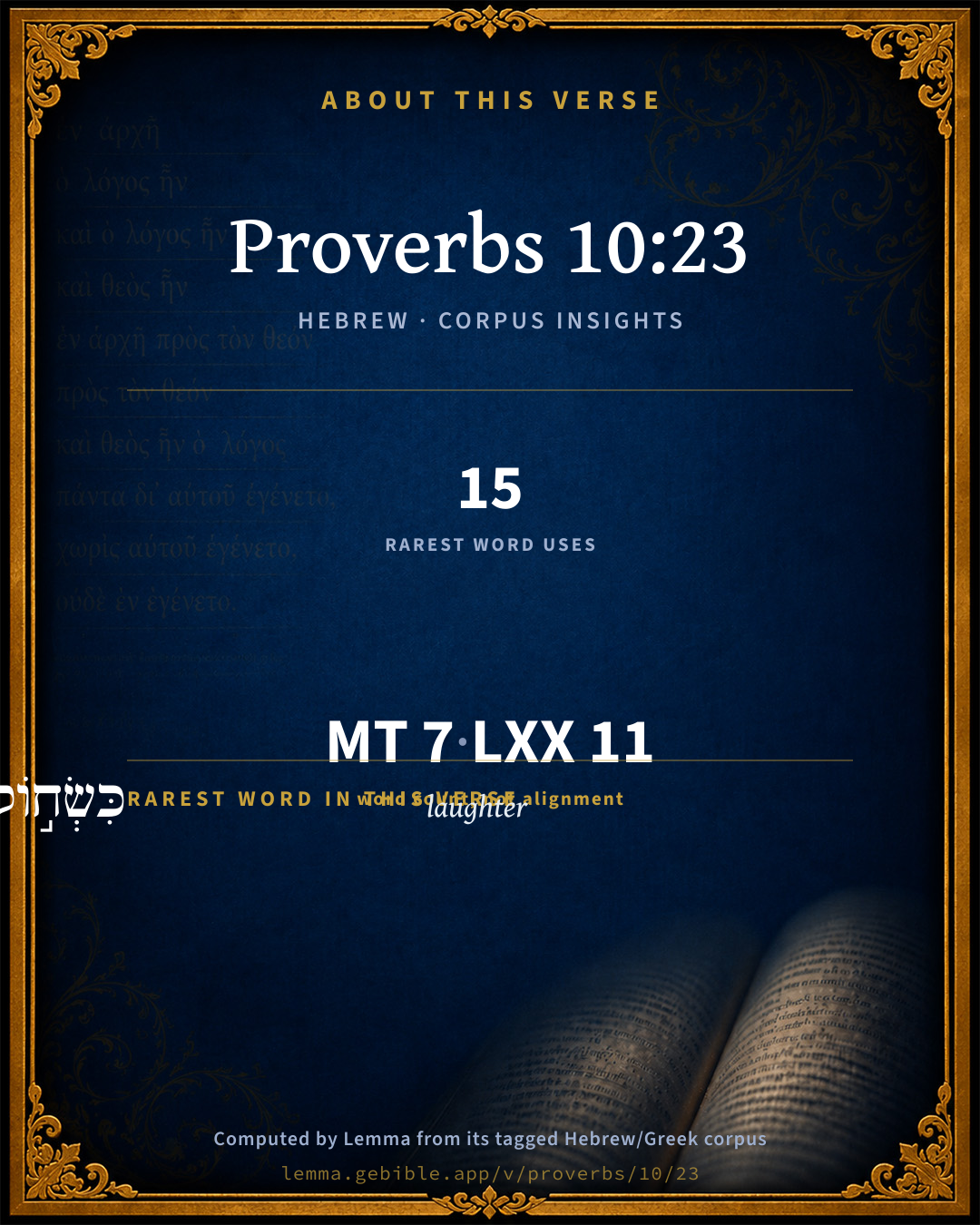
The rarest word here is כִּשְׂח֣וֹק laughter H7814 — appearing just 15 times in the whole Hebrew Bible.

Shared distinctive vocabulary

כִּשְׂח֣וֹק laughter H7814 occurs in 14 verses of the Hebrew Bible. Also found in:

Grammatical profile

  • 1 verb
  • 5 nouns
  • 1 adjective

Verb forms

  • עֲשׂ֣וֹת Qal · Infinitive Construct

Hebrew & Septuagint length

In English translation the verse runs 16 words from the Hebrew and 14 from the Septuagint (LXX English) — closely comparable.

A rough comparison of the two English renderings, which tokenize alike — not a word-level alignment.

Word counts can differ between the Hebrew and the Greek without any difference in meaning — e.g. the Hebrew direct-object marker אֵת has no separate Greek word, and Greek often adds the article ὁ.

In the original languages it is 7 Hebrew tokens and 11 Greek tokens — but the two are counted differently (Hebrew bundles its prefixes and suffixes into one token; the Greek is in lemma form), so that isn’t a like-for-like length.

Cross-references

5

Topical passages linked to Proverbs 10:23 in the Treasury of Scripture Knowledge — connected by theme and wording, ordered by reader-vote popularity; previews shown in the World English Bible.

  • Proverbs 15:21 Folly is joy to one who is void of wisdom, But a man of understanding keeps his way straight.
  • Proverbs 2:14 Who rejoice to do evil, And delight in the perverseness of evil;
  • Proverbs 14:9 Fools mock at making atonement for sins, But among the upright there is good will.
  • Proverbs 26:18–19 Like a madman who shoots firebrands, arrows, and death,
  • Ecclesiastes 11:9 Rejoice, young man, in your youth, And let your heart cheer you in the days of your youth, And walk in the ways of your heart, And in the sight of your eyes; But know that for all these things God will bring you into judgment.

Cross-references courtesy of OpenBible.info (CC BY 4.0).

Hebrew and Greek witnesses Masoretic Hebrew ↔ Greek Septuagint

The same verse in the two great witnesses to the Old Testament, shown verse-for-verse.

These are two independent witnesses, not word-aligned to each other, and the Septuagint is shown in lemma (dictionary) form.

Hebrew Proverbs 10:23 Masoretic · Westminster Leningrad Codex

כִּשְׂח֣וֹק לִ֭כְסִיל עֲשׂ֣וֹת זִמָּ֑ה וְ֝חָכְמָ֗ה לְאִ֣ישׁ תְּבוּנָֽה

It is a fool's pleasure to do wickedness, But wisdom is a man of understanding's pleasure.

World English Bible · Public Domain

Greek LXX Proverbs 10:23 Septuagint · lemma form

ἐν γέλως ἄφρων πράσσω κακός ὁ δέ σοφία ἀνήρ τίκτω φρόνησις

A fool does mischief in sport; but wisdom brings forth prudence for a man.

LXX2012 (modern English Septuagint) · Public Domain

On this verse, Whedon's Commentary on the Bible discusses the Septuagint’s reading. Read the note in Commentary ↓

Hebrew: Westminster Leningrad Codex (CC BY 4.0). Greek: Septuagint (public domain); English from LXX2012 (modern English Septuagint) (Public Domain). How the Septuagint differs from the Hebrew →

Commentary

Notes on Proverbs 10:23 from classic Christian and Jewish commentators (each source and its license shown beneath its notes). The classic Christian expositions comment on the surrounding passage and are grouped to its opening verse, so a note may address several verses; the Jewish commentaries on the Tanakh (Rashi and others) are per-verse, so they appear only where the commentator wrote on this verse.

Lemma curates 59 commentaries, every one of them public domain or Creative Commons licensed, each selected and text-cleaned for this edition rather than reprinted as found. About our sources →

Trapp's Complete Commentary

John Trapp

Pro 10:23 [It is] as sport to a fool to do mischief: but a man of understanding hath wisdom.

Ver. 23. It is a sport to a fool to do mischief.] He is then merriest when he hath the devil for his playfellow. He danceth to hell in his bolts, and as passing well apaid for his woeful bondage. Was he a father or a monster, think you, that, playing with his own child for a pastime, put his thumbs in the boy’s eyes, and thrust out the balls thereof This was Robert de Beliasme, Earl of Shrewsbury, in the reign of our Henry I, A.D. 1111. {a} And what a mad sport was that of Joab and Abner, {2Sa 2:14} to see and set those youngsters of Helkath Hazzurim to sheath their swords in their fellows’ bowels! And that of Nero, who set the city of Rome on fire for his pleasure, while he played on his harp, the destruction of Troy!

But a man of understanding hath wisdom.] Viz., For his sport or delight. It is his meat and drink - his honey and honeycomb, &c. Libenter omnibus omnes opes concesserim, ut mihi liceat, vi nulla interpellante, isto modo in literis vivero, saith Cicero, {b} - I would give all the wealth in the world that I might live altogether in my study, and have nothing to trouble me. Crede mihi extingui dulce esset mathematicarum artium studio, saith another; {c} Believe me, it were a dainty death to die studying the mathematics. Nusqam requiem inveni nisi in libro et claustro, saith a third; All the comfort I have is in a book, and a cloister, or closet. Mentior, if my soul accord him not, salth learned Doctor Slatter. {d} The old Lord Burley, lord high treasurer, to his dying day would carry always a "Cicero’s Offices" about him, either in his bosom or pocket. {e} And the Emperor Charles V took such delight in the mathematics, that even in the midst of his whole army, in his tent, he sat close at his study, having for that purpose as his instructor Turrianus of Cremona evermore with him; so sweet is the knowledge of human arts to those that have tasted them. {f} How much more the knowledge of the holy - which, saith Augur, is to ascend up into heaven {Pro 30:3-4} - to those mature ones who, "by reason of use, have their senses exercised to discern both good and evil!" {Heb 5:14 Psa 119:103 Job 23:12 Rom 7:22}

{a} Speed.

{b} Lib. ix. epist.

{c} Leo. Digges.

{d} Slatt. on 1 Ep. to Thessal., Epist. Dedic.

{e} Peach. Comp. Gentle.

{f} Idem, in his Valley of Vanity, p. 116.

John Trapp, A Commentary or Exposition upon All the Books of the Old and New Testament (1647–1656) — public domain. Text from a community e-Sword module.

The Biblical Illustrator

Joseph S. Exell

Pro_10:23

It is as sport to a fool to do mischief.

Moral phases of life

Human life has its spiritual and moral as well as its material and intellectual side. Five things in these verses of great moral significance.

I. Wealth making happy. Great temporal possessions are often the occasion of mental suffering. They awaken in the mind harassing cares, painful anxieties, and distressing suspicions. Wealth reached in harmony with the will of God, and employed in the service of benevolence and truth, has no sorrow, but tends to happiness in many ways.

II. Mischief done in sport. There is an innocent sport. The sport meant here is that which does injury to the reputation, the property, the peace, the comforts of others. Sport that turns the serious into ridicule, that makes merry in deeds of nefarious wickedness. It is the fool that makes a mock at sin; to the wise man sin is too grave a matter to laugh at.

III. Justice done to all. The anticipation of the righteous, and the forebodings of the wicked, shall both one day be realised. There is at times in every guilty conscience a fearful looking for of judgment. There is, on the other hand, in every godly soul a desire for a higher spiritual good.

IV. Indolence causing vexation. Vinegar sets the teeth on edge, and smoke gives pain to the eyes. Both irritate and annoy, so an indolent messenger provokes his master. Laziness is vexatious.

V. Character revealed in its issues. Good character prolongs life, and yields joy. The character of the wicked abbreviates life, and ends in ruin. How full is the Bible of human life! God has filled it with humanity in order that it might interest men, and improve them. (Homilist.)

The Biblical Illustrator, edited by Joseph S. Exell (c. 1880s–1900s) — public domain. Text from a community e-Sword module.

Joseph Benson's Commentary

Pro 10:23. It is as sport to a fool to do mischief — Or, as some render it, to work wickedness; yea, great and premeditated wickedness, as the word here used, זמה, properly signifies: he doth it with ease and delight, and without any shame, or remorse, or fear. But a man of understanding hath wisdom — Whereby he is kept from committing wickedness, and especially from sporting himself with it. But this last clause is rendered by many, And so is wisdom to a man of understanding: it is a sport or pleasure to him to practise wisdom or piety. Which translation makes the opposition between the two clauses more evident. Bishop Patrick thus paraphrases the verse: “A senseless sinner makes a jest of the most horrid impieties that can be committed by himself or others: but a man that weighs things wisely, considers that this is no laughing matter; and takes that pleasure in doing well which fools take in mischievous wickedness.”

Joseph Benson's Commentary on the Old and New Testaments (1811–1818) — public domain. Text from a community e-Sword module.

The Preacher's Complete Homiletical Commentary

Joseph S. Exell (gen. ed.)

CRITICAL NOTES.—

Pro_10:23. Second clause, “to a man of understanding wisdom is an enjoyment” (Zöckler).

MAIN HOMILETICS OF Pro_10:23

A TOUCHSTONE OF CHARACTER

The painter uses the dark background of his picture to set off the bright foreground. Sunlight never looks so beautiful as when seen shining upon a black thunder-cloud; it is the power of contrast. Solomon in his character-painting is constantly making use of this power. He is ever setting the dark and the light side by side—making the foolish or wicked man a dark background upon which to portray the moral features of the truly wise. The fool looks more foolish, and the good man more wise, by the contrast.

I. That which is an object of mirth is a touchstone of character. The fool makes sport out of mischief, out of that which does harm to his fellow-creatures, and consequently involves them in misery. If we saw a man making merriment over the burning of his neighbour’s house, we should conclude that he was either a maniac or utterly without a heart. A man who realised the meaning of such a calamity, and had any sympathy within him, could but be grieved at the sight. But men find occasions of mirth in matters that are of far more serious moment. The wise man tell us in chap. Pro_14:9, that “fools make a mock at sin”—that great “mischief of the universe.” The saint is made sad by that in which the sinner finds an occasion of mirth. “Oh that my head were waters, and mine eyes a fountain of tears, that I might weep day and night for the slain of the daughter of my people” (Jer_9:1). “Verily, verily, I say unto you, that ye shall weep and lament; but the world shall rejoice” (Joh_16:20). But the fool not only makes sport at mischief, it is his sport to do mischief; the one leads to the other. The fool who thinks sin is a laughing matter will not hesitate to commit sin himself, or to do his brother the irreparable mischief of leading him in the path of sin and death.

II. Men cease to make light of sin in proportion as they hare “understanding.” The text implies that a man who has any right comprehension of the end of life, the value of the soul, the reality of Divine and eternal things, will not, cannot, make a sport of mischief in any shape or degree, especially of the mischief of moral wrong. A baby might laugh at a blazing house, although its own mother might be enwrapped in the flames, but this would only be an evidence of his want of understanding. Nothing proclaims a man to be a fool so plainly as his mockery of sin. A man of wisdom has too just a sense of its terrible and ruinous consequence to feel anything but sad when he thinks of it. He knows what mischief it has worked, and is working in the universe, and his understanding of these things makes that which is the sport of the fool the subject of his most solemn thought.

OUTLINES AND SUGGESTIVE COMMENTS

The difference between the lost and the saved is, that to one it is but trifling to live; to the other it is the gravest “wisdom.”—Miller.

That man has arrived at an advanced stage of folly who takes as much pleasure in it as if it were an agreeable amusement. This, however, is to be expected in its natural course. Sinners at first feel much uneasiness from the operation of fear and shame, but they are hardened by the deceitfulness of sin, till at length they not only cast off all restraints, but become impudent in sin, and think it a manly action to cast away the cords of God, and to pour insult and abuse on their fellow-men. But it were safer far to sport with fire than with sin, which kindles a fire that will burn to the lowest hell. It may now be a sport to do mischief, but in the lake of fire and brimstone it will be no sport to have done it.—Lawson.

When a man diveth under water he feeleth no weight of the water, though there be many tons of it over his head; whereas half a tubful of the same water, taken out of the river and set upon the same man’s head, would be very burdensome unto him, and make him soon grow weary of it. In like manner, so long as a man is over head and ears in sin, he is not sensible of the weight of sin: it is not troublesome unto him; but when he beginneth once to come out of that state of sin wherein he lay and lived before, then beginneth sin to hang heavy upon him, and he to feel the heavy weight of it. So, so long as sin is in the will, the proper seat of sin, a man feeleth no weight of it, but, like a fool, it is a sport and pastime unto him to do evil. And it is therefore a good sign that sin is removed out of his seat—out of his chair of state—when it becomes ponderous and burdensome to us, as the elements do when they are out of their natural place.—Spencer’s Things New and Old.

The fool is then merriest when he hath the devil for his playfellow. He danceth well in his bolts, and is passing well afraid for his woful bondage.—Trapp.

The Preacher's Complete Homiletical Commentary (gen. ed. Joseph S. Exell; Funk & Wagnalls, c. 1892) — public domain (pre-1929). A full-Bible homiletical/sermon-outline anthology covering 65 of 66 books (2 John is absent from the source module). Text from a community e-Sword module.

Matthew Henry's Commentary

Here is, 1. Sin exceedingly sinful: It is as laughter to a fool to do mischief; it is as natural to him, and as pleasant, as it is to a man to laugh. Wickedness is his Isaac (that is the word here); it is his delight, his darling, and that in which he pleases himself. He makes a laughing matter of sin. When he is warned not to sin, from the consideration of the law of God and the revelation of his wrath against sin, he makes a jest of the admonition, and laughs at the shaking of the spear; when he has sinned, instead of sorrowing for it, he boasts of it, ridicules reproofs, and laughs away the convictions of his own conscience, Pro 14:9. 2. Wisdom exceedingly wise, for it carries along with it the evidence of its own excellency; it may be predicated of itself, and this is encomium enough; you need say no more in praise of a man of understanding than this, "He is an understanding man; he has wisdom; he is so wise as not to do mischief, or if he has, through oversight, offended, he is so wise as not to make a jest of it." Or, to pronounce wisdom wise indeed, read it thus: As it is a sport to a fool to do mischief, so it is to a man of understanding to have wisdom and to show it. Besides the future recompence, a good man has as much present pleasure in the restraints and exercises of religion as sinners can pretend to in the liberties and enjoyments of sin, and much more, and much better.

Matthew Henry's Commentary on the Whole Bible (1708–1710) — public domain (CC PDM 1.0). Text via the HelloAO Bible API.

Jamieson, Fausset & Brown

Robert Jamieson, A. R. Fausset & David Brown

Sin is the pleasure of the wicked; wisdom that of the good.

Jamieson, Fausset & Brown — Commentary Critical and Explanatory on the Whole Bible (1871) — public domain (CC PDM 1.0). Text via the HelloAO Bible API.

Adam Clarke's Commentary

Verse 23. It is a sport to a fool to do mischief] What a millstone weight of iniquity hangs about the necks of most of the jesters, facetious and witty people! "How many lies do they tell in jest, to go to the devil in earnest!"

Adam Clarke's Commentary on the Bible (1810–1826) — public domain. Text from a community e-Sword/MySword module.

Ellicott's Commentary for English Readers

(23) But a man of understanding hath wisdom.—Rather, But wisdom (is sport) to a man of understanding, i.e., one rejoices in mischief, the other (comp. Pro_8:30) in wise thoughts and deeds.

A Bible Commentary for English Readers, edited by Charles John Ellicott (1878–1897) — public domain. Text from a community e-Sword module.

The Cambridge Bible for Schools and Colleges

gen. ed. J. J. S. Perowne

23. hath wisdom] Rather, And so is wisdom (a sport or pastime) to a man of understanding. She imparts to him her own joy, or exultation. Comp. Pro_8:30, where the Heb. word is the same. See Joh_15:11.

The Cambridge Bible for Schools and Colleges (gen. ed. J. J. S. Perowne; Cambridge University Press, 1878–1918) — public domain. Text from a community e-Sword module.

John Gill's Exposition

It is as sport to a fool to do mischief,.... To do any injury to the persons and properties of men; which shows a most wicked and malicious spirit, a very depraved nature indeed: or rather "to commit sin" (o) of any sort, which he has devised in his own heart; it is as a "laughing" (p), as the words may be rendered; it is a laughing matter to him, he commits sin, and, when he has done it, laughs at it; instead of being ashamed of it, and humbled for it, he makes a mock at it, and a jest of it, as well as of all religion, and of the reproofs and admonitions of good men. Sin is pastime, he takes as much delight and pleasure in it as men do in their sports, and commits it as openly and freely; yea, not only takes pleasure in doing it himself, but in them that do it; see Pro 14:9;

but a man of understanding hath wisdom; to avoid sin, and not to do it, which is true wisdom, Job 28:28; for he has, as it may be rendered, from the use of the word in the Arabic language (q), a "bridle" or "restraint" upon him, that he cannot do mischief and delight in it, as the fool does: or "so is wisdom to a man of understanding" (r); that is, to do it; as it is a pleasure to a feel to commit sin, so it is a delight to an understanding man to do that which is wise and good; it is "meat and drink" to do the will of God, see Joh 4:34; he takes as much pleasure in it as men can do in their sports and pastimes; he has a truer pleasure and a better relish than they have; he delights in the law of God after the inward man; and Wisdom's ways, or the ways of Christ, are pleasantness to him; he runs the ways of his commandments with great alacrity and cheerfulness.

(o) "facere scelus", Montanus, Baynus, Junius & Tremellius, Cocceius, Michaelis; "perpetrare scelus", Piscator; "patrare facinus", Schultens. (p) "veluti risus", Mercerus, Gejerus, Michaelis. (q) Vid. Schultens de Defect. Hod. Ling. Heb. s. 216. (r) So some in Gejerus.

John Gill's Exposition of the Whole Bible (1746–1763) — public domain (CC PDM 1.0). Text via the HelloAO Bible API.

Albert Barnes' Notes on the Bible

As the fool finds his sport in doing mischief, so the man of understanding finds in wisdom his truest refreshment and delight.

Albert Barnes' Notes on the Bible (1834–1885) — public domain. Text from a community e-Sword/MySword module.

Haydock's Catholic Bible Commentary

Man. He is enabled to see the evil of sin, and to avoid it, Job xv. 16.

George Leo Haydock (1774–1849), Haydock's Catholic Family Bible and Commentary, 1859 edition — public domain. Excludes Psalms (Douay-Rheims chapter numbering differs from Protestant) and Deuterocanonical books (Catholic canon only).

Matthew Poole's English Annotations

As sport; he doth it with ease and delight, and without any shame, or remorse, or fear.

To do mischief or, as others, to work wickedness; yea, great and premeditated wickedness, as the Hebrew word properly signifies.

Hath wisdom; whereby he is kept from committing wickedness, and especially from sporting himself with it. But this clause is by divers learned interpreters rendered thus, and or so is wisdom to a man of understanding, it is a sport or pleasure to him to practise wisdom or piety; which translation makes the opposition more evident.

Matthew Poole's English Annotations on the Holy Bible (1683–1685) — public domain. Text from a community e-Sword/MySword module.

Whedon's Commentary on the Bible

Daniel D. Whedon

23. It is as sport — Better, It is sport.

Mischief — Not strong enough. It denotes wickedness or crime. The Septuagint renders the latter clause of the verse, “But wisdom brings prudence to a man.”

Daniel D. Whedon (gen. ed.), Commentary on the Old and New Testaments (1874–1909) — public domain. Text from a community e-Sword module.

The Pulpit Commentary

As sport. The wicked make their pastime and amusement in doing evil. A man of understanding hath wisdom. As thus put, the sentence is jejune. The Revised Version expresses the meaning better: "And so is wisdom to a man of understanding;" i.e. the wise man finds his refreshment in living a wise and prudent life, which is as easy and as pleasant to him as mischief is to the vicious. The wisdom intended is practical religion, the fear of God directing and showing itself in daily action. Septuagint, "A fool doeth mischief in sport (en gelwti ), but wisdom produceth prudence for a man."

The Pulpit Commentary (1880–1919), ed. H.D.M. Spence-Jones & Joseph S. Exell — public domain. Text from a community e-Sword module.

Keil & Delitzsch

C. F. Keil & F. Delitzsch

21 The lips of the righteous edify many;

But fools die through want of understanding.

Keil & Delitzsch — Biblical Commentary on the Old Testament (1861–1891) — public domain (CC PDM 1.0). Text via the HelloAO Bible API. (Old Testament only.)

Bridges on Proverbs

Charles Bridges

The wanton sport of putting others to pain argues the perverseness of a fool both in judgment and heart. (Pro 26:18-19 . 2Sa 2:14-16 .) Sometimes this cruel amusement may engage a man in the tempter’s work. (Pro 1:11-14 .) For fools, who make sport of mischief, may heedlessly go on to "make a mock of sin." (Pro 14:9 .) But even without going so far, should not we guard against mischievous jokes, tending to wound a neighbor’s character, or to give him uneasiness? Are we sufficiently careful against indulging our wit or humour at his expense? All this is not less unmanly, than it is inconsistent with the sobriety and gravity of a Christian profession. It is the pure native selfishness of the human heart. Should not also children’s play be sometimes under restraint? Young people cannot be too strongly disciplined to thoughtfulness and consideration of others. Never let their hilarity of spirits lead to make sport of that, which ought to call forth sympathy and tenderness. A man of understanding is too wise to find a reckless delight in his neighbor’s injury. The spirit of our Divine Master was according to his own law (Gal 6:2 ) — eminently considerate and sympathizing. (Luk 7:13 .) Let us who bear his name, cultivate his self-denying, loving mind. (Php 2:4-5 .)

Charles Bridges, An Exposition of the Book of Proverbs (1846) — public domain. Text from a community e-Sword module.

Kretzmann's Popular Commentary

Paul E. Kretzmann

v. 23. It is as sport to a fool to do mischief, that is, the practice of any form of iniquity is his delight, it agrees with his perverted sense of humor; but a man of understanding hath wisdom, that is his delight, therein he finds his pleasure.

Paul E. Kretzmann, Popular Commentary of the Bible (1921–1924) — public domain. Text from a community e-Sword module.

Rashi

Rabbi Shlomo Yitzchaki (Rashi)

As it is sport for a fool to carry out a sinful plot Heb. זמה, a plot of sins.

[so is] wisdom like sport to a man of understanding; i.e., in his eyes, it is easy to do.

Rashi on the Tanakh — English translations: “The Judaica Press complete Tanach with Rashi, translated by A. J. Rosenberg” (CC BY 4.0); “Pentateuch with Rashi's commentary by M. Rosenbaum and A.M. Silbermann, 1929-1934” (public domain); “The Metsudah Tanach series, Lakewood, N.J” (CC BY 4.0); and “The Book of Joshua, Metsudah Publications, 1997” (CC BY 4.0). Text via Sefaria.

Lesson kit

Teaching starters — assembled from the data on this page, not authored interpretation. Every prompt links to the verse data it draws on. Edit before teaching.

Proverbs, in the Wisdom, opens this verse with 7 words (7 distinct Hebrew lemmas). Its most distinctive word is sᵉchôwq (“laughter”). A historical commentator’s framing appears above. Read the whole chapter for the surrounding context.

Discussion questions

  1. How does “laughter” (sᵉchôwq) shape what this verse is saying?
  2. How does Job 8:21, which shares the word «laughter», read alongside this verse?
  3. These translations render this verse differently. What is at stake in choosing one wording over another?
  4. «עֲשׂ֣וֹת» is a Qal Infinitive Construct verb. How does that grammatical form shape the action described?
  5. Compare how Trapp's Complete Commentary and The Biblical Illustrator read this verse. Where do they agree or differ?

Things to notice

Reading settings

Reading text

Shown beneath each verse's original-language words.

Old Testament
Old Testament edition

Read the OT as the Masoretic Hebrew (MT) or the Greek Septuagint (LXX).

English shown for the Greek Septuagint (in the Hebrew ↔ Greek comparison).

Comparing translations? Open the Compare panel on any verse page to stack up to four side by side.