
Proverbs 9:16

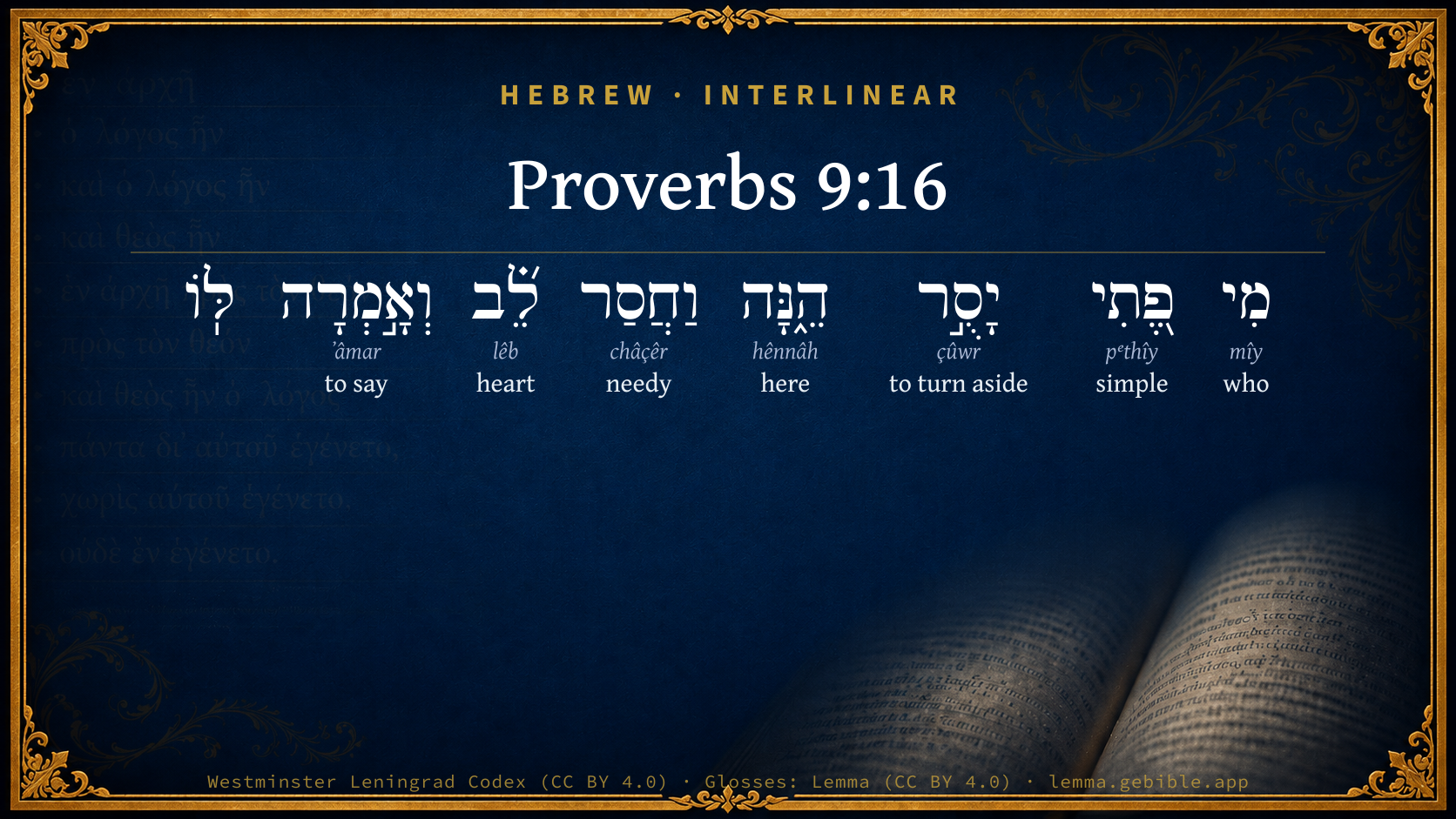
Hebrew (Westminster Leningrad Codex) Proverbs 9:16 appears in the Hebrew Old Testament. The text above is from the Westminster Leningrad Codex. Each word links to its Strong’s number, a concise gloss, and parsing drawn from the Open Scriptures Hebrew Bible morphology. Click any word for its full Brown-Driver-Briggs (BDB) entry.
Download image
Cite this verse

Proverbs 9:16 (World English Bible). Public Domain. Lemma interlinear Bible study tool, https://lemma.gebible.app/v/proverbs/9/16.

Show BibTeX & RIS
BibTeX
RIS
English Translation
"Whoever is simple, let him turn in here." As for him who is void of understanding, she says to him,
World English Bible · Public Domain
Download a study sheet

One document with this verse’s original text, its word-by-word gloss line, the meaning frame, cross-references with their text, attributed commentary, and full source and license credits — printable, and it pastes into notes with its structure intact.

This verse Autodidact and up

Study sheet (.html) Plain text (.txt)

A passage Seminary Student

Up to 50 verses in one chapter. A passage sheet keeps up to 6 commentary sources and 12 cross-references per verse, in the order this page ranks them, and says so on the sheet whenever that leaves anything out. Ask for a single verse and you get the Autodidact verse sheet above.

Everything on this page stays free to read, with no account — the sheet is a download of what is already on screen, not access to it.

Want to remove ads? Support Godless Engineer
Compare translations 3

The same verse in 3 English versions, stacked beneath the original-language interlinear above. Click any original word for its lexicon entry.

Each is an independent rendering of the whole verse — the interlinear is not word-aligned to these translations.

Highlighted words mark where these versions differ — a whole-verse word diff, not a word-by-word alignment.

  • World English Bible Public Domain
    "Whoever is simple, let him turn in here." As for him who is void of understanding, she says to him,
  • King James Version Public Domain
    Whoso is simple, let him turn in hither: and as for him that wanteth understanding, she saith to him,
  • unfoldingWord Literal Text CC BY-SA 4.0
    “Whoever naive, let him turn aside here!” And she says to him, the lacking of heart,

unfoldingWord Literal Text — © unfoldingWord, licensed CC BY-SA 4.0. Word-aligned USFM3 via Door43 (git.door43.org/unfoldingWord/en_ult).

Versions to compare (up to 4)

3 of 4 selected

Show all 18 translations

Every available English version of this verse, each an independent rendering of the whole verse.

  • World English Bible Public Domain
    "Whoever is simple, let him turn in here." As for him who is void of understanding, she says to him,
  • Berean Standard Bible Public Domain
    “Whoever is simple, let him turn in here!” she says to him who lacks judgment.
  • Majority Standard Bible Public Domain
    “Whoever is simple, let him turn in here!” she says to him who lacks judgment.
  • King James Version Public Domain
    Whoso is simple, let him turn in hither: and as for him that wanteth understanding, she saith to him,
  • American Standard Version (1901) Public Domain
    Whoso is simple, let him turn in hither; And as for him that is void of understanding, she saith to him,
  • Revised Version (1885) Public Domain
    Whoso is simple, let him turn in hither: and as for him that is void of understanding, she saith to him,
  • Geneva Bible (1599) Public Domain
    Who so is simple, let him come hither, and to him that is destitute of wisedome, shee sayth also,
  • Douay-Rheims (1899) Public Domain
    He that is a little one, let him turn to me. And to the fool she said:
  • Young's Literal Translation Public Domain
    `Who `is' simple? let him turn aside hither.' And whoso lacketh heart -- she said to him,
  • Literal Standard Version CC BY-SA 4.0
    “Who [is] simple? Let him turn aside here.” And whoever lacks heart—she said to him,
  • Unlocked Literal Bible CC BY-SA 4.0
    “Let anyone who is naive turn aside here,” she says to those who have no sense.
  • unfoldingWord Literal Text CC BY-SA 4.0
    “Whoever naive, let him turn aside here!” And she says to him, the lacking of heart,
  • Darby Bible Public Domain
    Whoso is simple, let him turn in hither. And to him that is void of understanding she saith,
  • World Messianic Bible Public Domain
    “Whoever is simple, let him turn in here.” As for him who is void of understanding, she says to him,
  • Webster's Bible Public Domain
    Whoever is simple, let him turn in hither: and as for him that wanteth understanding, she saith to him,
  • Free Bible Version CC BY-SA 4.0
    “Everybody who needs to learn, come and see me!” To people who don't have any sense she says,
  • Bible in Basic English Public Domain
    Whoever is simple, let him come in here: and to him who is without sense, she says:
  • JPS Tanakh (1917) Public Domain
    'Whoso is thoughtless, let him turn in hither'; and as for him that lacketh understanding, she saith to him:

Literal Standard Version (2020), Covenant Press — licensed CC BY-SA 4.0. Text via the HelloAO Bible API (eBible.org). Unlocked Literal Bible (unfoldingWord) — licensed CC BY-SA 4.0. Text via the HelloAO Bible API (eBible.org). unfoldingWord Literal Text — © unfoldingWord, licensed CC BY-SA 4.0. Word-aligned USFM3 via Door43 (git.door43.org/unfoldingWord/en_ult). Free Bible Version, Dr. Jonathan Gallagher — licensed CC BY-SA 4.0. Text via the HelloAO Bible API (eBible.org).

Word by word

More ways to search: Search by grammar → Find every occurrence → Compare this word →

Practice this passage: Drill this verse → Learn its vocabulary →

About this verse

These counts appear in no published source. They are computed here, from the morphology-tagged text and Lemma’s own curated glosses. What Lemma adds →

8
words
7
distinct lemmas
Wisdom
section

Notable vocabulary

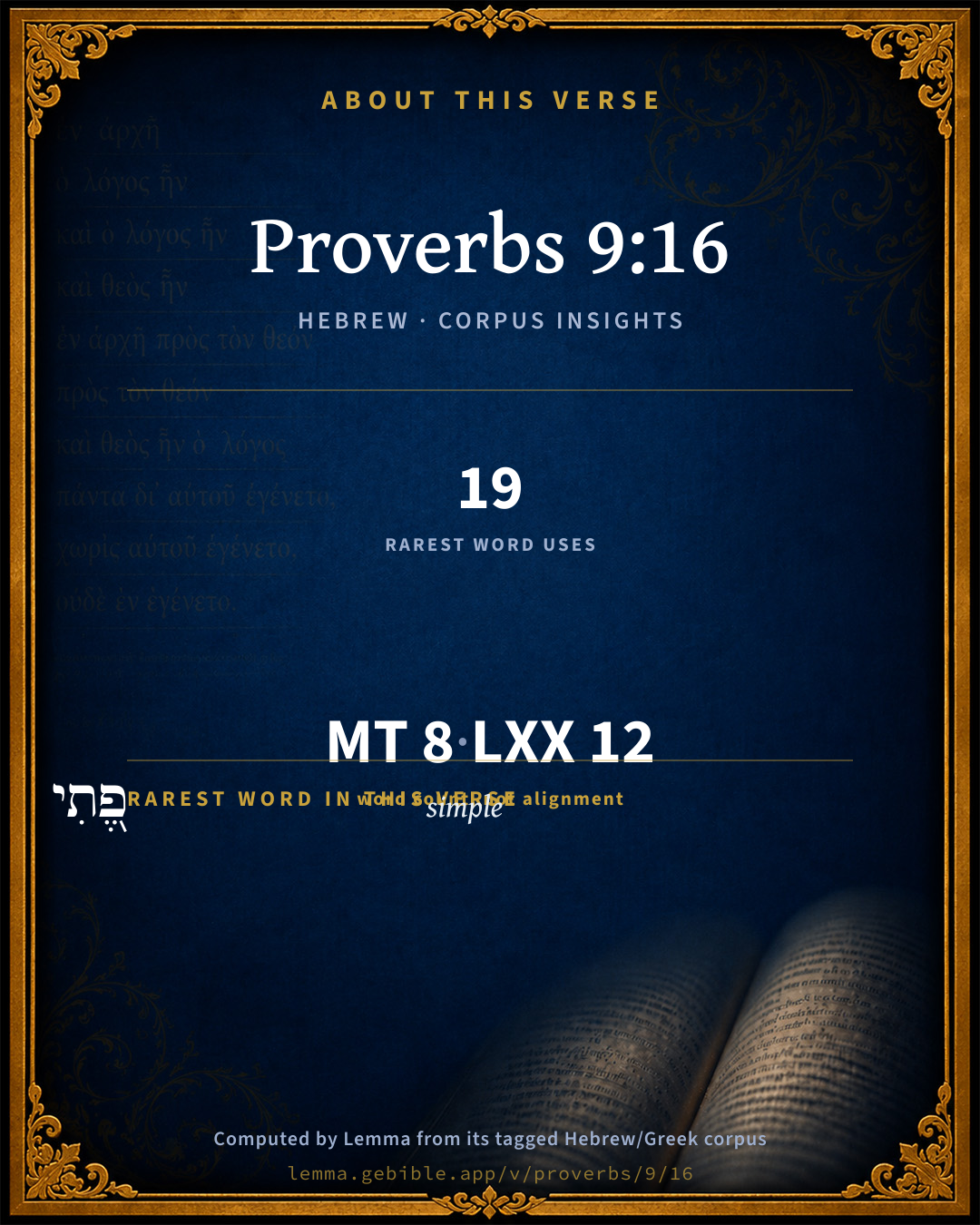
The rarest word here is פֶ֭תִי simple H6612 — appearing just 19 times in the whole Hebrew Bible.

Shared distinctive vocabulary

פֶ֭תִי simple H6612 occurs in 18 verses of the Hebrew Bible. Also found in:

Grammatical profile

  • 2 verbs
  • 2 nouns
  • 1 adjective
  • 1 preposition
  • 1 adverb
  • 1 particle

Verb forms

  • יָסֻ֣ר Qal · Jussive
  • וְאָ֣מְרָה Qal · Sequential Perfect

Hebrew & Septuagint length

In English translation the verse runs 20 words from the Hebrew and 21 from the Septuagint (LXX English) — closely comparable.

A rough comparison of the two English renderings, which tokenize alike — not a word-level alignment.

Word counts can differ between the Hebrew and the Greek without any difference in meaning — e.g. the Hebrew direct-object marker אֵת has no separate Greek word, and Greek often adds the article ὁ.

In the original languages it is 8 Hebrew tokens and 12 Greek tokens — but the two are counted differently (Hebrew bundles its prefixes and suffixes into one token; the Greek is in lemma form), so that isn’t a like-for-like length.

Cross-references

1

Topical passages linked to Proverbs 9:16 in the Treasury of Scripture Knowledge — connected by theme and wording, ordered by reader-vote popularity; previews shown in the World English Bible.

  • Proverbs 9:4 "Whoever is simple, let him turn in here!" As for him who is void of understanding, she says to him,

Cross-references courtesy of OpenBible.info (CC BY 4.0).

Hebrew and Greek witnesses Masoretic Hebrew ↔ Greek Septuagint

The same verse in the two great witnesses to the Old Testament, shown verse-for-verse.

These are two independent witnesses, not word-aligned to each other, and the Septuagint is shown in lemma (dictionary) form.

Hebrew Proverbs 9:16 Masoretic · Westminster Leningrad Codex

מִי פֶ֭תִי יָסֻ֣ר הֵ֑נָּה וַחֲסַר לֵ֝֗ב וְאָ֣מְרָה לּֽוֹ

"Whoever is simple, let him turn in here." As for him who is void of understanding, she says to him,

World English Bible · Public Domain

Greek LXX Proverbs 9:16 Septuagint · lemma form

ὅς εἰμί σύ ἄφρων ἐκκλίνω πρός ἐγώ ἐνδεής δέ φρόνησις παρακελεύω λέγω

saying, Whoso is most senseless of you, let him turn aside to me; and I exhort those that lack prudence, saying,

LXX2012 (modern English Septuagint) · Public Domain

Hebrew: Westminster Leningrad Codex (CC BY 4.0). Greek: Septuagint (public domain); English from LXX2012 (modern English Septuagint) (Public Domain). How the Septuagint differs from the Hebrew →

Commentary

Notes on Proverbs 9:16 from classic Christian and Jewish commentators (each source and its license shown beneath its notes). The classic Christian expositions comment on the surrounding passage and are grouped to its opening verse, so a note may address several verses; the Jewish commentaries on the Tanakh (Rashi and others) are per-verse, so they appear only where the commentator wrote on this verse.

Lemma curates 59 commentaries, every one of them public domain or Creative Commons licensed, each selected and text-cleaned for this edition rather than reprinted as found. About our sources →

Trapp's Complete Commentary

John Trapp

Pro 9:16 Whoso [is] simple, let him turn in hither: and [as for] him that wanteth understanding, she saith to him,

Ver. 16. Who is simple.] Wisdom’s own words. {Pro 9:4} Take heed, saith our Saviour; they come unto you "in sheep’s clothing"; {Mat 7:15} but trust them not, for "with fair words and flattering speeches they deceive the hearts of the simple" {Rom 16:18} Samuel himself could not have spoken more gravely, severely, divinely to Saul, than the fiend at Endor did. When the devil himself puts on gravity and religion, who can marvel at the hypocrisy of men?

John Trapp, A Commentary or Exposition upon All the Books of the Old and New Testament (1647–1656) — public domain. Text from a community e-Sword module.

Joseph Benson's Commentary

Pro 9:16-18. Whoso is simple — Which title is not given to them by her; for such a reproach would not have allured them, but driven them away; but by Solomon, who represents the matter of her invitation in his own words, that he might discover the truth of it, and thereby dissuade and deter those whom she invited. Stolen waters are sweet — A proverbial expression for unlawful pleasures, which are said to be sweet, partly from the difficulty of obtaining them, and partly because the very prohibition renders them more agreeable to man’s corrupt nature. But he knoweth not — He doth not consider it seriously, (whereby he proves his folly,) that the dead are there — The dead in sin, the spiritually dead, and those who are in the high road to be eternally dead. In other words, she invites him to his utter ruin, both of soul and body: for her guests are in the depths of hell — She sinks all those who accept of her invitation down to the very bottom of that pit from whence there is no redemption. “One of the profitable lessons to be learned from this chapter is, that there is nothing more inconsistent with wisdom than the service of those impure lusts which have been the ruin of all those who have been led by them; and therefore with this the wise man concludes his preface to the book of Proverbs, again repeating, Pro 9:10, that first principle on which all religion is built, and wherewith he began this preface, that the fear of the Lord is the beginning of wisdom. Indeed there is no true wisdom but religion.”

Joseph Benson's Commentary on the Old and New Testaments (1811–1818) — public domain. Text from a community e-Sword module.

Keil & Delitzsch

C. F. Keil & F. Delitzsch

The woman, who in her own person serves as a sign to her house, addresses those who pass by in their innocence (לתמּם, Sa2 15:11):

16 "Whoso is simple, let him turn in hither!"

And if any one is devoid of understanding, she saith to him:

17 "Stolen waters taste sweet,

And the bread of secrecy is pleasant."

פּתי (folly, simplicity) has a side accessible to good and its contrary: Wisdom is connected with the one side, and Folly with the other. And as the חסר־לב offers a vacuum to Wisdom which may perhaps be filled with the right contents, so is this vacuum welcome to Folly, because it meets there no resistance. In this sense, Pro 9:16 is like Pro 9:4 (excepting the addition of a connecting and of a concluding ו: et si quis excors, tum dicit ei); the word is the same in both, but the meaning, according to the two speakers, is different. That to which they both invite is the pleasure of her fellowship, under the symbol of eating and drinking; in the one case it is intellectual and spiritual enjoyment, in the other sensual. That Wisdom offers (Pro 9:5) bread and wine, and Folly water and bread, has its reason in this, that the particular pleasure to which the latter invites is of a sensual kind; for to drink water out of his own or out of another fountain is (Pro 3:15-20) the symbol of intercourse in married life, or of intercourse between the unmarried, particularly of adulterous intercourse. מים גּנוּבים (correct texts have it thus, without the Makkeph) is sexual intercourse which is stolen from him who has a right thereto, thus carnal intercourse with אושׁת אישׁ; and לחם סתרים fleshly lust, which, because it is contrary to the law, must seek (cf. furtum, secret love intrigue) concealment (סתרים, extensive plur., as מעמקּים; Bttcher, 694). Just such pleasure, after which one wipes his mouth as if he had done nothing (Pro 30:20), is for men who are without wisdom sweet (מתק, Job 20:12) and pleasant; the prohibition of it gives to such pleasure attraction, and the secrecy adds seasoning; and just such enjoyments the כסילות, personified carnality, offers. But woe to him who, befooled, enters her house!

Keil & Delitzsch — Biblical Commentary on the Old Testament (1861–1891) — public domain (CC PDM 1.0). Text via the HelloAO Bible API. (Old Testament only.)

Adam Clarke's Commentary

Verse 16. Whoso is simple, let him turn in hither] FOLLY or PLEASURE here personified, uses the very same expressions as employed by Wisdom, Pr 9:4. Wisdom says, "Let the simple turn in to me." No, says Folly, "Let the simple turn in to me." If he turn in to Wisdom, his folly shall be taken away and he shall become wise; if he turn in to Folly, his darkness will be thickened, and his folly will remain.

Wisdom sets up her school to instruct the ignorant:

Folly sets her school up next door, to defeat the designs of Wisdom.

Thus the saying of the satirist appears to be verified: -

"Wherever God erects a house of prayer,

The devil surely builds a chapel there.

And it is found upon examination,

The latter has the larger congregation."

DE FOE.

Adam Clarke's Commentary on the Bible (1810–1826) — public domain. Text from a community e-Sword/MySword module.

Ellicott's Commentary for English Readers

(16) Whoso is simple . . .—She imitates Wisdom closely in her address: Satan, too, transforms himself into an “angel of light” (2Co_11:14). Folly attracts those undecided characters who are in the right track, but have not the constancy to persevere in it; who, “in time of temptation, fall away.”

A Bible Commentary for English Readers, edited by Charles John Ellicott (1878–1897) — public domain. Text from a community e-Sword module.

John Gill's Exposition

Stolen waters are sweet,.... Wells and fountains of waters in those hot countries were very valuable, and were the property of particular persons; about which there were sometimes great strife and contention; and they were sometimes sealed and kept from the use of others; see Gen 26:18; now waters got by stealth from such wells and fountains were sweeter than their own, or what might be had in common and without difficulty, to which the proverb alludes. By which in general is meant, that all prohibited unlawful lusts and pleasures are desirable to men, and sweet in the enjoyment of them; and the pleasure promised by them is what makes them so desirable, and the more so because forbidden: and particularly as adultery, which is a sort of theft (r), and a drinking water out of another's cistern, Pro 5:15; being forbidden and unlawful, and secretly committed, is sweeter to an unclean person than a lawful enjoyment of his own wife; so false worship, superstition, and idolatry, the inventions of men, and obedience to their commands, which are no other than spiritual adultery, are more grateful and pleasing to a corrupt mind than the true and pure worship of God;

and bread eaten in secret is pleasant; or, "bread of secret places" (s); hidden bread, as the Targum, Vulgate Latin, and Syriac versions; that which is stolen and is another's (t), and is taken and hid in secret places, fetched out from thence, or eaten there: the sweet morsel of sin, rolled in the mouth, and kept under the tongue; secret lusts, private sins, particularly idolatry, to which men are secretly enticed, and which they privately commit, Deu 13:6; the same thing is designed by this clause as the forager.

(r) "Furtiva Verus", Ovid de Arte Amandi, l. 1. "Furta Jovis, furtiva munuscula", Catullus ad Mantium, Ep. 66. v. 140, 145. So Propertius, l. 2. eleg. 30. v. 28. Pindar; for which he was indebted to Solomon, according to Clemens of Alexandria, Paedagog. l. 3. p. 252. (s) "latebraram", Junius & Tremellius, Piscator, Michaelis. (t) "Quas habeat veneres aliens pecunia nescis", Juvenal. Satyr. 13.

John Gill's Exposition of the Whole Bible (1746–1763) — public domain (CC PDM 1.0). Text via the HelloAO Bible API.

Matthew Poole's English Annotations

Simple; which title is not given to them by her, for such a reproach would not have allured them, but driven them away; but by Solomon, who represents the matter of her invitation in his own words, that he might discover the truth of the business, and thereby dissuade and deter those whom she invited.

Matthew Poole's English Annotations on the Holy Bible (1683–1685) — public domain. Text from a community e-Sword/MySword module.

Whedon's Commentary on the Bible

Daniel D. Whedon

16. Turn in hither — “The feast of reason” and virtue to which wisdom invites is, as becomes its pure and elevated character, a public entertainment — open to the day — without blinds, or screens, or frosted windows; that of sinful pleasure, true to its character also, is in secret and darkness. Men are often most eager after enjoyments which are prohibited. The appetite for these pleasures is sharpened by the imposed restraints. “Sin, taking occasion by the commandment, [the prohibition,] works all manner of concupiscence.” Rom_7:7, et seq.

Daniel D. Whedon (gen. ed.), Commentary on the Old and New Testaments (1874–1909) — public domain. Text from a community e-Sword module.

The Pulpit Commentary

Vers. 16, 17. These verses contain the invitation which Vice, in imitation of Virtue, and assuming her voice and manner, offers to the wayfarers.

Whoso is simple, let him turn in hither. She uses the very same words which Wisdom utters (ver. 4). The latter had addressed the simple because they were inexperienced and undecided, and might be guided aright; the former now speaks to them because they have not vet made their final choice, can still be swayed by lower considerations, and may be led astray. Such persons find it hard to distinguish between the good and the evil, the false and the true, especially when their sensual appetite is aroused and sides with the temptress. No marvel is it that such are easily deceived; for we are told that, under certain circumstances, Satan transforms himself into an angel of light. (2Co_11:14) That wanteth understanding. This is the other class addressed by Wisdom, and which Folly now solicits, urging them to follow her on the path of pleasure, promising sensual enjoyment and security.

The Pulpit Commentary (1880–1919), ed. H.D.M. Spence-Jones & Joseph S. Exell — public domain. Text from a community e-Sword module.

John Wesley's Explanatory Notes

Simple - This title is not given them by her, but by Solomon.

John Wesley, Explanatory Notes Upon the Whole Bible (1754–1765) — public domain. Text via the GEBible commentary corpus.

unfoldingWord translationNotes

Door43 World Missions Community

is naive

"is inexperienced or immature"

turn aside here

"leave his path and come here"

she says

This is the foolish woman who was introduced in Proverbs 9:13.

those who have no sense

"those who do not have wisdom" or "those who are not wise"

Stolen waters are sweet, and bread of secrecy is delicious

The foolish woman speaks of the pleasure of stolen waters and bread of secrecy to tell men that if they sleep with her, they will have pleasure. This can be stated clearly in a simile: "You can enjoy me just as you enjoy water that you have stolen or bread that is secret" (See: Metaphor)

that the dead are there

"that the men who have gone to her are now dead"

in the depths of Sheol

"Sheol" refers to the world of the dead.

translationWords

die

Hades

unfoldingWord translationNotes — © Distant Shores Media and the Door43 World Missions Community, licensed CC BY-SA 4.0. Source: git.door43.org/Door43/en_tn.

Rashi

Rabbi Shlomo Yitzchaki (Rashi)

and whoever is devoid of sense (lit. and one devoid of sense.) and she says to him these words. What does she say to him?

Rashi on the Tanakh — English translations: “The Judaica Press complete Tanach with Rashi, translated by A. J. Rosenberg” (CC BY 4.0); “Pentateuch with Rashi's commentary by M. Rosenbaum and A.M. Silbermann, 1929-1934” (public domain); “The Metsudah Tanach series, Lakewood, N.J” (CC BY 4.0); and “The Book of Joshua, Metsudah Publications, 1997” (CC BY 4.0). Text via Sefaria.

Lesson kit

Teaching starters — assembled from the data on this page, not authored interpretation. Every prompt links to the verse data it draws on. Edit before teaching.

Proverbs, in the Wisdom, opens this verse with 8 words (7 distinct Hebrew lemmas). Its most distinctive word is pᵉthîy (“simple”). A historical commentator’s framing appears above. Read the whole chapter for the surrounding context.

Discussion questions

  1. How does “simple” (pᵉthîy) shape what this verse is saying?
  2. How does Psalms 19:7, which shares the word «simple», read alongside this verse?
  3. These translations render this verse differently; the difference is in the English rendering, not the original. What questions does that raise?
  4. «יָסֻ֣ר» is a Qal Jussive verb. How does that grammatical form shape the action described?
  5. Compare how Trapp's Complete Commentary and Joseph Benson's Commentary read this verse. Where do they agree or differ?

Things to notice

Reading settings

Reading text

Shown beneath each verse's original-language words.

Old Testament
Old Testament edition

Read the OT as the Masoretic Hebrew (MT) or the Greek Septuagint (LXX).

English shown for the Greek Septuagint (in the Hebrew ↔ Greek comparison).

Comparing translations? Open the Compare panel on any verse page to stack up to four side by side.