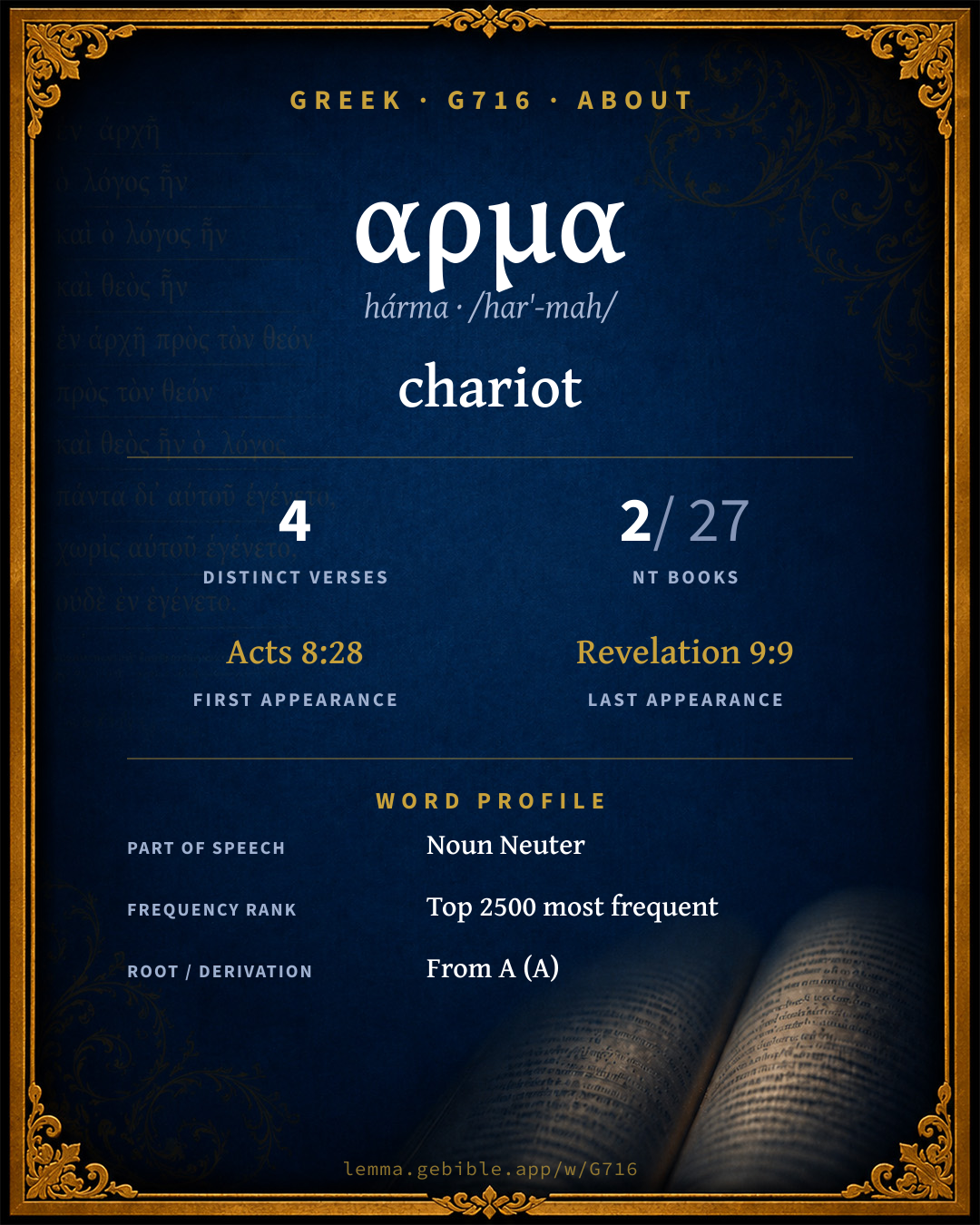
ἅρμα
chariot
‘chariot’ is one of 3 main senses fuller range ↓
Full lexicon entry — Thayer's Greek Lexicon
From Thayer's Greek Lexicon
Where this word appears
See every Genitive-case word in the Greek New Testament →
Grammar key — what these labels mean
Part of speech
- Noun
- A naming word — a person, place, thing, or idea.
Case
- Accusative
- The case of the direct object and of extent.
- Dative
- The case of the indirect object, means, or location — “to / for / with / in.”
- Genitive
- The case of source, possession, or “of” — answers “whose / from what.”
Gender
- Neuter
- Grammatically neuter.
Number
- Singular
- One.
- Plural
- More than one.
1 distinct verse where G716 appears in the Dative case, across 1 book. Filtered view — show all forms. Click any verse to open its interlinear word-by-word view. Verse text shown in the World English Bible for context — . Each verse’s Greek form is shown with its reference; the English is not keyword-highlighted, since the data carries no word-level English alignment. Use “Compare translations” on any verse to read it across multiple English versions. This concordance covers the Greek New Testament; Septuagint (Greek Old Testament) occurrences of this word are not indexed here.
Acts 1 verse
About this entry
At a glance — auto-summarized from this page’s data, not written by a person. Every figure links to its source below. This summary describes the numbers; it doesn’t interpret them.
The Greek noun αρμα centers on the idea of “chariot.” The Greek New Testament uses it only 4 verses. Acts dominates its distribution — 3 of 4 verses. Its earliest occurrence is Acts 8:28. Lexicons map it across 3 senses. Dig into 4-verse concordance and the renderings breakdown below.
Gloss history
Strong's 1890 vs modern scholarship
About this word
Strong's G716 catalogs a Greek word from the Greek New Testament.
These counts are not copied from any lexicon or concordance. They are computed here, from the morphology-tagged Greek New Testament. What Lemma adds →
- 4
- distinct verses
- The word appears in 4 distinct verses.
- 2 / 27
- NT books
- The word appears in 2 of 27 New Testament books.
- #1,877
- by frequency
- Top 2500 most frequent Greek words (rank 1,877 of 5,347 Greek words by occurrence).
View all 4 occurrences in the concordance →
Most concentrated in
- Acts 3 verses 75%
- Revelation 1 verse 25%
By section of the New Testament
By traditional corpus
Conventional, traditional groupings — biblical authorship is debated, so this is a traditional corpus grouping, not an authorship claim. Some books belong to more than one corpus (Luke is in both the Gospels and the Lukan corpus, and so on), so these shares overlap and need not total 100%. Each figure is a share of the word’s 4 distinct verses.
- Lukan (Luke–Acts) 3 verses · 75%
- Johannine 1 verse · 25%
- Revelation 1 verse · 25%
How translations render this word
Counts come from each version’s own published word-to-Strong’s tagging or interlinear alignment — an approximate guide to how each version renders this word, not a word-level alignment the data otherwise carries. Because each total is that version’s own tagged count, the per-version totals vary from one another and need not match the appearance or distinct-verse counts above. These counts may also differ from a printed concordance because Lemma counts each distinctly tagged rendering and does not collapse phrase taggings into a single head-word total. This is a fixed set of word-tagged versions (KJV, ASV, BSB, ULT) and does not change with the reading translation you choose elsewhere. Each version’s license is shown beside its name below (and on Sources).
- King James Version: Chariot 3×
- American Standard Version: Chariot 3×
- Berean Standard Bible: Chariot 3×
- unfoldingWord Literal Text: Chariot 3×
King James Version Public Domain
Renders G716 across 4 tagged occurrences — most commonly:
Plus 1 rendering that appears only once — usually multi-word phrases or single function words the recovered tagging swept in, not distinct renderings.
American Standard Version Public Domain
Renders G716 across 4 tagged occurrences — most commonly:
Plus 1 rendering that appears only once — usually multi-word phrases or single function words the recovered tagging swept in, not distinct renderings.
Berean Standard Bible Public Domain
Renders G716 across 4 tagged occurrences — most commonly:
Plus 1 rendering that appears only once — usually multi-word phrases or single function words the recovered tagging swept in, not distinct renderings.
unfoldingWord Literal Text CC BY-SA 4.0
Renders G716 across 5 tagged occurrences — most commonly:
Plus 2 renderings that appear only once — usually multi-word phrases or single function words the recovered tagging swept in, not distinct renderings.
Senses in Thayer's
The 3 senses Thayer's distinguishes for this word, in lexicon order (not ranked by frequency or importance). The full entry — with sub-senses — is in the Lexicon Entry tab.
- a chariot
- of war chariots (i.e. armed with scythes)
- chariots (drawn with many horses)
Word origin
Derived from Α (A) (G1) — alpha.
Forms in the corpus
The 4 distinct written forms G716 takes in the Greek New Testament, most frequent first — each parse links to that case’s occurrences in the concordance.
| Form | Parsing | Example | Uses |
|---|---|---|---|
| ἁρμάτων harmátōn | Noun, Genitive, Plural, Neuter | Revelation 9:9 | 1 |
| ἅρμα hárma | Noun, Accusative, Singular, Neuter | Acts 8:38 | 1 |
| ἅρματι hármati | Noun, Dative, Singular, Neuter | Acts 8:29 | 1 |
| ἅρματος hármatos | Noun, Genitive, Singular, Neuter | Acts 8:28 | 1 |
Same root — word family
Other Thayer's entries built from the same root as G716, grouped by Strong’s listed origin. These share a root / origin per the lexicon — not necessarily a shared meaning. Each links to that word’s own entry.
Derives from
Shares the same root
- αβαρης abarḗs G4 light
- αβυσσος ábyssos G12 abyss
- αγαμος ágamos G22 unmarried
- αγενεαλογητος agenealógētos G35 without genealogy
- αγενης agenḗs G36 ignoble
- αγναφος ágnaphos G46 unprocessed
- αγνοεω agnoéō G50 to be ignorant
- αγνωσια agnōsía G56 ignorance
- αγνωστος ágnōstos G57 unknown
- αγραμματος agrámmatos G62 unlearned
- αγρυπνεω agrypnéō G69 to watch
- αδαπανος adápanos G77 free
- αδελφος adelphós G80 brother
- αδηλος ádēlos G82 obscure
- αδης háidēs G86 hell
- αδιακριτος adiákritos G87 clear
- αδιαλειπτος adiáleiptos G88 continual
- αδικος ádikos G94 unjust
- αδοκιμος adókimos G96 unapproved
- αδολος ádolos G97 guileless
- αδυνατος adýnatos G102 weak
- αζυμος ázymos G106 unleavened
- αθανασια athanasía G110 immortal
- αθεμιτος athémitos G111 unlawful
+149 more words share this root (not shown).
Derived from this word
Proper names from this root
People and places named from this root — a name, not an additional meaning of the word.
Compare all same-root words → Showing 4 of 177 — not the complete family. 1 of the same-root words is a proper name (a person or place). They share a root, not necessarily a meaning.
Septuagint usage
The same Greek word αρμα appears 153 times in the Greek Old Testament (Septuagint), across 131 verses in 23 books.
- 153
- LXX occurrences
- Tagged occurrences of this Greek word in the Septuagint.
- 131
- verses
- Distinct Septuagint verses containing this word.
- 23 / 39
- OT books
- The word appears in 23 of the 39 Old Testament books.
Sample Septuagint occurrences
- Genesis 41:43 ἅρμα
- Exodus 14:6 ἅρμα
- Deuteronomy 11:4 ἅρμα
- Joshua 11:4 ἅρμα
- Judges 4:3 ἅρμα
- 1 Samuel 8:11 ἅρμα
- 2 Samuel 1:6 ἅρμα
- 1 Kings 1:5 ἅρμα
- 2 Kings 2:11 ἅρμα
- 1 Chronicles 18:4 ἅρμα
- 2 Chronicles 1:14 ἅρμα
- Psalms 19:8 ἅρμα
Septuagint occurrences (same lexeme)
Every verse where the same Strong’s number (G716) appears in the Greek Septuagint — showing the first 50 of 131. Verse text shown in the World English Bible for context; the Greek form is the matched word — the English is not keyword-highlighted.
- Genesis 41:43 ἅρμα and he made him to ride in the second chariot which he had. They cried before him, "Bow the knee!" He set him over all the land of Egypt.
- Genesis 46:29 ἅρμα Joseph made ready his chariot, and went up to meet Israel, his father, in Goshen. He presented himself to him, and fell on his neck, and wept on his neck a good while.
- Genesis 50:9 ἅρμα There went up with him both chariots and horsemen. It was a very great company.
- Exodus 14:6 ἅρμα He made ready his chariot, and took his army with him;
- Exodus 14:7 ἅρμα and he took six hundred chosen chariots, and all the chariots of Egypt, and captains over all of them.
- Exodus 14:9 ἅρμα The Egyptians pursued after them: all the horses and chariots of Pharaoh, his horsemen, and his army; and overtook them encamping by the sea, beside Pihahiroth, before Baal Zephon.
- Exodus 14:17 ἅρμα I, behold, I will harden the hearts of the Egyptians, and they shall go in after them: and I will get myself honor over Pharaoh, and over all his host, over his chariots, and over his horsemen.
- Exodus 14:18 ἅρμα The Egyptians shall know that I am Yahweh, when I have gotten myself honor over Pharaoh, over his chariots, and over his horsemen."
- Exodus 14:23 ἅρμα The Egyptians pursued, and went in after them into the midst of the sea: all of Pharaoh's horses, his chariots, and his horsemen.
- Exodus 14:25 ἅρμα He took off their chariot wheels, and they drove them heavily; so that the Egyptians said, "Let's flee from the face of Israel, for Yahweh fights for them against the Egyptians!"
- Exodus 14:26 ἅρμα Yahweh said to Moses, "Stretch out your hand over the sea, that the waters may come again on the Egyptians, on their chariots, and on their horsemen."
- Exodus 14:28 ἅρμα The waters returned, and covered the chariots and the horsemen, even all Pharaoh's army that went in after them into the sea. There remained not so much as one of them.
- Exodus 15:4 ἅρμα Pharaoh's chariots and his host has he cast into the sea; His chosen captains are sunk in the Red Sea.
- Exodus 15:19 ἅρμα For the horses of Pharaoh went in with his chariots and with his horsemen into the sea, and Yahweh brought back the waters of the sea on them; but the children of Israel walked on dry land in the midst of the sea.
- Deuteronomy 11:4 ἅρμα and what he did to the army of Egypt, to their horses, and to their chariots; how he made the water of the Red Sea to overflow them as they pursued after you, and how Yahweh has destroyed them to this day;
- Joshua 11:4 ἅρμα They went out, they and all their hosts with them, much people, even as the sand that is on the sea-shore in multitude, with horses and chariots very many.
- Joshua 11:6 ἅρμα Yahweh said to Joshua, Don't be afraid because of them; for tomorrow at this time will I deliver them up all slain before Israel: you shall hamstring their horses, and burn their chariots with fire.
- Joshua 11:9 ἅρμα Joshua did to them as Yahweh bade him: he hamstrung their horses, and burnt their chariots with fire.
- Joshua 24:6 ἅρμα I brought your fathers out of Egypt: and you came to the sea; and the Egyptians pursued after your fathers with chariots and with horsemen to the Red Sea.
- Judges 4:3 ἅρμα The children of Israel cried to Yahweh: for he had nine hundred chariots of iron; and twenty years he mightily oppressed the children of Israel.
- Judges 4:7 ἅρμα I will draw to you, to the river Kishon, Sisera, the captain of Jabin's army, with his chariots and his multitude; and I will deliver him into your hand.
- Judges 4:13 ἅρμα Sisera gathered together all his chariots, even nine hundred chariots of iron, and all the people who were with him, from Harosheth of the Gentiles, to the river Kishon.
- Judges 4:15 ἅρμα Yahweh confused Sisera, and all his chariots, and all his host, with the edge of the sword before Barak; and Sisera alighted from his chariot, and fled away on his feet.
- Judges 4:16 ἅρμα But Barak pursued after the chariots, and after the host, to Harosheth of the Gentiles: and all the host of Sisera fell by the edge of the sword; there was not a man left.
- Judges 5:28 ἅρμα Through the window she looked forth, and cried, The mother of Sisera [cried] through the lattice, Why is his chariot so long in coming? Why do the wheels of his chariots wait?
- 1 Samuel 8:11 ἅρμα He said, This will be the manner of the king who shall reign over you: he will take your sons, and appoint them to him, for his chariots, and to be his horsemen; and they shall run before his chariots;
- 1 Samuel 8:12 ἅρμα and he will appoint them to him for captains of thousands, and captains of fifties; and [he will set some] to plow his ground, and to reap his harvest, and to make his instruments of war, and the instruments of his chariots.
- 1 Samuel 13:5 ἅρμα The Philistines assembled themselves together to fight with Israel, thirty thousand chariots, and six thousand horsemen, and people as the sand which is on the sea-shore in multitude: and they came up, and encamped in Michmash, eastward of Beth Aven.
- 1 Samuel 15:12 ἅρμα Samuel rose early to meet Saul in the morning; and it was told Samuel, saying, Saul came to Carmel, and, behold, he set him up a monument, and turned, and passed on, and went down to Gilgal.
- 2 Samuel 1:6 ἅρμα The young man who told him said, As I happened by chance on Mount Gilboa, behold, Saul was leaning on his spear; and, behold, the chariots and the horsemen followed hard after him.
- 2 Samuel 8:4 ἅρμα David took from him one thousand seven hundred horsemen, and twenty thousand footmen: and David hamstrung all the chariot horses, but reserved of them for one hundred chariots.
- 2 Samuel 10:18 ἅρμα The Syrians fled before Israel; and David killed of the Syrians [the men of] seven hundred chariots, and forty thousand horsemen, and struck Shobach the captain of their host, so that he died there.
- 2 Samuel 15:1 ἅρμα It happened after this, that Absalom prepared him a chariot and horses, and fifty men to run before him.
- 1 Kings 1:5 ἅρμα Then Adonijah the son of Haggith exalted himself, saying, I will be king: and he prepared him chariots and horsemen, and fifty men to run before him.
- 1 Kings 2:46 ἅρμα So the king commanded Benaiah the son of Jehoiada; and he went out, and fell on him, so that he died. The kingdom was established in the hand of Solomon.
- 1 Kings 5:1 ἅρμα Hiram king of Tyre sent his servants to Solomon; for he had heard that they had anointed him king in the room of his father: for Hiram was ever a lover of David.
- 1 Kings 7:19 ἅρμα The capitals that were on the top of the pillars in the porch were of lily-work, four cubits.
- 1 Kings 10:22 ἅρμα For the king had at sea a navy of Tarshish with the navy of Hiram: once every three years came the navy of Tarshish, bringing gold, and silver, ivory, and apes, and peacocks.
- 1 Kings 10:26 ἅρμα Solomon gathered together chariots and horsemen: and he had a thousand and four hundred chariots, and twelve thousand horsemen, that he bestowed in the chariot cities, and with the king at Jerusalem.
- 1 Kings 10:29 ἅρμα A chariot came up and went out of Egypt for six hundred [shekels] of silver, and a horse for one hundred fifty; and so for all the kings of the Hittites, and for the kings of Syria, did they bring them out by their means.
- 1 Kings 12:24 ἅρμα Thus says Yahweh, You shall not go up, nor fight against your brothers the children of Israel: return every man to his house; for this thing is of me. So they listened to the word of Yahweh, and returned and went their way, according to the word of Yahweh.
- 1 Kings 18:44 ἅρμα It happened at the seventh time, that he said, "Behold, a small cloud, like a man's hand, is rising out of the sea." He said, Go up, tell Ahab, Make ready [your chariot], and get you down, that the rain not stop you.
- 1 Kings 21:1 ἅρμα It happened after these things, that Naboth the Jezreelite had a vineyard, which was in Jezreel, hard by the palace of Ahab king of Samaria.
- 1 Kings 21:21 ἅρμα Behold, I will bring evil on you, and will utterly sweep you away and will cut off from Ahab every man-child, and him who is shut up and him who is left at large in Israel:
- 1 Kings 21:25 ἅρμα (But there was none like Ahab, who did sell himself to do that which was evil in the sight of Yahweh, whom Jezebel his wife stirred up.
- 1 Kings 21:33 ἅρμα
- 1 Kings 22:31 ἅρμα Now the king of Syria had commanded the thirty-two captains of his chariots, saying, Fight neither with small nor great, save only with the king of Israel.
- 1 Kings 22:32 ἅρμα It happened, when the captains of the chariots saw Jehoshaphat, that they said, Surely it is the king of Israel; and they turned aside to fight against him: and Jehoshaphat cried out.
- 1 Kings 22:33 ἅρμα It happened, when the captains of the chariots saw that it was not the king of Israel, that they turned back from pursuing him.
- 1 Kings 22:35 ἅρμα The battle increased that day: and the king was stayed up in his chariot against the Syrians, and died at even; and the blood ran out of the wound into the bottom of the chariot.
These are occurrences of the same Greek lexeme (G716) in the Septuagint — not a translation of any one Hebrew word. The store carries no word-level Hebrew↔Greek alignment, so no Hebrew original is asserted here. Counts come from the recovered LXX Strong's tagging — high-frequency vocabulary is well covered, while rare or late forms may be untagged — so they reflect tagged occurrences and may slightly undercount.