
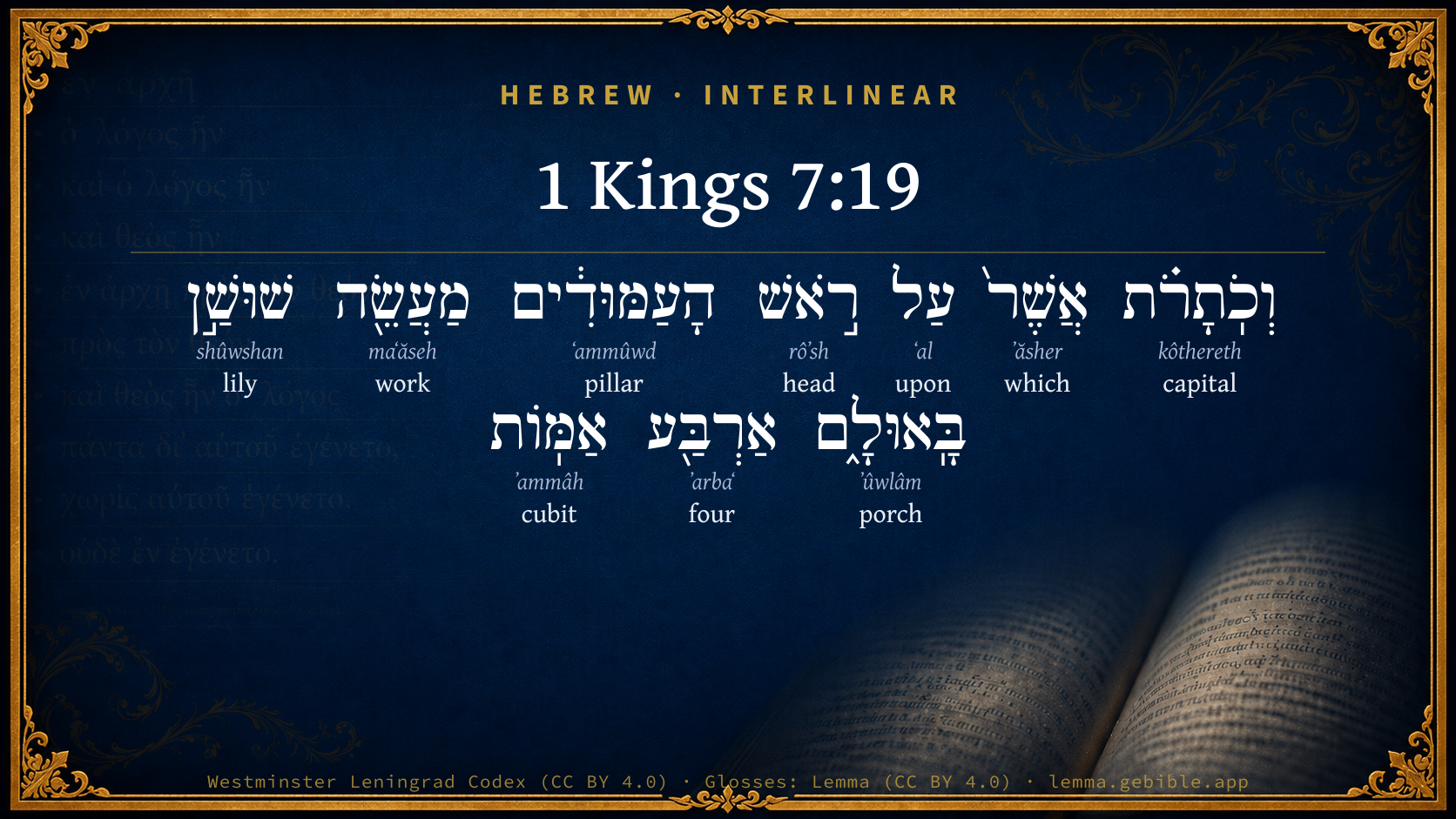
1 Kings 7:19

Hebrew (Westminster Leningrad Codex) 1 Kings 7:19 appears in the Hebrew Old Testament. The text above is from the Westminster Leningrad Codex. Each word links to its Strong’s number, a concise gloss, and parsing drawn from the Open Scriptures Hebrew Bible morphology. Click any word for its full Brown-Driver-Briggs (BDB) entry.
Download image
Cite this verse

1 Kings 7:19 (World English Bible). Public Domain. Lemma interlinear Bible study tool, https://lemma.gebible.app/v/1-kings/7/19.

Show BibTeX & RIS
BibTeX
RIS
English Translation
The capitals that were on the top of the pillars in the porch were of lily-work, four cubits.
World English Bible · Public Domain
Highlights
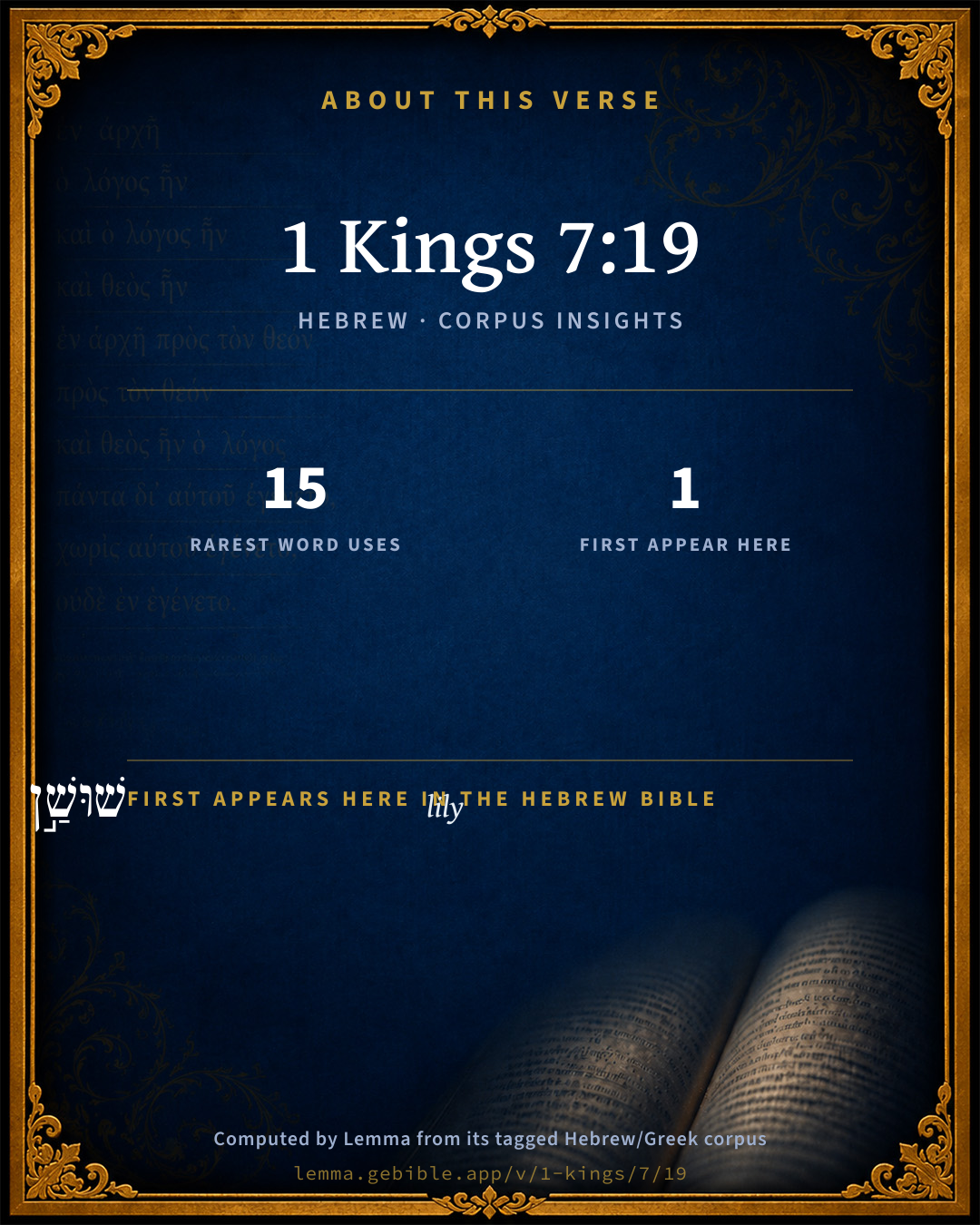
  • 1 first appearance in the Hebrew Bible
Full analysis ↓
Download a study sheet

One document with this verse’s original text, its word-by-word gloss line, the meaning frame, cross-references with their text, attributed commentary, and full source and license credits — printable, and it pastes into notes with its structure intact.

This verse Autodidact and up

Study sheet (.html) Plain text (.txt)

A passage Seminary Student

Up to 50 verses in one chapter. A passage sheet keeps up to 6 commentary sources and 12 cross-references per verse, in the order this page ranks them, and says so on the sheet whenever that leaves anything out. Ask for a single verse and you get the Autodidact verse sheet above.

Everything on this page stays free to read, with no account — the sheet is a download of what is already on screen, not access to it.

Want to remove ads? Support Godless Engineer
Compare translations 3

The same verse in 3 English versions, stacked beneath the original-language interlinear above. Click any original word for its lexicon entry.

Each is an independent rendering of the whole verse — the interlinear is not word-aligned to these translations.

Highlighted words mark where these versions differ — a whole-verse word diff, not a word-by-word alignment.

  • World English Bible Public Domain
    The capitals that were on the top of the pillars in the porch were of lily-work, four cubits.
  • King James Version Public Domain
    And the chapiters that were upon the top of the pillars were of lily work in the porch, four cubits.
  • unfoldingWord Literal Text CC BY-SA 4.0
    And the capitals that on the head of the pillars the work of a lily, on the porch, four cubits.

unfoldingWord Literal Text — © unfoldingWord, licensed CC BY-SA 4.0. Word-aligned USFM3 via Door43 (git.door43.org/unfoldingWord/en_ult).

Versions to compare (up to 4)

3 of 4 selected

Show all 18 translations

Every available English version of this verse, each an independent rendering of the whole verse.

  • World English Bible Public Domain
    The capitals that were on the top of the pillars in the porch were of lily-work, four cubits.
  • Berean Standard Bible Public Domain
    And the capitals atop the pillars in the portico were shaped like lilies, four cubits high.
  • Majority Standard Bible Public Domain
    And the capitals atop the pillars in the portico were shaped like lilies, four cubits high.
  • King James Version Public Domain
    And the chapiters that were upon the top of the pillars were of lily work in the porch, four cubits.
  • American Standard Version (1901) Public Domain
    And the capitals that were upon the top of the pillars in the porch were of lily-work, four cubits.
  • Revised Version (1885) Public Domain
    And the chapiters that were upon the top of the pillars in the porch were of lily work, four cubits.
  • Geneva Bible (1599) Public Domain
    And the chapiters that were on the toppe of the pillars were after lilye worke in ye porch, foure cubites.
  • Douay-Rheims (1899) Public Domain
    And the chapiters that were upon the top of the pillars, were of lily work in the porch, of four cubits.
  • Young's Literal Translation Public Domain
    And the chapiters that `are' on the top of the pillars `are' of lily-work in the porch, four cubits;
  • Literal Standard Version CC BY-SA 4.0
    And the chapiters that [are] on the top of the pillars [are] of lily-work in the porch, four cubits;
  • Unlocked Literal Bible CC BY-SA 4.0
    The capitals on the tops of the portico pillars were decorated with lilies, four cubits high.
  • unfoldingWord Literal Text CC BY-SA 4.0
    And the capitals that on the head of the pillars the work of a lily, on the porch, four cubits.
  • Darby Bible Public Domain
    And the capitals that were upon the top of the pillars were of lily-work [as] in the porch, four cubits.
  • World Messianic Bible Public Domain
    The capitals that were on the top of the pillars in the porch were of lily work, four cubits.
  • Webster's Bible Public Domain
    And the capitals that were upon the top of the pillars were of lily-work in the porch, four cubits.
  • Free Bible Version CC BY-SA 4.0
    The capitals placed on top of columns in the porch were in the shape of lilies, four cubits high.
  • Bible in Basic English Public Domain
    The crowns on the tops of the pillars were ornamented with a design of flowers, and were four cubits across.
  • JPS Tanakh (1917) Public Domain
    And the capitals that were upon the top of the pillars in the porch were of lily-work, four cubits.

Literal Standard Version (2020), Covenant Press — licensed CC BY-SA 4.0. Text via the HelloAO Bible API (eBible.org). Unlocked Literal Bible (unfoldingWord) — licensed CC BY-SA 4.0. Text via the HelloAO Bible API (eBible.org). unfoldingWord Literal Text — © unfoldingWord, licensed CC BY-SA 4.0. Word-aligned USFM3 via Door43 (git.door43.org/unfoldingWord/en_ult). Free Bible Version, Dr. Jonathan Gallagher — licensed CC BY-SA 4.0. Text via the HelloAO Bible API (eBible.org).

Word by word

More ways to search: Search by grammar → Find every occurrence → Compare this word →

Practice this passage: Drill this verse → Learn its vocabulary →

About this verse

These counts appear in no published source. They are computed here, from the morphology-tagged text and Lemma’s own curated glosses. What Lemma adds →

10
words
10
distinct lemmas
Historical
section

Notable vocabulary

The rarest word here is שׁוּשַׁ֣ן lily H7799 — appearing just 15 times in the whole Hebrew Bible.

First appearance in Scripture

This word makes its first canonical appearance in the Hebrew Bible here:

  • שׁוּשַׁ֣ן lily H7799

Shared distinctive vocabulary

שׁוּשַׁ֣ן lily H7799 occurs in 15 verses of the Hebrew Bible. Also found in:

Grammatical profile

  • 7 nouns
  • 1 adjective
  • 1 preposition
  • 1 particle

Hebrew & Septuagint length

In English translation the verse runs 18 words from the Hebrew and 16 from the Septuagint (LXX English) — closely comparable.

A rough comparison of the two English renderings, which tokenize alike — not a word-level alignment.

Word counts can differ between the Hebrew and the Greek without any difference in meaning — e.g. the Hebrew direct-object marker אֵת has no separate Greek word, and Greek often adds the article ὁ.

Cross-references

3

Topical passages linked to 1 Kings 7:19 in the Treasury of Scripture Knowledge — connected by theme and wording, ordered by reader-vote popularity; previews shown in the World English Bible.

  • 1 Kings 6:18 There was cedar on the house within, carved with buds and open flowers: all was cedar; there was no stone seen.
  • 1 Kings 6:32–35 So [he made] two doors of olive-wood; and he carved on them carvings of cherubim and palm trees and open flowers, and overlaid them with gold; and he spread the gold on the cherubim, and on the palm trees.
  • 1 Kings 7:22 On the top of the pillars was lily-work: so was the work of the pillars finished.

Cross-references courtesy of OpenBible.info (CC BY 4.0).

Hebrew and Greek witnesses Masoretic Hebrew ↔ Greek Septuagint

The same verse in the two great witnesses to the Old Testament, shown verse-for-verse.

These are two independent witnesses, not word-aligned to each other, and the Septuagint is shown in lemma (dictionary) form.

Hebrew 1 Kings 7:19 Masoretic · Westminster Leningrad Codex

וְכֹֽתָרֹ֗ת אֲשֶׁר֙ עַל רֹ֣אשׁ הָעַמּוּדִ֔ים מַעֲשֵׂ֖ה שׁוּשַׁ֣ן בָּֽאוּלָ֑ם אַרְבַּ֖ע אַמּֽוֹת

The capitals that were on the top of the pillars in the porch were of lily-work, four cubits.

World English Bible · Public Domain

Greek LXX 1 Kings 7:19 Septuagint · lemma form

καί ὁ ἔργον ὁ τροχός ἔργον τροχός ἅρμα ὁ χείρ αὐτός καί ὁ νῶτον αὐτός καί ὁ πραγματεία αὐτός ὁ πᾶς χωνευτός

And on the heads of the pillars he made lily-work against the porch, of four cubits,

LXX2012 (modern English Septuagint) · Public Domain

On this verse, The Pulpit Commentary discusses the Septuagint’s reading. Read the note in Commentary ↓

Hebrew: Westminster Leningrad Codex (CC BY 4.0). Greek: Septuagint (public domain); English from LXX2012 (modern English Septuagint) (Public Domain). How the Septuagint differs from the Hebrew →

Targum (Aramaic paraphrase)

1

The Targum is the ancient Jewish Aramaic paraphrase of the Hebrew Scriptures — an interpretive translation, not the Hebrew text itself. Onkelos (literal) and Pseudo-Jonathan (expansive) render the Torah, and Jonathan the Prophets. Coverage is partial: where no permissively-licensed English translation exists for a verse, only the Aramaic is shown. This is verse-level text, not a word-by-word alignment to the Hebrew.

  1. Targum Jonathan Prophets (Joshua–Malachi)
    וּקְרוֹנְתְּוָן דְעַל רֵישׁ עַמוּדַיָא עוֹבַד שׁוֹשַׁנְתָּא לָקִיט בְּאוּלַמָא אַרְבַּע אַמִין:

    (no public-domain English translation for this verse)

    Targum Jonathan — Aramaic: “Mikraot Gedolot” (public domain). English: “Sefaria Community Translation” (CC0 1.0 (public-domain dedication)); “London "Chaldee Paraphrase," 1871” (public domain). Text via Sefaria.

Commentary

Notes on 1 Kings 7:19 from classic Christian and Jewish commentators (each source and its license shown beneath its notes). The classic Christian expositions comment on the surrounding passage and are grouped to its opening verse, so a note may address several verses; the Jewish commentaries on the Tanakh (Rashi and others) are per-verse, so they appear only where the commentator wrote on this verse.

Lemma curates 59 commentaries, every one of them public domain or Creative Commons licensed, each selected and text-cleaned for this edition rather than reprinted as found. About our sources →

Trapp's Complete Commentary

John Trapp

1Ki 7:19 And the chapiters that [were] upon the top of the pillars [were] of lily work in the porch, four cubits.

Ver. 19. Were of lily work.] As also of other flowers, leaves, and fruits, implexu coronario incursantibus.

In the porch.] That was before the holy place; for there these pillars were set, {1Ki 7:21} to show the stability of this house, and of the spiritual temple for ever: the Rabbis say, of the house of David.

John Trapp, A Commentary or Exposition upon All the Books of the Old and New Testament (1647–1656) — public domain. Text from a community e-Sword module.

Geneva Bible (1599)

Geneva Bible translators

As was seen commonly wrought in costly porches.

Geneva Bible (1599) marginal notes — public domain. Text via Bolls.life.

Jamieson, Fausset & Brown

Robert Jamieson, A. R. Fausset & David Brown

lily work--beautiful ornaments, resembling the stalks, leaves, and blossoms of lilies--of large dimensions, as suited to the height of their position.

Jamieson, Fausset & Brown — Commentary Critical and Explanatory on the Whole Bible (1871) — public domain (CC PDM 1.0). Text via the HelloAO Bible API.

The Cambridge Bible for Schools and Colleges

gen. ed. J. J. S. Perowne

19. and the chapiters that were upon the top of the pillars] This verse refers to the four cubits of lily work, which was higher than the bellying portion of the capital, and formed the topmost part of the ornament.

were of lily work in the porch] The R.V. transposes in the porch were of lily work, thus marking clearly that the pillars were within the porch. The language of 2Ch_3:17 has induced some to think that they were outside, in the court. The words there are ‘he reared up the pillars before the temple,’ but the word rendered ‘temple’ is that which is constantly used (see below, 1Ki_7:21) for the holy place, and the porch was in front of that. So that though standing within the porch the pillars would still be ‘before the temple.’

The Cambridge Bible for Schools and Colleges (gen. ed. J. J. S. Perowne; Cambridge University Press, 1878–1918) — public domain. Text from a community e-Sword module.

John Gill's Exposition

And the chapiters upon the two pillars had pomegranates also above, over against the belly which was by the network,.... The supplement is needless, according to Dr. Lightfoot; the sense being only, that the chapiters were above the lily work, which wrought out as far as the belly of the chapiters, or the middle cubit of them, which the pomegranates filled up:

and the pomegranates were two hundred, in rows round about upon the other chapiter: there were so many in each, which in all made four hundred, as in Kg1 7:42. In Jer 52:23, it is said there were ninety six on a side, and yet one hundred round about; the meaning of which is, either that there were twenty four to every wind, as the word there is, and four on the four angles, and so in all one hundred; or, as the above learned writer, when the pillars were set to the wall, only ninety six appeared in sight in a row, the other four being hid behind them.

John Gill's Exposition of the Whole Bible (1746–1763) — public domain (CC PDM 1.0). Text via the HelloAO Bible API.

Albert Barnes' Notes on the Bible

There is a cornice of (so-called) lilywork at Persepolis, consisting of three ranges of broadish rounded leaves, one over the other. Lilies are also represented with much spirit on a bas-relief from Koyunjik.

Albert Barnes' Notes on the Bible (1834–1885) — public domain. Text from a community e-Sword/MySword module.

Haydock's Catholic Bible Commentary

Of lily-work, seems also transposed. Calmet would translate, Hebrew, "and he made pomegranates, two rows round each net, to cover the chapiter, which was at the top of the pillar, and in, &c., (19) and the chapiter, which was above the pillars of the court, (or porch) four cubits high. And he made rows of 200 pomegranates, all round, to cover one of the crowns of the pillars, and he did the like for the other crown; (20) and he also made a chapiter, like a rose, (or lily) at the top of the pillars, above, and over-against the body, which was beyond the nets." The rose seemed to grow out of the pillar. The chapiters were not square, but of a circular form. Pelletier supposes that these pillars were of the ancient Doric order. It is certain that all the chapiter was not in the form of a lily, as the Hebrew would now insinuate, but only the top part of it, chap. v. 22. The long addition of one of the crowns, &c., may not be necessary, if the original signify either; (as [in] ver. 15) "to cover either crown."

George Leo Haydock (1774–1849), Haydock's Catholic Family Bible and Commentary, 1859 edition — public domain. Excludes Psalms (Douay-Rheims chapter numbering differs from Protestant) and Deuterocanonical books (Catholic canon only).

Matthew Poole's English Annotations

Of lily work; made like the leaves of lilies, or such flowers.

In the porch; or, as in the porch, i.e. such work as there was in the porch of the temple, in which these pillars were set, 1Ki 7:21, that so the work of the tops of these pillars might agree with that in the top of the porch. So there is only an ellipsis or defect of the particle as, which is frequent, as Gen 49:9; Deu 33:22; Psa 11:1; Isa 21:8.

Four cubits; of which See Poole "1Ki 7:16".

Matthew Poole's English Annotations on the Holy Bible (1683–1685) — public domain. Text from a community e-Sword/MySword module.

Whedon's Commentary on the Bible

Daniel D. Whedon

19. The chapiters… were of lily work — That is, the upper part of each capital was wrought so as to resemble a full-blown lily-cup. The exact species of lily here intended cannot be determined. Some think the lotus flower is meant.

In the porch, four cubits — The exact reference of these words it is difficult to explain. They seem to have been transposed from their proper place in the text. Keil thinks the reading should be as in the porch. But we have no notice elsewhere of lily work in the porch. Others have suggested that the lilies projected four cubits into the porch. Wordsworth suggests that the lily work was on the inner side of the pillars towards the porch, and not on the outer side. Thenius takes the words to designate the position of the pillars themselves, as standing in the porch, and this, on the whole, seems to be the best explanation, though it seems to involve a confusion or transposition of words in the text. Since the circumference of the pillars was twelve cubits, (1Ki_7:15,) the diameter was a little less than four cubits, so that each pillar would take up the space of four cubits within and on either side of the porch.

Daniel D. Whedon (gen. ed.), Commentary on the Old and New Testaments (1874–1909) — public domain. Text from a community e-Sword module.

The Pulpit Commentary

And the chapiters that were upon the top of the pillars It is difficult to believe that these words, which are identical with those in vers. 16, 17, 18, can refer to a different a second and superposed capital (Rawlinson), or to the entablature (Fergusson) were of lily work i.e. , bassirelievi in imitation of flowering lilies. Probably the bowl-shaped chapiter was treated as a fullblown lily, just as the capitals of Egyptian pillars took the form of the lotus. The molten sea was similarly treated (ver. 26). The lily (vWv), from vWv), to be white), was undoubtedly an emblem of purity. Bahr observes that it may justly be named "the flower of the promised land," and that as the lotus was the religious flower of the Indian and Egyptian religions, so was the lily of the Jewish in the porch These words, are very obscure. Keil understands" as in the hall" (cf. kata to aujlam, LXX) But that idea would have been expressed by WaK; and nothing is said elsewhere about any lily work in the porch (Bahr). Ewald, too, thinks the decoration of the porch is referred to, and holds that a description of this lily work must once have preceded this statement, though it is now wanting. Thenius, al. suppose them to refer to the position of the pillars within the porch, and the "four cubits" mentioned presently, they take to indicate the diameter of the capitals. Wordsworth would render "inside or toward the porch," and understands that the lily work was only on the inside of the pillars. It is, perhaps, impossible to arrive at any certain conclusion, four cubits. This may either mean that of five cubits (which was the height of the entire capital), four, and these the upper four (ver. 22), were covered with lily work, while one cubit at the bottom of the capital was ornamented with chain-work or festeons we can hardly believe that nets, chains, and lily work were all combined in the same space, or it may refer to the position of the pillars in the portico.

The Pulpit Commentary (1880–1919), ed. H.D.M. Spence-Jones & Joseph S. Exell — public domain. Text from a community e-Sword module.

John Wesley's Explanatory Notes

Lilly work - Made like the leaves of lillies. In the porch - Or, as in the porch; such work as there was in the porch of the temple, in which these pillars were set, ver. 21, that so the work of the tops of these pillars might agree with that in the top of the porch.

John Wesley, Explanatory Notes Upon the Whole Bible (1754–1765) — public domain. Text via the GEBible commentary corpus.

Lesson kit

Teaching starters — assembled from the data on this page, not authored interpretation. Every prompt links to the verse data it draws on. Edit before teaching.

1 Kings, in the Historical, opens this verse with 10 words (10 distinct Hebrew lemmas). Its most distinctive word is shûwshan (“lily”). A historical commentator’s framing appears above. Read the whole chapter for the surrounding context.

Discussion questions

  1. How does “lily” (shûwshan) shape what this verse is saying?
  2. The word “lily” first appears here in Scripture. What is being introduced at this debut?
  3. 1 Kings 7:22 shares the word «lily» with this verse. How do the two illuminate each other?
  4. These translations render this verse differently; the difference is in the English rendering, not the original. What questions does that raise?
  5. Reading how Trapp's Complete Commentary and Geneva Bible (1599) read this verse, where do the two commentators agree and where do they part?

Things to notice

  • 1 word makes its first canonical appearance in Scripture here.
  • These translations choose different wording for 8 words in this verse.
  • 10 distinct Hebrew lemmas span 10 words in this verse.

Reading settings

Reading text

Shown beneath each verse's original-language words.

Old Testament
Old Testament edition

Read the OT as the Masoretic Hebrew (MT) or the Greek Septuagint (LXX).

English shown for the Greek Septuagint (in the Hebrew ↔ Greek comparison).

Comparing translations? Open the Compare panel on any verse page to stack up to four side by side.