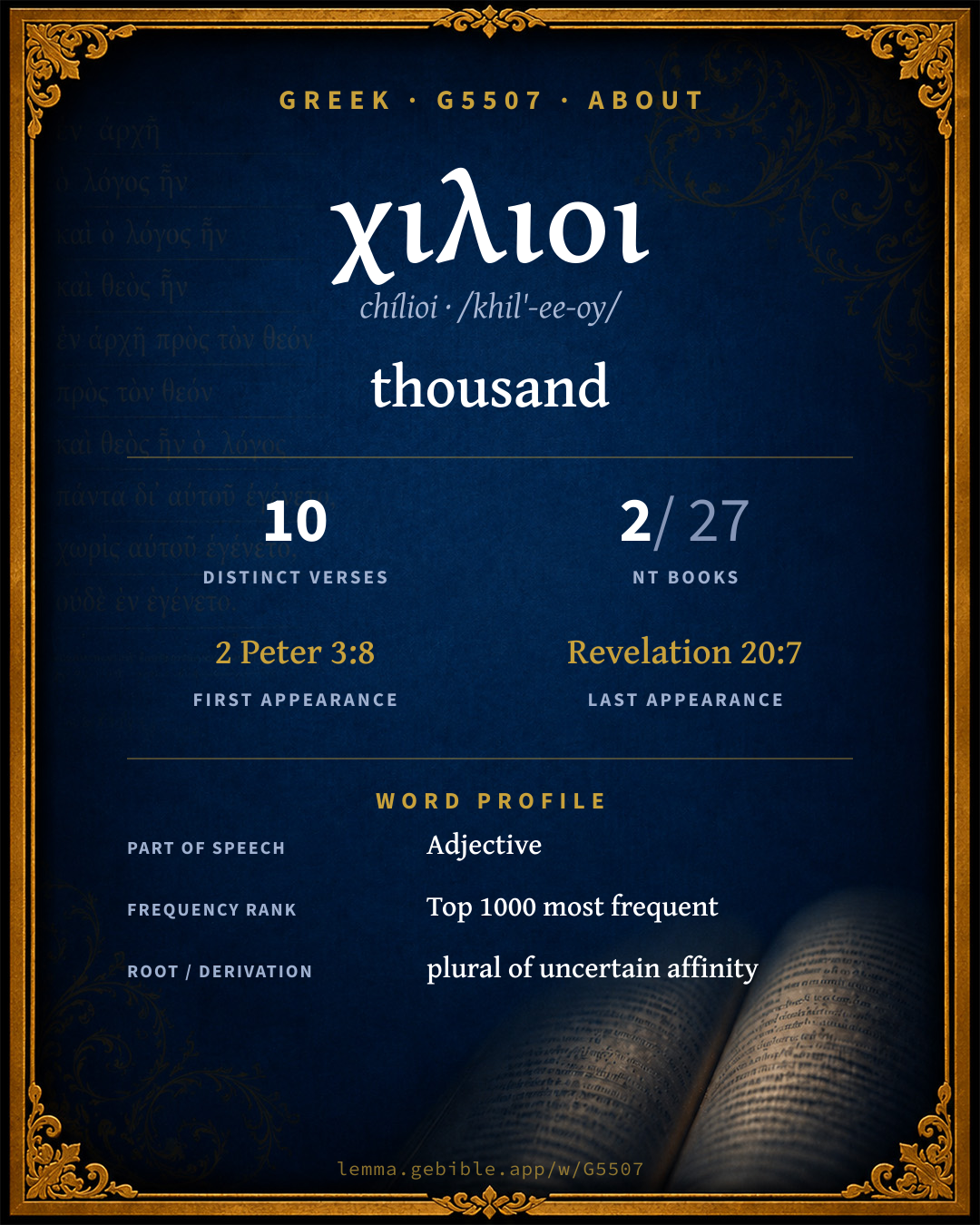
χίλιοι
thousand
Full lexicon entry — Thayer's Greek Lexicon
From Thayer's Greek Lexicon
Where this word appears
See every Accusative-case word in the Greek New Testament →
Grammar key — what these labels mean
Part of speech
- Adjective
- A word that describes or qualifies a noun.
Case
- Nominative
- The case of the subject (and the predicate nominative).
- Accusative
- The case of the direct object and of extent.
- Genitive
- The case of source, possession, or “of” — answers “whose / from what.”
Gender
- Neuter
- Grammatically neuter.
- Feminine
- Grammatically feminine.
- Masculine
- Grammatically masculine.
Number
- Plural
- More than one.
Grammatical forms
- Adjective, Nominative, Plural, Neuter 5 times (45%)
- Adjective, Accusative, Plural, Neuter 3 times (27%)
- Adjective, Accusative, Plural, Feminine 2 times (18%)
- Adjective, Genitive, Plural, Masculine 1 time (9%)
Parsed forms decoded from the imported morphology (Robinson–Tischendorf, public domain), counted across 11 parsed occurrences — not distinct verses.
Every verse where G5507 appears — 10 distinct verses across 2 books. Click any verse to open its interlinear word-by-word view. Verse text shown in the World English Bible for context — . Each verse’s Greek form is shown with its reference; the English is not keyword-highlighted, since the data carries no word-level English alignment. Use “Compare translations” on any verse to read it across multiple English versions. This concordance covers the Greek New Testament; Septuagint (Greek Old Testament) occurrences of this word are not indexed here.
2 Peter 1 verse
Revelation 9 verses
- Revelation 11:3 χιλίας adj acc pl fem I will give power to my two witnesses, and they will prophesy one thousand two hundred sixty days, clothed in sackcloth."
- Revelation 12:6 χιλίας adj acc pl fem The woman fled into the wilderness, where she has a place prepared by God, that there they may nourish her one thousand two hundred sixty days.
- Revelation 14:20 χιλίων adj gen pl masc The winepress was trodden outside of the city, and blood came out from the winepress, even to the bridles of the horses, as far as one thousand six hundred stadia.
- Revelation 20:2 χίλια adj acc pl neut He seized the dragon, the old serpent, which is the devil and Satan, who deceives the whole inhabited earth, and bound him for a thousand years,
- Revelation 20:3 χίλια adj nom pl neut and cast him into the abyss, and shut it, and sealed it over him, that he should deceive the nations no more, until the thousand years were finished. After this, he must be freed for a short time.
- Revelation 20:4 χίλια adj acc pl neut I saw thrones, and they sat on them, and judgment was given to them. I saw the souls of those who had been beheaded for the testimony of Jesus, and for the word of God, and such as didn't worship the beast nor his image, and didn't receive the mark on their forehead and on their hand. They lived, and reigned with Christ for the thousand years.
- Revelation 20:5 χίλια adj nom pl neut The rest of the dead didn't live until the thousand years were finished. This is the first resurrection.
- Revelation 20:6 χίλια adj acc pl neut Blessed and holy is he who has part in the first resurrection. Over these, the second death has no power, but they will be priests of God and of Christ, and will reign with him one thousand years.
- Revelation 20:7 χίλια adj nom pl neut And after the thousand years, Satan will be released from his prison,
About this entry
At a glance — auto-summarized from this page’s data, not written by a person. Every figure links to its source below. This summary describes the numbers; it doesn’t interpret them.
The Greek adjective χιλιοι centers on the idea of “thousand.” The word gravitates to Revelation (90%), then 2 Peter. It turns up in 10 verses across 2 books, an uncommon footprint. Its earliest occurrence is 2 Peter 3:8. It shares a root with χιλιας and χιλιαρχος. For the data behind this summary, explore the sense tree and the renderings breakdown below.
Gloss history
Strong's 1890 vs modern scholarship
About this word
Strong's G5507 catalogs a Greek word from the Greek New Testament.
These counts are not copied from any lexicon or concordance. They are computed here, from the morphology-tagged Greek New Testament. What Lemma adds →
- 10
- distinct verses
- The word appears in 10 distinct verses.
- 2 / 27
- NT books
- The word appears in 2 of 27 New Testament books.
- #978
- by frequency
- Top 1000 most frequent Greek words (rank 978 of 5,347 Greek words by occurrence).
View all 10 occurrences in the concordance →
Most concentrated in
- Revelation 9 verses 90%
- 2 Peter 1 verse 10%
By section of the New Testament
By traditional corpus
Conventional, traditional groupings — biblical authorship is debated, so this is a traditional corpus grouping, not an authorship claim. Some books belong to more than one corpus (Luke is in both the Gospels and the Lukan corpus, and so on), so these shares overlap and need not total 100%. Each figure is a share of the word’s 10 distinct verses.
- Johannine 9 verses · 90%
- Revelation 9 verses · 90%
- General (Catholic) Epistles 1 verse · 10%
How translations render this word
Counts come from each version’s own published word-to-Strong’s tagging or interlinear alignment — an approximate guide to how each version renders this word, not a word-level alignment the data otherwise carries. Because each total is that version’s own tagged count, the per-version totals vary from one another and need not match the appearance or distinct-verse counts above. These counts may also differ from a printed concordance because Lemma counts each distinctly tagged rendering and does not collapse phrase taggings into a single head-word total. This is a fixed set of word-tagged versions (KJV, ASV, BSB, ULT) and does not change with the reading translation you choose elsewhere. Each version’s license is shown beside its name below (and on Sources).
- King James Version: Thousand 11×
- American Standard Version: Thousand 11×
- Berean Standard Bible: Thousand 8×, For 2×
- unfoldingWord Literal Text: Thousand 6×
King James Version Public Domain
Renders G5507 across 11 tagged occurrences — most commonly:
American Standard Version Public Domain
Renders G5507 across 11 tagged occurrences — most commonly:
Berean Standard Bible Public Domain
Renders G5507 across 10 tagged occurrences — most commonly:
Not rendered by a distinct English word in 1 further occurrence.
unfoldingWord Literal Text CC BY-SA 4.0
Renders G5507 across 6 tagged occurrences — most commonly:
Not rendered by a distinct English word in 5 further occurrences.
Senses in Thayer's
The 1 sense Thayer's distinguishes for this word, in lexicon order (not ranked by frequency or importance). The full entry — with sub-senses — is in the Lexicon Entry tab.
- a thousand
Word origin
Origin: plural of uncertain affinity
Plural of uncertain affinity; a thousand : - thousand.
— Strong’s Exhaustive Concordance (1890), public domain.
Forms in the corpus
The 3 distinct written forms G5507 takes in the Greek New Testament, most frequent first — each parse links to that case’s occurrences in the concordance.
| Form | Parsing | Example | Uses |
|---|---|---|---|
| χίλια chília | Adjective, Nominative, Plural, Neuter | 2 Peter 3:8 | 8 |
| χιλίας chilías | Adjective, Accusative, Plural, Feminine | Revelation 11:3 | 2 |
| χιλίων chilíōn | Adjective, Genitive, Plural, Masculine | Revelation 14:20 | 1 |
Same root — word family
Other Thayer's entries built from the same root as G5507, grouped by Strong’s listed origin. These share a root / origin per the lexicon — not necessarily a shared meaning. Each links to that word’s own entry.
Derived from this word
Compare all same-root words → They share a root, not necessarily a meaning.
Septuagint usage
The same Greek word χιλιοι appears 90 times in the Greek Old Testament (Septuagint), across 81 verses in 21 books.
- 90
- LXX occurrences
- Tagged occurrences of this Greek word in the Septuagint.
- 81
- verses
- Distinct Septuagint verses containing this word.
- 21 / 39
- OT books
- The word appears in 21 of the 39 Old Testament books.
Sample Septuagint occurrences
- Genesis 20:14 χίλιοι
- Exodus 39:2 χίλιοι
- Numbers 3:50 χίλιοι
- Deuteronomy 7:9 χίλιοι
- Joshua 23:10 χίλιοι
- Judges 8:26 χίλιοι
- 1 Samuel 13:2 χίλιοι
- 2 Samuel 8:4 χίλιοι
- 1 Kings 3:4 χίλιοι
- 2 Kings 15:19 χίλιοι
- 1 Chronicles 9:13 χίλιοι
- 2 Chronicles 1:6 χίλιοι
Septuagint occurrences (same lexeme)
Every verse where the same Strong’s number (G5507) appears in the Greek Septuagint — showing the first 50 of 81. Verse text shown in the World English Bible for context; the Greek form is the matched word — the English is not keyword-highlighted.
- Genesis 20:14 χίλιοι Abimelech took sheep and oxen, men-servants and women-servants, and gave them to Abraham, and restored Sarah, his wife to him.
- Genesis 20:16 χίλιοι To Sarah he said, "Behold, I have given your brother a thousand pieces of silver. Behold, it is for you a covering of the eyes to all that are with you. In front of all you are vindicated."
- Exodus 39:2 χίλιοι He made the ephod of gold, blue, purple, scarlet, and fine twined linen.
- Exodus 39:5 χίλιοι The skillfully woven band that was on it, with which to fasten it on, was of the same piece, like its work; of gold, of blue, purple, scarlet, and fine twined linen; as Yahweh commanded Moses.
- Exodus 39:6 χίλιοι They worked the onyx stones, enclosed in settings of gold, engraved with the engravings of a signet, according to the names of the children of Israel.
- Numbers 3:50 χίλιοι from the firstborn of the children of Israel he took the money, one thousand three hundred sixty-five shekels, after the shekel of the sanctuary:
- Numbers 26:51 χίλιοι These are those who were numbered of the children of Israel, six hundred one thousand seven hundred thirty.
- Numbers 31:4 χίλιοι Of every tribe one thousand, throughout all the tribes of Israel, shall you send to the war.
- Numbers 31:5 χίλιοι So there were delivered, out of the thousands of Israel, a thousand of every tribe, twelve thousand armed for war.
- Numbers 31:6 χίλιοι Moses sent them, one thousand of every tribe, to the war, them and Phinehas the son of Eleazar the priest, to the war, with the vessels of the sanctuary and the trumpets for the alarm in his hand.
- Deuteronomy 7:9 χίλιοι Know therefore that Yahweh your God, he is God, the faithful God, who keeps covenant and loving kindness with them who love him and keep his commandments to a thousand generations,
- Deuteronomy 32:30 χίλιοι How should one chase a thousand, Two put ten thousand to flight, Except their Rock had sold them, Yahweh had delivered them up?
- Joshua 23:10 χίλιοι One man of you shall chase a thousand; for Yahweh your God, he it is who fights for you, as he spoke to you.
- Judges 8:26 χίλιοι The weight of the golden ear-rings that he requested was one thousand and seven hundred [shekels] of gold, besides the crescents, and the pendants, and the purple clothing that was on the kings of Midian, and besides the chains that were about their camels' necks.
- Judges 9:49 χίλιοι All the people likewise cut down every man his bough, and followed Abimelech, and put them to the stronghold, and set the stronghold on fire on them; so that all the men of the tower of Shechem died also, about a thousand men and women.
- Judges 15:15 χίλιοι He found a fresh jawbone of a donkey, and put forth his hand, and took it, and struck a thousand men therewith.
- Judges 15:16 χίλιοι Samson said, With the jawbone of a donkey, heaps on heaps, With the jawbone of a donkey I have struck a thousand men.
- Judges 16:5 χίλιοι The lords of the Philistines came up to her, and said to her, Entice him, and see in which his great strength lies, and by what means we may prevail against him, that we may bind him to afflict him: and we will each give you of us eleven hundred [pieces] of silver.
- Judges 17:2 χίλιοι He said to his mother, The eleven hundred [pieces] of silver that were taken from you, about which you did utter a curse, and did also speak it in my ears, behold, the silver is with me; I took it. His mother said, Blessed be my son of Yahweh.
- Judges 17:3 χίλιοι He restored the eleven hundred [pieces] of silver to his mother; and his mother said, I most assuredly dedicate the silver to Yahweh from my hand for my son, to make an engraved image and a molten image: now therefore I will restore it to you.
- Judges 20:10 χίλιοι and we will take ten men of one hundred throughout all the tribes of Israel, and one hundred of one thousand, and a thousand out of ten thousand, to get food for the people, that they may do, when they come to Gibeah of Benjamin, according to all the folly that they have worked in Israel.
- 1 Samuel 13:2 χίλιοι Saul chose him three thousand men of Israel, of which two thousand were with Saul in Michmash and in the Mount of Bethel, and one thousand were with Jonathan in Gibeah of Benjamin: and the rest of the people he sent every man to his tent.
- 1 Samuel 25:2 χίλιοι There was a man in Maon, whose possessions were in Carmel; and the man was very great, and he had three thousand sheep, and a thousand goats: and he was shearing his sheep in Carmel.
- 2 Samuel 8:4 χίλιοι David took from him one thousand seven hundred horsemen, and twenty thousand footmen: and David hamstrung all the chariot horses, but reserved of them for one hundred chariots.
- 2 Samuel 10:6 χίλιοι When the children of Ammon saw that they were become odious to David, the children of Ammon sent and hired the Syrians of Beth Rehob, and the Syrians of Zobah, twenty thousand footmen, and the king of Maacah with one thousand men, and the men of Tob twelve thousand men.
- 2 Samuel 18:12 χίλιοι The man said to Joab, Though I should receive a thousand [pieces of] silver in my hand, I still wouldn't put forth my hand against the king's son; for in our hearing the king charged you and Abishai and Ittai, saying, Beware that none touch the young man Absalom.
- 2 Samuel 19:18 χίλιοι There went over a ferry-boat to bring over the king's household, and to do what he thought good. Shimei the son of Gera fell down before the king, when he was come over the Jordan.
- 1 Kings 3:4 χίλιοι The king went to Gibeon to sacrifice there; for that was the great high place: a thousand burnt offerings did Solomon offer on that altar.
- 2 Kings 15:19 χίλιοι There came against the land Pul the king of Assyria; and Menahem gave Pul one thousand talents of silver, that his hand might be with him to confirm the kingdom in his hand.
- 2 Kings 24:16 χίλιοι All the men of might, even seven thousand, and the craftsmen and the smiths one thousand, all of them strong and apt for war, even them the king of Babylon brought captive to Babylon.
- 1 Chronicles 9:13 χίλιοι and their brothers, heads of their fathers' houses, one thousand seven hundred sixty; very able men for the work of the service of the house of God.
- 1 Chronicles 12:15 χίλιοι These are those who went over the Jordan in the first month, when it had overflowed all its banks; and they put to flight all them of the valleys, both toward the east, and toward the west.
- 1 Chronicles 12:35 χίλιοι Of the Danites who could set the battle in array, twenty-eight thousand six hundred.
- 1 Chronicles 16:15 χίλιοι Remember his covenant forever, The word which he commanded to a thousand generations,
- 1 Chronicles 18:4 χίλιοι David took from him one thousand chariots, and seven thousand horsemen, and twenty thousand footmen; and David hamstrung all the chariot horses, but reserved of them for one hundred chariots.
- 1 Chronicles 19:6 χίλιοι When the children of Ammon saw that they had made themselves odious to David, Hanun and the children of Ammon sent one thousand talents of silver to hire them chariots and horsemen out of Mesopotamia, and out of Arammaacah, and out of Zobah.
- 1 Chronicles 21:5 χίλιοι Joab gave up the sum of the numbering of the people to David. All those of Israel were one million one hundred thousand men who drew sword: and in Judah were four hundred seventy thousand men who drew sword.
- 1 Chronicles 22:14 χίλιοι Now, behold, in my affliction I have prepared for the house of Yahweh one hundred thousand talents of gold, and one thousand thousand talents of silver, and of brass and iron without weight; for it is in abundance: timber also and stone have I prepared; and you may add to them.
- 1 Chronicles 26:30 χίλιοι Of the Hebronites, Hashabiah and his brothers, men of valor, one thousand seven hundred, had the oversight of Israel beyond the Jordan westward, for all the business of Yahweh, and for the service of the king.
- 1 Chronicles 29:21 χίλιοι They sacrificed sacrifices to Yahweh, and offered burnt offerings to Yahweh, on the next day after that day, even one thousand bulls, one thousand rams, and one thousand lambs, with their drink-offerings, and sacrifices in abundance for all Israel,
- 2 Chronicles 1:6 χίλιοι Solomon went up there to the brazen altar before Yahweh, which was at the tent of meeting, and offered one thousand burnt offerings on it.
- 2 Chronicles 1:14 χίλιοι Solomon gathered chariots and horsemen: and he had one thousand four hundred chariots, and twelve thousand horsemen, that he placed in the chariot cities, and with the king at Jerusalem.
- 2 Chronicles 12:3 χίλιοι with twelve hundred chariots, and sixty thousand horsemen. The people were without number who came with him out of Egypt: the Lubim, the Sukkiim, and the Ethiopians.
- 2 Chronicles 14:8 χίλιοι Asa had an army that bore bucklers and spears, out of Judah three hundred thousand; and out of Benjamin, that bore shields and drew bows, two hundred eighty thousand: all these were mighty men of valor.
- 2 Chronicles 30:24 χίλιοι For Hezekiah king of Judah did give to the assembly for offerings one thousand bulls and seven thousand sheep; and the princes gave to the assembly a thousand bulls and ten thousand sheep: and a great number of priests sanctified themselves.
- Ezra 1:9 χίλιοι This is the number of them: thirty platters of gold, one thousand platters of silver, twenty-nine knives,
- Ezra 1:10 χίλιοι thirty bowls of gold, silver bowls of a second sort four hundred and ten, and other vessels one thousand.
- Ezra 2:7 χίλιοι The children of Elam, one thousand two hundred fifty-four.
- Ezra 2:31 χίλιοι The children of the other Elam, one thousand two hundred fifty-four.
- Ezra 2:37 χίλιοι The children of Immer, one thousand fifty-two.
These are occurrences of the same Greek lexeme (G5507) in the Septuagint — not a translation of any one Hebrew word. The store carries no word-level Hebrew↔Greek alignment, so no Hebrew original is asserted here. Counts come from the recovered LXX Strong's tagging — high-frequency vocabulary is well covered, while rare or late forms may be untagged — so they reflect tagged occurrences and may slightly undercount.