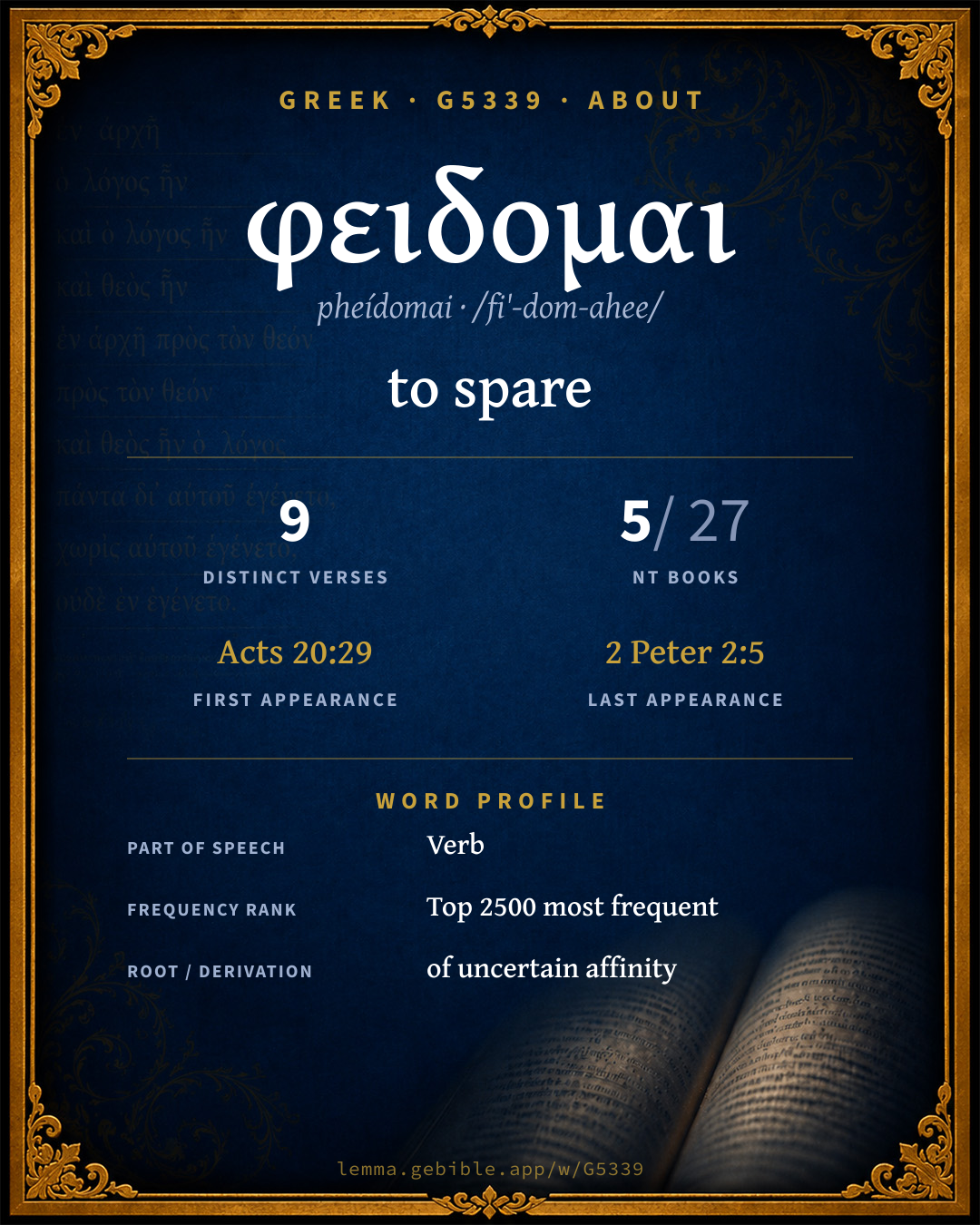
φείδομαι
to spare
‘to spare’ is one of 2 main senses fuller range ↓
Full lexicon entry — Thayer's Greek Lexicon
From Thayer's Greek Lexicon
Where this word appears
See every Aorist-tense verb in the Greek New Testament →
Grammar key — what these labels mean
Part of speech
- Verb
- An action or state-of-being word.
Tense
- Aorist
- Action viewed as a simple whole, without regard to duration — often past (perfective aspect).
- Present
- Ongoing or general action in present time (imperfective aspect).
- Future
- Action expected in future time.
Voice
- Middle deponent
- Middle in form but active in meaning.
- Middle or Passive deponent
- Middle/passive in form but active in meaning.
Mood
- Indicative
- States a fact or asks a factual question (the mood of reality).
- Participle
- A verbal adjective (“writing,” “having written”).
Case
- Nominative
- The case of the subject (and the predicate nominative).
Person
- 3rd person
- The one spoken about (“he / she / it / they”).
- 1st person
- The speaker (“I / we”).
Gender
- Masculine
- Grammatically masculine.
Number
- Singular
- One.
- Plural
- More than one.
Grammatical forms
- Verb, Aorist, Middle deponent, Indicative, 3rd person, Singular 4 times (40%)
- Verb, Present, Middle or Passive deponent, Indicative, 1st person, Singular 2 times (20%)
- Verb, Future, Middle deponent, Indicative, 1st person, Singular 1 time (10%)
- Verb, Future, Middle deponent, Indicative, 3rd person, Singular 1 time (10%)
- Verb, Present, Middle or Passive deponent, Participle, Nominative, Plural, Masculine 1 time (10%)
- Verb, Present, Middle or Passive deponent, Participle, Nominative, Singular, Masculine 1 time (10%)
Parsed forms decoded from the imported morphology (Robinson–Tischendorf, public domain), counted across 10 parsed occurrences — not distinct verses.
Every verse where G5339 appears — 9 distinct verses across 5 books. Click any verse to open its interlinear word-by-word view. Verse text shown in the World English Bible for context — . Each verse’s Greek form is shown with its reference; the English is not keyword-highlighted, since the data carries no word-level English alignment. Use “Compare translations” on any verse to read it across multiple English versions. This concordance covers the Greek New Testament; Septuagint (Greek Old Testament) occurrences of this word are not indexed here.
Acts 1 verse
Romans 2 verses
- Romans 8:32 ἐφείσατο aor mid.dep ind 3sg He who didn't spare his own Son, but delivered him up for us all, how would he not also with him freely give us all things?
- Romans 11:21 ἐφείσατο φείσεται aor mid.dep ind 3sg fut mid.dep ind 3sg for if God didn't spare the natural branches, neither will he spare you.
1 Corinthians 1 verse
2 Corinthians 3 verses
- 2 Corinthians 1:23 φειδόμενος pres mid/pass.dep ptcp nom sg masc But I call God for a witness to my soul, that I didn't come to Corinth to spare you.
- 2 Corinthians 12:6 φείδομαι pres mid/pass.dep ind 1sg For if I would desire to boast, I will not be foolish; for I will speak the truth. But I forbear, so that no man may account of me above that which he sees in me, or hears from me.
- 2 Corinthians 13:2 φείσομαι fut mid.dep ind 1sg I have said beforehand, and I do say beforehand, as when I was present the second time, so now, being absent, I write to those who have sinned before now, and to all the rest, that, if I come again, I will not spare;
2 Peter 2 verses
- 2 Peter 2:4 ἐφείσατο aor mid.dep ind 3sg For if God didn't spare angels when they sinned, but cast them down to Tartarus, and committed them to pits of darkness, to be reserved to judgment;
- 2 Peter 2:5 ἐφείσατο aor mid.dep ind 3sg and didn't spare the ancient world, but preserved Noah with seven others, a preacher of righteousness, when he brought a flood on the world of the ungodly;
About this entry
At a glance — auto-summarized from this page’s data, not written by a person. Every figure links to its source below. This summary describes the numbers; it doesn’t interpret them.
φειδομαι — transliterated pheídomai — is a Greek verb carrying the sense “to spare.” It first appears in Acts 20:29. The Greek New Testament uses it across 9 verses — uncommon. More than a third of its appearances fall in 2 Corinthians. Its lexical range runs to 2 senses. Each statement above links to its evidence; the full detail follows below.
Gloss history
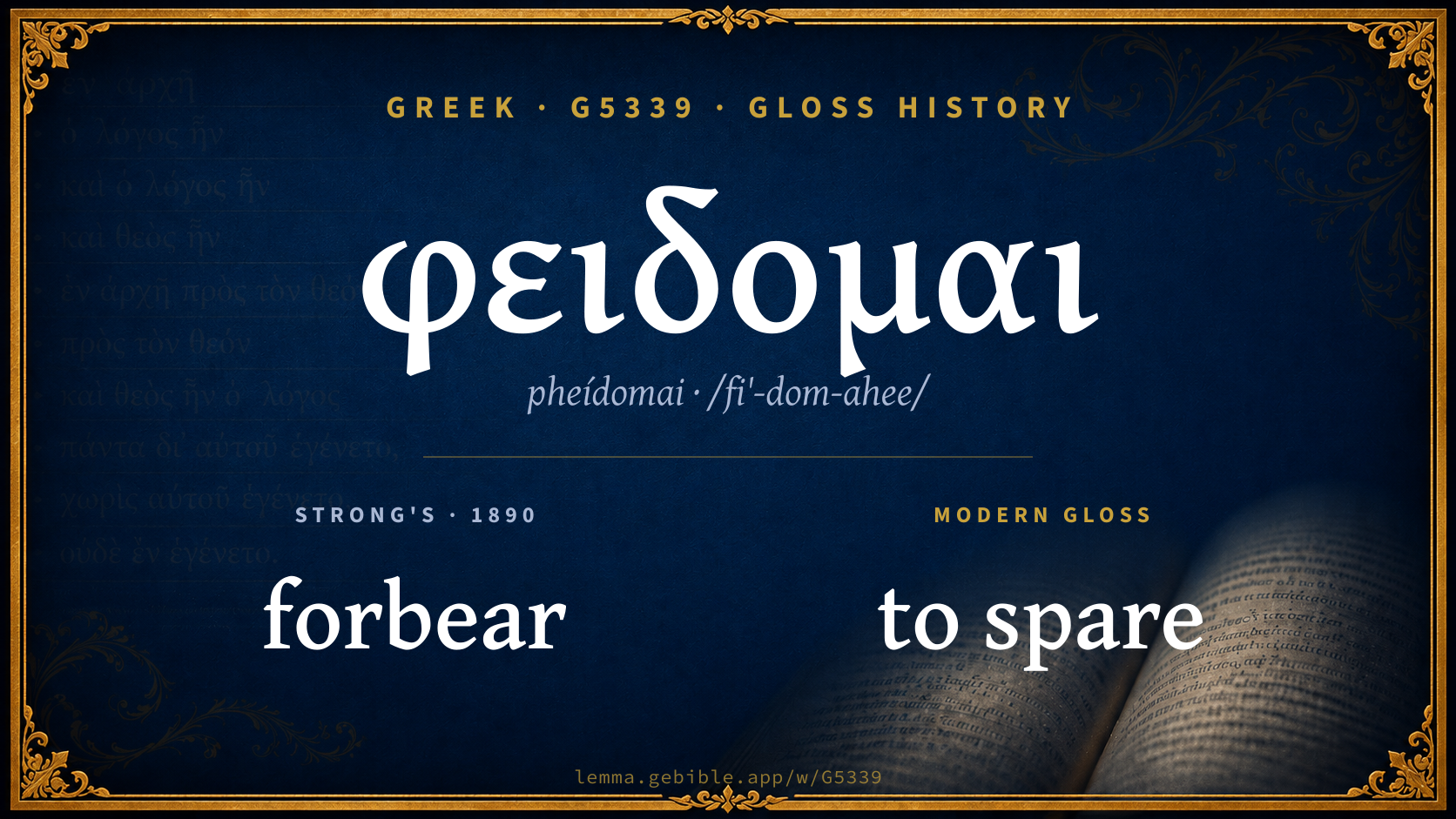
Strong's 1890 vs modern scholarship
About this word
Strong's G5339 catalogs a Greek word from the Greek New Testament.
These counts are not copied from any lexicon or concordance. They are computed here, from the morphology-tagged Greek New Testament. What Lemma adds →
- 9
- distinct verses
- The word appears in 9 distinct verses.
- 5 / 27
- NT books
- The word appears in 5 of 27 New Testament books.
- #1,056
- by frequency
- Top 2500 most frequent Greek words (rank 1,056 of 5,347 Greek words by occurrence).
View all 9 occurrences in the concordance →
Most concentrated in
- 2 Corinthians 3 verses 33%
- Romans 2 verses 22%
- 2 Peter 2 verses 22%
By section of the New Testament
By traditional corpus
Conventional, traditional groupings — biblical authorship is debated, so this is a traditional corpus grouping, not an authorship claim. Some books belong to more than one corpus (Luke is in both the Gospels and the Lukan corpus, and so on), so these shares overlap and need not total 100%. Each figure is a share of the word’s 9 distinct verses.
- Pauline corpus 6 verses · 67%
- General (Catholic) Epistles 2 verses · 22%
- Lukan (Luke–Acts) 1 verse · 11%
How translations render this word
Counts come from each version’s own published word-to-Strong’s tagging or interlinear alignment — an approximate guide to how each version renders this word, not a word-level alignment the data otherwise carries. Because each total is that version’s own tagged count, the per-version totals vary from one another and need not match the appearance or distinct-verse counts above. These counts may also differ from a printed concordance because Lemma counts each distinctly tagged rendering and does not collapse phrase taggings into a single head-word total. This is a fixed set of word-tagged versions (KJV, ASV, BSB, ULT) and does not change with the reading translation you choose elsewhere. Each version’s license is shown beside its name below (and on Sources).
- King James Version: Spare 4×, Spared 4×
- American Standard Version: Spared 4×, Spare 3×
- Berean Standard Bible: Spare 5×
- unfoldingWord Literal Text: Spare 5×, Did 3×, Sparing 2×
King James Version Public Domain
Renders G5339 across 12 tagged occurrences — most commonly:
Plus 4 renderings that appear only once — usually multi-word phrases or single function words the recovered tagging swept in, not distinct renderings.
American Standard Version Public Domain
Renders G5339 across 12 tagged occurrences — most commonly:
Plus 5 renderings that appear only once — usually multi-word phrases or single function words the recovered tagging swept in, not distinct renderings.
Berean Standard Bible Public Domain
Renders G5339 across 10 tagged occurrences — most commonly:
Plus 5 renderings that appear only once — usually multi-word phrases or single function words the recovered tagging swept in, not distinct renderings.
unfoldingWord Literal Text CC BY-SA 4.0
Renders G5339 across 17 tagged occurrences — most commonly:
Plus 7 renderings that appear only once — usually multi-word phrases or single function words the recovered tagging swept in, not distinct renderings.
Senses in Thayer's
The 2 senses Thayer's distinguishes for this word, in lexicon order (not ranked by frequency or importance). The full entry — with sub-senses — is in the Lexicon Entry tab.
- to spare
- to abstain
Word origin
Origin: of uncertain affinity
Of uncertain affinity; to be chary of that is (subjectively) to abstain or (objectively) to treat leniently : - forbear spare.
— Strong’s Exhaustive Concordance (1890), public domain.
Forms in the corpus
The 6 distinct written forms G5339 takes in the Greek New Testament, most frequent first — each parse links to that tense’s occurrences in the concordance.
| Form | Parsing | Example | Uses |
|---|---|---|---|
| ἐφείσατο epheísato | Verb, Aorist, Middle deponent, Indicative, 3rd person, Singular | Romans 8:32 | 4 |
| φείδομαι pheídomai | Verb, Present, Middle or Passive deponent, Indicative, 1st person, Singular | 1 Corinthians 7:28 | 2 |
| φείσεται pheísetai | Verb, Future, Middle deponent, Indicative, 3rd person, Singular | Romans 11:21 | 1 |
| φείσομαι pheísomai | Verb, Future, Middle deponent, Indicative, 1st person, Singular | 2 Corinthians 13:2 | 1 |
| φειδόμενοι pheidómenoi | Verb, Present, Middle or Passive deponent, Participle, Nominative, Plural, Masculine | Acts 20:29 | 1 |
| φειδόμενος pheidómenos | Verb, Present, Middle or Passive deponent, Participle, Nominative, Singular, Masculine | 2 Corinthians 1:23 | 1 |
Same root — word family
Other Thayer's entries built from the same root as G5339, grouped by Strong’s listed origin. These share a root / origin per the lexicon — not necessarily a shared meaning. Each links to that word’s own entry.
Derived from this word
Compare all same-root words → They share a root, not necessarily a meaning.
Septuagint usage
The same Greek word φειδομαι appears 76 times in the Greek Old Testament (Septuagint), across 76 verses in 20 books.
- 76
- LXX occurrences
- Tagged occurrences of this Greek word in the Septuagint.
- 76
- verses
- Distinct Septuagint verses containing this word.
- 20 / 39
- OT books
- The word appears in 20 of the 39 Old Testament books.
Sample Septuagint occurrences
- Genesis 19:16 φείδομαι
- Exodus 2:6 φείδομαι
- Deuteronomy 7:16 φείδομαι
- 1 Samuel 15:3 φείδομαι
- 2 Samuel 12:4 φείδομαι
- 2 Kings 5:20 φείδομαι
- 2 Chronicles 36:15 φείδομαι
- Ezra 23:22 φείδομαι
- Job 6:10 φείδομαι
- Psalms 18:14 φείδομαι
- Proverbs 6:34 φείδομαι
- Ecclesiastes 2:25 φείδομαι
Septuagint occurrences (same lexeme)
Every verse where the same Strong’s number (G5339) appears in the Greek Septuagint — showing the first 50 of 76. Verse text shown in the World English Bible for context; the Greek form is the matched word — the English is not keyword-highlighted.
- Genesis 19:16 φείδομαι But he lingered; and the men laid hold on his hand, and on the hand of his wife, and on the hand of his two daughters, Yahweh being merciful to him; and they took him out, and set him outside of the city.
- Genesis 20:6 φείδομαι God said to him in the dream, "Yes, I know that in the integrity of your heart you have done this, and I also withheld you from sinning against me. Therefore I didn't allow you to touch her.
- Genesis 22:12 φείδομαι He said, "Don't lay your hand on the boy, neither do anything to him. For now I know that you fear God, seeing you have not withheld your son, your only son, from me."
- Genesis 22:16 φείδομαι and said, "I have sworn by myself, says Yahweh, because you have done this thing, and have not withheld your son, your only son,
- Genesis 45:20 φείδομαι Also, don't concern yourselves about your belongings, for the good of all of the land of Egypt is yours."
- Exodus 2:6 φείδομαι She opened it, and saw the child, and, behold, the baby cried. She had compassion on him, and said, "This is one of the Hebrews' children."
- Deuteronomy 7:16 φείδομαι You shall consume all the peoples who Yahweh your God shall deliver to you; your eye shall not pity them: neither shall you serve their gods; for that will be a snare to you.
- Deuteronomy 13:9 φείδομαι but you shall surely kill him; your hand shall be first on him to put him to death, and afterwards the hand of all the people.
- Deuteronomy 19:13 φείδομαι Your eye shall not pity him, but you shall put away the innocent blood from Israel, that it may go well with you.
- Deuteronomy 19:21 φείδομαι Your eyes shall not pity; life [shall go] for life, eye for eye, tooth for tooth, hand for hand, foot for foot.
- Deuteronomy 25:12 φείδομαι then you shall cut off her hand, your eye shall have no pity.
- Deuteronomy 33:3 φείδομαι Yes, he loves the people; All his saints are in your hand: They sat down at your feet; [Everyone] shall receive of your words.
- 1 Samuel 15:3 φείδομαι Now go and strike Amalek, and utterly destroy all that they have, and don't spare them; but kill both man and woman, infant and suckling, ox and sheep, camel and donkey.
- 1 Samuel 24:11 φείδομαι Moreover, my father, behold, yes, see the skirt of your robe in my hand; for in that I cut off the skirt of your robe, and didn't kill you, know you and see that there is neither evil nor disobedience in my hand, and I have not sinned against you, though you hunt after my life to take it.
- 2 Samuel 12:4 φείδομαι A traveler came to the rich man, and he spared to take of his own flock and of his own herd, to dress for the wayfaring man who had come to him, but took the poor man's lamb, and dressed it for the man who had come to him."
- 2 Samuel 12:6 φείδομαι He shall restore the lamb fourfold, because he did this thing, and because he had no pity!"
- 2 Samuel 18:5 φείδομαι The king commanded Joab and Abishai and Ittai, saying, Deal gently for my sake with the young man, even with Absalom. All the people heard when the king gave all the captains charge concerning Absalom.
- 2 Samuel 18:16 φείδομαι Joab blew the trumpet, and the people returned from pursuing after Israel; for Joab held back the people.
- 2 Samuel 21:7 φείδομαι But the king spared Mephibosheth, the son of Jonathan the son of Saul, because of Yahweh's oath that was between them, between David and Jonathan the son of Saul.
- 2 Kings 5:20 φείδομαι But Gehazi the servant of Elisha the man of God, said, Behold, my master has spared this Naaman the Syrian, in not receiving at his hands that which he brought: as Yahweh lives, I will run after him, and take somewhat of him.
- 2 Chronicles 36:15 φείδομαι Yahweh, the God of their fathers, sent to them by his messengers, rising up early and sending, because he had compassion on his people, and on his dwelling-place:
- 2 Chronicles 36:17 φείδομαι Therefore he brought on them the king of the Chaldeans, who killed their young men with the sword in the house of their sanctuary, and had no compassion on young man or virgin, old man or gray-headed: he gave them all into his hand.
- Ezra 23:22 φείδομαι
- Job 6:10 φείδομαι Be it still my consolation, Yes, let me exult in pain that doesn't spare, That I have not denied the words of the Holy One.
- Job 7:11 φείδομαι "Therefore I will not keep silent. I will speak in the anguish of my spirit. I will complain in the bitterness of my soul.
- Job 16:5 φείδομαι But I would strengthen you with my mouth. The solace of my lips would relieve you.
- Job 16:13 φείδομαι His archers surround me. He splits my kidneys apart, and does not spare. He pours out my gall on the ground.
- Job 20:13 φείδομαι Though he spare it, and will not let it go, But keep it still within his mouth;
- Job 27:22 φείδομαι For it hurls at him, and does not spare, As he flees away from his hand.
- Job 30:10 φείδομαι They abhor me, they stand aloof from me, And don't hesitate to spit in my face.
- Job 33:18 φείδομαι He keeps back his soul from the pit, And his life from perishing by the sword.
- Job 42:3 φείδομαι You asked, 'Who is this who hides counsel without knowledge?' Therefore I have uttered that which I did not understand, Things too wonderful for me, which I didn't know.
- Psalms 18:14 φείδομαι He sent out his arrows, and scattered them; Yes, great lightning bolts, and routed them.
- Psalms 71:13 φείδομαι Let my accusers be disappointed and consumed. Let them be covered with disgrace and scorn who want to harm me.
- Psalms 77:50 φείδομαι
- Proverbs 6:34 φείδομαι For jealousy arouses the fury of the husband. He won't spare in the day of vengeance.
- Proverbs 10:19 φείδομαι In the multitude of words there is no lack of disobedience, But he who restrains his lips does wisely.
- Proverbs 13:24 φείδομαι One who spares the rod hates his son, But one who loves him is careful to discipline him.
- Proverbs 16:13 φείδομαι Righteous lips are the delight of kings. They value one who speaks the truth.
- Proverbs 17:27 φείδομαι He who spares his words has knowledge. He who is even tempered is a man of understanding.
- Proverbs 21:14 φείδομαι A gift in secret pacifies anger; And a bribe in the cloak, strong wrath.
- Proverbs 24:11 φείδομαι Rescue those who are being led away to death! Indeed, hold back those who are staggering to the slaughter!
- Ecclesiastes 2:25 φείδομαι For who can eat, or who can have enjoyment, more than I?
- Isaiah 13:18 φείδομαι [Their] bows shall dash the young men in pieces; and they shall have no pity on the fruit of the womb; their eye shall not spare children.
- Isaiah 14:6 φείδομαι who struck the peoples in wrath with a continual stroke, who ruled the nations in anger, with a persecution that none restrained.
- Isaiah 54:2 φείδομαι Enlarge the place of your tent, and let them stretch forth the curtains of your habitations; don't spare: lengthen your cords, and strengthen your stakes.
- Isaiah 58:1 φείδομαι Cry aloud, don't spare, lift up your voice like a trumpet, and declare to my people their disobedience, and to the house of Jacob their sins.
- Isaiah 63:9 φείδομαι In all their affliction he was afflicted, and the angel of his presence saved them: in his love and in his pity he redeemed them; and he bore them, and carried them all the days of old.
- Jeremiah 13:14 φείδομαι I will dash them one against another, even the fathers and the sons together, says Yahweh: I will not pity, nor spare, nor have compassion, that I should not destroy them.
- Jeremiah 14:10 φείδομαι Thus says Yahweh to this people, Even so have they loved to wander; they have not refrained their feet: therefore Yahweh does not accept them; now will he remember their iniquity, and visit their sins.
These are occurrences of the same Greek lexeme (G5339) in the Septuagint — not a translation of any one Hebrew word. The store carries no word-level Hebrew↔Greek alignment, so no Hebrew original is asserted here. Counts come from the recovered LXX Strong's tagging — high-frequency vocabulary is well covered, while rare or late forms may be untagged — so they reflect tagged occurrences and may slightly undercount.