Deuteronomy 19:21

Hebrew (Westminster Leningrad Codex) Deuteronomy 19:21 appears in the Hebrew Old Testament. The text above is from the Westminster Leningrad Codex. Each word links to its Strong’s number, a concise gloss, and parsing drawn from the Open Scriptures Hebrew Bible morphology. Click any word for its full Brown-Driver-Briggs (BDB) entry.
Download image
Cite this verse

Deuteronomy 19:21 (World English Bible). Public Domain. Lemma interlinear Bible study tool, https://lemma.gebible.app/v/deuteronomy/19/21.

Show BibTeX & RIS
BibTeX
RIS
English Translation
Your eyes shall not pity; life [shall go] for life, eye for eye, tooth for tooth, hand for hand, foot for foot.
World English Bible · Public Domain
Download a study sheet

One document with this verse’s original text, its word-by-word gloss line, the meaning frame, cross-references with their text, attributed commentary, and full source and license credits — printable, and it pastes into notes with its structure intact.

This verse Autodidact and up

Study sheet (.html) Plain text (.txt)

A passage Seminary Student

Up to 50 verses in one chapter. A passage sheet keeps up to 6 commentary sources and 12 cross-references per verse, in the order this page ranks them, and says so on the sheet whenever that leaves anything out. Ask for a single verse and you get the Autodidact verse sheet above.

Everything on this page stays free to read, with no account — the sheet is a download of what is already on screen, not access to it.

Want to remove ads? Support Godless Engineer
Compare translations 3

The same verse in 3 English versions, stacked beneath the original-language interlinear above. Click any original word for its lexicon entry.

Each is an independent rendering of the whole verse — the interlinear is not word-aligned to these translations.

Highlighted words mark where these versions differ — a whole-verse word diff, not a word-by-word alignment.

  • World English Bible Public Domain
    Your eyes shall not pity; life [shall go] for life, eye for eye, tooth for tooth, hand for hand, foot for foot.
  • King James Version Public Domain
    And thine eye shall not pity; but life shall go for life, eye for eye, tooth for tooth, hand for hand, foot for foot.
  • unfoldingWord Literal Text CC BY-SA 4.0
    And your eyes shall not have pity; a life for a life, an eye for an eye, a tooth for a tooth, a hand for a hand, a foot for a foot.

unfoldingWord Literal Text — © unfoldingWord, licensed CC BY-SA 4.0. Word-aligned USFM3 via Door43 (git.door43.org/unfoldingWord/en_ult).

Versions to compare (up to 4)

3 of 4 selected

Show all 18 translations

Every available English version of this verse, each an independent rendering of the whole verse.

  • World English Bible Public Domain
    Your eyes shall not pity; life [shall go] for life, eye for eye, tooth for tooth, hand for hand, foot for foot.
  • Berean Standard Bible Public Domain
    You must show no pity: life for life, eye for eye, tooth for tooth, hand for hand, and foot for foot.
  • Majority Standard Bible Public Domain
    You must show no pity: life for life, eye for eye, tooth for tooth, hand for hand, and foot for foot.
  • King James Version Public Domain
    And thine eye shall not pity; but life shall go for life, eye for eye, tooth for tooth, hand for hand, foot for foot.
  • American Standard Version (1901) Public Domain
    And thine eyes shall not pity; life `shall go' for life, eye for eye, tooth for tooth, hand for hand, foot for foot.
  • Revised Version (1885) Public Domain
    And thine eye shall not pity; life shall go for life, eye for eye, tooth for tooth, hand for hand, foot for foot.
  • Geneva Bible (1599) Public Domain
    Therefore thine eye shall have no compassion, but life for life, eye for eye, tooth for tooth, hand for hand, foote for foote.
  • Douay-Rheims (1899) Public Domain
    ,21Thou shalt not pity him, but shalt require life for life, eye for eye, tooth for tooth, hand for hand, foot for foot.
  • Young's Literal Translation Public Domain
    and thine eye doth not pity -- life for life, eye for eye, tooth for tooth, hand for hand, foot for foot.
  • Literal Standard Version CC BY-SA 4.0
    And your eye does not pity—life for life, eye for eye, tooth for tooth, hand for hand, foot for foot.”
  • Unlocked Literal Bible CC BY-SA 4.0
    Your eyes must not pity; life will pay for life, eye for eye, tooth for tooth, hand for hand, foot for foot.
  • unfoldingWord Literal Text CC BY-SA 4.0
    And your eyes shall not have pity; a life for a life, an eye for an eye, a tooth for a tooth, a hand for a hand, a foot for a foot.
  • Darby Bible Public Domain
    And thine eye shall not spare: life for life, eye for eye, tooth for tooth, hand for hand, foot for foot.
  • World Messianic Bible Public Domain
    Your eyes shall not pity: life for life, eye for eye, tooth for tooth, hand for hand, foot for foot.
  • Webster's Bible Public Domain
    And thy eye shall not pity; but life shall go for life, eye for eye, tooth for tooth, hand for hand, foot for foot.
  • Free Bible Version CC BY-SA 4.0
    Don't show any mercy. The rule is life for life, eye for eye, tooth for tooth, hand for hand, and foot for foot.
  • Bible in Basic English Public Domain
    Have no pity; let life be given for life, eye for eye, tooth for tooth, hand for hand, foot for foot.
  • JPS Tanakh (1917) Public Domain
    And thine eye shall not pity: life for life, eye for eye, tooth for tooth, hand for hand, foot for foot.

Literal Standard Version (2020), Covenant Press — licensed CC BY-SA 4.0. Text via the HelloAO Bible API (eBible.org). Unlocked Literal Bible (unfoldingWord) — licensed CC BY-SA 4.0. Text via the HelloAO Bible API (eBible.org). unfoldingWord Literal Text — © unfoldingWord, licensed CC BY-SA 4.0. Word-aligned USFM3 via Door43 (git.door43.org/unfoldingWord/en_ult). Free Bible Version, Dr. Jonathan Gallagher — licensed CC BY-SA 4.0. Text via the HelloAO Bible API (eBible.org).

Word by word

More ways to search: Search by grammar → Find every occurrence → Compare this word →

Practice this passage: Drill this verse → Learn its vocabulary →

תָח֖וֹס
chûwç
H2347
“to pity”
Verb, Qal, Imperfect, 3rd Person, Feminine, Singular
Part of Speech
Verb
Stem
Qal
Form
Imperfect
Person
3rd Person
Gender
Feminine
Number
Singular
Full BDB Definition

Origin: a primitive root

TWOT: 626

(Qal) to pity, have compassion, spare, look upon with compassion
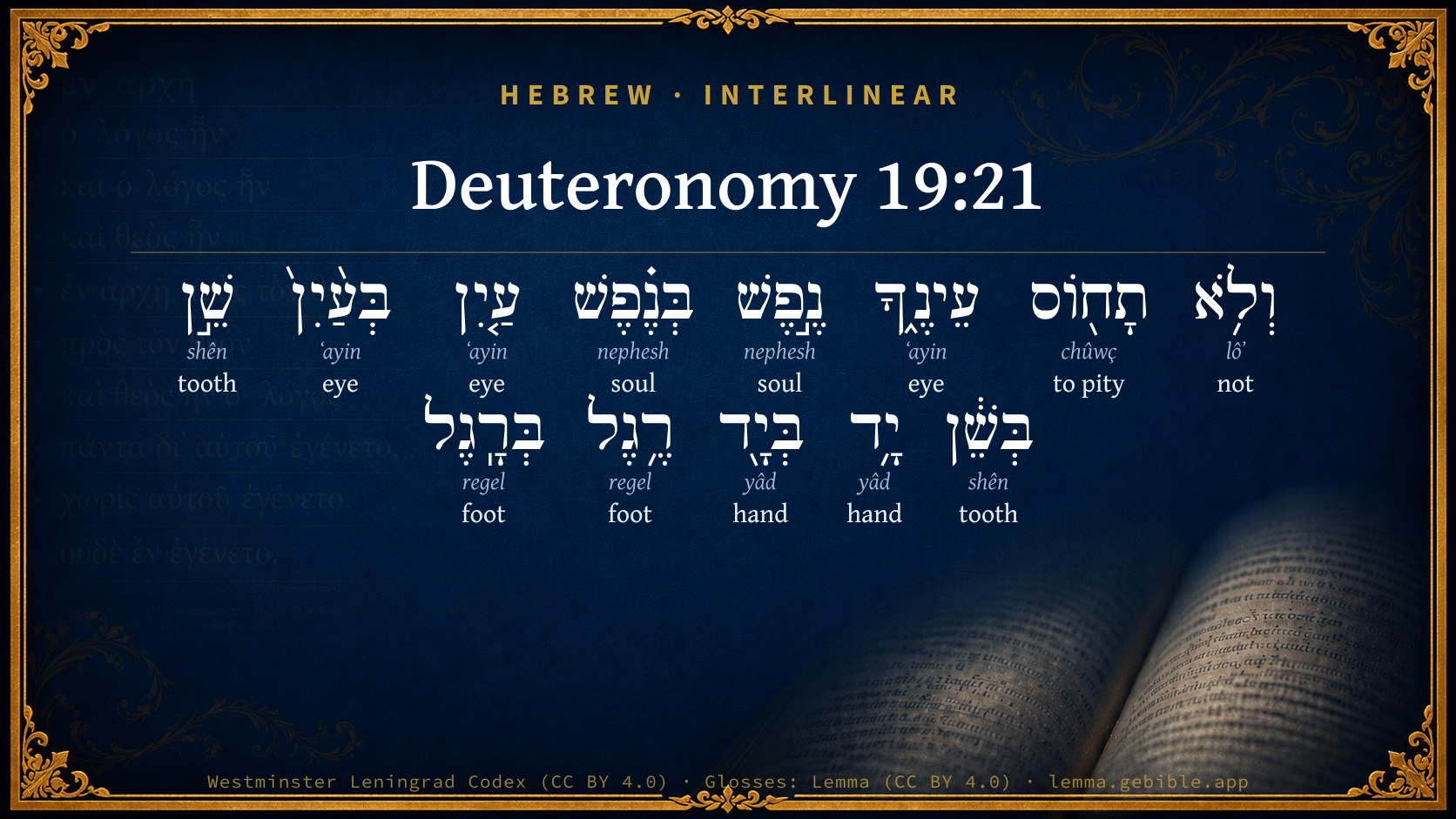
  1. וְלֹ֥א lôʼ H3808 “and · not” Conjunction + Particle, Negative
  2. עֵינֶ֑ךָ ʻayin H5869 “eye · your” Noun, Common, Both, Singular, Construct + Suffix, Personal, 2nd Person, Masculine, Singular
  3. נֶ֣פֶשׁ nephesh H5315 “soul” Noun, Common, Both, Singular, Absolute
  4. בְּנֶ֗פֶשׁ nephesh H5315 “in/at · soul” Preposition + Noun, Common, Both, Singular, Absolute
  5. עַ֤יִן ʻayin H5869 “eye” Noun, Common, Both, Singular, Absolute
  6. בְּעַ֨יִן֙ ʻayin H5869 “in/at · eye” Preposition + Noun, Common, Both, Singular, Absolute
  7. שֵׁ֣ן shên H8127 “tooth” Noun, Common, Both, Singular, Absolute
  8. בְּשֵׁ֔ן shên H8127 “in/at · tooth” Preposition + Noun, Common, Both, Singular, Absolute
  9. יָ֥ד yâd H3027 “hand” Noun, Common, Both, Singular, Absolute
  10. בְּיָ֖ד yâd H3027 “in/at · hand” Preposition + Noun, Common, Both, Singular, Absolute
  11. רֶ֥גֶל regel H7272 “foot” Noun, Common, Feminine, Singular, Absolute
  12. בְּרָֽגֶל regel H7272 “in/at · foot” Preposition + Noun, Common, Feminine, Singular, Absolute

About this verse

These counts appear in no published source. They are computed here, from the morphology-tagged text and Lemma’s own curated glosses. What Lemma adds →

13
words
7
distinct lemmas
Pentateuch
section

Notable vocabulary

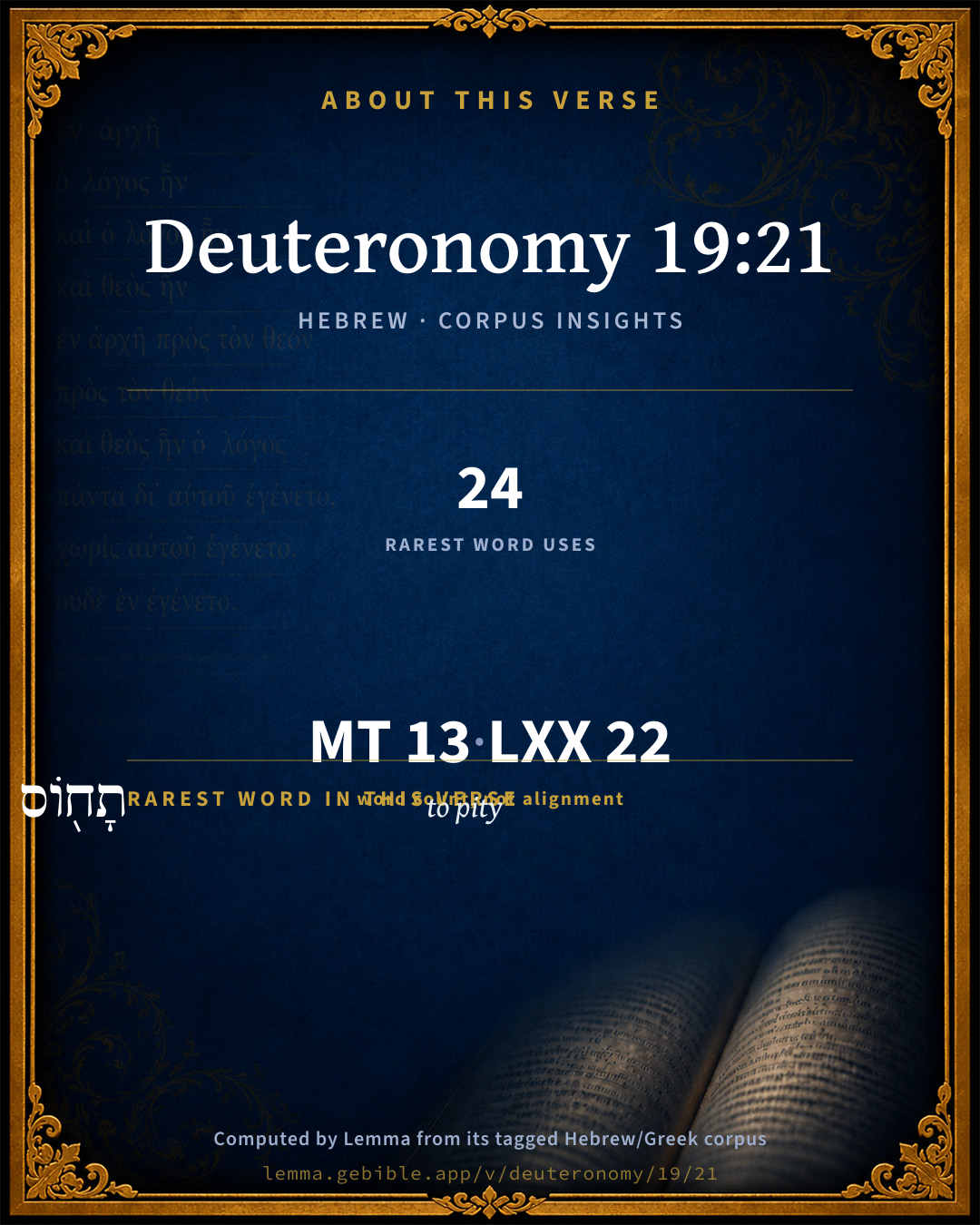
The rarest word here is תָח֖וֹס to pity H2347 — appearing just 24 times in the whole Hebrew Bible.

Shared distinctive vocabulary

תָח֖וֹס to pity H2347 occurs in 24 verses of the Hebrew Bible. Also found in:

Grammatical profile

  • 1 verb
  • 11 nouns
  • 1 particle

Verb forms

  • תָח֖וֹס Qal · Imperfect

Repetition

Words recur within this verse — often emphatic in Hebrew:

  • עֵינֶ֑ךָ eye H5869 ×3
  • נֶ֣פֶשׁ soul H5315 ×2
  • שֵׁ֣ן tooth H8127 ×2
  • יָ֥ד hand H3027 ×2
  • רֶ֥גֶל foot H7272 ×2

Hebrew & Septuagint length

In English translation the verse runs 22 words from the Hebrew and 24 from the Septuagint (LXX English) — closely comparable.

A rough comparison of the two English renderings, which tokenize alike — not a word-level alignment.

Word counts can differ between the Hebrew and the Greek without any difference in meaning — e.g. the Hebrew direct-object marker אֵת has no separate Greek word, and Greek often adds the article ὁ.

In the original languages it is 13 Hebrew tokens and 22 Greek tokens — but the two are counted differently (Hebrew bundles its prefixes and suffixes into one token; the Greek is in lemma form), so that isn’t a like-for-like length.

Cross-references

4

Topical passages linked to Deuteronomy 19:21 in the Treasury of Scripture Knowledge — connected by theme and wording, ordered by reader-vote popularity; previews shown in the World English Bible.

  • Matthew 5:38–39 "You have heard that it was said, 'An eye for an eye, and a tooth for a tooth.'
  • Exodus 21:23–25 But if any harm follows, then you must take life for life,
  • Deuteronomy 19:13 Your eye shall not pity him, but you shall put away the innocent blood from Israel, that it may go well with you.
  • Leviticus 24:17–21 "'He who strikes any man mortally shall surely be put to death.

Cross-references courtesy of OpenBible.info (CC BY 4.0).

Hebrew and Greek witnesses Masoretic Hebrew ↔ Greek Septuagint

The same verse in the two great witnesses to the Old Testament, shown verse-for-verse.

These are two independent witnesses, not word-aligned to each other, and the Septuagint is shown in lemma (dictionary) form.

Hebrew Deuteronomy 19:21 Masoretic · Westminster Leningrad Codex

וְלֹ֥א תָח֖וֹס עֵינֶ֑ךָ נֶ֣פֶשׁ בְּנֶ֗פֶשׁ עַ֤יִן בְּעַ֨יִן֙ שֵׁ֣ן בְּשֵׁ֔ן יָ֥ד בְּיָ֖ד רֶ֥גֶל בְּרָֽגֶל

Your eyes shall not pity; life [shall go] for life, eye for eye, tooth for tooth, hand for hand, foot for foot.

World English Bible · Public Domain

Greek LXX Deuteronomy 19:21 Septuagint · lemma form

οὐ φείδομαι ὁ ὀφθαλμός σύ ἐπί αὐτός ψυχή ἀντί ψυχή ὀφθαλμός ἀντί ὀφθαλμός ὀδούς ἀντί ὀδούς χείρ ἀντί χείρ πούς ἀντί πούς

Your eye shall not spare him: you shall exact life for life, eye for eye, tooth for tooth, hand for hand, foot for foot.

LXX2012 (modern English Septuagint) · Public Domain

Hebrew: Westminster Leningrad Codex (CC BY 4.0). Greek: Septuagint (public domain); English from LXX2012 (modern English Septuagint) (Public Domain). How the Septuagint differs from the Hebrew →

Targum (Aramaic paraphrase)

2

The Targum is the ancient Jewish Aramaic paraphrase of the Hebrew Scriptures — an interpretive translation, not the Hebrew text itself. Onkelos (literal) and Pseudo-Jonathan (expansive) render the Torah, and Jonathan the Prophets. Coverage is partial: where no permissively-licensed English translation exists for a verse, only the Aramaic is shown. This is verse-level text, not a word-by-word alignment to the Hebrew.

  1. Targum Onkelos Torah (Genesis–Deuteronomy)
    וְלָא תְחוּס עֵינָךְ נַפְשָׁא חֳלַף נַפְשָׁא עֵינָא חֳלַף עֵינָא שִׁנָא חֳלַף שִׁנָא יְדָא חֳלַף יְדָא רַגְלָא חֳלַף רַגְלָא

    (no public-domain English translation for this verse)

    Targum Onkelos — Aramaic: “Onkelos Genesis” (public domain); “Onkelos Exodus” (public domain); “Onkelos Leviticus” (public domain); “Onkelos Numbers” (public domain); “Onkelos Deuteronomy” (public domain). English: “Sefaria Community Translation” (CC0 1.0 (public-domain dedication)); “J.W. Etheridge. The Targums of Onkelos and Jonathan Ben Uzziel on the Pentateuch. London: Longmans, Green, 1862” (public domain). Text via Sefaria.

  2. Targum Pseudo-Jonathan Torah (Genesis–Deuteronomy)
    וְלָא תֵיחוֹס עֵינֵיכוֹן נַפְשָׁא חֲלוּפֵי נַפְשָׁא דְמֵי עֵינָא חוּלַף עֵינָא דְמֵי שִׁינָא חוּלַף שִׁינָא דְמֵי יְדָא חוּלַף יְדָא דְמֵי רִיגְלָא חוּלַף רִיגְלָא

    Your eye shall not spare; life for life, the value of an eye for an eye, the value of a tooth for a tooth, the value of a hand for a hand, the value of a foot for a foot.

    Targum Pseudo-Jonathan — Aramaic: “Targum Jonathan on Genesis” (public domain); “Targum Jonathan on Exodus” (public domain); “Targum Jonathan on Leviticus” (public domain); “Targum Jonathan on Numbers” (public domain); “Targum Jonathan on Deuteronomy” (public domain). English: “The Targum of Jonathan ben Uzziel, trans. J. W. Etheridge, London, 1862” (public domain). Text via Sefaria.

Commentary

Notes on Deuteronomy 19:21 from classic Christian and Jewish commentators (each source and its license shown beneath its notes). The classic Christian expositions comment on the surrounding passage and are grouped to its opening verse, so a note may address several verses; the Jewish commentaries on the Tanakh (Rashi and others) are per-verse, so they appear only where the commentator wrote on this verse.

Lemma curates 59 commentaries, every one of them public domain or Creative Commons licensed, each selected and text-cleaned for this edition rather than reprinted as found. About our sources →

Trapp's Complete Commentary

John Trapp

Deu 19:21 And thine eye shall not pity; [but] life [shall go] for life, eye for eye, tooth for tooth, hand for hand, foot for foot.

Ver. 21. Eye for eye, tooth for tooth.] {See Trapp on "Mat 5:38"}

John Trapp, A Commentary or Exposition upon All the Books of the Old and New Testament (1647–1656) — public domain. Text from a community e-Sword module.

Joseph Benson's Commentary

Deu 19:21. An eye for an eye — What punishment the law allotted to the accused, if he had been convicted, the same was the false accuser to bear.

Joseph Benson's Commentary on the Old and New Testaments (1811–1818) — public domain. Text from a community e-Sword module.

Tyndale Open Study Notes

Tyndale Open Resources

19:21 The legal principle described as life for life is known as lex talionis (“law of retaliation”), according to which the punishment must fit the crime (see Exod 21:23; Lev 24:20); it should be neither too lenient nor too severe. Appropriate punishment is a necessary function of government (cp. Rom 13:1-7), and it served to maintain Israel’s spiritual integrity as God’s people (see study note on Deut 17:7). But vengeance belongs to God, not individuals (see 1 Sam 25:26, 33; Matt 5:38-39; 1 Cor 6:1-8).

Tyndale Open Study Notes — © Tyndale Open Resources, licensed CC BY-SA 4.0. Text via the HelloAO Bible API.

Adam Clarke's Commentary

Verse 21. Life - for life, eye for eye, c.] The operation of such a law as this must have been very salutary: if a man prized his own members, he would naturally avoid injuring those of others. It is a pity that this law were not still in force: it would certainly prevent many of those savage acts which now both disgrace and injure society. I speak this in reference to law generally, and the provision that should be made to prevent and punish ferocious and malevolent offences. A Christian may always act on the plan of forgiving injuries and where the public peace and safety may not be affected, he should do so; but if law did not make a provision for the safety of the community by enactment against the profligate, civil society would soon be destroyed.

Adam Clarke's Commentary on the Bible (1810–1826) — public domain. Text from a community e-Sword/MySword module.

The Cambridge Bible for Schools and Colleges

gen. ed. J. J. S. Perowne

21. thine eye shall not pity] See on Deu_19:13, Deu_7:16.

life for life, etc.] The jus talionis, more fully in E, Exo_21:24 f.; cp. H, Lev_24:18; Lev_24:20. Very frequently in the Code of Ḫammurabi. See further Driver’s note on Exo_21:25.

The Cambridge Bible for Schools and Colleges (gen. ed. J. J. S. Perowne; Cambridge University Press, 1878–1918) — public domain. Text from a community e-Sword module.

Haydock's Catholic Bible Commentary

Pity. This regarded the judge, who must act with impartiality. (Worthington) --- The law admits of no mitigation, but inflicts the same punishment on the calumniating witness, as he intended should fall upon his brother. (Lyranus; &c.) --- Some Rabbins (apud Fag.) pretend that this was executed with rigour, only when the innocent had sustained some real injury. See Exodus xxi. 24. (Calmet)

George Leo Haydock (1774–1849), Haydock's Catholic Family Bible and Commentary, 1859 edition — public domain. Excludes Psalms (Douay-Rheims chapter numbering differs from Protestant) and Deuterocanonical books (Catholic canon only).

Matthew Poole's English Annotations

What punishment he intended or the law allotted to the accused, if he had been convicted, the same shall the false accuser bear. Of this law see on Exo 21:23; Lev 24:20

Matthew Poole's English Annotations on the Holy Bible (1683–1685) — public domain. Text from a community e-Sword/MySword module.

Whedon's Commentary on the Bible

Daniel D. Whedon

21. Thine eye shall not pity — It has been said that this is a harsh and cruel requirement. But it must be borne in mind that the usages which prevailed and the condition of society demanded stringent laws. The wise legislator adapts law to the circumstances of the people. Moses found the law of retaliation deeply seated. It has its foundations in the conception of impartial justice. With all his influence over the people he could not eradicate long-established usages. At the present day in the East there is a most cruel feature of the lex talionis. When the murderer cannot be reached the avengers have the right to kill any member of his family. See THOMSON’S Land and Book, vol. i, p. 448. If we turn to the words of Him who spake as never man spake, we see how the Gospel modifies the stern exactions of this law of retaliation. “Ye have heard that it hath been said, An eye for an eye, and a tooth for a tooth: but I say unto you, That ye resist not evil.” Mat_5:38-39.

Daniel D. Whedon (gen. ed.), Commentary on the Old and New Testaments (1874–1909) — public domain. Text from a community e-Sword module.

The Pulpit Commentary

The lex talionis was in this case to be observed. (cf. Lev_24:20) Practically, however, a pecuniary compensation might be accepted for the offence (cf. Josephus, "Antiq.," 4:8, 35).

The Pulpit Commentary (1880–1919), ed. H.D.M. Spence-Jones & Joseph S. Exell — public domain. Text from a community e-Sword module.

John Wesley's Explanatory Notes

Eye for eye - What punishment the law allotted to the accused, if he had been convicted, the same shall the false accuser bear.

John Wesley, Explanatory Notes Upon the Whole Bible (1754–1765) — public domain. Text via the GEBible commentary corpus.

Keil & Delitzsch

C. F. Keil & F. Delitzsch

The lex talionis was to be applied without reserve (see at Exo 21:23; Lev 24:20). According to Diod. Sic. (i. 77), the same law existed in Egypt with reference to false accusers.

Keil & Delitzsch — Biblical Commentary on the Old Testament (1861–1891) — public domain (CC PDM 1.0). Text via the HelloAO Bible API. (Old Testament only.)

Rashi

Rabbi Shlomo Yitzchaki (Rashi)

עין בעין EYE FOR EYE — i.e. monetary compensation; similarly also “tooth for tooth” etc. (Sifrei Devarim 190:16; Bava Kamma 84a; cf. also Rashi on Exodus 21:24).

Rashi on the Tanakh — English translations: “The Judaica Press complete Tanach with Rashi, translated by A. J. Rosenberg” (CC BY 4.0); “Pentateuch with Rashi's commentary by M. Rosenbaum and A.M. Silbermann, 1929-1934” (public domain); “The Metsudah Tanach series, Lakewood, N.J” (CC BY 4.0); and “The Book of Joshua, Metsudah Publications, 1997” (CC BY 4.0). Text via Sefaria.

Lesson kit

Teaching starters — assembled from the data on this page, not authored interpretation. Every prompt links to the verse data it draws on. Edit before teaching.

Deuteronomy, in the Pentateuch, opens this verse with 13 words (7 distinct Hebrew lemmas). Its most distinctive word is chûwç (“to pity”). A historical commentator’s framing appears above. Read the whole chapter for the surrounding context.

Discussion questions

  1. The word chûwç carries the sense “to pity.” How does it shape the verse?
  2. Genesis 45:20 shares the word «to pity» with this verse. How do the two illuminate each other?
  3. “eye” occurs 3× in this one verse. What is the effect of the repetition?
  4. These translations render this verse differently. What is at stake in choosing one wording over another?
  5. The verb «תָח֖וֹס» is Qal Imperfect. How does its form color the action?
  6. Reading how Trapp's Complete Commentary and Joseph Benson's Commentary read this verse, where do the two commentators agree and where do they part?

Things to notice

Reading settings

Reading text

Shown beneath each verse's original-language words.

Old Testament
Old Testament edition

Read the OT as the Masoretic Hebrew (MT) or the Greek Septuagint (LXX).

English shown for the Greek Septuagint (in the Hebrew ↔ Greek comparison).

Comparing translations? Open the Compare panel on any verse page to stack up to four side by side.