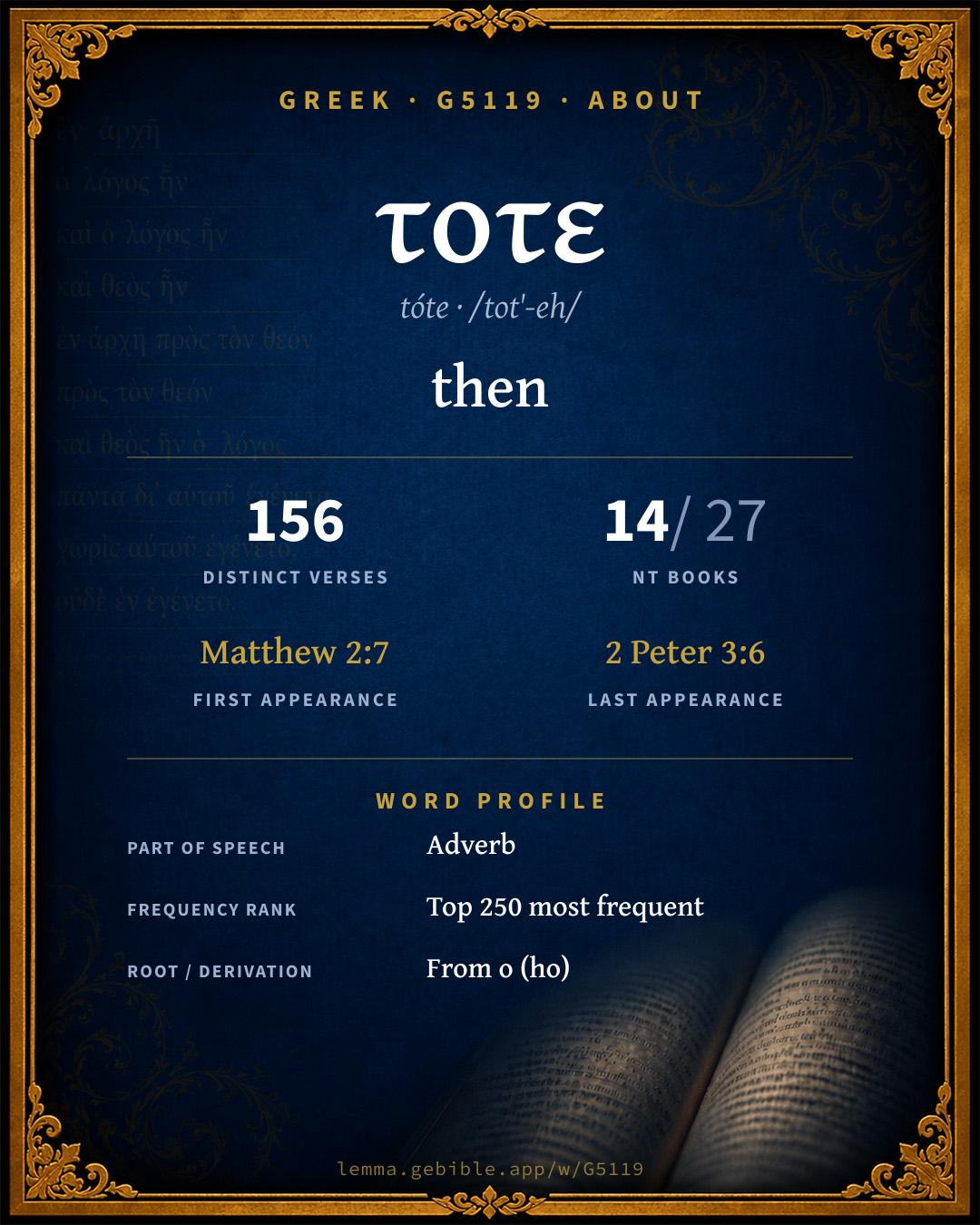
τότε
then
‘then’ is one of 2 main senses fuller range ↓
Full lexicon entry — Thayer's Greek Lexicon
From Thayer's Greek Lexicon
Where this word appears
Grammar key — what these labels mean
Part of speech
- Adverb
- A word that modifies a verb, adjective, or other adverb.
Every verse where G5119 appears in the Book of 1 Thessalonians — 1 distinct verse. Click any verse to open its interlinear word-by-word view. Verse text shown in the World English Bible for context — . Each verse’s Greek form is shown with its reference; the English is not keyword-highlighted, since the data carries no word-level English alignment. Use “Compare translations” on any verse to read it across multiple English versions. This concordance covers the Greek New Testament; Septuagint (Greek Old Testament) occurrences of this word are not indexed here.
1 Thessalonians
About this entry
At a glance — auto-summarized from this page’s data, not written by a person. Every figure links to its source below. This summary describes the numbers; it doesn’t interpret them.
τοτε — transliterated tóte — is a Greek verb carrying the sense “then.” More than half of its appearances fall in Matthew. The Greek New Testament uses it across 156 verses — common. Debuting at Matthew 2:7, it then recurs through the corpus. Thayer's distinguishes 2 senses for it. Each statement above links to its evidence; the full detail follows below.
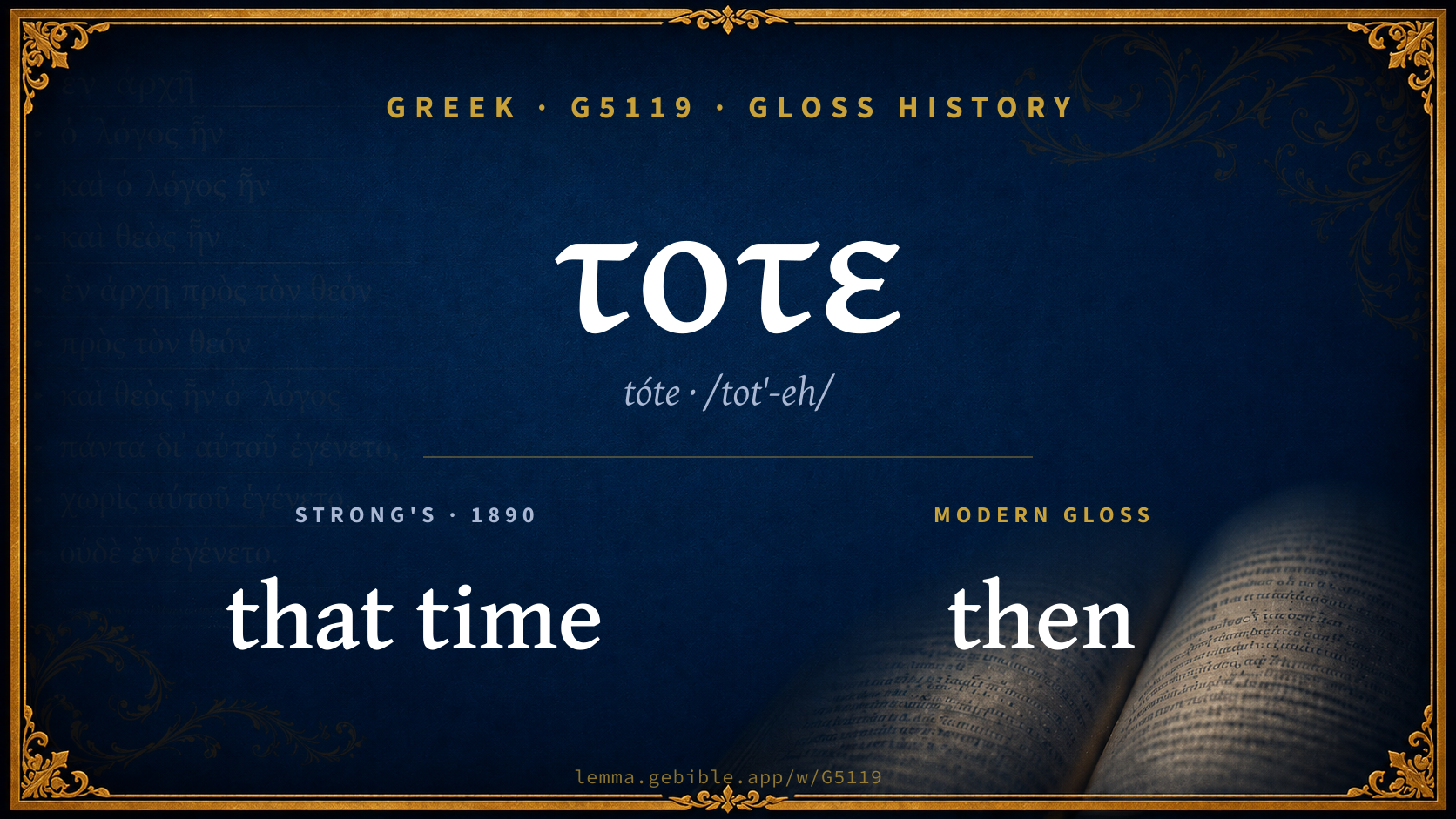
Gloss history
Strong's 1890 vs modern scholarship
About this word
Strong's G5119 catalogs a Greek word from the Greek New Testament.
These counts are not copied from any lexicon or concordance. They are computed here, from the morphology-tagged Greek New Testament. What Lemma adds →
- 156
- distinct verses
- The word appears in 156 distinct verses.
- 14 / 27
- NT books
- The word appears in 14 of 27 New Testament books.
- #101
- by frequency
- Top 250 most frequent Greek words (rank 101 of 5,347 Greek words by occurrence).
View all 156 occurrences in the concordance →
By section of the New Testament
By traditional corpus
Conventional, traditional groupings — biblical authorship is debated, so this is a traditional corpus grouping, not an authorship claim. Some books belong to more than one corpus (Luke is in both the Gospels and the Lukan corpus, and so on), so these shares overlap and need not total 100%. Each figure is a share of the word’s 156 distinct verses.
- Gospels 118 verses · 76%
- Lukan (Luke–Acts) 35 verses · 22%
- Pauline corpus 13 verses · 8%
- Johannine 9 verses · 6%
- Hebrews 3 verses · 2%
- General (Catholic) Epistles 1 verse · 1%
How translations render this word
Counts come from each version’s own published word-to-Strong’s tagging or interlinear alignment — an approximate guide to how each version renders this word, not a word-level alignment the data otherwise carries. Because each total is that version’s own tagged count, the per-version totals vary from one another and need not match the appearance or distinct-verse counts above. These counts may also differ from a printed concordance because Lemma counts each distinctly tagged rendering and does not collapse phrase taggings into a single head-word total. This is a fixed set of word-tagged versions (KJV, ASV, BSB, ULT) and does not change with the reading translation you choose elsewhere. Each version’s license is shown beside its name below (and on Sources).
- King James Version: Then 148×, Time 3×
- American Standard Version: Then 146×, Time 4×
- Berean Standard Bible: Then 92×, Time 21×, And 3×
- unfoldingWord Literal Text: Then 152×, Time 6×
King James Version Public Domain
Renders G5119 across 155 tagged occurrences — most commonly:
Plus 4 renderings that appear only once — usually multi-word phrases or single function words the recovered tagging swept in, not distinct renderings. Not rendered by a distinct English word in 4 further occurrences.
American Standard Version Public Domain
Renders G5119 across 155 tagged occurrences — most commonly:
Plus 5 renderings that appear only once — usually multi-word phrases or single function words the recovered tagging swept in, not distinct renderings.
Berean Standard Bible Public Domain
Renders G5119 across 126 tagged occurrences — most commonly:
Plus 6 renderings that appear only once — usually multi-word phrases or single function words the recovered tagging swept in, not distinct renderings. Not rendered by a distinct English word in 33 further occurrences.
unfoldingWord Literal Text CC BY-SA 4.0
Renders G5119 across 159 tagged occurrences — most commonly:
Plus 1 rendering that appears only once — usually multi-word phrases or single function words the recovered tagging swept in, not distinct renderings.
Senses in Thayer's
The 2 senses Thayer's distinguishes for this word, in lexicon order (not ranked by frequency or importance). The full entry — with sub-senses — is in the Lexicon Entry tab.
- then
- at that time
Word origin
Derived from ο (ho) (G3588).
Forms in the corpus
The 2 distinct written forms G5119 takes in the Greek New Testament, most frequent first — each parse links to that case’s occurrences in the concordance.
| Form | Parsing | Example | Uses |
|---|---|---|---|
| τότε tóte | Adverb | Matthew 2:7 | 128 |
| Τότε Tóte | Adverb | Matthew 2:16 | 29 |
Same root — word family
Other Thayer's entries built from the same root as G5119, grouped by Strong’s listed origin. These share a root / origin per the lexicon — not necessarily a shared meaning. Each links to that word’s own entry.
Derives from
Shares the same root
- τανυν tanŷn G3569 present
- οδε hóde G3592 this
- οιος hoîos G3634 what sort of
- ος hós G3739 who
- ουτος hoûtos G3778 this
- σημερον sḗmeron G4594 this day
- ταυτα tautá G5024 thus
- τηλικουτος tēlikoûtos G5082 of such size
- τοι toí G5104 truly
- τοσουτος tosoûtos G5118 so great
- του toû G5120 his
- τουναντιον tounantíon G5121 on the contrary
- τουνομα toúnoma G5122 by name
Proper names from this root
People and places named from this root — a name, not an additional meaning of the word.
- θεος theós G2316 God
- ο ων και ο ην και ο ερχομενος ho ṑn kaí ho ēn kaí ho erchómenos G3801 He who is
Compare all same-root words → Showing 4 of 17 — not the complete family. 2 of the same-root words are proper names (people or places). They share a root, not necessarily a meaning.
Septuagint usage
The same Greek word τοτε appears 188 times in the Greek Old Testament (Septuagint), across 176 verses in 26 books.
- 188
- LXX occurrences
- Tagged occurrences of this Greek word in the Septuagint.
- 176
- verses
- Distinct Septuagint verses containing this word.
- 26 / 39
- OT books
- The word appears in 26 of the 39 Old Testament books.
Sample Septuagint occurrences
- Genesis 12:6 τότε
- Exodus 12:44 τότε
- Leviticus 22:7 τότε
- Numbers 21:17 τότε
- Deuteronomy 4:41 τότε
- Joshua 1:8 τότε
- Judges 5:8 τότε
- 1 Samuel 6:3 τότε
- 2 Samuel 2:27 τότε
- 1 Kings 2:35 τότε
- 2 Kings 5:3 τότε
- 1 Chronicles 11:16 τότε
Septuagint occurrences (same lexeme)
Every verse where the same Strong’s number (G5119) appears in the Greek Septuagint — showing the first 50 of 176. Verse text shown in the World English Bible for context; the Greek form is the matched word — the English is not keyword-highlighted.
- Genesis 12:6 τότε Abram passed through the land to the place of Shechem, to the oak of Moreh. The Canaanite was then in the land.
- Genesis 13:7 τότε There was a strife between the herdsmen of Abram's cattle and the herdsmen of Lot's cattle: and the Canaanite and the Perizzite lived then in the land.
- Genesis 24:41 τότε Then will you be clear from my oath, when you come to my relatives. If they don't give her to you, you shall be clear from my oath.'
- Genesis 49:4 τότε Boiling over as water, you shall not have the pre-eminence; Because you went up to your father's bed; Then defiled it. He went up to my couch.
- Exodus 12:44 τότε but every man's servant who is bought for money, when you have circumcised him, then shall he eat of it.
- Exodus 12:48 τότε When a stranger shall live as a foreigner with you, and will keep the Passover to Yahweh, let all his males be circumcised, and then let him come near and keep it; and he shall be as one who is born in the land: but no uncircumcised person shall eat of it.
- Exodus 15:1 τότε Then Moses and the children of Israel sang this song to Yahweh, and said, "I will sing to Yahweh, for he has triumphed gloriously: The horse and his rider he has thrown into the sea.
- Exodus 15:15 τότε Then the chiefs of Edom were dismayed. Trembling takes hold of the mighty men of Moab. All the inhabitants of Canaan are melted away.
- Exodus 21:6 τότε then his master shall bring him to God, and shall bring him to the door or to the door-post, and his master shall bore his ear through with an awl, and he shall serve him for ever.
- Exodus 33:23 τότε then I will take away my hand, and you will see my back; but my face shall not be seen."
- Leviticus 22:7 τότε When the sun is down, he shall be clean; and afterward he shall eat of the holy things, because it is his bread.
- Leviticus 26:34 τότε Then the land will enjoy its sabbaths as long as it lies desolate and you are in your enemies' land. Even then the land will rest and enjoy its sabbaths.
- Leviticus 26:41 τότε I also walked contrary to them, and brought them into the land of their enemies: if then their uncircumcised heart is humbled, and they then accept the punishment of their iniquity;
- Leviticus 26:43 τότε The land also will be left by them, and will enjoy its sabbaths while it lies desolate without them: and they will accept the punishment of their iniquity; because, even because they rejected my ordinances, and their soul abhorred my statutes.
- Numbers 21:17 τότε Then sang Israel this song: Spring up, well; sing you to it:
- Deuteronomy 4:41 τότε Then Moses set apart three cities beyond the Jordan toward the sunrise;
- Deuteronomy 28:13 τότε Yahweh will make you the head, and not the tail; and you shall be above only, and you shall not be beneath; if you shall listen to the commandments of Yahweh your God, which I command you this day, to observe and to do [them],
- Deuteronomy 28:29 τότε and you shall grope at noonday, as the blind gropes in darkness, and you shall not prosper in your ways: and you shall be only oppressed and robbed always, and there shall be none to save you.
- Deuteronomy 29:19 τότε and it happen, when he hears the words of this curse, that he bless himself in his heart, saying, I shall have peace, though I walk in the stubbornness of my heart, to destroy the moist with the dry.
- Joshua 1:8 τότε This book of the law shall not depart out of your mouth, but you shall meditate thereon day and night, that you may observe to do according to all that is written therein: for then you shall make your way prosperous, and then you shall have good success.
- Joshua 6:10 τότε Joshua commanded the people, saying, You shall not shout, nor let your voice be heard, neither shall any word proceed out of your mouth, until the day I bid you shout; then shall you shout.
- Joshua 9:2 τότε that they gathered themselves together, to fight with Joshua and with Israel, with one accord.
- Joshua 10:12 τότε Then spoke Joshua to Yahweh in the day when Yahweh delivered up the Amorites before the children of Israel; and he said in the sight of Israel, Sun, stand you still on Gibeon; You, Moon, in the valley of Aijalon.
- Joshua 10:33 τότε Then Horam king of Gezer came up to help Lachish; and Joshua struck him and his people, until he had left him none remaining.
- Joshua 22:1 τότε Then Joshua called the Reubenites, and the Gadites, and the half-tribe of Manasseh,
- Judges 5:8 τότε They chose new gods; Then was war in the gates: Was there a shield or spear seen Among forty thousand in Israel?
- Judges 5:11 τότε Far from the noise of archers, in the places of drawing water, There shall they rehearse the righteous acts of Yahweh, [Even] the righteous acts of his rule in Israel. Then the people of Yahweh went down to the gates.
- Judges 5:13 τότε Then came down a remnant of the nobles [and] the people; Yahweh came down for me against the mighty.
- Judges 5:19 τότε The kings came and fought; Then fought the kings of Canaan. In Taanach by the waters of Megiddo: They took no gain of money.
- Judges 5:22 τότε Then did the horse hoofs stamp By reason of the prancings, the prancings of their strong ones.
- Judges 8:3 τότε God has delivered into your hand the princes of Midian, Oreb and Zeeb: and what was I able to do in comparison with you? Then their anger was abated toward him, when he had said that.
- Judges 13:21 τότε But the angel of Yahweh did no more appear to Manoah or to his wife. Then Manoah knew that he was the angel of Yahweh.
- 1 Samuel 6:3 τότε They said, "If you send away the ark of the God of Israel, don't send it empty; but by all means return him a trespass-offering: then you shall be healed, and it shall be known to you why his hand is not removed from you."
- 1 Samuel 25:34 τότε For in very deed, as Yahweh, the God of Israel, lives, who has withheld me from hurting you, except you had hurried and come to meet me, surely there wouldn't have been left to Nabal by the morning light so much as one man-child.
- 2 Samuel 2:27 τότε Joab said, As God lives, if you had not spoken, surely then in the morning the people had gone away, nor followed everyone his brother.
- 2 Samuel 5:24 τότε It shall be, when you hear the sound of marching in the tops of the mulberry trees, that then you shall bestir yourself; for then is Yahweh gone out before you to strike the host of the Philistines.
- 2 Samuel 15:34 τότε but if you return to the city, and tell Absalom, I will be your servant, O king; as I have been your father's servant in time past, so will I now be your servant; then will you defeat for me the counsel of Ahithophel.
- 2 Samuel 19:7 τότε Now therefore arise, go forth, and speak comfortably to your servants; for I swear by Yahweh, if you don't go forth, there will not stay a man with you this night: and that will be worse to you than all the evil that has happened to you from your youth until now.
- 2 Samuel 21:17 τότε But Abishai the son of Zeruiah helped him, and struck the Philistine, and killed him. Then the men of David swore to him, saying, You shall go no more out with us to battle, that you don't quench the lamp of Israel.
- 2 Samuel 21:18 τότε It came to pass after this, that there was again war with the Philistines at Gob: then Sibbecai the Hushathite killed Saph, who was of the sons of the giant.
- 2 Samuel 23:14 τότε David was then in the stronghold; and the garrison of the Philistines was then in Bethlehem.
- 2 Samuel 23:15 τότε David longed, and said, Oh that one would give me water to drink of the well of Bethlehem, which is by the gate!
- 1 Kings 2:35 τότε The king put Benaiah the son of Jehoiada in his room over the host; and Zadok the priest did the king put in the room of Abiathar.
- 1 Kings 3:16 τότε Then there came two women who were prostitutes, to the king, and stood before him.
- 1 Kings 5:14 τότε He sent them to Lebanon, ten thousand a month by courses; a month they were in Lebanon, and two months at home; and Adoniram was over the men subject to forced labor.
- 1 Kings 8:1 τότε Then Solomon assembled the elders of Israel, and all the heads of the tribes, the princes of the fathers' [houses] of the children of Israel, to king Solomon in Jerusalem, to bring up the ark of the covenant of Yahweh out of the city of David, which is Zion.
- 1 Kings 8:53 τότε For you did separate them from among all the peoples of the earth, to be your inheritance, as you spoke by Moses your servant, when you brought our fathers out of Egypt, Lord Yahweh.
- 1 Kings 9:9 τότε and they shall answer, Because they forsook Yahweh their God, who brought forth their fathers out of the land of Egypt, and laid hold on other gods, and worshiped them, and served them: therefore has Yahweh brought all this evil on them.
- 1 Kings 9:11 τότε (now Hiram the king of Tyre had furnished Solomon with cedar trees and fir trees, and with gold, according to all his desire), that then king Solomon gave Hiram twenty cities in the land of Galilee.
- 1 Kings 11:5 τότε For Solomon went after Ashtoreth the goddess of the Sidonians, and after Milcom the abomination of the Ammonites.
These are occurrences of the same Greek lexeme (G5119) in the Septuagint — not a translation of any one Hebrew word. The store carries no word-level Hebrew↔Greek alignment, so no Hebrew original is asserted here. Counts come from the recovered LXX Strong's tagging — high-frequency vocabulary is well covered, while rare or late forms may be untagged — so they reflect tagged occurrences and may slightly undercount.