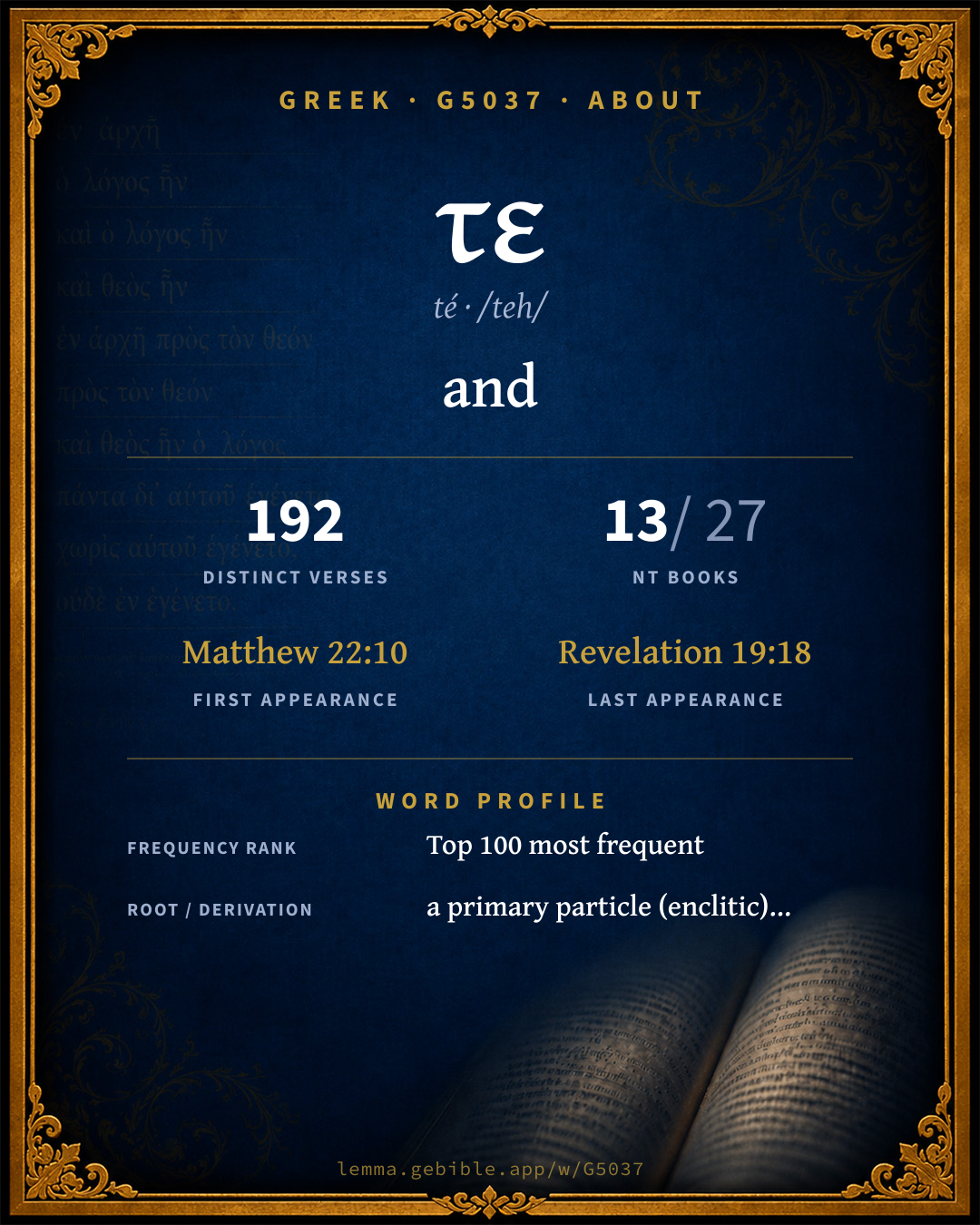
τε
and
‘and’ is one of 3 main senses fuller range ↓
Full lexicon entry — Thayer's Greek Lexicon
From Thayer's Greek Lexicon
Where this word appears
Grammar key — what these labels mean
Part of speech
- Particle
- A short, often untranslatable function word adding nuance or connection.
Every verse where G5037 appears in the Book of 2 Corinthians — 2 distinct verses. Click any verse to open its interlinear word-by-word view. Verse text shown in the World English Bible for context — . Each verse’s Greek form is shown with its reference; the English is not keyword-highlighted, since the data carries no word-level English alignment. Use “Compare translations” on any verse to read it across multiple English versions. This concordance covers the Greek New Testament; Septuagint (Greek Old Testament) occurrences of this word are not indexed here.
2 Corinthians
- 2 Corinthians 10:8 τε ptcl For though I should boast somewhat abundantly concerning our authority, (which the Lord gave for building you up, and not for casting you down) I will not be disappointed,
- 2 Corinthians 12:12 τε ptcl Truly the signs of an apostle were worked among you in all patience, in signs and wonders and mighty works.
About this entry
At a glance — auto-summarized from this page’s data, not written by a person. Every figure links to its source below. This summary describes the numbers; it doesn’t interpret them.
“and” is the headline sense of the Greek word τε (té). It clusters heavily in Acts, which alone accounts for 71% of its uses. With 192 verses in 13 books, it is a common word in the Greek New Testament. Scripture first uses it in Matthew 22:10. Catalogued under 3 senses, its meaning is not single-sense. See the sense tree, 192-verse concordance, and the renderings breakdown below.
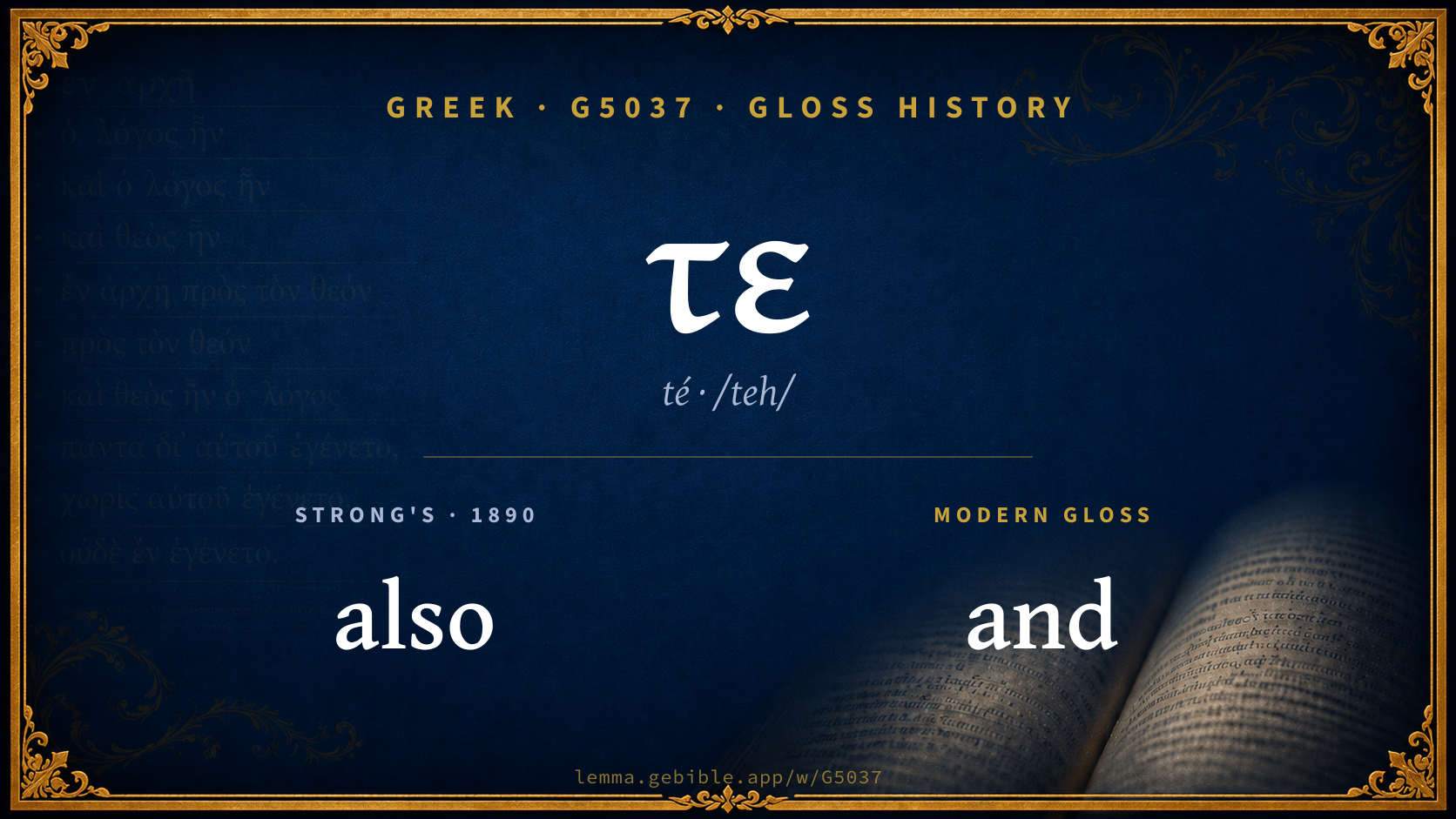
Gloss history
Strong's 1890 vs modern scholarship
About this word
Strong's G5037 catalogs a Greek word from the Greek New Testament.
These counts are not copied from any lexicon or concordance. They are computed here, from the morphology-tagged Greek New Testament. What Lemma adds →
- 192
- distinct verses
- The word appears in 192 distinct verses.
- 13 / 27
- NT books
- The word appears in 13 of 27 New Testament books.
- #77
- by frequency
- Top 100 most frequent Greek words (rank 77 of 5,347 Greek words by occurrence).
View all 192 occurrences in the concordance →
By section of the New Testament
By traditional corpus
Conventional, traditional groupings — biblical authorship is debated, so this is a traditional corpus grouping, not an authorship claim. Some books belong to more than one corpus (Luke is in both the Gospels and the Lukan corpus, and so on), so these shares overlap and need not total 100%. Each figure is a share of the word’s 192 distinct verses.
- Lukan (Luke–Acts) 143 verses · 74%
- Pauline corpus 21 verses · 11%
- Hebrews 19 verses · 10%
- Gospels 13 verses · 7%
- Johannine 4 verses · 2%
- General (Catholic) Epistles 2 verses · 1%
- Revelation 1 verse · 1%
How translations render this word
Counts come from each version’s own published word-to-Strong’s tagging or interlinear alignment — an approximate guide to how each version renders this word, not a word-level alignment the data otherwise carries. Because each total is that version’s own tagged count, the per-version totals vary from one another and need not match the appearance or distinct-verse counts above. These counts may also differ from a printed concordance because Lemma counts each distinctly tagged rendering and does not collapse phrase taggings into a single head-word total. This is a fixed set of word-tagged versions (KJV, ASV, BSB, ULT) and does not change with the reading translation you choose elsewhere. Each version’s license is shown beside its name below (and on Sources).
- King James Version: And 136×, Both 35×, Even 2×
- American Standard Version: And 135×, Both 30×, Also 2×
- Berean Standard Bible: And 50×, Both 15×, Then 6×
- unfoldingWord Literal Text: And 119×, Both 73×, Also 7×
King James Version Public Domain
Renders G5037 across 183 tagged occurrences — most commonly:
Plus 8 renderings that appear only once — usually multi-word phrases or single function words the recovered tagging swept in, not distinct renderings. Not rendered by a distinct English word in 29 further occurrences.
American Standard Version Public Domain
Renders G5037 across 192 tagged occurrences — most commonly:
Plus 21 renderings that appear only once — usually multi-word phrases or single function words the recovered tagging swept in, not distinct renderings. Not rendered by a distinct English word in 4 further occurrences.
Berean Standard Bible Public Domain
Renders G5037 across 94 tagged occurrences — most commonly:
Plus 7 renderings that appear only once — usually multi-word phrases or single function words the recovered tagging swept in, not distinct renderings. Not rendered by a distinct English word in 118 further occurrences.
unfoldingWord Literal Text CC BY-SA 4.0
Renders G5037 across 208 tagged occurrences — most commonly:
Plus 7 renderings that appear only once — usually multi-word phrases or single function words the recovered tagging swept in, not distinct renderings.
Senses in Thayer's
The 3 senses Thayer's distinguishes for this word, in lexicon order (not ranked by frequency or importance). The full entry — with sub-senses — is in the Lexicon Entry tab.
- not only ... but also
- both ... and
- as ... so
Word origin
Origin: a primary particle (enclitic) of connection or addition
A primary particle (enclitic) of connection or addition; both or also (properly as a correlation of G2532): - also and both even then whether. Often used in compounds usually as the latter part.
— Strong’s Exhaustive Concordance (1890), public domain.
Septuagint usage
The same Greek word τε appears 108 times in the Greek Old Testament (Septuagint), across 94 verses in 15 books.
- 108
- LXX occurrences
- Tagged occurrences of this Greek word in the Septuagint.
- 94
- verses
- Distinct Septuagint verses containing this word.
- 15 / 39
- OT books
- The word appears in 15 of the 39 Old Testament books.
Sample Septuagint occurrences
- Genesis 2:25 τε
- Exodus 1:11 τε
- Leviticus 1:10 τε
- Numbers 20:19 τε
- Deuteronomy 4:26 τε
- Joshua 22:13 τε
- 2 Kings 19:12 τε
- 1 Chronicles 28:14 τε
- Ezra 7:26 τε
- Esther 3:12 τε
- Job 2:9 τε
- Psalms 48:3 τε
Septuagint occurrences (same lexeme)
Every verse where the same Strong’s number (G5037) appears in the Greek Septuagint — showing the first 50 of 94. Verse text shown in the World English Bible for context; the Greek form is the matched word — the English is not keyword-highlighted.
- Genesis 2:25 τε They were both naked, the man and his wife, and were not ashamed.
- Genesis 3:8 τε They heard the voice of Yahweh God walking in the garden in the cool of the day, and the man and his wife hid themselves from the presence of Yahweh God among the trees of the garden.
- Genesis 13:17 τε Arise, walk through the land in the length of it and in the breadth of it; for I will give it to you."
- Genesis 20:11 τε Abraham said, "Because I thought, 'Surely the fear of God is not in this place. They will kill me for my wife's sake.'
- Genesis 27:3 τε Now therefore, please take your weapons, your quiver and your bow, and go out to the field, and take me venison.
- Genesis 27:36 τε He said, "Isn't he rightly named Jacob? For he has supplanted me these two times. He took away my birthright. See, now he has taken away my blessing." He said, "Haven't you reserved a blessing for me?"
- Genesis 31:52 τε May this heap be a witness, and the pillar be a witness, that I will not pass over this heap to you, and that you will not pass over this heap and this pillar to me, for harm.
- Genesis 34:26 τε They killed Hamor and Shechem, his son, with the edge of the sword, and took Dinah out of Shechem's house, and went away.
- Genesis 34:28 τε They took their flocks, their herds, their donkeys, that which was in the city, that which was in the field;
- Genesis 34:29 τε and all their wealth. They took captive all their little ones and their wives, and took as plunder everything that was in the house.
- Genesis 34:30 τε Jacob said to Simeon and Levi, "You have troubled me, to make me odious to the inhabitants of the land, among the Canaanites and the Perizzites. I am few in number. They will gather themselves together against me and strike me, and I will be destroyed, I and my house."
- Genesis 37:10 τε He told it to his father and to his brothers. His father rebuked him, and said to him, "What is this dream that you have dreamed? Will I and your mother and your brothers indeed come to bow ourselves down to you to the earth?"
- Genesis 41:10 τε Pharaoh was angry with his servants, and put me in custody in the house of the captain of the guard, me and the chief baker.
- Genesis 41:11 τε We dreamed a dream in one night, I and he. We dreamed each man according to the interpretation of his dream.
- Genesis 41:13 τε It happened, as he interpreted to us, so it was: he restored me to my office, and he hanged him."
- Genesis 48:13 τε Joseph took them both, Ephraim in his right hand toward Israel's left hand, and Manasseh in his left hand toward Israel's right hand, and brought them near to him.
- Exodus 1:11 τε Therefore they set taskmasters over them to afflict them with their burdens. They built storage cities for Pharaoh: Pithom and Raamses.
- Exodus 6:20 τε Amram took Jochebed his father's sister to himself as wife; and she bore him Aaron and Moses: and the years of the life of Amram were a hundred and thirty-seven years.
- Exodus 6:23 τε Aaron took Elisheba, the daughter of Amminadab, the sister of Nahshon, as his wife; and she bore him Nadab and Abihu, Eleazar and Ithamar.
- Exodus 7:19 τε Yahweh said to Moses, "Tell Aaron, 'Take your rod, and stretch out your hand over the waters of Egypt, over their rivers, over their streams, and over their pools, and over all their ponds of water, that they may become blood; and there shall be blood throughout all the land of Egypt, both in vessels of wood and in vessels of stone.'"
- Exodus 8:12 τε Moses and Aaron went out from Pharaoh, and Moses cried to Yahweh concerning the frogs which he had brought on Pharaoh.
- Exodus 8:13 τε Yahweh did according to the word of Moses, and the frogs died out of the houses, out of the courts, and out of the fields.
- Exodus 9:3 τε behold, the hand of Yahweh is on your cattle which are in the field, on the horses, on the donkeys, on the camels, on the herds, and on the flocks with a very grievous pestilence.
- Exodus 9:9 τε It shall become small dust over all the land of Egypt, and shall be a boil breaking forth with boils on man and on animal, throughout all the land of Egypt."
- Exodus 9:22 τε Yahweh said to Moses, "Stretch forth your hand toward the sky, that there may be hail in all the land of Egypt, on man, and on animal, and on every herb of the field, throughout the land of Egypt."
- Exodus 10:8 τε Moses and Aaron were brought again to Pharaoh, and he said to them, "Go, serve Yahweh your God; but who are those who will go?"
- Exodus 12:19 τε Seven days shall there be no yeast found in your houses, for whoever eats that which is leavened, that soul shall be cut off from the congregation of Israel, whether he be a foreigner, or one who is born in the land.
- Exodus 14:26 τε Yahweh said to Moses, "Stretch out your hand over the sea, that the waters may come again on the Egyptians, on their chariots, and on their horsemen."
- Exodus 19:13 τε No hand shall touch him, but he shall surely be stoned or shot through; whether it is animal or man, he shall not live.' When the trumpet sounds long, they shall come up to the mountain."
- Exodus 22:3 τε If the sun has risen on him, there shall be guilt of bloodshed for him; he shall make restitution. If he has nothing, then he shall be sold for his theft.
- Exodus 22:8 τε If the thief isn't found, then the master of the house shall come near to God, to find out if he hasn't put his hand to his neighbor's goods.
- Exodus 28:1 τε "Bring Aaron your brother, and his sons with him, near to you from among the children of Israel, that he may minister to me in the priest's office, even Aaron, Nadab and Abihu, Eleazar and Ithamar, Aaron's sons.
- Exodus 33:16 τε For how would people know that I have found favor in your sight, I and your people? Isn't it in that you go with us, so that we are separated, I and your people, from all the people who are on the surface of the earth?"
- Exodus 35:34 τε He has put in his heart that he may teach, both he, and Oholiab, the son of Ahisamach, of the tribe of Dan.
- Exodus 38:12 τε For the west side were hangings of fifty cubits, their pillars ten, and their sockets ten; the hooks of the pillars, and their fillets, of silver.
- Leviticus 1:10 τε "'If his offering is from the flock, from the sheep, or from the goats, for a burnt offering, he shall offer a male without blemish.
- Leviticus 3:1 τε "'If his offering is a sacrifice of peace offerings; if he offers it from the herd, whether male or female, he shall offer it without blemish before Yahweh.
- Leviticus 7:26 τε You shall not eat any blood, whether it is of bird or of animal, in any of your dwellings.
- Leviticus 9:24 τε There came forth fire from before Yahweh, and consumed the burnt offering and the fat upon the altar: and when all the people saw it, they shouted, and fell on their faces.
- Leviticus 24:16 τε He who blasphemes the name of Yahweh, he shall surely be put to death; all the congregation shall certainly stone him: the foreigner as well as the native-born, when he blasphemes the Name, shall be put to death.
- Leviticus 26:16 τε I also will do this to you: I will appoint terror over you, even consumption and fever, that shall consume the eyes, and make the soul to pine away; and you will sow your seed in vain, for your enemies will eat it.
- Leviticus 27:26 τε "'Only the firstborn among animals, which is made a firstborn to Yahweh, no man may dedicate it; whether an ox or sheep, it is Yahweh's.
- Numbers 20:19 τε The children of Israel said to him, We will go up by the highway; and if we drink of your water, I and my cattle, then will I give the price of it: let me only, without [doing] anything [else], pass through on my feet.
- Numbers 25:8 τε and he went after the man of Israel into the pavilion, and thrust both of them through, the man of Israel, and the woman through her body. So the plague was stayed from the children of Israel.
- Numbers 26:60 τε To Aaron were born Nadab and Abihu, Eleazar and Ithamar.
- Deuteronomy 4:26 τε I call heaven and earth to witness against you this day, that you shall soon utterly perish from off the land whereunto you go over the Jordan to possess it; you shall not prolong your days on it, but shall utterly be destroyed.
- Deuteronomy 8:19 τε It shall be, if you shall forget Yahweh your God, and walk after other gods, and serve them, and worship them, I testify against you this day that you shall surely perish.
- Deuteronomy 18:3 τε This shall be the priests' due from the people, from those who offer a sacrifice, whether it be ox or sheep, that they shall give to the priest the shoulder, and the two cheeks, and the maw.
- Deuteronomy 30:19 τε I call heaven and earth to witness against you this day, that I have set before you life and death, the blessing and the curse: therefore choose life, that you may live, you and your seed;
- Deuteronomy 31:28 τε Assemble to me all the elders of your tribes, and your officers, that I may speak these words in their ears, and call heaven and earth to witness against them.
These are occurrences of the same Greek lexeme (G5037) in the Septuagint — not a translation of any one Hebrew word. The store carries no word-level Hebrew↔Greek alignment, so no Hebrew original is asserted here. Counts come from the recovered LXX Strong's tagging — high-frequency vocabulary is well covered, while rare or late forms may be untagged — so they reflect tagged occurrences and may slightly undercount.