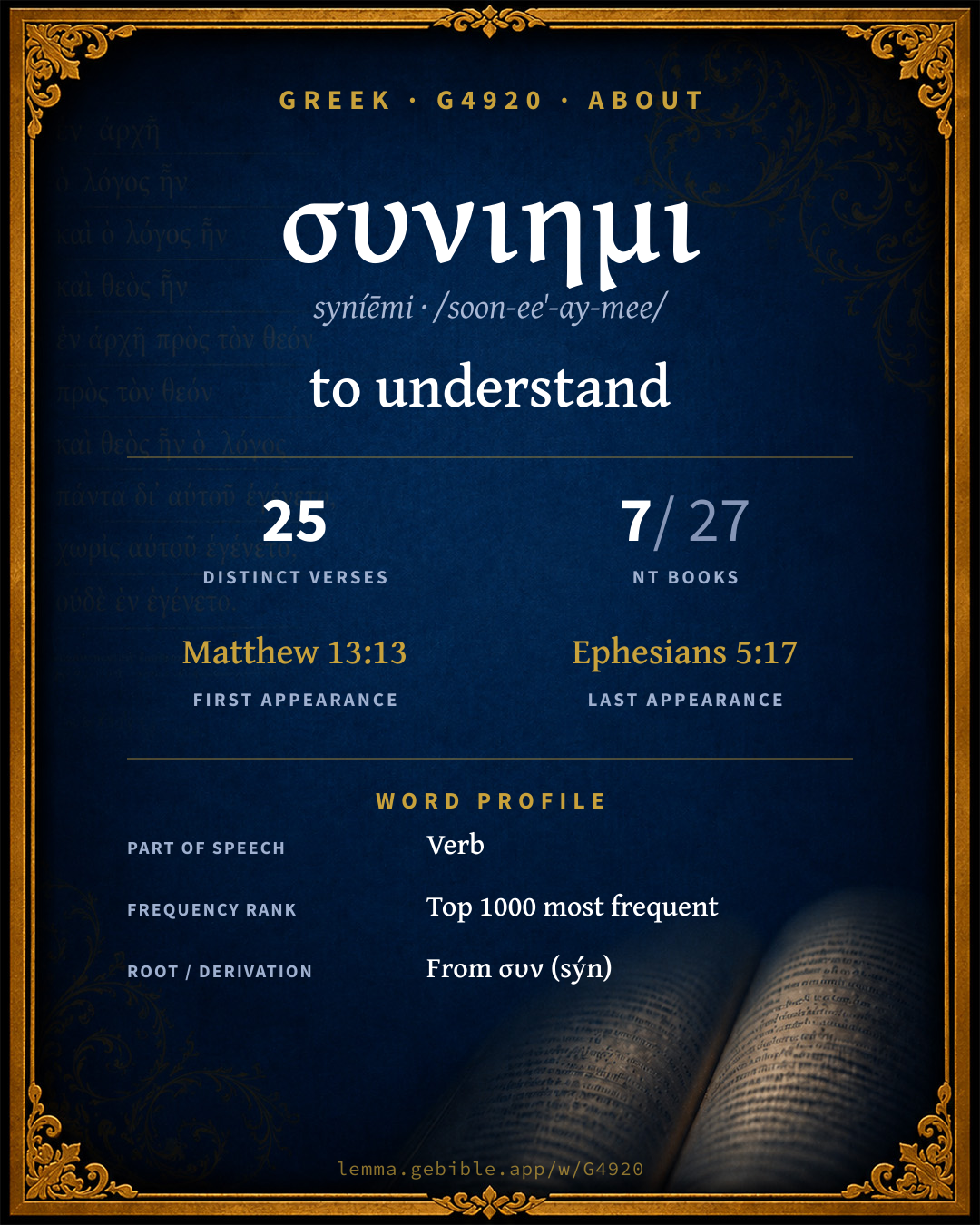
συνίημι
to understand
‘to understand’ is one of 2 main senses fuller range ↓
Full lexicon entry — Thayer's Greek Lexicon
From Thayer's Greek Lexicon
Where this word appears
See every Present-tense verb in the Greek New Testament →
Grammar key — what these labels mean
Part of speech
- Verb
- An action or state-of-being word.
Tense
- Aorist
- Action viewed as a simple whole, without regard to duration — often past (perfective aspect).
- Present
- Ongoing or general action in present time (imperfective aspect).
- Future
- Action expected in future time.
Voice
- Active
- The subject performs the action.
- Middle deponent
- Middle in form but active in meaning.
Mood
- Indicative
- States a fact or asks a factual question (the mood of reality).
- Subjunctive
- Expresses probability, purpose, or possibility (the mood of contingency).
- Imperative
- Expresses a command or request.
- Infinitive
- A verbal noun (“to write”), unmarked for person or number.
- Participle
- A verbal adjective (“writing,” “having written”).
Case
- Nominative
- The case of the subject (and the predicate nominative).
- Genitive
- The case of source, possession, or “of” — answers “whose / from what.”
Person
- 3rd person
- The one spoken about (“he / she / it / they”).
- 2nd person
- The one addressed (“you”).
Gender
- Masculine
- Grammatically masculine.
Number
- Plural
- More than one.
- Singular
- One.
Grammatical forms 13 distinct
- Verb, Aorist, Active, Indicative, 3rd person, Plural 6 times (23%)
- Verb, Aorist, Active, Subjunctive, 2nd person, Plural 2 times (8%)
- Verb, Aorist, Active, Subjunctive, 3rd person, Plural 2 times (8%)
- Verb, Present, Active, Indicative, 2nd person, Plural 2 times (8%)
- Verb, Present, Active, Indicative, 3rd person, Plural 2 times (8%)
- Verb, Present, Active, Imperative, 2nd person, Plural 2 times (8%)
- Verb, Present, Active, Infinitive 2 times (8%)
- Verb, Present, Active, Participle, Nominative, Singular, Masculine 2 times (8%)
+5 more forms (6 occurrences)
Parsed forms decoded from the imported morphology (Robinson–Tischendorf, public domain), counted across 26 parsed occurrences — not distinct verses.
Every verse where G4920 appears — 25 distinct verses across 7 books. Click any verse to open its interlinear word-by-word view. Verse text shown in the World English Bible for context — . Each verse’s Greek form is shown with its reference; the English is not keyword-highlighted, since the data carries no word-level English alignment. Use “Compare translations” on any verse to read it across multiple English versions. This concordance covers the Greek New Testament; Septuagint (Greek Old Testament) occurrences of this word are not indexed here.
Matthew 9 verses
- Matthew 13:13 συνίουσιν pres act ind 3pl Therefore I speak to them in parables, because seeing they don't see, and hearing, they don't hear, neither do they understand.
- Matthew 13:14 συνῆτε aor act subj 2pl In them the prophecy of Isaiah is fulfilled, which says, 'By hearing you will hear, And will in no way understand; Seeing you will see, And will in no way perceive:
- Matthew 13:15 συνῶσιν aor act subj 3pl For this people's heart has grown callous, Their ears are dull of hearing, They have closed their eyes; Or else perhaps they might perceive with their eyes, Hear with their ears, Understand with their heart, And should turn again; And I would heal them.'
- Matthew 13:19 συνιέντος pres act ptcp gen sg masc When anyone hears the word of the Kingdom, and doesn't understand it, the evil one comes, and snatches away that which has been sown in his heart. This is what was sown by the roadside.
- Matthew 13:23 συνιείς pres act ptcp nom sg masc What was sown on the good ground, this is he who hears the word, and understands it, who most assuredly bears fruit, and brings forth, some one hundred times as much, some sixty, and some thirty."
- Matthew 13:51 συνήκατε aor act ind 2pl Jesus said to them, "Have you understood all these things?" They answered him, "Yes, Lord."
- Matthew 15:10 συνίετε pres act impv 2pl He summoned the multitude, and said to them, "Hear, and understand.
- Matthew 16:12 συνῆκαν aor act ind 3pl Then they understood that he didn't tell them to beware of the yeast of bread, but of the teaching of the Pharisees and Sadducees.
- Matthew 17:13 συνῆκαν aor act ind 3pl Then the disciples understood that he spoke to them of John the Baptizer.
Mark 5 verses
- Mark 4:12 συνιῶσιν pres act subj 3pl that 'seeing they may see, and not perceive; and hearing they may hear, and not understand; lest perhaps they should turn again, and their sins should be forgiven them.'"
- Mark 6:52 συνῆκαν aor act ind 3pl for they hadn't understood about the loaves, but their hearts were hardened.
- Mark 7:14 σύνετε aor act impv 2pl He called all the multitude to himself, and said to them, "Hear me, all of you, and understand.
- Mark 8:17 συνίετε pres act ind 2pl Jesus, perceiving it, said to them, "Why do you reason that it's because you have no bread? Don't you perceive yet, neither understand? Is your heart still hardened?
- Mark 8:21 συνίετε pres act ind 2pl He asked them, "Don't you understand, yet?"
Luke 4 verses
- Luke 2:50 συνῆκαν aor act ind 3pl They didn't understand the saying which he spoke to them.
- Luke 8:10 συνιῶσιν pres act subj 3pl He said, "To you it is given to know the mysteries of the Kingdom of God, but to the rest in parables; that 'seeing they may not see, and hearing they may not understand.'
- Luke 18:34 συνῆκαν aor act ind 3pl They understood none of these things. This saying was hidden from them, and they didn't understand the things that were said.
- Luke 24:45 συνιέναι pres act inf Then he opened their minds, that they might understand the Scriptures.
Acts 3 verses
- Acts 7:25 συνιέναι συνῆκαν pres act inf aor act ind 3pl He supposed that his brothers understood that God, by his hand, was giving them deliverance; but they didn't understand.
- Acts 28:26 συνῆτε aor act subj 2pl saying, 'Go to this people, and say, In hearing, you will hear, But will in no way understand. In seeing, you will see, But will in no way perceive.
- Acts 28:27 συνῶσιν aor act subj 3pl For this people's heart has grown callous. Their ears are dull of hearing. Their eyes they have closed. Lest they should see with their eyes, Hear with their ears, Understand with their heart, And would turn again, And I would heal them.'
Romans 2 verses
2 Corinthians 1 verse
Ephesians 1 verse
About this entry
At a glance — auto-summarized from this page’s data, not written by a person. Every figure links to its source below. This summary describes the numbers; it doesn’t interpret them.
At its core, συνιημι (syníēmi) means “to understand.” It first appears in Matthew 13:13. It turns up in 25 verses across 7 books, an uncommon footprint. The word gravitates to Matthew (36%), then Mark and Luke. Ranging over 2 senses, it is not a single-sense word. Dig into 25-verse concordance and the renderings breakdown below.
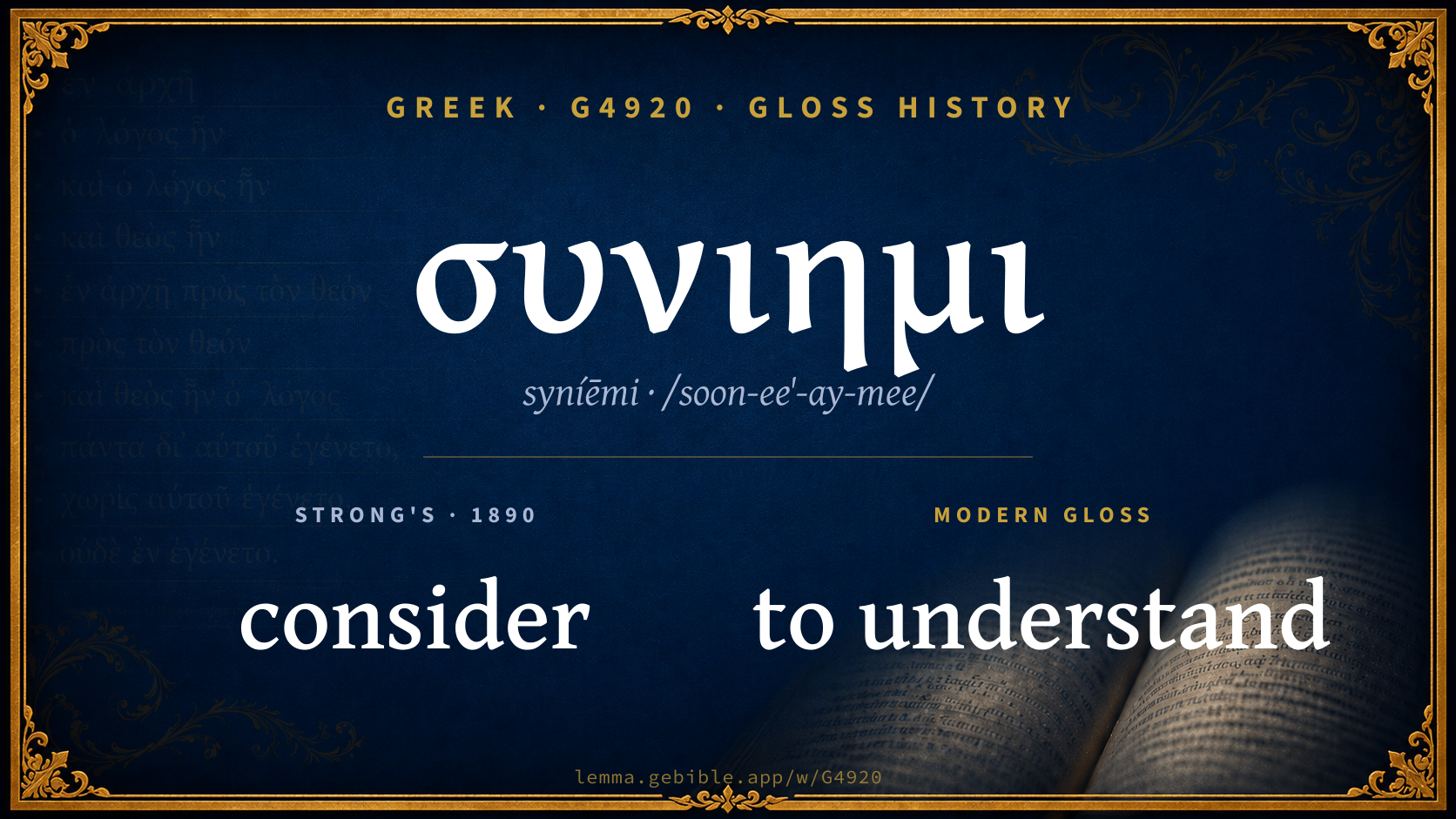
Gloss history
Strong's 1890 vs modern scholarship
About this word
Strong's G4920 catalogs a Greek word from the Greek New Testament.
These counts are not copied from any lexicon or concordance. They are computed here, from the morphology-tagged Greek New Testament. What Lemma adds →
- 25
- distinct verses
- The word appears in 25 distinct verses.
- 7 / 27
- NT books
- The word appears in 7 of 27 New Testament books.
- #513
- by frequency
- Top 1000 most frequent Greek words (rank 513 of 5,347 Greek words by occurrence).
View all 25 occurrences in the concordance →
By section of the New Testament
By traditional corpus
Conventional, traditional groupings — biblical authorship is debated, so this is a traditional corpus grouping, not an authorship claim. Some books belong to more than one corpus (Luke is in both the Gospels and the Lukan corpus, and so on), so these shares overlap and need not total 100%. Each figure is a share of the word’s 25 distinct verses.
- Gospels 18 verses · 72%
- Lukan (Luke–Acts) 7 verses · 28%
- Pauline corpus 4 verses · 16%
How translations render this word
Counts come from each version’s own published word-to-Strong’s tagging or interlinear alignment — an approximate guide to how each version renders this word, not a word-level alignment the data otherwise carries. Because each total is that version’s own tagged count, the per-version totals vary from one another and need not match the appearance or distinct-verse counts above. These counts may also differ from a printed concordance because Lemma counts each distinctly tagged rendering and does not collapse phrase taggings into a single head-word total. This is a fixed set of word-tagged versions (KJV, ASV, BSB, ULT) and does not change with the reading translation you choose elsewhere. Each version’s license is shown beside its name below (and on Sources).
- King James Version: Understand 9×, Understandeth 3×, Understood 3×
- American Standard Version: Understand 10×, Understood 4×, Understandeth 3×
- Berean Standard Bible: Understand 9×, Understanding 3×, Understands 2×
- unfoldingWord Literal Text: Understand 15×, Did 2×, They might understand 2×
King James Version Public Domain
Renders G4920 across 31 tagged occurrences — most commonly:
Plus 14 renderings that appear only once — usually multi-word phrases or single function words the recovered tagging swept in, not distinct renderings.
American Standard Version Public Domain
Renders G4920 across 34 tagged occurrences — most commonly:
Plus 13 renderings that appear only once — usually multi-word phrases or single function words the recovered tagging swept in, not distinct renderings.
Berean Standard Bible Public Domain
Renders G4920 across 25 tagged occurrences — most commonly:
Plus 11 renderings that appear only once — usually multi-word phrases or single function words the recovered tagging swept in, not distinct renderings. Not rendered by a distinct English word in 1 further occurrence.
unfoldingWord Literal Text CC BY-SA 4.0
Renders G4920 across 36 tagged occurrences — most commonly:
Plus 11 renderings that appear only once — usually multi-word phrases or single function words the recovered tagging swept in, not distinct renderings.
Senses in Thayer's
The 2 senses Thayer's distinguishes for this word, in lexicon order (not ranked by frequency or importance). The full entry — with sub-senses — is in the Lexicon Entry tab.
- in a hostile sense, of combatants
- to put (as it were) the perception with the thing perceived
Word origin
Derived from συν (sýn) (G4862) — with.
From G4862 and ἵημι hiē mi (to send ); to put together that is (mentally) to comprehend ; by implication to act piously : - consider understand be wise.
— Strong’s Exhaustive Concordance (1890), public domain.
Forms in the corpus
The 14 distinct written forms G4920 takes in the Greek New Testament, most frequent first — each parse links to that tense’s occurrences in the concordance.
Same root — word family
Other Thayer's entries built from the same root as G4920, grouped by Strong’s listed origin. These share a root / origin per the lexicon — not necessarily a shared meaning. Each links to that word’s own entry.
Derives from
Shares the same root
- κοινος koinós G2839 common
- συγγενης syngenḗs G4773 related by blood
- συγγνωμη syngnṓmē G4774 pardon
- συγκαθημαι synkáthēmai G4775 to sit together
- συγκαθιζω synkathízō G4776 to sit together
- συγκακοπαθεω synkakopathéō G4777 to suffer together
- συγκακουχεω synkakouchéō G4778 to be ill-treated together
- συγκαλεω synkaléō G4779 to call together
- συγκαλυπτω synkalýptō G4780 to cover completely
- συγκαμπτω synkámptō G4781 to bend together
- συγκαταβαινω synkatabaínō G4782 to go down with
- συγκατατιθεμαι synkatatíthemai G4784 to deposit together
- συγκαταψηφιζω synkatapsēphízō G4785 to vote against
- συγκεραννυμι synkeránnymi G4786 to mix together
- συγκλειω synkleíō G4788 to shut up
- συγκληρονομος synklēronómos G4789 joint heir
- συγκοινωνεω synkoinōnéō G4790 to share together
- συγκοινωνος synkoinōnós G4791 joint partner
- συγκομιζω synkomízō G4792 to collect together
- συγκρινω synkrínō G4793 to join together
- συγκυπτω synkýptō G4794 to bend together
- συγκυρια synkyría G4795 by chance
- συγχαιρω synchaírō G4796 to rejoice with
- συγχεω synchéō G4797 to disturb
+125 more words share this root (not shown).
Derived from this word
Compare all same-root words → Showing 4 of 153 — not the complete family. They share a root, not necessarily a meaning.
Septuagint usage
The same Greek word συνιημι appears 82 times in the Greek Old Testament (Septuagint), across 82 verses in 19 books.
- 82
- LXX occurrences
- Tagged occurrences of this Greek word in the Septuagint.
- 82
- verses
- Distinct Septuagint verses containing this word.
- 19 / 39
- OT books
- The word appears in 19 of the 39 Old Testament books.
Sample Septuagint occurrences
- Exodus 35:35 συνἵημι
- Deuteronomy 29:8 συνἵημι
- Joshua 1:8 συνἵημι
- 1 Samuel 2:10 συνἵημι
- 2 Samuel 12:19 συνἵημι
- 1 Kings 2:3 συνἵημι
- 2 Kings 18:7 συνἵημι
- 1 Chronicles 25:7 συνἵημι
- 2 Chronicles 20:17 συνἵημι
- Ezra 8:15 συνἵημι
- Job 15:9 συνἵημι
- Psalms 2:10 συνἵημι
Septuagint occurrences (same lexeme)
Every verse where the same Strong’s number (G4920) appears in the Greek Septuagint — showing the first 50 of 82. Verse text shown in the World English Bible for context; the Greek form is the matched word — the English is not keyword-highlighted.
- Exodus 35:35 συνἵημι He has filled them with wisdom of heart, to work all manner of workmanship, of the engraver, of the skillful workman, and of the embroiderer, in blue, in purple, in scarlet, and in fine linen, and of the weaver, even of those who do any workmanship, and of those who make skillful works.
- Exodus 36:1 συνἵημι "Bezalel and Oholiab shall work with every wise-hearted man, in whom Yahweh has put wisdom and understanding to know how to work all the work for the service of the sanctuary, according to all that Yahweh has commanded."
- Deuteronomy 29:8 συνἵημι and we took their land, and gave it for an inheritance to the Reubenites, and to the Gadites, and to the half-tribe of the Manassites.
- Deuteronomy 32:7 συνἵημι Remember the days of old, Consider the years of many generations: Ask your father, and he will show you; Your elders, and they will tell you.
- Deuteronomy 32:29 συνἵημι Oh that they were wise, that they understood this, That they would consider their latter end!
- Joshua 1:8 συνἵημι This book of the law shall not depart out of your mouth, but you shall meditate thereon day and night, that you may observe to do according to all that is written therein: for then you shall make your way prosperous, and then you shall have good success.
- 1 Samuel 2:10 συνἵημι Those who strive with Yahweh shall be broken to pieces; Against them will he thunder in the sky: Yahweh will judge the ends of the earth; He will give strength to his king, Exalt the horn of his anointed.
- 1 Samuel 18:7 συνἵημι The women sang one to another as they played, and said, Saul has slain his thousands, David his ten thousands.
- 1 Samuel 18:8 συνἵημι Saul was very angry, and this saying displeased him; and he said, They have ascribed to David ten thousands, and to me they have ascribed but thousands: and what can he have more but the kingdom?
- 2 Samuel 12:19 συνἵημι But when David saw that his servants were whispering together, David perceived that the child was dead; and David said to his servants, Is the child dead? They said, He is dead.
- 1 Kings 2:3 συνἵημι and keep the charge of Yahweh your God, to walk in his ways, to keep his statutes, [and] his commandments, and his ordinances, and his testimonies, according to that which is written in the law of Moses, that you may prosper in all that you do, and wherever you turn yourself.
- 1 Kings 3:9 συνἵημι Give your servant therefore an understanding heart to judge your people, that I may discern between good and evil; for who is able to judge this your great people?
- 2 Kings 18:7 συνἵημι Yahweh was with him; wherever he went forth he prospered: and he rebelled against the king of Assyria, and didn't serve him.
- 1 Chronicles 25:7 συνἵημι The number of them, with their brothers who were instructed in singing to Yahweh, even all who were skillful, was two hundred eighty-eight.
- 2 Chronicles 20:17 συνἵημι You shall not need to fight in this [battle]: set yourselves, stand you still, and see the salvation of Yahweh with you, O Judah and Jerusalem; don't be afraid, nor be dismayed: tomorrow go out against them: for Yahweh is with you.
- 2 Chronicles 34:12 συνἵημι The men did the work faithfully: and the overseers of them were Jahath and Obadiah, the Levites, of the sons of Merari; and Zechariah and Meshullam, of the sons of the Kohathites, to set it forward; and [others of] the Levites, all who were skillful with instruments of music.
- Ezra 8:15 συνἵημι I gathered them together to the river that runs to Ahava; and there we encamped three days: and I viewed the people, and the priests, and found there none of the sons of Levi.
- Ezra 8:16 συνἵημι Then sent I for Eliezer, for Ariel, for Shemaiah, and for Elnathan, and for Jarib, and for Elnathan, and for Nathan, and for Zechariah, and for Meshullam, chief men; also for Joiarib, and for Elnathan, who were teachers.
- Ezra 18:2 συνἵημι
- Ezra 18:3 συνἵημι
- Ezra 18:8 συνἵημι
- Ezra 18:12 συνἵημι
- Ezra 23:7 συνἵημι
- Job 15:9 συνἵημι What do you know, that we don't know? What do you understand, which is not in us?
- Job 20:2 συνἵημι "Therefore do my thoughts give answer to me, Even by reason of my haste that is in me.
- Job 31:1 συνἵημι "I made a covenant with my eyes, How then should I look lustfully at a young woman?
- Job 32:12 συνἵημι Yes, I gave you my full attention, But there was no one who convinced Job, Or who answered his words, among you.
- Job 36:4 συνἵημι For truly my words are not false. One who is perfect in knowledge is with you.
- Job 38:31 συνἵημι "Can you bind the cluster of the Pleiades, Or loosen the cords of Orion?
- Psalms 2:10 συνἵημι Now therefore be wise, you kings. Be instructed, you judges of the earth.
- Psalms 5:2 συνἵημι Listen to the voice of my cry, my King and my God; For to you do I pray.
- Psalms 13:2 συνἵημι How long shall I take counsel in my soul, Having sorrow in my heart every day? How long shall my enemy triumph over me?
- Psalms 18:13 συνἵημι Yahweh also thundered in the sky, The Most High uttered his voice: Hailstones and coals of fire.
- Psalms 27:5 συνἵημι For in the day of trouble he will keep me secretly in his pavilion. In the covert of his tent he will hide me. He will lift me up on a rock.
- Psalms 32:15 συνἵημι
- Psalms 35:4 συνἵημι Let those who seek after my soul be disappointed and brought to dishonor. Let those who plot my ruin be turned back and confounded.
- Psalms 40:2 συνἵημι He brought me up also out of a horrible pit, Out of the miry clay. He set my feet on a rock, And gave me a firm place to stand.
- Psalms 48:13 συνἵημι Mark well her bulwarks. Consider her palaces, That you may tell it to the next generation.
- Psalms 48:21 συνἵημι
- Psalms 49:22 συνἵημι
- Psalms 52:3 συνἵημι You love evil more than good, Lying rather than speaking the truth. Selah.
- Psalms 57:10 συνἵημι For your great loving kindness reaches to the heavens, And your truth to the skies.
- Psalms 63:10 συνἵημι They shall be given over to the power of the sword. They shall be jackal food.
- Psalms 72:17 συνἵημι His name endures forever. His name continues as long as the sun. Men shall be blessed by him. All nations will call him blessed.
- Psalms 81:5 συνἵημι He appointed it in Joseph for a testimony, When he went out over the land of Egypt, I heard a language that I didn't know.
- Psalms 91:7 συνἵημι A thousand may fall at your side, And ten thousand at your right hand; But it will not come near you.
- Psalms 93:7 συνἵημι
- Psalms 93:8 συνἵημι
- Psalms 100:2 συνἵημι Serve Yahweh with gladness. Come before his presence with singing.
- Psalms 105:7 συνἵημι He is Yahweh, our God. His judgments are in all the earth.
These are occurrences of the same Greek lexeme (G4920) in the Septuagint — not a translation of any one Hebrew word. The store carries no word-level Hebrew↔Greek alignment, so no Hebrew original is asserted here. Counts come from the recovered LXX Strong's tagging — high-frequency vocabulary is well covered, while rare or late forms may be untagged — so they reflect tagged occurrences and may slightly undercount.