
Psalms 105:7

Hebrew (Westminster Leningrad Codex) Psalms 105:7 appears in the Hebrew Old Testament. The text above is from the Westminster Leningrad Codex. Each word links to its Strong’s number, a concise gloss, and parsing drawn from the Open Scriptures Hebrew Bible morphology. Click any word for its full Brown-Driver-Briggs (BDB) entry.
Download image
Cite this verse

Psalms 105:7 (World English Bible). Public Domain. Lemma interlinear Bible study tool, https://lemma.gebible.app/v/psalms/105/7.

Show BibTeX & RIS
BibTeX
RIS
English Translation
He is Yahweh, our God. His judgments are in all the earth.
World English Bible · Public Domain
Download a study sheet

One document with this verse’s original text, its word-by-word gloss line, the meaning frame, cross-references with their text, attributed commentary, and full source and license credits — printable, and it pastes into notes with its structure intact.

This verse Autodidact and up

Study sheet (.html) Plain text (.txt)

A passage Seminary Student

Up to 50 verses in one chapter. A passage sheet keeps up to 6 commentary sources and 12 cross-references per verse, in the order this page ranks them, and says so on the sheet whenever that leaves anything out. Ask for a single verse and you get the Autodidact verse sheet above.

Everything on this page stays free to read, with no account — the sheet is a download of what is already on screen, not access to it.

Want to remove ads? Support Godless Engineer
Compare translations 3

The same verse in 3 English versions, stacked beneath the original-language interlinear above. Click any original word for its lexicon entry.

Each is an independent rendering of the whole verse — the interlinear is not word-aligned to these translations.

Highlighted words mark where these versions differ — a whole-verse word diff, not a word-by-word alignment.

  • World English Bible Public Domain
    He is Yahweh, our God. His judgments are in all the earth.
  • King James Version Public Domain
    He is the LORD our God: his judgments are in all the earth.
  • unfoldingWord Literal Text CC BY-SA 4.0
    He is Yahweh, our God. His decrees in all the earth.

unfoldingWord Literal Text — © unfoldingWord, licensed CC BY-SA 4.0. Word-aligned USFM3 via Door43 (git.door43.org/unfoldingWord/en_ult).

Versions to compare (up to 4)

3 of 4 selected

Show all 18 translations

Every available English version of this verse, each an independent rendering of the whole verse.

  • World English Bible Public Domain
    He is Yahweh, our God. His judgments are in all the earth.
  • Berean Standard Bible Public Domain
    He is the LORD our God; His judgments carry throughout the earth.
  • Majority Standard Bible Public Domain
    He is the LORD our God; His judgments carry throughout the earth.
  • King James Version Public Domain
    He is the LORD our God: his judgments are in all the earth.
  • American Standard Version (1901) Public Domain
    He is Jehovah our God: His judgments are in all the earth.
  • Revised Version (1885) Public Domain
    He is the LORD our God: his judgments are in all the earth.
  • Geneva Bible (1599) Public Domain
    He is the Lord our God: his iudgements are through all the earth.
  • Douay-Rheims (1899) Public Domain
    He is the Lord our God: his judgments are in all the earth.
  • Young's Literal Translation Public Domain
    He `is' Jehovah our God, In all the earth `are' His judgments.
  • Literal Standard Version CC BY-SA 4.0
    He [is] our God YHWH, || His judgments [are] in all the earth.
  • Unlocked Literal Bible CC BY-SA 4.0
    He is Yahweh, our God. His decrees are on all the earth.
  • unfoldingWord Literal Text CC BY-SA 4.0
    He is Yahweh, our God. His decrees in all the earth.
  • Darby Bible Public Domain
    He, Jehovah, is our God; his judgments are in all the earth.
  • World Messianic Bible Public Domain
    He is the LORD, our God. His judgments are in all the earth.
  • Webster's Bible Public Domain
    He is the LORD our God: his judgments are in all the earth.
  • Free Bible Version CC BY-SA 4.0
    He is the Lord, our God, his judgments cover the whole earth.
  • Bible in Basic English Public Domain
    He is the Lord our God: he is judge of all the earth.
  • JPS Tanakh (1917) Public Domain
    He is the LORD our God; His judgments are in all the earth.

Literal Standard Version (2020), Covenant Press — licensed CC BY-SA 4.0. Text via the HelloAO Bible API (eBible.org). Unlocked Literal Bible (unfoldingWord) — licensed CC BY-SA 4.0. Text via the HelloAO Bible API (eBible.org). unfoldingWord Literal Text — © unfoldingWord, licensed CC BY-SA 4.0. Word-aligned USFM3 via Door43 (git.door43.org/unfoldingWord/en_ult). Free Bible Version, Dr. Jonathan Gallagher — licensed CC BY-SA 4.0. Text via the HelloAO Bible API (eBible.org).

Word by word

More ways to search: Search by grammar → Find every occurrence → Compare this word →

Practice this passage: Drill this verse → Learn its vocabulary →

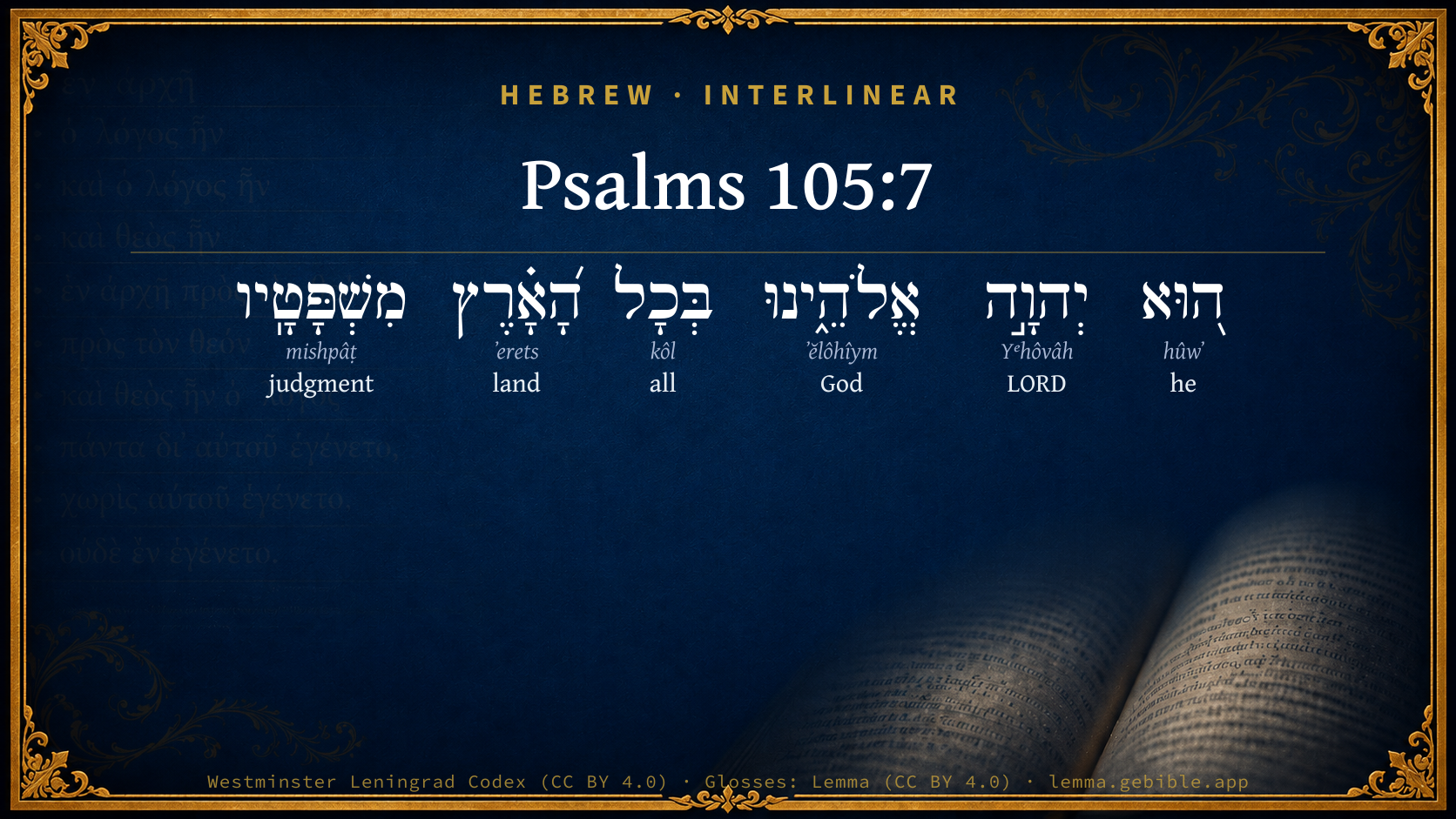
מִשְׁפָּטָֽיו
mishpâṭ
H4941
“judgments · his”
Noun, Common, Masculine, Plural, Construct + Suffix, Personal, 3rd Person, Masculine, Singular
Part of Speech
Noun
Type
Common
Gender
Masculine
Number
Plural
State
Construct
Full BDB Definition

Origin: from H8199

TWOT: 2443c

judgment, justice, ordinance - judgment - act of deciding a case - place, court, seat of judgment - process, procedure, litigation (before judges) - case, cause (presented for judgment) - sentence, decision (of judgment) - execution (of judgment) - time (of judgment) - justice, right, rectitude (attributes of God or man) - ordinance - decision (in law) - right, privilege, due (legal) - proper, fitting, measure, fitness, custom, manner, plan
  1. ה֭וּא hûwʼ H1931 “he” Pronoun, Personal, 3rd Person, Masculine, Singular
  2. יְהוָ֣ה Yᵉhôvâh H3068 “LORD” Noun, Proper
  3. אֱלֹהֵ֑ינוּ ʼĕlôhîym H430 “God(s) · our” Noun, Common, Masculine, Plural, Construct + Suffix, Personal, 1st Person, Common, Plural
  4. בְּכָל kôl H3605 “in/at · all of” Preposition + Noun, Common, Masculine, Singular, Construct
  5. הָ֝אָ֗רֶץ ʼerets H776 “the · land” Particle, Definite Article + Noun, Common, Both, Singular, Absolute

About this verse

These counts appear in no published source. They are computed here, from the morphology-tagged text and Lemma’s own curated glosses. What Lemma adds →

6
words
6
distinct lemmas
Wisdom
section

Grammatical profile

  • 5 nouns
  • 1 pronoun

Hebrew & Septuagint length

In English translation the verse runs 12 words from the Hebrew and 13 from the Septuagint (LXX English) — closely comparable.

A rough comparison of the two English renderings, which tokenize alike — not a word-level alignment.

Word counts can differ between the Hebrew and the Greek without any difference in meaning — e.g. the Hebrew direct-object marker אֵת has no separate Greek word, and Greek often adds the article ὁ.

Cross-references

10

Topical passages linked to Psalms 105:7 in the Treasury of Scripture Knowledge — connected by theme and wording, ordered by reader-vote popularity; previews shown in the World English Bible.

  • Isaiah 26:9 With my soul have I desired you in the night; yes, with my spirit within me will I seek you earnestly: for when your judgments are in the earth, the inhabitants of the world learn righteousness.
  • Exodus 20:2 "I am Yahweh your God, who brought you out of the land of Egypt, out of the house of bondage.
  • Deuteronomy 26:17–18 You have declared Yahweh this day to be your God, and that you would walk in his ways, and keep his statutes, and his commandments, and his ordinances, and listen to his voice:
  • Psalms 95:7 For he is our God. We are the people of his pasture, And the sheep in his care. Today, oh that you would hear his voice!
  • Revelation 15:4 Who wouldn't fear you, Lord, And glorify your name? For you only are holy. For all the nations will come and worship before you. For your righteous acts have been revealed."
  • Genesis 17:7 I will establish my covenant between me and you and your seed after you throughout their generations for an everlasting covenant, to be a God to you and to your seed after you.
  • Deuteronomy 29:10–15 You stand this day all of you before Yahweh your God; your heads, your tribes, your elders, and your officers, even all the men of Israel,
  • Joshua 24:15–24 If it seem evil to you to serve Yahweh, choose you this day whom you will serve; whether the gods which your fathers served that were beyond the River, or the gods of the Amorites, in whose land you dwell: but as for me and my house, we will serve Yahweh.
  • Psalms 48:10–11 As is your name, God, So is your praise to the ends of the earth. Your right hand is full of righteousness.
  • Psalms 100:3 Know that Yahweh, he is God. It is he who has made us, and we are his. We are his people, and the sheep of his pasture.

Cross-references courtesy of OpenBible.info (CC BY 4.0).

Hebrew and Greek witnesses Masoretic Hebrew ↔ Greek Septuagint

The same verse in the two great witnesses to the Old Testament, shown verse-for-verse.

You’re reading Greek Psalm 104 (Hebrew Psalm 105). The Septuagint counts the superscription, so verse numbers can differ from the Hebrew — chapter-level alignment, not verse-by-verse. Numbering follows Rahlfs.

These are two independent witnesses, not word-aligned to each other, and the Septuagint is shown in lemma (dictionary) form.

Hebrew Psalms 105:7 Masoretic · Westminster Leningrad Codex

ה֭וּא יְהוָ֣ה אֱלֹהֵ֑ינוּ בְּכָל הָ֝אָ֗רֶץ מִשְׁפָּטָֽיו

He is Yahweh, our God. His judgments are in all the earth.

World English Bible · Public Domain

Greek LXX Greek Psalm 104:7 Septuagint · lemma form

αὐτός κύριος ὁ θεός ἐγώ ἐν πᾶς ὁ γῆ ὁ κρίμα αὐτός

He is the Lord our God; his judgments are in all the earth.

LXX2012 (modern English Septuagint) · Public Domain

On this verse, Keil & Delitzsch discusses the Septuagint’s reading. Read the note in Commentary ↓

Hebrew: Westminster Leningrad Codex (CC BY 4.0). Greek: Septuagint (public domain); English from LXX2012 (modern English Septuagint) (Public Domain). How the Septuagint differs from the Hebrew →

Commentary

Notes on Psalms 105:7 from classic Christian and Jewish commentators (each source and its license shown beneath its notes). The classic Christian expositions comment on the surrounding passage and are grouped to its opening verse, so a note may address several verses; the Jewish commentaries on the Tanakh (Rashi and others) are per-verse, so they appear only where the commentator wrote on this verse.

Lemma curates 59 commentaries, every one of them public domain or Creative Commons licensed, each selected and text-cleaned for this edition rather than reprinted as found. About our sources →

Trapp's Complete Commentary

John Trapp

Psa 105:7 He [is] the LORD our God: his judgments [are] in all the earth.

Ver. 7. He is the Lord] Jehovah, the essentiator, the promise keeper, therefore praise him. He is also in covenant with us, and will we not do him this right?

His judgments are in all the earth] His executions upon the Egyptians and Philistines are far and near notified and discoursed.

John Trapp, A Commentary or Exposition upon All the Books of the Old and New Testament (1647–1656) — public domain. Text from a community e-Sword module.

The Biblical Illustrator

Joseph S. Exell

Psa_105:7-15

He is the Lord our God: His judgments are in all the earth.

God in Jewish history, working for His people

I. His absolute sovereignty (verse 9). The selection of Abraham to distinguished privileges is only an example of what has been going on in the history of men in all times. All men are not alike endowed, nor alike distinguished in privilege. Some have more health, more beauty, more talent, more enjoyments, than others. Shall any find fault with this? Who art thou that repliest against God? We should, however, always remember that Gods sovereignty is not arbitrary power, not capricious impulse, but is evermore the free expression of His heart, and that heart is love.

II. His inviolable faithfulness (verse 8). Men fail to fulfil their promises from one of three reasons--either because they were insincere when they made the promise, or because they subsequently changed their minds, or because difficulties occurred which they never anticipated. None of these reasons can be ascribed to God.

III. His territorial proprietorship (verse 11). Let all landowners remember that the acres they call their own are only borrowed property, they are only tenants at will, or rather stewards, responsible for the use they make of every foot of ground.

IV. His compassionate superintendence. He watched over them.

1. When they were few (verse 12). How He watched over Abraham, Isaac, and Jacob, only three! We lose individuals in the mass. To Him the individual is the object of interest, the individual is His offspring, representative, fountain of immeasurable influence. Unto that man will I look.

2. When they were wandering strangers (verse 13). Though unknown, ignored, it may be despised, the few wandered amongst ten thousand strangers, His eye was upon them, and His sympathies were with them.

3. When they were threatened (verses 14, 15). (Homilist.)

The Biblical Illustrator, edited by Joseph S. Exell (c. 1880s–1900s) — public domain. Text from a community e-Sword module.

Keil & Delitzsch

C. F. Keil & F. Delitzsch

The poet now begins himself to do that to which he encourages Israel. Jahve is Israel's God: His righteous rule extends over the whole earth, whilst His people experience His inviolable faithfulness to His covenant. יהוה in Psa 105:7 is in apposition to הוּא, for the God who bears this name is as a matter of course the object of the song of praise. זכר is the perfect of practically pledges certainty (cf. Psa 111:5, where we find instead the future of confident prospect). The chronicler has זכרוּ instead (lxx again something different: μνημονεύωμεν); but the object is not the demanding but the promissory side of the covenant, so that consequently it is not Israel's remembering but God's that is spoken of. He remembers His covenant in all time to come, so that exile and want of independence as a state are only temporary, exceptional conditions. צוּה has its radical signification here, to establish, institute, Psa 111:9. לאלף דּור (in which expression דור is a specifying accusative) is taken from Deu 7:9. And since דּבר is the covenant word of promise, it can be continued אשׁר כּרת; and Hag 2:5 (vid., Khler thereon) shows that אשׁר is not joined to בריתו over Psa 105:8. וּשׁבוּעתו, however, is a second object to זכר (since דּבר with what belongs to it as an apposition is out of the question). It is the oath on Moriah (Gen 22:16) that is meant, which applied to Abraham and his seed. לישׂחק (chronicler ליצחק), as in Amo 7:9; Jer 33:26. To זכר is appended ויּעמרדה; the suffix, intended as neuter, points to what follows, viz., this, that Canaan shall be Israel's hereditary land. From Abraham and Isaac we come to Jacob-Israel, who as being the father of the twelve is the twelve-tribe nation itself that is coming into existence; hence the plural can alternate with the singular in Psa 105:11. את־ארץ כּנען (chronicler, without the את) is an accusative of the object, and חבל נחלתכם accusative of the predicate: the land of Canaan as the province of your own hereditary possession measured out with a measuring line (Psa 78:55).

Keil & Delitzsch — Biblical Commentary on the Old Testament (1861–1891) — public domain (CC PDM 1.0). Text via the HelloAO Bible API. (Old Testament only.)

Adam Clarke's Commentary

Verse 7. He is the Lord our God] He is Jehovah, the self-existent and eternal God. He is our God, he is our portion; has taken us for his people, and makes us happy in his love.

The following abstract of the history of the Israelites presents but few difficulties. See Clarke on Ps 78:1, &c.

Adam Clarke's Commentary on the Bible (1810–1826) — public domain. Text from a community e-Sword/MySword module.

Ellicott's Commentary for English Readers

(7-11) First cause of praise; the ancient covenant.

A Bible Commentary for English Readers, edited by Charles John Ellicott (1878–1897) — public domain. Text from a community e-Sword module.

The Cambridge Bible for Schools and Colleges

gen. ed. J. J. S. Perowne

7. He, Jehovah, is our God] He stands in a special and peculiar relation to Israel the people of His choice: but He is no mere national Deity: His judgements are in all the earth; He exercises an universal rule over all nations as “the Judge of all the earth” (Gen_18:25).

7–12. The theme of the Psalm. Jehovah has been true to the promise which He made to the patriarchs, to give them the land of Canaan.

The Cambridge Bible for Schools and Colleges (gen. ed. J. J. S. Perowne; Cambridge University Press, 1878–1918) — public domain. Text from a community e-Sword module.

John Gill's Exposition

He is the lord our God,.... Here begin the arguments to excite to praise and thankfulness; and the first is taken from what God is, and is to us; he is Jehovah, the Being of beings, a self-existent Being, the author of all beings, but receives his own from none; being undivided, independent, and self-sufficient, invariably and unchangeably the same, which is, and was, and is to come; and who has a sovereign power and authority over all creatures, whose name alone is Jehovah; nor is that name applicable or communicable to any created being; and yet this Jehovah is our God, our God in covenant, our God in Christ; our God that has blessed us with all spiritual blessings in Christ; our God that has regenerated, adopted, and justified us; that supplies all our wants, and will be our God and our portion for ever; and therefore worthy of all praise, honour, and glory.

His judgments are all the earth: not his laws and statutes, his word and ordinances, or the revelation of his mind and will as faith and worship, which are sometimes meant by his judgments; for these were not in all the earth, were only known to the people of the Jews at this time, Psa 147:19, rather his judgments on the Egyptians, or his plagues upon them for refusing to let Israel go, the fame of which was spread throughout the world: and may take in all the judgments of God in other parts of the world, as on Sodom and Gomorrah, and especially the universal deluge, which destroyed the world of the ungodly; and by such judgments the Lord is known, Psa 9:16 and for these he is to be praised; as they are expressive of his holiness and justice; as he will be for his judgments on antichrist, when they are made manifest, Rev 15:4. This may also respect in general God's government of the world, and his righteous judging in it; who is a God that judgeth in the earth, and governs it by his power and wisdom, and in righteousness; and this righteous Judge is our God.

John Gill's Exposition of the Whole Bible (1746–1763) — public domain (CC PDM 1.0). Text via the HelloAO Bible API.

Albert Barnes' Notes on the Bible

He is the Lord our God - His name is Yahweh - the true God; and this God is ours. See the notes at Psa 95:7.

His judgments are in all the earth - More properly “in all the land;” that is, in every part of the land he is honored as our God. His institutions are established here; his laws are obeyed here; his worship is celebrated here. No other God is worshipped here; everywhere he is acknowledged as the nation’s God.

Albert Barnes' Notes on the Bible (1834–1885) — public domain. Text from a community e-Sword/MySword module.

Matthew Poole's English Annotations

Either,

1. The fame of his judgments upon the Egyptians is spread over the face of the earth. Or,

2. God executes his judgments upon all nations and people; which may be here noted as a foil to magnify God’s grace to them who were the monuments of his mercy, when all the world besides them fell under his just severity.

Matthew Poole's English Annotations on the Holy Bible (1683–1685) — public domain. Text from a community e-Sword/MySword module.

The Treasury of David

Charles H. Spurgeon

Ver. 7. He is the Lord our God. Blessed be his name. Jehovah condescends to be our God. This sentence contains a greater wealth of meaning than all the eloquence of orators can compass, and there is more joy in it than in all the sonnets of them that make merry.

His judgments are in all the earth, or in all the land, for the whole of the country was instructed by his law, ruled by his statutes, and protected by his authority. What a joy it is that our God is never absent from us, he is never nonresident, never an absentee ruler, his judgments are in all the places in which we dwell. If the second clause of this verse refers to the whole world, it is very beautiful to see the speciality of Israel's election united with the universality of Jehovah's reign. Not alone to the one nation did the Lord reveal himself, but his glory flashed around the globe. It is wonderful that the Jewish people should have become so exclusive, and have so utterly lost the missionary spirit, for their sacred literature is full of the broad and generous sympathies which are so consistent with the worship of "the God of the whole earth." Nor is it less painful to observe that among a certain class of believers in God's election of grace there lingers a hard exclusive spirit, fatal to compassion and zeal. It would be well for these also to remember that their Redeemer is "the Saviour of all men, specially of them that believe."

Ver. 7. God's relation to his elect and to all mankind.

Psalms 105:8*

Charles H. Spurgeon's The Treasury of David (1869–1885) — public domain. Psalms only. Text from a community e-Sword/MySword module.

Whedon's Commentary on the Bible

Daniel D. Whedon

7. He is the Lord our God—Having earnestly exhorted them to faithfulness and zeal in the service of God by a rapid glance at his works, and by their holy lineage, the psalmist now proceeds to extol the mighty acts of God, and his marvellous patience and fidelity through all the ages of their history, as their highest incentive to obedience and faithfulness. The mention of Abraham and Isaac (Psa_105:6) had already suggested the “covenant,” which he intimates in the “our God,” and expressly mentions Psa_105:8

Daniel D. Whedon (gen. ed.), Commentary on the Old and New Testaments (1874–1909) — public domain. Text from a community e-Sword module.

The Pulpit Commentary

He is the Lord our God; rather, he, Jehovah, is our God. The psalmist now commences the praise of Jehovah in his own person, acting as spokesman for his people; and first of all declares his Godhead; next, his universal dominion. His judgments are in all the earth; i.e. "his sentences, decrees, laws, have a universal range, and command the obedience of all men."

The Pulpit Commentary (1880–1919), ed. H.D.M. Spence-Jones & Joseph S. Exell — public domain. Text from a community e-Sword module.

John Wesley's Explanatory Notes

Judgments - God executes his judgments upon all nations and people.

John Wesley, Explanatory Notes Upon the Whole Bible (1754–1765) — public domain. Text via the GEBible commentary corpus.

unfoldingWord translationNotes

Door43 World Missions Community

He keeps in mind ... the word that he commanded

These two phrases share similar meanings and are used together for emphasis. The word "word" refers to the covenant. AT: "He keeps in mind his covenant forever, the promise he made" (See: Parallelism and Metonymy)

keeps in mind

This means to remember and think about something. AT: "remembers" (See: Idiom)

a thousand generations

"1,000 generations" (See: Numbers)

translationWords

God

earth

mind

covenant

eternity

word

command

generation

unfoldingWord translationNotes — © Distant Shores Media and the Door43 World Missions Community, licensed CC BY-SA 4.0. Source: git.door43.org/Door43/en_tn.

Lesson kit

Teaching starters — assembled from the data on this page, not authored interpretation. Every prompt links to the verse data it draws on. Edit before teaching.

Psalms, in the Wisdom, opens this verse with 6 words (6 distinct Hebrew lemmas). Its most distinctive word is mishpâṭ (“judgment”). A historical commentator’s framing appears above. Read the whole chapter for the surrounding context.

Discussion questions

  1. What does “judgment” (mishpâṭ) contribute to the verse as a whole?
  2. How does Isaiah 26:9, which shares this passage’s theme, read alongside this verse?
  3. These translations render this verse differently; the difference is in the English rendering, not the original. What questions does that raise?
  4. Compare how Trapp's Complete Commentary and The Biblical Illustrator read this verse. Where do they agree or differ?

Things to notice

Reading settings

Reading text

Shown beneath each verse's original-language words.

Old Testament
Old Testament edition

Read the OT as the Masoretic Hebrew (MT) or the Greek Septuagint (LXX).

English shown for the Greek Septuagint (in the Hebrew ↔ Greek comparison).

Comparing translations? Open the Compare panel on any verse page to stack up to four side by side.