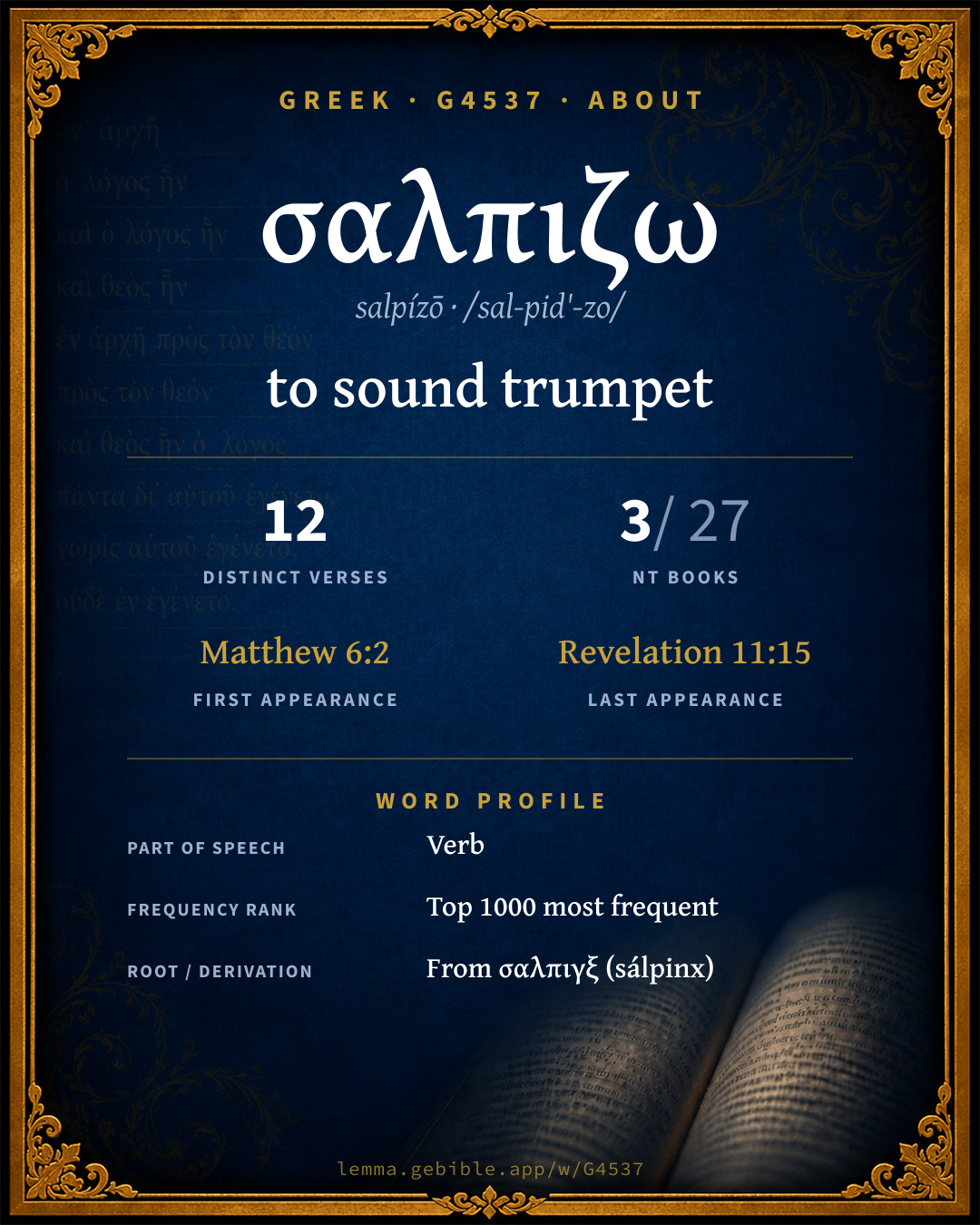
σαλπίζω
to sound trumpet
Full lexicon entry — Thayer's Greek Lexicon
From Thayer's Greek Lexicon
Where this word appears
See every Aorist-tense verb in the Greek New Testament →
Grammar key — what these labels mean
Part of speech
- Verb
- An action or state-of-being word.
Tense
- Aorist
- Action viewed as a simple whole, without regard to duration — often past (perfective aspect).
- Present
- Ongoing or general action in present time (imperfective aspect).
- Future
- Action expected in future time.
Voice
- Active
- The subject performs the action.
Mood
- Indicative
- States a fact or asks a factual question (the mood of reality).
- Infinitive
- A verbal noun (“to write”), unmarked for person or number.
- Subjunctive
- Expresses probability, purpose, or possibility (the mood of contingency).
Person
- 3rd person
- The one spoken about (“he / she / it / they”).
- 2nd person
- The one addressed (“you”).
Number
- Singular
- One.
- Plural
- More than one.
Grammatical forms
- Verb, Aorist, Active, Indicative, 3rd person, Singular 7 times (58%)
- Verb, Present, Active, Infinitive 2 times (17%)
- Verb, Aorist, Active, Subjunctive, 2nd person, Singular 1 time (8%)
- Verb, Aorist, Active, Subjunctive, 3rd person, Plural 1 time (8%)
- Verb, Future, Active, Indicative, 3rd person, Singular 1 time (8%)
Parsed forms decoded from the imported morphology (Robinson–Tischendorf, public domain), counted across 12 parsed occurrences — not distinct verses.
Every verse where G4537 appears — 12 distinct verses across 3 books. Click any verse to open its interlinear word-by-word view. Verse text shown in the World English Bible for context — . Each verse’s Greek form is shown with its reference; the English is not keyword-highlighted, since the data carries no word-level English alignment. Use “Compare translations” on any verse to read it across multiple English versions. This concordance covers the Greek New Testament; Septuagint (Greek Old Testament) occurrences of this word are not indexed here.
Matthew 1 verse
1 Corinthians 1 verse
Revelation 10 verses
- Revelation 8:6 σαλπίσωσιν aor act subj 3pl The seven angels who had the seven trumpets prepared themselves to sound.
- Revelation 8:7 ἐσάλπισεν aor act ind 3sg The first sounded, and there followed hail and fire, mixed with blood, and they were thrown to the earth. One third of the earth was burnt up, and one third of the trees were burnt up, and all green grass was burnt up.
- Revelation 8:8 ἐσάλπισεν aor act ind 3sg The second angel sounded, and something like a great burning mountain was thrown into the sea. One third of the sea became blood,
- Revelation 8:10 ἐσάλπισεν aor act ind 3sg The third angel sounded, and a great star fell from the sky, burning like a torch, and it fell on one third of the rivers, and on the springs of the waters.
- Revelation 8:12 ἐσάλπισεν aor act ind 3sg The fourth angel sounded, and one third of the sun was struck, and one third of the moon, and one third of the stars; so that one third of them would be darkened, and the day wouldn't shine for one third of it, and the night in the same way.
- Revelation 8:13 σαλπίζειν pres act inf I saw, and I heard an eagle, flying in mid heaven, saying with a loud voice, "Woe! Woe! Woe for those who dwell on the earth, because of the other voices of the trumpets of the three angels, who are yet to sound!"
- Revelation 9:1 ἐσάλπισεν aor act ind 3sg The fifth angel sounded, and I saw a star from the sky which had fallen to the earth. The key to the pit of the abyss was given to him.
- Revelation 9:13 ἐσάλπισεν aor act ind 3sg The sixth angel sounded. I heard a voice from the horns of the golden altar which is before God,
- Revelation 10:7 σαλπίζειν pres act inf but in the days of the voice of the seventh angel, when he is about to sound, then the mystery of God is finished, as he declared to his servants, the prophets.
- Revelation 11:15 ἐσάλπισεν aor act ind 3sg The seventh angel sounded, and great voices in heaven followed, saying, "The kingdom of the world has become the Kingdom of our Lord, and of his Christ. He will reign forever and ever!"
About this entry
At a glance — auto-summarized from this page’s data, not written by a person. Every figure links to its source below. This summary describes the numbers; it doesn’t interpret them.
The Greek verb σαλπιζω centers on the idea of “to sound trumpet.” Revelation dominates its distribution — 10 of 12 verses. The Greek New Testament uses it across 12 verses — uncommon. Its earliest occurrence is Matthew 6:2. Its English rendering has broadened — “sounded” classically, “sounded trumpet” (Berean Standard Bible) and “trumpeted” (unfoldingWord Literal Text) in modern versions; see the renderings breakdown. For the data behind this summary, explore the sense tree and the renderings breakdown below.
Gloss history
Strong's 1890 vs modern scholarship
About this word
Strong's G4537 catalogs a Greek word from the Greek New Testament.
These counts are not copied from any lexicon or concordance. They are computed here, from the morphology-tagged Greek New Testament. What Lemma adds →
- 12
- distinct verses
- The word appears in 12 distinct verses.
- 3 / 27
- NT books
- The word appears in 3 of 27 New Testament books.
- #904
- by frequency
- Top 1000 most frequent Greek words (rank 904 of 5,347 Greek words by occurrence).
View all 12 occurrences in the concordance →
Most concentrated in
- Revelation 10 verses 83%
- Matthew 1 verse 8%
- 1 Corinthians 1 verse 8%
By section of the New Testament
By traditional corpus
Conventional, traditional groupings — biblical authorship is debated, so this is a traditional corpus grouping, not an authorship claim. Some books belong to more than one corpus (Luke is in both the Gospels and the Lukan corpus, and so on), so these shares overlap and need not total 100%. Each figure is a share of the word’s 12 distinct verses.
- Johannine 10 verses · 83%
- Revelation 10 verses · 83%
- Gospels 1 verse · 8%
- Pauline corpus 1 verse · 8%
How translations render this word
Counts come from each version’s own published word-to-Strong’s tagging or interlinear alignment — an approximate guide to how each version renders this word, not a word-level alignment the data otherwise carries. Because each total is that version’s own tagged count, the per-version totals vary from one another and need not match the appearance or distinct-verse counts above. These counts may also differ from a printed concordance because Lemma counts each distinctly tagged rendering and does not collapse phrase taggings into a single head-word total. This is a fixed set of word-tagged versions (KJV, ASV, BSB, ULT) and does not change with the reading translation you choose elsewhere. Each version’s license is shown beside its name below (and on Sources).
- King James Version: Sounded 7×, Sound 3×
- American Standard Version: Sounded 6×, Sound 3×
- Berean Standard Bible: Sounded trumpet 7×
- unfoldingWord Literal Text: Trumpeted 7×, Trumpet 2×
King James Version Public Domain
Renders G4537 across 13 tagged occurrences — most commonly:
Plus 3 renderings that appear only once — usually multi-word phrases or single function words the recovered tagging swept in, not distinct renderings.
American Standard Version Public Domain
Renders G4537 across 12 tagged occurrences — most commonly:
Plus 3 renderings that appear only once — usually multi-word phrases or single function words the recovered tagging swept in, not distinct renderings.
Berean Standard Bible Public Domain
Renders G4537 across 12 tagged occurrences — most commonly:
Plus 5 renderings that appear only once — usually multi-word phrases or single function words the recovered tagging swept in, not distinct renderings.
unfoldingWord Literal Text CC BY-SA 4.0
Renders G4537 across 13 tagged occurrences — most commonly:
Plus 4 renderings that appear only once — usually multi-word phrases or single function words the recovered tagging swept in, not distinct renderings.
Senses in Thayer's
The 1 sense Thayer's distinguishes for this word, in lexicon order (not ranked by frequency or importance). The full entry — with sub-senses — is in the Lexicon Entry tab.
- to sound a trumpet
Word origin
Derived from σαλπιγξ (sálpinx) (G4536) — trumpet.
From G4536 ; to trumpet that is sound a blast (literally or figuratively): - (which are yet to) sound (a trumpet).
— Strong’s Exhaustive Concordance (1890), public domain.
Forms in the corpus
The 5 distinct written forms G4537 takes in the Greek New Testament, most frequent first — each parse links to that tense’s occurrences in the concordance.
| Form | Parsing | Example | Uses |
|---|---|---|---|
| ἐσάλπισεν esálpisen | Verb, Aorist, Active, Indicative, 3rd person, Singular | Revelation 8:7 | 7 |
| σαλπίζειν salpízein | Verb, Present, Active, Infinitive | Revelation 8:13 | 2 |
| σαλπίσει salpísei | Verb, Future, Active, Indicative, 3rd person, Singular | 1 Corinthians 15:52 | 1 |
| σαλπίσωσιν salpísōsin | Verb, Aorist, Active, Subjunctive, 3rd person, Plural | Revelation 8:6 | 1 |
| σαλπίσῃς salpísēs | Verb, Aorist, Active, Subjunctive, 2nd person, Singular | Matthew 6:2 | 1 |
Same root — word family
Other Thayer's entries built from the same root as G4537, grouped by Strong’s listed origin. These share a root / origin per the lexicon — not necessarily a shared meaning. Each links to that word’s own entry.
Derives from
Derived from this word
Compare all same-root words → They share a root, not necessarily a meaning.
Septuagint usage
The same Greek word σαλπιζω appears 50 times in the Greek Old Testament (Septuagint), across 45 verses in 17 books.
- 50
- LXX occurrences
- Tagged occurrences of this Greek word in the Septuagint.
- 45
- verses
- Distinct Septuagint verses containing this word.
- 17 / 39
- OT books
- The word appears in 17 of the 39 Old Testament books.
Sample Septuagint occurrences
- Numbers 10:3 σαλπίζω
- Joshua 6:5 σαλπίζω
- Judges 3:27 σαλπίζω
- 1 Samuel 13:3 σαλπίζω
- 2 Samuel 2:28 σαλπίζω
- 1 Kings 1:34 σαλπίζω
- 2 Kings 9:13 σαλπίζω
- 1 Chronicles 15:24 σαλπίζω
- 2 Chronicles 5:12 σαλπίζω
- Ezra 14:12 σαλπίζω
- Psalms 80:4 σαλπίζω
- Isaiah 27:13 σαλπίζω
Septuagint occurrences (same lexeme)
Every verse where the same Strong’s number (G4537) appears in the Greek Septuagint. Verse text shown in the World English Bible for context; the Greek form is the matched word — the English is not keyword-highlighted.
- Numbers 10:3 σαλπίζω When they shall blow them, all the congregation shall gather themselves to you at the door of the tent of meeting.
- Numbers 10:4 σαλπίζω If they blow but one, then the princes, the heads of the thousands of Israel, shall gather themselves to you.
- Numbers 10:5 σαλπίζω When you blow an alarm, the camps that lie on the east side shall take their journey.
- Numbers 10:6 σαλπίζω When you blow an alarm the second time, the camps that lie on the south side shall take their journey: they shall blow an alarm for their journeys.
- Numbers 10:7 σαλπίζω But when the assembly is to be gathered together, you shall blow, but you shall not sound an alarm.
- Numbers 10:8 σαλπίζω The sons of Aaron, the priests, shall blow the trumpets; and they shall be to you for a statute forever throughout your generations.
- Numbers 10:10 σαλπίζω Also in the day of your gladness, and in your set feasts, and in the beginnings of your months, you shall blow the trumpets over your burnt offerings, and over the sacrifices of your peace-offerings; and they shall be to you for a memorial before your God: I am Yahweh your God.
- Joshua 6:5 σαλπίζω It shall be that when they make a long blast with the ram's horn, and when you hear the sound of the trumpet, all the people shall shout with a great shout; and the wall of the city shall fall down flat, and the people shall go up every man straight before him.
- Joshua 6:9 σαλπίζω The armed men went before the priests who blew the trumpets, and the rearward went after the ark, [the priests] blowing the trumpets as they went.
- Joshua 6:13 σαλπίζω The seven priests bearing the seven trumpets of rams' horns before the ark of Yahweh went on continually, and blew the trumpets: and the armed men went before them; and the rearward came after the ark of Yahweh, [the priests] blowing the trumpets as they went.
- Joshua 6:16 σαλπίζω It happened at the seventh time, when the priests blew the trumpets, Joshua said to the people, Shout; for Yahweh has given you the city.
- Joshua 6:20 σαλπίζω So the people shouted, and [the priests] blew the trumpets; and it happened, when the people heard the sound of the trumpet, that the people shouted with a great shout, and the wall fell down flat, so that the people went up into the city, every man straight before him, and they took the city.
- Judges 3:27 σαλπίζω It happened, when he had come, that he blew a trumpet in the hill-country of Ephraim; and the children of Israel went down with him from the hill-country, and he before them.
- Judges 6:34 σαλπίζω But the Spirit of Yahweh came on Gideon; and he blew a trumpet; and Abiezer was gathered together after him.
- Judges 7:18 σαλπίζω When I blow the trumpet, I and all who are with me, then blow you the trumpets also on every side of all the camp, and say, For Yahweh and for Gideon.
- Judges 7:19 σαλπίζω So Gideon, and the hundred men who were with him, came to the outermost part of the camp in the beginning of the middle watch, when they had but newly set the watch: and they blew the trumpets, and broke in pieces the pitchers that were in their hands.
- Judges 7:20 σαλπίζω The three companies blew the trumpets, and broke the pitchers, and held the torches in their left hands, and the trumpets in their right hands with which to blow; and they cried, The sword of Yahweh and of Gideon.
- Judges 7:22 σαλπίζω They blew the three hundred trumpets, and Yahweh set every man's sword against his fellow, and against all the host; and the host fled as far as Beth-shittah toward Zererah, as far as the border of Abel Meholah, by Tabbath.
- 1 Samuel 13:3 σαλπίζω Jonathan struck the garrison of the Philistines that was in Geba: and the Philistines heard of it. Saul blew the trumpet throughout all the land, saying, Let the Hebrews hear.
- 2 Samuel 2:28 σαλπίζω So Joab blew the trumpet; and all the people stood still, and pursued after Israel no more, neither fought they any more.
- 2 Samuel 18:16 σαλπίζω Joab blew the trumpet, and the people returned from pursuing after Israel; for Joab held back the people.
- 2 Samuel 20:1 σαλπίζω There happened to be there a base fellow, whose name was Sheba, the son of Bichri, a Benjamite: and he blew the trumpet, and said, We have no portion in David, neither have we inheritance in the son of Jesse: every man to his tents, Israel.
- 2 Samuel 20:22 σαλπίζω Then the woman went to all the people in her wisdom. They cut off the head of Sheba the son of Bichri, and threw it out to Joab. He blew the trumpet, and they were dispersed from the city, every man to his tent. Joab returned to Jerusalem to the king.
- 1 Kings 1:34 σαλπίζω and let Zadok the priest and Nathan the prophet anoint him there king over Israel; and blow you the trumpet, and say, [Long] live king Solomon.
- 1 Kings 1:39 σαλπίζω Zadok the priest took the horn of oil out of the Tent, and anointed Solomon. They blew the trumpet; and all the people said, [Long] live king Solomon.
- 2 Kings 9:13 σαλπίζω Then they hurried, and took every man his garment, and put it under him on the top of the stairs, and blew the trumpet, saying, Jehu is king.
- 2 Kings 11:14 σαλπίζω and she looked, and, behold, the king stood by the pillar, as the manner was, and the captains and the trumpets by the king; and all the people of the land rejoiced, and blew trumpets. Then Athaliah tore her clothes, and cried, Treason! treason!
- 1 Chronicles 15:24 σαλπίζω Shebaniah, and Joshaphat, and Nethanel, and Amasai, and Zechariah, and Benaiah, and Eliezer, the priests, did blow the trumpets before the ark of God: and Obed-edom and Jehiah were doorkeepers for the ark.
- 2 Chronicles 5:12 σαλπίζω also the Levites who were the singers, all of them, even Asaph, Heman, Jeduthun, and their sons and their brothers, arrayed in fine linen, with cymbals and psalteries and harps, stood at the east end of the altar, and with them one hundred twenty priests sounding with trumpets;)
- 2 Chronicles 5:13 σαλπίζω it happened, when the trumpeters and singers were as one, to make one sound to be heard in praising and thanking Yahweh; and when they lifted up their voice with the trumpets and cymbals and instruments of music, and praised Yahweh, [saying], For he is good; for his loving kindness endures forever; that then the house was filled with a cloud, even the house of Yahweh,
- 2 Chronicles 7:6 σαλπίζω The priests stood, according to their offices; the Levites also with instruments of music of Yahweh, which David the king had made to give thanks to Yahweh, (for his loving kindness endures for ever), when David praised by their ministry: and the priests sounded trumpets before them; and all Israel stood.
- 2 Chronicles 13:14 σαλπίζω When Judah looked back, behold, the battle was before and behind them; and they cried to Yahweh, and the priests sounded with the trumpets.
- 2 Chronicles 23:13 σαλπίζω and she looked, and, behold, the king stood by his pillar at the entrance, and the captains and the trumpets by the king; and all the people of the land rejoiced, and blew trumpets; the singers also [played] on instruments of music, and led the singing of praise. Then Athaliah tore her clothes, and said, Treason! treason!
- 2 Chronicles 29:28 σαλπίζω All the assembly worshiped, and the singers sang, and the trumpeters sounded; all this [continued] until the burnt offering was finished.
- Ezra 14:12 σαλπίζω
- Psalms 80:4 σαλπίζω Yahweh God of hosts, How long will you be angry against the prayer of your people?
- Isaiah 27:13 σαλπίζω It shall happen in that day, that a great trumpet shall be blown; and they shall come who were ready to perish in the land of Assyria, and those who were outcasts in the land of Egypt; and they shall worship Yahweh in the holy mountain at Jerusalem.
- Isaiah 44:23 σαλπίζω Sing, you heavens, for Yahweh has done it; shout, you lower parts of the earth; break forth into singing, you mountains, O forest, and every tree therein: for Yahweh has redeemed Jacob, and will glorify himself in Israel.
- Jeremiah 28:27 σαλπίζω
- Ezekiel 7:14 σαλπίζω They have blown the trumpet, and have made all ready; but none goes to the battle; for my wrath is on all the multitude of it.
- Ezekiel 33:3 σαλπίζω if, when he sees the sword come on the land, he blow the trumpet, and warn the people;
- Hosea 5:8 σαλπίζω "Blow the cornet in Gibeah, And the trumpet in Ramah! Sound a battle cry at Beth Aven, behind you, Benjamin!
- Joel 2:1 σαλπίζω Blow you the trumpet in Zion, And sound an alarm in my holy mountain! Let all the inhabitants of the land tremble, For the day of Yahweh comes, For it is close at hand:
- Joel 2:15 σαλπίζω Blow the trumpet in Zion! Sanctify a fast. Call a solemn assembly.
- Zechariah 9:14 σαλπίζω Yahweh will be seen over them; And his arrow will go flash like lightning; And the Lord Yahweh will blow the trumpet, And will go with whirlwinds of the south.
These are occurrences of the same Greek lexeme (G4537) in the Septuagint — not a translation of any one Hebrew word. The store carries no word-level Hebrew↔Greek alignment, so no Hebrew original is asserted here. Counts come from the recovered LXX Strong's tagging — high-frequency vocabulary is well covered, while rare or late forms may be untagged — so they reflect tagged occurrences and may slightly undercount.