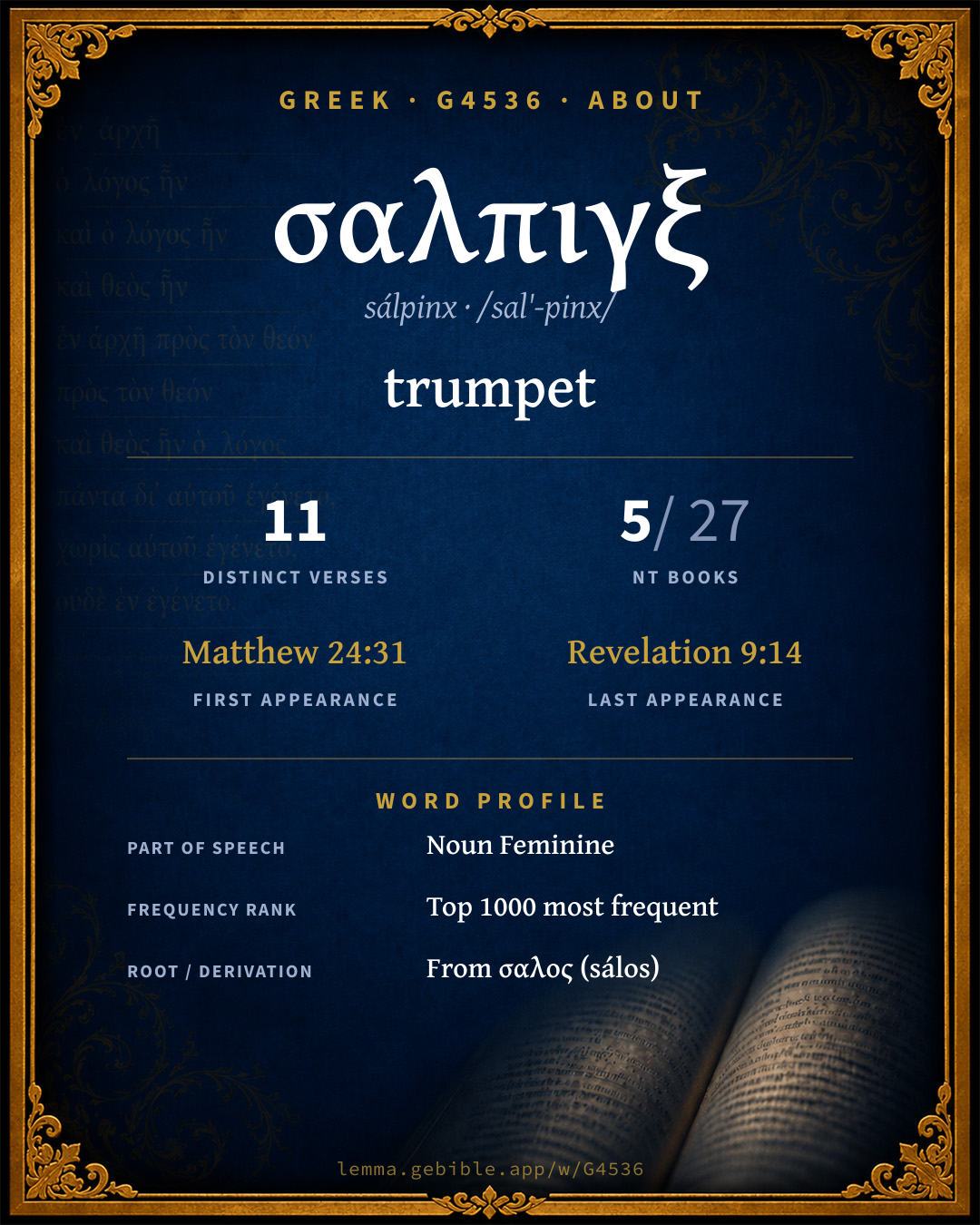
σάλπιγξ
trumpet
Full lexicon entry — Thayer's Greek Lexicon
From Thayer's Greek Lexicon
Where this word appears
See every Genitive-case word in the Greek New Testament →
Grammar key — what these labels mean
Part of speech
- Noun
- A naming word — a person, place, thing, or idea.
Case
- Genitive
- The case of source, possession, or “of” — answers “whose / from what.”
- Dative
- The case of the indirect object, means, or location — “to / for / with / in.”
- Accusative
- The case of the direct object and of extent.
- Nominative
- The case of the subject (and the predicate nominative).
Gender
- Feminine
- Grammatically feminine.
Number
- Singular
- One.
- Plural
- More than one.
Grammatical forms
- Noun, Genitive, Singular, Feminine 5 times (45%)
- Noun, Dative, Singular, Feminine 2 times (18%)
- Noun, Accusative, Plural, Feminine 1 time (9%)
- Noun, Accusative, Singular, Feminine 1 time (9%)
- Noun, Nominative, Plural, Feminine 1 time (9%)
- Noun, Nominative, Singular, Feminine 1 time (9%)
Parsed forms decoded from the imported morphology (Robinson–Tischendorf, public domain), counted across 11 parsed occurrences — not distinct verses.
Every verse where G4536 appears — 11 distinct verses across 5 books. Click any verse to open its interlinear word-by-word view. Verse text shown in the World English Bible for context — . Each verse’s Greek form is shown with its reference; the English is not keyword-highlighted, since the data carries no word-level English alignment. Use “Compare translations” on any verse to read it across multiple English versions. This concordance covers the Greek New Testament; Septuagint (Greek Old Testament) occurrences of this word are not indexed here.
Matthew 1 verse
1 Corinthians 2 verses
- 1 Corinthians 14:8 σάλπιγξ n nom sg fem For if the trumpet gave an uncertain sound, who would prepare himself for war?
- 1 Corinthians 15:52 σάλπιγγι n dat sg fem in a moment, in the twinkling of an eye, at the last trumpet. For the trumpet will sound, and the dead will be raised incorruptible, and we will be changed.
1 Thessalonians 1 verse
Hebrews 1 verse
Revelation 6 verses
- Revelation 1:10 σάλπιγγος n gen sg fem I was in the Spirit on the Lord's day, and I heard behind me a loud voice, like a trumpet
- Revelation 4:1 σάλπιγγος n gen sg fem After these things I looked and saw a door opened in heaven, and the first voice that I heard, like a trumpet speaking with me, was one saying, "Come up here, and I will show you the things which must happen after this."
- Revelation 8:2 σάλπιγγες n nom pl fem I saw the seven angels who stand before God, and seven trumpets were given to them.
- Revelation 8:6 σάλπιγγας n acc pl fem The seven angels who had the seven trumpets prepared themselves to sound.
- Revelation 8:13 σάλπιγγος n gen sg fem I saw, and I heard an eagle, flying in mid heaven, saying with a loud voice, "Woe! Woe! Woe for those who dwell on the earth, because of the other voices of the trumpets of the three angels, who are yet to sound!"
- Revelation 9:14 σάλπιγγα n acc sg fem saying to the sixth angel who had one trumpet, "Free the four angels who are bound at the great river Euphrates!"
About this entry
At a glance — auto-summarized from this page’s data, not written by a person. Every figure links to its source below. This summary describes the numbers; it doesn’t interpret them.
“trumpet” is the headline sense of the Greek noun σαλπιγξ (sálpinx). More than half of its appearances fall in Revelation. The Greek New Testament uses it across 11 verses — uncommon. First canonically at Matthew 24:31, it enters the text early. It shares a root with σαλος, σαλευω and σαλπιζω. See the sense tree, 11-verse concordance, and the renderings breakdown below.
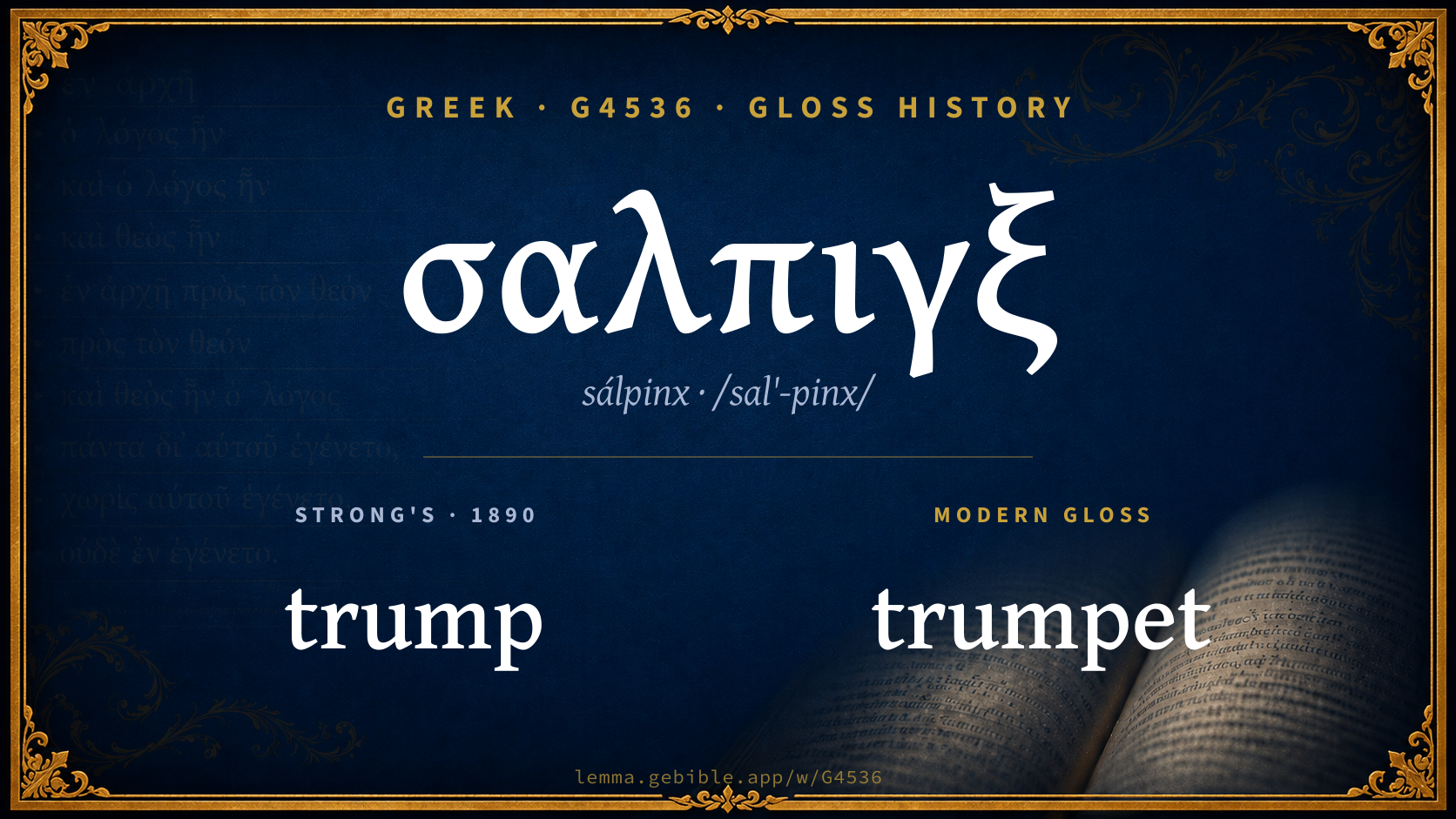
Gloss history
Strong's 1890 vs modern scholarship
About this word
Strong's G4536 catalogs a Greek word from the Greek New Testament.
These counts are not copied from any lexicon or concordance. They are computed here, from the morphology-tagged Greek New Testament. What Lemma adds →
- 11
- distinct verses
- The word appears in 11 distinct verses.
- 5 / 27
- NT books
- The word appears in 5 of 27 New Testament books.
- #978
- by frequency
- Top 1000 most frequent Greek words (rank 978 of 5,347 Greek words by occurrence).
View all 11 occurrences in the concordance →
Most concentrated in
- Revelation 6 verses 55%
- 1 Corinthians 2 verses 18%
- Matthew 1 verse 9%
By section of the New Testament
By traditional corpus
Conventional, traditional groupings — biblical authorship is debated, so this is a traditional corpus grouping, not an authorship claim. Some books belong to more than one corpus (Luke is in both the Gospels and the Lukan corpus, and so on), so these shares overlap and need not total 100%. Each figure is a share of the word’s 11 distinct verses.
- Johannine 6 verses · 55%
- Revelation 6 verses · 55%
- Pauline corpus 3 verses · 27%
- Gospels 1 verse · 9%
- Hebrews 1 verse · 9%
How translations render this word
Counts come from each version’s own published word-to-Strong’s tagging or interlinear alignment — an approximate guide to how each version renders this word, not a word-level alignment the data otherwise carries. Because each total is that version’s own tagged count, the per-version totals vary from one another and need not match the appearance or distinct-verse counts above. These counts may also differ from a printed concordance because Lemma counts each distinctly tagged rendering and does not collapse phrase taggings into a single head-word total. This is a fixed set of word-tagged versions (KJV, ASV, BSB, ULT) and does not change with the reading translation you choose elsewhere. Each version’s license is shown beside its name below (and on Sources).
- King James Version: Trumpet 7×, Trump 2×, Trumpets 2×
- American Standard Version: Trumpet 6×, Trump 2×, Trumpets 2×
- Berean Standard Bible: Trumpet 8×, Trumpets 2×
- unfoldingWord Literal Text: Trumpet 9×, Trumpets 2×
King James Version Public Domain
Renders G4536 across 11 tagged occurrences — most commonly:
American Standard Version Public Domain
Renders G4536 across 11 tagged occurrences — most commonly:
Plus 1 rendering that appears only once — usually multi-word phrases or single function words the recovered tagging swept in, not distinct renderings.
Berean Standard Bible Public Domain
Renders G4536 across 11 tagged occurrences — most commonly:
Plus 1 rendering that appears only once — usually multi-word phrases or single function words the recovered tagging swept in, not distinct renderings.
unfoldingWord Literal Text CC BY-SA 4.0
Renders G4536 across 12 tagged occurrences — most commonly:
Plus 1 rendering that appears only once — usually multi-word phrases or single function words the recovered tagging swept in, not distinct renderings.
Senses in Thayer's
The 1 sense Thayer's distinguishes for this word, in lexicon order (not ranked by frequency or importance). The full entry — with sub-senses — is in the Lexicon Entry tab.
- a trumpet
Word origin
Derived from σαλος (sálos) (G4535) — swell.
Perhaps from G4535 (through the idea of quavering or reverberation ); a trumpet : - trump (-et).
— Strong’s Exhaustive Concordance (1890), public domain.
Forms in the corpus
The 6 distinct written forms G4536 takes in the Greek New Testament, most frequent first — each parse links to that case’s occurrences in the concordance.
| Form | Parsing | Example | Uses |
|---|---|---|---|
| σάλπιγγος sálpingos | Noun, Genitive, Singular, Feminine | Matthew 24:31 | 5 |
| σάλπιγγι sálpingi | Noun, Dative, Singular, Feminine | 1 Corinthians 15:52 | 2 |
| σάλπιγγα sálpinga | Noun, Accusative, Singular, Feminine | Revelation 9:14 | 1 |
| σάλπιγγας sálpingas | Noun, Accusative, Plural, Feminine | Revelation 8:6 | 1 |
| σάλπιγγες sálpinges | Noun, Nominative, Plural, Feminine | Revelation 8:2 | 1 |
| σάλπιγξ sálpinx | Noun, Nominative, Singular, Feminine | 1 Corinthians 14:8 | 1 |
Same root — word family
Other Thayer's entries built from the same root as G4536, grouped by Strong’s listed origin. These share a root / origin per the lexicon — not necessarily a shared meaning. Each links to that word’s own entry.
Derives from
Shares the same root
Derived from this word
Proper names from this root
People and places named from this root — a name, not an additional meaning of the word.
Compare all same-root words → Showing 4 of 5 — not the complete family. 1 of the same-root words is a proper name (a person or place). They share a root, not necessarily a meaning.
Septuagint usage
The same Greek word σαλπιγξ appears 78 times in the Greek Old Testament (Septuagint), across 72 verses in 21 books.
- 78
- LXX occurrences
- Tagged occurrences of this Greek word in the Septuagint.
- 72
- verses
- Distinct Septuagint verses containing this word.
- 21 / 39
- OT books
- The word appears in 21 of the 39 Old Testament books.
Sample Septuagint occurrences
- Exodus 19:13 σάλπιγξ
- Leviticus 23:24 σάλπιγξ
- Numbers 10:2 σάλπιγξ
- Joshua 6:5 σάλπιγξ
- 1 Samuel 13:3 σάλπιγξ
- 2 Samuel 2:28 σάλπιγξ
- 2 Kings 11:14 σάλπιγξ
- 1 Chronicles 13:8 σάλπιγξ
- 2 Chronicles 5:12 σάλπιγξ
- Ezra 3:10 σάλπιγξ
- Job 39:24 σάλπιγξ
- Psalms 46:6 σάλπιγξ
Septuagint occurrences (same lexeme)
Every verse where the same Strong’s number (G4536) appears in the Greek Septuagint — showing the first 50 of 72. Verse text shown in the World English Bible for context; the Greek form is the matched word — the English is not keyword-highlighted.
- Exodus 19:13 σάλπιγξ No hand shall touch him, but he shall surely be stoned or shot through; whether it is animal or man, he shall not live.' When the trumpet sounds long, they shall come up to the mountain."
- Exodus 19:16 σάλπιγξ It happened on the third day, when it was morning, that there were thunders and lightnings, and a thick cloud on the mountain, and the sound of an exceedingly loud trumpet; and all the people who were in the camp trembled.
- Exodus 19:19 σάλπιγξ When the sound of the trumpet grew louder and louder, Moses spoke, and God answered him by a voice.
- Exodus 20:18 σάλπιγξ All the people perceived the thunderings, the lightnings, the sound of the trumpet, and the mountain smoking. When the people saw it, they trembled, and stayed at a distance.
- Leviticus 23:24 σάλπιγξ "Speak to the children of Israel, saying, 'In the seventh month, on the first day of the month, shall be a solemn rest to you, a memorial of blowing of trumpets, a holy convocation.
- Leviticus 25:9 σάλπιγξ Then you shall sound the loud trumpet on the tenth day of the seventh month. On the Day of Atonement you shall sound the trumpet throughout all your land.
- Numbers 10:2 σάλπιγξ Make you two trumpets of silver; of beaten work shall you make them: and you shall use them for the calling of the congregation, and for the journeying of the camps.
- Numbers 10:8 σάλπιγξ The sons of Aaron, the priests, shall blow the trumpets; and they shall be to you for a statute forever throughout your generations.
- Numbers 10:9 σάλπιγξ When you go to war in your land against the adversary who oppresses you, then you shall sound an alarm with the trumpets; and you shall be remembered before Yahweh your God, and you shall be saved from your enemies.
- Numbers 10:10 σάλπιγξ Also in the day of your gladness, and in your set feasts, and in the beginnings of your months, you shall blow the trumpets over your burnt offerings, and over the sacrifices of your peace-offerings; and they shall be to you for a memorial before your God: I am Yahweh your God.
- Numbers 31:6 σάλπιγξ Moses sent them, one thousand of every tribe, to the war, them and Phinehas the son of Eleazar the priest, to the war, with the vessels of the sanctuary and the trumpets for the alarm in his hand.
- Joshua 6:5 σάλπιγξ It shall be that when they make a long blast with the ram's horn, and when you hear the sound of the trumpet, all the people shall shout with a great shout; and the wall of the city shall fall down flat, and the people shall go up every man straight before him.
- Joshua 6:8 σάλπιγξ It was so, that when Joshua had spoken to the people, the seven priests bearing the seven trumpets of rams' horns before Yahweh passed on, and blew the trumpets: and the ark of the covenant of Yahweh followed them.
- Joshua 6:13 σάλπιγξ The seven priests bearing the seven trumpets of rams' horns before the ark of Yahweh went on continually, and blew the trumpets: and the armed men went before them; and the rearward came after the ark of Yahweh, [the priests] blowing the trumpets as they went.
- Joshua 6:20 σάλπιγξ So the people shouted, and [the priests] blew the trumpets; and it happened, when the people heard the sound of the trumpet, that the people shouted with a great shout, and the wall fell down flat, so that the people went up into the city, every man straight before him, and they took the city.
- 1 Samuel 13:3 σάλπιγξ Jonathan struck the garrison of the Philistines that was in Geba: and the Philistines heard of it. Saul blew the trumpet throughout all the land, saying, Let the Hebrews hear.
- 2 Samuel 2:28 σάλπιγξ So Joab blew the trumpet; and all the people stood still, and pursued after Israel no more, neither fought they any more.
- 2 Samuel 6:15 σάλπιγξ So David and all the house of Israel brought up the ark of Yahweh with shouting, and with the sound of the trumpet.
- 2 Kings 11:14 σάλπιγξ and she looked, and, behold, the king stood by the pillar, as the manner was, and the captains and the trumpets by the king; and all the people of the land rejoiced, and blew trumpets. Then Athaliah tore her clothes, and cried, Treason! treason!
- 2 Kings 12:14 σάλπιγξ for they gave that to those who did the work, and repaired therewith the house of Yahweh.
- 1 Chronicles 13:8 σάλπιγξ David and all Israel played before God with all their might, even with songs, and with harps, and with psalteries, and with tambourines, and with cymbals, and with trumpets.
- 1 Chronicles 15:24 σάλπιγξ Shebaniah, and Joshaphat, and Nethanel, and Amasai, and Zechariah, and Benaiah, and Eliezer, the priests, did blow the trumpets before the ark of God: and Obed-edom and Jehiah were doorkeepers for the ark.
- 1 Chronicles 15:28 σάλπιγξ Thus all Israel brought up the ark of the covenant of Yahweh with shouting, and with sound of the cornet, and with trumpets, and with cymbals, sounding aloud with psalteries and harps.
- 1 Chronicles 16:6 σάλπιγξ and Benaiah and Jahaziel the priests with trumpets continually, before the ark of the covenant of God.
- 1 Chronicles 16:42 σάλπιγξ and with them Heman and Jeduthun [with] trumpets and cymbals for those that should sound aloud, and [with] instruments for the songs of God; and the sons of Jeduthun to be at the gate.
- 2 Chronicles 5:12 σάλπιγξ also the Levites who were the singers, all of them, even Asaph, Heman, Jeduthun, and their sons and their brothers, arrayed in fine linen, with cymbals and psalteries and harps, stood at the east end of the altar, and with them one hundred twenty priests sounding with trumpets;)
- 2 Chronicles 5:13 σάλπιγξ it happened, when the trumpeters and singers were as one, to make one sound to be heard in praising and thanking Yahweh; and when they lifted up their voice with the trumpets and cymbals and instruments of music, and praised Yahweh, [saying], For he is good; for his loving kindness endures forever; that then the house was filled with a cloud, even the house of Yahweh,
- 2 Chronicles 7:6 σάλπιγξ The priests stood, according to their offices; the Levites also with instruments of music of Yahweh, which David the king had made to give thanks to Yahweh, (for his loving kindness endures for ever), when David praised by their ministry: and the priests sounded trumpets before them; and all Israel stood.
- 2 Chronicles 13:12 σάλπιγξ Behold, God is with us at our head, and his priests with the trumpets of alarm to sound an alarm against you. Children of Israel, don't you fight against Yahweh, the God of your fathers; for you shall not prosper.
- 2 Chronicles 13:14 σάλπιγξ When Judah looked back, behold, the battle was before and behind them; and they cried to Yahweh, and the priests sounded with the trumpets.
- 2 Chronicles 15:14 σάλπιγξ They swore to Yahweh with a loud voice, and with shouting, and with trumpets, and with cornets.
- 2 Chronicles 20:28 σάλπιγξ They came to Jerusalem with psalteries and harps and trumpets to the house of Yahweh.
- 2 Chronicles 23:13 σάλπιγξ and she looked, and, behold, the king stood by his pillar at the entrance, and the captains and the trumpets by the king; and all the people of the land rejoiced, and blew trumpets; the singers also [played] on instruments of music, and led the singing of praise. Then Athaliah tore her clothes, and said, Treason! treason!
- 2 Chronicles 29:26 σάλπιγξ The Levites stood with the instruments of David, and the priests with the trumpets.
- 2 Chronicles 29:27 σάλπιγξ Hezekiah commanded to offer the burnt offering on the altar. When the burnt offering began, the song of Yahweh began also, and the trumpets, together with the instruments of David king of Israel.
- 2 Chronicles 29:28 σάλπιγξ All the assembly worshiped, and the singers sang, and the trumpeters sounded; all this [continued] until the burnt offering was finished.
- Ezra 3:10 σάλπιγξ When the builders laid the foundation of the temple of Yahweh, they set the priests in their clothing with trumpets, and the Levites the sons of Asaph with cymbals, to praise Yahweh, after the order of David king of Israel.
- Ezra 18:15 σάλπιγξ
- Ezra 22:35 σάλπιγξ
- Ezra 22:41 σάλπιγξ
- Job 39:24 σάλπιγξ He eats up the ground with fierceness and rage, Neither does he stand still at the sound of the trumpet.
- Job 39:25 σάλπιγξ As often as the trumpet sounds he snorts, 'Aha!' He smells the battle afar off, The thunder of the captains, and the shouting.
- Psalms 46:6 σάλπιγξ The nations raged. The kingdoms were moved. He lifted his voice, and the earth melted.
- Psalms 80:4 σάλπιγξ Yahweh God of hosts, How long will you be angry against the prayer of your people?
- Psalms 97:6 σάλπιγξ The heavens declare his righteousness. All the peoples have seen his glory.
- Psalms 150:3 σάλπιγξ Praise him with the sounding of the trumpet! Praise him with harp and lyre!
- Isaiah 18:3 σάλπιγξ All you inhabitants of the world, and you dwellers on the earth, when an ensign is lifted up on the mountains, look; and when the trumpet is blown, listen.
- Isaiah 27:13 σάλπιγξ It shall happen in that day, that a great trumpet shall be blown; and they shall come who were ready to perish in the land of Assyria, and those who were outcasts in the land of Egypt; and they shall worship Yahweh in the holy mountain at Jerusalem.
- Isaiah 58:1 σάλπιγξ Cry aloud, don't spare, lift up your voice like a trumpet, and declare to my people their disobedience, and to the house of Jacob their sins.
- Jeremiah 4:5 σάλπιγξ Declare you in Judah, and publish in Jerusalem; and say, Blow you the trumpet in the land: cry aloud and say, Assemble yourselves, and let us go into the fortified cities.
These are occurrences of the same Greek lexeme (G4536) in the Septuagint — not a translation of any one Hebrew word. The store carries no word-level Hebrew↔Greek alignment, so no Hebrew original is asserted here. Counts come from the recovered LXX Strong's tagging — high-frequency vocabulary is well covered, while rare or late forms may be untagged — so they reflect tagged occurrences and may slightly undercount.