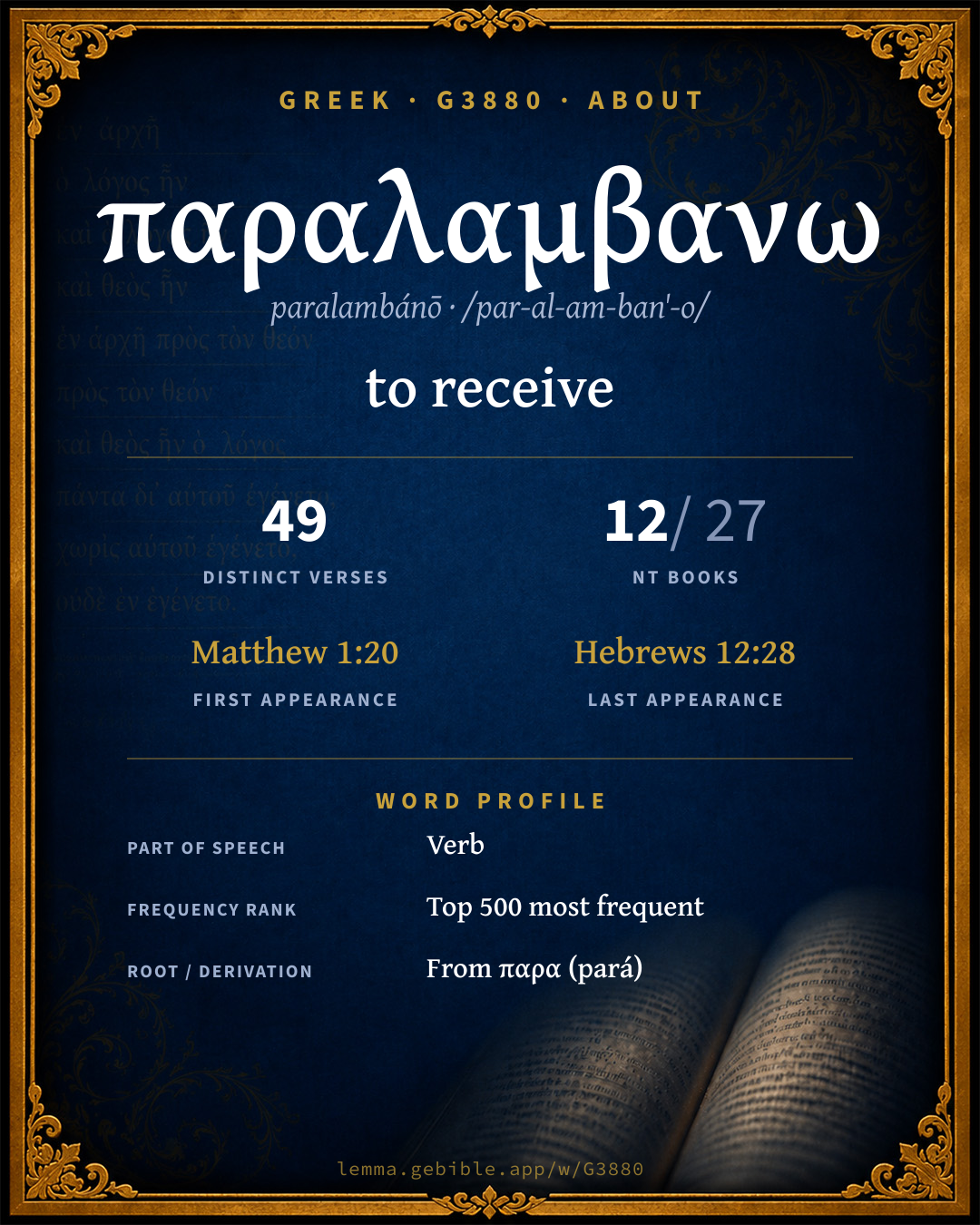
παραλαμβάνω
to receive
‘to receive’ is one of 2 main senses fuller range ↓
Full lexicon entry — Thayer's Greek Lexicon
From Thayer's Greek Lexicon
Where this word appears
See every Aorist-tense verb in the Greek New Testament →
Grammar key — what these labels mean
Part of speech
- Verb
- An action or state-of-being word.
Tense
- Aorist
- Action viewed as a simple whole, without regard to duration — often past (perfective aspect).
- Present
- Ongoing or general action in present time (imperfective aspect).
- Future
- Action expected in future time.
Voice
- Active
- The subject performs the action.
- Passive
- The subject receives the action.
- Middle deponent
- Middle in form but active in meaning.
Mood
- Participle
- A verbal adjective (“writing,” “having written”).
- Indicative
- States a fact or asks a factual question (the mood of reality).
- Imperative
- Expresses a command or request.
- Infinitive
- A verbal noun (“to write”), unmarked for person or number.
Case
- Nominative
- The case of the subject (and the predicate nominative).
- Accusative
- The case of the direct object and of extent.
Person
- 3rd person
- The one spoken about (“he / she / it / they”).
- 2nd person
- The one addressed (“you”).
- 1st person
- The speaker (“I / we”).
Gender
- Masculine
- Grammatically masculine.
Number
- Singular
- One.
- Plural
- More than one.
Grammatical forms 16 distinct
- Verb, Aorist, Active, Participle, Nominative, Singular, Masculine 10 times (20%)
- Verb, Present, Active, Indicative, 3rd person, Singular 8 times (16%)
- Verb, Aorist, Active, Indicative, 2nd person, Plural 5 times (10%)
- Verb, Aorist, Active, Indicative, 3rd person, Singular 4 times (8%)
- Verb, Aorist, Active, Indicative, 3rd person, Plural 4 times (8%)
- Verb, Aorist, Active, Indicative, 1st person, Singular 3 times (6%)
- Verb, Aorist, Active, Imperative, 2nd person, Singular 3 times (6%)
- Verb, Aorist, Active, Participle, Nominative, Plural, Masculine 2 times (4%)
+8 more forms (10 occurrences)
Parsed forms decoded from the imported morphology (Robinson–Tischendorf, public domain), counted across 49 parsed occurrences — not distinct verses.
Every verse where G3880 appears — 49 distinct verses across 12 books. Click any verse to open its interlinear word-by-word view. Verse text shown in the World English Bible for context — . Each verse’s Greek form is shown with its reference; the English is not keyword-highlighted, since the data carries no word-level English alignment. Use “Compare translations” on any verse to read it across multiple English versions. This concordance covers the Greek New Testament; Septuagint (Greek Old Testament) occurrences of this word are not indexed here.
Matthew 16 verses
- Matthew 1:20 παραλαβεῖν aor act inf But when he thought about these things, behold, an angel of the Lord appeared to him in a dream, saying, "Joseph, son of David, don't be afraid to take to yourself Mary, your wife, for that which is conceived in her is of the Holy Spirit.
- Matthew 1:24 παρέλαβεν aor act ind 3sg Joseph arose from his sleep, and did as the angel of the Lord commanded him, and took his wife to himself;
- Matthew 2:13 παράλαβε aor act impv 2sg Now when they had departed, behold, an angel of the Lord appeared to Joseph in a dream, saying, "Arise and take the young child and his mother, and flee into Egypt, and stay there until I tell you, for Herod will seek the young child to destroy him."
- Matthew 2:14 παρέλαβεν aor act ind 3sg He arose and took the young child and his mother by night, and departed into Egypt,
- Matthew 2:20 παράλαβε aor act impv 2sg "Arise and take the young child and his mother, and go into the land of Israel, for those who sought the young child's life are dead."
- Matthew 2:21 παρέλαβεν aor act ind 3sg He arose and took the young child and his mother, and came into the land of Israel.
- Matthew 4:5 παραλαμβάνει pres act ind 3sg Then the devil took him into the holy city. He set him on the pinnacle of the temple,
- Matthew 4:8 παραλαμβάνει pres act ind 3sg Again, the devil took him to an exceedingly high mountain, and showed him all the kingdoms of the world, and their glory.
- Matthew 12:45 παραλαμβάνει pres act ind 3sg Then he goes, and takes with himself seven other spirits more evil than he is, and they enter in and dwell there. The last state of that man becomes worse than the first. Even so will it be also to this evil generation."
- Matthew 17:1 παραλαμβάνει pres act ind 3sg After six days, Jesus took with him Peter, James, and John his brother, and brought them up into a high mountain by themselves.
- Matthew 18:16 παράλαβε aor act impv 2sg But if he doesn't listen, take one or two more with you, that at the mouth of two or three witnesses every word may be established.
- Matthew 20:17 παρέλαβεν aor act ind 3sg As Jesus was going up to Jerusalem, he took the twelve disciples aside, and on the way he said to them,
- Matthew 24:40 παραλαμβάνεται pres pass ind 3sg Then two men will be in the field: one will be taken and one will be left;
- Matthew 24:41 παραλαμβάνεται pres pass ind 3sg two women grinding at the mill, one will be taken and one will be left.
- Matthew 26:37 παραλαβὼν aor act ptcp nom sg masc He took with him Peter and the two sons of Zebedee, and began to be sorrowful and severely troubled.
- Matthew 27:27 παραλαβόντες aor act ptcp nom pl masc Then the governor's soldiers took Jesus into the Praetorium, and gathered the whole garrison together against him.
Mark 6 verses
- Mark 4:36 παραλαμβάνουσιν pres act ind 3pl Leaving the multitude, they took him with them, even as he was, in the boat. Other small boats were also with him.
- Mark 5:40 παραλαμβάνει pres act ind 3sg They ridiculed him. But he, having put them all out, took the father of the child and her mother and those who were with him, and went in where the child was lying.
- Mark 7:4 παρέλαβον aor act ind 3pl They don't eat when they come from the marketplace, unless they bathe themselves, and there are many other things, which they have received to hold to: washings of cups, pitchers, bronze vessels, and couches.)
- Mark 9:2 παραλαμβάνει pres act ind 3sg After six days Jesus took with him Peter, James, and John, and brought them up onto a high mountain privately by themselves, and he was changed into another form in front of them.
- Mark 10:32 παραλαβὼν aor act ptcp nom sg masc They were on the way, going up to Jerusalem; and Jesus was going in front of them, and they were amazed; and those who followed were afraid. He again took the twelve, and began to tell them the things that were going to happen to him.
- Mark 14:33 παραλαμβάνει pres act ind 3sg He took with him Peter, James, and John, and began to be greatly troubled and distressed.
Luke 6 verses
- Luke 9:10 παραλαβὼν aor act ptcp nom sg masc The apostles, when they had returned, told him what things they had done. He took them, and withdrew apart to a deserted place of a city called Bethsaida.
- Luke 9:28 παραλαβὼν aor act ptcp nom sg masc It happened about eight days after these sayings, that he took with him Peter, John, and James, and went up onto the mountain to pray.
- Luke 11:26 παραλαμβάνει pres act ind 3sg Then he goes, and takes seven other spirits more evil than himself, and they enter in and dwell there. The last state of that man becomes worse than the first."
- Luke 17:34 παραλημφθήσεται fut pass ind 3sg I tell you, in that night there will be two people in one bed. The one will be taken, and the other will be left.
- Luke 17:35 παραλημφθήσεται fut pass ind 3sg There will be two grinding grain together. One will be taken, and the other will be left."
- Luke 18:31 Παραλαβὼν aor act ptcp nom sg masc He took the twelve aside, and said to them, "Behold, we are going up to Jerusalem, and all the things that are written through the prophets concerning the Son of Man will be completed.
John 3 verses
- John 1:11 παρέλαβον aor act ind 3pl He came to his own, and those who were his own didn't receive him.
- John 14:3 παραλήμψομαι fut mid.dep ind 1sg If I go and prepare a place for you, I will come again, and will receive you to myself; that where I am, you may be there also.
- John 19:16 Παρέλαβον aor act ind 3pl So then he delivered him to them to be crucified. So they took Jesus and led him away.
Acts 6 verses
- Acts 15:39 παραλαβόντα aor act ptcp acc sg masc Then the contention grew so sharp that they separated from each other. Barnabas took Mark with him, and sailed away to Cyprus,
- Acts 16:33 παραλαβὼν aor act ptcp nom sg masc He took them the same hour of the night, and washed their stripes, and was immediately baptized, he and all his household.
- Acts 21:24 παραλαβὼν aor act ptcp nom sg masc Take them, and purify yourself with them, and pay their expenses for them, that they may shave their heads. Then all will know that there is no truth in the things that they have been informed about you, but that you yourself also walk keeping the law.
- Acts 21:26 παραλαβὼν aor act ptcp nom sg masc Then Paul took the men, and the next day, purified himself and went with them into the temple, declaring the fulfillment of the days of purification, until the offering was offered for every one of them.
- Acts 21:32 παραλαβὼν aor act ptcp nom sg masc Immediately he took soldiers and centurions, and ran down to them. They, when they saw the chief captain and the soldiers, stopped beating Paul.
- Acts 23:18 παραλαβὼν aor act ptcp nom sg masc So he took him, and brought him to the commanding officer, and said, "Paul, the prisoner, summoned me and asked me to bring this young man to you, who has something to tell you."
1 Corinthians 3 verses
- 1 Corinthians 11:23 παρέλαβον aor act ind 1sg For I received from the Lord that which also I delivered to you, that the Lord Jesus on the night in which he was betrayed took bread.
- 1 Corinthians 15:1 παρελάβετε aor act ind 2pl Now I declare to you, brothers, the Gospel which I preached to you, which also you received, in which you also stand,
- 1 Corinthians 15:3 παρέλαβον aor act ind 1sg For I delivered to you first of all that which I also received: that Christ died for our sins according to the Scriptures,
Galatians 2 verses
- Galatians 1:9 παρελάβετε aor act ind 2pl As we have said before, so I now say again: if any man preaches to you any gospel other than that which you received, let him be cursed.
- Galatians 1:12 παρέλαβον aor act ind 1sg For neither did I receive it from man, nor was I taught it, but it came to me through revelation of Jesus Christ.
Philippians 1 verse
Colossians 2 verses
1 Thessalonians 2 verses
- 1 Thessalonians 2:13 παραλαβόντες aor act ptcp nom pl masc For this cause we also thank God without ceasing, that, when you received from us the word of the message of God, you accepted it not as the word of men, but, as it is in truth, the word of God, which also works in you who believe.
- 1 Thessalonians 4:1 παρελάβετε aor act ind 2pl Finally then, brothers, we beg and exhort you in the Lord Jesus, that as you received from us how you ought to walk and to please God, that you abound more and more.
2 Thessalonians 1 verse
Hebrews 1 verse
About this entry
At a glance — auto-summarized from this page’s data, not written by a person. Every figure links to its source below. This summary describes the numbers; it doesn’t interpret them.
παραλαμβανω — transliterated paralambánō — is a Greek verb carrying the sense “to receive.” Older and newer Bibles part ways — “he took” in the King James Version, “taking” (unfoldingWord Literal Text) in modern versions. See the renderings breakdown. It appears 49 verses across 12 books of the Greek New Testament, among its moderately common vocabulary. More than a third of its appearances fall in Matthew. Thayer's distinguishes 2 senses for it. See the sense tree, 49-verse concordance, and the renderings breakdown below.
Gloss history
Strong's 1890 vs modern scholarship

About this word
Strong's G3880 catalogs a Greek word from the Greek New Testament.
These counts are not copied from any lexicon or concordance. They are computed here, from the morphology-tagged Greek New Testament. What Lemma adds →
- 49
- distinct verses
- The word appears in 49 distinct verses.
- 12 / 27
- NT books
- The word appears in 12 of 27 New Testament books.
- #316
- by frequency
- Top 500 most frequent Greek words (rank 316 of 5,347 Greek words by occurrence).
View all 49 occurrences in the concordance →
By section of the New Testament
By traditional corpus
Conventional, traditional groupings — biblical authorship is debated, so this is a traditional corpus grouping, not an authorship claim. Some books belong to more than one corpus (Luke is in both the Gospels and the Lukan corpus, and so on), so these shares overlap and need not total 100%. Each figure is a share of the word’s 49 distinct verses.
- Gospels 31 verses · 63%
- Lukan (Luke–Acts) 12 verses · 24%
- Pauline corpus 11 verses · 22%
- Johannine 3 verses · 6%
- Hebrews 1 verse · 2%
How translations render this word
Counts come from each version’s own published word-to-Strong’s tagging or interlinear alignment — an approximate guide to how each version renders this word, not a word-level alignment the data otherwise carries. Because each total is that version’s own tagged count, the per-version totals vary from one another and need not match the appearance or distinct-verse counts above. These counts may also differ from a printed concordance because Lemma counts each distinctly tagged rendering and does not collapse phrase taggings into a single head-word total. This is a fixed set of word-tagged versions (KJV, ASV, BSB, ULT) and does not change with the reading translation you choose elsewhere. Each version’s license is shown beside its name below (and on Sources).
- King James Version: He took 7×, Took 7×, Taketh 6×
- American Standard Version: He took 7×, Taketh 7×, Took 5×
- Berean Standard Bible: Took 11×, He took 4×, Take 4×
- unfoldingWord Literal Text: Taking 6×, Takes along 5×, You received 5×
King James Version Public Domain
Renders G3880 across 54 tagged occurrences — most commonly:
Plus 11 renderings that appear only once — usually multi-word phrases or single function words the recovered tagging swept in, not distinct renderings.
American Standard Version Public Domain
Renders G3880 across 51 tagged occurrences — most commonly:
Plus 15 renderings that appear only once — usually multi-word phrases or single function words the recovered tagging swept in, not distinct renderings.
Berean Standard Bible Public Domain
Renders G3880 across 49 tagged occurrences — most commonly:
Plus 13 renderings that appear only once — usually multi-word phrases or single function words the recovered tagging swept in, not distinct renderings.
unfoldingWord Literal Text CC BY-SA 4.0
Renders G3880 across 58 tagged occurrences — most commonly:
Plus 16 renderings that appear only once — usually multi-word phrases or single function words the recovered tagging swept in, not distinct renderings.
Senses in Thayer's
The 2 senses Thayer's distinguishes for this word, in lexicon order (not ranked by frequency or importance). The full entry — with sub-senses — is in the Lexicon Entry tab.
- to take to, to take with one's self, to join to one's self
- to receive something transmitted
Word origin
Derived from παρα (pará) (G3844) — from.
Forms in the corpus
The 18 distinct written forms G3880 takes in the Greek New Testament, most frequent first — each parse links to that tense’s occurrences in the concordance.
Same root — word family
Other Thayer's entries built from the same root as G3880, grouped by Strong’s listed origin. These share a root / origin per the lexicon — not necessarily a shared meaning. Each links to that word’s own entry.
Derives from
Shares the same root
- παραβαινω parabaínō G3845 to neglect
- παραβαλλω parabállō G3846 to place beside
- παραβιαζομαι parabiázomai G3849 to compel
- παραβουλευομαι parabouleúomai G3851 to consult wrongly
- παραγγελλω parangéllō G3853 to announce
- παραγινομαι paragínomai G3854 to appear
- παραγω parágō G3855 to pass by
- παραδειγματιζω paradeigmatízō G3856 to make example
- παραδεχομαι paradéchomai G3858 to receive
- παραδιατριβη paradiatribḗ G3859 empty business
- παραδιδωμι paradídōmi G3860 to deliver
- παραδοξος parádoxos G3861 strange
- παραζηλοω parazēlóō G3863 to provoke
- παραθαλασσιος parathalássios G3864 by the sea
- παραθεωρεω paratheōréō G3865 to compare
- παραινεω parainéō G3867 to exhort
- παραιτεομαι paraitéomai G3868 to beg pardon
- παρακαθιζω parakathízō G3869 to sit beside
- παρακαλεω parakaléō G3870 to call beside
- παρακαλυπτω parakalýptō G3871 to cover up
- παρακαταθηκη parakatathḗkē G3872 deposit
- παρακειμαι parákeimai G3873 to lie beside
- παρακολουθεω parakolouthéō G3877 to follow after
- παρακουω parakoúō G3878 to disobey
+51 more words share this root (not shown).
Proper names from this root
People and places named from this root — a name, not an additional meaning of the word.
Compare all same-root words → Showing 4 of 78 — not the complete family. 1 of the same-root words is a proper name (a person or place). They share a root, not necessarily a meaning.
Septuagint usage
The same Greek word παραλαμβανω appears 24 times in the Greek Old Testament (Septuagint), across 23 verses in 9 books.
- 24
- LXX occurrences
- Tagged occurrences of this Greek word in the Septuagint.
- 23
- verses
- Distinct Septuagint verses containing this word.
- 9 / 39
- OT books
- The word appears in 9 of the 39 Old Testament books.
Sample Septuagint occurrences
- Genesis 19:17 παραλαμβάνω
- Numbers 22:41 παραλαμβάνω
- Joshua 4:2 παραλαμβάνω
- 2 Chronicles 25:11 παραλαμβάνω
- Job 1:4 παραλαμβάνω
- Song of Solomon 8:2 παραλαμβάνω
- Jeremiah 30:17 παραλαμβάνω
- Lamentations 3:2 παραλαμβάνω
- Daniel 4:24 παραλαμβάνω
Septuagint occurrences (same lexeme)
Every verse where the same Strong’s number (G3880) appears in the Greek Septuagint. Verse text shown in the World English Bible for context; the Greek form is the matched word — the English is not keyword-highlighted.
- Genesis 19:17 παραλαμβάνω It came to pass, when they had taken them out, that he said, "Escape for your life! Don't look behind you, neither stay anywhere in the plain. Escape to the mountain, lest you be consumed!"
- Genesis 22:3 παραλαμβάνω Abraham rose early in the morning, and saddled his donkey, and took two of his young men with him, and Isaac his son. He split the wood for the burnt offering, and rose up, and went to the place of which God had told him.
- Genesis 31:23 παραλαμβάνω He took his relatives with him, and pursued after him seven days' journey. He overtook him in the mountain of Gilead.
- Genesis 45:18 παραλαμβάνω Take your father and your households, and come to me, and I will give you the good of the land of Egypt, and you will eat the fat of the land.'
- Genesis 47:2 παραλαμβάνω From among his brothers he took five men, and presented them to Pharaoh.
- Numbers 22:41 παραλαμβάνω It happened in the morning, that Balak took Balaam, and brought him up into the high places of Baal; and he saw from there the utmost part of the people.
- Numbers 23:14 παραλαμβάνω He took him into the field of Zophim, to the top of Pisgah, and built seven altars, and offered up a bull and a ram on every altar.
- Numbers 23:20 παραλαμβάνω Behold, I have received [commandment] to bless: He has blessed, and I can't reverse it.
- Numbers 23:27 παραλαμβάνω Balak said to Balaam, Come now, I will take you to another place; peradventure it will please God that you may curse me them from there.
- Numbers 23:28 παραλαμβάνω Balak took Balaam to the top of Peor, that looks down on the desert.
- Joshua 4:2 παραλαμβάνω Take twelve men out of the people, out of every tribe a man,
- 2 Chronicles 25:11 παραλαμβάνω Amaziah took courage, and led forth his people, and went to the Valley of Salt, and struck of the children of Seir ten thousand.
- Job 1:4 παραλαμβάνω His sons went and held a feast in the house of each one on his birthday; and they sent and called for their three sisters to eat and to drink with them.
- Song of Solomon 8:2 παραλαμβάνω I would lead you, bringing you into my mother's house, Who would instruct me. I would have you drink spiced wine, Of the juice of my pomegranate.
- Jeremiah 30:17 παραλαμβάνω For I will restore health to you, and I will heal you of your wounds, says Yahweh; because they have called you an outcast, [saying], It is Zion, whom no man seeks after.
- Jeremiah 30:18 παραλαμβάνω Thus says Yahweh: Behold, I will turn again the captivity of Jacob's tents, and have compassion on his dwelling-places; and the city shall be built on its own hill, and the palace shall be inhabited after its own manner.
- Jeremiah 39:7 παραλαμβάνω Moreover he put out Zedekiah's eyes, and bound him in fetters, to carry him to Babylon.
- Lamentations 3:2 παραλαμβάνω He has led me and caused me to walk in darkness, and not in light.
- Daniel 4:24 παραλαμβάνω this is the interpretation, O king, and it is the decree of the Most High, which is come on my lord the king:
- Daniel 6:1 παραλαμβάνω It pleased Darius to set over the kingdom one hundred twenty satraps, who should be throughout the whole kingdom;
- Daniel 6:20 παραλαμβάνω When he came near to the den to Daniel, he cried with a lamentable voice; the king spoke and said to Daniel, Daniel, servant of the living God, is your God, whom you serve continually, able to deliver you from the lions?
- Daniel 6:29 παραλαμβάνω
- Daniel 7:18 παραλαμβάνω But the saints of the Most High shall receive the kingdom, and possess the kingdom forever, even forever and ever.
These are occurrences of the same Greek lexeme (G3880) in the Septuagint — not a translation of any one Hebrew word. The store carries no word-level Hebrew↔Greek alignment, so no Hebrew original is asserted here. Counts come from the recovered LXX Strong's tagging — high-frequency vocabulary is well covered, while rare or late forms may be untagged — so they reflect tagged occurrences and may slightly undercount.