
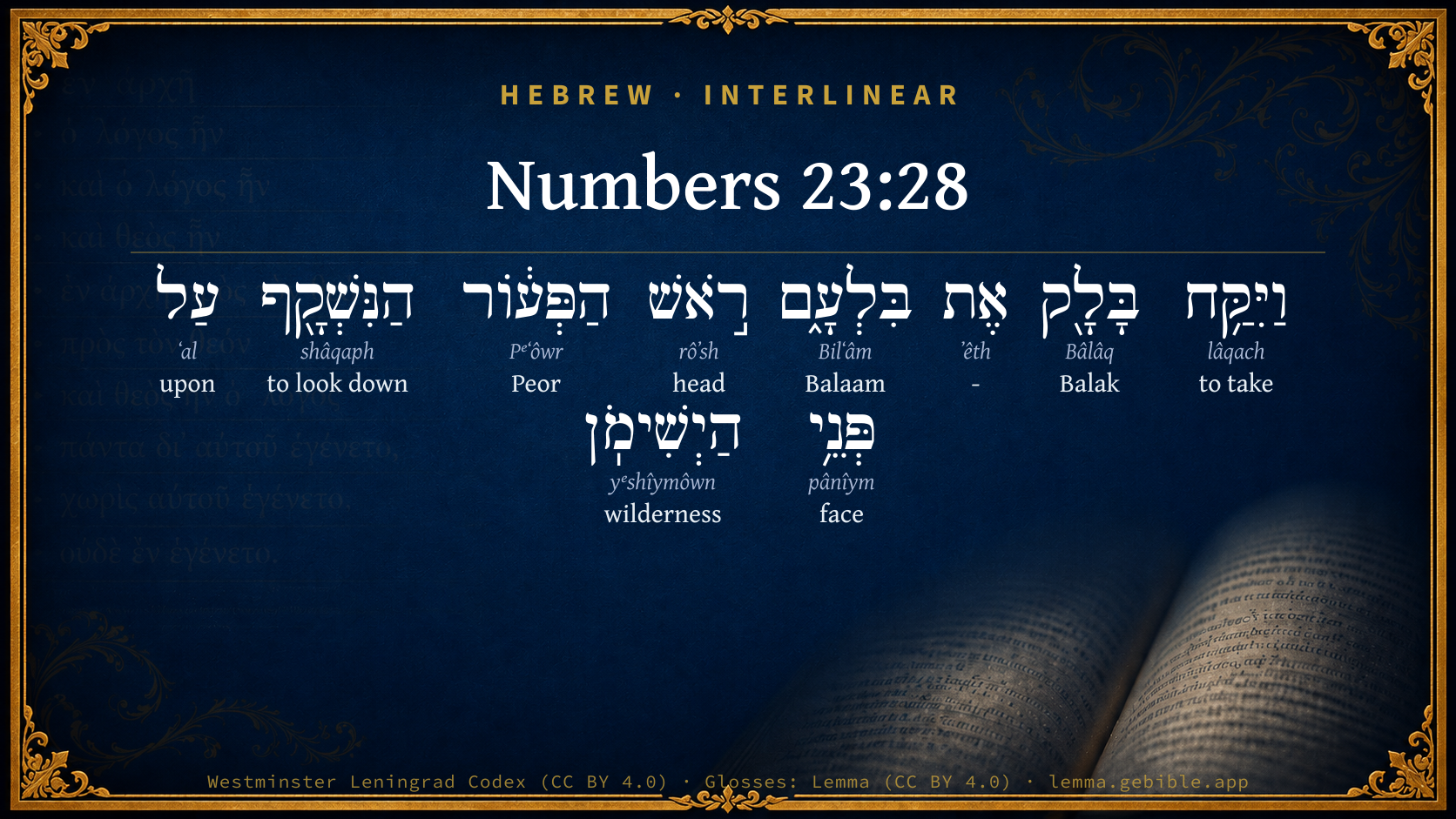
Numbers 23:28

Hebrew (Westminster Leningrad Codex) Numbers 23:28 appears in the Hebrew Old Testament. The text above is from the Westminster Leningrad Codex. Each word links to its Strong’s number, a concise gloss, and parsing drawn from the Open Scriptures Hebrew Bible morphology. Click any word for its full Brown-Driver-Briggs (BDB) entry.
Download image
Cite this verse

Numbers 23:28 (World English Bible). Public Domain. Lemma interlinear Bible study tool, https://lemma.gebible.app/v/numbers/23/28.

Show BibTeX & RIS
BibTeX
RIS
English Translation
Balak took Balaam to the top of Peor, that looks down on the desert.
World English Bible · Public Domain
Highlights
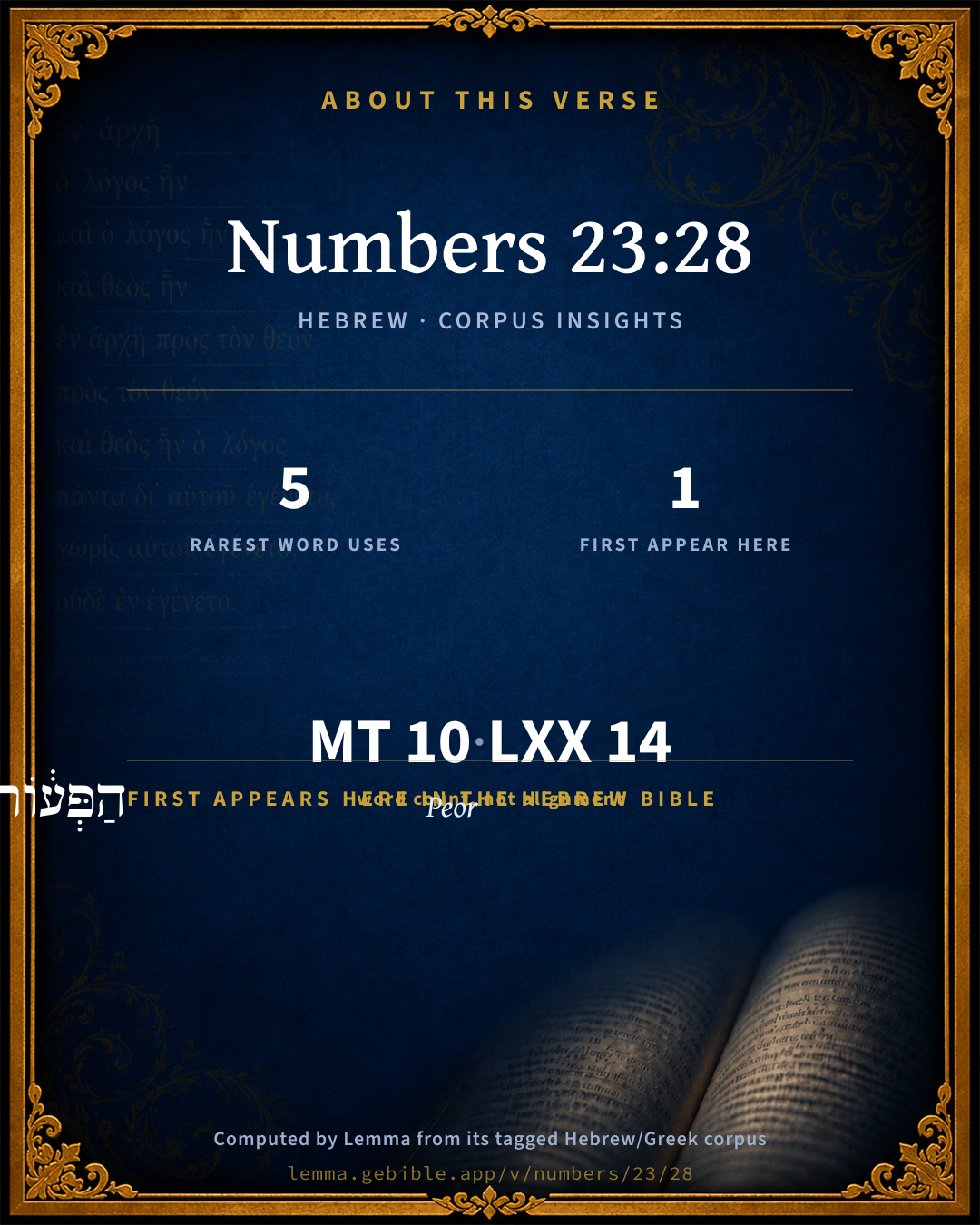
  • 1 first appearance in the Hebrew Bible
Full analysis ↓
Download a study sheet

One document with this verse’s original text, its word-by-word gloss line, the meaning frame, cross-references with their text, attributed commentary, and full source and license credits — printable, and it pastes into notes with its structure intact.

This verse Autodidact and up

Study sheet (.html) Plain text (.txt)

A passage Seminary Student

Up to 50 verses in one chapter. A passage sheet keeps up to 6 commentary sources and 12 cross-references per verse, in the order this page ranks them, and says so on the sheet whenever that leaves anything out. Ask for a single verse and you get the Autodidact verse sheet above.

Everything on this page stays free to read, with no account — the sheet is a download of what is already on screen, not access to it.

Want to remove ads? Support Godless Engineer
Compare translations 3

The same verse in 3 English versions, stacked beneath the original-language interlinear above. Click any original word for its lexicon entry.

Each is an independent rendering of the whole verse — the interlinear is not word-aligned to these translations.

Highlighted words mark where these versions differ — a whole-verse word diff, not a word-by-word alignment.

  • World English Bible Public Domain
    Balak took Balaam to the top of Peor, that looks down on the desert.
  • King James Version Public Domain
    And Balak brought Balaam unto the top of Peor, that looketh toward Jeshimon.
  • unfoldingWord Literal Text CC BY-SA 4.0
    And Balak took Balaam to the top of Peor, the one looking down over the face of the wasteland.

unfoldingWord Literal Text — © unfoldingWord, licensed CC BY-SA 4.0. Word-aligned USFM3 via Door43 (git.door43.org/unfoldingWord/en_ult).

Versions to compare (up to 4)

3 of 4 selected

Show all 18 translations

Every available English version of this verse, each an independent rendering of the whole verse.

  • World English Bible Public Domain
    Balak took Balaam to the top of Peor, that looks down on the desert.
  • Berean Standard Bible Public Domain
    And Balak took Balaam to the top of Peor, which overlooks the wasteland.
  • Majority Standard Bible Public Domain
    And Balak took Balaam to the top of Peor, which overlooks the wasteland.
  • King James Version Public Domain
    And Balak brought Balaam unto the top of Peor, that looketh toward Jeshimon.
  • American Standard Version (1901) Public Domain
    And Balak took Balaam unto the top of Peor, that looketh down upon the desert.
  • Revised Version (1885) Public Domain
    And Balak took Balaam unto the top of Peor, that looketh down upon the desert.
  • Geneva Bible (1599) Public Domain
    So Balak brought Balaam vnto the top of Peor, that looketh toward Ieshmon.
  • Douay-Rheims (1899) Public Domain
    And when he had brought him upon the top of mount Phogor, which looketh towards the wilderness,
  • Young's Literal Translation Public Domain
    And Balak taketh Balaam to the top of Peor, which is looking on the front of the wilderness,
  • Literal Standard Version CC BY-SA 4.0
    And Balak takes Balaam to the top of Peor, which is looking on the front of the wilderness,
  • Unlocked Literal Bible CC BY-SA 4.0
    So Balak took Balaam to the top of Mount Peor, which looks down on the wilderness.
  • unfoldingWord Literal Text CC BY-SA 4.0
    And Balak took Balaam to the top of Peor, the one looking down over the face of the wasteland.
  • Darby Bible Public Domain
    And Balak brought Balaam to the top of Peor, which looks over the surface of the waste.
  • World Messianic Bible Public Domain
    Balak took Balaam to the top of Peor, that looks down on the desert.
  • Webster's Bible Public Domain
    And Balak brought Balaam to the top of Peor, that looketh towards Jeshimon.
  • Free Bible Version CC BY-SA 4.0
    Balak took Balaam to the top of Mount Peor, which looks down on the wastelands.
  • Bible in Basic English Public Domain
    So Balak took Balaam to the top of Peor, looking down over the waste land.
  • JPS Tanakh (1917) Public Domain
    And Balak took Balaam unto the top of Peor, that looketh down upon the desert.

Literal Standard Version (2020), Covenant Press — licensed CC BY-SA 4.0. Text via the HelloAO Bible API (eBible.org). Unlocked Literal Bible (unfoldingWord) — licensed CC BY-SA 4.0. Text via the HelloAO Bible API (eBible.org). unfoldingWord Literal Text — © unfoldingWord, licensed CC BY-SA 4.0. Word-aligned USFM3 via Door43 (git.door43.org/unfoldingWord/en_ult). Free Bible Version, Dr. Jonathan Gallagher — licensed CC BY-SA 4.0. Text via the HelloAO Bible API (eBible.org).

Word by word

More ways to search: Search by grammar → Find every occurrence → Compare this word →

Practice this passage: Drill this verse → Learn its vocabulary →

הַפְּע֔וֹר
Pᵉʻôwr
H6465
“the · Peor”
Particle, Definite Article + Noun, Proper
Part of Speech
Particle + Noun
Type
Proper
Full BDB Definition

Origin: from H6473

TWOT: None

Peor = "cleft" - a mountain peak in Moab belonging to the Abarim range and near Pisgah (noun proper locative) - a false god worshipped in Moab; corresponds to Baal (noun proper deity)
  1. וַיִּקַּ֥ח lâqach H3947 “and · to take” Conjunction + Verb, Qal, Sequential Imperfect, 3rd Person, Masculine, Singular
  2. בָּלָ֖ק Bâlâq H1111 “Balak” Noun, Proper
  3. אֶת ʼêth H853 “-” Particle, Direct Object
  4. בִּלְעָ֑ם Bilʻâm H1109 “Balaam” Noun, Proper
  5. רֹ֣אשׁ rôʼsh H7218 “head of” Noun, Common, Masculine, Singular, Construct
  6. הַנִּשְׁקָ֖ף shâqaph H8259 “the · looking down” Particle, Definite Article + Verb, Niphal, Participle Active, Masculine, Singular, Absolute
  7. עַל ʻal H5921 “upon” Preposition
  8. פְּנֵ֥י pânîym H6440 “face(s) of” Noun, Common, Both, Plural, Construct
  9. הַיְשִׁימֹֽן yᵉshîymôwn H3452 “the · wilderness” Particle, Definite Article + Noun, Common, Masculine, Singular, Absolute

About this verse

These counts appear in no published source. They are computed here, from the morphology-tagged text and Lemma’s own curated glosses. What Lemma adds →

10
words
10
distinct lemmas
Pentateuch
section

Notable vocabulary

The rarest word here is הַפְּע֔וֹר Peor H6465 — appearing just 5 times in the whole Hebrew Bible.

First appearance in Scripture

This word makes its first canonical appearance in the Hebrew Bible here:

  • הַפְּע֔וֹר Peor H6465

Shared distinctive vocabulary

הַפְּע֔וֹר Peor H6465 occurs in 4 verses of the Hebrew Bible. Also found in:

Grammatical profile

  • 2 verbs
  • 6 nouns
  • 1 preposition
  • 1 particle

Verb forms

  • וַיִּקַּ֥ח Qal · Sequential Imperfect
  • הַנִּשְׁקָ֖ף Niphal · Participle Active

Hebrew & Septuagint length

In English translation the verse runs 14 words from the Hebrew and 14 from the Septuagint (LXX English) — the same length.

A rough comparison of the two English renderings, which tokenize alike — not a word-level alignment.

Word counts can differ between the Hebrew and the Greek without any difference in meaning — e.g. the Hebrew direct-object marker אֵת has no separate Greek word, and Greek often adds the article ὁ.

In the original languages it is 10 Hebrew tokens and 14 Greek tokens — but the two are counted differently (Hebrew bundles its prefixes and suffixes into one token; the Greek is in lemma form), so that isn’t a like-for-like length.

Cross-references

2

Topical passages linked to Numbers 23:28 in the Treasury of Scripture Knowledge — connected by theme and wording, ordered by reader-vote popularity; previews shown in the World English Bible.

  • Numbers 21:20 and from Bamoth to the valley that is in the field of Moab, to the top of Pisgah, which looks down on the desert.
  • Psalms 106:28 They joined themselves also to Baal Peor, And ate the sacrifices of the dead.

Cross-references courtesy of OpenBible.info (CC BY 4.0).

Hebrew and Greek witnesses Masoretic Hebrew ↔ Greek Septuagint

The same verse in the two great witnesses to the Old Testament, shown verse-for-verse.

These are two independent witnesses, not word-aligned to each other, and the Septuagint is shown in lemma (dictionary) form.

Hebrew Numbers 23:28 Masoretic · Westminster Leningrad Codex

וַיִּקַּ֥ח בָּלָ֖ק אֶת בִּלְעָ֑ם רֹ֣אשׁ הַפְּע֔וֹר הַנִּשְׁקָ֖ף עַל פְּנֵ֥י הַיְשִׁימֹֽן

Balak took Balaam to the top of Peor, that looks down on the desert.

World English Bible · Public Domain

Greek LXX Numbers 23:28 Septuagint · lemma form

καί παραλαμβάνω βαλακ ὁ βαλααμ ἐπί κορυφή ὁ φογωρ ὁ παρατείνω εἰς ὁ ἔρημος

And Balac took Balaam to the top of Phogor, which extends to the wilderness.

LXX2012 (modern English Septuagint) · Public Domain

On this verse, The Cambridge Bible for Schools and Colleges discusses the Septuagint’s reading. Read the note in Commentary ↓

Hebrew: Westminster Leningrad Codex (CC BY 4.0). Greek: Septuagint (public domain); English from LXX2012 (modern English Septuagint) (Public Domain). How the Septuagint differs from the Hebrew →

Targum (Aramaic paraphrase)

2

The Targum is the ancient Jewish Aramaic paraphrase of the Hebrew Scriptures — an interpretive translation, not the Hebrew text itself. Onkelos (literal) and Pseudo-Jonathan (expansive) render the Torah, and Jonathan the Prophets. Coverage is partial: where no permissively-licensed English translation exists for a verse, only the Aramaic is shown. This is verse-level text, not a word-by-word alignment to the Hebrew.

  1. Targum Onkelos Torah (Genesis–Deuteronomy)
    וּדְבַר בָּלָק יַת בִּלְעָם רֵישׁ רָמָתָא דְמִסְתַּכְּיָא עַל אַפֵּי בֵּית יְשִׁימוֹן

    (no public-domain English translation for this verse)

    Targum Onkelos — Aramaic: “Onkelos Genesis” (public domain); “Onkelos Exodus” (public domain); “Onkelos Leviticus” (public domain); “Onkelos Numbers” (public domain); “Onkelos Deuteronomy” (public domain). English: “Sefaria Community Translation” (CC0 1.0 (public-domain dedication)); “J.W. Etheridge. The Targums of Onkelos and Jonathan Ben Uzziel on the Pentateuch. London: Longmans, Green, 1862” (public domain). Text via Sefaria.

  2. Targum Pseudo-Jonathan Torah (Genesis–Deuteronomy)
    וּדְבַר בָּלָק יַת בִּלְעָם לְרֵישׁ רָמָתָא דְמַדִיקָא עַל אַנְפֵּי בֵּית יְשִׁימוֹת

    And Balak led Bileam to the high place of the prospect which looketh toward Beth Jeshimoth.

    Targum Pseudo-Jonathan — Aramaic: “Targum Jonathan on Genesis” (public domain); “Targum Jonathan on Exodus” (public domain); “Targum Jonathan on Leviticus” (public domain); “Targum Jonathan on Numbers” (public domain); “Targum Jonathan on Deuteronomy” (public domain). English: “The Targum of Jonathan ben Uzziel, trans. J. W. Etheridge, London, 1862” (public domain). Text via Sefaria.

Commentary

Notes on Numbers 23:28 from classic Christian and Jewish commentators (each source and its license shown beneath its notes). The classic Christian expositions comment on the surrounding passage and are grouped to its opening verse, so a note may address several verses; the Jewish commentaries on the Tanakh (Rashi and others) are per-verse, so they appear only where the commentator wrote on this verse.

Lemma curates 59 commentaries, every one of them public domain or Creative Commons licensed, each selected and text-cleaned for this edition rather than reprinted as found. About our sources →

Trapp's Complete Commentary

John Trapp

Num 23:28 And Balak brought Balaam unto the top of Peor, that looketh toward Jeshimon.

Ver. 28. Unto the top of Peor.] An idolatrous and therefore most unlikely place. {Deu 3:29}

John Trapp, A Commentary or Exposition upon All the Books of the Old and New Testament (1647–1656) — public domain. Text from a community e-Sword module.

The Biblical Illustrator

Joseph S. Exell

Num_23:28-30

Balak brought Balaam unto the top of Peor.

The wicked are wise in their kind to bring their wicked purposes to pass

We may observe by continual experience the nature of ungodly men. They are cunning in their kind; they watch their ways and times to fit them to work out their wicked devices. Balak knew well enough he was not able to meet the Israelites in the open field, and therefore dealeth otherwise. This is it which Stephen in his apology noteth (Act_7:19). Thus did Laban deal toward Jacob (Gen_31:1-2; Gen_31:41), changing his mind, revoking his bargains, altering his wages, murmuring at his prosperity, and changing his countenance toward him. This is noted also in the parable recorded (Luk_16:8). This we see by many examples. Ahithophels counsel was esteemed like as one who had asked counsel at the oracle of God, so were all his counsels both with David and with Absalom. The like we see in Herod when he heard of the birth of Christ, as of a new-born King, by the wise men. He pretendeth piety, but useth policy to destroy the babe our Saviour. The same we might observe in the scribes and Pharisees after the ascension of Christ. They spared no means to hinder the course of the gospel (Act_3:1-26; Act_4:1-37; Act_5:1-42.), but used sometimes fair means, sometimes threatenings, sometimes commandments to stop the mouths of the apostles. All which testimonies teach us that which the prophet Jeremiah saith (Jer_4:22) of the people in his time agreeable to the truth of this doctrine: They are wise to do evil, bat to do well they have no knowledge. The reasons follow.

1. They serve a cunning master, the author of all confusion, the contriver of all mischief, the worker of all wickedness, that old subtle serpent who worketh in all the children of disobedience (Eph_2:2).

2. God giveth even to wicked men wisdom and understanding, to magnify His mercy, who is good to all, and to aggravate their sin, who are made thereby without excuse (Rom_1:20-21). Now, the greater His goodness is toward them, the heavier shall His judgment and their punishment be (Luk_12:48). What is it that thou hast not received? And if thou hast received it, why dost thou not glorify Him of whom thou hast received it?

3. The enemies of God have knowledge, experience, foresight; they are as wise as serpents, as subtle as foxes, to the end God may use them as His rods in correcting His Church and in trying the faith of His people. So He proved the patience of the Israelites by Pharaoh and the Egyptians, and by the cunning and crafty fetches which they practised for their overthrow and destruction. So He tried Joseph and Mary by the dissimulation of Herod, by whom they were constrained to depart out of Judaea and to fly into the land of Egypt. The uses to be made of this doctrine are many.

(1) This should, on the other side, teach us to deal wisely and warily with them, lest we be snared and circumvented by them. We are set as upon a hill, we are placed as upon a stage. If we profess Christ Jesus, a small spot will be seen in our garment. It behoveth us, therefore, to be wise as serpents and innocent as doves, according to the counsel of our Saviour, to the end we may Stop the mouths of gainsayers. Their wisdom is joined with wickedness; our wisdom must be seasoned with godliness. Their policy is iniquity; with us policy and innocency must accompany together, and kiss one another. Their wisdom is a circumventing by laying of snares; our wisdom must be circumspect in avoiding snares. If we have this wariness mingled with true sincerity, and all our actions without dissimulation, it is both lawful and expedient to set wisdom against wisdom, and policy against policy, and care against care, and understanding against understanding, that so through their subtlety and our simplicity we be not taken in their traps which they have laid for us.

(2) It is our duty to pray to God to be delivered from them, and trust in Him for His help: He scattereth the devices of the crafty, so that their hands cannot accomplish that which their hearts have enterprised--an excellent comfort to all the servants of God not to fear the high reaches and deep devices of their enemies.

(3) This serveth to reprove two sorts of men that esteem not aright of this worldly wisdom of wicked men; for some are offended at their wisdom because it is so great, others rest contented in it because it is so excellent. (W. Attersoll.)

.

The Biblical Illustrator, edited by Joseph S. Exell (c. 1880s–1900s) — public domain. Text from a community e-Sword module.

Joseph Benson's Commentary

Num 23:28. Unto the top of Peor — The most famous high-place in all the country of Moab, where, as Seiden conjectures, Baal had a temple, called Beth-peor, or the house of Peor, (Deu 3:29,) and was therefore named Baal-peor. Balak seems to have chosen this place in hope that, being the residence, as he fancied, of Baal, the god of Moab, the God of Israel would not or could not come thither to hinder the operation; or that, being a place acceptable to his god, it must be so to Jehovah, and that there he would be induced to favour their designs. Such are the idle conceits that foolish men have of the living and true God, and so vain are their imaginations concerning him! Thus the Syrians fancied Jehovah to be the God of the hills, but not of the valleys, (1Ki 20:28,) as if he were more powerful in one place than he is in every place! Here they repeat their expensive sacrifice of seven bullocks and seven rams, upon seven altars, although they had no promise on which to build their hopes of success. And shall we, who have many and faithful promises, from Him who cannot lie, that the vision at the end shall speak, not persevere to ask that we may receive the divine favour and blessing, and to seek that we may find them? Shall we not continue instant in prayer, without weariness or fainting, and by a patient continuance in well-doing, seek glory, honour, and immortality?

Joseph Benson's Commentary on the Old and New Testaments (1811–1818) — public domain. Text from a community e-Sword module.

Jamieson, Fausset & Brown

Robert Jamieson, A. R. Fausset & David Brown

Balak brought Balaam unto the top of Peor--or, Beth-peor (Deu 3:29), the eminence on which a temple of Baal stood.

that looketh toward Jeshimon--the desert tract in the south of Palestine, on both sides of the Dead Sea.

Next: Numbers Chapter 24

Jamieson, Fausset & Brown — Commentary Critical and Explanatory on the Whole Bible (1871) — public domain (CC PDM 1.0). Text via the HelloAO Bible API.

Adam Clarke's Commentary

Verse 28. Unto the top of Peor] Probably the place where the famous Baal-peor had his chief temple. He appears to have been the Priapus of the Moabites, and to have been worshipped with the same obscene and abominable rites.

Adam Clarke's Commentary on the Bible (1810–1826) — public domain. Text from a community e-Sword/MySword module.

Ellicott's Commentary for English Readers

(28) Unto the top of Peor.—Mount Peor was one peak of the northern part of the mountains of Abarim. It was nearer than the other heights to the camp of the Israelites. It looked toward, or over the face of Jeshimon, i.e., the waste (or, desert). See Num_21:20.

A Bible Commentary for English Readers, edited by Charles John Ellicott (1878–1897) — public domain. Text from a community e-Sword module.

The Cambridge Bible for Schools and Colleges

gen. ed. J. J. S. Perowne

28. the top of the Peor &c.] An expression exactly parallel to that in Num_21:20 (see note). The site of ‘the Peor’ is unknown, but it was evidently in the neighbourhood of the Pisgah. And Beth-peor (Deu_3:29; Deu_4:46; Deu_34:6, Jos_13:20) cannot have been far distant, since it was evidently a sanctuary where the Baal or Lord of Peor (Num_25:3; Num_25:5) was worshipped. The LXX. equivalent for Peor is Phogôr; and Eusebius speaks of a mountain of that name opposite Jericho, and says that part of it was 7 miles from Heshbon. It should probably, therefore, be placed quite close to the Wady Ḥeshbân (see art. ‘Beth-Peor’ in Enc. Bibl. [Note: nc. Bibl. Encyclopaedia Biblica.] ).

The Cambridge Bible for Schools and Colleges (gen. ed. J. J. S. Perowne; Cambridge University Press, 1878–1918) — public domain. Text from a community e-Sword module.

John Gill's Exposition

And Balak brought Balaam to the top of Peor,.... The name of an high mountain in Moab, so called from a gap or opening in it; here the idol Baal was worshipped, and from hence had the name of Baalpeor, Num 25:3 and here, very probably, was a temple built to the honour of him, called Bethpeor, the house or temple of Baalpeor, Deu 34:6,

that looketh towards Jeshimon; as Pisgah also did, and very likely it was not far from it, since from thence they came hither, Num 23:14. Jeshimon is the same with Bethjesimoth, and so the Targum of Jonathan here calls it, a part of the plains of Moab, where Israel lay encamped, Num 33:49 so that from hence Balaam could have a full view of them.

John Gill's Exposition of the Whole Bible (1746–1763) — public domain (CC PDM 1.0). Text via the HelloAO Bible API.

Albert Barnes' Notes on the Bible

The position of Peor northward from Pisgah, along the Abarim heights, is approximately determined by the extant notices of Beth-peor.

Jeshimon - was the waste, in the great valley below, where stood Beth-jeshimoth, “the house of the wastes.”

Albert Barnes' Notes on the Bible (1834–1885) — public domain. Text from a community e-Sword/MySword module.

Haydock's Catholic Bible Commentary

Phogor. Hebrew, "Pehor, which looketh towards Jeshimon, or the desert." This was a part of the same chain of the mountains Abarim, with Phasga, ver. 14. Balac foolishly supposed that in a different aspect, he might still obtain what he wanted; and the soothsayer was no less infatuated in following him. But he soon felt an internal monitor, who informed him, that he need not put himself to no farther trouble, in retiring alone, to prepare himself for the operation of the spirit. More glorious predictions in favour of Israel, presented themselves so forcibly, that he could hardly refrain, and durst no longer forbear proclaiming them aloud, chap xxiv. 1. (Haydock)

George Leo Haydock (1774–1849), Haydock's Catholic Family Bible and Commentary, 1859 edition — public domain. Excludes Psalms (Douay-Rheims chapter numbering differs from Protestant) and Deuterocanonical books (Catholic canon only).

Matthew Poole's English Annotations

Peor, a high place called Beth-peor, Deu 3:29, i.e. the house or temple of Peer, because there they worshipped Baal-peor.

Matthew Poole's English Annotations on the Holy Bible (1683–1685) — public domain. Text from a community e-Sword/MySword module.

Whedon's Commentary on the Bible

Daniel D. Whedon

28. No enchantment — Augury, or prediction of future events by observing the flights of birds and other phenomena.

Against Jacob… against Israel — Rather, In Jacob and in Israel. Divination was a pretended unveiling of the future by means of alleged manifestations of the Deity within the human mind. The Israelites, having the oracle of Jehovah and Jehovah himself, the fountain of revelation, constantly among them, had no need of the equivocal, uncertain, and deceitful auguries and divinations which misled the Gentile nations.

According to this time — Rather, at that time R.V., “Now shall it be said of Jacob and of Israel.”

What hath God wrought — Hence the infinite superiority of Judaism over paganism in respect to the certainty of religious knowledge.

28. Peor — Near to Beth-peor, a town of the Reubenites, (Jos_13:20, note,) was one of the northern peaks of Abarim. “This point answers admirably to Professor Paine’s Pisgah, Mount Siaghah.

Num_21:20, note. Either this or the second foreland, where are ruinous heaps, from both of which there is a near and distinct view of the plain from ‘Beth-jeshimon unto Abel-shittim,’ may be the top of Peor.” — Ridgaway.

Jeshimon — See Num_21:20, note.

Daniel D. Whedon (gen. ed.), Commentary on the Old and New Testaments (1874–1909) — public domain. Text from a community e-Sword module.

The Pulpit Commentary

Unto the top of Peer. On the meaning of Peer see on Num_25:3. This Peer was a summit of the Abarim ranges northwards from Pisgah, and nearer to the Israelites. The adjacent village, Beth-Peer, was near the place of Moses" burial. (Deu_34:6) From the phrase used in Deu_3:29 Deu_4:46, with which the testimony of Eusebius agrees, it must have lain almost opposite Jericho on the heights behind the Arboth Moab. From Peer, therefore, the whole encampment, in all its length and breadth, would lie beneath their gaze. Jeshi-men. See on Num_21:20.

The Pulpit Commentary (1880–1919), ed. H.D.M. Spence-Jones & Joseph S. Exell — public domain. Text from a community e-Sword module.

John Wesley's Explanatory Notes

Peor - An high place called Beth-peor, Deut. iii, 29. That is, the house or temple of Peor, because there they worshipped Baal- peor.

John Wesley, Explanatory Notes Upon the Whole Bible (1754–1765) — public domain. Text via the GEBible commentary corpus.

unfoldingWord translationNotes

Door43 World Missions Community

which looks down on the wilderness

It is understood that this wilderness was where Israel was camped. AT: "which looks down on the wilderness where Israel was" (See: Assumed Knowledge and Implicit Information)

translationWords

Peor

desert

altar

cow

ewe

unfoldingWord translationNotes — © Distant Shores Media and the Door43 World Missions Community, licensed CC BY-SA 4.0. Source: git.door43.org/Door43/en_tn.

Rashi

Rabbi Shlomo Yitzchaki (Rashi)

ראש הפעור THE TOP OF PEOR — Balak was a great soothsayer and he foresaw that they would once be punished on account of Peor, but he knew not by what. He said: Perhaps the curse will fall upon them from there (be effective against them if pronounced there). So, too, all astrologers: they see something that will once happen but they know not exactly what they see (cf. Sotah 12b).

Rashi on the Tanakh — English translations: “The Judaica Press complete Tanach with Rashi, translated by A. J. Rosenberg” (CC BY 4.0); “Pentateuch with Rashi's commentary by M. Rosenbaum and A.M. Silbermann, 1929-1934” (public domain); “The Metsudah Tanach series, Lakewood, N.J” (CC BY 4.0); and “The Book of Joshua, Metsudah Publications, 1997” (CC BY 4.0). Text via Sefaria.

Lesson kit

Teaching starters — assembled from the data on this page, not authored interpretation. Every prompt links to the verse data it draws on. Edit before teaching.

Numbers, in the Pentateuch, opens this verse with 10 words (10 distinct Hebrew lemmas). Its most distinctive word is Pᵉʻôwr (“Peor”). A historical commentator’s framing appears above. Read the whole chapter for the surrounding context.

Discussion questions

  1. The word Pᵉʻôwr carries the sense “Peor.” How does it shape the verse?
  2. This is the first place “Peor” appears in Scripture (first appears here). What does its debut here establish?
  3. How does Numbers 25:18, which shares the word «Peor», read alongside this verse?
  4. These translations render this verse differently. What is at stake in choosing one wording over another?
  5. «וַיִּקַּ֥ח» is a Qal Sequential Imperfect verb. How does that grammatical form shape the action described?
  6. Compare how Trapp's Complete Commentary and The Biblical Illustrator read this verse. Where do they agree or differ?

Things to notice

Reading settings

Reading text

Shown beneath each verse's original-language words.

Old Testament
Old Testament edition

Read the OT as the Masoretic Hebrew (MT) or the Greek Septuagint (LXX).

English shown for the Greek Septuagint (in the Hebrew ↔ Greek comparison).

Comparing translations? Open the Compare panel on any verse page to stack up to four side by side.