
John 19:16

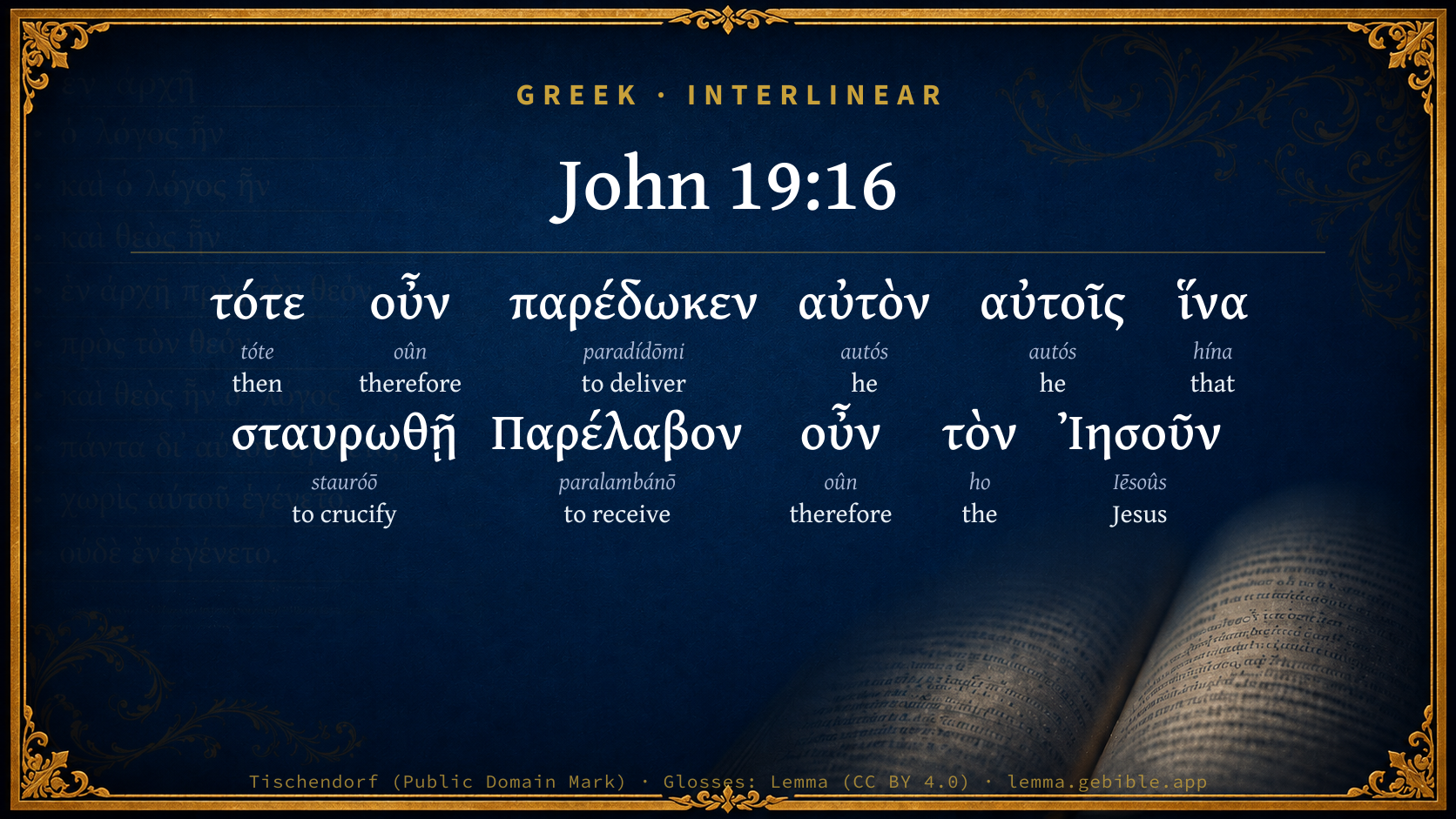
Greek (Tischendorf 8th ed.) John 19:16 appears in the Greek New Testament. The text above is from the Tischendorf 8th edition. Each word links to its Strong’s number and a concise gloss. Click any word for its full Thayer’s Greek Lexicon entry.
Download image
Cite this verse

John 19:16 (World English Bible). Public Domain. Lemma interlinear Bible study tool, https://lemma.gebible.app/v/john/19/16.

Show BibTeX & RIS
BibTeX
RIS
English Translation
So then he delivered him to them to be crucified. So they took Jesus and led him away.
World English Bible · Public Domain
Download a study sheet

One document with this verse’s original text, its word-by-word gloss line, the meaning frame, cross-references with their text, attributed commentary, and full source and license credits — printable, and it pastes into notes with its structure intact.

This verse Autodidact and up

Study sheet (.html) Plain text (.txt)

A passage Seminary Student

Up to 50 verses in one chapter. A passage sheet keeps up to 6 commentary sources and 12 cross-references per verse, in the order this page ranks them, and says so on the sheet whenever that leaves anything out. Ask for a single verse and you get the Autodidact verse sheet above.

Everything on this page stays free to read, with no account — the sheet is a download of what is already on screen, not access to it.

Want to remove ads? Support Godless Engineer
Compare translations 3

The same verse in 3 English versions, stacked beneath the original-language interlinear above. Click any original word for its lexicon entry.

Each is an independent rendering of the whole verse — the interlinear is not word-aligned to these translations.

Highlighted words mark where these versions differ — a whole-verse word diff, not a word-by-word alignment.

  • World English Bible Public Domain
    So then he delivered him to them to be crucified. So they took Jesus and led him away.
  • King James Version Public Domain
    Then delivered he him therefore unto them to be crucified. And they took Jesus, and led him away.
  • unfoldingWord Literal Text CC BY-SA 4.0
    Therefore, he then handed him over to them so that he might be crucified, and they took Jesus led away.

unfoldingWord Literal Text — © unfoldingWord, licensed CC BY-SA 4.0. Word-aligned USFM3 via Door43 (git.door43.org/unfoldingWord/en_ult).

Versions to compare (up to 4)

3 of 4 selected

Show all 19 translations

Every available English version of this verse, each an independent rendering of the whole verse.

  • World English Bible Public Domain
    So then he delivered him to them to be crucified. So they took Jesus and led him away.
  • Berean Standard Bible Public Domain
    Then Pilate handed Jesus over to be crucified, and the soldiers took Him away.
  • Majority Standard Bible Public Domain
    Then Pilate handed Jesus over to be crucified, and the soldiers took Him and led Him away.
  • King James Version Public Domain
    Then delivered he him therefore unto them to be crucified. And they took Jesus, and led him away.
  • American Standard Version (1901) Public Domain
    Then therefore he delivered him unto them to be crucified.
  • Revised Version (1885) Public Domain
    Then therefore he delivered him unto them to be crucified.
  • Geneva Bible (1599) Public Domain
    Then deliuered he him vnto them, to be crucified. And they tooke Iesus, and led him away.
  • Douay-Rheims (1899) Public Domain
    Then therefore he delivered him to them to be crucified. And they took Jesus, and led him forth.
  • Young's Literal Translation Public Domain
    Then, therefore, he delivered him up to them, that he may be crucified, and they took Jesus and led `him' away,
  • Literal Standard Version CC BY-SA 4.0
    Then, therefore, he delivered Him up to them, that He may be crucified, and they took Jesus and led [Him] away,
  • Unlocked Literal Bible CC BY-SA 4.0
    Then Pilate gave Jesus over to them to be crucified.
  • unfoldingWord Literal Text CC BY-SA 4.0
    Therefore, he then handed him over to them so that he might be crucified, and they took Jesus led away.
  • Darby Bible Public Domain
    Then therefore he delivered him up to them, that he might be crucified; and they took Jesus and led him away.
  • World Messianic Bible Public Domain
    So then he delivered him to them to be crucified. So they took Yeshua and led him away.
  • Webster's Bible Public Domain
    Then therefore he delivered him to them to be crucified. And they took Jesus, and led him away.
  • Free Bible Version CC BY-SA 4.0
    So he handed Jesus over to them to be crucified.
  • Bible in Basic English Public Domain
    So then he gave him up to them to be put to death on the cross. And they took Jesus away;
  • Text-Critical English NT CC BY 4.0
    Then Pilate handed Jesus over to them to be crucified. The Crucifixion So they took Jesus and led him away.
  • Tyndale New Testament (1534) Public Domain
    Then delyvered he him vnto them to be crucified. And they toke Iesus and led him awaye.

Literal Standard Version (2020), Covenant Press — licensed CC BY-SA 4.0. Text via the HelloAO Bible API (eBible.org). Unlocked Literal Bible (unfoldingWord) — licensed CC BY-SA 4.0. Text via the HelloAO Bible API (eBible.org). unfoldingWord Literal Text — © unfoldingWord, licensed CC BY-SA 4.0. Word-aligned USFM3 via Door43 (git.door43.org/unfoldingWord/en_ult). Free Bible Version, Dr. Jonathan Gallagher — licensed CC BY-SA 4.0. Text via the HelloAO Bible API (eBible.org).

Word by word

More ways to search: Search by grammar → Find every occurrence → Compare this word →

Practice this passage: Drill this verse → Learn its vocabulary →

σταυρωθῇ
stauróō
G4717
“to crucify”
Verb, Aorist, Passive, Subjunctive, 3rd person, Singular
Part of Speech
Verb
Tense
Aorist
Voice
Passive
Mood
Subjunctive
Person
3rd person
Number
Singular
Full Thayer's Definition

Origin: from G4716

TDNT: 16:41,1

1. to stake, drive down stakes 2. to fortify with driven stakes, to palisade 3. to crucify a. to crucify one b. metaph. to crucify the flesh, destroy its power utterly (the nature of the figure implying that the destruction is attended with intense pain)
  1. τότε tóte G5119 “then” Adverb
  2. οὖν oûn G3767 “therefore” Conjunction
  3. παρέδωκεν paradídōmi G3860 “to deliver” Verb, Aorist, Active, Indicative, 3rd person, Singular
  4. αὐτὸν autós G846 “he” Personal pronoun, Accusative, Singular, Masculine
  5. αὐτοῖς autós G846 “he” Personal pronoun, Dative, Plural, Masculine
  6. ἵνα hína G2443 “that” Conjunction
  7. Παρέλαβον paralambánō G3880 “to receive” Verb, Aorist, Active, Indicative, 3rd person, Plural
  8. οὖν oûn G3767 “therefore” Conjunction
  9. τὸν ho G3588 “the” Article, Accusative, Singular, Masculine
  10. Ἰησοῦν Iēsoûs G2424 “Jesus” Noun, Accusative, Singular, Masculine

About this verse

These counts appear in no published source. They are computed here, from the morphology-tagged text and Lemma’s own curated glosses. What Lemma adds →

11
words
9
distinct lemmas
Gospels
section

Shared distinctive vocabulary

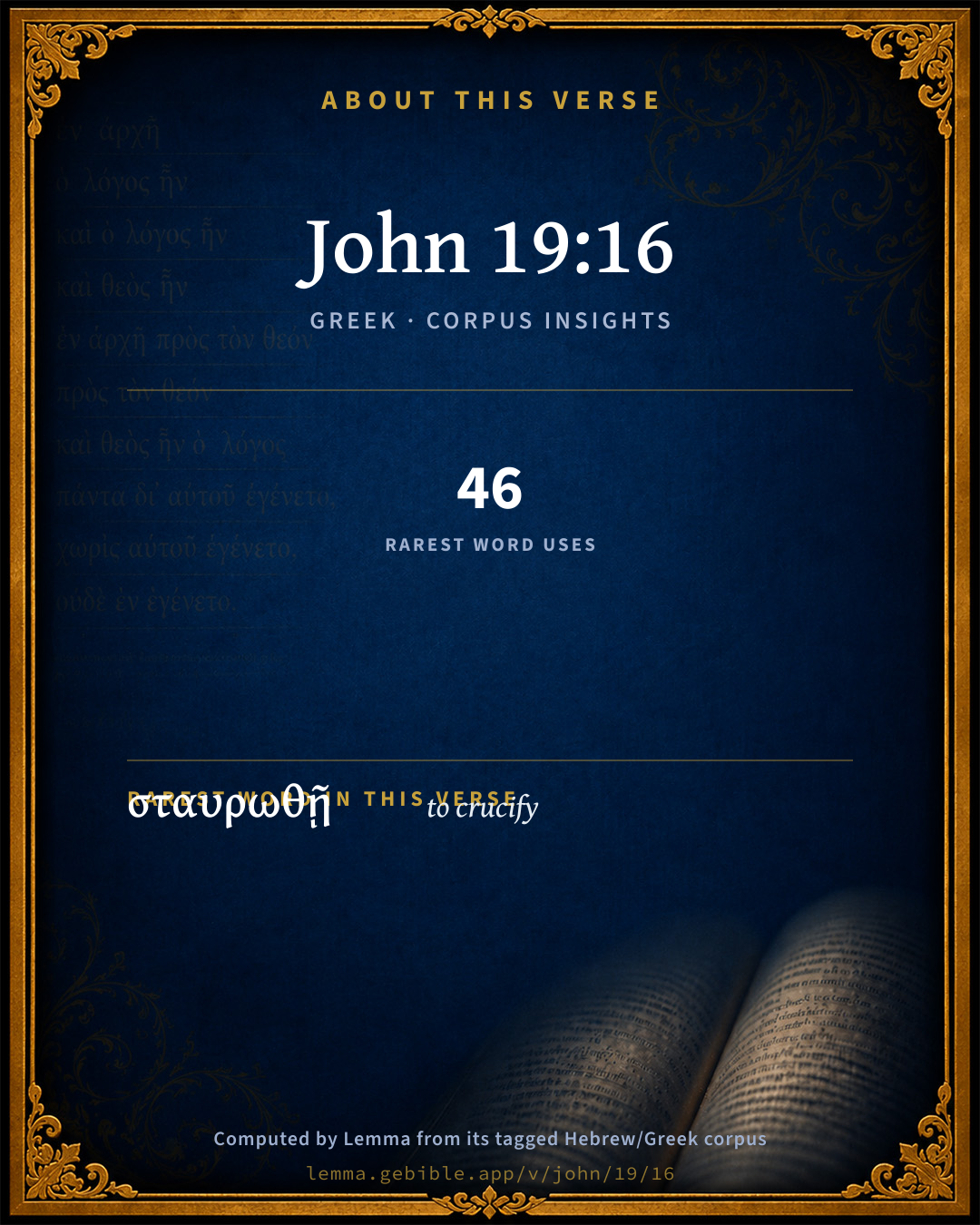
σταυρωθῇ to crucify G4717 occurs in 42 verses of the Greek New Testament. Also found in:
Repetition

Words recur within this verse:

  • οὖν therefore G3767 ×2
  • αὐτὸν he G846 ×2

Cross-references

3

Topical passages linked to John 19:16 in the Treasury of Scripture Knowledge — connected by theme and wording, ordered by reader-vote popularity; previews shown in the World English Bible.

  • Matthew 27:26–31 Then he released to them Barabbas, but Jesus he flogged and delivered to be crucified.
  • Luke 23:24–25 Pilate decreed that what they asked for should be done.
  • Mark 15:15–20 Pilate, wishing to please the multitude, released Barabbas to them, and handed over Jesus, when he had flogged him, to be crucified.

Cross-references courtesy of OpenBible.info (CC BY 4.0).

Where the printed editions differ

2 variants

Places in this verse where the major printed Greek editions disagree on the wording in a way that affects the translation — a comparison of editions, not a manuscript-by-manuscript collation. The editions are the modern critical texts (Nestlé-Aland 28/27, SBL, Westcott-Hort, Tregelles, Tyndale House) and the traditional texts behind the KJV (the Textus Receptus and the Byzantine/Majority text). It is not a claim about which reading is original.

  1. Different wording
    οὖν

    “therefore”

    In NA28NA27TynSBLWHTreg Not in TRByz

    δὲ (de) 'now' occurs in traditional manuscripts (TR+Byz) instead of οὖν (oun) 'therefore' in older manuscripts (NA28+NA27+Tyn+SBL+WH+Treg)

  2. Extra text
    καὶ

    “and”

    In TRByz Not in NA28NA27TynSBLWHTreg

Textual data: Translators Amalgamated Greek New Testament (STEPBible TAGNT) · CC BY 4.0.

Commentary

Notes on John 19:16 from classic Christian and Jewish commentators (each source and its license shown beneath its notes). The classic Christian expositions comment on the surrounding passage and are grouped to its opening verse, so a note may address several verses; the Jewish commentaries on the Tanakh (Rashi and others) are per-verse, so they appear only where the commentator wrote on this verse.

Lemma curates 59 commentaries, every one of them public domain or Creative Commons licensed, each selected and text-cleaned for this edition rather than reprinted as found. About our sources →

Matthew Henry's Commentary

We have here sentence of death passed upon our Lord Jesus, and execution done soon after. A mighty struggle Pilate had had within him between his convictions and his corruptions; but at length his convictions yielded, and his corruptions prevailed, the fear of man having a greater power over him than the fear of God.

I. Pilate gave judgment against Christ, and signed the warrant for his execution, Joh 19:16. We may see here, 1. How Pilate sinned against his conscience: he had again and again pronounced him innocent, and yet at last condemned him as guilty. Pilate, since he came to be governor, had in many instances disobliged and exasperated the Jewish nation; for he was a man of a haughty and implacable spirit, and extremely wedded to his humour. He had seized upon the Corban, and spent it upon a water-work; he had brought into Jerusalem shields stamped with Caesar's image, which was very provoking to the Jews; he had sacrificed the lives of many to his resolutions herein. Fearing therefore that he should be complained of for these and other insolences, he was willing to gratify the Jews. Now this makes the matter much worse. If he had been of an easy, soft, and pliable disposition, his yielding to so strong a stream had been the more excusable; but for a man that was so wilful in other things, and of so fierce a resolution, to be overcome in a thing of this nature, shows him to be a bad man indeed, that could better bear the wronging of his conscience than the crossing of his humour. 2. How he endeavoured to transfer the guilt upon the Jews. He delivered him not to his own officers (as usual), but to the prosecutors, the chief priests and elders; so excusing the wrong to his own conscience with this, that it was but a permissive condemnation, and that he did not put Christ to death, but only connived at those that did it. 3. How Christ was made sin for us. We deserved to have been condemned, but Christ was condemned for us, that to us there might be no condemnation. God was now entering into judgment with his Son, that he might not enter into judgment with his servants.

II. Judgment was no sooner given than with all possible expedition the prosecutors, having gained their point, resolved to lose not time lest Pilate should change his mind, and order a reprieve (those are enemies to our souls, the worst of enemies, that hurry us to sin, and then leave us no room to undo what we have done amiss), and also lest there should be an uproar among the people, and they should find a greater number against them than they had with so much artifice got to be for them. It were well if we would be thus expeditious in that which is good, and not stay for more difficulties.

1. They immediately hurried away the prisoner. The chief priests greedily flew upon the prey which they had been long waiting for; now it is drawn into their net. Or they, that is, the soldiers who were to attend the execution, they took him and led him away, not to the place whence he came, and thence to the place of execution, as is usual with us, but directly to the place of execution. Both the priests and the soldiers joined in leading him away. Now was the Son of man delivered into the hands of men, wicked and unreasonable men. By the law of Moses (and in appeals by our law) the prosecutors were to be the executioners, Deu 17:7. And the priests here were proud of the office. His being led away does not suppose him to have made any opposition, but the scripture must be fulfilled, he was led as a sheep to the slaughter, Act 8:32. We deserved to have been led forth with the workers of iniquity as criminals to execution, Psa 125:5. But he was led forth for us, that we might escape.

2. To add to his misery, they obliged him as long as he was able, to carry his cross (Joh 19:17), according to the custom among the Romans; hence Furcifer was among them a name of reproach. Their crosses did not stand up constantly, as our gibbets do in the places of execution, because the malefactor was nailed to the cross as it lay along upon the ground, and then it was lifted up, and fastened in the earth, and removed when the execution was over, and commonly buried with the body; so that every one that was crucified had a cross of his own. Now Christ's carrying his cross may be considered, (1.) As a part of his sufferings; he endured the cross literally. It was a long and thick piece of timber that was necessary for such a use, and some think it was neither seasoned nor hewn. The blessed body of the Lord Jesus was tender, and unaccustomed to such burdens; it had now lately been harassed and tired out; his shoulders were sore with the stripes they had given him; every jog of the cross would renew his smart, and be apt to strike the thorns he was crowned with into his head; yet all this he patiently underwent, and it was but the beginning of sorrows. (2.) As answering the type which went before him; Isaac, when he was to be offered, carried the wood on which he was to be bound and with which he was to be burned. (3.) As very significant of his undertaking, the Father having laid upon him the iniquity of us all (Isa 53:6), and he having to take away sin by bearing it in his own body upon the tree, Pe1 2:24. He had said in effect, On me be the curse; for he was made a curse for us, and therefore on him was the cross. (4.) As very instructive to us. Our Master hereby taught all his disciples to take up their cross, and follow him. Whatever cross he calls us out to bear at any time, we must remember that he bore the cross first, and, by bearing it for us, bears it off from us in great measure, for thus he hath made his yoke easy, and his burden light. He bore that end of the cross that had the curse upon it; this was the heavy end; and hence all that are his are enabled to call their afflictions for him light, and but for a moment.

3. They brought him to the place of execution: He went forth, not dragged against his will, but voluntary in his sufferings. He went forth out of the city, for he was crucified without the gate, Heb 13:12. And, to put the greater infamy upon his sufferings, he was brought to the common place of execution, as one in all points numbered among the transgressors, a place called Golgotha, the place of a skull, where they threw dead men's skulls and bones, or where the heads of beheaded malefactors were left, - a place ceremonially unclean; there Christ suffered, because he was made sin for us, that he might purge our consciences from dead works, and the pollution of them. If one would take notice of the traditions of the elders, there are two which are mentioned by many of the ancient writers concerning this place: - (1.) That Adam was buried here, and that this was the place of his skull, and they observe that where death triumphed over the first Adam there the second Adam triumphed over him. Gerhard quotes for this tradition Origen, Cyprian, Epiphanius, Austin, Jerome, and others. (2.) That this was that mountain in the land of Moriah on which Abraham offered up Isaac, and the ram was a ransom for Isaac.

4. There they crucified him, and the other malefactors with him (Joh 19:18): There they crucified him. Observe (1.) What death Christ died; the death of the cross, a bloody, painful, shameful death, a cursed death. He was nailed to the cross, as a sacrifice bound to the altar, as a Saviour fixed for his undertaking; his ear nailed to God's door-post, to serve him for ever. He was lifted up as the brazen serpent, hung between heaven and earth because we were unworthy of either, and abandoned by both. His hands were stretched out to invite and embrace us; he hung upon the tree some hours, dying gradually in the full use of reason and speech, that he might actually resign himself a sacrifice. (2.) In what company he died: Two others with him. Probably these would not have been executed at that time, but at the request of the chief priests, to add to the disgrace of our Lord Jesus, which might be the reason why one of them reviled him, because their death was hastened for his sake. Had they taken two of his disciples, and crucified them with him, it had been an honour to him; but, if such as they had been partakers with him in suffering, it would have looked as if they had been undertakers with him in satisfaction. Therefore it was ordered that his fellow-sufferers should be the worst of sinners, that he might bear our reproach, and that the merit might appear to be his only. This exposed him much to the people's contempt and hatred, who are apt to judge of persons by the lump, and are not curious in distinguishing, and would conclude him not only malefactor because he was yoked with malefactors, but the worst of the three because put in the midst. But thus the scripture was fulfilled, He was numbered among the transgressors. He did not die at the altar among the sacrifices, nor mingle his blood with that of bulls and goats; but he died among the criminals, and mingled his blood with theirs who were sacrificed to public justice.

And now let us pause awhile, and with an eye of faith look upon Jesus. Was ever sorrow like unto his sorrow? See him who was clothed with glory stripped of it all, and clothed with shame - him who was the praise of angels made a reproach of men - him who had been with eternal delight and joy in the bosom of his Father now in the extremities of pain and agony. See him bleeding, see him struggling, see him dying, see him and love him, love him and live to him, and study what we shall render.

Matthew Henry's Commentary on the Whole Bible (1708–1710) — public domain (CC PDM 1.0). Text via the HelloAO Bible API.

The Cambridge Bible for Schools and Colleges

gen. ed. J. J. S. Perowne

16. Then delivered he, &c.] Better, Then therefore delivered he, &c. In none of the Gospels does it appear that Pilate pronounced sentence on Jesus; he perhaps purposely avoided doing so. But in delivering Him over to the priests he does not allow them to act for themselves: ‘he delivered Him to them that He might be crucified’ by Roman soldiers; not that they might crucify Him themselves.

And they took] The best authorities give, They therefore took. The word for ‘took’ should rather be rendered received, as in the only other places in which it occurs in this Gospel, Joh_1:11, Joh_14:3. It means to ‘accept what is offered, receive from the hands of another.’ A comparison of the three texts is instructive. The eternal Son is given by the Father, comes to his own inheritance, and His own people received Him not (Joh_1:11). The Incarnate Son is given up by Pilate to His own people, and they received Him to crucify Him (Joh_19:16). The glorified Son comes again to His own people, to receive them unto Himself (Joh_14:3).

and led him away] These words are of very doubtful authority.

The Cambridge Bible for Schools and Colleges (gen. ed. J. J. S. Perowne; Cambridge University Press, 1878–1918) — public domain. Text from a community e-Sword module.

The Biblical Illustrator

Joseph S. Exell

Joh_19:16

Then delivered he Him therefore unto them to be crucified

When?

I. NOT WHEN THE EVIDENCE AGAINST JESUS WAS CONCLUSIVE. Charges had been made, but nothing had been proved. Neither in their testimony, nor in the utterances of Jesus Himself, did Pilate find any ground for passing the death-sentence.

II. NOT WHEN HEROD SENT HIM BACK TO PILATE. Had that ruler sent word that Christ was worthy of death, Pilate might have yielded, and then have passed sentence on the prisoner. But Pilate says: No, nor yet Herod: for I sent you to him; and lo, nothing worthy of death is done unto Him.

III. NOT WHEN HIS WIFE URGED HIM TO PLEASE THE JEWS. Herod had, indeed, beheaded John the Baptist through his wifes influence. But, singularly enough, Pilates wife defended the righteous Prisoner.

IV. NOT WHEN HE THOUGHT THAT THE MOTIVES OF HIS ACCUSERS WERE JUST AND HOLY. Pilate was not by any means deceived by them.

V. NOT WHEN HE HAD NO POWER TO DELIVER CHRIST FROM THEIR RAGE. Knowest Thou not that I have power, &c. The power lay absolutely in his hands. The Jews knew this, and Pilate knew it. He never could have pleaded that he was powerless.

VI. NOT WHEN HIS CONSCIENCE FAILED TO ACT IN THIS MATTER. If ever Pilates conscience was active, it was just at this time. To the very last it strove with him, even to the extent of making him wash his hands. His testy answer to the Jews, later on, when they wanted the superscription over the cross changed, shows that he was irritated at having been dragged into the position in which he found himself.

VII. WHEN HE SAW THAT BY REFUSAL HE WOULD FORFEIT THE FAVOUR OF THE JEWS. He did not want to do wrong, if he could help it. But, at the same time, he did not want to lose the favour of the Jewish leaders. Two desires strove within him for the mastery. The conflict was long and bitter. All arguments but one were in favour of the release of Jesus. But all just arguments had to go to the wall before the one selfish motive of popularity. Conclusion: And are there no modern Pilates? The youngest child has had experience enough to enable him to sympathize keenly with this man.

1. For no one lives long in this world without finding that, sooner or later, duty and desire conflict with each other. Not for lack of light, but for lack of will, do men go astray.

2. Like Pilate, men seek to evade the responsibility for their actions. How often circumstances are blamed, or companions are made the bearers of the responsibility. Inability to resist is pleaded. Any flimsy excuse is laid hold of and magnified, in order to shift the guilt of the act from the sinning soul. Pilates hand-washing seems to us frivolous and childish. Is it any more childish than half of the foolish excuses offered for the evil deeds of many?

3. It is very possible that a previous misdeed of Pilates may have occurred to him as a reason for this iniquitous act (Luk_13:1). Is it too fanciful to suppose that at this time Pilate saw an opportunity to regain the popularity which then he had lost? One lie calls for another, and one dishonest deed begets a second. The only way out of past wrong is to confess it, and break from the bondage of old-time sins. Otherwise, the last state of a man simply becomes worse than his first. (A. F. Schauffler.)

The morally wrong ever inexpedient

I. A DIFFICULTY REMOVED DESTINED TO APPEAR IN MORE TERRIBLE FORMS Then delivered he, &c. In this no doubt Pilate felt that he had got rid of a difficulty. How to meet the claims of his imperial master, maintain his popularity with the Jews, and save his conscience, constituted a difficulty that had distracted him beyond measure. Now handing Christ over to the Jews he would breathe more freely. Alas! the difficulty is merely temporarily shifted and pushed for a moment out of sight, but otherwise becoming, more huge and revolting. No difficulty can be removed by outraging or ignoring rectitude.

1. One man has a financial difficulty: accumulated debts drag him down, and he knows not how to deliver himself. He makes himself bankrupt, or forges a bill and fancies the difficulty removed. Not so.

2. Another has a social difficulty. By amorous impulses and reckless vows, he has committed himself to some one whom he comes to loathe as an intolerable infliction. In an evil moment he uses a razor or administers a poison, foolishly supposing that the difficulty is got rid of. But the old tormentor, though buried in the earth, is alive in memory to haunt it for ever.

3. Another has a moral difficulty; his conscience is oppressed with a sense of guilt, and he seeks to remove the difficulty by resorting to drink and revelry. But the sleeping conscience soon awakes.

II. A CONQUEST ACHIEVED WHICH MUST OVERWHELM THE VICTORS IN ULTIMATE RUIN. And they took Jesus and led Him away. The Jews were now triumphant: but of what worth was their victory? Even in this life they felt the rebound. A few years on, and the king they chose ravaged their country, destroyed their Temple, extinguished their national life, and scattered them throughout the earth. Truly the triumphing of the wicked is short. History abounds in instances of conquests reversed and victors vanquished. Whoso taketh the sword shall perish by the sword. The slaveholders martyred John Brown, and thought they had killed the antislavery movement; hut in the course of a few years the cause of slavery was ruined. The principle is this--what is wrongfully achieved must lead to ruin. A man struggles for a fortune. He achieves it, but how? He struggles for senatorial honours, but how? The how is the question. All the produce of human labour, however valuable, if unrighteously obtained, the justice of the universe turns into stone that will grind the possessors to powder. (D. Thomas, D. D.)

And they took Jesus, and led Him away

The procession of sorrow

I. CHRIST AS LED FORTH. Pilate scourged our Saviour according to the custom of Roman courts, and gave him over to the Praetorian guards to insult him. We do not read that they removed the crown of thorns, and therefore it is probable that our Saviour wore it along the Via Dolorosa. They put on Him His own clothes that the multitude might discern Him to be the very man who had professed to be the Messiah. We all know that a different dress will often raise a doubt about the identity of an individual; but lo! the people saw Him in the street wearing His garment without seam. How they led Him forth we do not know; perhaps with a rope about His neck, since it was not unusual for the Romans thus to conduct criminals to the gallows. We care, however, far more for the fact that He went forth carrying His cross. This was intended at once to proclaim His guilt and intimate His doom.

1. We learn here as we see Christ led forth that which was set forth in shadow by the scapegoat. Did not the high-priest bring the scapegoat, and put both his hands upon its head, confessing the sins of the people, that thus those sins might be laid upon the goat? Then the goat was led away by a fit man into the wilderness, and it carried away the sins of the people. Now we see Jesus brought before the priests and rulers, who pronounce Him guilty; God Himself imputes our sins to Him; He was made sin for us; and, as the great Scapegoat, led away by the appointed officers of justice.

2. Jesus was conducted to the common place of death. Our great Hero, the destroyer of Death, bearded the lion in his den, and slew the monster in his own castle.

3. He was led thither to aggravate His shame. Calvary was like our Old Bailey. Christ must die a felons death in the place where horrid crimes had met their due reward. In this, too, He draws the nearer to us, He was numbered with the transgressors, &c.

4. But the great lesson is, let us go forth, therefore, without the camp, bearing His reproach.

(1) The multitude are leading Him forth from the Temple. He is not allowed to worship with them.

(2) He is exiled from their friendship. No man dare whisper a word of comfort to Him.

(3) He is banished from their society, as if He were a leper. See, here is a picture of what we may expect from men if we are faithful to our Master. It is not likely that we shall be able to worship with them, have their friendship, or be received into their society. Go ye, then, like the Master, expecting to earn reproach, without the camp.

II. CHRIST CARRYING HIS CROSS. I have shown you, believer, your position; let me now show you your service. Christ comes forth from Pilates hall with the cumbrous wood, all to heavy for His exhausted frame; so they place it upon Simon, a Cyrenian. He was the father of Alexander and Rufus, two persons well known in the early Church; let us hope that salvation came to his house when he was compelled to bear the Saviours cross. Let us comfort ourselves with this thought, that in our case, as in Simons

1. It is not our cross, but Christs which we carry. When your religion brings the trial of cruel mockings upon you, then remember, it is Christs cross; and how delightful is it to carry that.

2. You carry the cross after Him. Your path is marked with footprints of your Lord.

3. You bear this cross in partnership. It is the opinion of some that Simon only carried one end of it. That is possible; Christ may have carried the heavier end. Certainly it is so with you. Rutherford says, Whenever Christ gives us a cross, He cries, Halves, My love. Others think that Simon carried the whole of the cross. If he carried all the cross, yet he only carried the wood of it; he did not bear the sin which made it such a load. If you think that you suffer all that a Christian can suffer, yet, remember, there is not one drop of wrath in all your sea of sorrow. Jesus took that.

4. Although Simon carried Christs cross, he did not volunteer to do it, but they compelled him. I fear that the most of us carry it by compulsion; at least when it first comes on to our shoulders we do not like it; but the world compels us to bear Christs cross. I do not think we should seek after needless persecution. That man deserves no pity who purposely excites the disgust of other people. We must not make a cross of our own. Let there be nothing but your religion to object to, and then if that offends them, it is a cross which you must carry joyfully.

5. Though Simon had to bear the cross for a very little while, it gave him lasting honour. The cross we have to carry is only for a little while at most. I reckon that these light afflictions, &c.

III. CHRIST AND HIS MOURNERS. When the voice of sympathy prevailed over the voice of Scorn, Jesus paused, and said, Daughters of Jerusalem, weep not for Me, &c. This was a very proper sorrow; Jesus did not by any means forbid it, He only recommended another sorrow as being better.

1. Weep not because the Saviour bled, but because your sins made Him bleed. The Lord thinks far more of the tears of repentance than of the mere drops of human sympathy.

2. Weep over those who have brought that blood upon their heads. We ought not to forget the Jews.

3. Sorrow deeply for the souls of all unregenerate men and women. What Christ suffered for us, these must suffer for themselves, except they put their trust in Christ.

IV. CHRISTS FELLOW-SUFFERERS. There were two other cross-bearers, malefactors. Their crosses were just as heavy as the Lords, and one of them had no sympathy with him, and his bearing the cross only led to his death, and not to his salvation. I have met with persons who have suffered much, and therefore suppose that because of that they shall escape punishment. Yonder malefactor carried his cross and died on it; and you will carry your sorrows, and be damned with them, except you repent. No sufferings of ours have anything to do with the atonement of sin.

V. THE SAVIOURS WARNING QUESTION. If they do these things in the green tree, what will they do in the dry? If I, the innocent substitute for sinners, suffer thus, what will be done when the sinner himself shall fall into the hands of an angry God? Remember that when God saw Christ in the sinners place He did not spare Him, and when He finds you without Christ, He will not spare you. (C. H. Spurgeon.)

The Biblical Illustrator, edited by Joseph S. Exell (c. 1880s–1900s) — public domain. Text from a community e-Sword module.

Joseph Benson's Commentary

Joh 19:16-18. Then delivered he him — Having now laid aside all thoughts of saving Jesus, Pilate gave him up to the will of his enemies, and commanded the soldiers to prepare for his execution. And they took Jesus, and led him away — After they had insulted and abused him, as is related Mat 27:27-31; Mar 15:16-20, where see the notes. And he, bearing his cross — Not the whole cross, (for that was too large and heavy,) but the transverse beam of it, to which his hands were afterward fastened. This part they used to make the person carry who was to be executed. Went forth — Out of the city, to a place which it seems lay on the western side of Jerusalem, but a little without the boundaries of it; unto a place called a place of the scull — The place of execution had this name given it from the criminals’ bones which lay scattered there. See note on Mat 27:33. Golgotha is a Syriac word, and signifies a scull, or head. Here some of Christ’s friends offered him a stupifying potion, with a view, probably, to render him insensible of the ignominy and pain of his punishment. See note on Mat 27:33-34. And two other with him, on either side one — See note on Luk 23:32-33.

Joseph Benson's Commentary on the Old and New Testaments (1811–1818) — public domain. Text from a community e-Sword module.

Godbey's Commentary on the New Testament

William B. Godbey

CHAPTER 27.

JESUS LED TO CALVARY

Mat 27:31-34; Mar 15:20-23; Luk 23:26-33; Joh 19:16-17. “And they took Jesus, and led Him away, carrying His cross.” Mark: “And when they mocked Him, they divested Him of His purple robe, and put on Him His own raiment, and led Him away, that they may crucify Him.” You see the crown of thorns was not taken off but remained on His brow throughout His crucifixion. “They compel Simon, a certain Cyrenian along with them, having come from the country, the father of Alexander and Rufus, that he may bear His cross.” As the city of Cyrene stood on the northern shore of Africa, there is at least a probability that this was a stout, muscular colored man, who enjoyed the honor of carrying the cross, which proved too much for the fainting Jesus after a night of sleepless harassment and terrible suffering, attended by the loss of much blood.

Luk 23:27-32. “And a great crowd of people followed Him, and of women, who continued to weep and bewail Him. And Jesus, turning to them, said, Daughters of Jerusalem, weep not over Me, but weep for yourselves, and your children. For, behold, the days are coming in which they will say, Blessed are the barren, and the wombs which did not bring forth, and the breasts which did not nurse. Then they will begin to say to the mountains, Fall on us; and to the hills, Cover us.” These words of our Savior describe the horrific sufferings which came on those people forty years from that date, the Roman wars lasting five years, and resulting in the destruction of Jerusalem, the death of a million, the slavery of another million, the exile of the little remnant, and the annihilation of the Jewish polity. All this He saw in vivid panorama before His eyes — mountains of the dead, rivers of blood, and the desolation of the city and the land.

“Because if they do these things in the green tree, what may be done in the dry?” This statement is metaphoric; e. g., If, while Mercy’s door is wide open, the Holy Ghost wooing, Jesus and His apostles and evangelists preaching, and everything prosperous and auspicious, they reject and crucify Him who came from heaven to save them, killing their own Christ for whom they had waited two thousand years, what will they do when the Holy Ghost has retreated away, and God has turned them over to hardness of heart and reprobacy of mind, to believe lies and be condemned? Thus the green tree emblematizes the mercy and grace abounding in the days of Jesus; and the dry, the horrific spiritual dearth coming on the land because they insulted God, slew His Son, and outraged the Holy Ghost.

“And there were also two others, malefactors, being led, along with Him to be put to death.” Mat 27:33-34 : “And having come into the place called Golgotha, which is denominated the place of a skull, they gave Him vinegar mingled with gall to drink; and tasting it, He did not wish to drink.” This was a soporific potion, conducive to the lulling of the nerves to insensibility and the obtundification of the feeling, so as to mitigate the awful severity of the pain, somewhat corresponding with the modern chloroform. You see that Jesus declined to drink it, preferring to enjoy the clear and unclouded exercise of His intellect and the full acumen of His nerves. So when physicians want you to take chloroform, or some kind of a nervous sedative, which might probably render you unconscious of your suffering, you have the example of Jesus declining all artificial relief when passing through the terrible ordeal of crucifixion, enjoying the normal exercise of nerves and brain. Calvary is not far from Pilate’s judgment-hall, the ascension beginning in the city about one square from the hall, and continuing really to the summit of Calvary, passing northward through the Damascus Gate, then turning somewhat eastward, the mountain being one of the peaks of Bezetha, and within the angle formed by the road to Jericho, leading east, and the way to Damascus leading north, as the Romans were in the habit of crucifying their criminals in the most public and conspicuous places, so as to present the greatest possible terror to evildoers. Heb 13:12, locates it “without the gate.” Calvary is Greek, and means “skull,” because the hill has the shape of a human skull. When I first came to Jerusalem, with nothing but the Scripture for my guide, I recognized Calvary before any one pointed it out to me.

William B. Godbey, Commentary on the New Testament (1896–1900) — public domain. Text from a community e-Sword module.

F. W. Grant's Numerical Bible

Section 1. (Joh 19:16-30.)

Obedience perfected.

The first section shows us then His obedience unto death completed. John’s presentation of all this is unique, both in what he gives and in what he omits. Details are little dwelt upon: a few points are brought into prominence, every one of which has its manifest bearing upon the general presentation. The simplicity and depth that everywhere pervade the Gospel are nowhere more conspicuous than they are here.

1. First, He comes, bearing His cross, to Golgotha, the place of a skull, -the place of the kingdom of death. This is plainly what the world is because of sin, -death being the stamp of the government of God upon it. For this the Lord sought it: here His love to men brought Him; only He could lift this burden from them, and for this He must come Himself under it. Those two others whom we well know, to whom death is clearly such a penalty, are on either side of Him, and He in the midst. Penalty it is He is taking; Himself on the division line between the saved and the unsaved, the Transformer of death into that which effects the transition from penalty to Paradise.

2. He comes thus into death as King, -"King of the Jews," indeed, but which in its full rendering implies so much. It faces the Jew, the Greek, the Roman, affirming to each in his own language, with a positiveness which His enemies vainly strive to set aside, a meaning for each one. Here is indeed God’s King, -King in death as in life, -here in a peculiar way affirmed; His Cross henceforth to be the very sign of His power, the sceptre under which they bow, in adoring homage.

3. Now we see what indeed recalls the burnt-offering. This was flayed, that all beneath might be exposed, and its perfection seen. So now they strip the Lord, and expose Him. Here, in this Gospel alone, His seamless robe is spoken of, in figure that robe of righteousness which in Him was indeed seamless, but which now human hands have stripped from off Him, giving Him the malefactor’s place instead. But how fully is He displayed by it in a righteousness which glorifies the righteousness of God itself, by penalty owned and taken in grace for others! It is not relaxed or modified, as many would teach, but taken in its full intensity of suffering; which alone would maintain the perfect righteousness of it. But thus He has a righteousness acquired as Man, which as Man He needs not. It is not His personal obedience in life, but in stooping to that which, because of His righteous life, could be no due of His. Thus it remains for the lot (which refers the whole disposal of it to the Lord) to decide whose it shall be. God has decided that it shall belong to the man of faith; and so the best robe in the Father’s house is reserved for the returning prodigal; keeping nearer to what is before us here, let us say, to those who pierced His hands and feet, or drove the spear into His blessed side.

4. Amid it all, He has still the human tenderness which shows unchanged the Man Christ Jesus. His mother, standing by His cross, He commends to the care of His beloved disciple, the spiritual link being more than the natural, even while the natural is being recognized. Here, with one exception in the first chapter of Acts, we part with Mary; she is not mentioned in the after-books. In all the doctrine of the epistles she has no place. Blessed among women as she is surely by her connection with the human nature of our Lord, the entire silence of Scripture as to her in that fulness of Christian truth which it was the office of the Spirit of truth to communicate is the decisive overthrow of the whole Babel-structure of Mariolatry which Romanism has built up upon a mere sand-foundation. She remains for us in the word of God, a simple woman rejoicing in God her Saviour, -a stone in the temple to His praise, and with no temple of her own. To use the grace of the Redeemer in taking flesh among us by her means to exalt the mother to the dishonor of Christ her Lord is truly a refined wickedness worthy of the arch-deceiver of mankind.

5. We find now the divine end reached, and as it only could be, by the divine way; the Lord Himself here declares the perfect accomplishment of all that Scripture has foretold, save one thing only, and in death, as in life, Scripture is for Him the authoritative word of the living God. As in the temptation He had refused to minister to His own need, apart from that by every word of which, He declared, man lives, so now, on the same principle, He makes known that need, not that it might be ministered to, but that Scripture might be fulfilled. He does not Himself fulfil it; God can be trusted to take care for that; but He gives utterance to the distress which will as uttered occasion the fulfilment. The terrible thirst of crucifixion is upon Him; but that is not enough to force the parched lips to speech; but it is written, "In My thirst they gave Me vinegar to drink:" this opens them. He will show Himself, as ever, in active obedience to the will of God, which He came to accomplish. He simply says, "I thirst:" and by the unsympathetic hands of those around His cross, the vinegar is tendered, and the prophecy fulfilled.

All is finished: and His own lips declare it. The very smallness, apparently, of this last matter cared for is absolute proof that no scripture whatever could be left as of no importance. The entire body of Old Testament prophecy is confirmed and certified with all the weight of Christ’s authority. He had said before, "Scripture cannot be broken:" and we know exactly what for Him was "Scripture." Here, amid the intense sufferings of the cross, we see how completely He owned and was guided by it. That will of God which He came to do was here marked out for Him. The Law was in His heart; and in the very replacing of the Old Testament sacrifices by His one supreme sacrifice, (of which the psalm referred to speaks,) every part of this was honored and upheld. The Antitype necessarily confirmed the type He was displacing, and we have seen this in all the detail given us in the Gospels.

It is to His sacrificial work that the Lord undoubtedly has reference here. All scripture as to Himself was certainly not yet fulfilled; but the work of propitiation was accomplished, His words, of course, anticipating (as we have seen to be so much the character of the Gospel of John) the death which was now just before Him. The cup of wrath was, in fact, already drained, as the comparison of Mark and Luke fully assures us. The awful cry of forsaken sorrow which we find in the former has been already exchanged for the cry of "Father," with which the enjoyment of all that this endeared relationship implies has returned also. Death remains yet, before full atonement is completed; for death and judgment are the double penalty upon man. Death, however, is governmental, not the necessary expression of divine holiness as against sin. Men may, therefore, die in the full favor of God; while the wrath of God would be impossible to be felt by one enjoying it. Death and the cup of wrath were both taken by the Lord; the latter first, -death following to complete the work; and thus now, at the moment of death, the Victor’s cry, "It is finished." (See Introduction pp. 26-28.)

So He delivers up His spirit to the Father. We do not find Him, as in Luke, actually saying, "Father;" and this would seem more suited an utterance in the Gospel of the Manhood, than here, where (though not exclusively) the Only-begotten is set before us. Yet it is, as we know, to the Father that He commends it. Here He does not commend it, but delivers it up; He has power over it, as mere man has not; and the expression is stronger in this respect than that in Matthew, where the proper rendering is that "He dismissed" it. The expression in each Gospel is in the most perfect accordance with the character of each.

F. W. Grant, The Numerical Bible (4th ed., 1903) — public domain. Text from a community e-Sword module.

Tyndale Open Study Notes

Tyndale Open Resources

19:16 Pilate turned Jesus over to the Roman garrison, who prepared Jesus for crucifixion by a second flogging (Mark 15:15), which brought him near death. Bleeding profusely, his clothes soaked in blood, his thorn-laced crown now digging deeply into his head, and nearly in shock, Jesus was marched to a site outside the city.

Tyndale Open Study Notes — © Tyndale Open Resources, licensed CC BY-SA 4.0. Text via the HelloAO Bible API.

Godet's Commentaries

Frédéric Louis Godet

Third Section: 19:16b-42. The Execution of Jesus.

1. The crucifixion: Joh 19:16 b-18;

2. The inscription: Joh 19:19-22;

3. The parting of the garments: Joh 19:23-24;

4. The filial legacy: Joh 19:25-27;

5. The death: Joh 19:28-30;

6. The breaking of the legs and the spearthrust: Joh 19:31-37;

7. The burial: Joh 19:38-42.

John does not desire to present a complete picture of the crucifixion of Jesus. He brings out some circumstances omitted by his predecessors, and at the same time completes and gives precision to their narratives.

Vv. 16b-18. “Now they took Jesus;and, bearing his cross, he went out of the city [going] to the place called the place of the skull, in Hebrew Golgotha, 18, where they crucified him, and with him two others, on either side one, and Jesus in the midst.”

These two verses sum up very briefly the Synoptic narrative. The subject of they took is: the Jews (Joh 19:16 a); it was they who executed the sentence by the hands of the soldiers. It would be otherwise if the following words: and they led Him away, in the T. R., were authentic. For the subject would then be: the soldiers.

According to ancient testimonies, condemned persons were obliged to bear their own cross, at least the horizontal piece of wood. This is implied, moreover, in the figurative expression used by Jesus in the Synoptics: “If any man will come after me,...let him take up his cross” (Mat 16:24 and parallels). John alone mentions this particular in the sufferings of Jesus. And in this he does not contradict the Synoptics, who relate that Simon of Cyrene was compelled to perform this office. For the participle βαστάζων, bearing, is closely connected with the verb ἐξῆλθεν,he went forth bearing. At the moment of setting out, Jesus was subjected to the common rule. Afterwards it was feared, no doubt, that He might succumb, and advantage was taken of the meeting with Simon to free Him from the burden.

Moses had prohibited capital executions in the enclosure of the camp (Lev 24:14, Num 15:35), and the people remained faithful to the spirit of this law, by putting criminals to death outside of the walls of cities (1Ki 21:13, Act 7:58). It is on this custom that the exhortation in Heb 13:12-13 is founded. ᾿Εξῆλθεν accordingly means:He went forth from the city. The Holy Sepulchre is now quite a distance within the interior of Jerusalem; but the city wall may have been displaced. The bare rock in this place seems to prove, even now, that this part of the city was formerly not inhabited. Moreover, there exists no certain tradition respecting the place of the crucifixion and that of the burial of Jesus.

The name place of the skull does not come from the executions which took place on this spot; the plural would then be necessary: place of skulls; and among the Jews such remains would not have been left uncovered. The origin of the name was undoubtedly the rounded form and the bare aspect of the hill. Golgotha :גֻּלְ‡ֹגּלֶת, H1653, in Aramaic גּוּלְגֹּלֶתא, skull, from גָּלַל, H1670, to roll. The word ἑβραιστί, which is found four times in our Gospel, is found again twice in the Apocalypse, but nowhere else in the whole New Testament.

The cross had the form of a T. It was not very high (see Joh 19:29). Sometimes it was laid on the ground, the condemned person was nailed to it, then it was raised up. But most frequently it was made firm in the ground; the condemned person was raised to the proper height by means of cords (in crucem tollere); then the hands were nailed to the transverse piece of wood. That they might not be torn by the weight of the body, the latter rested on a block of wood fastened to the shaft of the cross, on which the condemned sat as on horseback. There has been a long discussion, in modern times, on the question whether the feet were also nailed. The passages from ancient writers cited by Meyer (see on Mat 27:35) and Keim are decisive; they prove that, as a rule, the feet were nailed. Luk 24:39 leads us to think that this was the case with Jesus. The condemned commonly lived on the cross twelve hours, sometimes even to the third day.

This kind of death united in the highest degree the pains and infamy of all other punishments. Cradelissimum teterrimumque supplicium, says Cicero (in Verrem). The increasing inflammation of the wounds, the unnatural position, the forced immobility and the rigidity of the limbs which resulted from it, the local congestions, especially in the head, the inexpressible anguish resulting from the disturbance of the circulation, a burning fever and thirst tortured the condemned without killing him.

Was it the Jews who had demanded the execution of the other two condemned persons, in order to render the shame of Jesus more complete? Or must we find here an insult on Pilate’s part to the Jewish people represented by these two companions in punishment of their King? It is difficult to say.

The inscription:

Frédéric Louis Godet — Commentaries on Luke, John, Romans, and 1 Corinthians — English translation (T&T Clark, Edinburgh, 1870s–1890s) — public domain. Text from a community e-Sword module.

Geneva Bible (1599)

Geneva Bible translators

Christ fasteneth Satan, sin and death to the cross.

Geneva Bible (1599) marginal notes — public domain. Text via Bolls.life.

Jamieson, Fausset & Brown

Robert Jamieson, A. R. Fausset & David Brown

Then delivered he him therefore unto them to be crucified, &c.--(See Mar 15:15).

Jamieson, Fausset & Brown — Commentary Critical and Explanatory on the Whole Bible (1871) — public domain (CC PDM 1.0). Text via the HelloAO Bible API.

Adam Clarke's Commentary

Verse 16. Then delivered he him] This was not till after he had washed his hands, Mt 27:24, to show, by that symbolical action, that he was innocent of the death of Christ. John omits this circumstance, together with the insults which Christ received from the soldiers. See Mt 27:26, c. Mr 15:16, &c.

Adam Clarke's Commentary on the Bible (1810–1826) — public domain. Text from a community e-Sword/MySword module.

John Calvin's Commentaries

16. Then, therefore, he delivered him to them to be crucified. Pilate was, no doubt constrained by their importunity to deliver Christ; and yet this was not done in a tumultuous manner, but he was solemnly condemned in the ordinary form, because there were also two robbers who, after having been tried, were at the same time condemned to be crucified. But John employs this expression, in order to make it more fully evident that Christ, though he had not been convicted of any crime, was given up to the insatiable cruelty of the people.

John Calvin's Commentaries (1540-1563) — public domain. Text from the Calvin Translation Society English edition (1840s-50s) via the Christian Classics Ethereal Library (ccel.org). Calvin's coverage is partial (roughly two-thirds of the Bible); uncommented books and verses are honest gaps, never fabricated. The 19th-century editor's footnotes and remarks are omitted so the notes are faithfully Calvin's own voice.

Ellicott's Commentary for English Readers

(16) Then delivered he him therefore unto them—i.e., to the chief priests. The Crucifixion was actually carried out by the Roman soldiers, acting under the direction of the chief priests,

And led him away.—These words should probably be omitted.

A Bible Commentary for English Readers, edited by Charles John Ellicott (1878–1897) — public domain. Text from a community e-Sword module.

John Gill's Exposition

Then delivered he him therefore,.... Perceiving he could not by any means work upon them, and that nothing would satisfy them but his death; he therefore passed sentence on him, and gave him up to their will,

unto them to be crucified; as they requested, and which was done in a judicial way, and all by divine appointment, according to the counsel and foreknowledge of God:

and they took Jesus and led him away; directly from the judgment hall, out of the city to the place of execution, whither he was led as a lamb to the slaughter, without opening his mouth against God or man; but behaved with the utmost patience, meekness, and resignation.

John Gill's Exposition of the Whole Bible (1746–1763) — public domain (CC PDM 1.0). Text via the HelloAO Bible API.

Trapp's Complete Commentary

John Trapp

16 Then delivered he him therefore unto them to be crucified. And they took Jesus, and led him away.

Ver. 16. Then delivered he him, &c.] Overcome by their importunity, and over awed by the fear of Caesar to condenm the innocent. It was Cato’s complaint, that private men’s thieves are laid by the heels, and in cold irons; but these public thieves that wrong and rob the commonwealth sit in scarlet, with gold chains about their necks. Sinisterity is an enemy to sincerity. {a} All self-respects and corrupt ends must be laid aside by men in authority and justice, as Moses speaks, that is, pure justice without mud must run down, Deu 16:20. Durescite, durescite, said the smith to the duke, that dared not do justice.

{a} Privatorum fures in nervo et compedibus vitam agunt; publici in auro et purpura visuntur. {Gellius, Attic Nights, l. 11. c. 18. 2:349}

John Trapp, A Commentary or Exposition upon All the Books of the Old and New Testament (1647–1656) — public domain. Text from a community e-Sword module.

Albert Barnes' Notes on the Bible

See the notes at Mat 27:32-37.

Joh 19:22

What I have written ... - This declaration implied that he would make no change. He was impatient, and weary of their solicitations. He had yielded to them contrary to the convictions of his own conscience, and he now declared his purpose to yield no further.

Albert Barnes' Notes on the Bible (1834–1885) — public domain. Text from a community e-Sword/MySword module.

Matthew Poole's English Annotations

This must be at or about twelve of the clock, for that must be signified by the sixth hour, Joh 19:14. Pilate condemned him, and delivered him to the executioner, who (as the manner is in such cases) led him away.

Matthew Poole's English Annotations on the Holy Bible (1683–1685) — public domain. Text from a community e-Sword/MySword module.

Scofield Reference Notes

C. I. Scofield

Then

For order of events, (See Scofield "Mat 27:33").

The Scofield Reference Bible (1917 edition), notes by C. I. Scofield — public domain. Text from a community e-Sword module.

Kretzmann's Popular Commentary

Paul E. Kretzmann

The Crucifixion.

v. 16. And they took Jesus, and led Him away.

v. 17. And He, bearing His cross, went forth into a place called the place of a skull, which is called in the Hebrew Golgotha;

v. 18. where they crucified Him, and two other with Him, on either side one, and Jesus in the midst.

v. 19. And Pilate wrote a title, and put it on the cross. And the writing was, Jesus of Nazareth, the King of the Jews.

v. 20. This title then read many of the Jews; for the place where Jesus was crucified was nigh to the city; and it was written in Hebrew and Greek and Latin.

v. 21. Then said the chief priests of the Jews to Pilate, Write not, The King of the Jews; but that He said, I am the King of the Jews.

v. 22. Pilate answered, What I have written I have written.

John omits the account of the insults and cruelties which the soldiers inflicted upon Christ. See Mat 27:26-30; Mar 15:16-19. Death by crucifixion was the sentence, the most shameful death known to the Romans, one meted out only to criminals of the worst type. The execution of the sentence was in the hands of the soldiers, who carried it out according to custom, adding such little indignities and cruelties as they might devise on the spur of the moment. They took Jesus along with them, leading Him away from the praetorium. And He was bearing His cross, loaded down with the heavy log that must have hurt the lacerated back most cruelly. Of the relief afforded by the meeting with Simon of Cyrene, John says nothing, since this fact was known from the other gospels. In this way the procession reached a place which, after its shape, was called Calvary, the place of the skull, or, in the Aramaic form of the Hebrew language, Golgotha. Its exact location has never been determined in spite of the many claims that such has been the case. And it is best so, since even now the various denominations that have representatives at the Holy City are in the habit of fighting almost pitched battles over the supposed holy places. There on Calvary the soldiers then crucified Jesus, fastening Him to the cross-arms of the tree of curse and shame by driving nails through His hands and feet. The crucifixion and the torture of being suspended by His own flesh caused excruciating agony. And here the shame and disgrace was intensified and emphasized by the fact that Jesus was placed between two malefactors, men who were guilty of criminal acts and had deserved the penalty of death. Thus Jesus became a malefactor, took the place of the malefactors of the whole world. What we had become guilty of by our sins and transgressions: the greatest shame, curse, and damnation, all this was laid upon Him, in order that we might be free. "Thus Christ was crucified and hanged to the cross as the greatest thief, scoundrel, rebel, and murderer ever seen in the world, and the innocent Lamb, Christ, must bear and pay strange debts; for it is in our interest. Our sins they arc that lie upon His neck; we are such sinners, thieves, scoundrels, rebels, and murderers. For though we are not so coarse in our actions, yet such is our state before God. But here Christ comes in our stead, and bears our sins, and pays them, in order that we might receive help. For if we believe in Him, not only we that avoid the outward, coarse sins will be saved through Christ, but also those that fall into coarse, outward sins are saved, if they truly repent and believe in Christ. " After Jesus had been crucified, there was some difficulty and discussion concerning the superscription. For Pilate had chosen the version: Jesus of Nazareth, the King of the Jews, as containing the chief accusation against the Lord. Incidentally, this was a form of revenge on the part of Pilate, who regarded Jesus as a harmless fool, and wanted the Jews to feel that such a man was the proper king for them. The leaders of the Jews felt the sting of the words all the more since so many people went’ by the place of crucifixion, Calvary being near to the city’s gates. The fact also that the superscription had been composed by Pilate in the three languages that were in use in Palestine, in Hebrew-Aramaic, which was spoken by the common people, in Greek, which was the language of commerce, and in Latin, which was the language of court and camp, did much to make the matter contained in the words known. The chief priests of the Jews therefore remonstrated with Pilate with the object of having the reading changed to some form which would throw the blame on Jesus, that He had made the claim of being the King of the Jews. As it read, the superscription sounded as though the claim were admitted. But Pilate, with a firmness which would have stood him In good stead a few hours before, a firmness which was here reinforced by obstinacy and stubbornness, absolutely declined to make any change. But in all these things the hand of God must be discerned. It was God’s dispensation to have this very title placed over the head of Jesus. This Jesus of Nazareth who was crucified by the Jews is in truth the King of the Jews in the best sense of the word, the Messiah of Israel. This Messiah was to bring salvation to all the people of the entire world, whose chief languages were here used. By the torture of His cross and by His bitter death Jesus has atoned fully for the transgressions of the world. And this fact should be made known to all nations on earth, that they might place their trust in their Substitute that died on Calvary.

Paul E. Kretzmann, Popular Commentary of the Bible (1921–1924) — public domain. Text from a community e-Sword module.

Cambridge Greek Testament for Schools and Colleges

16. τότε οὗν π. In none of the Gospels does it appear that Pilate pronounced sentence on Jesus; he perhaps purposely avoided doing so. But in delivering Him over to the priests he does not allow them to act for themselves: ‘he delivered Him to them that He might be crucified’ by Roman soldiers; not that they might crucify Him themselves.

Cambridge Greek Testament for Schools and Colleges (Cambridge University Press, 1896; 21 vols, various authors incl. Carr, Maclear, Plummer, Farrar, Lumby, Moule, M. R. James, Simcox) — public domain. Text from a community e-Sword module.

Alford’s Greek Testament

Henry Alford

16.] Here the scourging seems (Matt., Mark) to have taken place, or perhaps to have been renewed, since the former one was not that customary before execution, but conceded by Pilate to the mob in hope of satisfying them.

16 b-42.] Jesus surrenders himself to death. Mat 27:31-61.Mar 15:20-47Mar 15:20-47. Luk 23:26-56. Compare the notes on the four throughout.

16.] παρέλ., viz. the chief priests.

Henry Alford, The Greek Testament (1849–1861) — public domain. Text from a community e-Sword module.

International Critical Commentary

16. τότε οὖν παρέδωκεν κτλ. Pilate’s efforts to save Jesus had failed. The people had taken up the cry, “Crucify Him!” The priests had just announced their loyalty to Cæsar in extravagant terms, and Pilate was afraid of their innuendo (v. 12) that he was not overzealous in Cæsar’s cause. Therefore, afraid of the popular clamour, and not specially interested in the fate of an unpopular fanatic (as he deemed Jesus to be), “he delivered Him to them,” i.e. to the Jews (cf. 18:36 ἳνα μὴ παραδοθῶ τοῖς Ἰουδαίοις), “that He might be crucified.”

The usual form of sentence in such cases was “ibis ad crucem,” but the Gospels do not record that it was formally pronounced. This may have been done, but in any case Pilate’s attitude was rather that he acquiesced in the capital penalty being inflicted than that he approved it. According to Roman custom, after the death sentence was pronounced, the criminal was first scourged, and then led off to execution without delay. So Josephus says of crucifixions under the procurator Florus: μαστιγῶσαί τε πρὸ τοῦ βήματος καὶ σταυρῷ προσηλῶσαι (Bell. Jud. ii. 14. 9). Mk. (followed by Mt.) represents the scourging of Jesus as taking place at this point, that is, after His sentence. According to Jn. (19:1), He had already been scourged by Pilate’s order, in the hope that the Jews would be satisfied with this sufficiently terrible punishment (cf. Luk 23:22). It is probable that Jn.’s report is the more accurate here; and it is not likely that Pilate would have permitted a second scourging.

The Crucifixion and the Title on the Cross (vv. 17-22)

International Critical Commentary — older volumes (1896–1929), various authors — public domain. Text from a community e-Sword module.

Vincent's Word Studies in the New Testament

Marvin R. Vincent

Delivered. Luke says, delivered to their will (xxiii. 25). Pilate pronounced no sentence, but disclaimed all responsibility for the act, and delivered Christ up to them [αυτοις] , they having invoked the responsibility upon themselves. See Mt 27:24, 25.

And led Him away. The best texts omit.

Marvin R. Vincent, Word Studies in the New Testament (1887–1900) — public domain. Text from a community e-Sword/MySword module.

Lesson kit

Teaching starters — assembled from the data on this page, not authored interpretation. Every prompt links to the verse data it draws on. Edit before teaching.

John, in the Gospels, opens this verse with 11 words (9 distinct Greek lemmas). Its most distinctive word is stauróō (“to crucify”). A historical commentator’s framing appears above. Read the whole chapter for the surrounding context.

Discussion questions

  1. How does “to crucify” (stauróō) shape what this verse is saying?
  2. Matthew 20:19 shares the word «to crucify» with this verse. How do the two illuminate each other?
  3. “therefore” occurs 2× in this one verse. What is the effect of the repetition?
  4. The translations on this page render this verse differently — a whole-verse word diff, not a word-by-word alignment. What might account for the different wordings?
  5. Reading how Matthew Henry's Commentary and The Cambridge Bible for Schools and Colleges read this verse, where do the two commentators agree and where do they part?

Things to notice

  • These translations choose different wording for 5 words in this verse.
  • “therefore” occurs 2× in this single verse.
  • 9 distinct Greek lemmas span 11 words in this verse.

Reading settings

Reading text

Shown beneath each verse's original-language words.

Old Testament
Old Testament edition

Read the OT as the Masoretic Hebrew (MT) or the Greek Septuagint (LXX).

English shown for the Greek Septuagint (in the Hebrew ↔ Greek comparison).

Comparing translations? Open the Compare panel on any verse page to stack up to four side by side.