Galatians 1:9

Greek (Tischendorf 8th ed.) Galatians 1:9 appears in the Greek New Testament. The text above is from the Tischendorf 8th edition. Each word links to its Strong’s number and a concise gloss. Click any word for its full Thayer’s Greek Lexicon entry.
Download image
Cite this verse

Galatians 1:9 (World English Bible). Public Domain. Lemma interlinear Bible study tool, https://lemma.gebible.app/v/galatians/1/9.

Show BibTeX & RIS
BibTeX
RIS
English Translation
As we have said before, so I now say again: if any man preaches to you any gospel other than that which you received, let him be cursed.
World English Bible · Public Domain
Download a study sheet

One document with this verse’s original text, its word-by-word gloss line, the meaning frame, cross-references with their text, attributed commentary, and full source and license credits — printable, and it pastes into notes with its structure intact.

This verse Autodidact and up

Study sheet (.html) Plain text (.txt)

A passage Seminary Student

Up to 50 verses in one chapter. A passage sheet keeps up to 6 commentary sources and 12 cross-references per verse, in the order this page ranks them, and says so on the sheet whenever that leaves anything out. Ask for a single verse and you get the Autodidact verse sheet above.

Everything on this page stays free to read, with no account — the sheet is a download of what is already on screen, not access to it.

Want to remove ads? Support Godless Engineer
Compare translations 3

The same verse in 3 English versions, stacked beneath the original-language interlinear above. Click any original word for its lexicon entry.

Each is an independent rendering of the whole verse — the interlinear is not word-aligned to these translations.

Highlighted words mark where these versions differ — a whole-verse word diff, not a word-by-word alignment.

  • World English Bible Public Domain
    As we have said before, so I now say again: if any man preaches to you any gospel other than that which you received, let him be cursed.
  • King James Version Public Domain
    As we said before, so say I now again, if any man preach any other gospel unto you than that ye have received, let him be accursed.
  • unfoldingWord Literal Text CC BY-SA 4.0
    As we have said before, and now I say again, “If anyone proclaims to you a gospel other than the one you received, let him be cursed.”

unfoldingWord Literal Text — © unfoldingWord, licensed CC BY-SA 4.0. Word-aligned USFM3 via Door43 (git.door43.org/unfoldingWord/en_ult).

Versions to compare (up to 4)

3 of 4 selected

Show all 19 translations

Every available English version of this verse, each an independent rendering of the whole verse.

  • World English Bible Public Domain
    As we have said before, so I now say again: if any man preaches to you any gospel other than that which you received, let him be cursed.
  • Berean Standard Bible Public Domain
    As we have said before, so now I say again: If anyone is preaching to you a gospel contrary to the one you received, let him be under a curse!
  • Majority Standard Bible Public Domain
    As we have said before, so now I say again: If anyone is preaching to you a gospel contrary to the one you received, let him be under a curse!
  • King James Version Public Domain
    As we said before, so say I now again, if any man preach any other gospel unto you than that ye have received, let him be accursed.
  • American Standard Version (1901) Public Domain
    As we have said before, so say I now again, if any man preacheth unto you any gospel other than that which ye received, let him be anathema.
  • Revised Version (1885) Public Domain
    As we have said before, so say I now again, If any man preacheth unto you any gospel other than that which ye received, let him be anathema.
  • Geneva Bible (1599) Public Domain
    As we sayd before, so say I now againe, If any man preach vnto you otherwise, then that ye haue receiued, let him be accursed.
  • Douay-Rheims (1899) Public Domain
    As we said before, so now I say again: If any one preach to you a gospel, besides that which you have received, let him be anathema.
  • Young's Literal Translation Public Domain
    as we have said before, and now say again, If any one to you may proclaim good news different from what ye did receive -- anathema let him be!
  • Literal Standard Version CC BY-SA 4.0
    As we have said before, and now say again: if anyone may proclaim to you good news different from what you received—let him be accursed!
  • Unlocked Literal Bible CC BY-SA 4.0
    As we have said before, so now I say again, “If someone proclaims to you a gospel other than the one you received, let him be cursed.”
  • unfoldingWord Literal Text CC BY-SA 4.0
    As we have said before, and now I say again, “If anyone proclaims to you a gospel other than the one you received, let him be cursed.”
  • Darby Bible Public Domain
    As we have said before, now also again I say, If any one announce to you as glad tidings [anything] besides what ye have received, let him be accursed.
  • World Messianic Bible Public Domain
    As we have said before, so I now say again: if any man preaches to you any “good news” other than that which you received, let him be cursed.
  • Webster's Bible Public Domain
    As we said before, so I say now again, If any man preacheth any other gospel to you than that ye have received, let him be accursed.
  • Free Bible Version CC BY-SA 4.0
    I repeat what we've told you before: if anyone promotes any other kind of good news than what you've already accepted, let them be condemned!
  • Bible in Basic English Public Domain
    As we have said before, so say I now again, If any man is a preacher to you of any good news other than that which has been given to you, let there be a curse on him.
  • Text-Critical English NT CC BY 4.0
    As we have said before, so now I say again: If anyone preaches to you a gospel contrary to what you received, let him be accursed!
  • Tyndale New Testament (1534) Public Domain
    As I sayde before so saye I now agayne yf eny man preache eny other thinge vnto you then that ye have receaved holde him accursed.

Literal Standard Version (2020), Covenant Press — licensed CC BY-SA 4.0. Text via the HelloAO Bible API (eBible.org). Unlocked Literal Bible (unfoldingWord) — licensed CC BY-SA 4.0. Text via the HelloAO Bible API (eBible.org). unfoldingWord Literal Text — © unfoldingWord, licensed CC BY-SA 4.0. Word-aligned USFM3 via Door43 (git.door43.org/unfoldingWord/en_ult). Free Bible Version, Dr. Jonathan Gallagher — licensed CC BY-SA 4.0. Text via the HelloAO Bible API (eBible.org).

Word by word

More ways to search: Search by grammar → Find every occurrence → Compare this word →

Practice this passage: Drill this verse → Learn its vocabulary →

ἀνάθεμα
anáthema
G331
“accursed thing”
Noun, Nominative, Singular, Neuter
Part of Speech
Noun
Case
Nominative
Number
Singular
Gender
Neuter
Full Thayer's Definition

Origin: from G394

TDNT: 06:54,6

1. a thing set up or laid by in order to be kept a. specifically, an offering resulting from a vow, which after being consecrated to a god was hung upon the walls or columns of the temple, or put in some other conspicuous place 2. a thing devoted to God without hope of being redeemed, and if an animal, to be slain; therefore a person or thing doomed to destruction a. a curse b. a man accursed, devoted to the direst of woes
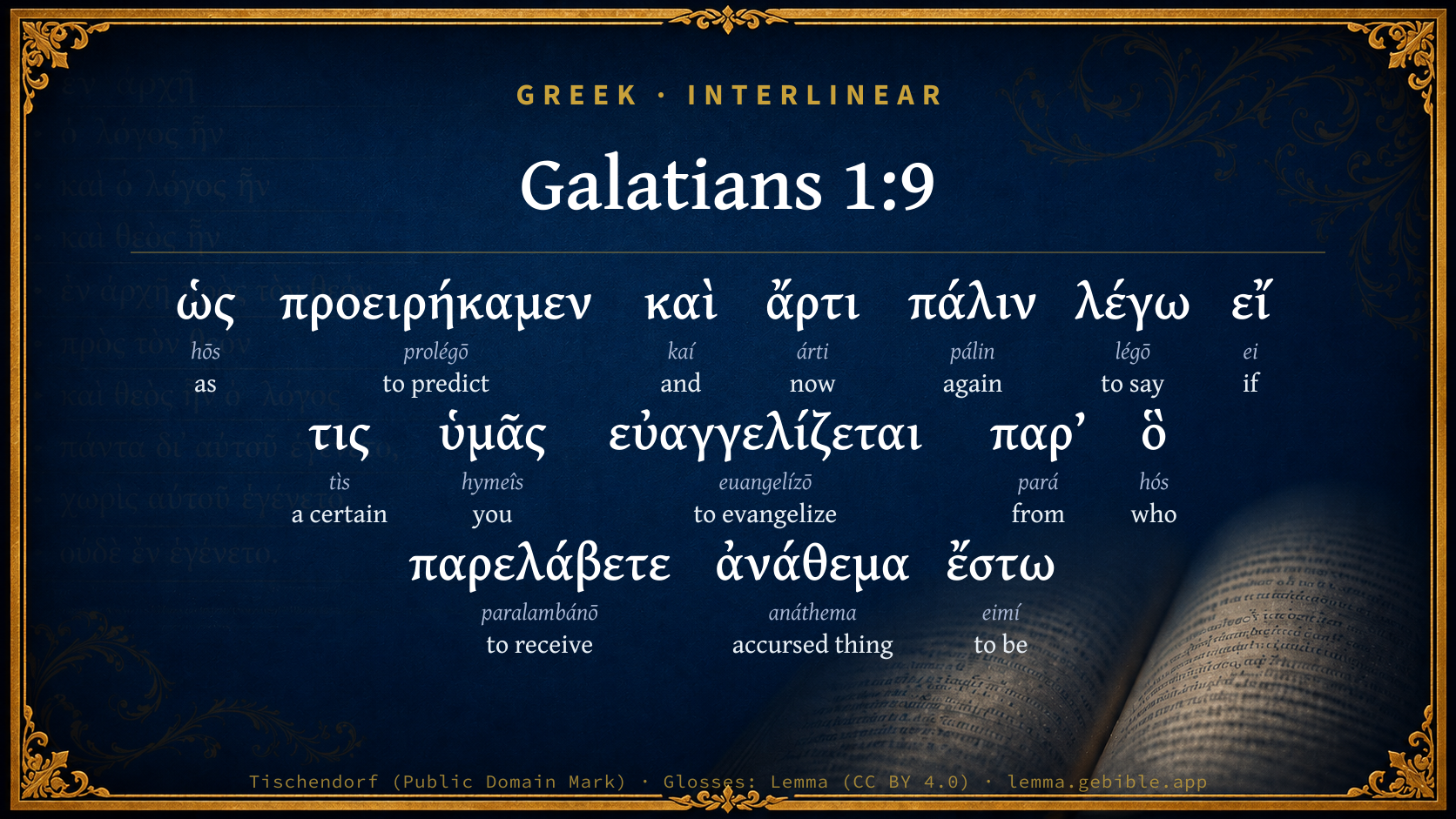
  1. ὡς hōs G5613 “as” Adverb
  2. προειρήκαμεν prolégō G4302 “to predict” Verb, Perfect, Active, Indicative, 1st person, Plural
  3. καὶ kaí G2532 “and” Conjunction
  4. ἄρτι árti G737 “now” Adverb
  5. πάλιν pálin G3825 “again” Adverb
  6. λέγω légō G3004 “to say” Verb, Present, Active, Indicative, 1st person, Singular
  7. εἴ ei G1487 “if” Conditional
  8. τις tìs G5100 “a certain” Indefinite pronoun, Nominative, Singular, Masculine
  9. ὑμᾶς hymeîs G5210 “you” Personal pronoun, 2nd person, Accusative, Plural
  10. εὐαγγελίζεται euangelízō G2097 “to evangelize” Verb, Present, Middle, Indicative, 3rd person, Singular
  11. παρ’ pará G3844 “from” Preposition
  12. ὃ hós G3739 “who” Relative pronoun, Accusative, Singular, Neuter
  13. παρελάβετε paralambánō G3880 “to receive” Verb, Aorist, Active, Indicative, 2nd person, Plural
  14. ἔστω eimí G1510 “to be” Verb, Present, Active, Imperative, 3rd person, Singular

About this verse

These counts appear in no published source. They are computed here, from the morphology-tagged text and Lemma’s own curated glosses. What Lemma adds →

15
words
15
distinct lemmas
Pauline Epistles
section

Notable vocabulary

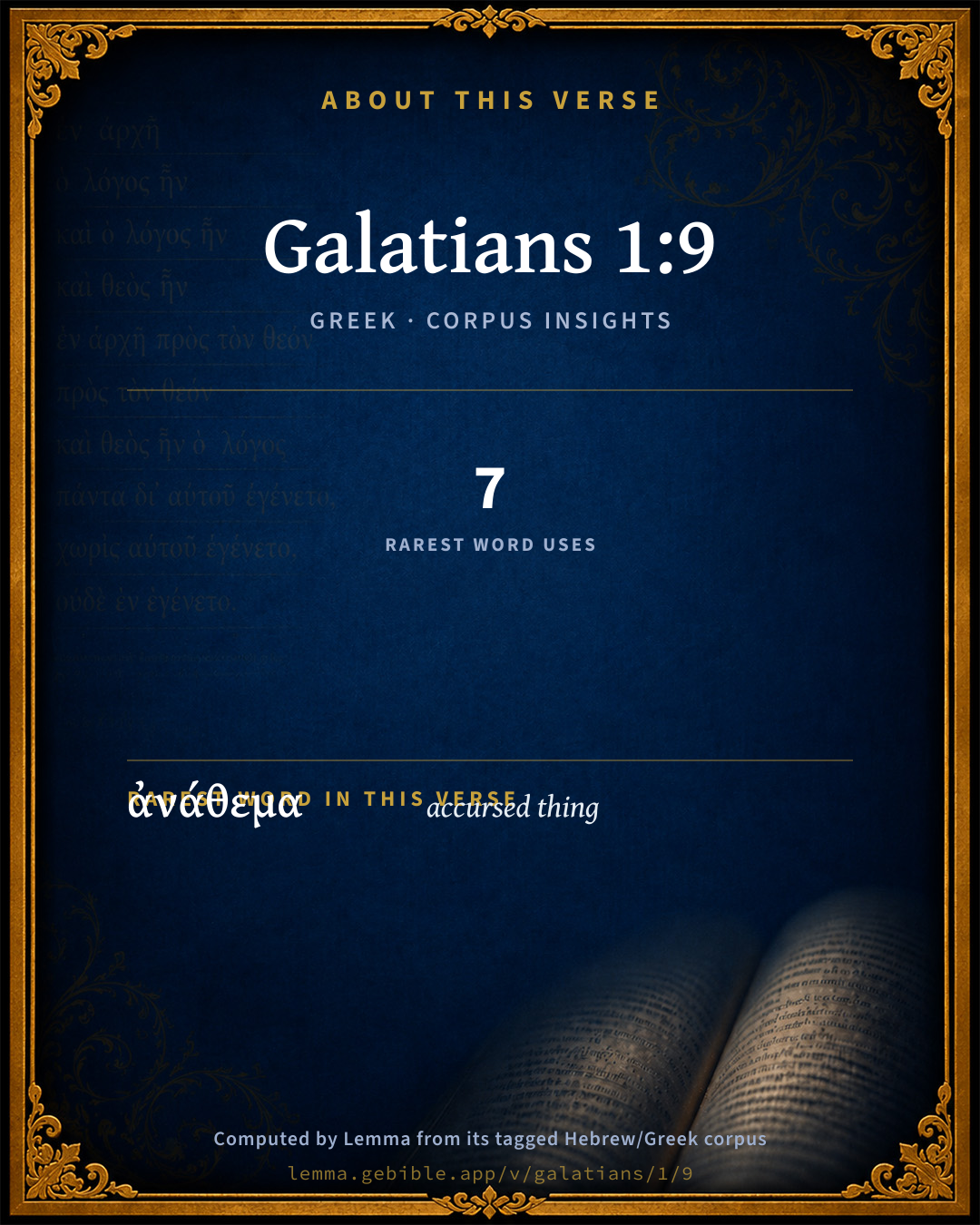
The rarest word here is ἀνάθεμα accursed thing G331 — appearing just 7 times in the whole Greek New Testament.

Shared distinctive vocabulary

ἀνάθεμα accursed thing G331 occurs in 7 verses of the Greek New Testament. Also found in:

Cross-references

8

Topical passages linked to Galatians 1:9 in the Treasury of Scripture Knowledge — connected by theme and wording, ordered by reader-vote popularity; previews shown in the World English Bible.

  • Romans 16:17 Now I beg you, brothers, look out for those who are causing the divisions and occasions of stumbling, contrary to the doctrine which you learned, and turn away from them.
  • Deuteronomy 4:2 You shall not add to the word which I command you, neither shall you diminish from it, that you may keep the commandments of Yahweh your God which I command you.
  • Proverbs 30:6 Don't you add to his words, Lest he reprove you, and you be found a liar.
  • Revelation 22:18–19 I testify to everyone who hears the words of the prophecy of this book, if anyone adds to them, may God add to him the plagues which are written in this book.
  • Deuteronomy 12:32–13:11 Whatever thing I command you, that shall you observe to do: you shall not add thereto, nor diminish from it.
  • 2 Corinthians 1:17 When I therefore was thus determined, did I show fickleness? Or the things that I purpose, do I purpose according to the flesh, that with me there should be the "Yes, yes" and the "No, no?"
  • 2 Corinthians 13:1–2 This is the third time I am coming to you. "At the mouth of two or three witnesses shall every word established."
  • Philippians 3:1 Finally, my brothers, rejoice in the Lord. To write the same things to you, to me indeed is not tiresome, but for you it is safe.

Cross-references courtesy of OpenBible.info (CC BY 4.0).

Commentary

Notes on Galatians 1:9 from classic Christian and Jewish commentators (each source and its license shown beneath its notes). The classic Christian expositions comment on the surrounding passage and are grouped to its opening verse, so a note may address several verses; the Jewish commentaries on the Tanakh (Rashi and others) are per-verse, so they appear only where the commentator wrote on this verse.

Lemma curates 59 commentaries, every one of them public domain or Creative Commons licensed, each selected and text-cleaned for this edition rather than reprinted as found. About our sources →

Tyndale Open Study Notes

Tyndale Open Resources

1:9 The Good News . . . you welcomed was precisely the message Paul had preached to them (1:8; cp. 2 Thes 2:15).

Tyndale Open Study Notes — © Tyndale Open Resources, licensed CC BY-SA 4.0. Text via the HelloAO Bible API.

Bengel's Gnomon

Johann Albrecht Bengel

Gal 1:9. Ὡς, as) He speaks deliberately. He seems to have paused between the writing of each verse. A similar asseveration is repeated, ch. Gal 5:2-3; Gal 5:21.—προειρήκαμεν, we said before) In the plural: for in Gal 1:8 he wrote we have preached, also in the plural.—λέγω, I say) in the singular. All knew the truth of the Gospel; Paul knew that the minds of the Galatians had been truly impressed with the Gospel; he now therefore says, ye have received, and by this expression there is an epitasis [emphatic addition, or augmentation of force] in the repetition.[3]—ΕἸ) if. This is more positive than εἂν [though it should happen that], Gal 1:8.—ὙΜᾶς ΕὐΑΓΓΕΛΊΖΕΤΑΙ, furnish you with any other Gospel [preach to you]) Here ὑμᾶς is put before the verb ΕὐΑΓΓΕΛΊΖΕΤΑΙ, though in the 8th verse ὙΜῖΝ is put after; this is for the sake of emphasis; moreover we are not to suppose that there is no distinction intended in the different cases [ὙΜῖΝ and ὙΜᾶς]: We have preached the Gospel to you, has the dative of advantage: To furnish any one [Accusative] with a Gospel, is fitted to direct a sneer against the false teachers’ pretensions.

[3] See Append. on Epitasis. In the first use of the words, ver. S, “Though we, etc., preach any other Gospel,” there do not occur the words “than that ye have received.” The addition of these words, Gal 1:9, on the second use or repetition of the former words, constitutes the Epitasis.—ED.

Bengel's Gnomon of the New Testament — English translation (T&T Clark, Edinburgh, 1860) — public domain. Text from a community e-Sword module.

Meyer's Critical & Exegetical Commentary

Heinrich August Wilhelm Meyer

Gal_1:9. Again the same curse (deliberate loquitur, Bengel); but now the addition of an allusion to an earlier utterance of it increases still more its solemn earnestness.

ὡς προειρήκαμεν] is referred by Chrysostom, Theophylact, Theodoret, Oecumenius, Luther, Erasmus, Estius, Grotius, Bengel, and most of the earlier expositors, also Flatt, Winer, Matthies, Neander, to Gal_1:8. But in this case Paul would have written merely ὡς εἰρήκαμεν, πάλιν λέγω, or simply πάλιν ἐρῶ, as in Php_4:4. The compound verb προειρήκαμεν (Gal_5:21; 2Co_7:3; 2Co_13:2; 1Th_4:6) and καὶ ἄρτι point necessarily to an earlier time, in contrast to the present. Hence the Peschito, Jerome (comp. Augustine, who leaves a choice between the two views), Semler, Koppe, Borger, Rückert, Usteri, Schott, Olshausen, Baumgarten-Crusius, de Wette, Hilgenfeld, Ewald, Wieseler, Hofmann, Reithmayr, and others, rightly take it as indicating the presence of the apostle among the Galatians at the time when he uttered this curse; comp. Gal_5:3. We must, however, look upon this presence as the second and not the first visit (Hofmann); for the expression in the form of curse betrays an advanced stage of the danger, and not a merely prophylactic measure.

καὶ ἄρτι πάλιν λέγω] apodosis, so say I also now (at the present moment) again; so that πάλιν thus glances back to the time to which the προ applied. Rückert regards ὡς … λέγω together as the protasis (comp. Ewald), in which case the proper apodosis, so it is in fact, before εἴ τις would be wanting. Or rather, if ὡς … λέγω were the protasis, εἴ τις ὑμᾶς … ἀνάθεμα ἔστω would be the real apodosis. But why introduce at all such a forced departure from the separation, which presents itself so naturally, and is so full of emphasis, of ὡς … λέγω into protasis and apodosis? The reference of προειρήκ. to an earlier time is certain enough; and ἄρτι, now, in the sense of the point of time then present, is very usual in Greek authors (Lobeck, ad Phryn. p. 18 ff.) and in the N.T.

εἴ τις ὑμᾶς κ.τ.λ.] Paul does not here, as in Gal_1:8, again use ἐάν with the subjunctive, but on account of the actual occurrence puts the positive εἰ,thus giving to his utterance a climactic character, as in Act_5:38 f. (see on the passage); Luk_13:9; Winer, p. 277 [E. T. 369]; Buttmann, neut. Gr. p. 190; Stallbaum, ad Plat. Phaed. p. 93 B. Comp. 2Co_12:20-21, μήπως

μήπως-g0-

μή-g0-.

As to εὐαγγελίζεσθαι with the accusative,[21] which does not occur elsewhere in Pauls writings, see Lobeck, ad Phryn. p. 268.

παρελάβετε] often used of that which one gets through instruction. See Kypke, II. p. 222. It may, however, denote either to take (actively), as in 1Co_15:1; 1Jn_1:10; Php_4:9; or to receive (passively), as in Gal_1:12; 1Th_2:13; 1Co_15:3, et al. The latter is preferable here, as a parallel to εὐηγγελισάμεθα ὑμῖν in Gal_1:8.

[21] The studied design which Bengel discovers in the alternation between ὑμῖν (ver. 8) and ὑμᾶς (ver. 9), evangelio aliquem instruere convenit insultationi falsorum doctorum, is groundless. For they might say just as boastingly, evangelium praedicavimus vobis! The change in the words is accidental.

Meyer — Critical and Exegetical Commentary on the New Testament — English translation by Peter Christie, edited by Frederick Crombie (T&T Clark, 1880) — public domain. Text from a community e-Sword module.

Expositor's Greek Testament

ed. W. Robertson Nicoll

Gal 1:9 . προειρήκαμεν . The contrast between this plural and the singular λέγω proves that Paul is here referring, not to previous warnings of his own by letter, but to joint warnings given by his companions Silas and Timothy as well as himself during his visit to the Churches. He never speaks of himself in the plural number. ὡς … ἄρτι : as we have also forewarned you of late, I say again . Our versions interpret προειρήκαμεν we have said before and καὶ ἄρτι πάλιν λέγω so say I now again . But Greek usage forbids this antithesis between προ . and ἄρτι . Προλέγειν means to forewarn , not to say in time past ( cf. 2Co 13:2 , Gal 5:21 , 1Th 3:4 ); while ἄρτι is used indifferently of recent or of present time. In Mat 9:18 , 1Th 3:6 it means of late , in Mat 26:53 , Joh 13:7 ; Joh 13:37 ; Joh 16:12 ; Joh 16:31 , 1Co 13:12 ; 1Co 16:7 it means now , by way of contrast with the future. Ἄρτι cannot therefore be used to contrast the present time with the immediate past. The words καὶ ἄρτι belong really to the preceding clause, and contain a reminder how recent had been the warnings which the Apostle is repeating. Since the rendering of Joh 9:25 Whereas I was blind, now I see appears to contradict this view of ἄρτι , it may be well to point out that ὤν does not mean whereas I was , but that the speaker’s real meaning was, I being ( sc. , by nature) blind now see .

The true rendering is of some historical importance, as evidence that warnings on the subject of circumcision had been given to the Galatians by Paul and his companions during a recent visit (see Introd., p. 146).

The Expositor's Greek Testament, edited by W. Robertson Nicoll (1897–1910) — public domain. Text from a community e-Sword module.

Jamieson, Fausset & Brown

Robert Jamieson, A. R. Fausset & David Brown

said before--when we were visiting you (so "before" means, Co2 13:2). Compare Gal 5:2-3, Gal 1:21. Translate, "If any man preacheth unto you any gospel BESIDE that which," &c. Observe the indicative, not the subjunctive or conditional mood, is used, "preacheth," literally, "furnisheth you with any gospel." The fact is assumed, not merely supposed as a contingency, as in Gal 1:8, "preach," or "should preach." This implies that he had already observed (namely, during his last visit) the machinations of the Judaizing teachers: but his surprise (Gal 1:6) now at the Galatians being misled by them, implies that they had not apparently been so then. As in Gal 1:8 he had said, "which we preached," so here, with an augmentation of the force, "which ye received"; acknowledging that they had truly accepted it.

accursed--The opposite appears in Gal 6:16.

Jamieson, Fausset & Brown — Commentary Critical and Explanatory on the Whole Bible (1871) — public domain (CC PDM 1.0). Text via the HelloAO Bible API.

Adam Clarke's Commentary

Verse 9. Let him be accursed.] Perhaps this is not designed as an imprecation, but a simple direction; for the word here may be understood as implying that such a person should, have no countenance in his bad work, but let him, as Theodoret expresses it, Αλλοτριος εστω του κοινου σωματος της εκκλησιας, be separated from the communion of the Church. This, however, would also imply that unless the person repented, the Divine judgments would soon follow.

Adam Clarke's Commentary on the Bible (1810–1826) — public domain. Text from a community e-Sword/MySword module.

John Calvin's Commentaries

9. As we said before. Leaving out, in this instance, the mention of himself and of angels, he repeats the former assertion, that it is unlawful for any man to teach anything contrary to what they had learned. Observe the expression — ye have received; for he uniformly insists, that they must not regard the gospel as something unknown, existing in the air, or in their own imaginations. He exhorts them to entertain a firm and serious conviction, that the doctrine which they had received and embraced is the true gospel of Christ. Nothing can be more inconsistent with the nature of faith than a feeble, wavering assent. What, then, must be the consequence, if ignorance of the nature and character of the gospel shall lead to hesitation? Accordingly he enjoins them to regard as devils those who shall dare to bring forward a gospel different from his, — meaning by another gospel, one to which the inventions of other men are added; for the doctrine of the false apostles was not entirely contrary, or even different, from that of Paul, but corrupted by false additions.

To what poor subterfuges do the Papists resort, in order to escape from the Apostle’s declaration! First, they tell us, that we have not in our possession the whole of Paul’s preaching, and cannot know what it contained, unless the Galatians who heard it shall be raised from the dead, in order to appear as witnesses. Next, they assert, that it is not every kind of addition which is forbidden, but that other gospels only are condemned. What Paul’s doctrine was, so far as it concerns us to know, may be learned with sufficient clearness from his writings. Of this gospel, it is plain, the whole of Popery is a dreadful perversion. And from the nature of the case, we remark in conclusion, it is manifest that any spurious doctrine whatever is at variance with Paul’s preaching; so that these cavils will avail them nothing.

John Calvin's Commentaries (1540-1563) — public domain. Text from the Calvin Translation Society English edition (1840s-50s) via the Christian Classics Ethereal Library (ccel.org). Calvin's coverage is partial (roughly two-thirds of the Bible); uncommented books and verses are honest gaps, never fabricated. The 19th-century editor's footnotes and remarks are omitted so the notes are faithfully Calvin's own voice.

Ellicott's Commentary for English Readers

(9) As we said before.—Probably, upon his last (i.e., his second) visit, at the beginning of this, his third, great missionary journey (Act_18:23). The germs of the apostasy in the Galatian Church would be already visible.

A Bible Commentary for English Readers, edited by Charles John Ellicott (1878–1897) — public domain. Text from a community e-Sword module.

The Cambridge Bible for Schools and Colleges

gen. ed. J. J. S. Perowne

9. He repeats his denunciation with slight differences. (1) He does not mention ‘an angel from heaven’, (2) what in the preceding verse he put hypothetically, “should any … preach”, is now assumed to be the fact, “if any is preaching”; (3) there, it was a Gospel which St Paul had preached to them, here, it is a Gospel which they had ‘received’. This reception of the truth made its relinquishment more perilous.

As we said before] lit. as we have said before. The reference is not to Gal_1:8, but to the teaching of St Paul and his colleagues on the occasion of his second visit to them. They had drifted away from their old position: St Paul’s position is ‘now’ the same as ‘before’.

The Cambridge Bible for Schools and Colleges (gen. ed. J. J. S. Perowne; Cambridge University Press, 1878–1918) — public domain. Text from a community e-Sword module.

John Gill's Exposition

As we have said before, so say I now again,.... Either when he first preached the Gospel among them; or rather referring to what he had just now said, which he repeats with some little alteration; as if any, men, or angels, be they of what name, figure, rank, or office whatever,

preach any other Gospel unto you, than that ye have received; and as the apostle thought, readily, willingly, sincerely, and heartily, in the love of it; assenting to the truth, feeling the power of it, and openly professing it:

let him be accursed; which he repeats, for the more solemn asseveration and confirmation of it; and to show that this did not drop from his lips hastily and inadvertently; nor did it proceed from any irregular passions, or was spoken by him in heat, and in an angry mood, his mind being ruffled, disturbed, and discomposed; but was said by him in the most serious and solemn manner, upon the most thoughtful and mature consideration of the affair.

John Gill's Exposition of the Whole Bible (1746–1763) — public domain (CC PDM 1.0). Text via the HelloAO Bible API.

Trapp's Complete Commentary

John Trapp

9 As we said before, so say I now again, If any man preach any other gospel unto you than that ye have received, let him be accursed.

Ver. 9. Than that ye have] Of the camel it is said, that he will never carry any more weight than what at first is laid upon him; nor go one foot beyond his ordinary journey. Conscience will not budge nor yield a hair for an angel’s authority. Stand fast in the good old way, and find rest, Jer 6:16.

John Trapp, A Commentary or Exposition upon All the Books of the Old and New Testament (1647–1656) — public domain. Text from a community e-Sword module.

Albert Barnes' Notes on the Bible

As we said before - That is, in the previous verse. It is equivalent to saying, “as I have just said;” see 2Co 7:3. It cannot be supposed that he had said this when he was with them, as it cannot be believed that he then anticipated that his doctrines would be perverted, and that another gospel would be preached to them. The sentiment of Gal 1:8 is here repeated on account of its importance. It is common in the Scriptures, as indeed it is everywhere else, to repeat a declaration in order to deepen the impression of its importance and its truth. Paul would not be misunderstood on this point. He would leave no doubt as to his meaning. He would not have it supposed that he had uttered the sentiment in Gal 1:8 hastily; and he therefore repeats it with emphasis.

Than that ye have received - In the previous verse, it is, “that which we have preached.” By this change in the phraseology he designs, probably, to remind them that they had once solemnly professed to embrace that system. It had not only been “preached” to them, it had been “embraced” by them. The teachers of the new system, therefore, were really in opposition to the once avowed sentiments of the Galatians; to what they knew to be true. They were not only to be held accursed, therefore, because Paul so declared, but because they preached what the Galatians themselves knew to be false, or what was contrary to that which they had themselves professed to be true.

Albert Barnes' Notes on the Bible (1834–1885) — public domain. Text from a community e-Sword/MySword module.

Haydock's Catholic Bible Commentary

The terrible sentence awarded by St. Paul, bears equally strong against modern as against ancient innovators in religion.

George Leo Haydock (1774–1849), Haydock's Catholic Family Bible and Commentary, 1859 edition — public domain. Excludes Psalms (Douay-Rheims chapter numbering differs from Protestant) and Deuterocanonical books (Catholic canon only).

Whedon's Commentary on the Bible

Daniel D. Whedon

9. As we said before—On former occasions forewarned you. Paul doubtless here recalls to the memory of these misguided men how he had foretold the coming of these very intruders, and the danger of their being accepted. The time of this forewarning was probably his last visit.

Accursed—The menacing repetition of this anathema indicated his own firmness, and the awfulness of their danger. The guilt of their apostasy is aggravated by the repetition of the warnings.

Daniel D. Whedon (gen. ed.), Commentary on the Old and New Testaments (1874–1909) — public domain. Text from a community e-Sword module.

The Pulpit Commentary

As we said before, so say I now again (wJv proeirhkamen kailin legw); as we have said before, now also (or, and as now) I am saying again. The complexion of the sentence, especially in the Greek, a good deal resembles that inrhka 2Co_13:2," I have said beforehand, and I do say beforehand (proei kaigw), as when I was present the second time, so now being absent." In this latter passage, the perfect, "I have said beforehand," points to the time indicated in the words," as when I was present the second time." The resemblance between the two passages, notwithstanding the somewhat different senses in which the verb (prolegein) is used in them, suggests the view that here likewise in the first clause the verb refers to some former occasion on which the apostle was personally present with those he is writing to. The Greek verb (prolegein), "say before," is sometimes equivalent to "forewarn," as 1Th_4:6; Gal_5:21; and 2Co_13:2 (twice). Sometimes it means "say on a former occasion," 1Co_7:3, and most probably here. The first clause has by some been supposed to refer to the preceding verse. But recent critics generally agree in feeling that both the verb "we have said before" and the adverb "now" suggest the sense of a wider interval of time. The use of the verb in 2Co_7:3 has been cited on behalf of the other view. But even if the somewhat doubtful idea be admitted that 2Co_7:3 points back to the twelfth verse of the preceding chapter, it would stillfail to furnish an adequate parallel. For not only is it parted from the earlier passage by the number of verses which intervene, but also by a succession of varying moods of feeling and diverse styles of address. Account has to be taken of the change of number between "we have said before" and "I am saying again." The only probable explanation is that the "we" recites the same persons as in the words "we preached" in ver. 8; whereas Paul, as now writing (probably) with his own hand, presents himself individually as reiterating that solemn affirmation. The words, "now also I am saying again," as marking a time contrasted with that earlier one referred to, contemplate the asseveration made in the eighth verso as well as in this. In the "now" the apostle indicates, not so much the moment of his writing, as the just then subsisting juncture of circumstances in Galatia, which called for the renewal of his commination. Its earlier utterance referred to may have occurred either in the second visit to Galatia, mentioned in Act_18:23, or in the first, mentioned in Act_16:6. When taking leave of his disciples on either occasion he may have been led to thus emphatically insist upon the sacred, inviolable character of the gospel, by his observation on the one hand of the fickleness and impressionableness which characterized this people, and on the other by the frequency with which perversions of Christian doctrine were already seen to be infesting the Churches. Compare also the apostle"s warning to the Ephesians. (Act_20:28-31) If any man preach any other gospel unto you than that ye have received, let him be accursed (ei tiv uJmav eujaggelizetai par o parelabete, ajnaqema estw); if any man is preaching unto you a gospel other than that which ye received, let him be anathema. The verbal variations in these words, as compared with those in ver. 8, are slight. One, however, deserves attention: "If any one is preaching" compared with "If... an angel should preach. " By this change in the form of making the supposition, the denunciation seems to come down out of the region of bare hypothesis to that of, perhaps, present reality. If so, the thunder of the apostle"s anathema would be felt by his readers approaching nearer and nearer to the head of seine particular individual among themselves, towards whom their eyes would at once be directed with the feeling that it was, perhaps, his doom that the apostle was now pronouncing. The construction in the Greek of the verb "preach the gospel" (eujaggelizomai), with the accusative of the person to whom the message is brought, is found also in Act_13:32 Act_14:21. In sense there seems to be no appreciable difference between this construction of the verb and that with the dative as found in the preceding verse and often.

The Pulpit Commentary (1880–1919), ed. H.D.M. Spence-Jones & Joseph S. Exell — public domain. Text from a community e-Sword module.

John Wesley's Explanatory Notes

As - He speaks upon mature deliberation; after pausing, it seems, between the two verses. We - I and the brethren who are with me. Have said before - Many times, in effect, if not in terms. So I say - All those brethren knew the truth of the gospel. St. Paul knew the Galatians had received the true gospel.

John Wesley, Explanatory Notes Upon the Whole Bible (1754–1765) — public domain. Text via the GEBible commentary corpus.

Luther on Galatians

Martin Luther

VERSE 9. As we said before, so say I now again. If any man preach any other gospel unto you than that ye have received, let him be accursed.

Paul repeats the curse, directing it now upon other persons. Before, he cursed himself, his brethren, and an angel from heaven. "Now," he says, "if there are any others who preach a gospel different from that you have received from us, let them also be accursed." Paul herewith curses and excommunicates all false teachers including his opponents. He is so worked up that he dares to curse all who pervert his Gospel. Would to God that this terrible pronouncement of the Apostle might strike fear into the hearts of all who pervert the Gospel of Paul.

The Galatians might say: "Paul, we do not pervert the Gospel you have brought unto us. We did not quite understand it. That is all. Now these teachers who came after you have explained everything so beautifully."

This explanation the Apostle refuses to accept. They must add nothing; they must correct nothing. "What you received from me is the genuine Gospel of God. Let it stand. If any man brings any other gospel than the one I brought you, or promises to deliver better things than you have received from me, let him be accursed."

In spite of this emphatic denunciation so many accept the pope as the supreme judge of the Scriptures. "The Church," they say, "chose only four gospels. The Church might have chosen more. Ergo the Church is above the Gospel." With equal force one might argue: "I approve the Scriptures. Ergo I am above the Scriptures. John the Baptist confessed Christ. Hence he is above Christ." Paul subordinates himself, all preachers, all the angels of heaven, everybody to the Sacred Scriptures. We are not the masters, judges, or arbiters, but witnesses, disciples, and confessors of the Scriptures, whether we be pope, Luther, Augustine, Paul, or an angel from heaven.

Martin Luther — Commentary on the Epistle to the Galatians (1535), English translation by Theodore Graebner (Zondervan, 1939) — public domain (U.S. copyright not renewed). Text from a community e-Sword module.

McGarvey & Pendleton's Commentaries

J. W. McGarvey

As we have said before, so say I now again, If any man preacheth unto you any gospel other than that which ye received, let him be anathema. [Here the apostle supposes an impossibility, that he may thereby show that it is not possible to make any alterations in the gospel which God would sanction or accept. No man could make such alterations; no, not even an angel. Chrysostom suggests that these gospel perverters claim for their teaching the authority of the older apostles, Peter, James, John, etc., and interprets Paul thus: "Don't tell me of John, don't tell me of James. If one of the highest angels were to come, corrupting the truth originally preached, he must be rejected. . . . When the truth is in question, respect of persons is inadmissible." In this connection it is interesting to note that the Galatians had at first received Paul as an angel of light ( Gal_4:14 ), and they were now probably so receiving these perverters. Also we may observe that the words of angels would be valueless if spoken in an improper spirit ( 1Co_13:1 ), and lastly that the sayings of Jesus differ from the sayings of the law in this very respect, viz.: they are weightier than any words conveyed through the agency of angels ( Heb_1:2 ; Heb_2:1-3 ). Upon all such perverters Paul pours out the anathema of God, devoting them to destruction. See 1Co_16:22 . In later centuries the anathema became associated with excommunication, until the two words became convertible terms; but no such confusion of terms existed in Paul's day, and his words mean more even than severance from the church. Moreover, excommunication would not affect angels, since they are not members of our churches. Paul's language shows that at his last visit ( Act_18:23 ) he had warned the Galatians against such Judaizers, and he now makes the warning more effectual by repetition. His reference to his former words suggests surprise that they should have so far forgotten them as to be misled despite them. The strong wording of this entire passage forms a solemn warning against the sin of corrupting the gospel. All offices, appearances and reputations to the contrary, whoso perverts the divine truth is an enemy to Christ, and rests under the curse of God. Compare Mat_7:22-23 . And who will presume to say how large or important a change must be to constitute a perversion? It is best, as Dean Howson observes, to understand Paul as "precluding any deviation of any kind from the original gospel."]

J. W. McGarvey (with Philip Y. Pendleton), Commentaries on the New Testament (The Fourfold Gospel, 1914; Acts; and the epistles) — public domain. Text from a community e-Sword/MySword module.

The People's New Testament

B. W. Johnson

9. As we said before. This refers, it is generally supposed, to Paul's last visit to Galatia, mentioned in Acts 18:23, at which time he had warned the brethren against the Judaizers. The strong language shows how great a sin it is to pervert the gospel or Bible truth.

B. W. Johnson's The People's New Testament with Notes (1889–1891) — public domain. Electronic text from the Christian Classics Ethereal Library (CCEL) ThML edition.

Cambridge Greek Testament for Schools and Colleges

9. Repeats the curse, but (a) the change from the subjunctive to the indicative suggests that there is a person actually engaged in this erroneous preaching; (b) St Paul lays stress on the fact that the gospel of this person contradicts what they had in fact accepted.

ὡς προειρήκαμεν (cf. Gal 5:2-3; Gal 5:21), καὶ ἄρτι πάλιν. ἄρτι, Gal 1:10. The statement appears to be too emphatic to refer to Gal 1:8. It would seem therefore that even on his last visit (hardly on his first) he felt the need of warning them against possible false teaching. Probably however it had not actually come to them then, or he would hardly have expressed surprise at their beginning to fall away (Gal 1:6). Compare Gal 4:16 note and the Introduction, p. xxxvi.

ὑμᾶς. In Gal 1:8 εὐαγγ. takes the dative. But the accusative is the simplest objective case, and when the emphasis lies not on the verb but on the object it is readily employed when a choice is possible, as was the case with εὐαγγ. in late Greek; cf. Luk 3:18.

παρελάβετε, “received at our hands,” Col 2:6 note. He says this “lest the Galatians should say: We, O Paul, do not pervert the Gospel that thou hast preached unto us: we understood thee not rightly, but the teachers that came after thee have declared unto us the true meaning thereof” (Luther).

Cambridge Greek Testament for Schools and Colleges (Cambridge University Press, 1896; 21 vols, various authors incl. Carr, Maclear, Plummer, Farrar, Lumby, Moule, M. R. James, Simcox) — public domain. Text from a community e-Sword module.

Alford’s Greek Testament

Henry Alford

9.] As we said before (referring, not to ver. 8 as most Commentators; for the word more naturally, as in 2Co 13:2 (so προείπαμεν, 1Th 4:6), relates to something said on a former occasion,—and the plural seems here to bind it to εὐηγγελισάμεθα,—but to what he had said during his presence with them: see a similar reference, ch. 5:3, 21), I also now say again,—If any one is (no longer now a supposition, but an assumption of the fact: see Hermann, ut supra; and Ellic.’s note) evangelizing you (reff.) other (with another gospel) than that which ye received (from us), let him be accursed (see above).

Henry Alford, The Greek Testament (1849–1861) — public domain. Text from a community e-Sword module.

International Critical Commentary

9. ὡς προειρήκαμεν, καὶ ἄρτι πάλιν λέγω, “As we said before so now I say again.” The προ- in προειρήκαμεν may mean “before” either in the sense “on a former occasion,” as, e. g., in 2Co 7:3, Heb 4:7, or in a predictive sense “before the event spoken of,” as in Mar 13:23, Rom 9:29, 2Co 13:2. The two ideas are indeed not mutually exclusive. But the fact that v. 9 b, which is distinctly said to be a repetition of the utterance referred to in προειρήκαμεν, is not a prediction shows that προ- refers to a previous utterance of these words. This previous utterance, however, is not that of v. 8, but something said on a previous occasion, as e. g., on a visit to Galatia, orin a previous letter. Paul does, indeed, not infrequently use a plural in speaking of himself alone, and even change abruptly from plural to singular (see 1Th 2:18, 1Th 2:3:1, 1Th 2:6, 2Co 1:13 f., 2Co 1:23, 2Co 1:10:2, 2Co 1:11:21, and Dick, Der schriftstellerische Plural bei Paulus, pp. 143 ff.), and προειρήκαμεν could in itself refer to something just said in the letter (see 2Co 7:3). But the use of ἄρτι here implying difference of time between the two utterances excludes the supposition that he is here referring to words just written down. Since we know of no previous letter to the Galatians, the previous utterance was probably made by Paul (or by Paul and his companions—on this point the plural can not in view of 2Co 1:13 f. and other passages cited above be said to be decisive) when he was in Galatia. On which of the two occasions on which he had probably already visited the Galatians (4:13) this warning was given, depends somewhat on the question of the chronology of these visits, itself turning in large part on the location of the churches. See Introd., p. xxi. The very fact that he felt it necessary to utter such a warning as this suggests an already existing danger. If the churches, being in northern Galatia, were founded on his second missionary journey, there might easily have been occasion for such a warning on his first visit to them. If, on the other hand, the churches were in southern Galatia, and hence founded on the first missionary journey, it is less probable that he had occasion at that time to utter so pointed a warning, and more likely that he refers to something said on the occasion of his second visit.

The perfect tense of προειρήκαμεν marks this saying as not simply a past fact, but as one of which the result remains, doubtless in that they remember (or may be assumed to remember) the utterance of the saying. BMT 74, 85. The tense therefore conveys an appeal to their memory of the utterance. This reference to the existing result of the saying can not be expressed in English except by an interjected clause, “as we told you and you remember,” and inasmuch as the use of the English perfect in such a connection suggests a recent action—in this case most naturally an utterance just made in the preceding sentence—the best translation is the simple past, which though it leaves unexpressed a part of the meaning of the Greek, has at least the advantage of not expressing anything not conveyed by the Greek. BMT 82.

The strict force of καί before ἄρτι is doubtless adverbial, “also,” but English idiom in such a case prefers the simple “so.” Cf. Joh 6:57, Joh 6:13:33, 1Co 15:49. The fuller and more definitely comparative expression οὕτως καί occurs 1Co 15:22, Gal 4:29, etc. ἄρτι, frequent in papyri, of strictly present time (M. and M. Voc. s. v.), is cited by Nägeli, Wortschatz, p. 78, as a word of the unliterary Κοινή; yet see numerous classical exx. in L. & S.

εἴ τις ὑμᾶς εὐαγγελίζεται παρʼ ὃ παρελάβετε, ἀνάθεμα ἔστω. “If any one is preaching to you a gospel not in accordance with that which ye received, let him be accursed.” This sentence differs from that of v. 8 in two respects which affect the thought: (1) the element of concession and improbability disappears in the omission of ἡμεῖς ἢ ἄγγελος ἐξ οὐρανοῦ; (2) the form of the condition that suggests future possibility is displaced by that which expresses simple present supposition, and which is often used when the condition is known to be actually fulfilled. The result is to bring the supposition closer home to the actual case, and since it was known both to Paul and his readers that the condition εἴ τις … παρελάβετε was at that very time in process of fulfilment, to apply the ἀνάθεμα ἔστω directly to those who were then preaching in Galatia.

International Critical Commentary — older volumes (1896–1929), various authors — public domain. Text from a community e-Sword module.

Vincent's Word Studies in the New Testament

Marvin R. Vincent

As we said before [ως προειρηκαμεν] . Comp. 2Co 13:2; Phi 3:18. Not to be referred to the preceding verse, since the compound verb would be too strong, and now in the following clause points to an earlier time, a previous visit. Comp. Gal 5:21; 2Co 8:2; 1Th 4:6.

Marvin R. Vincent, Word Studies in the New Testament (1887–1900) — public domain. Text from a community e-Sword/MySword module.

Lesson kit

Teaching starters — assembled from the data on this page, not authored interpretation. Every prompt links to the verse data it draws on. Edit before teaching.

Galatians, in the Pauline Epistles, opens this verse with 15 words (15 distinct Greek lemmas). Its most distinctive word is anáthema (“accursed thing”). A historical commentator’s framing appears above. Read the whole chapter for the surrounding context.

Discussion questions

  1. What does “accursed thing” (anáthema) contribute to the verse as a whole?
  2. Luke 21:5 shares the word «accursed thing» with this verse. How do the two illuminate each other?
  3. These translations render this verse differently. What is at stake in choosing one wording over another?
  4. Reading how Tyndale Open Study Notes and Bengel's Gnomon read this verse, where do the two commentators agree and where do they part?

Things to notice

Reading settings

Reading text

Shown beneath each verse's original-language words.

Old Testament
Old Testament edition

Read the OT as the Masoretic Hebrew (MT) or the Greek Septuagint (LXX).

English shown for the Greek Septuagint (in the Hebrew ↔ Greek comparison).

Comparing translations? Open the Compare panel on any verse page to stack up to four side by side.